Hank Aaron, Home Run King Who Defied Racism, Dies at 86

He held the most celebrated record in sports for more than 30 years.

Hank Aaron was among the greatest all-around players in baseball history, earning his home run record in the face of hate mail and even death threats.
Hank Aaron was among the greatest all-around players in baseball history, earning his home run record in the face of hate mail and even death threats.Credit…Mark Rucker/Transcendental Graphics, via Getty Images

By Richard Goldstein

  • Published Jan. 22, 2021Updated Jan. 23, 2021 (NYTimes.com)

Hank Aaron, who faced down racism as he eclipsed Babe Ruth as baseball’s home run king, hitting 755 homers and holding the most celebrated record in sports for more than 30 years, has died. He was 86.

The Atlanta Braves, his team for many years, confirmed the death on Friday in a message from its chairman, Terry McGuirk. No other details were provided.

Playing for 23 seasons, all but his final two years with the Braves in Milwaukee and then Atlanta, Aaron was among the greatest all-around players in baseball history and one of the last major league stars to have played in the Negro leagues.

But his pursuit of Ruth’s record of 714 home runs proved a deeply troubling affair beyond the pressures of the ball field. When he hit his 715th home run, on the evening of April 8, 1974, against the Los Angeles Dodgers at Atlanta-Fulton County Stadium, he prevailed in the face of hate mail and even death threats spewing outrage that a Black man could supplant a white baseball icon.

Aaron was routinely brilliant, performing with seemingly effortless grace, but he had little flash, notwithstanding his nickname in the sports pages, Hammerin’ Hank. He long felt that he had not been accorded the recognition he deserved.

He played for teams far beyond the news media centers of New York and the West Coast, and his Braves won only two pennants and a single World Series championship, those coming long before he approached Ruth’s record.

Aaron did not enjoy the idolatry accorded the Yankees’ Mickey Mantle or match the exuberance and electric presence of the Giants’ Willie Mays, his outfield contemporaries and rivals for acclamation as the greatest ballplayer in major league history.

But when he was elected to the Baseball Hall of Fame in 1982, his first year of eligibility, Aaron received 97.8 percent of the vote from baseball writers, second at the time only to Ty Cobb, who was inducted in 1936.

Aaron grew up in Alabama amid rigid segregation and its humiliations, and he faced abuse from the stands while playing in the South as a minor leaguer. Years later, he felt that Braves fans were largely indifferent or hostile to him as he chased Ruth’s record. And the baseball commissioner at the time, Bowie Kuhn, was not present when he hit his historic 715th home run.

All that, and especially the hate mail that besieged him, seared Aaron for years to come.

As the 20th anniversary of his home run feat approached in the early 1990s, he told the sports columnist William C. Rhoden of The New York Times, “April 8, 1974, really led up to turning me off on baseball.”

“It really made me see for the first time a clear picture of what this country is about,” he said. “My kids had to live like they were in prison because of kidnap threats, and I had to live like a pig in a slaughter camp. I had to duck. I had to go out the back door of the ball parks. I had to have a police escort with me all the time. I was getting threatening letters every single day. All of these things have put a bad taste in my mouth, and it won’t go away. They carved a piece of my heart away.”

Aaron’s achievements went well beyond his home run prowess. In fact, he never hit as many as 50 homers in a single season.

He was a two-time National League batting champion and had a career batting average of .305. He was the league’s most valuable player in 1957, when the Milwaukee Braves won their only World Series championship. He was voted an All-Star in all but his first and last seasons, and he won three Gold Glove awards for his play in right field.

Aaron combined with the Hall of Fame third baseman Eddie Mathews for 863 home runs during their 13 years together on the Braves, the most ever for two teammates.

Aaron remains No. 1 in the major leagues in total bases (6,856) and runs batted in (2,297); No. 2 in at-bats (12,364), behind Pete Rose; and No. 3 in hits (3,771), behind Rose and Cobb. He won the National League’s single-season home run title four times, though his highest total was only 47, in 1971. Matching his jersey number, he hit exactly 44 home runs in four different seasons.

On April 4, 1974, Aaron hit his 714th home run, tying Ruth’s record, during a game against the Cincinnati Reds before a sellout crowd of 52,154 at Riverfront Stadium.
On April 4, 1974, Aaron hit his 714th home run, tying Ruth’s record, during a game against the Cincinnati Reds before a sellout crowd of 52,154 at Riverfront Stadium.Credit…Associated Press

At six feet tall and 180 pounds, Aaron was hardly the picture of a slugger, but he had thick, powerful wrists, enabling him to whip the bat out of his right-handed stance with uncommon speed.

“He had great forearms and wrists,” Lew Burdette, the outstanding Braves pitcher, recalled in Danny Peary’s oral history “We Played the Game” (1994). “He could be fooled completely and be way out on his front foot, and the bat would still be back, and he’d just roll his wrists and hit the ball out of the ballpark.”

Aaron was quick on the bases and in the outfield.

“There aren’t five men faster in baseball, and no better base runner,” Bobby Bragan, Aaron’s manager in the mid-1960s, told Sports Illustrated. “If you need a base, he’ll steal it quietly. If you need a shoestring catch, he’ll make it, and his hat won’t fly off and he won’t fall on his butt. He does it like DiMaggio.”

Aaron was a keen student of pitching and kept himself in excellent shape.

“I concentrated on the pitchers,” he said in his memoir, “I Had a Hammer” (1991, with Lonnie Wheeler). “I didn’t stay up nights worrying about my weight distribution, or the location of my hands, or the turn of my hips: I stayed up thinking about the pitcher I was going to face the next day. I used to play every pitcher in my mind before I went to the ballpark.”

Dusty Baker, later a longtime manager, was mentored by Aaron when he was a young player with the Braves.

“Nobody had concentration like he did, sitting there in the dugout, looking at the pitcher through the little hole in his cap to focus on the release point,” Baker once said. “Never saw anyone do that before Hank.”

Baker said Aaron had been hampered by sciatic nerve problems but had the ability to “think away the pain and to condition himself like no other baseball player of his time.”

The San Francisco Giants’ Barry Bonds surpassed Aaron’s home run record in August 2007 and went on to hit 762 homers. But many inside baseball and out considered Bonds’s achievement to be tainted by suspicions that he had used performance-enhancing drugs in what came to be known as baseball’s steroid era, when bulked-up players achieved stunning feats of slugging.

Aaron did not speak out on steroid use, but he declined to follow Bonds around the league to witness his 756th home run. When it came in San Francisco against the Washington Nationals, Aaron limited himself to a message on the stadium’s video board: “My hope today, as it was on that April evening in 1974, is that the achievement of this record will inspire others to chase their own dreams.”ImageAaron began the 1952 season with the Negro leagues’ Indianapolis Clowns, but he was signed in June by the Braves, who were in their last season in Boston.Credit…Negro Leagues Baseball Museum, Inc.

Henry Louis Aaron was born on Feb. 5, 1934, in Mobile, Ala., one of eight children of Herbert and Estella (Pritchett) Aaron. His father worked in shipyards. His mother joined with her husband in overseeing a close-knit family. She encouraged Henry (he never liked being called Hank, as he would customarily be known on the sports pages) to consider going to college.

In March 1948, a year after Jackie Robinson broke the modern major league color barrier with the Brooklyn Dodgers, Robinson was in Mobile for a spring training game. Henry Aaron was in the crowd of Black youngsters who had gathered in town to hear Robinson tell them of the possibilities that would be opening to Black people.

Robinson spoke of the need to strive for a good education. But Henry, only 14 but already a talented sandlot ballplayer, cared little for his high school studies. He idolized Robinson and envisioned professional baseball as the road to escaping poverty and segregation.

While a teenager, he played alongside men many years his senior as a shortstop for the semipro Mobile Black Bears. (Mobile over the years was a breeding ground for top baseball talent, producing Satchel Paige and later the Hall of Famers Billy Williams and Willie McCovey.) He was then signed by the Negro leagues’ Indianapolis Clowns, a barnstorming team that combined entertainment with baseball, much like basketball’s Harlem Globetrotters.

After beginning the 1952 season with the Clowns, Aaron was signed in June by the Braves, who were in their last season in Boston. They assigned him to play for their farm team in Eau Claire, Wis., and he was named the Northern League’s rookie of the year that season.

He was promoted in 1953 to play second base for the Jacksonville, Fla., team of the South Atlantic League, or the Sally League, becoming one of the circuit’s first five Black players.

Now he was back in the Old South.

“The whites used to yell from the stands and call us alligator bait,” Felix Mantilla, an infielder from Puerto Rico who roomed with Aaron at Jacksonville and later joined him in Milwaukee, told Howard Bryant in “The Last Hero: A Life of Henry Aaron” (2010). “Jacksonville wasn’t so bad. But places like Columbus and Macon, those places were wicked.”

Aaron led the Sally League in hitting and was voted its most valuable player. But he was a poor infielder, so he learned to play the outfield in Puerto Rican winter ball and in 1954 earned a trip to spring training with the Braves, who were in their second season in Milwaukee.

When outfielder Bobby Thomson, newly acquired from the New York Giants (less than three years after his celebrated pennant-winning homer at the Polo Grounds), broke an ankle during the exhibition season, Aaron took his place.

He hit his first major league home run on April 23, at Sportsman’s Park in St. Louis, off the Cardinals’ Vic Raschi, the former Yankee standout. Thomson returned in July, but Aaron remained a regular until he, too, broke an ankle early in September. He finished with 13 home runs and a .280 batting average.

Aaron emerged as a star in 1955, hitting .314, and he won his first batting title the following season, batting .328. When he was voted the National League’s Most Valuable Player in 1957, he came close to capturing the batting triple crown, leading the league in home runs (44) and runs batted in (132) and finishing in a tie for third place in hitting with a .322 average.ImageAaron’s Braves teammates carried him off the field after his 11th-inning home run against the Cardinals lifted Milwaukee to the 1957 National League pennant on Sept. 23.Credit…Associated Press

The Braves won their first pennant in Milwaukee in 1957, clinching it with Aaron’s 11th-inning home run against the Cardinals on Sept. 23.

In the World Series, Aaron hit .393 with three home runs as the Braves defeated the Yankees in seven games. Milwaukee won the pennant again in 1958, this time losing to the Yankees in a seven-game World Series.

Aaron had his only three-homer game on June 21, 1959, at the San Francisco Giants’ Seals Stadium, their home before moving to Candlestick Park. He won his second batting title that season, hitting .355, but the Braves lost a pennant playoff to the Dodgers.

Aaron’s younger brother Tommie joined the Braves in 1962, playing regularly as a first baseman and outfielder, and on June 12, the brothers hit home runs in the same game, against the Dodgers. On Aug. 20, 1965, Aaron and Mathews became the No. 1 home run tandem in major league history, surpassing the mark of 722 homers hit by Ruth and Lou Gehrig with the Yankees.

With the Braves no longer pennant contenders and attendance declining, they moved to Atlanta in 1966. But they returned to the top of the standings in 1969, capturing the National League West after a divisional alignment and the playoff system had been put into place.

In the first National League Championship Series, Aaron hit three home runs, but the Braves were swept in three games in the year of the Miracle Mets.

Aaron became the ninth player to achieve the 3,000-hit milestone when he singled against the Reds at Crosley Field in Cincinnati on May 17, 1970. In February 1972, he became the highest-paid player in baseball history, signing a three-year, $600,000 deal (about $3.7 million in today’s money).

When he won the home run title in 1957 with 44, Aaron was slashing line drives all over the park, almost half of them having been opposite-field homers, to right field. But by the early 1970s he was pulling the ball more. He hit 34 home runs in the strike-shortened 1972 season.

As Aaron chased Ruth’s record in 1973, he finally emerged as a national figure. He appeared on the covers of Time and Newsweek and was sought out for television and newspaper interviews.

Charles Schulz, whose “Peanuts” comic strip had become a staple of national popular culture, turned his attention to Aaron in August 1973 with drawings that ridiculed the bigots besieging him.

Aaron received some 930,000 pieces of fan mail, but among the good wishes were numerous racist letters. Some contained threats, and those were turned over to the F.B.I. The Braves hired two Atlanta police officers to sit in the stands while off duty, overlooking Aaron in the outfield, in the event of trouble.

Aaron was 39 years old that season and appeared in only 120 games. After he hit his 700th home run on July 21 off the Philadelphia Phillies’ Ken Brett in Atlanta, he said he was “kind of disappointed” over the failure of Commissioner Kuhn to convey congratulations. Kuhn responded by saying he was one of Aaron’s biggest rooters, and he promised to lead the celebration when he hit Nos. 714 and 715.

Aaron hit 40 home runs in the 1973 season, leaving him one shy of Ruth’s record, with 713.ImageAs Aaron chased Ruth’s record in 1973, he finally emerged as a national figure. He appeared on “The Flip Wilson Show” in October of that year.Credit…United Press International

The off-season was filled with anticipation, and it also held commercial opportunities. Though Aaron had received few promotional offers in his career, the television manufacturer Magnavox signed him in January 1974 to a five-year, $1 million contract in anticipation of his breaking Ruth’s record.

But there were troubles anew as spring training loomed. The Braves’ ownership said it intended to keep Aaron out of the team’s three-game season-opening series in Cincinnati so that he would have a chance to tie and break Ruth’s record when the team returned for its opening homestand, a presumed box-office bonanza.

Aaron seemed amenable enough. “The people of Atlanta are the people I have to please,” he said at a sports dinner. “I believe I owe it to them.”

But Kuhn told the Braves that he expected them to play Aaron in at least two of the three games in Cincinnati, citing the integrity of the game.

Aaron was in the lineup when the Braves opened against the Reds on Thursday afternoon, April 4, before a sellout crowd of 52,154 at Riverfront Stadium. He came to the plate in the first inning with two men on base and one out, facing Jack Billingham, a 19-game winner the previous season. Aaron let the first four pitches go by, the count reaching 3 and 1, and then Billingham delivered a sinker that headed toward the outside part of the plate but tailed in. Aaron lashed a rising liner that cleared the 12-foot-high wall slightly to the left of the 375-foot sign in left-center field.

No. 714 flashed on the scoreboard above the upper deck in center field as a Cincinnati police officer caught the baseball on the first bounce after it had fallen into the gap between the outfield fence and a high wall fronting the stands. Aaron trotted around the bases, his head held high, his elbows back.ImageBowie Kuhn, the baseball commissioner, presented Aaron with a trophy on the field in Cincinnati after his 714th home run.Credit…Bob Johnson/Associated Press

He received a standing ovation as his teammates swarmed out of their dugout to greet him. Moments later, Kuhn and Vice President Gerald R. Ford, who had thrown out the first ball, went onto the field to congratulate him. A member of the Reds’ grounds crew retrieved the baseball from the police officer, and it was presented to Aaron.

Later in the game, Aaron was retired twice and walked. He was not in the starting lineup for the second game in Cincinnati but played in the third game after Kuhn threatened penalties against the Braves if he were held out again. Aaron went homerless in that game in any case, remaining tied with Ruth.

The Braves opened their home schedule the following Monday night against the Los Angeles Dodgers, before a record home crowd of 53,775. In the fourth inning, with a misty rain falling and nobody on base, Aaron strode to the plate, facing the left-hander Al Downing. Ball one.

Next came a fastball down the middle, and Aaron connected. He drove the ball 400 feet over the left-center field fence for home run No. 715.ImageAaron watched the flight of the ball on his 715th home run. He broke a record that had stood since Ruth hit his last major league home run in 1935.Credit…Harry Harris/Associated Press

The fans erupted with an 11-minute ovation, and Tom House, a reliever for the Braves, returned the ball from the Atlanta bullpen.

The veteran Dodgers broadcaster Vin Scully waited while the roars resounded, and then he spoke to the history of the moment, on the diamond and beyond it.

“What a marvelous moment for baseball,” he said. “What a marvelous moment for Atlanta and the state of Georgia. What a marvelous moment for the country and the world. A Black man is getting a standing ovation in the Deep South for breaking a record of an all-time baseball idol.”

Aaron’s parents came onto the field, and there were hugs all around. Aaron was finally receiving the adulation that he had long felt his due. In addition to the Magnavox deal, there were some 230 “Atlanta Salutes Hank Aaron” billboards posted around the city, with corporate sponsorship.ImageAaron was mobbed by his teammates following his 715th home run. Despite the death threats that Aaron received before breaking the record, security at Atlanta’s stadium failed to prevent a few fans from getting onto the field and circling the bases with Aaron.Credit…Associated Press

But when Aaron hit homer No. 715, Kuhn was not present. The commissioner was in Cleveland, speaking to an Indians booster organization. He sent Monte Irvin, an official in his office and one of baseball’s first outstanding African-American players, with the New York Giants, to represent him. Aaron viewed it as a snub, and he did not forget it.

In mid-June, when the Braves played the Mets in their first series of the season at Shea Stadium, Aaron was presented with New York City’s Gold Medal, its highest award, by Mayor Abraham D. Beame in a ceremony outside City Hall. He toured Harlem in a motorcade and spoke to 5,000 young people at Marcus Garvey Park.

But there were discordant notes as well. When Mathews, his slugging teammate, was fired as manager just before the 1974 All-Star Game, Aaron said he felt “a little bit insulted” at not being offered the opportunity to become major league baseball’s first Black manager.

The post went instead to Clyde King, a veteran baseball man. The following season, Frank Robinson, who died in 2019, became the first Black manager, with the Indians.

Aaron had little interest in continuing to play for the Braves after the 1974 season. He felt that notwithstanding Atlanta’s reputation as a progressive representative of the New South, he had received only tepid backing from the fans as he neared Ruth’s record. And he heard racial abuse from some fans that reminded him of his minor league days in the Sally League.

“I didn’t expect the fans to give me a standing ovation every time I stepped on the field, but I thought a few of them might come over to my side as I approached Ruth,” Aaron said in his memoir. “At the very least, I felt I had earned the right not be verbally abused and racially ravaged in my home ballpark.”

The modern civil rights movement made historic gains during Aaron’s career, but he knew that the road to equal treatment remained long.

“Any Black who thinks the same thing can’t happen today is sadly mistaken,” he told The Times in 1994. “It happens now with people in three-piece suits instead of with hoods on.”

Early on in his career, Black players were barred from hotels where white teammates stayed during spring training in Florida. Aaron joined with Bill Bruton, the Braves’ African-American center fielder, in pressing management for change, with no immediate success. Although Aaron wasn’t vocal on the larger civil rights scene, he became interested in the writings of James Baldwin, decrying patience in the face of racism.

Aaron contributed a chapter to “Baseball Has Done It,” Jackie Robinson’s 1964 collection of first-person accounts from baseball figures telling of their battles against racism.

“I’ve read some newspapermen saying I was just a dumb kid from the South with no education and all I knew was to go out there and hit,” Aaron wrote. “Baseball has done a lot for me, given me an education in meeting other kinds of people,” he continued. But he added pointedly, “It has taught me that regardless of who you are and how much money you make, you are still a Negro.”

Following his record-breaking 1974 season, Aaron was traded to the Milwaukee Brewers of the American League. He signed a two-year contract at $240,000 a season that enabled him to close out his major league career in the city where it began. In those two years, he hit 22 home runs, his 755th and final one coming on July 20, 1976, against Dick Drago of the California Angels.

That same year, Aaron was named the Braves’ vice president in charge of player development, overseeing their farm system. He held that post until 1989. He was later a senior vice president of the Braves and worked on behalf of the Hank Aaron Chasing the Dream Foundation, which helped gifted children develop their talent. His business interests included auto dealerships and fast-food restaurants.

The Atlanta Braves retired Aaron’s No. 44 in April 1977 and unveiled a statue, depicting him swinging, at Atlanta-Fulton County Stadium in 1982. They moved it to their second home, Turner Field, in 1997. The address of that facility, now known as Georgia State Stadium, is 755 Hank Aaron Drive.

A new statue that captures the moment of impact between bat and ball on Aaron’s 715th home run was created by the Atlanta-based artist Ross Rossin for SunTrust Park (now Truist Park), to which the Braves moved for the 2017 season.

On the 25th anniversary of Aaron’s 715th home run, Major League Baseball created the Hank Aaron Award, given annually to the players with the best overall offensive performances in each league.

Aaron received the Presidential Medal of Freedom, the nation’s highest civilian award, from President George W. Bush in 2002. The citation said he “embodies the true spirit of our nation.” The Baseball Hall of Fame opened a permanent exhibit in 2009 chronicling Aaron’s life. His childhood home was moved on a flatbed truck to the grounds of Hank Aaron Stadium, which was the home of the Mobile BayBears, a former minor league team, and opened as a museum in 2010.

Aaron is the 10th Baseball Hall of Famer to die since last April, and the third this year alone. The longtime Dodger manager Tommy Lasorda and the pitcher Don Sutton both died this month.ImageAaron and his wife, Billye, at a ceremony celebrating the 40th anniversary of his 715th home run before the start of a game between the Braves and the Mets in Atlanta on April 8, 2014. Credit…David Goldman/Associated Press

Aaron’s survivors include his wife, Billye; two sons, Lary and Henry Jr., and two daughters, Dorinda and Gaile, all of whom he had with his first wife, Barbara (the marriage ended in divorce); and his daughter Ceci, from Billye Aaron’s first marriage. His brother Tommie, who played intermittently for the Braves for six seasons after his rookie year as a regular, died of leukemia in 1984 at age 45.

When Aaron celebrated his 80th birthday in February 2014, Billye Aaron and the baseball commissioner at the time, Bud Selig, hosted a party at the Hay-Adams hotel in Washington, where President Barack Obama and his family lived for two weeks before his first inauguration.

“There’s a young man who lives right over there whose life’s path was made easier by Henry Aaron,” Attorney General Eric H. Holder Jr. said as he glanced at the White House across the street, Sports Illustrated reported.

The Smithsonian Institution’s National Portrait Gallery unveiled an oil painting of Aaron by Mr. Rossin to mark the occasion.

The Braves honored Aaron at their home opener on April 8, 2014, the 40th anniversary of his breaking Ruth’s record. Though weak from a partial hip replacement after a fall, he spoke briefly. The number 715 had been mowed into the outfield grass, where 715 fans held baseball-shaped signs, each with a number and a date signifying every one of those home runs.

Aaron, Mays, Sandy Koufax and Johnny Bench were selected by fan balloting as the four greatest living players in a promotion leading up to the 2015 All-Star Game at Great American Ball Park in Cincinnati. They were introduced on the field before the first pitch.

For virtually all his major league career, Aaron competed against Willie Mays.

“It’s just not my way to be flashy or flamboyant the way, say, Willie is,” Aaron said in a 1970 interview with Sport magazine. “I have my own even rhythm, and I guess it just doesn’t attract the kind of attention that a more colorful style does.”

Both were raised in Alabama (Mays in Westfield and then Fairfield, about 225 miles north of Mobile), and they both played in the Negro leagues. But there was a perception of frostiness between them. When they were interviewed together by Bob Costas in 2008 for his HBO program “Costas Now,” they played down any antagonism. Aaron said there had been “competition” but “no resentment, no animosity.”

Aaron crossed baseball paths with Mickey Mantle in two World Series and in All-Star Games.

“If they had a choice of who they wanted to break Babe Ruth’s record, it would have been Mickey Mantle first,” he once said. “Mickey was like Marilyn Monroe. He didn’t have to be the greatest ballplayer. He had that charisma. The Yankees had won all those pennants.”

When he was inducted into the Hall of Fame, Aaron felt he had finally been accorded the respect he deserved. But he did not slight the Babe.

“It was always this player and that player and then Henry Aaron, but now I think I’m appreciated,” Aaron said. As for Ruth’s devotees: “I never wanted them to forget Babe Ruth. I just wanted them to remember Henry Aaron.”

(Submitted by Michael Kelly, H.W.)

“The misinformation persists…” A Conversation with Brendan Nyhan of Dartmouth & The New York Times

Brendan Nyhan

ProfessorDartmouth College @BrendanNyhan

Brendan Nyhan teaches at Dartmouth and is a contributor to The Upshot at The New York Times. He joined The Communications Network to discuss his recent research into false information: how it takes hold and why it persists. A lightly edited transcript follows. 

The Communications Network (comnetwork.org) 

Let’s start with a broader picture Brendan. Why are people fooled by false information? What makes them susceptible to that?

Brendan Nyhan:  

There’s a couple of big problems when it comes to politics, but I think the kinds of problems I’m describing actually do extend farther beyond politics. The first problem is that when it comes to things like politics the incentives for us to have accurate beliefs are actually pretty weak.

You have a much stronger incentive for instance to buy a reliable car than you do to know the correct information about say an initiative you’re voting, or the presidential candidate you’re supporting, or the issue that you’re telling people your opinion about. So the accuracy motivations for us in politics are quite weak.

That’s fine. That’s normal. Democracy has always been that way. People have better things to do most of the time and we all have lives. But it is something we have to contend with because it makes people more susceptible to false information. There just aren’t strong incentives to go out and get correct information. That’s the first problem.

The second is we have in a lot of cases at least when it comes to controversial issues strong beliefs. We have strong preferences about the right thing to do or the side that is right in a given debate. What decades of research have shown is that those beliefs, those preferences about politics or issues influence how we process information. So they make us more likely to think information we get is true if it confirms our predispositions and less likely to think it’s true if it contradicts our preconceptions.

We shouldn’t just assume that facts and evidence are the best or the most effective approach to informing people or changing their behavior.

The Communications Network: 
In your work, particularly in healthcare reform, for those of us who have followed the debate, there are a lot of myths out there. Let’s talk about some of those myths and what are some ways that you would advice communicators and others who are confronting those strongly held beliefs. What’s the best way to have an informed debate and conversation about that?

Brendan Nyhan:       
Well it’s challenging when it comes to an issue like healthcare reform because it’s already so politicized. Much of my research has come to some fairly depressing conclusions about the difficulty of changing people’s minds when it comes to those kinds of issues. It’s very hard. There may be better and worse ways to approach it though.

Some ideas we’ve offered, my coauthor Jason Reifler and I based on our research are for instance to use graphics when possible. Sometimes that’s more effective to conveying evidence than text. There’s also psychological research that suggest that repeating false information can have a reinforcing effect on the misperception. So sometimes people want to say this is the claim and it’s not true and they end up actually reinforcing the claim they’re trying to debunk. In a lot of cases putting the emphasis on the truth is going to be more accurate than directly repeating and reinforcing the false claim.

The bigger picture problem here if we can just zoom back out away from exactly how you communicate that information is what happened to healthcare reform in the first place. Now it’s important to be clear that healthcare reform is a huge issue. We should have a political debate about it. The problem is that that political debate has extended from a partisan and ideological divide over opinions to a partisan and ideological divide over facts. Once that happens it’s very difficult to undue, it’s very difficult to have a debate based on a shared set of facts.

The Communications Network:            
Are there examples you’ve seen of debates that have turned that corner and taken it away from a conversation about what facts are valid or not valid and got it back to the issues?

Brendan Nyhan:       
It’s a tough question of course because the point at which the debate shifts is the point where it becomes invisible to us. The reason these debates are so salient is because precisely because they’re so controversial. Once the consensus is strong, they tend to drop off the radar.

But with that said maybe a good example might be the debate over whether smoking causes cancer. It’s taken decades but the expert scientific consensus on that issue is now reflected in public beliefs and there’s virtually no contestation of that claim, which wasn’t true for a long time.

So it is possible but that’s a very extreme case. Many people had personal contact with people who were smokers who had health problems. The scientific evidence was unusually strong and visible relative to other kinds of debates. It’s not clear that’s replicable on a policy issue like healthcare reform more generally, but at least it suggests that it isn’t impossible to have that kind of a change.

misinformation

The Communications Network:            
One of the tools that we’ve seen in the last 10 years or so to help with the public debate is fact checking by newspapers and other media outlets. What’s your research shown you about the value of fact checking by newspapers? What works and doesn’t work?

Brendan Nyhan:       
Yeah, fact checking is an incredibly interesting change in how journalism is done in this country. For a long time the mainstream media in this country has shied away from arbitrating debates over matters of fact, which is it’s the classic he said she said approach to journalism. Fact checking has rejected that and said journalists should try to arbitrate these competing claims.

My coauthor and I tried to evaluate whether fact checking was effective in changing people’s minds. What we found was that at least for controversial issues it can sometimes be ineffective or even counterproductive. Among the people who were most predisposed to believe in a misperception, which is typically the group we’re most concerned about in the first place. That could be liberals believing something negative about President Bush or conservatives believing that there were no weapons of mass destruction in Iraq for instance.

We shouldn’t overstate the effectiveness of fact checking for members of the public. For the reasons we talked about before it’s hard to change people’s minds when they want to hold a given belief. But I don’t think fact checking is without purpose. In particular I think it provides an important check on political elites who don’t receive very strong negative feedback or repercussions when they make false or misleading statements.

That’s something that we’ve shown in research as well when we actually made the threat from fact checking more salient to a group of say legislators, we found they were less likely to have the accuracy of their statements questioned.

[pullquote1 align=”center” variation=”deepblue”]Decades of research have shown those beliefs, those preferences about politics or issues influence how we process information… they make us more likely to think information we get is true if it confirms our predispositions and less likely to think it’s true if it contradicts our preconceptions. [/pullquote1]

The Communications Network:            
What tools would you recommend newspapers and other media outlets use besides fact checking columns? What should they be looking at in addition to that?

Brendan Nyhan:       
I tend to think that fact checking shouldn’t be reserved for specialized columns and websites. If fact checking is an important part of the kind of journalism that a media organization wants to practice, then it should be integrated into the day to day function of the newspaper or TV station or whatever it is.

Sometimes there’s this outsourcing of fact checking to one specific column or to outside groups and there’s a risk to that, is used as an excuse to not fact check in the day to day reporting, which is of course mostly political coverage. I think that the most important thing as far as accountability is to have fact checking built into the rhythms of daily journalism.

Now on deadline not every journalist can fact check every single statement they hear. But I do think media organizations should take their obligations to asses the accuracy of the claims that they publish seriously and to avoid the kinds of he said she said coverage that can be so pathological.

The Communications Network:            
Let’s talk about balance in media reporting. You’ve written about what you call false balance and this practice of reporters that were always seeking out an opposing point of view, even when sometimes the facts may not support it. How did this practice came about, why do you think it continues, and what can we do to change it?

Brendan Nyhan:       
The development of the norm of objectivity is something that took place in approximately the early 20th century in this country and it coincided with favorable economics for newspapers. James Hamilton at Stanford University who is one of my advisors from graduate school found that when the economies of scale were strong for having one big printing press in a town instead of multiple competing newspapers the people who owned the newspapers needed an approach that would allow them to attract subscribes with different political points of view.

Objectivity is a way to do that. It’s a way to avoid alienating half of your readers all the time, which is of course what more partisan sources of approaches will tend to do. There’s a strong economic rationale for that approach that’s helped maintain it and has become part of the ethos of professional journalism.

The problem is sometimes laudable neutrality over opinions turns into neutrality over facts. That can resort of cartoonish extremes in some cases as reporters try to avoid taking a stand on almost anything. I think there’s been something of a reaction to that practice within journalism because it had become so cartoonish and in some cases the evidence on one side of debate was so strong relative to other that to cover the debate in a balanced fashion was itself misleading.

The Communications Network:            
What would it take to change that? The economics of the business have to be different? Do we need new media outlets?

Brendan Nyhan:       
I think that the changing economics of media have started to facilitate this already. The kind of classic he said she said journalism that I’m describing thrived at a point when there were a few competing outlets and you were literally telling readers what happened and they couldn’t get that information from any other places.

But the kinds of commodity news that used to be the bread and butter of a lot of outlets are easily accessible from almost anywhere now to people with different technology, and so news organizations are trying to differentiate themselves in various ways. They’re under more market pressure to differentiate. I think that has led them to explore different kinds of voices and reporting styles including more of an emphasis on facts and data.

That’s not universal of course but it’s becoming more widely practiced. Similarly actually there are more explicitly ideological and partisan outlets out there, which can have their own pathologies, but it does mean they’re less hung up on being balanced.

The Communications Network:            
An important source of news for many people now are social networks. You’ve looked at the influence that social networks can have on people’s behavior. I think in particular of an article you wrote about the public debate about vaccination. Can you tell us what you learned about that and what lessons that offers for health communicators in particular?

Brendan Nyhan:       
There’s a lot of interest in the role of social networks in health. There’s at least evidence that’s consistent with the idea that the people who were connected to influence are health beliefs and practices. That’s harder to show in the most rigorous scientific fashion because of course we can’t run or at least it’s very difficult to run scientific studies where we decide who you’re going to be friends with or who you’re going to be related to.

But the evidence we see suggests that who we talk to about health matters and who we’re friends with affects our health in some ways. Including in the study I did is related to our beliefs about flu shots which is a kind of vaccination and one that’s not nearly as universal as it should be according to public health community.

The Communications Network:            
Speaking of vaccinations there’s been tremendous debate in recent years about autism and the effects of vaccination on autism. When I was looking at your articles on this topic this was another instance where you talked about false balance. What lessons does it offer for people about the persistence of false information?

Brendan Nyhan:       
The childhood vaccines’ issue and the myth that vaccines cause autism is one of the most disturbing examples of misinformation in recent years, and one with potentially horrifying consequences for the health and safety of kids in this country. It starts with a fully discredited article that claimed to link the measles, mumps, and rubella vaccine to autism which set off a cascade of misinformation as that got more and more attention and scared people, in particular in the UK away from vaccinating.

In this country we’ve been lucky enough to not see the more damaging kind of declines in vaccination that they saw in Britain, but the threat remains because that misinformation is out there. It’s been debunked by numerous studies and experts. The person who was behind the study was stripped of his medical license, and yet, the misinformation persists, which shows how these things once are out there are very difficult to contain.

Many parents report of having hearth of this myth and approximately a quarter of parents say that they believe it’s true, which is a real threat to public health because for childhood vaccinations to work we need near universal compliance in some cases. If varies by disease but that’s a potentially significant threat.

So in the study with several coauthors I tested whether the language the Center for Disease Controls uses on their own website to challenge this myth about autism is effective at reducing parents’ concerns about the supposedly dangers of vaccinate, which are actually quite safe.

What we found was pretty disturbing I think as far as how difficult again it is to correct misinformation. The parents in our study, it was a nationally represented group of parents with children living at home, and when we showed them this corrective information debunking the autism myth, it did have the effect of reducing their belief that vaccines cause autism relative to a control group. So it was effective in changing their minds about scientific matter in question, which is good. That’s encouraging.

The problem is that the ultimate bottom line for vaccination is whether people will vaccinate. That’s what matters for public health. And when we asked people, “Would you vaccinate a future child with the measles, mumps, and rubella vaccine,” the parents who had the least favorable attitude towards vaccines, which is precisely the group we’re most concerned about from a public health perspective, actually became less likely to say they would do so when they got that scientific evidence debunking the autism claim.[pullquote1 align=”center” variation=”deepblue”]What we found was pretty disturbing I think as far as how difficult again it is to correct misinformation.[/pullquote1]

So it seems to have provoked them into counter arguing not the evidence itself but their attitude or belief toward vaccines, thinking about concerns they might have about vaccines or objections they have.

The Communications Network:            
So why do you think that’s so? You’ve presented the scientific evidence, you’ve had a non expectant reaction. Did you dig deeper into why they had that reaction and what might be influencing their thinking?

It’s very difficult to look into people’s minds on something like this. It’s one of the great challenges of social science research. We can’t precisely identify why people do what they do when we conduct a study. But we can try to make an inference based on the data we do have and the theory that we’re drawing on.

The theory we’re drawing on which is consistent with a great deal of research is that when people get this unwelcome information, they often bring reasons to mind that would counteract that belief. It’s uncomfortable for them to be told that this attitude or belief they have is wrong or perhaps based on incorrect evidence, and so they’re going to try to butcher that belief by saying, “Oh, why do I not like vaccines? Well, maybe it’s not the autism thing, but I have some other concern.”

The process of bringing those ideas to mind they may end up coming to believe more strongly in these concerns or objections they have to vaccines than they otherwise would have. Now that’s only a theory. That’s an interpretation, but we think it’s one that’s at least consistent with what we know.

The Communications Network:           
So as you talk it almost sounds as if they’re embarrassed to be found in a place where they might appear to be ignorant and then their reaction is to almost double down on their position.

Brendan Nyhan:       
That’s right. I should say by the way that this is a deeply human reaction, one that you and I and everyone who listens to this will have on a regular basis when we’re challenged, when our beliefs are challenged, or our point of view is challenged. It’s a feature of human psychology. We don’t like to be told that we’re wrong and we try to defend our existing beliefs. That’s normal and it’s not something that’s particular to the people who are misinformed on one or the other issue. It really is a deep feature of human psychology, and I should say it’s normal.

If we changed our mind every time we heard a counterargument we would never be able to hold an opinion for more than a few minutes. What’s problematic is when our factual beliefs become driven by our preferences about what we want to believe versus what the evidence actually says.

The Communications Network:            
Have you seen examples in your research of what can persuade people eventually to move away from that position where they might have initially resist the facts? Are there techniques, or methods, or case studies you’ve seen that might be effective?

Brendan Nyhan:       
We have specific examples of how you might present information to people. But as I suggested earlier, the point at which these controversies become politicized, matters of dispute, is the one where everything gets way harder. So I think a better way to think about it is how can elites and institutions promote better debates and a stronger reliance on evidence in public debate.

I think there’s too much blaming of the public for what are very normal sorts of reactions to what they’re hearing and not enough scrutiny of the elites for misinforming them in the first place. There are a few negative reputational consequences for misleading people about these debates, and the institutions, in particular of journalism haven’t done a great job of presenting that information in an accurate fashion.

Let me give you an example to try to make this a little more concrete. A lot of the coverage about healthcare reform it is framed as a matter of democrats say, X and republicans say why, which promotes the kind of tribal thinking that’s going to make it very hard to change peoples’ minds about matters of fact.

A better approach in an article I like very much was published on the ABC news website and said, “Doctors and healthcare experts agree that there are no death panels.” It specifically quoted a republican healthcare expert who had, who might have more credibility with people who didn’t like Obamacare saying that while she didn’t agree with the President’s plan there wasn’t a death panel. I think that kind of an approach is much better example of how elites and institutions can communicate with the public in a way that hopefully is more informative.

When [those] labels starts getting attached to various sides of the debate, it can become very difficult to have the evidence speak clearly to people because it gets wrapped up in matters of identity and things that have nothing to do with fact but will often cloud people’s judgment.

The Communications Network:            
When you look at examples of where elites or institutions have a made a difference, you’ve talked about tobacco control and how it took many years but public attitudes did change and people did accept the link between tobacco and cancer. Are there institutions or elites who stand out who are always persuasive, or does it depend on the issue?

Brendan Nyhan:       
I think it depends on the issue. In a lot of cases these debates, particularly in recent years would become politically more polarized have mapped to partisan or ideological lines. But that’s not necessarily the case. Sometimes they map to religious lines or cultural or social lines.

But the more general problem is when people’s identity starts being wrapped up in what they believe and it starts becoming a matter of as a democrat or as a republican or as someone from the north or someone from the south, or as a member from this religion or that religion I should believe X. When those labels starts getting attached to various sides of the debate, it can become very difficult to have the evidence speak clearly to people because it gets wrapped up in matters of identity and things that have nothing to do with fact but will often cloud people’s judgment.

The Communications Network:            
As we wrap up I’d like to get your advice about what communicators might do in their day to day work to be persuasive? You recently wrote a story for the Columbia Journalism Review laying out three practical tips for how political scientists and other social scientists could make a difference in public debates.  I think your advice would be helpful to anyone. Could you talk a little bit about that?

Brendan Nyhan:      
What I was writing about is how social scientists could contribute to public debate, but as you said these maybe true more generally. One is there’s a particular point at which social scientists can often more effectively intervene in a public debate. It’s often, that’s true of any communicator and that’s when the point that they’re trying to make is most relevant to some larger news event or issue that’s topical. So finding those points of leverage can be powerful, in particular when it comes to misinformation of course tailoring this information more quickly before it can disseminate, before it can spread and metastases it’s going to be extremely important.

Then presenting information in a compelling manner, not in a misleading manner  for instance using graphics instead of text. In one of my studies we used graphical representation showing how pronounced the warming trend was in global temperatures across a series of different measurement sources to just show that all of these sources were registering the exact same trend in global warming.

That was much more compelling to people in convincing them about global warming than just describing that trend in textual terms. So in some cases getting down to the underlying data and showing it to people graphically is going to be an effective strategy.

The Communications Network:            
Before we wrap up is there anything else you’d like to say Brendan, main points you’d like to make that we haven’t addressed?

Brendan Nyhan:       
Sure. Well, the last thing I’ll say is just that I think a theme that runs through a lot of my research is that we shouldn’t just assume that facts and evidence are the best or the most effective approach to informing people or changing their behavior. That’s an assumption that spans a variety of fields from health to education to politics and journalism. In all of those cases people are increasingly confronting the ways that just getting people information or providing evidence to them may actually not be effective.

What we need to do is look empirically and test what messages and approaches will be more effective in helping feel far more accurate to make better judgments. That’s something that I think some of the organizations that your listeners work for may be able to contribute to.

To listen to or download the audio version of our SmartCast interview, click here

(Contributed by Gwyllm Llwydd)

Continue reading “The misinformation persists…” A Conversation with Brendan Nyhan of Dartmouth & The New York Times

Book: “The Masque of the Red Death”

The Masque of the Red Death

The Masque of the Red Death

by Edgar Allan Poe 

Librarian’s note: this entry relates to the story “The Masque of the Red Death.” Collections of short stories by the author can be found elsewhere.

The story follows Prince Prospero’s attempts to avoid a dangerous plague known as the Red Death by hiding in his converted abbey home. He and many other wealthy nobles, have a masquerade ball using seven large rooms in the abbey, each decorated with a different color. The last one is velvet black.

In the midst of their revelry, a mysterious figure disguised as a Red Death victim enters and makes his way through each of the rooms.

The story follows many traditions of Gothic fiction and is often analyzed as an allegory about the inevitability of death, though some critics advise against an allegorical reading. Many different interpretations have been presented, as well as attempts to identify the true nature of the titular disease.

(Goodreads.com)

THE THEATRICAL CONCEPT POWERFUL ENOUGH TO BREAK A TRUMPIAN SPELL

The Great German Playwright Bertholt Brecht Knew How to Jolt an Audience Out of Narrative Complacency

The Theatrical Concept Powerful Enough to Break a Trumpian Spell  | Zocalo Public Square • Arizona State University • Smithsonian

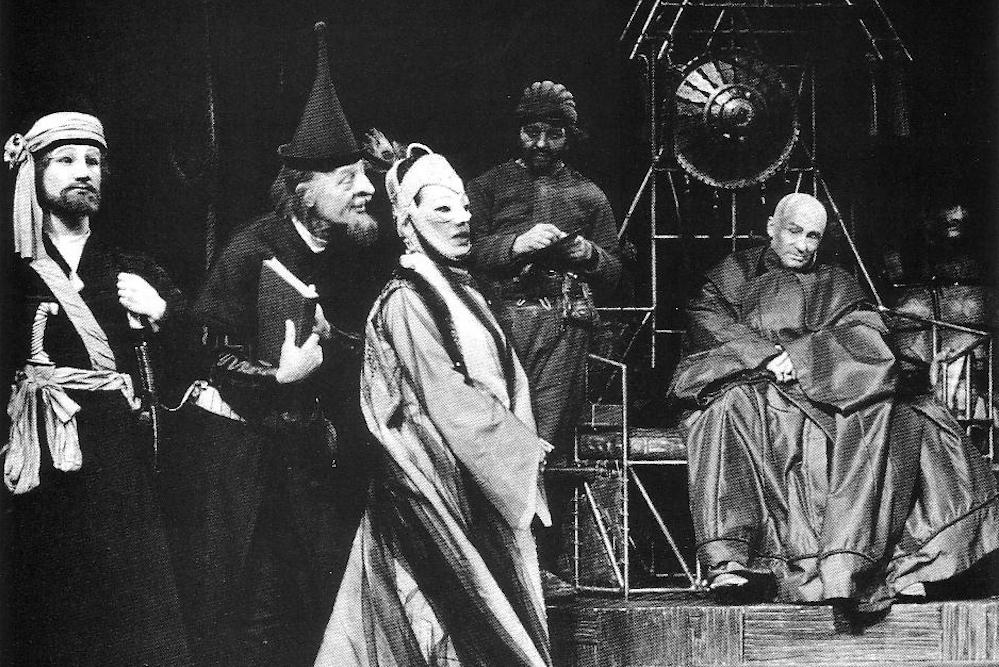
A performance of Bertholt Brecht’s Caucasian Chalk Circle staged in 1954 by the Berliner Ensemble. Nachlass Siewert im Forum für Nachlässe von Künstlerinnen und Künstlern e.V./Wikimedia Commons.

by OLIVER MAYER | JANUARY 21, 2021 (zocalopublicsquare.org)

“All the gang of those who rule us
Hope our quarrels never stop
Helping them to split and fool us
So they can remain on top.”
— Bertholt Brecht, Solidarity Song

How strange to watch Trump’s failed insurrection on Congress unfold from one’s living room TV during COVID lockdown—sidelined by stay-at-home orders, reduced to binging the way one might devour The Queen’s Gambit or Ozark into the wee hours with snacks and pets sharing the couch. Watching an attempted coup was a strangely stupefying and passive experience.

It all looked a bit like a mash-up of movie motifs—angry white mobs with pitchforks from Frankenstein, many resembling extras from Hillbilly Elegy, self-righteously storming the seat of power, each addled MAGA-wearing inglourious basterd starring in the action movie of their life.

Even as we wondered how far the horror show would go, there were numerous moments along the way that seemed staged, performed almost pro forma, for the benefit of the larger narrative. Perhaps this was Trump’s obligatory scene, anticipated by the national audience and provided by the willing protagonist after years of veiled and not-so-veiled promises and gestures worth a thousand words.

In a sickening way, the storming of the Capitol was a real-time made-for-TV event, an entertainment designed to mainline directly to the emotions and to narcotize the critical eye, leading straight to racism, xenophobia, demagoguery, and fascism.

At least that’s what Bertholt Brecht would have thought. The great German playwright, who had a front-row seat to the early acts of the Hitler show, found his answer for such theatrical manipulations in 1936. Verfremdungseffekt, shortened to the V-effekt or awkwardly translated into English as “the alienation effect,” was meant to cause a jolt that forced an audience awake and into an analytical mind. Brecht was intent that the viewer be disabused that the play they were watching was somehow predestined, inviolable, or written in stone: He wanted them to understand that what they were watching was real.

Brecht knew that reality is corruptible, particularly when presented in emotional terms by skilled storytellers. Drama can give dimension to grievance, blood and thunder, and make it all seem true as gospel. The playwright could use V-effekt to carve out alienation and distance from the emotional demands and expectations of lead characters. Rather than settling back and being entertained by the story, Brecht asked his audience to sit up and pay attention to the tells—the unconscious clues that, when put together, help reveal the fundamental manipulation taking place.The great German playwright, who had a front-row seat to the early acts of the Hitler show, found his answer for such theatrical manipulations in 1936. Verfremdungseffekt, shortened to the V-effekt or awkwardly translated into English as “the alienation effect,” was meant to cause a jolt that forced an audience awake and into an analytical mind.

Traditionally, the playwright employs the V-effekt. But with stakes as high as they are now, it’s up to us to stop the sturm und drang. Applying the V-effekt to the events around the failed putsch demands that we jolt ourselves awake, whether we are watching it unfold on FOX, MSNBC, or 4Chan. We are participants, too, even if we are made to feel otherwise.

Perhaps it’s Azdak in Brecht’s Caucasian Chalk Circle who most embodies the jolt that awakens the audience, destroying their illusion of being unseen spectators in the events taking place by addressing them directly. Facing rampant injustice, including the successful coup by a “Fat Prince,” Brecht stops the action and introduces us to Azdak, the witty and corrupt judge who must determine who is guilty and who is innocent. Announcing his proclivities upfront and revealing his weaknesses for wine and women, he makes no attempt to hide his unsoundness as a judge. Yet precisely because of his very human vanities, he proves to be a keen arbitor of wrong and right.

“You want Justice, but do you want to pay for it?” Azdak asks. “It is good for Justice to do it in the open. The wind blows her skirt up and you can see what’s underneath.”

The Theatrical Concept Powerful Enough to Break a Trumpian Spell  | Zocalo Public Square • Arizona State University • Smithsonian

Torsten Schemmel plays the role of judge Azdak in Brecht’s Caucasian Chalk Circle (Vorpommersche Landesbühne 2009). Courtesy of Wikimedia Commons.

This is our time to demand to see what’s underneath. According to multiple news sources, Trump-friendly internet users described the assault on Congress as “like a movie” and “the best show they’d ever seen.” The trouble, of course, is that it was not a movie. It was real. People died.

Despite identifying emotionally with their leading man, the Capitol rioters were blind to the fact that Trump actually had little or nothing to do with them or their interests. In his rabble-rousing speech at the Save America rally just before the assault, Trump promised to walk alongside his fans; of course, he was nowhere near when the deal went down.

As reality-star-in-chief, he groomed us to expect the narrative he unfolded to be performed yet again by others on his behalf. Trump’s story was designed to aggrandize him while giving his devotees their very own part in a real-life action movie.

Telling a lie over and over can make it seem true. It can also remove agency from the viewer, ceding the individual’s judgement over to the expectations of the story being told. Brecht refused to let his audience lose themselves in the funhouse mirror of such representations. “Art is not a mirror held up to reality but a hammer with which to shape it,” he wrote.

Watching the events of the Capitol insurrection and its aftermath, I found myself searching within for that same symbolic hammer—not as a weapon or a shield but as a tool to jolt myself awake, to shake off the dopamine effects of four-plus years of the Trump saga and to pound out an alternative to their zero-sum fallacy.

It helps to be a playwright. Our vocation is not tethered to capital in the same way as screenwriters; we can, and usually do, lose money on our creations. It dawns on most of us over time that it’s better that way, that the artistic freedom to tell an inconvenient truth can coexist somewhat—but not entirely—with capitalism. At a certain point, the narrative needs a jolt, even if it means biting the hand of our benefactors and awakening the ire of our audience.

It’s long been said that theater is an invalid at Death’s door, yet theater hasn’t expired in 2,500 years. I like to think it’s partly because the best playwrights take a hammer to the zero sum of their reality and reshape it.

The reshaping involves intellectual empathy, the ability to consider the experiences of others—not just who they are but where they come from and what they’re reacting to. Intellectual empathy can be grown, but it takes work. One must support diverse and unpredictable responses from individuals about the story they are seeing. One must deny groupthink and the urge to join the throng making pat conclusions because it feels good or it is expected of them. Intellectual empathy extends beyond the binary conventions of tribalism. It analyzes characters on and off the stage and judges them not just on what they say but what they do.

The continued indignation on both sides of the political aisle in America today is simply another narrative convention, pre-determined, even programmed deep within us. If we’re not careful, our emotional investment gets us stuck in a Marvel Comics world of superheroes and supervillains who fight for or against us. One bad real-life movie begets another.

What we need to be doing, instead, is fighting for ourselves. If we want to change the story of our country, we are the ones who need the alienation effect, and we need it now. The movie conventions of endless cause-and-effect and kneejerk action-reaction need to stop. The narrative needs a reboot.

Describing his V-effekt, Brecht writes:

Reality changes; in order to represent it, modes of representation must also change. Nothing comes from nothing; the new comes from the old, but that is why it is new. Every art contributes to the greatest art of all, the art of living.

Perhaps the failed insurrection was the jolt needed to reawaken our intellectual empathy. It remains to be seen. The story is ours to tell.

OLIVER MAYER is a playwright, poet, and professor at USC’s School of Dramatic Arts.

Book: “Revolutionary Love: A Political Manifesto to Heal and Transform the World”

Revolutionary Love: A Political Manifesto to Heal and Transform the World

Revolutionary Love: A Political Manifesto to Heal and Transform the World

by Michael Lerner 

From social theorist and psychotherapist Rabbi Michael Lerner comes a strategy for a new socialism built on love, kindness, and compassion for one another. Revolutionary Love proposes a method to replace what Lerner terms the “capitalist globalization of selfishness” with a globalization of generosity, prophetic empathy, and environmental sanity.

Lerner challenges liberal and progressive forces to move beyond often weak-kneed and visionless politics to build instead a movement that can reverse the environmental destructiveness and social injustice caused by the relentless pursuit of economic growth and profits. Revisiting the hidden injuries of class, Lerner shows that much of the suffering in our society—including most of its addictions and the growing embrace of right-wing nationalism and reactionary versions of fundamentalism—is driven by frustrated needs for community, love, respect, and connection to a higher purpose in life. Yet these needs are too often missing from liberal discourse. No matter that progressive programs are smartly constructed—they cannot be achieved unless they speak to the heart and address the pain so many people experience.

Liberals and progressives need coherent alternatives to capitalism, but previous visions of socialism do not address the yearning for anything beyond material benefits. Inspired by Herbert Marcuse, Erich Fromm, and Carol Gilligan, Revolutionary Love offers a strategy to create the “Caring Society.” Lerner details how a civilization infused with love could put an end to global poverty, homelessness, and hunger, while democratizing the economy, shifting to a twenty-eight-hour work week, and saving the life-support system of Earth. He asks that we develop the courage to stop listening to those who tell us that fundamental social transformation is “unrealistic.” 

(Goodreads.com)

2021 Astrological Predictions Podcast with Landria Onkka

Landria Onkka Join Landria Onkka with Astrologist, Wendy Cicchetti on this podcast to discuss the planetary energies, what we can expect in 2021 and beyond, and how the planets affect us. Contact Wendy at wendy@twixtearthandsky.com and tell her Landria sent you for a discount, and join me in the next Miracle Circle at https://landriaonkka.com/the-monthly-… Receive “Manifest Anything,” a FREE weekly email video tutorial on how to master manifesting https://landriaonkka.com/free-inspira…. #landriaonkka#astrology#2021prediction Subscribe to this channel if you would like more https://www.youtube.com/c/landriaonkka and click on the bell to be notified of upcoming videos! Learn how to control your income and freedom like I have with a free videos series at https://landriaonkka.net/get-started Would you like a personal response to your spiritual or business question? Contact me at https://www.wisio.com/LandriaOnkka Instagram https://www.instagram.com/Landriaonkka/ Facebook business page https://www.facebook.com/Landria-Onkk… Spiritual Facebook page https://www.facebook.com/landriaonkka…

My Cancer Journey 1/21

Ned Henry January 21, 2021 · nedhenry.medium.com

12:00 AM So who read the synopsis of Act 2 of the Valkyries AND saw Django Unchained? Remember Brünnhilde in Django Unchained. She was a pretty important character.

I watched more TV today than I have in months. I watched the PBS coverage of the inauguration from 10:30 AM to 10 PM (well I watched it on tape starting at 3 PM) when Katy Perry closed the show with fireworks. Great day. Great day for America. Lots of things I loved but none more than the 22 year poet and her poem that she delivered with her hands as much as her voice. This is my highlight from a day of them.

I remember an old English teacher my sophomore year in high school, Father Flynn. I was at the boarding school seminary. Fr. Flynn was sort of lazy, rolly polly old bald guy in his black cassock. He would say “Ah, Mr. Henry, Ah what is the Ah vocabulary word today?” He used a lots Ah’s for emphasis I guess. Every Monday he gave us vocabulary words to learn for the week, Tuesdays and Thursdays were study period in the classroom. He sat up front and smoked his pipe and read to himself, while we all worked quietly on our memorization or the words. Wednesday I think was the vocabulary test and Friday we recited whatever he had given us to memorize that week. So on Monday we knew the vocabulary we had to learn and we knew the poem or whatever we had to memorize and deliver in front of the entire class on Friday. Kind of a strange class. I doubt English classes are like that anymore. Memorizing stuff like the Highwayman, or Poe or the Gettysburg address. It was always something long and hard (Sometimes it was in Latin) and we all hated this boring boring class but we were stuck in it. It was English class for the year. Fridays were the worst especially if you were shaky in your presentation and got called out or yelled at for not knowing it. Can’t remember if he wrapped our knuckles with a ruler or not when we messed up. Probably not. While my generation may have been memorizing the Gettyburg Address, your generation (Gen Z) is going to be the ones to memorize Amanda Gorman’s stirring poem. (If you do memorizing at all.) That one will last in the history books far beyond the rest of the speeches and songs from yesterday. That litttle girl has talent and moxie. Listen again. I rewound 4 times yesterday when we got to her poem. Just couldn’t get enough of her words. 22 years old.

ACIM Lessson 20 — I am determined to see.

4 PM — Cancer is just not fun. Sorry about that. Spent much of the day at the cancer center waiting for them to get my chemo ready for injection into my spine. I’m more tired. Using a cane to help me walk — the one I had after my orthopedic surgeries. Decided to take the help getting around. Constipated. (• slow-moving; restricted or inhibited in some way: he’s one of those emotionally constipated, stiff-upper-lip types.
ORIGIN
mid 16th century: from Latin constipat- ‘crowded or pressed together’, from the verb constipare, from con- ‘together’ + stipare ‘press, cram’.) It sucks.

Jack and Carey sent me a book today. Anne Lamont — Plan B Further Thoughts on Faith. I wonder if I have any. I’ll take it tomorrow and crack it while I’m in my 7 hour fusion of chemo. Will let you know. Long day tomorrow. I have to get there at 7 AM. I am determined to see.

La Traviata tonight. I’m sad. Just sad. OK but sad. Gonna go sit with the weeping buddha.

Image for post

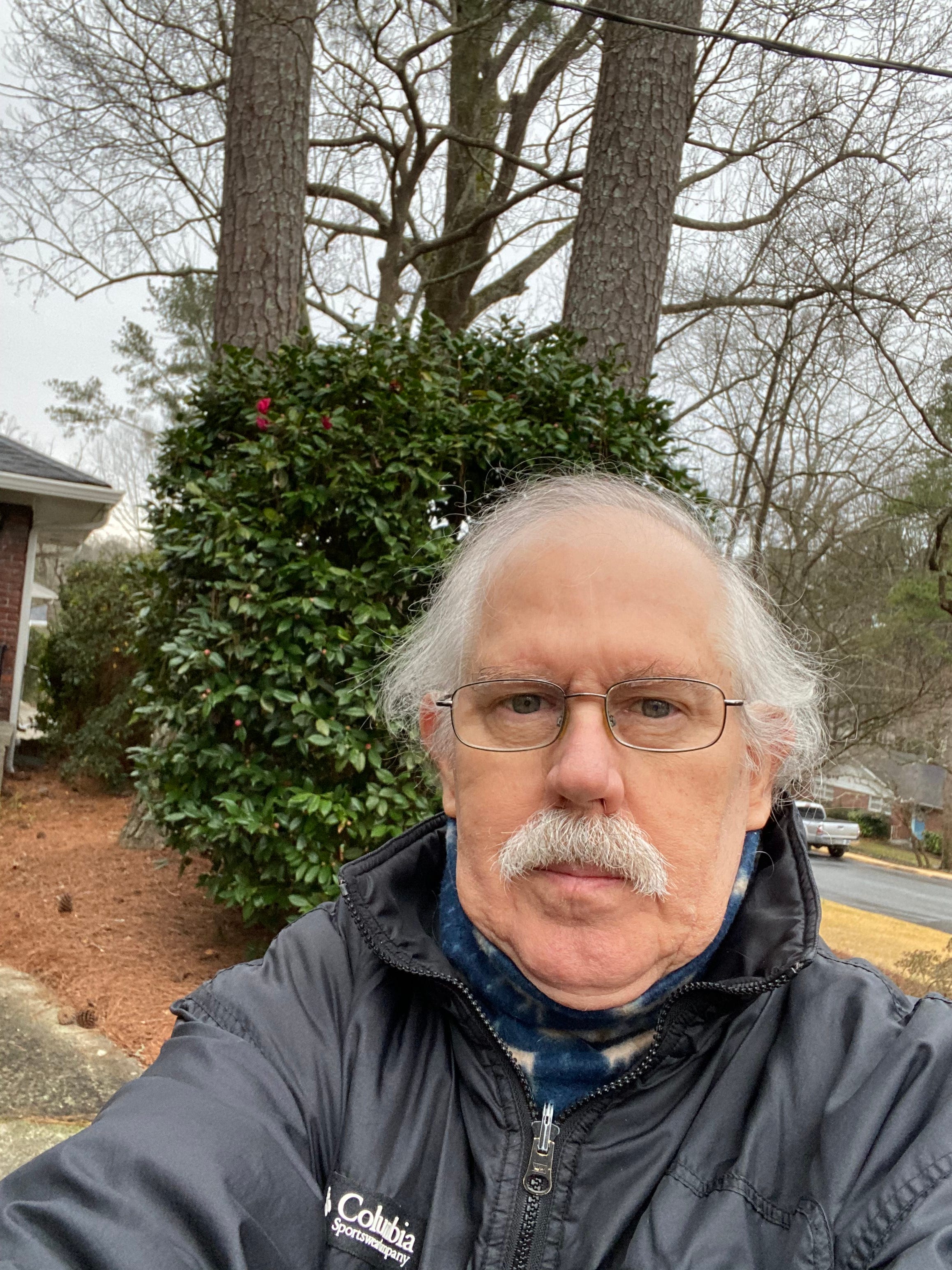
Here’s today’s selfie taken this morning before I went to the cancer center for my spine chemo.