
From Wikipedia, the free encyclopedia
.jpg)

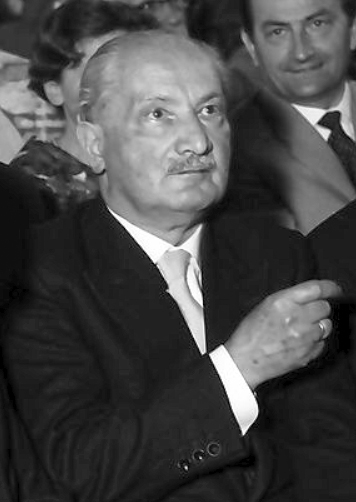
Martin Heidegger (/ˈhaɪdɛɡər, ˈhaɪdɪɡər/;[12][13] German: [ˈmaʁtiːn ˈhaɪdɛɡɐ];[14][12] 26 September 1889 – 26 May 1976) was a German philosopher who is widely regarded as one of the most important philosophers of the 20th century. He is best known for contributions to phenomenology, hermeneutics, and existentialism.
In Being and Time (1927), Heidegger addresses the meaning of “being” by considering the question, “what is common to all entities that makes them entities?” Heidegger approaches this question through an analysis of Dasein, his term for the specific type of being that humans possess, and which he associates closely with his concept of “being-in-the-world” (In-der-Welt-sein).[15]:193 This conception of the human is in contrast with that of Rationalist thinkers like René Descartes, who had understood human existence most basically as thinking, as in Cogito ergo sum (“I think therefore I am”).
Heidegger’s later work includes criticism of the view, common in the Western tradition, that all of nature is a “standing reserve” on call, as if it were a part of industrial inventory.[16][17]
Heidegger was a member and supporter of the Nazi Party.[18][19] There is controversy as to the relationship between his philosophy and his Nazism.[20][21]
Biography
Early years
The Mesnerhaus in Meßkirch, where Heidegger grew up

Heidegger was born in rural Meßkirch, Baden-Württemberg, the son of Johanna (Kempf) and Friedrich Heidegger.[22] Raised a Roman Catholic, he was the son of the sexton of the village church that adhered to the First Vatican Council of 1870, which was observed mainly by the poorer class of Meßkirch. His family could not afford to send him to university, so he entered a Jesuit seminary, though he was turned away within weeks because of the health requirement and what the director and doctor of the seminary described as a psychosomatic heart condition. Heidegger was short and sinewy, with dark piercing eyes. He enjoyed outdoor pursuits, being especially proficient at skiing.[23]
Studying theology at the University of Freiburg while supported by the church, later he switched his field of study to philosophy. Heidegger completed his doctoral thesis on psychologism in 1914,[24] influenced by Neo-Thomism and Neo-Kantianism, directed by Arthur Schneider.[25] In 1916, he finished his venia legendi with a habilitation thesis on Duns Scotus[26] directed by Heinrich Rickert[27] and influenced by Edmund Husserl‘s phenomenology.[28]
In the two years following, he worked first as an unsalaried Privatdozent then served as a soldier during the final year of World War I; serving “the last ten months of the war” with “the last three of those in a meteorological unit on the western front“.[6]
Marburg[edit]
In 1923, Heidegger was elected to an extraordinary Professorship in Philosophy at the University of Marburg.[29] His colleagues there included Rudolf Bultmann, Nicolai Hartmann, and Paul Natorp.[30]:65 Heidegger’s students at Marburg included Hans-Georg Gadamer, Hannah Arendt, Karl Löwith, Gerhard Krüger, Leo Strauss, Jacob Klein, Günther Anders, and Hans Jonas. Following on from Aristotle, he began to develop in his lectures the main theme of his philosophy: the question of the sense of being. He extended the concept of subject to the dimension of history and concrete existence, which he found prefigured in such Christian thinkers as Saint Paul, Augustine of Hippo, Luther, and Kierkegaard. He also read the works of Wilhelm Dilthey, Husserl, Max Scheler,[31] and Friedrich Nietzsche.[32]
Freiburg
In 1927, Heidegger published his main work, Sein und Zeit (Being and Time). When Husserl retired as Professor of Philosophy in 1928, Heidegger accepted Freiburg’s election to be his successor, in spite of a counter-offer by Marburg. Heidegger remained at Freiburg im Breisgau for the rest of his life, declining a number of later offers, including one from Humboldt University of Berlin. His students at Freiburg included Hannah Arendt, Günther Anders, Hans Jonas, Karl Löwith, Charles Malik, Herbert Marcuse, Ernst Nolte, and Karl Rahner.[33][34][35] Emmanuel Levinas attended his lecture courses during his stay in Freiburg in 1928, as did Jan Patočka in 1933; Patočka in particular was deeply influenced by him.[36][37]
Heidegger was elected rector of the University on 21 April 1933, and joined the National Socialist German Workers’ (Nazi) Party on 1 May.[38] During his time as rector of Freiburg, Heidegger was not only a member of the Nazi Party, but an enthusiastic supporter of the Nazis.[39][40][19] There is controversy as to the relationship between his philosophy and his Nazism.[20]
He wanted to position himself as the philosopher of the Party, but the highly abstract nature of his work and the opposition of Alfred Rosenberg, who himself aspired to act in that position, limited Heidegger’s role. His resignation from the rectorate owed more to his frustration as an administrator than to any principled opposition to the Nazis, according to historians.[41] In his inaugural address as rector on 27 May he expressed his support of a German revolution, and in an article and a speech to the students from the same year he also supported Adolf Hitler.[42]:3:11 In November 1933, Heidegger signed the Vow of allegiance of the Professors of the German Universities and High-Schools to Adolf Hitler and the National Socialistic State.
Heidegger resigned the rectorate in April 1934, but remained a member of the Nazi Party until 1945 even though (as Julian Young asserts) the Nazis eventually prevented him from publishing.[42]:3 In the autumn of 1944, Heidegger was drafted into the Volkssturm, assigned to dig anti-tank ditches along the Rhine.[43]
Heidegger’s Black Notebooks, written between 1931 and 1941 and first published in 2014, contain several expressions of anti-semitic sentiments, which have led to a re-evaluation of Heidegger’s relation to Nazism.[44][45] Having analysed the Black Notebooks, Donatella di Cesare asserts in her book Heidegger and the Jews that “metaphysical anti-Semitism” and antipathy toward Jews were central to Heidegger’s philosophical work. Heidegger, according to di Cesare, considered Jewish people to be agents of modernity disfiguring the spirit of Western civilization; he held the Holocaust to be the logical result of the Jewish acceleration of technology, and thus blamed the Jewish genocide on its victims themselves.[46]
Post-war
In late 1946, as France engaged in épuration légale in its Occupation zone, the French military authorities determined that Heidegger should be blocked from teaching or participating in any university activities because of his association with the Nazi Party.[47] The denazification procedures against Heidegger continued until March 1949 when he was finally pronounced a Mitläufer (the second lowest of five categories of “incrimination” by association with the Nazi regime). No punitive measures against him were proposed.[48] This opened the way for his readmission to teaching at Freiburg University in the winter semester of 1950–51.[48] He was granted emeritus status and then taught regularly from 1951 until 1958, and by invitation until 1967.
Personal life
Heidegger’s stone-and-tile chalet clustered among others at Todtnauberg

Heidegger married Elfride Petri on 21 March 1917,[49] in a Catholic ceremony officiated by his friend Engelbert Krebs [de], and a week later in a Protestant ceremony in the presence of her parents. Their first son, Jörg, was born in 1919.[50]:159 Elfride then gave birth to Hermann [de] in August 1920. Heidegger knew that he was not Hermann’s biological father but raised him as his son. Hermann’s biological father, who became godfather to his son, was family friend and doctor Friedel Caesar. Hermann was told of this at the age of 14;[51] Hermann became a historian and would later serve as the executor of Heidegger’s will.[52] Hermann Heidegger died on 13 January 2020.[53]
Heidegger had a long romantic relationship with Hannah Arendt and an affair (over many decades) with Elisabeth Blochmann, both students of his. Arendt was Jewish, and Blochmann had one Jewish parent, making them subject to severe persecution by the Nazi authorities. He helped Blochmann emigrate from Germany before the start of World War II and resumed contact with both of them after the war.[54] Heidegger’s letters to his wife contain information about several other affairs of his.[52]
Heidegger spent much time at his vacation home at Todtnauberg, on the edge of the Black Forest.[55] He considered the seclusion provided by the forest to be the best environment in which to engage in philosophical thought.[56]Heidegger’s grave in Meßkirch

A few months before his death, he met with Bernhard Welte, a Catholic priest, Freiburg University professor and earlier correspondent. The exact nature of their conversation is not known, but what is known is that it included talk of Heidegger’s relationship to the Catholic Church and subsequent Christian burial at which the priest officiated.[57][58][59]:10 Heidegger died on 26 May 1976,[60][61]:1 and was buried in the Meßkirch cemetery.[62]
Philosophy
View from Heidegger’s vacation chalet in Todtnauberg. Heidegger wrote most of Being and Time there.

Dasein
In the 1927 Being and Time, Heidegger rejects the Cartesean view of the human being as a subjective spectator of objects, according to Marcella Horrigan-Kelly (et al.).[63] The book instead holds that both subject and object are inseparable. In presenting “being” as inseparable, “Heidegger introduced the term Dasein (literally: being there), intended to embody a ‘living being’ through their activity of ’being there’ and ‘being in the world’ “(Horrigan-Kelly).[63] “Famously, Heidegger writes of Dasein as Being-in-the-world,” according to Michael Wheeler (2011). Understood as a unitary phenomenon rather than a contingent, additive combination, being-in-the-world is an essential characteristic of Dasein, Wheeler writes.[64]
Heidegger’s account of Dasein in Being and Time passes through a dissection of the experiences of Angst, “the Nothing” and mortality, and then through an analysis of the structure of “Care” as such. From there he raises the problem of “authenticity,” that is, the potentiality for mortal Dasein to exist fully enough that it might actually understand being and its possibilities. Dasein is not “man,” but is nothing other than “man,” according to Heidegger. Moreover, he wrote that Dasein is “the being that will give access to the question of the meaning of Being.”[65]
Being
Dasein’s ordinary and even mundane experience of “being-in-the-world” provides “access to the meaning” or “sense of being” (Sinn des Seins) This access via Dasein is also that “in terms of which something becomes intelligible as something.”[66] Heidegger proposes that this meaning would elucidate ordinary “prescientific” understanding, which precedes abstract ways of knowing, such as logic or theory.[67]
This supposed “non-linguistic, pre-cognitive access” to the meaning of Being didn’t underscore any particular, preferred narrative, according to an account of Richard Rorty‘s analysis by Edward Grippe.[68] In this account, Heidegger holds that no particular understanding of Being (nor state of Dasein and its endeavors) is to be preferred over another. Moreover, “Rorty agrees with Heidegger that there is no hidden power called Being,” Grippe writes, adding that Heidegger’s concept of Being is viewed by Rorty as metaphorical.
But Heidegger actually offers “no sense of how we might answer the question of being as such,” writes Simon Critchley in a nine-part blog commentary on the work for The Guardian (2009). The book instead provides “an answer to the question of what it means to be human,” according to Critchley.[69] Nonetheless, Heidegger does present the concept: “‘Being’ is not something like a being but is rather “what determines beings as beings.”[70] The interpreters Thomas Sheehan and Mark Wrathall each separately assert that commentators’ emphasis on the term “Being” is misplaced, and that Heidegger’s central focus was never on “Being” as such. Wrathall wrote (2011) that Heidegger’s elaborate concept of “unconcealment” was his central, life-long focus, while Sheehan (2015) proposed that the philosopher’s prime focus was on that which “brings about being as a givenness of entities.”[71][72]
Heidegger claims that traditional ontology has prejudicially overlooked the question of being. His analysis employs a hermeneutic circle, relying upon repetitive yet progressive acts of interpretation.[73]
Time
Heidegger believes that time finds its meaning in death, according to Michael Kelley. That is, time is understood only from a finite or mortal vantage. Dasein’s essential mode of being in the world is temporal: Having been “thrown” into a world implies a “pastness” to its being. Dasein occupies itself with the present tasks required by goals it has projected on the future. Thus Heidegger concludes that Dasein’s fundamental characteristic is temporality, Kelley writes.[74][75]
Dasein as an inseparable subject/object, cannot be separated from its objective “historicality.” On the one hand, Dasein is “stretched along” between birth and death, and thrown into its world; into its possibilities which Dasein is charged with assuming. On the other hand, Dasein’s access to this world and these possibilities is always via a history and a tradition—this is the question of “world historicality.”
Ontological difference and fundamental ontology
Central to Heidegger’s philosophy is the notion of ontological difference: the difference between being as such and specific entities.[76][77] He accuses the philosophical tradition of being forgetful of this distinction, which has led to the mistake of understanding being as such as a kind of ultimate entity, for example as “idea, energeia, substance, monad or will to power”.[76][78][79] Heidegger tries to rectify this mistake in his own fundamental ontology by focusing on the meaning of being instead, a project which is akin to contemporary meta-ontology.[80][81] One method to achieve this is by studying the human being, or Dasein, in Heidegger’s terminology.[82] The reason for this is that we already have a pre-ontological understanding of being that shapes how we experience the world. Phenomenology can be used to make this implicit understanding explicit, but it has to be accompanied by hermeneutics in order to avoid the distortions due to the forgetfulness of being.[76]