If the Big Guy in the sky wanted to measure the collective IQ of his people, he might give them a simple problem with some incentive to solve it. “I think I’ll send a virus that kills but can be easily guarded against.
Let’s see which of my people can figure out that by simply not coughing, breathing or sneezing on each other they can protect themselves until I send them the vaccine antidote. Heck, I’ll even let most know it’s coming in advance so they can study up and show me how bright they are.” Most of his people around the globe figured it out fast, almost instantly and God was pleased. But not in my house.In my realm those with the upper hand earned a sub-average rating, with a good number designated as idiots. So, I ask God, what are we to do?“
The modestly IQed are easily confused,” he responded. “Perhaps if you line up America’s dead end to end and ask them to count. The 211 mile walk it will take them to do so may bring them to the light.”
Today, it would be easy to assume that same-gender desire, particularly among men, is at odds with the history of Christianity. After all, many elements of modern conservative evangelical Christianity, from the infamous campaigns of the Westboro Baptist Church to faith-based pushes for anti-LGBTQ policy, give the impression that the religion is fundamentally opposed to the LGBTQ community.
The division, however, is not as rigid as one might imagine. Historical evidence speaks to a rich tradition of continuity in literature, philosophy and culture that runs from antiquity all the way to medieval Christianity, where same-gender intimacies were able to flourish.
In fact, we can find across the medieval world the potent glimmers of queer community and the role it played in formulating a language for Christian subjects as marginalized and persecuted peoples. Many stories of how queer figures maneuvered across various secular and religious spaces of the medieval world share a jaw-dropping candidness about same-gender intimacies and sexuality, and can provide important evidence about how medieval writers thought about the intersections of gender and sexual desire.
While same-gender relations were not accepted within medieval Christianity the way they are by many today, they also did not elicit the intense disdain that we find within the modern Christian right. Despite evidence of great diversity in sexual practices, same-gender intimacies hardly are the focus of concern for most early-Christian and medieval writers. In fact, prohibitions against same-gender intercourse happened selectively, often motivated by political factors more so than religious ones. For example, in the sixth-century, Emperor Justinian’s historian, Prokopios, tells us that Justinian passed legislation against same-sex relations only so that he could persecute certain political enemies whose sexual histories were known to him.
In addition, across the medieval Mediterranean, we find a series of saints’ lives that tell the stories of individuals who had been assigned female at birth, but became monks in all-male monastic communities. In the story of Saint Eugenia, who briefly lived her life as the male monk Eugenios, the saint is sexually harassed by a woman by the name of Melania. The text is quite clear that Melania is drawn to the monk’s male appearance. This story is important, because it demonstrates to us the need to treat these monks as men and not to misgender them as women. Rich and complex in their own right, these figures allowed medieval authors to tackle difficult questions about community, gender, sexuality and piety.
Since authors did not always know how to grasp and interpret their protagonist’s gender, the stories expose to us the ways in which sexual desire between men manifested itself in religious communities. In the story of the fifth-century saint Smaragdos, the young, beardless monk arrives at the monastery, where he is isolated by the Abbot and placed in a separate cell. The author tells us that he was placed here so that he could not be seen by his brothers, lest he cause them to stumble because of his emerald-like beauty.
We might surmise that the narrator is able to write with such frankness about same-gender desire precisely because the conceit is that this monk, assigned female at birth, is a woman (in some capacity) in his mind. But a familiarity with these texts and a sensitivity to the languages in which they were originally written shows a much more complex reality to this separation and prohibition.
The Abbot is never confused as to how or why a young monk might sexually arouse his fellow monks, nor is there any concern or question of his gender. A similar awareness of same-gender desire in monasteries is evident across a wide spread of early Christian and medieval authors. For example, in Cyril of Scythopolis’ Life of the fifth-century Palestinian monastic founder Euthymios, the monk asks his followers to “take care not to let your youngest brother come near my cell, for because of the warfare of the enemy it is not right for a feminine face to be found in the [monastery].” And such prohibition against “feminine faces” or “beardless men” are found across the rules written to regulate monastic life. Likewise, in his mid-seventh century Heavenly Ladder, John Klimachos praises monks who are particularly adept at stirring up animosity between two others who have “developed a lustful state for one another.”
Yet, despite discomfort about sexual intimacies stirred up within the cloisters, the perceived problem always comes down to the fact that these men are committed to celibacy, not that they are men. This same-gender sexual activity is treated with less concern than instances of monks who are accused of having sex with women outside the monastery. While relations between monks are courteously dissolved and handled internally, intercourse with women often leads to a monk’s expulsion from the community.
In a surprising and telling instance, the seventh-century theologian Maximos the Confessor reflects on what it is that binds communities together, stating that it is “sensual affection” and “desires” (erota) that causes creatures to flock as one. It is from this “erotic faculty” that animals flock together, being drawn “toward a partner of the same kind as one.” Here, his description of conviviality builds on a language of intimacies between similars, providing ample metaphors in Greek for the filiations between men in monastic communities and other social groups.
But, institutionalized spaces for same-gender intimacies were not unique to the monastic world in the Middle Ages. For example, the rite of spiritual brotherhood or adelphopoiēsis (literally, “brother-making”) bound two men in a spiritual brotherhood, echoing certain elements of the marriage rite. The process has been controversially heralded by the late Yale historian John Boswell as a medieval “same-sex union.” We are even told that these spiritual brothers would share the same bed and live closely bound lives.
While scholars over the years have added a great deal of nuance to Boswell’s initial argument, they have also strongly attempted to deny any form of same-gender desire behind the rite. An unpublished manuscript at the Vatican Library, however, tells a very different story. In this text, which can only be consulted in its original handwritten medieval Greek, the 13th century Patriarch of Constantinople, Athanasius I, writing centuries after the inception of the rite, condemns it because it allegedly “brings about coitus and depravity.” In this later period, we see a newfound homophobic resistance to the rite that, in the reaction’s vitriol, speaks to the role this rite could really play for men committing themselves to each other: The Patriarch’s words acknowledge the reality that no matter its intention, the rite enabled the space for sexual intimacies between men. That the “brother-making” rite possibly allowed room to maneuver for premodern queer men, long before that term ever existed, is critical to the history of Christianity.
Narratives like these push us to understand the ways in which intimacies between men existed in various aspects of religious life, even between monks. These relations may not have always been prized or embraced, but they also did not receive the hatred and intensity of vitriol they find in radicalized Christianity today. In fact, the evidence we have suggests that in the privacy of monastic communities and rites like adelphopoiēsis, queer figures had ample room to exist in loving relationships, far beyond what the archive has been able to preserve.
Our written sources point obliquely to the existence of these relations, but detailed stories of these intimacies are left only as an imprint, an outline in the sand of lives now lost that have been forgotten by history. As historians, our role is not simply to regurgitate what was written, but to read between the lines. That’s the only way we’ll unearth the realities of subjects whose lives were either shielded by secrecy or erased, often on purpose, by the history that followed.
Image captionThe Proud Boys have denied being a homophobic organisation
Members of the LGBT community have been making #ProudBoys trend on social media by posting images of gay pride and pictures of themselves with loved ones.
The trend is part of efforts to drown out posts and content related to a far-right, anti-immigrant group of the same name.
Actors, artists and the Canadian armed forces are among those who have shared supportive pictures.
The Proud Boys group has denied being a homophobic organisation.
Since the beginning of last week, the term #ProudBoys has been tweeted more than 88,000 times.
The majority of them have been posted since 1 October. That day, former Star Trek actor and LGBT rights activist George Takei suggested on Twitter that “gay guys” should use the hashtag to share pictures of themselves “making out with each other or doing very gay things.” Skip Twitter post by @GeorgeTakei
End of Twitter post by @GeorgeTakei
His tweet also referred to a similar campaign by Korean pop music (K-pop) fans, launched earlier this year. In support of the Black Lives Matter movement, Twitter users flooded social media with pictures of Korean musicians with the hashtags #WhiteLivesMatter and #AllLivesMatter – tags which have been used online by people critical of the Black Lives Matter movement.
Other participants of the latest #ProudBoys trend have included Bobby Berk, a host of the Netflix show Queer Eye. Skip Twitter post by @bobbyberk
End of Twitter post by @bobbyberk
Canada’s armed forces have also shared a picture of two men kissing, which has been shared over 27,000 times. Skip Twitter post by @CAFinUS
End of Twitter post by @CAFinUS
Enrique Tarrio, chairman of the Proud Boys group, told US broadcaster CNN he is not sure what social media users are trying to achieve.
“I think it’s hysterical,” said Mr Tarrio. “This isn’t something that’s offensive to us. It’s not an insult. We aren’t homophobic. We don’t care who people sleep with.
“One of the messages they want to send with this is that they’re trying to drown out our supporters, they’re trying to silence us,” he added. “When you’re trying to drown out other people’s thoughts, I don’t think there’s anything progressive about that.”
Founded in 2016 by Canadian-British right-wing activist Gavin McInnes, the Proud Boys is a far-right, anti-immigrant, all-male group.
While not exclusively white, they have became notorious for violent confrontations against left-wing rival groups. Facebook, Instagram, Twitter and YouTube have all banned the Proud Boys from their platforms.
US President Donald Trump drew criticism last week after comments about the group during a presidential debate with Joe Biden. When asked to condemn white supremacist and militia groups, Mr Trump instead called on the Proud Boys to “stand back and stand by”.
Many members of the group, including Mr Tarrio, took his words as an endorsement. But the president has since said that he condemns the Proud Boys and all white supremacists.
Media caption: Trump: “I don’t know who the Proud Boys are”
Many of us experience pain in our childhoods, and young people face trauma all over the world. How is it possible to recover? Do those abused always go on to hurt others? This incredible bestseller has overturned the way we view trauma, by showing how the extraordinary power of resilience can heal damaged lives.
Renowned psychoanalyst Boris Cyrulnik has dealt with many young victims of distress and he relates stories of children who have been abused, orphaned, fought in wars and escaped genocide, yet who have not only survived, but grown in the face of adversity. By the way we deal with our memories and emotions, he shows, we can reshape our lives and transform pain into something stronger – just as a grain of sand in an oyster becomes a pearl.
Resilience is not just about resisting; it is about learning to live. This life-changing book points the way towards hope and happiness.
Perhaps one of the most revolutionary works of philosophy ever presented, The Phenomenology of Spirit is Hegel’s 1807 work that is in numerous ways extraordinary. It begins with a Preface, created after the rest of the manuscript was completed, that explains the core of his method and what sets it apart from any preceding philosophy. The Introduction, written before the rest of the work, summarizes and completes Kant’s ideas on skepticism by rendering it moot and encouraging idealism and self-realization. The body of the work is divided into six sections of varying length, entitled “Consciousness,” “Self-Consciousness,” “Reason,” “Spirit,” “Religion,” and “Absolute Knowledge.” A myriad of topics are discussed, and explained in such a harmoniously complex way that the method has been termed Hegelian dialectic. Ultimately, the work as a whole is a remarkable study of the mind’s growth from its direct awareness to scientific philosophy, proving to be a difficult yet highly influential and enduring work.
“… life may be compared to a piece of embroidery, of which, during the first half of his time, a man gets a sight of the right side, and during the second half, of the wrong. The wrong side is not so pretty as the right, but it is more instructive; it shows the way in which the threads have been worked together”
Henri Julien Félix Rousseau (French: [ɑ̃ʁi ʒyljɛ̃ feliks ʁuso]; 21 May 1844 – 2 September 1910)[1] was a French post-impressionist painter in the Naïve or Primitive manner.[2][3] He was also known as Le Douanier (the customs officer), a humorous description of his occupation as a toll and tax collector.[1] He started painting seriously in his early forties; by age 49, he retired from his job to work on his art full-time.[4]
Ridiculed during his lifetime by critics, he came to be recognized as a self-taught genius whose works are of high artistic quality.[5][6] Rousseau’s work exerted an extensive influence on several generations of avant-garde artists.[4]
Biography
Early life
Rousseau was born in Laval, Mayenne, France, in 1844 into the family of a tinsmith; he was forced to work there as a small boy.[7] He attended Laval High School as a day student, and then as a boarder after his father became a debtor and his parents had to leave the town upon the seizure of their house. Though mediocre in some of his high school subjects, Rousseau won prizes for drawing and music.[8]
After high school, he worked for a lawyer and studied law, but “attempted a small perjury and sought refuge in the army.”[9] He served four years, starting in 1863. With his father’s death, Rousseau moved to Paris in 1868 to support his widowed mother as a government employee.[citation needed]
In 1868, he married Clémence Boitard, his landlord’s 15-year-old daughter, with whom he had six children (only one survived). In 1871, he was appointed as a collector of the octroi of Paris, collecting taxes on goods entering Paris. His wife died in 1888 and he married Josephine Noury in 1898.[citation needed]
From 1886, he exhibited regularly in the Salon des Indépendants, and, although his work was not placed prominently, it drew an increasing following over the years. Tiger in a Tropical Storm (Surprised!) was exhibited in 1891, and Rousseau received his first serious review when the young artist Félix Vallotton wrote: “His tiger surprising its prey ought not to be missed; it’s the alpha and omega of painting.” Yet it was more than a decade before Rousseau returned to depicting his vision of jungles.[4]
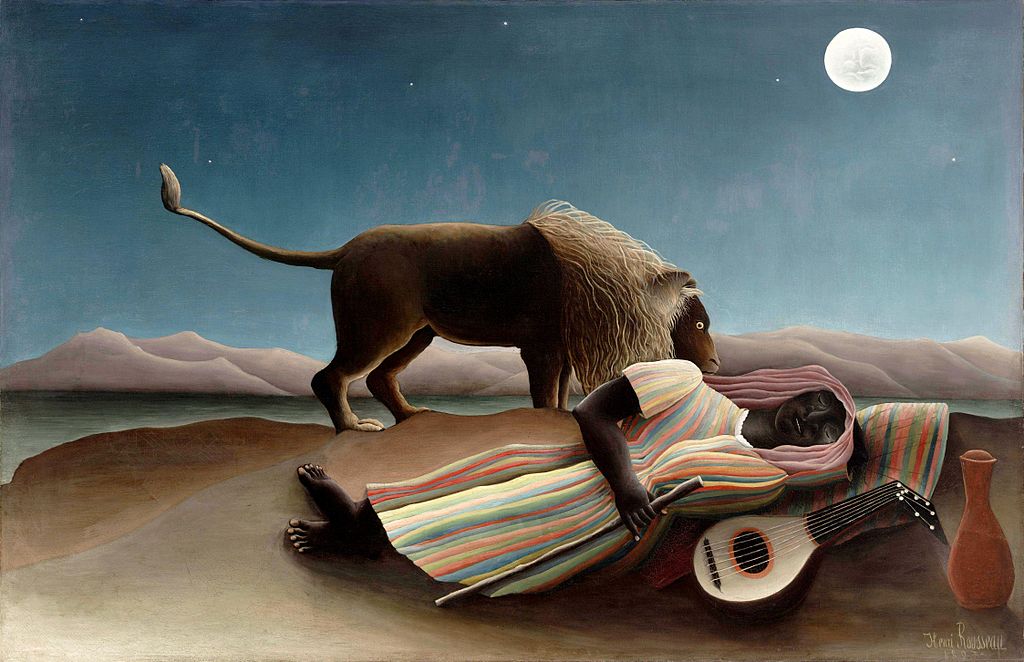
In 1893, Rousseau moved to a studio in Montparnasse where he lived and worked until his death in 1910.[10] In 1897, he produced one of his most famous paintings, La Bohémienne endormie (The Sleeping Gypsy).
In 1905, Rousseau’s large jungle scene The Hungry Lion Throws Itself on the Antelope was exhibited at the Salon des Indépendants near works by younger leading avant-garde artists such as Henri Matisse, in what is now seen as the first showing of The Fauves. Rousseau’s painting may even have influenced the naming of the Fauves.[4]
When Pablo Picasso happened upon a painting by Rousseau being sold on the street as a canvas to be painted over, the younger artist instantly recognised Rousseau’s genius and went to meet him. In 1908, Picasso held a half serious, half burlesque banquet in his studio at Le Bateau-Lavoir in Rousseau’s honour.[1]Le Banquet Rousseau, “one of the most notable social events of the twentieth century,” wrote American poet and literary critic John Malcolm Brinnin, “was neither an orgiastic occasion nor even an opulent one. Its subsequent fame grew from the fact that it was a colorful happening within a revolutionary art movement at a point of that movement’s earliest success, and from the fact that it was attended by individuals whose separate influences radiated like spokes of creative light across the art world for generations.”[11]
Maurice Raynal, in Les Soirées de Paris, 15 January 1914, p. 69, wrote about “Le Banquet Rousseau”.[13] Years later the French writer André Salmon recalled the setting of the illustrious banquet:
Here the nights of the Blue Period passed… here the days of the Rose Period flowered… here the Demoiselles d’Avignon halted in their dance to re-group themselves in accordance with the golden number and the secret of the fourth dimension… here fraternized the poets elevated by serious criticism into the School of the Rue Ravignan… here in these shadowy corridors lived the true worshippers of fire … here one evening in the year 1908 unrolled the pageantry of the first and last banquet offered by his admirers to the painter Henri Rousseau called the Douanier.[11][12][14]
Retirement and death
After Rousseau’s retirement in 1893, he supplemented his small pension with part-time jobs and work such as playing a violin in the streets. He also worked briefly at Le petit Journal, where he produced a number of its covers.[4] Rousseau exhibited his final painting, The Dream, in March 1910, at the Salon des Independants.The Dream (1910), MoMA
In the same month Rousseau suffered a phlegmon in his leg, one which he ignored.[15] In August, when he was admitted to the Necker Hospital[16] in Paris where his son had died, he was found to have gangrene in his leg. After an operation, he died from a blood clot on 2 September 1910.
We salute you Gentle Rousseau you can hear us. Delaunay, his wife, Monsieur Queval and myself. Let our luggage pass duty free through the gates of heaven. We will bring you brushes paints and canvas. That you may spend your sacred leisure in the light and Truth of Painting. As you once did my portrait facing the stars, lion and the gypsy.
Rousseau claimed he had “no teacher other than nature”,[3] although he admitted he had received “some advice” from two established Academic painters, Félix Auguste Clément and Jean-Léon Gérôme.[17] Essentially, he was self-taught and is considered to be a naïve or primitive painter.
His best-known paintings depict jungle scenes, even though he never left France or saw a jungle. Stories spread by admirers that his army service included the French expeditionary force to Mexico are unfounded. His inspiration came from illustrations in children’s books[18] and the botanical gardens in Paris, as well as tableaux of taxidermy wild animals. During his term of service, he had also met soldiers who had survived the French expedition to Mexico, and he listened to their stories of the subtropical country they had encountered. To the critic Arsène Alexandre, he described his frequent visits to the Jardin des Plantes: “When I go into the glass houses and I see the strange plants of exotic lands, it seems to me that I enter into a dream.”
Along with his exotic scenes there was a concurrent output of smaller topographical images of the city and its suburbs.
He claimed to have invented a new genre of portrait landscape, which he achieved by starting a painting with a specific view, such as a favourite part of the city, and then depicting a person in the foreground.
Criticism and recognition
Rousseau’s flat, seemingly childish style was disparaged by many critics; people often were shocked by his work or ridiculed it.[6][19] His ingenuousness was extreme, and he always aspired, in vain, to conventional acceptance. Many observers commented that he painted like a child, but the work shows sophistication with his particular technique.[3][6]
In 1911, a retrospective exhibition of Rousseau’s works was shown at the Salon des Indépendants. His paintings were also shown at the first Blaue Reiter exhibition.
The American poet Sylvia Plath was a great admirer of Rousseau, referencing his art, as well as drawing inspiration from his works in her poetry. The poem, “Yadwigha, on a Red Couch, Among Lilies” (1958), is based upon his painting, The Dream, whilst the poem “Snakecharmer” (1957) is based upon his painting The Snake Charmer.[21]
The song “The Jungle Line”, by Joni Mitchell, is based upon a Rousseau painting.[22]
Underground comic artist Bill Griffith drew a four-page biographical sketch of Rousseau, A Couch in the Sun, which was included in issue #2 of the Arcade anthology.
The visual style of Michel Ocelot‘s 1998 animation film, Kirikou and the Sorceress, is partly inspired by Rousseau, particularly the depiction of the jungle vegetation.[23]
A Rousseau painting was used as an inspiration for the 2005 animated film Madagascar.[24]
Exhibitions
Two major museum exhibitions of his work were held in 1984–85 (in Paris, at the Grand Palais; and in New York, at the Museum of Modern Art) and in 2001 (Tübingen, Germany). “These efforts countered the persona of the humble, oblivious naïf by detailing his assured single-mindedness and tracked the extensive influence his work exerted on several generations of vanguard artists,” critic Roberta Smith wrote in a review of a later exhibition.[4]
A major exhibition of his work, “Henri Rousseau: Jungles in Paris”, was shown at the Tate Modern from November 2005 for four months, organised by the Tate and the Musée d’Orsay, where the show also appeared. The exhibition, encompassing 49 of his paintings, was on display at the National Gallery of Art in Washington from 16 July to 15 October 2006.
A major collection of Rousseau’s work was shown at the Grand Palais from 15 March to 19 June 2006.
One thing we learned in the Translation class was to see the “nothingness” of evil. The human viewpoint thinks this is impossible. But, we Translators, nevertheless, set out to prove the nothingness of evil, and (with the syllogistic process of Translation), we do this!
Translation is quite different from positive thinking. William James wrote: “Healthy mindedness is inadequate as a philosophical doctrine because the evil facts (which positive thinking refuses to acknowledge) are a genuine portion of reality and they (the evil facts) may sometimes turn out to be the best key to life’s significance.”
Evil is not a genuine portion of reality – evil is a false assumption about reality. Problems are Teachers – IF we are willing to learn from them. Translation explores evil and searches through it for the Reality that is hidden beneath it! When you correct the error of 2+2=5 you discover the truth that 2+2=4.
In my next talk (Sunday, October 11), a few weeks before the election, I will explore the nothingness of evil and help you see what John Milton said: “Good – the more it is communicated, the more it grows.”See you Sunday!



 Fourteenth century tombstone relief at a monastery built in 1009 in the Pyrenees Universal Images Group via Getty
 Princeton University Press





.jpg)


.jpg)
