
Monthly Archives: October 2020
Why do we feel pain?
Why Are Democrats Praying for the Speedy Recovery of a “Fascist Dictator”?
People typically rejoice over, not lament, the death of someone they genuinely believe is a fascist dictator.
Glenn Greenwald October 4 2020 (theintercept.com)
House Whip James Clyburn (D-SC), on CNN, August 2, 2020
THE TYPICAL REACTION to the death of a tyrant — whether by revolutionary violence or natural causes — is not one of grief and sadness but joyous celebration. It is not hard to understand why: when a nation and its oppressed citizenry are finally liberated from the suffocating, savage grip of fascist dictatorship, they feel joy for themselves, their families and the future of their nation. That is the same reason people have always hoped for, or work toward, the death of despots: they want to rid themselves of those who impose tyranny on them.
When Romanians learned in 1989 of the summary execution of their despised dictator Nicolae Ceausescu, “residents t[ook] to the streets to celebrate the downfall of the dictator.” In 2006, “many Chileans celebrated the death of dictator Augusto Pinochet,” as “a cacophony of horns sounded as hundreds of thousands took to streets and plazas across the country when it was announced the man who ruled ruthlessly for 17 years had died at age 91, a week after suffering a heart attack.” “Cuban dictator Fidel Castro is dead, so celebrate we will,” read a 2016 South Florida Sun-Sentinel op-ed by a Cuban-American who appeared to genuinely believe that Castro was a vicious dictator, and thus expressed the natural, normal reaction of someone who believes a country has been freed from the grip of a despot. So typical is this reaction to the death of a leader perceived as a dictator that history is replete with countless similar examples over many decades and across the world.
Yet in the U.S., a radically different dynamic is playing out. Over the past several years, but particularly in the months heading into the 2020 election, it has become extremely common for prominent Democrats and their media allies to refer to President Trump as a dictator, a fascist, a tyrant hellbent on destroying U.S. democracy, a genocidal racist, and even a Nazi. And yet, the overwhelming reaction in those mainstream precincts to the news that the fascist dictator has contracted a potentially lethal virus is to hope and pray that he makes a speedy recovery whereby he can resume his democracy-destroying, genocidal, tyrannical, fascist rule.
In March of last year, as CNN put it, “two powerful House Democrats invoked Adolf Hitler’s actions in Germany and the treatment of Jews during World War I and in the 1920s to warn against the direction the US is moving in, with both saying Donald Trump’s presidency presents an unprecedented threat to democracy.” One of the Democratic lawmakers who explicitly invoked Nazism and Hitler as the proper prism to understand Trump’s rule was House Whip James Clyburn of South Carolina. Just two months ago, Clyburn went back on CNN and warned that Trump was preparing to hold despotic power even if he loses, pronouncing: “I feel very strongly that he is Mussolini, Putin is Hitler.”
CNN, March 20, 2019
Yet when Clyburn learned this week that our modern-day Hitler who is on the precipice of ending democracy had contracted a fatal virus, he did not celebrate but instead, for some reason, lamented the news, wishing “the First Family a speedy and complete recovery.” Why would you possibly wish a speedy recovery — rather than a quick demise — to someone you believe is a Hitler-like perpetrator of genocide whose recovery would enable fascism to continue? That seems counter-intuitive and counter-productive.
MSNBC star Rachel Maddow began invoking Nazism and Hitler in connection with Trump as early as 2016, when Politico reported that, once Trump secured the GOP nomination, the on-air personality “has been reading up lately on Adolf Hitler’s rise to power in Germany, the MSNBC anchor told Rolling Stone, because that’s where she thinks the United States could be headed.” Maddow has notoriously spent the last four years manically obsessed with the claim that Trump has such a corrupt relationship with Russian President Vladimir Putin that it is the Kremlin, thanks to Trump, which secretly runs the U.S. and is using that power to plot harm to large numbers of Americans by, for instance, seizing the power to cut off their heat in the dead of winter. Maddow was explicitly linking Trump to classic fascism as early as 2015.
Yet upon learning that the fascist, Kremlin-controlled, Nazi-like dictator had become ill, Maddow launched a one-woman crusade demanding that her fellow liberals pray earnestly for his recovery. She first posted an extremely effusive tweet: “God bless the president and the first lady. If you pray, please pray for their speedy and complete recovery…” Presumably in response to widespread liberal confusion and criticisms — wait, you spent four years telling us he’s a fascist racist Nazi-like despot and now you insist that we pray for his health? — Maddow devoted a segment on her show in which, with great passion and emotion, she urged her viewers to react to Trump’s COVID diagnosis with the same compassion and through the same prism as if a friend who smokes cigarettes learned she had lung cancer:
Rachel Maddow, making the case for sympathy for Trump, compares him contracting covid to your friend getting lung cancer because they didn’t quit smoking despite knowing the risks: “Your instinct might be to blame them. Go right ahead, enjoy that Schadenfreude.” pic.twitter.com/T1pO03QT73— Ibrahim (@Ibrahimpols) October 3, 2020
These sentiments were not unique to Maddow. Indeed, that all decent people should hope and pray for Trump’s speedy recovery was the virtually unanimous consensus of leading Democratic Party figures, expressed by Barack Obama, Kamala Harris, Pete Buttigieg, Hillary Clinton, Bill Clinton, Joe Biden and Bernie Sanders. “Jane and I wish the President and First Lady a full and speedy recovery,” said the Vermont Senator.
How is this messaging — we hope the racist fascist genocidal Nazi-like dictator gets well soon and returns to work? — not creating extreme cognitive dissonance among those who believed that they actually were sincere in their maximalist denunciations and invocations of fascism and Nazism regarding Trump? Shouldn’t liberals not just be confused but overtly disgusted at their leaders who want Trump to survive and return in full health to imposing fascism and genocide on Americans?
Here, for instance, is the fairly representative reaction of a left-wing political operative — the Democratic Socialist of America’s Jack Califano, who served as the 2020 Sanders Campaign’s Deputy Distributed Organizing Director — to Maddow’s segment urging that all good liberals pray for Trump’s recovery and avoid wishing ill on their fellow human being:
That reaction makes logical sense on its own terms. If one really does believe that Trump is a “genocidal Nazi” — a Hitler-equivalent fascist dictator engaged in the deliberate mass slaughter of a particular ethnic or religious group (genocide) — then it would be not just irrational but madness and moral bankruptcy to hope that the Nazi genocidal fascist makes a speedy recovery and returns to work. But that’s exactly what virtually every prominent Democratic Party leader is doing. Is Califano regretful about having worked for the presidential campaign of someone who sends warm wishes to a genocidal Nazi?
There are a few potential explanations that may account for this extremely unusual and confounding behavior of praying for, rather than against, the well-being of a fascist dictator. Perhaps Democratic leaders are simply pretending to be hoping for Trump’s well-being for political purposes while secretly hoping that he suffers and dies. Or perhaps national Democratic politicians have ascended to a state of spiritual elevation rarely seen in modern political history, in which they are capable of praying for even those they most dislike, including ones they believe are imposing fascism on their nation? Or perhaps, maybe more likely, Democratic leaders do not really believe the things they have spent four years saying about Trump and, like George W. Bush and Dick Cheney before him, are applying such labels of historic evil to him for political advantage but still see him as one of them, whom they intend to rehabilitate and honor once he is out of power.
Whatever else is true, their behavior upon hearing that someone they claim to regard as a genocidal racist fascist tyrant has contracted a fatal virus is extremely unusual when compared to how people throughout history react when learning of similar news. It is worth interrogating what accounts for such a baffling dynamic.
CONTACT THE AUTHOR:
Glenn Greenwald glenn.greenwald@theintercept.com @ggreenwald
How Ordinary People Can Save Their Country
By Ariel Dorfman | October 7, 2020 (tikkun.org)

Photo by Morning Brew on Unsplash
Can you recognize this country?
In a momentous election, a narcissistic president—who has never won the popular vote—unleashes the full force of his executive powers in order to avoid defeat. At frenzied rallies, he accuses his democratic opponents of being puppets of dark foreign interests, captives of radical revolutionaries bent on spreading chaos and violence, a threat to Christian and Western civilization. He warns his turbulent partisans that if he does not carry the day, hordes of poor people will invade their neighborhoods and their women will not be safe. He derides those who protest against him and does nothing to stop well-equipped right-wing thugs from attacking them. He signals that if the vote goes against him, he will refuse to concede, that he will invoke his awesome authority as commander in chief to continue in office.
I am not describing the current U.S. election, but a plebiscite in Chile 32 years ago, which would determine whether General Augusto Pinochet, the country’s dictator since the coup of September 1973, would remain in power for another eight years. A “no” vote against Pinochet and his junta would initiate a transition to democratic elections. This was a chance to end the brutal repression and draconian censorship of his regime, which had closed both houses of Congress, executed thousands of opponents, and opened concentration camps across the land.
Pinochet’s attempts to triumph in that 1988 referendum, which he saw as a way to legitimize his rule, eerily presaged Donald Trump’s incendiary rhetoric and measures as he confronts the likelihood, if the polls are right, of losing to Joe Biden in November. That distant referendum in Chile offers the U.S. an example of how ordinary people can, through peaceful mobilization and decisive action, save their republic from an authoritarian figure.
Pinochet’s dictatorship had forced me into exile, but I watched from afar as a movement of trade unions, shantytown dwellers, and feminist collectives, as well as civic, student, and professional organizations, let go of their differences and came together against Pinochet. The men and women of Chile knew that the vote was their best opportunity to stop the country from continuing its long night of darkness. They accelerated and enhanced what had already been a large mobilization effort, and I and others helped gather outside recognition and celebrity support. The victory had to be unequivocal, of such magnitude that Pinochet and his allies could not dispute the results.
Many had predicted, at the time, that such an exploit was impossible, given the fanaticism of his followers, who believed that Pinochet had ushered in a strong economy; the fear the dictator’s regime had instilled in his subjects; and the real danger people faced for voting against him. But I was among those who believed that a day of reckoning awaited him. Whenever anyone asked me how Chile could achieve such a seemingly fantastical feat, my jocular answer was that the rabbits would do it. I was referring to La Rebelión de los Conejos Mágicos, a children’s story I had written while in exile, in which a megalomaniac wolf king is dethroned by a peaceful army of nibbling rabbits, the very creatures His Wolfiness had contended did not exist. I was convinced that the Chilean people, like the mischievous protagonists of my fable, would emerge from the shadows and humiliate the autocrat who believed himself invincible.
My wife and I returned to Chile and on October 5, 1988, joined an astonishing 90 percent of the electorate to cast a ballot in the plebiscite. The results were clear—56 percent of Chileans voted to oust Pinochet. Though the tyrant, cowering in the presidential palace, wanted to declare martial law and disregard the final tally, he found himself isolated when the air force, the national police, and prominent conservatives recognized the opposition’s obvious success.
The Chilean plebiscite was a formidable example of why voting matters: Just one tiny mark on a ballot, and then one more, and then yet another can forge a better, luminous collective future. If we had thought that one vote was inconsequential, or that showing up wasn’t worthwhile, because Pinochet would ignore his defeat, the outcome would have been very different.
Trump is a less fearsome figure than Pinochet and therefore should be easier to vanquish. No matter how much the current American president admires strongmen and totalitarians abroad, he has been constrained from imitating their worst tactics, unable to jail and torture dissidents, disappear and exile opponents, or silence the media, as the Chilean dictator did.
Yet Trump has still done great harm to the country and the Constitution. Despite his criminal and arrogant mishandling of COVID-19—a disease he now has—despite his vandalization of the environment, his war against science and decency, and his divisive white-supremacist jargon, he enjoys a degree of popularity similar to the 44 percent that Pinochet received in the referendum. That support might be enough to tempt Trump, if the results on Election Night are tardy or muddled, to declare a national emergency, invoke the Insurrection Act, and call on his well-armed followers to impose “law and order.”
To avoid such a terrifying scenario, Americans who believe in democracy must recognize, as so many of us did in Chile, that the election must be decided in an irrefutable landslide, an immediate and conclusive display of the popular will reflected in the vote margins and the Electoral College. Millions of voters should be ready to defend the verdict, with their bodies in the streets, if the election is in danger of being stolen.
Even though some may accuse me of excessive optimism, I am confident of the future. Witnessing the deployment of so many inspired Americans in favor of environmental advocacy, racial justice, and women’s and immigrants’ rights over the past several years, I believe that, like the rabbits battling the despot who denied their existence, like the fearless men and women of Chile who more than three decades ago confronted a dictator, a significant majority of the citizens of the United States will show the world that the most powerful man on earth must bow to the more powerful voice of a peaceful and mobilized people.
…………….
ABOUT ARIEL DORFMAN
Ariel Dorfman is the Chilean American author of Death and the Maiden. His most recent books are Cautivos and The Rabbits’ Rebellion.
The hubris of meritocracy
In conversation: Michael Sandel
5th October 2020 (iai.tv)
We live in a meritocracy where anyone can make it if they try. Or so we have grown up believing. Extreme polarisation and radical social protest on both ends of the political spectrum tells another story. One of winner and losers, and rage against entrenched inequality.
Renowned philosopher Michael Sandel exposes the hubris a meritocracy generates among the winners and the harsh judgement it imposes on those left behind. He puts forward his vision of an alternative way of thinking about success – more attentive to the role of luck in human affairs, more conducive to an ethic of humility and solidarity, and more affirming of the dignity of work.
The Speaker
Michael Sandel is a political philosopher and currently the Anne T. and Robert M. Bass Professor of Government Theory at Harvard Law School. His course Justice has been viewed by tens of millions of people around the world, including China, where Sandel was named the “most influential foreign figure of the year”. He’s known for his critique of John Rawls.
This video was recorded at the Institute of Art and Ideas’ annual philosophy and music festival HowTheLightGetsIn. For more information and tickets, visit https://howthelightgetsin.org
Baby Boomers look back at The 1960s
David Hoffman To support my efforts to create more clips please donate to me at www.patreon.com/allinaday. WATCH THE ENTIRE CLIP. MANY GREAT STORIES. This is a portion from the 6th episode of my PBS television series on the 1960s, Making Sense Of The Sixties. Fascinating to talk to folks who lived it and are now reflecting on it and what has happened since. Whatever you think about the 60s, the generation who experienced that time sees it like the World War II generation sees the war. Extremely powerful in their lives.
Created using
YouTube Video Editor
Source videos
Photographer Bruce Davidson: Inside A 1950s Brooklyn Gang | TIME
TIME Taken in the hot New York summer of 1959, Bruce Davidson’s classic essay Brooklyn Gang, New York, infiltrates a close-knit group of teenagers as they sunbathed, smoked and bloodied each other up. They were young, poor and reckless but the very embodiment of 1950s cool. Subscribe to TIME ►► http://po.st/SubscribeTIME Get closer to the world of entertainment and celebrity news as TIME gives you access and insight on the people who make what you watch, read and share. https://www.youtube.com/playlist?list… Money helps you learn how to spend and invest your money. Find advice and guidance you can count on from how to negotiate, how to save and everything in between. https://www.youtube.com/playlist?list… Find out more about the latest developments in science and technology as TIME’s access brings you to the ideas and people changing our world. https://www.youtube.com/playlist?list… Let TIME show you everything you need to know about drones, autonomous cars, smart devices and the latest inventions which are shaping industries and our way of living https://www.youtube.com/playlist?list… Stay up to date on breaking news from around the world through TIME’s trusted reporting, insight and access https://www.youtube.com/playlist?list…
How a Scrap of Papyrus Launched a Reconsideration of Early Christianity
Ariel Sabar on Jesus and His Wife
Dr. Karen Leigh King had reached the summit of her field as a dazzling interpreter of condemned scripture. On her bookshelves at Harvard Divinity School were ancient texts as mysterious as they were startling. Among them were the Sophia of Jesus Christ, the Secret Revelation of John and the Gospel of Judas. The Gospel of Mary—as in Magdalene—was a favorite. So was The Thunder, Perfect Mind, a poem voiced by a female god whose paradoxical self-affirmations King found “incredibly inclusive.”
Such writings were nowhere to be found in the church-sanctioned collection of sacred literature commonly known as the New Testament. Early bishops had rejected them as heresies and sought their eradication. For hundreds of years, no one knew what became of them. But in the late 1800s, fragments of papyrus bearing traces of these lost scriptures began turning up at archaeological sites and antiquities shops across Egypt. The story they told about the earliest centuries of Christianity would force historians to reexamine almost everything they thought they knew about the world’s predominant faith. The more pieces of papyrus the deserts disgorged, the more the official history of Christianity—“the master story,” as King called it—began to look like a lie.
To King, these newly unearthed texts were the missing pieces of a Bible that might have been, had history taken a different course. In the suppressed writings of ancient believers she saw a Christianity more open-armed and less taken with violence than the one passed down by the long line of powerful popes and Sunday sermonizers. “We are only beginning to construct the pieces of a fuller and more accurate narrative of Christian beginnings,” she declared. “The dry desert of Egyptian Africa has yielded a feast for the nourishment of the mind and perhaps for the spirit as well.”
When colleagues published a book celebrating her scholarship, they titled it Re-Making the World. “In a quiet voice,” they wrote, “she has changed the face of early Christian studies.”
*
As an eminent Harvard historian of banished gospels, King could pack a college lecture hall nearly anywhere in the world. But students weren’t the only ones who sought her instruction. Her work at the fringes of faith drew notice from mystics, conspiracists and mediums, some of whom regarded her as a bearer of secret knowledge. One email correspondent sent her a code he said unlocked the mysteries of the Bible. Another asked for the key to the seemingly random order of Jesus’s sayings in the apocryphal Gospel of Thomas. “Some woman offered me ‘True facts about Mary Magdalene,’ because, she told me, ‘I am Mary Magdalene,’ ” King recalled. “I get a lot of that kind of stuff.”
To many orthodox and evangelical believers, the gospels King studied were no less blasphemous now than they had been to the Church Fathers: they were delusions wrought by the devil, detours from the one true way. And this explained the other genre of email King had to contend with—the dark stream of threats and hate. Some messages were so toxic that King quarantined them in a folder she labeled “Poison.”
“Repent,” people had urged her, “while there’s still time.”
*
July 9, 2010, was a Friday at the end of a long Boston heat wave. At a little before noon, King, who worked at home in the summers, received an email that Harvard Divinity School’s spam filters had labeled “SUSPECT.” King didn’t recognize the sender. But the subject line—“Coptic gnostic gospels in my collection”—suggested someone more credible than the “kooky” strangers who sometimes emailed. The scriptures King wrote about, which dated from the second to fourth century A.D., were sometimes called Gnostic, because of their view that salvation came not from the death and resurrection of Jesus but from personal knowledge, or gnosis, of the divine. Coptic, meanwhile, was the language of Egypt’s earliest Christians and of some of the oldest surviving copies of the gospels. Most of the known Gnostic manuscripts were discovered between the 1890s and the 1940s, and many had long since been cataloged and conserved in libraries and museums in Egypt, Germany and the United Kingdom. Were a set of previously unknown gospels to come to light now, it would electrify biblical studies. The field had so few texts for so many scholars that every discovery occasioned a kind of stir—along with sometimes jealous fights for access.
The sender introduced himself as a manuscript collector. He told King he had about fifteen fragments of Coptic papyrus, one of which had recently rekindled his curiosity. “Unfortunately I don’t read Coptic,” he wrote. But he had an English translation. It “points,” he wrote, “towards a gnostic gospel, in which Jesus and a disciple had an argument about Mary.
“Since I read some of your publications you [sic] name came to my mind,” he continued. “If you are interested in having a closer look, I gladly email photos.”
King replied that she was very interested.
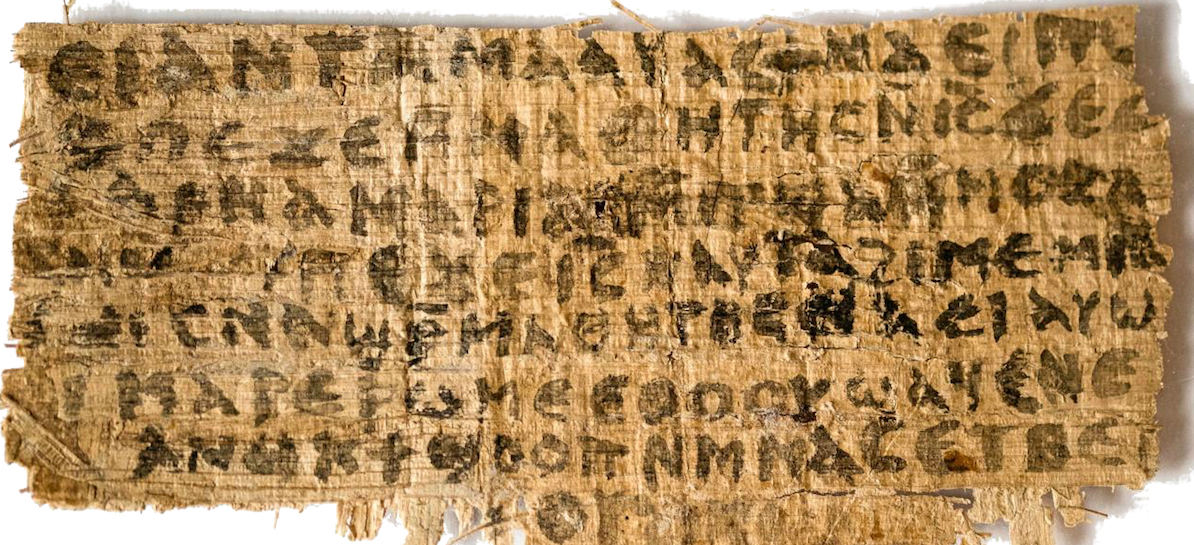
Five hours later, the man emailed images of a dozen papyrus fragments. He called her attention to two. Coptic Papyrus 01-11 was a piece of the Gospel of John he believed dated to the third century A.D. The other—Coptic Papyrus 02-11—was the text about Mary he’d mentioned in his first email. He now called it “an unknown Gospel.” A metal ruler, pictured along its bottom edge, showed it to be about three-by-one-and-a-half inches, nearly the dimensions of a business card. Its front side, or recto, was covered with eight lines of thickly stroked Coptic handwriting. Every line was incomplete, a sign that the scrap had probably broken off, or been cut, from the middle of some larger page.
What riveted King was the one line lacking any known precedent: “peje Iēsous nau ta-hime” was Coptic for “Jesus said to them, ‘My wife.’”
King recognized some of the surviving words. The first line, for instance, recalled a verse from the Gospel of Thomas. Other phrases smacked of the Gospel of Mary, a second-century text that depicted Mary Magdalene as superior, in Jesus’s eyes, to the male apostles. It happened that King was the world’s foremost expert on the Gospel of Mary; her research on it, as a young scholar in California, had first brought her to Harvard’s attention in the 1990s. In books and lectures, King had used the text to dispel what she saw as one of the most pernicious falsehoods in the history of Christianity: the portrayal of Mary Magdalene as a repentant prostitute—a slander, sanctioned by popes, whose true purpose, King believed, was to keep Christian women from power as the fledgling Church courted the patronage of patriarchal Rome.
The parallels between these familiar texts and the collector’s “unknown Gospel” were remarkable. But what riveted King was the one line lacking any known precedent: “peje Iēsous nau ta-hime” was Coptic for “Jesus said to them, ‘My wife.’”
The phrase was so extraordinary that King didn’t quite believe it. But the surrounding words seemed to leave little doubt. Just before Jesus speaks, the disciples pose a question about the worthiness of a woman named Mariam, or Mary. “My wife . . . ,” Jesus replies, “. . . she is able to be my disciple . . . / . . . Let wicked people swell up . . . / . . . As for me, I dwell with her in order to . . .”
It was a portrait of Jesus—married, living with his wife Mary Magdalene, cursing her detractors—unlike any known to history.
*
For more than fifteen centuries, Christian authorities had equated sex—and, in turn, women—with sin. For centuries, preachers and theologians taught believers to feel shame and revulsion at the most human of yearnings. If evidence existed that Jesus married and chose his wife as a disciple—or even just that some early Christians believed he did—it would bring unprecedented scrutiny to how and why this vilification of sex prevailed. The celibacy of clergy and the exclusion of women from the priesthood were predicated, in no small part, on the presumption of Jesus’s bachelorhood and on his choice of only male apostles. If a group of early Christians saw Mary Magdalene as Jesus’s wife, it might explain why the Church went to such lengths to recast her as a prostitute—a tearful outcast who washes Jesus’s feet with perfumed hair after repenting her sins.
King had spent much of her career questioning the completeness of the Church’s “data,” as she pointedly called it. Modern discoveries like the Gospel of Thomas and the Gospel of Mary—and now perhaps this text, too—showed just how effective the Church Fathers had been at skewing the data by literally burying the beliefs of Christians they didn’t like. Indeed, the sands of Egypt might have swallowed these forbidden scriptures forever, were it not for the territorial ambitions of a twenty-eight-year-old French general.
*
On July 1, 1798, Napoleon Bonaparte landed in the Egyptian port of Alexandria with forty thousand soldiers and dreams of empire. Fresh from his victories in Italy, he lusted for greater glory—a spectacular conquest that would simultaneously thwart British trade with North Africa and slake what some have called his “Oriental complex.”
“I saw the way to achieve all my dreams,” he said of Egypt. “I would found a religion, I saw myself marching on the way to Asia, mounted on an elephant, a turban on my head, and in my hand a new Koran that I would have composed to suit my needs.” He aimed to exploit “the realm of all history for my own profit.”
The expedition was, for Napoleon, a rare military fiasco. Under the cover of an August night in 1799, he slipped onto a frigate back to Europe, leaving Egypt to chaos and his soldiers to privation and mutiny. Napoleon could claim for his misadventure just one triumph: it had opened the land of the Pharaohs to the exploits of Western scholars. Along with arms, ships and soldiers, Napoleon had ferried with him from France some 170 intellectuals, or savants—some of the most luminous scientists, artists and engineers of his day. The savants returned with drawings of Egyptian wonders, from the tombs at Luxor to the zodiac at Dendera. A company of French soldiers expanding a fort near the town of Rosetta, meanwhile, uncovered a slab of polished granite engraved with three parallel blocks of text: one in Egyptian hieroglyphs; one in Greek; and one in demotic, a precursor to Coptic. The slab would become known as the Rosetta Stone. The French scholar Jean-François Champollion used its side-by-side translations to crack the code of hieroglyphics, opening the writings of the ancient Egyptians to the modern world. The savants published their extraordinary finds in a set of twenty-three volumes, Description de l’Égypte, that effectively established the field of Egyptology and lofted Europe into the throes of “Egyptomania.”
Egypt was soon awash with Western merchants, diplomats, spies and adventurers, along with a cavalcade of antiquities hunters and dealers, who discovered what the French scholar Hélène Cuvigny called “an archaeological El Dorado.” The lust for exotica from a grand civilization was so unquenchable that deals were struck in which neither buyer nor seller knew exactly what was trading hands. Warnings about price gouging and forgery were sounded as early as the 1830s. Occasionally, though, a buyer got very lucky.
*
On a January day in 1896, a German scholar named Carl Reinhardt strolled into an antiquities shop in Cairo. A dealer took out a codex, or book, of Coptic papyri and claimed that a fellah, a peasant, had found it wrapped in feathers and stuffed in a wall niche in the city of Akhmim, three hundred miles south of Cairo. Neither the dealer nor Reinhardt could decipher its contents, but Reinhardt paid the man and carried the codex back to Berlin, depositing it in the city’s illustrious Egyptian Museum. By the summer, a young German Coptologist named Carl Schmidt had sat down to try to make sense of it. Schmidt called the handwriting “of uncommon refinement” and dated its style to the fifth century A.D. But it wasn’t until he reached the end pages—where ancient scribes left titles—that he saw the breathtaking words:
The Gospel
according to
Mary
If looks didn’t deceive, it was the first known gospel written in the name of a woman.
In a central scene, the risen Jesus tells the disciples to go out and “preach the good news.” Yet when Jesus departs, the disciples weep, fearful of coming to the same gruesome end as the Savior. “If they did not spare him,” they ask, “how will they spare us?”
A woman named Mary, who appears to be Mary Magdalene, stands up to fire their courage. “Do not weep and be distressed nor let your hearts be irresolute,” she says. “For his grace will be with you all and will shelter you.”
“Sister,” the apostle Peter replies, “we know that the Savior loved you more than all other women. Tell us the words of the Savior that you remember, the things you know that we don’t because we haven’t heard them.”
“I will teach you about what is hidden from you,” Mary says, then gently mocks the men’s cowardice. She says that when she found Jesus in a vision, he answered, “How wonderful you are for not wavering at seeing me!”
But Jesus’s revelation to her—about the soul’s ascent, past dark powers, to a place of silence—arouses suspicion in Peter’s brother, Andrew, who complains that he doubts Mary’s “strange ideas.”
Peter, for his part, throws a jealous fit over Jesus’s preference for Mary. “Did he, then, speak with a woman in private without our knowing about it?” he asks. “Are we to turn around and listen to her? Did he choose her over us?”
“My brother, Peter, what are you imagining?” Mary asks, weeping. “Do you think that I have thought up these things by myself in my heart or that I am telling lies about the Savior?”
The disciple Levi puts an end to the quarrel, calling Peter temperamental and telling the others to be ashamed. He reminds the men that only the Savior decides who can announce the good news. “For if the Savior made her worthy,” Levi says of Mary, “who are you then for your part to reject her? Assuredly the Savior’s knowledge of her is completely reliable. That is why he loved her more than us.” The gospel ends with the chastened disciples going out into the world to preach.
It was a striking reversal of expectation. In the tradition familiar to modern believers, Peter is “the rock” upon which Jesus founds the Church, and Mary Magdalene, a reformed prostitute. Here, Peter is a hothead, and Mary, the rock, the only person steady enough to succeed Jesus as counselor to the disciples. To doubt her, as Levi suggests, was to doubt the Savior himself.
*
Until the day in 1896 when Reinhardt acquired the codex, almost everything scholars knew about texts like the Gospel of Mary came from the fulminations of second-century heresy hunters. Epiphanius, a bishop from Cyprus, called his diatribe The Medicine Chest, comparing Gnostic interpretations of Jesus’s teachings to a sickness on the Christian body. The Gnostics were “deluded people” who “forge nonsensical books,” having “grown from [their teachers] like fruit from a dunghill,” he wrote. These “despicable, erring” believers “assault us like a swarm of insects, infecting us with diseases, smelly eruptions, and sores.”
Irenaeus, the bishop of Lyon, took a different tack, accusing the Gnostics of preening narcissism. “They proclaim themselves as being ‘perfect,’ so that no one can be compared to them,” he writes in Against Heresies. “They assert that they themselves know more than all others, and . . . are free in every respect to act as they please, having no one to fear in anything.” Among other outrages, Irenaeus said, the Gnostics “boast that they possess more Gospels than there really are.” Gnosticism’s favor among women was a particular irritant; its teachers, Irenaeus wrote, “deceived many silly women, and defiled them.”
Through this fog of venom, it was hard for modern scholars to get a true picture of the Gnostic texts. It was as if, say, every copy of James Joyce’s Ulysses had been destroyed and all a prospective reader could go on—to see if it was any good—were the reviews of critics who hated it. The one certainty was that these second-century bishops succeeded in elevating their model of Christianity to orthodoxy while demoting their rivals’ to heresy. The Roman Catholic Church eventually sainted Epiphanius and Irenaeus, honoring them as “Church Fathers.” The Gnostic gospels they raged against, meanwhile, vanished from places of worship. If anyone in antiquity recorded the means of destruction— whether it was by burning, burial or neglect—their accounts don’t survive.
The discovery of the Gospel of Mary—along with three other lost texts tucked in the same codex—was a breakthrough of incalculable proportions. Silenced groups of early Christians were at last speaking in their own words, their voices creaky from long burial but muzzled no more. “We are thus for the first time,” wrote Carl Schmidt’s colleague Adolf von Harnack, “able to check the Gnostic system, as the Church Fathers presented it, against the original.”
Karen King was fresh out of graduate school in the mid-1980s when senior scholars asked her to introduce the Gospel of Mary in a new edition of The Nag Hammadi Library in English. The book was the definitive collection of the most important set of Gnostic gospels. (The cliffs near Nag Hammadi, Egypt, were the site, in 1945, of the largest single discovery.) In a previous edition of the book, a pair of distinguished male scholars had between them eked out just two paragraphs. King’s introduction, her first published words on the Gospel of Mary, spanned two pages. It was clear, even then, that she saw prior interpretations as severely wanting. The Gospel of Mary, she argued, was nothing less than a “head-on” attack on “orthodox positions that deny the validity of esoteric revelation and reject the authority of women to teach.”
As King saw it, debates over women’s spiritual authority were as contentious in the ancient world as they were in her own time. The Catholic catechism barred women’s ordination because “the Lord Jesus chose men to form the college of the twelve apostles, and the apostles did the same when they chose collaborators to succeed them.” The New Testament was even more proscriptive. “I do not permit a woman to teach or to exercise authority over a man; rather, she is to remain quiet,” the apostle Paul decrees in his First Epistle to Timothy. Paul says that women will be saved by childbearing, so long as they maintain “self-control.” If women have questions, he writes in his First Epistle to the Corinthians, “let them ask their husbands at home. For it is shameful for a woman to speak in church.”
The Gospel of Mary told a decidedly different story, and King would spend years mining its fragmentary pages for clues to its origins and meaning. She presented her findings in a breakthrough 2003 book, The Gospel of Mary of Magdala: Jesus and the First Woman Apostle. The Gospel of Mary, she argued,
presents a radical interpretation of Jesus’ teachings as a path to inner spiritual knowledge; it rejects his suffering and death as the path to eternal life; it exposes the erroneous view that Mary of Magdala was a prostitute for what it is—a piece of theological fiction; it presents the most straightforward and convincing argument in any early Christian writing for the legitimacy of women’s leadership; it offers a sharp critique of illegitimate power and a utopian vision of spiritual perfection; it challenges our rather romantic views about the harmony and unanimity of the first Christians; and it asks us to rethink the basis for church authority. All written in the name of a woman.
The Gospel of Mary, in other words, challenged almost everything modern Christians took for granted about their faith, from the meaning of Jesus’s death to the basis of the Church’s legitimacy. It was no accident that the longest chapter in King’s book bore the magisterial title “The History of Christianity.” As a young scholar in the 1980s, King had seen the Gospel of Mary through a pinhole, as a critique of the leadership of Peter and Andrew. The longer she sat with its pages, however, the more they opened up to her. She saw them now as the other side of a rancorous debate over gender in the early church—a fight that took place before men monopolized control, a fight that might well have gone the other way. King argued that Mary was a contemporary of some of the twenty-seven books that would make the New Testament, and not—as most scholars believed—a late second-century reaction to them. It was a daringly original argument. No one had interpreted Mary this way, King wrote, “until now.”
*
King’s trailblazing instincts traced in part to her childhood amid the soaring mountains of southwest Montana. She’d grown up riding horses and trailing cattle in a valley ringed by abandoned gold and silver mines with names like Smuggler, Paymaster and Lucky Strike. The road through Sheridan—a no-stoplight, seven-hundred-person town an hour’s drive south of Butte—is still known as the Vigilante Trail, after the citizens’ committee that brought frontier justice to the masked highwaymen who terrorized prospectors during Montana’s 19th-century gold rush.
“She was someone who loved to go up in the Rockies on a horse and camp for days,” recalled Robert Berchman, a graduate school classmate at Brown University. “The idea of striking out on your own and achieving your goals—whether it was trekking through grizzly country for three days and coming out alive—that was part of Karen’s character.” Asked who the “grizzlies” were in his metaphor, Berchman said, “Anyone sitting in the audience who was listening to your paper and was going to come after you.”
“I was raised to think that emotions were irrational,” Karen King once said. Montana had “a very cowboy ethic,” and part of it was, “Show no vulnerability.”
*
The best-known private collectors of biblical manuscripts were early 20th-century business tycoons: Alfred Chester Beatty was a mining magnate known as the King of Copper; Charles Lang Freer, a railroad baron; J. Pierpont Morgan, a Wall Street financier. They had the riches to compete with a syndicate of European universities and museums, known as “the papyrus cartel,” for the most exhilarating finds. The hunt for ancient copies of the Bible reaped American-style publicity, with colorful details that evoked the era’s stereotypes about the exotic East. “Words of Christ, Lost 1,300 Years,” declared a banner headline in a 1908 issue of a Chicago newspaper. “Charles L. Freer Tells the Story of His Great Find in Egypt’s Sands: How a Moslem Arab Who Made the Wonderful Find Let Him into the Secret and How the Purchase Was Completed After Secret Conferences and Tedious Negotiations—Manuscript Is More Valuable than the One Held Sacred in British Museum.”
The twenty-first century produced a new breed of collector: wealthy evangelical Christians. Robert Van Kampen, a multimillionaire investment banker, and Steve Green, the billionaire president of the Hobby Lobby craft store chain, stockpiled large caches of Christian manuscripts in hopes of proving the Bible’s God-given inerrancy across the ages.
As best as King could tell, her email correspondent belonged to neither camp. “A complete stranger,” King said of him in August 2012, when I began reporting a story on the papyrus for Smithsonian. (The magazine, published by the Smithsonian Institution, had learned of her discovery a few weeks before her announcement in Rome.) I had hoped to interview the collector for my article or to at least learn more about his background. But King couldn’t oblige. The man, she said, did not want to be identified.
Her colleagues were naturally curious about the fragment’s origins, but King was by no means the first scholar to defer to a private collector’s wishes. Though the world of manuscript collecting had its publicity seekers, it also had its more reclusive habitués—hobbyists with smaller budgets, more idiosyncratic tastes and no interest in press. There was no single “type” among these amateur collectors, according to the Christian manuscript scholar Brent Nongbri, but at least a few were people, often with some academic training, who savored the idea of owning “a little bit of the past.”A challenge for historians of antiquity wasn’t just how few ancient manuscripts survived but how little remained of those that did.
Where this man lived, what he did for a living, his nationality— King wasn’t free to say. But she had no reason to suspect he was hiding anything. In her very first email to him, she had asked about the papyrus’s provenance, or ownership history. Knowing where an antiquity came from—and whose hands it had passed through—helped scholars determine whether it was legally obtained and genuinely ancient. The man responded within a few hours: he had purchased his papyri from a German American man in the 1990s; the German American, in turn, had acquired them in communist East Germany in the 1960s. Where the papyri were before the 1960s the collector didn’t seem to know. But few papyri, even those in museums, could be traced with any certainty to the patch of desert where some fellah first plucked them from the sand. And the stories of discovery that Egyptian antiquities dealers retailed to Western buyers in the early 20th century? Scholars are now of a mind that most were tall tales, hatched by dealers to deter customers from bypassing middlemen and going straight to the source. What mattered in the eyes of the law and academic ethics was that antiquities were in Western hands before new international restrictions in the 1970s on the export of cultural artifacts from their lands of origin. To judge by the collector’s paperwork, the papyri were in Germany no later than the early 1960s, which put King well in the clear.
*
A challenge for historians of antiquity wasn’t just how few ancient manuscripts survived but how little remained of those that did. Papyrus was a brittle medium, made from the flattened, sun-dried stalks of a flowering sedge native to the Nile. For a codex to stay intact for hundreds of years, even in a climate as arid as Egypt’s, would be extraordinary. Oxygen, insects and the ravages of time visited slow but inexorable destruction. Most papyri in collections today were so decrepit that they looked less like the pages of a book than like continents on a map, with rugged coastlines, odd peninsulas and plunging straits. Scholars needed to draw on deep wells of learning to propose restorations of missing text. The itch to get creative—not just by filling gaps, but by “correcting” the surrounding text in ways that make a manuscript more exciting—can grow so strong that the late American papyrologist Herbert Youtie coined a dictum. Known as Lex Youtie, Latin for “Youtie’s Rule,” it advises, “Iuxta lacunam ne mutaveris,” or, roughly, “Next to a hole, thou shalt not edit.”
The papyri that called to King were often Christianity’s most damaged and cryptic—the ones whose holes, or lacunae, posed the knottiest tests of intellect and erudition. For her doctoral dissertation at Brown, she deciphered a Nag Hammadi text called Allogenes, or “The Stranger.” It survived in a single Coptic manuscript so mangled that many scholars saw it as too fragmentary to properly interpret. King wrested from its incomplete pages a universal story of a soul’s alienation and redemption. The protagonist, an anonymous figure called the Stranger, “represents every person who is not at home in the world,” King wrote.
Its twist—about Mary Magdalene as Jesus’s wife and disciple—redeemed the wrongly maligned Magdalene twice over; challenged Church teachings on priestly celibacy and women’s leadership; and filled one of the biggest holes in gospel accounts of Jesus’s life.
The full text of the Gospel of Mary was no less elusive. Ten of its nineteen pages—including the first six and middle four—were missing. The surviving nine were strewn with archipelagoes of lacunae. But enough remained for King to summon what she called a “Christianity lost for almost fifteen hundred years.” When someone at a public lecture asked whether she thought of herself as a “treasure hunter”—an Indiana Jones who scoured the outback for talismans—King demurred. “The metaphor that probably comes closer,” she said, is “puzzle figure-outer, a solver of mysteries.”
*
The gapped English translation in the collector’s July 2010 email to King was itself a kind of riddle:
me not. For my mother she gave to me the
( ) The disciples said to Jesus this ( )
( ) abdicate, Mary be worthy of you (not)
( ) Jesus said this to them: My wife (and)
( ) she can become a disciple to me and
No man who is wicked, is he? SIC!
I exist within her, because ( )
( ) a ( )
The “SIC!” signaled that someone had found an error in the sixth line, but whether the fault lay in the translation or in the original Coptic was unclear. If the rest of the translation was accurate, however, the collector’s hunch looked right: the papyrus appeared to concern a dispute between Jesus and the disciples over someone named “Mary.”
But which Mary? The name belonged to nearly a quarter of the Jewish women in Palestine between 330 B.C. and A.D. 200, according to the Israeli historian Tal Ilan. In the New Testament gospels, the ratio was more lopsided still: six of the sixteen named women were Marys, and at least two of them, Jesus’s mother and Mary Magdalene, were close to Jesus. To narrow the field, one needed texts showing fights over a Mary, and these occurred in just one place: the Gnostic gospels. No fewer than three Gnostic texts depicted conflicts over a woman by that name, and in each case that woman was Mary Magdalene. Among them, only the Gospel of Mary portrayed an all-out row over Magdalene, but Jesus isn’t present for it. Not in the surviving pages. Could the quarrel at the end have had a prologue? Could the collector’s papyrus be a piece of it? King had long believed that Mary’s lost pages would one day surface, and for a simple reason: the codex that Carl Reinhardt purchased in Cairo a century earlier was in reasonably good shape. One theory was that its missing pages had simply decomposed over the preceding 1,500 years. But another struck King as more likely: modern antiquities dealers, she believed, had probably sold the pages piecemeal, in a misguided effort to maximize profits. “These missing leaves of the Gospel of Mary probably still are extant,” King told a Northern California audience in October 2003, during a four-hour seminar on the gospel, one of several she led for the public in those years.
“Maybe they’re sitting in somebody’s drawer somewhere,” she said, nodding at the audience. “And they may not even know what they have.”
*
How could the collector have missed the translation’s most striking line? Why had his first email pointed to “an argument about Mary,” rather than the showstopping “Jesus said this to them: My wife”? It didn’t matter. The fragment distilled all the themes King found most compelling in the Gospel of Mary, then went them one better. Its twist—about Mary Magdalene as Jesus’s wife and disciple—redeemed the wrongly maligned Magdalene twice over; challenged Church teachings on priestly celibacy and women’s leadership; and filled one of the biggest holes in gospel accounts of Jesus’s life. It was the missing link between texts King had spent decades writing and talking about. She made up her mind before so much as translating the fragment herself: Coptic Papyrus 02-11 was a modern forgery.
But something soon changed. A year after deciding the fragment was a fake, King travelled to Rome to announce the discovery of what she called a long-lost scripture. In a room overlooking the dome of St. Peter’s Basilica, she told an audience of elite scholars that she had already given the scrap of papyrus a name.
“I dubbed it—just simply for reference purposes—‘The Gospel of Jesus’s Wife.’”
__________________________________
From Veritas by Ariel Sabar. Used with the permission of Doubleday Books. Copyright © 2020 by Ariel Sabar.

Ariel Sabar
Ariel Sabar is an award-winning journalist whose work has appeared in The Atlantic, The New York Times, Harper’s Magazine, The Washington Post, and many other publications. He is the author of My Father’s Paradise: A Son’s Search for His Jewish Past in Kurdish Iraq, which won the National Book Critics Circle Award.
Book: “An American Covenant: A Story of Women, Mysticism, and the Making of Modern America”
An American Covenant: A Story of Women, Mysticism, and the Making of Modern America
by Lucile Scott (Goodreads Author), Jill Soloway (Goodreads Author) (Introduction)
A history of mystic resistance and liberation and of five women who transcended the expected to transform America.
For centuries, women who emerge as mystic leaders have played vital roles in American culture. For just as long, they’ve been subjugated and ridiculed. Today, women and others across the nation are once again turning to their mystic powers to #HexThePatriarchy and help fight the forces that seem bent on relegating them to second-class citizenry.
Amid this tumult, Lucile Scott looks to the past and the stories of five women over three centuries to form an ancestral spiritual coven: Marie Laveau, the Voodoo Queen of New Orleans; Cora L. V. Scott, nineteenth-century Spiritualist superstar; Helena Blavatsky, mother of Theosophy; Zsuzsanna Budapest, feminist witch and founder of Dianic Wicca; and Marianne Williamson, presidential candidate and preacher of the New Age Gospel of Love. Each, in their own ways, defied masculine preconceptions about power.
A scathing queer feminist history and a personal quest for transcendence, An American Covenant opens our eyes to the paths forged by women who inspired the nation in their own times—and who will no longer be forgotten or silenced in ours.
(Goodreads.com)
Francis of Assisi: Queer side revealed for saint who loved creation, peace and the poor
by Kittredge Cherry | Oct 4, 2020 (qspirit.net)

Historical records reveal a queer side to Saint Francis of Assisi, one of the most beloved religious figures of all time. The 13th-century friar is celebrated for loving animals, hugging lepers, embracing poverty and praying for peace, but few know about his love for another man and his gender nonconformity. His feast day is Oct. 4.
Francis is “a uniquely gender-bending historic figure” according to Franciscan scholar Kevin Elphick. His extravagant love crossed boundaries. Other Franciscan friars referred to Francis as “Mother” during his lifetime. He encouraged his friars to be mothers to each other when in hermitage together, and used other gender-bending metaphors to describe the spiritual life.
He experienced a vision of an all-female Trinity, who in turn saluted him as “Lady Poverty,” a title that he welcomed. Francis allowed a widow to enter the male-only cloister, naming her “Brother Jacoba.” His partner in ministry was a woman, Clare of Assisi, and he cut her hair in a man’s tonsured style when she joined his male-only religious order.
Pope Francis took him as his namesake in 2013, explaining that “Francis was a man of peace, a man of poverty, a man who loved and protected creation.”
Francis embraced outcasts and nature
Francis was born to a wealthy family in 1181 or 1182 in the Italian town of Assisi. As a young man he renounced his wealth, even stripping off his clothes, and devoted himself to a life of poverty in the service of Christ.
He connected with nature, calling all animals “brother” and “sister” and celebrating them in his famous Canticle of the Sun. Animal blessing events are happening all over the world in October for the Feast of St. Francis, the patron saint of animals. Click here for the animal blessing prayer by Q Spirit founder Kittredge Cherry.
He saw the face of Christ in lepers, the most reviled outcasts of his time, and nursed them with compassion. William Hart McNichols puts Francis’ ministry into a contemporary context by showing him embracing a gay Jesus with AIDS in “St. Francis ‘Neath the Bitter Tree,” pictured here. Words on the cross proclaim that Christ is an “AIDS leper” as well as a “drug user” and “homosexual,” outcast groups at high risk for getting AIDS. The two men gaze intently at each other with unspeakable love as Francis hugs the wounded Christ. It was commissioned in 1991 by a New Jersey doctor who worked with AIDS patients, and is discussed in the book Art That Dares: Gay Jesus, Woman Christ, and More by Kittredge Cherry.
“Saint Francis Embracing Christ” by Francisco Ribalta (Wikimedia Commons)

McNichols created the icon in his own style based on a 1668 painting by Spanish painter Bartolome Esteban Murillo, which was surely inspired by the more passionate 1620 version of fellow Spaniard Francisco Ribalta. In Ribalta’s work, Christ responds to St. Francis’ ecstatic kiss by giving the saint his crown of thorns, the symbol of suffering that leads to divine union.
Francis dearly loved his male companion
When Francis (1181-1226) was a young man, he had an unnamed male companion whom he dearly loved — and who was written out of history after the first biography. Elphick has spent years researching the queer side of Saint Francis, including travel to his hometown of Assisi. There he photographed artwork depicting the man he believes may have been the saint’s beloved soulmate: Brother Elias of Cortona.

Francis of Assisi and the man he loved in “They Shelter in a Cave” by José Benlliure y Gil, 1926 (Wikimedia Commons)

The earliest companion of Francis, a man whom Francis “loved more than any other because he was the same age” and because of “the great familiarity of their mutual affection” remains nameless. Elphick’s research suggests that the unnamed soulmate of Saint Francis was Brother Elias of Cortona.
Francis called Elias “Mother” and gave him a special blessing. Elias expressed much concern about Francis’ body and his health. Francis and Elias each describe the other in affectionate terms. However, very quickly after Francis died, Elias is written out of history and discredited. Elphick presents the scholarly evidence about their relationship in the detailed article at the Jesus in Love Blog: “Brother Elias: Soulmate to Saint Francis of Assisi?”
Early evidence of the various ways that Francis crossed gender boundaries are gathered in the ground-breaking unpublished master’s thesis “Gender Liminality in the Franciscan Sources” by Elphick, who is both a Franciscan scholar and a supervisor on a suicide prevention hotline in New York. He wrote the thesis for a master’s degree in Franciscan studies from St. Bonaventure University in New York.

Francis’ love for another man is described in his earliest biography, The First Life of St Francis of Assisi by Thomas of Celano, a follower of Francis who knew him personally. The biography was completed by 1230, just four years after Francis died. Celano says that when Francis was in his 20s, before embracing a life of poverty, he dearly loved a special male friend:
“Now there was a man in the city of Assisi whom Francis loved more than any other, and since they were of the same age and their constant association and ties of affection emboldened Francis to share his secret with him, he would often take this friend off to secluded spots where they could discuss private matters and tell him that he had chanced upon a great and precious treasure. His friend was delighted and, intrigued by what he had heard, he gladly accompanied Francis wherever he asked. There was a cave near Assisi where the two friends often went to talk about this treasure.”
In his thesis, Elphick points out, “Because homosexuality and ‘gay’ identities are modern constructs, it is impossible and inaccurate to attempt to read these modern categories into the personalities of historical figures.” Instead he uses the word “homoaffectional” to describe the relationship of Francis and his beloved companion.

Brother Elias (center) at the Baptismal font where St. Francis was christened in the Cathedral of San Rufino in Assisi, Italy. (Photo by Kevin Elphick)
“The relationship is inescapably homoaffectional, describing a shared intimacy between two Medieval men. That this first companion disappears from the later tradition is cause for suspicion and further inquiry…. The tone in Celano’s earliest account captures the flavor and intimacy of this relationship, perhaps too much so for an increasingly homophobic church and society.”
Francis and his beloved friend are seldom depicted by artists, but they are shown together in a rare and hard-to-find image: “They shelter in a cave” (Se cobijan en una cueva) by Spanish painter José Benlliure y Gil. It is the 8th in his series of 74 images from the life of Saint Francis. The series was published by Franciscans in Valencia, Spain, in 1926 in a book to mark the 700th anniversary of the saint’s death. A commentary in Spanish about the picture is available online.
Elphick finds many more examples of what he calls “gender liminality” in historical documents on Francis. He defines liminality as “crossing the threshold of gender, either symbolically, or by actions within a person’s life that breach the social boundaries of gender.”
Francis and the all-female Trinity: “Three women appeared”
Francis rejoiced when an all-female Trinity greeted him as “Lady Poverty” in a queer experience that has been ignored, sanitized and perhaps suppressed for centuries, even though it is “hiding in plain sight” in the earliest source and in at least one famous altarpiece:.
The 13th-century friar’s little-known encounter disrupts and reverses traditional distinctions of gender and social class. For Francis, such earthly restrictions cannot limit God.
Detail of Saint Francis with female Trinity by Sassetta… better known as “The Marriage of Saint Francis with Lady Poverty” (Wikipedia)

Christian doctrine says that there is one God in three persons: “Father, Son and Holy Spirit.” Francis saw this Holy Trinity embodied instead as “three poor women.” Does that make them Mother God, Christa and the Holy Spirit? Church authorities sometimes allow the Holy Spirit to be represented as female, but never the entire Trinity — except this time.
Disregarding his biological sex, the women call Francis himself “Lady Poverty” — and he loves it! The genderbending name honors his commitment to upend social hierarchies and embrace poverty as a spiritual path.
Later writers and artists downgraded the identity of the three women. Instead of embodying the Holy Trinity, they were said to represent the virtues of poverty, chastity and obedience. Lady Poverty ceased to be a name for Francis, and was recast as his bride in a mystical marriage.
Take a close look at the 15th-century painting by Italian Renaissance artist Stefano di Giovanni di Consolo, who is known as Sassetta.
Many usually reliable websites display this painting with titles such as “The Marriage of Saint Francis to Lady Poverty” or “The Mystical Marriage of Saint Francis.” Mystical, yes. But what makes them think this is a marriage? And how did the identity of Lady Poverty switch from Francis himself to one of the women? The dominance of heterosexual marriage and gender conformity must have been too powerful to resist. However, the painting matches the original story much better than the marriage model.
The painting is labeled as the mystical marriage of Francis with Lady Poverty, but a close examination shows that it illustrates the story of Francis and the female Trinity. He is not marrying Lady Poverty — he IS Lady Poverty! Later the same female Trinity floats over the ecstatic Francis in the altar’s climactic central image.
A female Trinity appears in “Saint Francis in Ecstasy” by Sassetta. (Wikipedia)


The story of Francis’ encounter with the female Trinity is recorded in chapter LX of “The Remembrance of the Desire of a Soul,” one volume in the Francis trilogy. It was written within two years of Francis’ death in 1226 by Thomas of Celano, a contemporary of Francis and his earliest biographer. Here is the text, as translated by Regis Armstrong:
Chapter LX: How three women appeared to him on the road, and how they disappeared after a novel greeting
I will tell in a few words something marvelous, doubtful in interpretation, most certain in truth. When Francis, the poor man of Christ, was traveling from Rieti to Siena for the treatment of his eyes, he passed through the plain near Rocca Campiglia, taking as a companion on the journey a doctor who was very devoted to the Order. Three poor women appeared by the road as Saint Francis was passing. They were so similar in stature, age, and face that you would think they were a three-part piece of matter, modeled by one form. As Saint Francis approached, they reverently bowed their heads, and hailed him with a new greeting, saying: “Welcome, Lady Poverty!” At once the saint was filled with unspeakable joy, for he had in himself nothing that he would so gladly have people hail as what these women had chosen. And since he thought at first that they really were poor women, he turned to the doctor who was accompanying him, and said: “I beg you, for God’s sake, give, something to these poor women.” The doctor immediately took out some coins, and leaping from his horse he gave some to each of them. They then went on for a short way, and suddenly the doctor and the brothers glanced back and saw no women at all on that whole plain. They were utterly amazed and counted the event as a marvel of the Lord, knowing these were not women who had flown away faster than birds.

Who are these three supernatural women? Early Franciscan writer Saint Bonaventure (1221-1274) wrote in his Life of Saint Francis that this triple goddess symbolized the three virtues of charity, obedience and poverty. His interpretation has been widely accepted.
Kevin Elphick, a scholar specializing in queer Franciscan subjects, explains in a recent article how “the language describing the three women is inescapably Trinitarian in formula.” The description of them as “a three-part piece of matter, modeled by one form,” closely resembles Christian creeds that proclaim the Trinity as three distinct persons of one substance.
He points out how the appearance of the three women also echoes the story in Genesis of how Abraham and Sarah welcomed three mysterious visitors. They are interpreted in Christian tradition as the three persons of the Holy Trinity. Elphick presents full evidence for the Trinitarian understanding in his article “Thee Poor Women Appeared” in the winter 2016 issue of “Franciscan Connections: A Spiritual Review.”
Of course, all this mislabeling makes it virtually impossible for researchers to find the beautiful paintings of Francis with the female Trinity… despite the fact that art prints are widely available for both the “marriage” and the ecstasy of Francis.
Francis embraced a Muslim sultan
A famous peace prayer is attributed to St. Francis. It begins, “God, make me an instrument of your peace.” Late in his life Francis embodied this message through man-to-man Christian-Muslim dialogue in the Mideast, a region where people are still at war.
In 1219 Francis went to Damietta, Egypt, with the European armies during the Fifth Crusade. He hoped to discuss religion peacefully with the Muslims. He tried to prevent Crusaders from attacking Muslims at the Battle of Damietta, but he failed. Francis was captured and taken to the sultan Malek al-Kamil. At first they tried to convert each other, but each man soon recognized that the other already knew and loved God. They remained together, discussing spirituality, for about three weeks between Sept. 1 and Sept. 26.
“Francis Meets the Sultan of Egypt” by JR Leveroni
Florida artist JR Leveroni painted Francis meeting the sultan in a colorful modern style that he calls “evolved Impressionism.” The third man in the painting is Francis’ travelling companion, a friar named Illuminatus. They travelled together, just the two of them. Leveroni specializes in painting religious themes, sometimes exploring theme of same-sex love.
“St. Francis and the Sultan” by Robert Lentz. Prints available at Amazon and Trinity Stores.
Their meeting is celebrated as a model of interfaith dialogue in the icon “St. Francis and the Sultan” by Robert Lentz, a Franciscan friar known for his innovative and LGBTQ-positive icons. He is stationed at Holy Name College in Silver Spring, Maryland. Lentz discussed the icon in a video.
Francis received the stigmata
In 1224, when Francis was in his 40s, he received the stigmata — marks like the crucifixion wounds of Christ in his hands, feet and side. California artist Kevin Raye Larson emphasizes the sensuality of the ecstatic moment in “St Francis of Assisi Receiving the Stigmata,” pictured here. The painting has appeared on the cover of the spirituality issue of “Frontiers,” the Los Angeles gay lifestyle magazine.

Along with the stigmata came other health problems. When Francis sensed death approaching, he called for Jacoba de Settesoli, a Roman noblewoman devoted to him and his teachings. Francis stayed in her house when in Rome. Celano’s 13th-century account in the “Treatise on the Miracles of Blessed Francis” reports that Francis greeted the news of her arrival at the male-only cloister with a decidedly queer statement that breaks gender rules::
“Blessed be God, who has guided the Lady Jacoba, our brother, to us. Open the door and bring her in, for our Brother Jacoba does not have to observe the decree against women.”

The widow called “Brother Jacoba” by Francis kneels near the dying Francis of Assisi in “48. Jacoba of Settesoli is associated with the mourning” (Jacoba de Settesoli se asocia al duelo) by José Benlliure y Gil, 1926 (Wikimedia Commons)

Francis died a few days later on Oct. 3, 1226. Two years after Francis’ death, Pope Gregory IX declared him a saint and commissioned Celano’s biography, the one that includes the love between Francis and his male companion.
Elphick adds an intriguing footnote about how the queer side of Francis has manifested outside official Christianity. Francis is venerated in the Yoruba religion of Africa as Orunmila, the orisha of wisdom, patron of animals and a transgendered deity who engages in same-sex eroticism.
At the end of his thesis, Elphick concludes that breaking gender rules is an extraordinary God-given power or “charism” that Franciscans offer to the church and the world.
“What are the lives of figures like Mother Francis, Brother Jacoba and Mother Juana de la Cruz revealing to us in our own day? I think that the Franciscan charism of gender liminality has much to teach our Church and fellow community of humans in our day. In a church divided over issues of ordination of women, inclusive language, and sexual orientation, I believe that the Franciscan tradition has important figures to hold up and from whom to learn. For issues which we have not even yet begun to explore theologically in authentic ways, issues such as hermaphroditism, transsexuality, genderedness and sexual orientation, I believe the Franciscan voice can be prophetic.”

“Saint Francis in Ecstasy” by Caravaggio (Wikimedia Commons)
Poet explores love between Francis and Jesus
Poet Jim Wise explores the love between Francis and Jesus with a touch of homoeroticism in his poem “Stigmata.”
He describes himself as “Queer Poet, Hermetic Mendicant, and Pantheist, itinerant theologist and roving Chaote – an Earth-centered, Eros-loving, Logos-chasing, dirt-worshiping revolutionary – living in the American Midwest.” He considers himself “something of a UCC Old Catholic spiritual pilgrim” because he attended seminary under sponsorship of the United Church of Christ and was ordained in an Old Catholic jurisdiction. The following poem comes from his “Queer Psalter” collection, currently a work in progress. Wise’s poetry has appeared in RFD Journal, The Gay and Lesbian Review Worldwide, and a host of online literary journals and zines.
Stigmata
By Jim Wise
Pierced by Christ,
the great penetration
only a God can give.
Assisi boy Francis
was the first, you know.
Out of all the pious faithful,
out of all the priests and
monks and friars and
whispering mystics who
cruised Christ down
the centuries, it took a
beggar boy dressed out
in a rough habit, singing
songs to the sun and moon
to catch the Messiah’s eye.
Francesco,
Saint Francis,
the beloved of the Lover
who was Love Itself
in human form.
Christ loves everyone.
So we’re told and
so we believe but
the stigmata is proof
that Christ, like most
of us, has a type.
He may love everyone
but his sacred lust is
reserved for barefoot
hippie boys who live
life wild and free,
who don’t clutter their
brief lives with things
and stuff and junk,
who always keep a
backpack near the
door just in case
the spirit moves.
Christ goes for those
careless guys who rent
apartments instead of
buy big houses with
thirty year loans,
who drive beat-up old
junkers or second-hand
jeeps or who take the
bus when they need
to go downtown, who
let their hair grow out
and give their stubble
permission to go wild,
who never waste a minute
worrying about whether
or not they have enough
in their retirement fund
to get them through life
and safely in the ground.
I’ll bet Christ loved
Berkeley back in the day,
and I have to wonder.
If I drove down to Asheville
on the hottest day of summer,
would I see a group of
barefoot hippie boys with
bleeding hands and feet?
For the feast of Saint Francis: Get a pet portrait
Get a pet portrait of your dog or cat! Artist Trudie Barreras has renewed her pet-portrait offer for the Feast of Saint Francis of Assisi, patron saint of animals.
She will make a pastel drawing of your animal companion for a $25 donation to the Q Spirit / Jesus in Love project on LGBTQ spirituality. Click here for more info.
Pet portraits by Trudie Barreras
Links related to Francis of Assisi
“The Message of St. Francis” by Kevin C. A. Elphick (The Empty Closet)
To read this post in Spanish / en español, go to Santos Queer:
San Francisco de Asís: La evidencia histórica revela su lado gay
___
Top image credit:
“St. Francis ‘Neath the Bitter Tree” by William Hart McNichols ©
___
This post is part of the LGBTQ Saints series by Kittredge Cherry. Traditional and alternative saints, people in the Bible, LGBTQ martyrs, authors, theologians, religious leaders, artists, deities and other figures of special interest to lesbian, gay, bisexual and transgender and queer (LGBTQ) people and our allies are covered.
This article was originally published on Q Spirit in October 2017 and was updated for accuracy and expanded with new material on Oct. 3, 2020.
Copyright © Kittredge Cherry. All rights reserved.
Qspirit.net presents the Jesus in Love Blog on LGBTQ spirituality.

FollowKittredge CherryFounder at Q SpiritKittredge Cherry is a lesbian Christian author who writes regularly about LGBTQ spirituality.She holds degrees in religion, journalism and art history.She was ordained by Metropolitan Community Churches and served as its national ecumenical officer, advocating for LGBTQ rights at the National Council of Churches and World Council of Churches.(Visited 3,591 times, 56 visits today)