Social media platforms have become de facto public spaces, where freedom of speech is exercised. But when online speech pushes the limits of acceptability, where do we draw the line? Are conservatives and liberals treated differently? And who gets to decide? This CBSN Originals documentary explores the controversy that’s spread far beyond Twitter and Facebook, with real-life consequences.
Getty ImagesLike father, like son. Bassist Wolfgang Van Halen grew up to be in a band with his guitarist dad, Eddie Van Halen. Conveniently, that band is named… Van Halen.
For Eddie Van Halen, making music is all about having good ears and a talent for experimenting with guitars and amps to create just the right sound.
Now 60, Van Halen told The Associated Press he’s ready to get back on the road. His band recorded a live album — its first with founding singer David Lee Roth — in 2013, and it’s waiting for a release date.
On Thursday, Eddie Van Halen is visiting the Smithsonian for a sold-out event to donate some instruments to the National Museum of American History and to discuss making music and his innovative guitar and amp designs. He even holds patents on some inventions.
Van Halen, it turns out, is a Dutch immigrant born in Amsterdam who came to the U.S. when he was 7. Many people just think he was born a rock star, he says. It wasn’t so easy, though, for him and his brother and bandmate Alex. Their family immigrated to California in 1962, drawn by the “land of opportunity.” Their father was a musician who also worked as a janitor, while their Indonesian-born mother was a maid. The Van Halens shared a house with three other families.
“We showed up here with the equivalent of $50 and a piano,” Van Halen said. “We came halfway around the world without money, without a set job, no place to live and couldn’t even speak the language.
“What saved us was my father being a musician and slowly meeting other musicians and gigging on weekends, everything from weddings to you name it to make money.”
Van Halen went on to help lead one of the most popular rock bands of the 1980s, known for hits including “Jump” and “Why Can’t This Be Love.” He discussed his immigrant roots and his penchant for experimentation.
AP: Did you feel like an outsider as a new immigrant?
Van Halen: Oh yeah. Believe it or not, the very first school I went to was still segregated where people of color were on a certain side of the playground and white kids were on the other side. Since I was also considered a second-class citizen at the time, I was lumped with the black people. It was rough, but music was a common thread in our family that saved us.
What sparked your interest in pursuing music more seriously?
It was definitely just being in a house that was full of music. My earliest memories of music were banging pots and pans together, marching to John Philip Sousa marches. And hearing my dad. He had his music going downstairs, practicing.
I understand you never learned to read music. How did you learn to play?
I was just blessed with good ears, to the disappointment of my piano teacher. … I had to see what my fingers were doing. Believe it or not, I’m not very good at playing in pitch dark on guitar either. I need to see where I’m at.
How did you work to keep the Van Halen sound current over the decades?
I think being true to ourselves and not trying to follow trends. We never did. We actually got signed to Warner Brothers in 1977 in the midst of punk and disco. We were the odd man out, so to speak. Of course when we started playing clubs, we had to play Top 40 songs, and for the life of me, I could never make anything sound the way it was supposed to sound. I could never emulate other people’s playing – a blessing in disguise.
What was the most important thing you’ve done to innovate with your equipment?
I’d say combining a Gibson (guitar) with a Fender. After that, every company on the planet made a guitar like that. Before that, there was no Fender or a Stratocaster-style guitar with a humbucker in it. (He also modified his amplifier by attaching a light dimmer to regulate the voltage.) A lot of people had no idea what I was doing. … And I didn’t bother telling anyone because it was kind of my little secret.
What does it mean to you now to be donating some of your guitars to the Smithsonian?
What more could you ask for to be recognized as being part of having contributed to change, you know? … All I can say is only in America.
If we believe that we, as Americans, are bound together by a common concern for each other, then an urgent national priority is upon us. We must begin to end the disgrace of this other America.
And this is one of the great tasks of leadership for us, as individuals and citizens this year. But even if we act to erase material poverty, there is another greater task, it is to confront the poverty of satisfaction – purpose and dignity – that afflicts us all. Too much and for too long, we seemed to have surrendered personal excellence and community values in the mere accumulation of material things. Our Gross National Product, now, is over $800 billion dollars a year, but that Gross National Product – if we judge the United States of America by that – that Gross National Product counts air pollution and cigarette advertising, and ambulances to clear our highways of carnage. It counts special locks for our doors and the jails for the people who break them. It counts the destruction of the redwood and the loss of our natural wonder in chaotic sprawl. It counts napalm and counts nuclear warheads and armored cars for the police to fight the riots in our cities. It counts Whitman’s rifle and Speck’s knife, and the television programs which glorify violence in order to sell toys to our children. Yet the gross national product does not allow for the health of our children, the quality of their education or the joy of their play. It does not include the beauty of our poetry or the strength of our marriages, the intelligence of our public debate or the integrity of our public officials. It measures neither our wit nor our courage, neither our wisdom nor our learning, neither our compassion nor our devotion to our country, it measures everything in short, except that which makes life worthwhile. And it can tell us everything about America except why we are proud that we are Americans.
This is the dawning of the Age of Aquarius” – 5th Dimension, 1969
Every 2,150 years approximately we have a new Astrological Age.
The much-anticipated Age of Aquarius begins when the March equinox point moves out of the constellation Pisces and into the constellation Aquarius.
When will that be?
There’s no firm consensus among astrologers as to when the Age of Aquarius will begin (or has already begun!).
Most claim that the Age of Aquarius arrived during the 20th century, while others claim it will arrive in the 24th century.
One thing we do know, however, is that it takes around 200-300 years to gradually transition from one age to another. And right now, we are transitioning from the Age of Pisces to the Age of Aquarius.
We can already witness the Aquarian influences. Technological advancements, science, and the internet are the trademarks of Aquarius – and they are all already here.
The Age of Aquarius’ ultimate goal is individual freedom and liberation.
Having liberated ourselves from the collective karma of humanity during the Age of Pisces, which is now coming to an end, we are gradually starting to transition into having more and more individual freedom (Aquarius).
What can we expect from the Age of Aquarius?
Let’s try to find the answers by looking at the previous Ages. Before the Age of Pisces, we had the age of Aries, and before that the Age of Taurus, we had the Age of Gemini, and so on. We only have historical records dating from the Age of Leo:
Age of Leo (10,800 BC to 8,600 BC)
The Age of Leo was thought to be the “Great Golden Age”.
This is when the Ice Age ended and the climate began to warm up. “Warming up” = Sun (Leo).
The cultures of the world during this time worshipped the Sun, the ruler of Leo. Solar gods and deities were paid the highest respects during this Age; cat worship (Lions in particular) also became prevalent.
Age of Cancer (8600 BC to 6500 BC)
The Age of Cancer was the age of the “Great Mother” and goddess worship. Figurines of voluptuous Mother Goddess from this period are found all over the world. This is when the matriarchal culture was at its peak.
Humans started agriculture and farming, which allowed them to build homes, ‘domesticate’, and settle down (home and family are Cancer symbols).
Cancer is a water sign, and this age was brought in by the Great Floods, as depicted by multiple myths and stories for example the Noah’s Ark, or the Epic of Gilgamesh.
Age of Gemini (6500 BC to 4000 BC)
During this age, humans began to develop their intellect, as well as languages and written communication.
The Age of Gemini is also when people began to move and trade both crafts and ideas between tribes and different cultures.
The emergence of myths and stories about “Twins” (Adam and Eve, Cain and Abel, or Enki and Enlil).
The Garden of Eden is an Age of Gemini myth. Once Adam and Eve tasted the fruit from the “tree of knowledge” they ‘became aware’ that they were naked, and were thereafter driven out of Eden.
The story’s message is that with greater awareness (intellect/Gemini) comes choice and consequence.
Before the Age of Gemini – during the age of Cancer – human consciousness was tribal, not individualistic.
It’s only with the Age of Gemini that humans began to perceive reality through duality – e.g the separation of subject and object/Gemini; this is when individual consciousness was born.
Age of Taurus (4000 BC to 2000 BC)
The Age of Taurus is when money and banking were invented.
Money and wealth became the key drivers for growth during this age. Humans improved farming which led to the development of cities and settled life.
Bull worship could be seen in many cultures during that time as well as the worship of nature spirits and fertility goddesses.
Age of Aries (2000 BC to 0 AD)
The general peacefulness seen in the Age of Taurus eventually came to an end – the Age of Aries is when the Iron Age with its weapons, warfare, and the great military cultures emerged.
Mythology became hero-centered – depicting the hero-warrior winning their way to glory.
History from this age has left us the myths of heroes and warriors: Moses, Hercules, Spartacus, Alexander the Great. Masculine gods challenged the established feminine goddesses, and matriarchy was replaced by patriarchy.
The Age of Aries is also when monotheistic religions (one consciousness vs. multiple gods) were born.
One particularly important archetype of the Age of Aries was Moses. Moses condemned the worship of the “golden calf” – a symbol for the bull – symbolically ‘declaring’ the end of the Age of Taurus and the beginning of the Age of Aries.
Moreover, Moses also spoke about “what comes” once the energy of the Ego is channeled through heroic actions.
The process of individuation – which eventually culminates with the “death of Ego” – was a prerequisite for finding the “Promised land” – a metaphor for the Age of Pisces’ transcendence.
The Age of Aries’ process of individuation was necessary; this is how we humans developed courage and ownership of our destiny. However once “Aries/me-first” energy was fully embedded in our consciousness, it was time for something different… it was time for the age of Pisces.
The lamb of God that was sacrificed at the birth of Jesus was a symbolic end of the Age of Aries and the dawn of the New Age of Pisces.
Age of Pisces spanned from approximately 0 to 2000
After 2000 years of wars and military development, a different approach was needed.
As the Age of Pisces emerged, humanity came to the understanding that the ego development (from the Age of Aries) was not enough; and that the ego must be channeled through something greater.
The Age of Pisces introduced the concepts of surrender, compassion, kindness, charity, empathy, and sacrifice.
The warrior-hero ideal of the Aries age evolved into the transcendent ideal of the saint. The Age of Pisces has been the age of great world religions: Judaism, Christianity, Islam, Hinduism, and Buddhism.
As with any astrological age, the animal symbolism is strikingly literal. The symbol of Christians is the fish. Jesus’ disciples were fishermen.
At the heart of Jesus’ (and other religious leaders) teachings, was the idea that we should love each other because we are all ‘one’, and because to hate someone, meant to hate oneself.
Jesus initiated the age of Pisces with his sacrifice; it was through sacrifice that our “sins” were washed away. Pisces indeed is connected to the symbols of “sins” or “karmic baggage”, but also, with the opportunity to be released and redeemed from these through sacrifice and surrender.
The symbol of “Pisces” is two fish that swim in different directions, yet they are tied together by an umbilical cord. This image is a symbol for the “ego” and the “soul” that have different agendas, yet are part of the same ‘whole’.
The higher purpose of the Age of Pisces is understanding that separation is just an illusion and that we can become ‘whole again’ when we reconcile the Ego and the Soul, or the YIN and YANG parts of our psyche.
This process of reconciliation is not easy, but it’s only when we find our inner unity, that we will be able to step into the Age of Aquarius with awareness.
Age of Aquarius (2000-4000)
As long as the ego is separate from the soul, we won’t have freedom and progress (Aquarius’ higher manifestation), but instead will have division and will continue to attempt to use machines (weapons, robots, or the internet) to justify one side of the story – either “the ego” or “the soul”.
However, sooner or later, at the end of this ‘cosmic battle’, when we’ll reconcile the YING and the YANG, and we will eventually find a “new Renaissance” – or the triumph of Aquarius’ highest values: humanitarianism, knowledge, reason, innovation, and people who work towards a greater goal.
As we are shifting from the Age of Pisces into the Age of Aquarius, we will learn that each individual is important – not as an amorphous mass easy to maneuver (Age of Pisces).
Every single one of us is born for a reason, and we all can bring our own contribution to the development of society. Every single one of us can make the world a better place.
Aquarius is the opposite sign from Leo. Leo is what makes us unique. Leo is the creator, the leader. Aquarius takes Leo’s unique qualities to the “next level” putting them into a higher context.
“Me” is put into the use of “We” – so that we can create something much greater than the sum of individual efforts. But of course, to get to “We”, we need to acknowledge each person’s unique qualities.
In Greek mythology, Aquarius is Prometheus, the Titan God that stole fire from the Gods and gave it to humans. The fire is, of course, a symbol for the light of knowledge, but also, quite literally, Aquarius is a symbol for electricity and other types of renewable energy.
During this new Age, we can expect new types of energies to be discovered. Other likely developments are artificial intelligence, space travel, and connections with other forms of life.
Aquarius is the most global sign of the zodiac – it rules networks and communities based on a mutual vision. In the next 2000 years, there’s no more place for top-down, hierarchical cultures or extreme political doctrines.
Aquarius is a democratic, egalitarian sign; the types of top-down systems that have dominated our society in the last millennia will simply cease to work.
The Age of Aquarius will come with a completely different “operating system” – something we haven’t seen yet… at least in the last 26.000 years.
We have, of course, started to witness the influence of the Age of Aquarius already since the late 18th century, with the discovery of Uranus (Aquarius’ modern ruler) which also coincided with the discovery of electricity.
These Aquarian influences have since then intensified, especially in the last 50 years.
Jupiter Conjunct Saturn December 21st, 2020 – The Age Of Aquarius
The next “Age of Aquarius” moment is December 21st, 2020, when Jupiter and Saturn meet for the first time in millennials, at 0° Aquarius.
What are the chances to have the 2 slowest moving visible planets of our solar system meeting exactly in the 1st degree of Aquarius?
The Jupiter-Saturn conjunction on December 21st, 2020 may well be that final ‘cosmic push’ that will mark the official beginning of the Age of Aquarius.
Change is around the corner and will come sooner than we expect. Humanity’s next chapter is currently being written, right in front of our eyes.
Liver cancer is one of the most difficult cancers to detect, but synthetic biologist Tal Danino had a left-field thought: What if we could create a probiotic, edible bacteria that was “programmed” to find liver tumors? His insight exploits something we’re just beginning to understand about bacteria: their power of quorum sensing, or doing something together once they reach critical mass. Danino, a TED Fellow, explains how quorum sensing works — and how clever bacteria working together could someday change cancer treatment.
This talk was presented at an official TED conference, and was featured by our editors on the home page.
America’s Political Crack-Up Is an Opportunity to Learn More From the Rest of the World
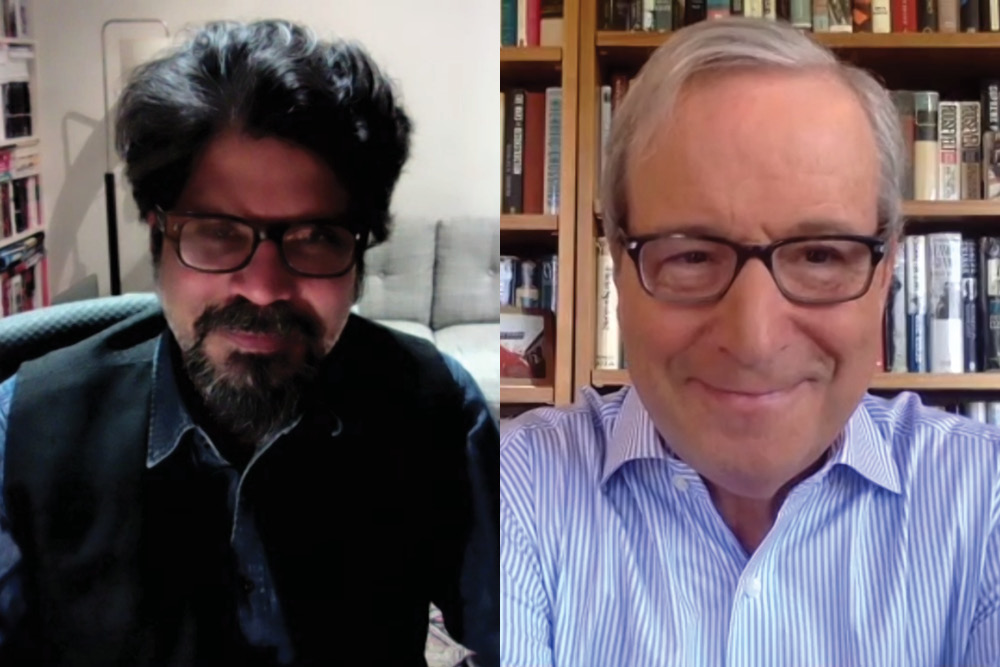
Panelists Pankaj Mishra and Ronald Brownstein discuss “Has Hysteria Conquered America?”
by JOE MATHEWS | OCTOBER 7, 2020 (zocalopublicsquare.org)
Political hysteria has conquered America—and made the United States much more like the rest of the world.
So argued the London-based essayist and novelist Pankaj Mishra during a fast-paced and wide-ranging Zócalo/Noēma Magazine online event yesterday, titled “Has Hysteria Conquered America?”
Mishra and The Atlantic senior editor Ronald Brownstein, who served as discussion moderator, spent over an hour discussing how international trends and intellectual history might explain today’s American politics.
Those politics, Mishra and Brownstein agreed, are full of conspiracy theories, xenophobia, over-the-top rhetoric, and questionable thinking. Over the course of the event, the two writers tried to locate the reasons for this crack-up—in economic dislocation, racism, wars, imperialism, and especially in Americans’ misunderstanding of their own place in the world.
Mishra, who is Indian and the author most recently of Bland Fanatics: Liberals, Race and Empire, suggested that it may have been easier to understand what’s happening in America if you’re not American. “I’ve come to the subject not through the American experience, but through the experience of India, supposedly the world’s largest democracy,” said Mishra. During his life, education, and work as a writer in India, he saw democracy decline. “A whole culture of hatred, of division, was emerging,” he said, “and many people were happily subscribing to it and looking for a demagogue who could at least seem to be protecting their rights.”
“With that kind of training,” Mishra concludes, “what’s happened in America hasn’t come as a huge surprise.”“I think the 2020s in America are going to be the 1850s,” said Brownstein, “where you had a rising majority whose agenda is being stalemated by a minority that controls a lot of the key institutions.”
Pressed by Brownstein, a leading American political journalist, on what explains political hysteria in the U.S. and around the world, Mishra returned to themes from his previous book Age of Anger: A History of the Present. The modern world, he said, is based on “contradictory promises.” The first promise is equality and individual dignity. But the second promise, “is that we will realize individual and national power through capitalism.” That, he said, is “when the contradictions start becoming sharper and sharper, because capitalism tends to generate inequality.”
Inequality creates disaffection with society, and starts to undermine democracy. And democracy’s spread in recent decades, because it coincided with the rise of neoliberal capitalism, produced a backlash because “the promise of equality got entangled with the promise of prosperity,” Mishra said.
Right-wing populism, Mishra said, is part of that backlash, and is driven by a desire for protection not just from capitalism but from the many disasters afflicting the world.
“There’s a sense that the world is falling apart and we have to take drastic measures to protect ourselves,” Mishra said. “The survivalist instinct has kicked in, in many different parts of the world.”
This backlash has surprised many leaders and thinkers in the U.S., the U.K., and the West who Mishra described as “too self-absorbed, far too self-congratulatory, [and] not really perceptive enough to the sufferings or ordeals of ordinary people.” Mishra also cited the widespread hubris that the U.S. had reached “a particular summit of human achievement.”
“One reason we are unable to look at our world clearly is because we are too influenced by a certain ideology of progress and of continuous, irreversible improvement,” said Mishra, adding: “Trump has been welcome in at least one aspect—he’s forced us to confront many of these problems that we understated or ignored or suppressed in the past.”Mishra said the country’s recent path posed a warning to those who saw it as a global model. “What America offers to the rest of the world is a cautionary tale. You were trying to imitate America, but America can end up in a very unfortunate place.”
Very few progressive thinkers in the West have been exposed to a lot of non-Western thought, said Mishra, citing, in particular, the criticisms of Western liberalism by Gandhi. He lamented how Western writers routinely pontificate about Iran or Russia or other societies without speaking the language, or reading the leading thinkers from those parts of the world. Those with broader experience and knowledge, who often are outsiders or minorities in a society, he said, can be more perceptive.
Brownstein, who authored The Second Civil War: How Extreme Partisanship Has Paralyzed Washington and Polarized America in 2007, agreed. “As a card-carrying member of that mainstream punditocracy, I can say that the person who I encountered in 2016 who was the most convinced throughout that Trump could win was an African American pollster named Cornell Belcher.” Belcher correctly predicted that Trump’s open racism “would not be disqualifying for as many voters as someone like me probably thought in 2016.”
During a question-and-answer period, audience members offered queries about China, the balance of power between the countries, the pandemic, the global power of American culture, and what Mishra thinks of Los Angeles (he said he enjoys going for walks and visiting bookstores on his visits). Some audience questions asked the two writers to predict the future.
“I think the 2020s in America are going to be the 1850s,” said Brownstein, “where you had a rising majority whose agenda is being stalemated by a minority that controls a lot of the key institutions.”
In response to a question about the perceptions of the United States, Mishra said the country’s recent path posed a warning to those who saw it as a global model. “What America offers to the rest of the world is a cautionary tale. You were trying to imitate America, but America can end up in a very unfortunate place.”
For the U.S., humility is now in order, and a willingness to look and think more broadly about everyone’s needs. “Arrogance [and] hubris have, in a way, reached a monstrous culmination with those images of Trump on the White House balcony taking off his mask,” Mishra said. “Humility has an opportunity right now to make itself manifest.”
We could realistically see people starting to live and work on the Moon in the next decade — and how we do it matters, says space policy researcher Jessy Kate Schingler. In this fascinating talk, she discusses the critical issues that arise when we consider civilization in outer space — such as governance, property rights and resource management — and shows how the Moon can be a template for solving our biggest challenges here on Earth.
This talk was presented at an official TED conference, and was featured by our editors on the home page.
The Hill Newman, the fan-favorite recurring character from “Seinfeld,” trashes President Trump for “premeditated assault on the US mail” in a new ad from Democratic super PAC PACRONYM.
is an associate professor of philosophy and director of the Bertrand Russell Research Centre at McMaster University in Ontario. His first book, ‘Consciousness Is Motor: Warp and Weft in William James’, is forthcoming.Listen here
In November 1914, Bernard Bosanquet delivered the inaugural address to the Aristotelian Society’s 36th session. An ageing titan of British idealism, Bosanquet called his talk ‘Science and Philosophy’. It was a broadside on Bertrand Russell’s now-legendary book Our Knowledge of the External World (1914) in which Russell sought to model a new ‘scientific’ method for doing philosophy that made the logical analysis of propositions fundamental. This logic-centric style would come to define what we now know as analytic philosophy.
Bosanquet’s opening complaint about Russell’s methodology was, surprisingly, political. He argued that the ‘scientific’ methodology would inevitably make philosophy ‘cosmopolitan in character and free from special national qualities’. Since logic, and science more generally, respects no political or cultural boundaries, Russell’s philosophy could never function as a distinctive expression of a people. This was a problem for Bosanquet. He held ‘that philosophy, being, like language, art, and poetry, a product of the whole man, is a thing which would forfeit some of its essence if it were to lose its national quality’. British idealism for Britons, and German idealism for Germans.
The cosmopolitanism that Bosanquet thought implicit in Russell’s philosophical methodology was no illusion. Two weeks prior to Bosanquet’s attack at the Society, Russell had delivered a lecture at Oxford that would be published under the title ‘On Scientific Method in Philosophy’. Today it is remembered as a call to arms for logical analysis and it largely restated, in a more pointed way, the methodological outlook of Our Knowledge. Russell’s essay is not overtly political. And yet privately, Russell told one colleague that the talk ‘was partly inspired by disgust at the universal outburst of “righteousness” in all nations since the war began. It seems the essence of virtue is persecution, and it has given me a disgust of all ethical notions, which evidently are chiefly useful as an excuse for murder.’ To another colleague, he described the lecture as ‘inspired by the bloodthirstiness of professors here and in Germany. I gave it at Oxford, and it produced all the disgust I had hoped.’
It might seem peculiar to find Russell talking about war and murder in connection with a lecture on – of all things –philosophical methodology. But one can see these concerns emerging directly in at least one passage in the lecture itself. Russell had drawn a contrast between his own scientific methodology and the methodology of those who incorporate a strong ethical element in their philosophy, likening the latter to The Grand Augur, a character from a story he attributed to the Chinese philosopher Chuang Tzu. The Grand Augur makes an obviously self-serving argument for butchering some pigs: these animals should be grateful to be slaughtered because it is always an ‘honour’ to ‘die on a war-shield’. Russell’s suggestion is that ethical philosophy offers little more than self-serving argument to justify nationalistic violence. What is more, Russell had held up Bosanquet himself as an example of the kind of moralising metaphysics he meant to repudiate. In private, Russell referred to the essay as ‘Philosophers and Pigs’.
The political anxieties at play begin to make sense when one bears in mind the timing of all of this. Bosanquet’s attack was delivered in the midst of the earthquake that was Britain’s entry into the Great War. The quake didn’t just shake soldiers on the battlefield. It also shook intellectuals, and would permanently change the direction of abstract pursuits that might seem highly remote from the concerns of warfare, like epistemology and metaphysics. For Russell, a crucial spark of the violence was nationalism, and he regarded scientific philosophy as a tool for opposing it.
At the time of Bosanquet’s Aristotelian Society address, his Philosophical Theory of the State (1899) had recently been published in its second edition. That work is often regarded as the highwater mark for idealist political philosophy. For Bosanquet, the ‘Nation-State’ was the ‘supreme community’ and ultimate source of authority. ‘Moral relations presuppose an organised life,’ he had contended, but an organised life is possible only in a national community. Especially during the First World War, this approach would be criticised for seeming to make international relations a matter of anarchy, and idealist advocacy for a strong state was seen as providing implicit support both for German bellicosity during the war and for Britain’s entry into it.
Britain joined the war four months before Bosanquet’s attack on Russell, and politics was unavoidable at the Aristotelian Society. The Society’s president that year was the Right Honourable Arthur Balfour, former Conservative prime minister, and a regular contributor to philosophical journals such as Mind. Balfour would shortly become Britain’s Foreign Secretary, a position he held through the remainder of the war. Meanwhile, Russell was already publicly associated with the push for British neutrality. Just after returning from Harvard University in the summer of 1914, he set about gathering the signatures of more than 60 dons at the University of Cambridge in a letter urging Britain to keep out of the war. Published on 3 August, the letter constitutes the only known such appeal on the part of academics.
The UK entered the war the next day. By the end of the week, the House of Commons passed the Defence of the Realm Act (DORA), which gave the government broad wartime powers – including censorship. In 1916, Russell would be dismissed from his post at Trinity College, Cambridge, following his conviction under DORA (and thanks in part to a campaign at the university led by another British idealist, J M E McTaggart). Russell spent six months in jail for his outspoken pacifism.
Recent historians have criticised analytic philosophy for disengaging from public affairs during the long 20th century. Some of its leading exponents, such as W V Quine, have been accused of cocooning themselves in a methodology they were pleased to call apolitical, particularly during periods when academics were coming under attack for purported Leftist sympathies, such as during the Joseph McCarthy era. One prominent critic (the philosopher John McCumber) has even suggested that, since anti-German sentiment in Britain during the First World War resembled in irrational vitriol the anti-communist sentiment during the McCarthy years in the US, the very founding of analytic philosophy itself – including in the hands of Russell – was also tainted with a self-serving political quietism.
But in fact that gets things almost exactly backwards. Russell’s antiwar protest was so extensive that it would cost him both his job and, for a time, his personal freedom. His theoretical antidote to the irrational, sectarian vitriol between European nations was to try to show how logic could function as an international language that could be used impartially and dispassionately to adjudicate disputes. His theoretical antidote was, in other words, analytic philosophy.
‘The truth, whatever it may be, is the same in England, France, and Germany … it is in its essence neutral’
The contrast with Bosanquet is again instructive. In a passage from Philosophical Theory of the State that would foreshadow his later attack on Russell, Bosanquet had decried ‘the idea of a universal language’ which, as ‘a substitute for national languages, … would mean a dead level of intelligence unsuited to every actual national mind, the destruction of literature and poetry.’ Russell didn’t intend logic to become the language of literature and poetry, much less to destroy those practices. But he very much intended his ‘scientific’ methodology to destroy a conception of philosophy as an articulation of a ‘national mind’.
The connection between Russell’s antinationalism and his metaphilosophy comes out sharply in his political writing of the era. In April 1915, he was again railing against the role philosophers were playing in promoting nationalism:
Leibniz, writing to a French correspondent at a time when France and Hanover were at war, speaks of ‘this war, in which philosophy takes no interest’. … We have travelled far since those days. In modern times, philosophers, professors and intellectuals generally undertake willingly to provide their respective governments with those ingenious distortions and those subtle untruths by which it is made to appear that all good is on one side and all wickedness on the other … I cannot but think that the men of learning, by allowing partiality to colour their thoughts and words, have missed the opportunity of performing a service to mankind for which their training should have specially fitted them. The truth, whatever it may be, is the same in England, France, and Germany, in Russia and in Austria. It will not adapt itself to national needs: it is in its essence neutral.
Today, with nationalism recrudescent, we are in a good position to appreciate that Russell’s insistence on the neutrality of truth was not mere platitude. Idealists of his time might not have gone quite so far as to deny truth’s neutrality outright, but they certainly saw overall philosophical excellence as distinctively tied to nationality. For Bosanquet and his allies, British idealism wasn’t just trying to get at the truth. It also aimed to express the national character of the British people.
Russell has often been regarded as someone who wanted to rid philosophy of ‘ethics’. But he advocated banning ‘ethics’ under a specific and narrow description of that enterprise, one that plainly resonated with his antinationalist politics. Compare the above quotation from Justice in War-time (1916) with this passage from his more overtly philosophical ‘On Scientific Method in Philosophy’ (1914):
Ethics is essentially a product of the gregarious instinct, that is to say, of the instinct to cooperate with those who are to form our own group against those who belong to other groups. Those who belong to our own group are good; those who belong to hostile groups are wicked. The ends which are pursued by our own group are desirable ends, the ends pursued by hostile groups are nefarious. The subjectivity of this situation is not apparent to the gregarious animal, which feels that the general principles of justice are on the side of its own herd. When the animal has arrived at the dignity of the metaphysician, it invents ethics as the embodiment of its belief in the justice of its own herd.
Russell in fact developed his own ethical theories; what he was most dismissive of was the specific kind of communitarian approach to value advocated by neo-Hegelians such as Bosanquet, an approach Russell saw as propping up the nationalist sentiments that had just exploded into a world war.
Idealism was not the only form of metaphysics that Russell saw as conducive to nationalism. He also went after the French philosopher Henri Bergson, as well as the Pragmatists in the US – both familiar targets for him. Russell had attacked Bergson in a series of talks in the spring of 1913, which were collected with several replies as a small book around the same time as Our Knowledge. While Russell was mostly concerned with the details of Bergson’s metaphysical system, he made his underlying political concerns clear at the outset. He portrayed Bergson as seeing successful ‘action’ rather than theoretical ‘understanding’ as the ultimate aim of philosophy, and this emphasis on action as inevitably leading to ‘imperialism’.
Bergson would become one of the most important French intellectuals arguing for military engagement during the Great War. In fact, two weeks after Bosanquet had condemned Russell’s cosmopolitanism, Bergson gave the presidential address to the Académie des Sciences Morales et Politiques which was quickly translated and published in English as The Meaning of the War (1915). Bergson’s bellicosity – in contradistinction from Russell’s advocacy of British neutrality – is on clear display in these lines from the book’s opening and closing paragraphs, respectively:
[T]here are forms of anger which, by a thorough comprehension of their objects, derive the force to sustain and renew their vigour. Our anger is of that kind. We have only to detach the inner meaning of this war, and our horror for those who made it will be increased. Moreover, nothing is easier. A little history, and a little philosophy, will suffice.
To the force which feeds only on its own brutality we are opposing that which seeks outside and above itself a principle of life and renovation. Whilst the one is gradually spending itself, the other is continually remaking itself. The one is already wavering, the other abides unshaken. Have no fear, our force will slay theirs.
Bosanquet’s defenders have often claimed that it is a misreading to suggest that his theoretical work actually justifies nationalism, and I don’t know of any evidence that he actively promoted militarism. But Bergson was extremely vocal in offering emotional and philosophical pleas in support of allied military action during the Great War, and in a way that helps make sense of Russell’s description of some philosophy professors as ‘bloodthirsty’. In February 1917, the French government even sent Bergson to personally lobby the US president Woodrow Wilson to get the Americans to join the war effort.
The British decision to join the war was a fundamentally different calculation than what France faced
I do not wish to suggest that Russell had all righteous justice on his side, and Bergson all wickedness. We do well to remember that France faced a starkly different set of concerns in entering the war. It shares an approximately 450-km (280-mile) border with Germany. The British Isles are and were, of course, insulated by water from such Continental strife, and to many neutralists the country stood to gain little from sending soldiers.
But on 3 August 1914, the day that Russell’s co-signed letter advocating neutrality was published, the British calculation suddenly became more complicated. The Germans declared war on France and announced their intention to attack through Belgium, whose own neutrality had been guaranteed by Britain since the 1839 Treaty of London. The Germans marched on Belgium the next day, and the British entered the war in a matter of hours, seeking both to honour the treaty and to protect Belgian ports that are directly across the English Channel. So the British decision to join the war was neither irrational nor unprovoked; but it was a fundamentally different calculation than what France faced.
Still, Russell’s continued advocacy of neutralism highlights his tendency to seek pacifistic solutions even to the most harrowing of international problems. And this brings us to Pragmatism. Russell criticised the Pragmatist theory of truth, and often used Pragmatism as a foil for his own analytic method. But his relationship with the American tradition is a more complex matter than has generally been appreciated. For one thing, the distinctive strain of pacifism Russell developed during the First World War had been directly influenced by William James, one of Pragmatism’s key architects. Shortly before his death in 1910, James had delivered two addresses on pacifism that had impressed Russell greatly, named ‘Remarks at the Peace Banquet’ and ‘The Moral Equivalent of War’. James’s pacifism was not built on unrealistic optimism, but on a frank acknowledgement of a very human thirst for violence:
The plain truth is that people want war. They want it anyhow; for itself; and apart from each and every possible consequence. It is the final bouquet of life’s fireworks. The born soldiers want it hot and actual. The non-combatants want it in the background, and always as an open possibility, to feed imagination on and keep excitement going.
James proposed diverting the human passion for violence away from fellow humans. Instead of conscripting young people into battalions, he advocated forming an ‘army enlisted against nature’ or something like what would become a national service corps. Although Russell did not find this solution fully satisfactory, he would later say in Why Men Fight (1917) that James’s ‘statement of the problem could not be bettered; and so far as I know, he is the only writer who has faced the problem adequately.’
James did not live to see the Great War. But he came from a family tradition of American progressivism that was very much in the cosmopolitan, internationalist spirit of Russell’s own ancestral ‘radicalism’, as it has often been called in the UK. Thirty years Russell’s senior and American by birth, James’s pacifism grew out of concerns about US expansionism in particular. He often voiced these concerns in a language of antinationalism that would have resonated deeply with somebody like Russell. Consider this passage from James’s ‘Address on the Philippine Question’ (1903) delivered at the fifth annual meeting of the Anti-Imperialist League in Boston:
Political virtue does not follow geographical divisions. It follows the eternal division inside of each country between the more animal and the more intellectual kind of men, between the tory and the liberal tendencies, the jingoism and animal instinct that would run things by main force and brute possession, and the critical conscience that believes in educational methods and in rational rules of right … The great international and cosmopolitan liberal party, the party of conscience and intelligence the world over, has, in short, absorbed us [‘us’ being anti-imperialists]; and we are only its American section, carrying on the war against the powers of darkness here, playing our part in the long, long campaign for truth and fair dealing which must go on in all the countries of the world until the end of time. Let us cheerfully settle into our interminable task.
Russell would be in lockstep with the ‘international and cosmopolitan’ idea that we are on a ‘long campaign for truth and fair dealing … in all the countries’. Thus James and Russell shared a pacifist cosmopolitanism that stands in stark contrast with Bosanquet’s grounding of all value inside a nation-state, and with Bergson’s ‘our-force-will-slay-theirs’ nationalism. It therefore seems unlikely that Russell had James in mind as one of the ‘bloodthirsty’ ‘pigs’ whose philosophy needed to be opposed on moralistic ground. Indeed, Russell was forthcoming about his longstanding admiration for James. Despite their real philosophical differences, we find Russell writing in the 1940s that ‘among eminent philosophers, excluding men still alive, the most personally impressive, to me, was William James.’
‘Two things which are at present increasingly disappearing: loving kindness and scientific impartiality’
Russell was highly critical of James’s book Pragmatism (1907), but that conflict was something closer to a civil strife. Russell could not accept that the truth of an idea is a matter of the idea’s utility (this was his gloss on James’s epistemology). A despot can make it very useful indeed for subjects to believe that the Dear Leader is a messenger of God, Russell worried. But it is worth remembering that Russell highly respected James’s pioneering work in empirical psychology, and connecting truth with utility was James’s own attempt to extract philosophical lessons from the best scientific enquiry. In fact, much like Russell, James often framed his own Pragmatism in direct opposition with the kind of neo-Hegelian idealism represented by the likes of Bosanquet.
Here one might charge Russell with a confusion. His central complaint with Pragmatism is that the peaceful resolution of disputes depends on the existence of a rational ‘standard’ that is independent of community opinion, and to which all can appeal. He thinks Pragmatism seeks such a standard, but fails philosophically to furnish one (whereas Bergson and Bosanquet do not even seek an international rationality). As he puts it elsewhere, ‘impartiality of contemplation is, in the intellectual sphere, that very same virtue of disinterestedness which, in the sphere of action, appears as justice and unselfishness’. Pragmatism is not impartial enough. And yet Russell apparently saw his own philosophical methodology as anything but politically neutral. He had an impartialist view of truth – but that commitment is embedded in a broader metaphilosophy that itself had an antinationalistic agenda, as we have seen. So how can Russell reconcile his own antinationalistic metaphilosophy with the idea that the truth must be an impartial matter?
Later in life, as the Second World War was winding down, Russell offered this way of handling the apparent tension:
If human life is again to become tolerable, mankind must acquire two things which are at present increasingly disappearing: loving kindness and scientific impartiality. These two things are inter-connected. At present, in every country, the schools teach a narrow nationalism and a view of history quite different from that taught in any other country. There is no scientific impartiality, and the departures from impartiality are such as to diminish loving kindness between nations.
Nobody could reasonably say that either antinationalism or cosmopolitanism is baked into Anglo-American philosophical methodology anymore. Russell was a pioneer in showing generations what it might mean to place formal logic at the heart of a ‘scientific’ philosophy. But a myopia has settled over our work in the intervening years.
We have retained much of Russell’s scientific methodology. Philosophical careers stand or fall now on the subtlety of one’s logical distinctions, or on the cleverness of the moves one makes on carefully circumscribed, technical matters. That kind of work is perfectly fine. But we have lost sight of the political rationale for laying out the rules of the philosophical game in the way Russell did, with an appeal to logic as an international language, and a standard of truth that is ‘the same in England, France, and Germany, in Russia and in Austria’.
What spectacles can help us correct our philosophical myopia? I suggest that historical reflection itself can play a salutary role. Unfortunately, history of philosophy has lately been under attack, so I will close with a few remarks on its utility.
In a widely discussed recent blog post attacking the history of philosophy as a useless undertaking, Michael Huemer of the University of Colorado Boulder tells us about the good kind of philosophy he thinks historians fail to produce:
[L]et’s suppose that you have a really good historian of philosophy, who does a really great piece of work by the standards of the field, which also is completely correct and persuasive. What is the most that can have been accomplished?
Answer: ‘Now we know what philosopher P meant by utterance U.’ Before that, maybe some people thought that U meant X; now we know that it meant Y.
This is of no philosophical import. We still don’t know whether X or Y is true.
Notice that this particular way of construing philosophy’s real job, as the evaluation of whether timeless theses are true, plain and simple, has not been universally shared. Certainly it was not Bosanquet’s view.
The metaphilosophy Huemer expresses is widely accepted today, and it is a descendant of Russell’s. But Russell’s view was different. He thought history of philosophy was valuable in itself, and made influential contributions in this area; and he thought even technical philosophy can be assessed in terms of its social and political consequences, which we get a grip on precisely by looking at history (a point Eric Schliesser has been exploring). So why did analytic philosophy modify its methodology over the years? That is a historical question, and one Huemer would have us pass over in silence, apparently, because ‘history of philosophy isn’t history or philosophy.’ But without answering this question, one should not feel confident in seeing Huemer’s metaphilosophy, popular as it is today, as inevitable.
Huemer aside, the lesson of my discussion isn’t that we should simply imitate Russell’s old project more faithfully. Today’s nationalist menace isn’t your grandmother’s. But Russell was right that even technical philosophy has political consequences, as Russell was keen to emphasise, and his unique way of embedding philosophical practice in a larger struggle against the bloodthirsty, against the war-mongers, against those who would ‘diminish loving kindness between nations’, is worth studying in its own context. Maybe we can learn something. For historical reflection stands to loosen hackneyed assumptions about what philosophical reflection is or can be. It stands to knock back the toxic complacency that says that philosophy inevitably must be, always has been, or can’t help but be, politically quiet.
Wendy Cicchetti | Twixt Earth and Sky Join Master International Astrologer Wendy Cicchetti on the complex and powerful, upcoming Mercury retrograde as well as the other planetary players causing trouble in October through the beginning of the year. Be Aware!
Contact Wendy for Readings at Wendy@TwixtEarthandSky.com
The accumulated energies that will be impacting us through October and November are very complex and challenging. Much could be revealed at this time.
As a result, I felt I should let all of you know what the energies are and what to watch for. This is a very important time in the evolution in our planet and all of its inhabitants.
I hope you find this video helpful.
Consciousness, spirituality, biography, sexuality, androgyny, futurism, space, the arts, science, astrology, democracy, humor, books, movies and more