Book: “Becoming God”

Blank 133x176

Becoming God: 108 Epigrams from the Cherubinic Pilgrim by Angelus Silesius

by Andrew Harvey 

Becoming God quite simply helps you define what God is and isn’t. Its short, eloquent 108 epigrams, written by a 17th-century German mystic, open a window into the heart of God and awaken the joy of spiritual connection open to everyone. In this vibrant new volume, you will find the treasure you may not have known you were seeking. Slow down to a stop. Sit quietly with each poem as a meditation, as a living prayer. Mirabai Starr, author of Wild Mercy One of those rare, mystical jewels that enchant the soul. A perfect book to read on days when you are in need of grace. Caroline Myss, author of Anatomy of the Spirit With these brilliant translations, Andrew Harvey brings us to the doorway of great wisdom. Once inside, we are reminded of that which we have most deeply forgotten- our inherent divinity. In these troubled times, this profound offering calls us home! Jeff Brown, author of Grounded Spirituality

(Goodreads.com)

Do You Trust Enough to Let Go?

By Craig Hamilton

(integralenlightenment.org)

Question:

At the heart of your teaching, and of many other spiritual teachings, is a kind of demand to let go of our ego’s wants and needs. I get this at a cognitive level. And when I sit down to meditate, I find it fairly easy to simply let go of everything. But when I get up off the cushion, I find that letting go is much more difficult. I’m afraid that if I let go of my own personal needs and wants, then I’ll end up being influenced by others. I won’t be in control of my life and I’ll get pushed around. Is this fear reasonable and what do I do about it?

Answer:

This is a very important question. Thank you for bringing it to light. A lot of people have this fear when they begin to seriously engage with letting go of their ego’s agenda and surrendering to a deeper wisdom and care. And the thing is, in a world where the primary context for our lives is defined by the ego, it’s a justifiable fear. If all we have to guide us are our personal egoic needs and wants, then we’re in a kind of zero sum game with everyone else’s egoic needs and wants. So if we suppress our own egoic drives, we’ll end up getting pushed around by others. Our behavior will be driven primarily by the needs and wants of those around us. 

This is something that many people have experienced in their lives. Many of us know what it’s like to not stand for our own needs. We’ve had the experience, to varying degrees, of self-abandonment where we find that we’re living in service of everybody else’s needs—often at the expense of our own. And many people have done a lot of important work to learn how to take a stand for themselves, their needs and wants and value. 

So when we encounter a spiritual teaching that’s telling us to let go of our needs and wants, we’re naturally skeptical. We’re told that if we can let go of our smaller, pettier motivations and align with something bigger, then a deeper part of ourselves will come forth and begin to guide us. But this takes a huge leap of faith. 

And so we experience a lot of fear. We’re afraid of what’s going to happen to us if we stop standing up for ourselves in the ways we’re accustomed to. We’re afraid that we’ll end up becoming a doormat for everyone else and that just won’t be fair. No one will look out for us but ourselves. And if we’ve already worked hard to be able to stand up for ourselves, this fear is even greater. 

So in an ordinary or conventional context, this is a justifiable concern. But if we’re interested in spiritual awakening, we need to find a way to leave it behind.   The simple truth is that if we’re constantly worried about fulfilling our needs and wants, there’s not going to be any room for the divine to come flowing in. There won’t be space for the deeper dimensions of who we are to shine through and become the driving force of our being—which is the ultimate goal of this kind of spiritual practice. 

If we want to be able to take this leap of faith so that we can become a vessel for something sacred, we need to develop a profound degree of trust. We have to trust that if we relinquish our personal egoic needs, we won’t get overwhelmed by everybody else’s. 

And the question is, when you take this leap of faith, who are you really trusting? I would argue that you’re actually trusting yourself. You’re trusting that you have the strength to hold your ground when it matters, and to not be swayed by other people’s egoic needs and demands. 

Think about it. What is it that knocks us off center? What makes us vulnerable to being swayed by other people’s ego motivations? What causes us to become doormats?

I would argue that it’s because we actually want something from other people. We want something out of the relationships we have with others. We want people to like us, to notice us, to support us and take care of us. The only reason any of us can get thrown off by other people’s demands and needs is because of our own wanting. 

So when you take a stand in yourself and take the position of not needing or wanting anything from this world, then you’ll also stop needing or wanting anything from other people; and then their egoic wants, needs, and desires aren’t going to have any impact on you. 

Because at the end of the day, is there really any difference between the needs and wants of everyone else’s ego and your own? In a sense, they’re really one in the same. So you’re trusting yourself to take a stand in your own deeper motivations against the egoic tendencies of both yourself and others. 

If you can get to a place where you relate to them as the same, then it simplifies things. You’re not choosing between what your ego wants, and what everybody else’s ego wants from you, and then what God or the Evolutionary Impulse wants from you. You’re really choosing between the motivations of the divine and the ego—in both yourself and others. 

This clarity and simplicity only really begins to show up when we decide to take a stand. When we decide to let go of wanting and we really go all the way with it, we’re no longer affected by what anybody else wants us to do. 

When you take this stand, you have a kind of clarity. You just want to do the right thing for the right reasons. In any given situation, you just want to do the best thing for the highest possible good. You don’t need anything from this world or from anyone else. 

From this place of simplicity, you can then discern what’s needed in the moment. You begin to perceive the highest, truest, best, most wholesome, healthy, evolutionary response that you can give in each and every moment. That becomes all you really care about. You don’t need anything from anyone else. You don’t need their affirmation or their approval. You don’t even need their love. It’s a profound freedom. And this freedom ultimately comes from your ability to trust. 

The best way to build this trust, is simply to do it. When you take the risk of trusting your highest and deepest self, then you discover the freedom I’m talking about. And that gives you even more trust and confidence. It gives you faith. 

The more you experience this mysterious quality of wisdom and energy that comes from letting go, the more your faith will grow. The more you see that it keeps showing up, the more trust you’ll have that it will show up in the future. 

At the end of the day, this willingness to relinquish personal wanting is really an act of surrender. You have to trust that if you do it, you’ll still be able to find your way and take care of everything that needs to be taken care of. You have to have faith that your response to life will lead to good things. 

To use theistic language you’re learning how to trust in God. You’re learning how to trust in this deeper intelligence and knowing and strength and creativity that will fill you up when you get out of the way. You’re trusting that this divine power will come in and give you everything you need to meet the challenges of any moment you could encounter with grace and wisdom and care. 

When you can trust in this way, you’ll begin to experience this mysterious faculty of wisdom and strength that seemingly comes out of nowhere. You’ll find yourself overwhelmed by this energy that compels you to respond perfectly in the moment. It’s not you. It’s something else, something bigger. Something you can’t claim or own. Something you can’t even hold onto. Where it comes from is a mystery. But it’s always there when you trust, when you let go. 

This Extraordinary Bird Is Both Male and Female, Divided Down the Middle

Daisy Hernandez October 9, 2020 (finance.yahoo.com)

From Popular Mechanics

  • Scientists have discovered a gynandromorphic (two-sexed) bird in a Pennsylvania nature reserve.
  • The bird displays an even split down the middle between male and female feather coloring, leaving researchers to label it a “unicorn.”
  • The bird is likely a product of a genetic anomaly, but it’s perfectly healthy.

Every once in a while, a genetic anomaly will occur in the animal world that blows scientists’ minds. Take, for example, the exotic bird in the image above. It’s “gynandromorphic,” which means a specimen containing both female and male characteristics that can sometimes be seen in physical traits on the body.

Meet the rose-breasted grosbeak (Pheucticus ludovicianus), which displays an even split down the middle between male and female feather coloring. The bird’s right side shows red plumage (male), while and its left shows golden yellow feathers (female), according to scientists from the Carnegie Museum of Natural History’s Powdermill Nature Reserve in Pennsylvania, who recently discovered it.

The scientists were “very excited to see such a rarity up close, and are riding the high of this once-in-a-lifetime experience,” they said in a press release. Annie Lindsay, bird banding program manager at Powdermill, said one researcher referred to the experience as “seeing a unicorn,” while another described the discovery as an adrenaline rush, because it was “so remarkable.”

Here’s why: Powdermill has been banding and studying several different species since 1962—approximately 13,000 birds annually—and out of the several hundred thousand birds ornithologists have seen at the site, just fewer than 10 have been gynandromorphs like the rose-breasted grosbeak. The last time Powdermill saw a gynandromorph was in 2005, when the team found a grosbeak that looked very similar to this one.

Science Alert says the bird is “the product of a genetic anomaly,” but nothing is definitive without either a blood test or autopsy.

Despite the bird’s rare bona fides, however, the grosbeak is perfectly healthy. “Bilateral gynandromorphism, while very uncommon, is normal and provides an excellent example of a fascinating genetic process that few people ever encounter,” Lindsay said.

(Contributed by Janet Cornwell, H.W., m.)

Evolutionary revolutionary

To the Left

BY RYDER MAWBY | STAFFLAST UPDATED OCTOBER 4, 2020 (dailycal.org)

My mother always told me, “Democrats are the good guys and Republicans are the bad ones.” I learned pretty fast this was just her simplification of the truth.

Research says we model our political opinions off our parents, but I’m not fully convinced. Maybe I did have a bad habit of parroting everything my mother said — what can I say, I’m a mama’s boy — but I’ve found that my own views developed alongside my critical thinking skills. I’m constantly having political disagreements with my family. On the contrary, it was my environment that shaped my political views.

In seventh grade, I did a book report on Charles Darwin. Despite having no natural affinity for the evolutionary sciences, Darwin’s theory has always stuck with me. Darwin proposed that as animals — he used the example of finches — geographically isolate from one another over a long period of time, they develop new traits to adapt to their respective environments.

Sometimes I feel like a finch that has been separated from everyone else at UC Berkeley for the entirety of its life. Being an out-of-state student in a sea of Californians can be unsettling. Aside from the minute cultural differences — thinking Safeway was a gas station for the majority of my life and brutally mispronouncing Yosemite — I feel fundamentally separated from my peers because of my upbringing.

I didn’t even think much of politics before moving, aside from a select few issues such as gun control and LGBTQ+ rights, and this was generally true for most of my peers. But the problem wasn’t just Virginia — it was my own stubbornness (typical of a Taurus) that kept me from thinking about the society we live in more critically.

I was, admittedly, a raging capitalist. I believed in lowering taxes for the rich and adopting United Kingdom-esque austerity policies. Yet here I am, nearly four years later, writing this article on the other side of the spectrum as a Marxist-Leninist. Trust me, I didn’t expect this outcome either, but the sudden shift in my cultural background radically changed the way I think about society.

When I first moved to California, this newfound leftist scene felt like a “radical liberalism,” when in reality it’s a completely divergent field of thought. The main factor in my enlightenment was the prevalence of drug problems in San Francisco. It’s easy to pass off drug addiction as some unimportant issue when you haven’t ever seen anyone actively struggling to cope, but living in San Francisco made me think about what could be done to help these people. And the answer sure wasn’t conservative policies, as I had once believed.

Separating myself from where I grew up opened my mind to a world of contemporary issues that I wasn’t aware of before, like the institutional issues affecting those who face homelessness, the futile war on drugs and the unnecessarily taboo nature of sex work. Geographical isolation led me to view these issues as reflections of their seemingly “immoral nature” — when in reality the discourse surrounding these issues is merely a reflection of the close-minded attitudes held toward them.

I’ve found that those of my friends who hold revolutionary sentiments toward our government have been directly affected by the capitalist-imposed obstacles that cause them to gain what Marx and Engels describe as class consciousness. But living as a cisgender, straight-passing male in a predominantly white community led me to adopt the status quo as a survival tactic, like a chameleon blending into its surroundings. It was easier to let others do the thinking than to do it myself.

Sometimes I’m jealous of my friends who grew up in California. But at the same time, I think about how I wouldn’t be me without my background. I wouldn’t be me without Virginia. The culmination of every minute detail of my childhood led to the mindset I hold today. It’s realistic to think that I would be a completely different person if I grew up in San Francisco.

Americans are indoctrinated constantly. Every aspect of our personal lives has some biased innuendo swaying our perception. We quite literally live under social constructions. Your gender? That’s a social construct. The idea that you have to work a 9-to-5 job for the rest of your life? Yeah, that’s a social construct too.

At this point, it’s very hard to have genuine, unbiased reactions to events — everything feels fake, whether it aligns with your point of view or not. It’s a perpetual, thoughtless cycle: Wake up, read some fake news, eat some fake food and go to sleep in your fake bed.

I was so absorbed within my community that I relied on identity politics to shape my political outlook. Coming to California heightened my critical understanding, and ultimately moving to Berkeley away from my entire family led me to a more “woke” point of view. I am no longer constrained by my community’s bias — instead, I’m surrounded by thousands of people with thousands of different stories.

People insisted that Berkeley would “radicalize” me. And well, they weren’t completely wrong. But I view my “radicalization” as education. Truthfully, if every American were to be educated on income inequality, for example, we would have a much smoother time adopting beneficial social policies. What we need more of in the United States is experience. In order to create a civil society (because we clearly haven’t achieved that point yet), we need to encourage others to experience ideas outside of their comfort zone.

So while many of my acquaintances and family members view my newfound “revolutionary” sentiments as negative consequences of my environment — I view these beliefs as my evolution.

Ryder Mawby writes the Monday column on his transition from the East to West Coast. Contact him at opinion@dailycal.org.

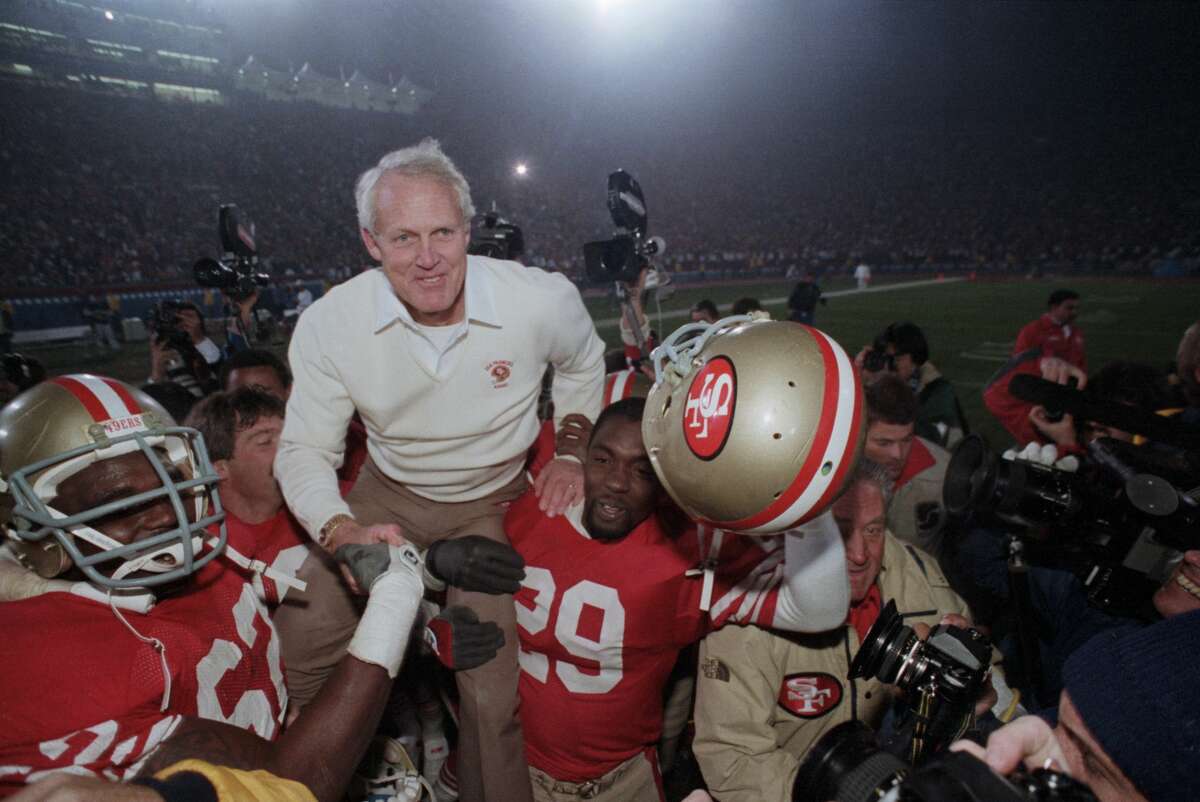
Remember Bill Walsh’s sarcastic pep talk before 49ers-Dolphins Super Bowl XIX?

Alex Shultz, SFGATE Oct. 9, 2020 (sfgate.com)

San Francisco 49ers players carry their coach Bill Walsh off the field after they win the 1985 Super Bowl.
San Francisco 49ers players carry their coach Bill Walsh off the field after they win the 1985 Super Bowl.Bettmann/Bettmann Archive

In January 1985, San Francisco 49ers coach Bill Walsh was publicly signaling humility and the utmost respect for his upcoming Super Bowl XIX opponent, the Miami Dolphins.

But in the locker room, minutes before the big game, Walsh adopted a very different tact to motivate his team, launching into an annoyed, sarcastic pep talk about San Francisco’s seemingly invincible foe, led by superstar quarterback Dan Marino.

On Sunday, the 49ers and Dolphins will face off for the 14th time. (Miami currently has seven victories in 13 matchups.) There’s no superstar Dolphins quarterback this go-around, and the 2-2 49ers hardly look like Super Bowl contenders themselves. One way for 49ers coach Kyle Shanahan to get his squad back on track? Perhaps modeling his pregame speech after Walsh’s.

During the 1984-85 season, the Niners finished 15-1, best in the NFL, with a massive 15.5 points per game margin of victory. They had the top-ranked defense in the league, and the second-most potent offense … behind the Miami Dolphins.

With MVP Marino at the helm, the Dolphins obliterated the rest of the AFC, achieving a 14-2 record. Marino surpassed 5,000 yards passing for the first time in NFL history.

A 49ers-Dolphins Super Bowl felt like an inevitability, and that’s exactly what happened — Miami crushed the Seattle Seahawks and Pittsburgh Steelers, while the 49ers beat the New York Giants and blew out the Chicago Bears.

In the lead-up to the Super Bowl, Walsh was interviewed by CBS sports director Wayne Walker. He was effusive in his praise for Miami’s defense, its wide receivers (“the receivers are exceptional football players”), and especially its quarterback. “Marino is throwing the ball in an amazing fashion,” he said. “… He’s got the quick, strong arm, and he doesn’t have to get his feet just right to throw it. He can just whip the ball to anyone without really indicating where it’s going.”

Then came game day, Jan. 20. Pro Bowl safety Dwight Hicks still remembers exactly what Walsh told his team. As he recounted to the NFL Network:

“I can remember Walsh lying down in the middle of the floor, and he just started rumbling on and on about Miami — oh, they have such a great offense! Oh my God! How are we going to stop them? Jeez, their defense… how are we going to be able to get a first down? Or even a yard? He just wanted to light that fire before we came out of the locker room.”

Walsh finished his speech, turned to Hicks and asked, “Don’t you just want to break the wall and go kick their ass right now?”

That is, essentially, what the 49ers did (minus the wall-breaking).

It was a back-and-forth first quarter, but Joe Montana established himself as the best quarterback in the NFL by game’s end, far outplaying Marino. Montana won Super Bowl MVP, throwing for a then-record 331 yards and three passing touchdowns, while adding 59 rushing yards and a rushing touchdown. Marino was picked off twice, and the 49ers won it all, 38-16.

Book: “American Gods”

American Gods (American Gods, #1)

American Gods

(American Gods #1)

by Neil Gaiman (Goodreads Author) 

Days before his release from prison, Shadow’s wife, Laura, dies in a mysterious car crash. Numbly, he makes his way back home. On the plane, he encounters the enigmatic Mr Wednesday, who claims to be a refugee from a distant war, a former god and the king of America.

Together they embark on a profoundly strange journey across the heart of the USA, whilst all around them a storm of preternatural and epic proportions threatens to break.

Scary, gripping and deeply unsettling, American Gods takes a long, hard look into the soul of America. You’ll be surprised by what – and who – it finds there…

This is the author’s preferred text, never before published in the UK, and is about 12,000 words longer than the previous UK edition.

(Goodreads.com)

Encore: THE SOCIAL DILEMMA | OFFICIAL TRAILER | NETFLIX

Netflix We tweet, we like, and we share— but what are the consequences of our growing dependence on social media? As digital platforms increasingly become a lifeline to stay connected, Silicon Valley insiders reveal how social media is reprogramming civilization by exposing what’s hiding on the other side of your screen. https://Netflix.com/thesocialdilemma ABOUT THE SOCIAL DILEMMA The world has long recognized the positive applications of social media, from its role in empowering protesters to speak out against oppression during the Arab Spring uprisings almost a decade ago, to serving an instrumental role in fighting for equity and justice today. And in 2020, during an astonishing global pandemic, social media has become our lifeline to stay in touch with loved ones, as well as proving to be an asset for mobilizing civil rights protests. However, the system that connects us also invisibly controls us. The collective lack of understanding about how these platforms actually operate has led to hidden and often harmful consequences to society—consequences that are becoming more and more evident over time, and consequences that, the subjects in The Social Dilemma suggest, are an existential threat to humanity. The Social Dilemma is a powerful exploration of the disproportionate impact that a relatively small number of engineers in Silicon Valley have over the way we think, act, and live our lives. The film deftly tackles an underlying cause of our viral conspiracy theories, teenage mental health issues, rampant misinformation and political polarization, and makes these issues visceral, understandable, and urgent. Through a unique combination of documentary investigation and entertaining narrative drama, award-winning filmmakers Jeff Orlowski (Chasing Ice, Chasing Coral) and Larissa Rhodes (Chasing Coral) have once again exposed the invisible in a manner that is both enlightening and harrowing as they disrupt the disrupters by unveiling the hidden machinations behind everyone’s favorite social media and search platforms. The film features compelling interviews with high-profile tech whistleblowers and innovation leaders including Tristan Harris of the Center for Humane Technology; the co-inventor of the Facebook “Like” button, Justin Rosenstein; Tim Kendall, former President of Pinterest and former Director of Monetization at Facebook; Cathy O’Neil, author of Weapons of Math Destruction; Rashida Richardson, Director of Policy at the AI Now Institute, and many others. Demonstrating how social media affects consumers on a personal level, these fascinating insider insights are seamlessly woven into a captivating narrative, including Vincent Kartheiser (Mad Men), that illuminates the very real consequences these seemingly innocent technologies can have on our everyday lives. SUBSCRIBE: http://bit.ly/29qBUt7

We Can Prevent ACEs

Centers for Disease Control and Prevention (CDC) Childhood experiences, both positive and negative, have a tremendous impact on future violence victimization and perpetration, and lifelong health and opportunity. As such, adverse childhood experiences (ACEs) are an important public health issue. Learn how everyone can help prevent ACEs by using strategies to create safe, stable, nurturing relationships and environments for all children. Comments on this video are allowed in accordance with our comment policy: http://www.cdc.gov/SocialMedia/Tools/… For complete audio descriptions, please visit: https://www.cdc.gov/violencepreventio… This video can also be viewed at https://www.cdc.gov/violencepreventio…