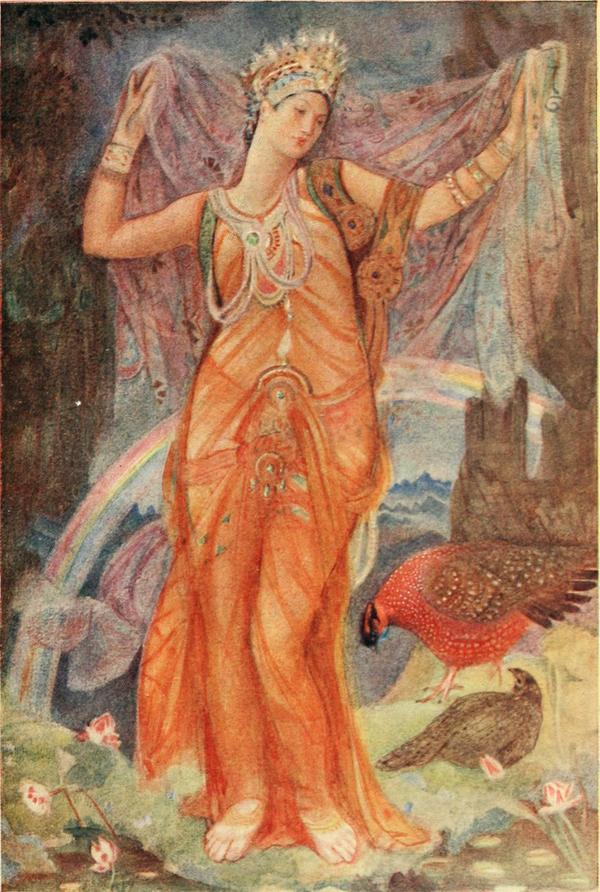
Genesis 45: 4-15

And Joseph says to his brothers: 

“I am Joseph your brother, whom ye sold into Egypt.  Now therefore be not grieved, nor angry with yourselves, that ye sold me hither: for God [Consciousness] did send me before you to preserve life. . . . So now it was not you that sent me hither, but God [Consciousness]. . . .

“And he fell upon his brother Benjamin’s neck and wept; and Benjamin wept upon his neck.  Moreover he kissed his brethren, and wept upon them; and after that his brethren talked with him.”

The lucid dreaming playbook: how to take charge of your dreams

Article Image
Still from ‘Eternal sunshine of the spotless mind’ (2004, directed by Michel Gondry)


In Tibetan Buddhism, the group of tantric techniques known as milam aim to reveal the illusory nature of waking life by having practitioners perform yoga in their dreams. It’s a ritualised version of one of the most mysterious faculties of the human mind: to know that we’re dreaming even while asleep, a state known as lucid dreaming.

Lucidity (awareness of the dream) is different to control (having power over the parameters of the experience, which can include summoning up objects and people, attaining superpowers and travelling to fantastic worlds). But the two are closely linked, and many ancient spiritual traditions teach that dreams can yield to us with time and practice. How?

As a researcher in psychology, I’ve approached this question scientifically. Despite the long history of lucid dreaming in human societies, it wasn’t until 1975 that researchers came up with an ingenious way to verify the phenomenon empirically. The first step was the insight that the muscles of the eyes are not paralysed during sleep, unlike the rest of the body. Inspired by the work of Celia Green, the British hypnotherapist Keith Hearne reasoned that this should allow lucid dreamers to communicate with the outside world. He had an experienced dreamer spend several nights in a sleep lab, and instructed him to flick his eyes left to right with pre-arranged signs when he finally entered a lucid dream. The volunteer succeeded, and Hearne was able to record the movements – which corresponded with the Rapid Eye Movement (REM) phase of sleep. Many later studies have since replicated these findings.

Yet distilling reliable methods for inducing lucid dreams has proved to be a struggle. Although around 40 studies have been conducted on the subject since the 1970s, most of them reported scant success – in most studies, between around 3 per cent and 13 per cent of attempts resulted in a lucid dream. But when I first started my PhD, I noticed that most of the research was limited by such things as the small sample sizes and unreliable measurements – so I set about trying to address the limitations and investigate some of the more promising methods.

In the study I published with colleagues at the University of Adelaide, the best technique turned out to be something called Mnemonic Induction of Lucid Dreams (MILD), originally developed in the 1970s by the American psychophysiologist Stephen LaBerge. It involves the following steps:

1. Set an alarm for five hours after you go to bed.

2. When the alarm sounds, try to remember a dream from just before you woke up. If you can’t, just recall any dream you had recently.

3. Lie in a comfortable position with the lights off and repeat the phrase: ‘Next time I’m dreaming, I will remember I’m dreaming.’ Do this silently in your mind. You need to put real meaning into the words and focus on your intention to remember.

4. Every time you repeat the phrase at step 3, imagine yourself back in the dream you recalled at step 2, and visualise yourself remembering that you are dreaming.

5. Repeat steps 3 and 4 until you either fall asleep or are sure that your intention to remember is set. This should be the last thing in your mind before falling asleep. If you find yourself repeatedly coming back to your intention to remember that you’re dreaming, that’s a good sign it’s firm in your mind.

We relied on data from 169 people from all over Australia, who kept a dream journal so we could measure the effect of induction techniques against their ‘baseline’ tendency. More than half the people who used MILD ended up having at least one lucid dream in the week they started practising; they also went from experiencing these dreams about one night out of 11 to about one night in six. These findings are very exciting, and are some of the highest success rates reported in the scientific literature.

Surprisingly, the number of times that people repeated the mantra about remembering that they’re dreaming, or even the amount of time spent on MILD overall, did not predict success. Instead, the most important factor was being able to complete the technique and then go back to sleep quickly. In fact, it proved almost twice as effective when people fell asleep within five minutes after setting their intention. If you want to try this for yourself, you’ll need to experiment in order to get the right level of wakefulness when the alarm goes off – enough to allow you to complete the steps, but not so much that you’ll struggle to doze off again. Doing the technique after five or so hours of sleep is important, too: most of our dreams occur in the last two to three hours before waking, and you want to minimise the time between finishing the technique and entering REM sleep.

It takes a bit of practice, but if you’re lucky you might even have a lucid dream using MILD on your first night. If you do become aware that you’re dreaming, it’s important to stay calm, since intense emotions can trigger a premature awakening. And if the dream starts to fade or seems unstable, you can try rubbing your hands together vigorously from within the dream. It sounds strange, but this strategy works by flooding the brain with sensations from within the dream, which decreases the chance of becoming aware of your sleeping physical body, and waking up.

Aside from the sheer joy of being able to bend an imaginary world to your will, there’s a range of additional psychological benefits to lucid dreaming. For one, it can help with nightmares: simply knowing that you’re dreaming often brings relief during a nasty episode. You might also be able to use dreams to process trauma: confronting what’s haunting you, making peace with an attacker, escaping the situation by flying away, or even just waking up. Other potential applications include practising sporting skills by night, having more ‘active’ participants for studies about sleep and dreaming, and the pursuit of creative inspiration. With practice, our dream state can feel almost as vivid to us as the world itself – and leaves you wondering, perhaps, where fantasy ends and reality begins.Aeon counter – do not remove

This article was originally published at Aeon and has been republished under Creative Commons.

Subjectifying the Universe: Ursula K. Le Guin on Science and Poetry as Complementary Modes of Comprehending and Tending to the Natural World

By Maria Popova (brainpickings.org)

“What men are poets,” the Nobel-winning physicist Richard Feynman asked in what may be the world’s most poetic footnote“who can speak of Jupiter if he were a man, but if he is an immense spinning sphere of methane and ammonia must be silent?” Two centuries before him, the poet William Wordsworth had insisted that “poetry is the breath and finer spirit of all knowledge… the impassioned expression which is in the countenance of all Science.”

I too have long cherished this unheralded common ground between poetry and science as complementary worldviews of contemplation and observation — a cherishment of which The Universe in Verse was born — and have encountered no more beautiful an articulation of it than the one Ursula K. Le Guin (October 21, 1929–January 22, 2018) offered in the preface to her final poetry collection, Late in the Day (public library).

Ursula K. Le Guin by Benjamin Reed

Marine biologist Rachel Carson, who catalyzed the modern environmental movement and pioneered a new aesthetic of poetic writing about science, once asserted that “there is in us a deeply seated response to the natural universe, which is part of our humanity.” More than half a century after Carson, Le Guin considers how poetry and science both humble us to that elemental aspect of our humanity and train us to be better stewards of the natural world to which we belong:

To use the world well, to be able to stop wasting it and our time in it, we need to relearn our being in it.

Skill in living, awareness of belonging to the world, delight in being part of the world, always tends to involve knowing our kinship as animals with animals. Darwin first gave that knowledge a scientific basis. And now, both poets and scientists are extending the rational aspect of our sense of relationship to creatures without nervous systems and to non-living beings — our fellowship as creatures with other creatures, things with other things.

Decades after the trailblazing Scottish mountaineer and poet Nan Shepherd contemplated the “intricate interplay” of the natural world in the living mountain, Le Guin adds:

Relationship among all things appears to be complex and reciprocal — always at least two-way, back-and-forth. It seems that nothing is single in this universe, and nothing goes one way.

In this view, we humans appear as particularly lively, intense, aware nodes of relation in an infinite network of connections, simple or complicated, direct or hidden, strong or delicate, temporary or very long-lasting. A web of connections, infinite but locally fragile, with and among everything — all beings — including what we generally class as things, objects.

Illustration by Arthur Rackham for a rare 1917 edition of the Brothers Grimm fairy tales.

In consonance with the recently uncovered astonishing science of what trees feel and how they communicate, Le Guin adds:

Descartes and the behaviorists willfully saw dogs as machines, without feeling. Is seeing plants as without feeling a similar arrogance? One way to stop seeing trees, or rivers, or hills, only as “natural resources,” is to class them as fellow beings — kinfolk.

In a sentiment that calls to mind quantum theory founding father Niels Bohr’s arresting meditation on subjective vs. objective reality, Le Guin reflects on the larger point:

I guess I’m trying to subjectify the universe, because look where objectifying it has gotten us. To subjectify is not necessarily to co-opt, colonize, exploit. Rather it may involve a great reach outward of the mind and imagination.

Art by Lia Halloran from Your Body is a Space That Sees

Le Guin considers the shared impulse beneath poetry and science, flowing across the valve between self and world from opposite directions:

Poetry is the human language that can try to say what a tree or a rock or a river is, that is, to speak humanly for it, in both senses of the word “for.” A poem can do so by relating the quality of an individual human relationship to a thing, a rock or river or tree, or simply by describing the thing as truthfully as possible.

Science describes accurately from outside, poetry describes accurately from inside. Science explicates, poetry implicates. Both celebrate what they describe. We need the languages of both science and poetry to save us from merely stockpiling endless “information” that fails to inform our ignorance or our irresponsibility.

Each, Le Guin argues, is a mode of tending to the world — the outer world, the inner world — and, as such, trains us to be better participants in and protectors of the vibrant, vigorous interconnectedness of which we are but a tiny part:

By replacing unfounded, willful opinion, science can increase moral sensitivity; by demonstrating and performing aesthetic order or beauty, poetry can move minds to the sense of fellowship that prevents careless usage and exploitation of our fellow beings, waste and cruelty.

[…]

The seventeenth-century Christian mystic Henry Vaughan wrote:

     So hills and valleys into singing break,
And though poor stones have neither speech nor tongue,
While active winds and streams both run and speak,
Yet stones are deep in admiration.

By admiration, Vaughan meant reverence for God’s sacred order of things, and joy in it, delight. By admiration, I understand reverence for the infinite connectedness, the naturally sacred order of things, and joy in it, delight. So we admit stones to our holy communion; so the stones may admit us to theirs.

Complement Late in the Day with an embodiment of that admiring delight in some beautiful poems celebrating science, then revisit Le Guin on growing olderthe power of language to transform and redeemstorytelling as an instrument of freedom, her feminist translation of the Tao Te Ching, and her classic unsexing of gender.

SUNDAY NIGHT TRANSLATION GROUP — APRIL 15, 2018

Translation  is a 5-step system of syllogistic reasoning using words and their meanings and histories to transform the testimony of the senses and uncover the underlying timeless reality of Being/Consciousness.

Translators:  Hanz Bolen, Melissa Goodnight, Richard Branam, Mike Zonta.

Sense testimony:  New possibilities may feel threatening and cause emotions that are disorienting.

Conclusions:

1)  Truth is the timeless, uncrowded, regular now of infinite possibilities, effecting and affecting all.
2)  One Infinite, Consciousness Beingness, That I AM, is continually expressing in limitlessly diverse outpicturing, that is absolutely unconditionally unencumbered, and always freely experiencing the unerring direction of Cosmic Intention.
3)  I am Universal Integrity touching knowing causing instantaneously everywhere sound agreeable strong self evident well being and beauty.
4)  Truth is the Sunny-day. Life in the Lightness, weightless illumination.

The Sunday Night Translation Group meets at 7pm Pacific time via Skype. There is also a Sunday morning Translation group which meets at 7am Pacific time via GoToMeeting.com.  See Upcoming Events on the BB to join, or start a group of your own.

The First ‘April 23rd Doomsday’ Was Predicted in 1843

 Wait For It...The First 'April 23rd Doomsday' Was Predicted in 1843
The latest doomsday prediction points to April 23, 2018, as the end.  Credit: iStock/Getty Images Plus


Call it the recycled doomsday: A new prediction for the end of the world sets the apocalypse date as Monday, April 23, based on a mishmash of old numerology, re-readings of the biblical Book of Revelation and rehashed conspiracy theories about a rogue “Planet X.”

Even the calendar date of the prediction, April 23, hearkens back to one of the most famous failed apocalypse predictors of all time, William Miller. A Baptist preacher whose followers would eventually form the Seventh-day Adventist Church, Miller predicted multiple doomsday dates in the mid-1800s, including one on April 23, 1843. He was most famous for a later prediction of Oct. 22, 1844, a date that would live on in infamy as “The Great Disappointment” when Jesus Christ did not appear to kick off the end of the world. [End of the World? Top 10 Doomsday Threats]

The latest doomsday predictor with a slippery grasp on dates is David Meade, who previously claimed that a rare alignment of stars on Sept. 23, 2017, heralded the end. Meade said that the star alignment would precede the passage by Earth of a rogue planet called Planet X, which would cause all sorts of geological trials and tribulations, culminating in the eventual return of Jesus per the Book of Revelation.

Strange News Snapshot: Week of Apr. 8, 2018
What’s weird in science news this week? A mummified monkey, the risk of night owl habits, and sperm on the International Space Station.

Meade’s new prediction is more of the same. According to an interview with the Express tabloid, Meade has now pegged April 23, 2018, as the new apocalypse start date. The reason, he said, is that on that date, the sun, moon and Jupiter will align in the constellation of Virgo, echoing Revelation 12:1-2, which refers to a “woman clothed with the sun, with the moon under her feet and a crown of twelve stars on her head” laboring to give birth to an eventual global dictator with a role to play in the end of the world.

This same passage was Meade’s basis for predicting Sept. 23, 2017, as the start of the apocalypse, though in that case, he fixated on an alignment of the sun in Virgo with nine stars and the planets Mercury, Venus and Mars. [10 Failed Doomsday Predictions]

“Some of Meade’s astral speculation ironically might echo at least some of the inspiration of the original, which draws on older Jewish, Greco-Roman, and other traditions,” said Allen Kerkeslager, a professor of ancient and comparative religion at St. Joseph’s University in Philadelphia.

“But the author of Revelation was wrong in his predictions, so neither this book nor any other ancient book is of much relevance for predicting the future,” Kerkeslager told Live Science.

Strangely, Jupiter is not actually aligned within the constellation of Virgo on April 23; rather, it will appear from Earth to be within the constellation Libra. On that same date, the sun will appear to align with the constellation Aries and the moon in the constellation Gemini. (To track these celestial bodies — and generate your own creative doomsday predictions — visit The Sky Live’s Planetarium feature.)

Meade has never been consistent with his predictions. The International Business Times reported in February that he was calling March 2018 as the trigger date for the apocalypse. He has also said he believes that a seven-year tribulation period preceding the end started on Aug. 21, 2017, and Oct. 15, 2015. Meade’s website also dwells on North Korea’s nuclear program as a sign of the End Times.

Meanwhile, the existence of Planet X, sometimes known as Nibiru, has been repeatedly debunked. Astronomers are searching for a possible Earth-size world in the outer solar system that they sometimes call “Planet X” or “Planet Nine,” but this is not the same Planet X described by conspiracy theorists. In the conspiracy view, NASA is hiding the existence of a rogue planet that is hurtling toward Earth, ready to spark all manner of tsunamis and earthquakes as it zings by.

Nibiru originated from doomsday theorist Nancy Lieder. On her website, Lieder channels aliens called Zetas and peddles a complex web of interrelated conspiracy theories. Lieder first floated the idea of Nibiru in the 1990s and predicted its passage by Earth in 2003. Since then, the rogue planet has become the bogeyman of multiple doomsday predictions, including the 2012 Maya apocalypse, which was based on the supposed end of the ancient Maya calendar.

A rogue planet moving through the solar system would be pretty obvious to astronomers, who can detect planets far beyond our home solar system by looking for the wobbles their passage causes in the stars they orbit.

The mishmash of all of these disparate theories — from the biblical, to the cosmological, to the political — may be a symptom of the kind of conspiracy cross-pollination that occurs online. Meade is active on YouTube, where he chats with other doomsday “prophets” such as Paul Begley, host of the self-produced show “The Coming Apocalypse.” Meade also sells self-published books about his theories on Amazon.

Original article on Live Science.

Aries New Moon, April 15, 2018 (26 degrees) 6:57 pm PDT

Wendy Cicchetti

The Aries New Moon calls forth our creativity, courage, and commitment and sparks a quantum leap forward. It’s time to clarify what we want to create and take inspired action toward our dreams. Though every New Moon brings an opportunity for rebirth and renewal, this one is supercharged. Not only is it the first New Moon of the astrological new year initiated at the Aries equinox on March 20, it’s also conjunct Uranus, planet of revolution, freedom, and sudden change.

Since 2011, Uranus in Aries has encouraged us to break out of limiting self-concepts and liberate our unique genius. Now, as Uranus prepares to move into Taurus on May 15, this New Moon brings a jolt of awareness about our true self and higher purpose, underlining the lessons of the last seven years. We’re challenged to move through our fears and take the risk of going after what we really want.

While the Sun is exalted in Aries and strengthens our desire and will, the Uranian influence at this New Moon suggests that we might need to surrender the preferences of our egomind to the unexpected flow of change. Our task is to follow our passion and excitement, and trust what unfolds.

Also conjunct the New Moon is another disruptor of the status quo — Eris, Goddess of Discord. Uranus and Eris have been traveling together since 2016, and the New Moon right between these forces catalyzes their conjunction. We can harness the surge of fire from this Aries stellium to help us break through stagnation and reawaken our warrior spirit. This lunar cycle could be a wild ride, but creativity arises out of chaos, and our hidden gifts and powers are often revealed only through friction and conflict.

Mercury, also in Aries, stations direct at the New Moon — another affirmation that it’s time to move forward. Since March 22, Mercury retrograde has compelled us to slow down, reconnect with our deepest desires, and renew our vitality. As Mercury stations, it conjoins Chiron, now at the last degree of Pisces and about to move into Aries on April 17. This alignment encourages us to move forward with a new perspective on our wounds, rather than feeling victimized and held back by our pain.

Ideally, Chiron in Pisces has opened our hearts to greater compassion, and we want to maintain that tenderness as Chiron transitions into the Warrior sign: “The ideal of warriorship is that the warrior should be sad and tender, and because of that, the warrior can be very brave as well. Without that heartfelt sadness, bravery is brittle, like a china cup.” (Chögyam Trungpa, Shambhala: The Sacred Path of the Warrior)

Further empowering this New Moon, Mars, ruler of Aries, is in Capricorn, the sign of its exaltation. Mars in Capricorn brings the focus, discipline, and persistence to harness the Aries fire in a productive direction and translate our inspiration into form. The key is to own our authority as the creator of our own experience, while releasing the need to control. Mars sits between Saturnand Pluto, and this formidable Capricorn lineup — especially with Pluto in the mix — suggests that this New Moon is a time of not only powerful beginnings, but also completions.

The strong Saturnian influence at this New Moon advises sidestepping impatience and impulsivity in favor of strategy and long-term planning. At the same time, we don’t want to let our fears keep us from taking action. Successful integration of Aries and Capricorn entails taking a strategic risk, doing the work, and trusting the process. We have support from retrograde Jupiter in Scorpio, which sextiles the Mars–Pluto conjunction and is approaching its second trine to Neptune in Pisces (exact on May 25).

This article is from the Mountain Astrologer, written by Emily Trinkaus

PLAN YOUR OWN NEW MOON CEREMONY. Give yourself some quiet time in meditation to see where you need to seed new ways of becoming. List these areas within your life you want to change. What areas do you want to break free from the norm and become more productive and discerning? The NEW MOON is the time to manifest the personal attributes you want to cultivate as well as the tangible things you want to bring to you. Possible phrasing: I now manifest ____ into my life. I am now _______ . Remember, think, envision and feel with as much emotion as possible, as though you already have what you want. Thoughts are things and the brain manifests exactly what you show it in the form of thoughts, visuals and emotions. The Buddha said, and I am paraphrasing, “We are the sum total of our thoughts up to today. ” If we want to be different then we must change our thoughts. “If you always do what you’ve always done then you’ll always get what you’ve always got.” CONSCIOUS CHANGE is the key.

Brett Davis: “Mad for Wrestlers and Detergent”

By Jason Zinoman (NYTimes.com)

April 11, 2018

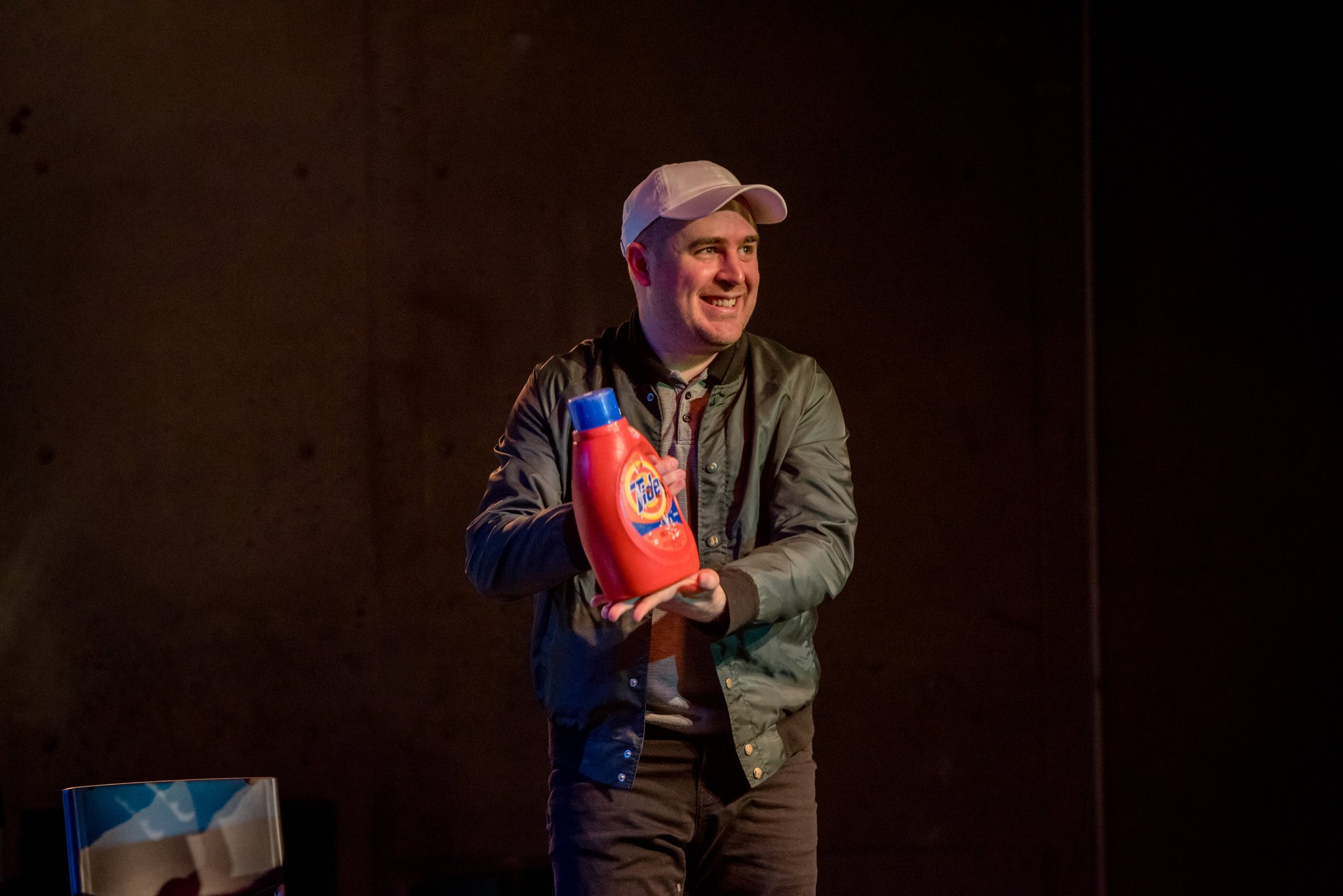
Mr. Davis has a gift for manufacturing hostility that quickly turns absurd.  But what makes him compelling is how committed he is to his performance–never breaking character and persuading you of the reality of whatever extreme emotion he reaches for, no matter how ridiculous the situation.  When he confessed his love to a bottle of Tide, it seemed like a silly joke, but it has blossomed into a long arc, a romance that everyone he talks to finds funny, then disturbing.

In a live taping of the podcast on Sunday at Abrons Arts Center on the Lower East Side, Kevin McDonald, a former member of Kids in the Hall, officiated a wedding between Mr. Davis and his detergent.  This ceremony ended characteristically, with a burst of violence that spilled out into the hallway of the theater when a police officer character arrested him, shoving him against the wall.

But first there was the baffling tenderness between a man and his Tide.  Mr. David gazed at the bottle, caressing it.  When he kissed the cap, he lingered, in a way that was halfway between creepy and silly.  But clearly this love affair has issues.  Looking sheepish, he confessed:  “I have looked at other bottles.”

Consciousness, spirituality, biography, sexuality, androgyny, futurism, space, the arts, science, astrology, democracy, humor, books, movies and more