
The Shift Network
Uploaded on Feb 15, 2018
Monthly Archives: February 2018
Is it lust or is it love? How to tell — and how you can have both at once

iStock
Researcher and therapist Terri Orbuch shares what she’s learned from studying couples for three decades.
I’ve studied the romances and relationship patterns of thousands of people for three decades, and I’ve heard many of them talk about that wild, out-of-control feeling at the beginning of a new relationship — you know, when you can’t eat, you can’t sleep and you can’t get anything done because you’re constantly thinking about this person. It’s like an obsession. I bet if I asked you to close your eyes, no matter your age, you could remember that powerful and amazing feeling. I can, and I’ve been married for 25 years.
But when we’re in that heightened arousal state at the beginning of a romance, many of us wonder: “What am I feeling? Am I in lust or am I in love?” After talking to hundreds of couples, I’ve come to believe there are four signs that differentiate love from lust.
The first sign that it’s love rather than lust is connection. When you’re in love, you want your partner to connect with all the people in your life. You want them to spend time together and to like each other. You want to show them off to your friends and family, and you want your friends and family to be impressed by them. Instead of wanting to keep them to yourself, you bring them out and introduce them to the people who are most important to you.
The second sign is using “we” language rather than “I” language. When two people are in love, their lives become intertwined and they begin to think of themselves not as separate individuals but as a couple. The more intertwined their lives are, the more mutuality. Mutuality is when you refer to the two of you as an “us” or “we.” For example, if I asked you what you were doing last weekend, a person in love would tell me, “We went out to the movies” or “We went up north for the weekend,” instead of “I went to the movies with Sandy” or “I went up north for the weekend and Sandy came along.”
The third sign is self-disclosure. Love can motivate us to reveal a lot about ourselves to the other person. When we’re in love, we want to share our dreams, our fears, our goals, our past, our future. We might tell them secrets that we’ve never told anyone before. When we’re in lust, you only peel away a few layers of our personalities. We tell the other person about our hobbies, our movie or music preferences, but that’s about it. We don’t go to the deep core of ourselves. When you’re in love, you go straight to the core. Not only are you sharing about more topics, but what you say about each topic is deeper, more personal in nature. So, if you want to distinguish between lust and love, look at what you’re talking about with the other person.
The fourth sign is influence. When two people are in love, what one person does — or wants to do — influences the other person in meaningful and strong ways. For example, if you’re thinking about moving to another state because of your job, you’d go to the other person before you made a decision. Likewise, if something upsetting happens to you — a medical diagnosis, job loss, the death of a family member — you’d go to this person for support and assistance. Or, if something good happens to you — you got a promotion, you receive a surprise inheritance — you’d go to this person because you’d want them to share your good news and celebrate with you.
As you can see, lust and love are very different from one another. Yet we want that lustful desire in a loving long-term relationship too. Can you re-create that urgent longing? Absolutely! From my work with couples, I’ve learned there are three behaviors you can add to your relationship to reignite that desire. Those three behaviors are actually the same ones that fueled your lust when you first met that person.
The first strategy to bring back lust is to engage in new activities with your partner. Think about it — when you first got together, everything was new for the two of you. Every date you went on, every restaurant you ate at, every activity you did, was a novel experience for the two of you. Of course, as time went on, the newness wore off. To re-create lust, you need to find new things to do with your partner. It can be as simple as going to a different part of the city that you’ve never been to, or doing something for the first time — like ice skating, bike riding, fishing — with your partner. My husband and I signed up for a cooking class. Neither of us had ever taken that kind of class and when we did it together, it fueled the lust. Anything new can inspire those feelings of freshness and excitement.
The second strategy is to add surprise or mystery. Again, think back. At the beginning, everything you learned about your partner was so interesting and exciting. She told you she had a pet snake when she was a kid, or that he was closest to his grandmother growing up, and you went, “What? Wow!” It was all fascinating to you. Of course, as time goes on in a relationship, you feel like you know your partner almost too well. You know what they like to do on Sundays, you know that they snore when they sleep, and they chew with their mouth open. But no, adding surprise to a relationship isn’t just about lingerie and roleplaying. Show up at your partner’s workplace unexpectedly and take them out to lunch or dinner. Send a flirty text in the middle of the afternoon. One of the wives in my long-term study on couples said she made a treasure hunt for her husband. He went around the city without her, following little notes she left for him, and he found the experience full of adventure.
The third and final strategy is to do arousal-producing activities together.But it’s not what you think; this is about doing things that give you an adrenaline rush, things that are novel and interesting. What relationship scientists have learned is if you do an arousal-producing activity with your partner — like exercising side by side, watching a comedy show or a scary movie, or going surfing — your adrenaline rush can actually get transferred to your partner and your relationship.
Now I realize this may sound like a lot of work. But I can assure you that it’s worth it. The good news is that lust and love, as different as they are, can exist together in a relationship. Just remember: moments of passion are some of the highlights of our lives, and you can never have too many.
This piece was adapted from a talk given at TEDxOaklandUniversity.
Water the Fruit, Enjoy the Fruit
TRANSLATION ADVENTURE – 2/18/18
Translators: Richard Hartnett, Ned Henry, Heather Williams
SENSE TESTIMONY: Powerless people get violent
5th Step Conclusions:
-
Power is One, ever present Energy, Constant, Whole, Here Now, available to all Life.
-
All Beingness knows it is Truth and thus feels/knows it is powerful, thus people feel peaceful.
-
One Consciousness validates the inherent power within all life.
Movie: “The Story of Ruth”

The Story of Ruth is a 1960 American historical romance film directed by Henry Koster, shot in CinemaScope and DeLuxe Color, and released by 20th Century Fox. The screenplay, written by Norman Corwin, is an adaptation of the biblical Book of Ruth. The film stars Stuart Whitman as Boaz, Tom Tryon as Mahlon, Peggy Wood as Naomi, Viveca Lindfors as Eleilat, Jeff Morrow as Tob, and introduces 19-year old Elana Eden as Ruth.
Plot
The first part of the film revolves around Ruth, visualized as a pagan idolatress in her youth who serves as the spiritual teacher of a young Moabitess girl, Tebah, who is being prepared to be sacrificed to Chemosh, a Moabite deity. Unhappy with the ritual crown created for Tebah, high-priestess Eleilat, along with Ruth, instruct Mahlon, the Judean artisan, to revamp the crown with jewels and glitter. Mahlon delivers the crown to Ruth at the temple, and he begins to question her about the existence of Chemosh. Ruth becomes doubtful of her religion and ultimately falls in love with Mahlon, sharing an interest in monotheism.
The non-biblical part ends with the sight of the Moabite girl being sacrificed, from which a distressed Ruth flees. The Moabites condemn Mahlon, his father Elimelech, and brother Chilion. Chilion and Elimelech die in the prison, while Mahlon’s punishment is to work at the quarries for the rest of his life. Ruth, however, attempts to escape with Mahlon, but he is wounded before he flees the quarries and dies in a cave afterwards, marrying Ruth just prior to his death.
The biblical storyline begins as Naomi (who was married to Elimelech), Orpah (who was married to Chilion), and Ruth are widowed. The second part is based more on the Book of Ruth, although a subplot is added, that of the Bethlehemites‘ initial disapproval of Ruth’s pagan past and Naomi’s closest kinsman rejecting Ruth as his wife. As the next of kin after him, Boaz successfully obtains Ruth’s hand in marriage. As the film concludes, the final verses of the Book of Ruth are quoted.
Biography: Bishop Berkeley
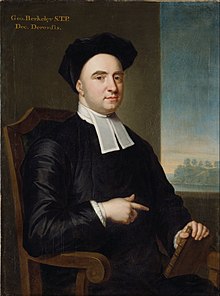
Biography: George Berkeley (12 March 1685 – 14 January 1753) — known as Bishop Berkeley (Bishop of Cloyne) — was an Irish philosopher whose primary achievement was the advancement of a theory he called “immaterialism” (later referred to as “subjective idealism” by others). This theory denies the existence of material substance and instead contends that familiar objects like tables and chairs are only ideas in the minds of perceivers and, as a result, cannot exist without being perceived. Berkeley is also known for his critique of abstraction, an important premise in his argument for immaterialism. Berkeley College, one of Yale University’s 14 residential colleges, is named after George Berkeley. In 1709, Berkeley published his first major work, An Essay towards a New Theory of Vision, in which he discussed the limitations of human vision and advanced the theory that the proper objects of sight are not material objects, but light and colour.[3] This foreshadowed his chief philosophical work, A Treatise Concerning the Principles of Human Knowledge, in 1710, which, after its poor reception, he rewrote in dialogue form and published under the title Three Dialogues between Hylas and Philonous in 1713.[4] In this book, Berkeley’s views were represented by Philonous (Greek: “lover of mind”), while Hylas (Greek: “matter”) embodies the Irish thinker’s opponents, in particular John Locke. Berkeley argued against Isaac Newton’s doctrine of absolute space, time and motion in De Motu[5] (On Motion), published 1721. His arguments were a precursor to the views of Mach and Einstein.[citation needed] In 1732, he published Alciphron, a Christian apologetic against the free-thinkers, and in 1734, he published The Analyst, a critique of the foundations of calculus, which was influential in the development of mathematics. His last major philosophical work, Siris (1744), begins by advocating the medicinal use of tar water and then continues to discuss a wide range of topics, including science, philosophy, and theology. Interest in Berkeley’s work increased after World War II because he tackled many of the issues of paramount interest to philosophy in the 20th century, such as the problems of perception, the difference between primary and secondary qualities, and the importance of language.[6]
Jordan Peterson on the psyche

“The psyche is not just human.”
–Jordan Bernt Peterson (born June 12, 1962) is a Canadian clinical psychologist, cultural critic, and professor of psychology at the University of Toronto. Wikipedia
Are You Following Your Bliss or your Blisters?
Have you ever wanted to take a course, start a new business, join a group, and… something gets in the way?
You are too busy, an unexpected bill comes, a family member needs your help…

Are these obstacles signs from the universe that it’s not supposed to be? Or that you need to put your dreams on hold?
Does that suggest the universe will make things easy, all the traffic signals will be green, in order for you to follow your heart and even your calling?
Yes there is a sense of timing to things. Synchronicities occur. Interference can alert you to things to watch out for and perhaps re-evaluate.
FOLLOWING YOUR HEART
We have been tempted to call it quits when moving forward becomes more difficult than we had figured. And it would be an easy way out to say that instead of making an extra effort, or finding a creative solution, we were somehow being “guided” not to continue.
The problem is, as we know, a life without challenge is unrewarding. And it’s actually not so much fun trying to always play it safe. Yes the angels are helping and surely they are not putting up obstacles for us to achieve our heart’s desires.
FOLLOWING YOUR BLISTERS
“Follow your bliss,” writer Joseph Campbell once famously said. He was said to have later reconsidered this statement, seeing how it was misused “to feeling good no matter what.” He supposedly quipped that he should have said, “Follow your blisters.”
We do highly recommend feeling good. Just don’t let it be a way of avoiding responsibility or doing what it takes to succeed.
You can feel good and make the extra effort when needed to go forward, and be truly happy in the process. It can feel good knowing that you did your best, even if it took a lot of effort to do so.
EMBRACING STRESS — NEW RESEARCH
New research shows that using the inevitable stress that life brings gives you more purpose, health and resilience. In contrast, avoiding and fearing stress actually weakens and depresses you.
In other words, it’s your attitude toward stress that’s key. A positive mindset toward stress can improve your situation, make you more compassionate, and put you in the flow. And using stress can give life more meaning and purpose.
So following your heart, even with the challenges that entails, makes you stronger. You can use difficult experiences to evolve.
A QUICK EXAMPLE
One lady once told us how she tried to be a holistic practitioner for a few months but it didn’t work, so she quit.
Some things (like a profession or calling) take more than a few months to master. The deeper growth and experience requires time and effort.
When we started our holistic practice (we still had full time jobs at the time), we enjoyed it so much we would do it even if we didn’t get paid (which was sometimes the case when we began).
Over time, our commitment paid off, despite the many setbacks and trial and error that we experienced along the way.
We know many other people, including some whom we have trained, who succeed by persevering in doing what they love and feel called to do.
IN THE END
At the end of your life, do you want some obstacle — a missed appointment, an unexpected bill, a failed attempt- to limit your success, to have held you back from all that you could have become?
You deserve the best, and that comes with some ups and downs.
Your seen and unseen friends are trying to help you, not hold you back.
Be strong. Be courageous.. and go for it!
Steve Kerr allows Warriors players to coach themselves in Suns rout

After securing his 250th win with the franchise on Saturday, Golden State Warriors head coach Steve Kerr decided to hand over the coaching duties and take a break against the Phoenix Suns on Monday night.
But he didn’t hand the reigns to his assistants or other members of his coaching staff. Instead, he gave responsibility to his players to coach themselves in a rare occurrence.
During a timeout midway through the first quarter, Kerr gave his clipboard and pen to veteran Andre Iguodala.
Iggy sat in Kerr’s usual chair and proceeded to break down plays for his teammates while his head coach stood to the side.
As the game wore on, both David West and Draymond Green – who wasn’t playing due to a sprained finger – were also given turns to put their coaching hats on and call plays.
As he wasn’t involved in the encounter, Green ran most of the timeout huddles during the game.
It clearly had the desired effect as the Warriors crushed the Suns 129-83 and were at their devastating best.

Steve Kerr is gonna sit this one out


Speaking after the game, Kerr explained that his players needed to hear a new voice and he wanted to do this as a way of motivating his players.
“I told them the other night after the last game [on Saturday] that we were going to do it,” Kerr said, per ESPN. “It’s their team. I think that’s one of the first things you have to consider as a coach.
“It’s not your team, it’s not [general manager] Bob Myers’ team, it’s not [owner] Joe Lacob’s team — although I’m not going to tell Joe that.
“It’s the players’ team, and they have to take ownership of it. And as coaches, our job is to nudge them in the right direction, guide them, but we don’t control them.

Steve Kerr explains his decision to let the players coach tonight.

“They determine their own fate and I don’t feel like we focused well at all the last month, and it just seemed like the right thing to do. I thought they communicated really well together and drew up some nice plays, and it was a good night for the guys.”
Superstars and veteran players are occasionally given freedom to speak their mind and take control of timeouts, but this move by the Warriors head coach was uncommon.
It didn’t go down well with some Phoenix players as Jared Dudley described it as a “lack of respect” but Kerr immediately spoke to Suns counterpart Jay Triano after the game and explained that wasn’t his intention.
“I told Jay afterward that it had nothing to do with being disrespectful,” Kerr said. “It had to do with me reaching my team. I have not reached them for the last month.

“They’re tired of my voice. I’m tired of my voice. It’s been a long haul these last few years and I wasn’t reaching them, and we just figured it was probably a good night to pull a trick out of the hat and do something different.”
With the All-Star break just days away and in a matchup at home against one of the worst teams in the west, it would’ve been simple for the Dubs to take things easy on the night.
But Kerr’s shake-up didn’t allow for that to happen and it’s why he’s one of the best coaches in the league.
The psychology of Nietzsche and how to use it yourself

The Thinker and Nietzsche. How can we use Nietzsche’s insights to help understand how we think? (Getty Images and Scotty Hendricks)
While we have talked about Nietzschean philosophy before, Nietzsche also considered himself a first-rate psychologist, going so far as to claim in Ecce Homo, “That a psychologist without equal speaks from my writings – this is perhaps the first insight gained by a good reader.” He then goes on the claim that he is the first philosopher to engage in real psychology.
He may have been on to something, as it is often possible to read his philosophy as psychology and many of his philosophical concepts can be applied as psychological concepts. While psychologists have generally not credited him beyond the occasional reference, his ideas foreshadow some of the most revolutionary ideas in the history of the science.
Here, we present some of the psychological insights Nietzsche gave us.
Nietzsche begins his psychology with what was a radical notion; the idea that you cannot hope to know all about your mind all of the time. While the idea of a person having subconscious ideas, feelings, drives, and repressed memories is not shocking to us, the idea that man, “the rational animal” might not be able to understand how the mind worked at all times would have shocked the thinkers who first read Nietzsche.
He also understood that outside influences could have major effects on the of psyches of individuals. He explains in Human All Too Human that “Direct self-observation is not nearly sufficient for us to know ourselves: we need history, for the past flows on within us in a hundred waves.” Hinting that he understands that our deeper selves are influenced by many more factors than meets the eye. He lists among those factors culture and history, alongside our upbringings and a multitude of drives.
That we still have animal drives is a fact we often try to suppress. But one that Nietzsche saw as a mere fact and one to be dealt with. Dubbed “The Beast Within” by Zarathustra, these drives towards sex and aggression were being suppressed by an archaic morality which saw them as wicked. Nietzsche saw this repression as causing potential energy to go to waste. He argued that it was much better to understand that we have these primal drives and that’s alright, so long as they can be subdued and harnessed.

Are you driving your desires, or are your desires driving you? (Getty Images)
But, what should they be harnessed for?
In a world, self-overcoming. Nietzsche was all about personal growth, and his psychology reflects this. Nietzsche viewed the mind as a collection of drives. These drives were often in direct opposition to one another. It is the responsibility of the individual to organize these drives to support a single goal.
Even then, however, Nietzsche views this selection as one drive being stronger than any other one and does not see us as independent of the drives that we are composed of. To organize yourself is really to overcome all of your other drives, which are also parts of the self.
The exact nature of Nietzsche’s ideas is, again, hard to determine as he was less than systematic and often made nearly contradictory statements. He does praise the man who can build himself up, saying that his favorite proto-Ubermensch Goethe, “disciplined himself to wholeness, he created himself.” in Twilight of the Idols.
However, he also said that “At the bottom of us, really “deep down,” there is, of course, something unteachable, some granite of spiritual fatum of predetermined decision and answer to predetermined selected questions. Whenever a cardinal problem is at stake, there speaks an unchangeable ‘this is I.’”’ in Beyond Good and Evil
It does seem possible to say that Nietzsche is taking a middle road, arguing that it is possible to create yourself within limits set by your nature, culture, and historical forces. How much real freedom this grants the typical person in choosing what they will become is debatable, especially since Nietzsche didn’t believe in free will like the rest of the existentialists.
His often referenced “Will to Power” also fits in with this goal of self-creation. Walter Kauffmann explains in his book Nietzsche, Philosopher, Psychologist, Antichrist that “The will to power is thus introduced as the will to overcome oneself. That this is no accident is certain. The will to power is not mentioned again until much later—and then at length—in the chapter “On Self-Overcoming.” After that, it is mentioned only once more in Zarathustra. The will to power is conceived of as the will to overcome oneself.”
A truly powerful individual will be able to harness their competing drives to help propel them to a singular goal, one which they choose for reasons which are their own; though they are influenced at some level by their innate nature. This conception of self-development has echoes in humanistic psychology.
How can I use this?
Ask yourself if you are in control of your desires. Can you ignore one temptation in order to advance towards a larger goal? If you can’t, Dr. Nietzsche would say that you have yet to overcome some of your desires and they are derailing your ability to become what you can be.
While Nietzsche was skeptical of the benefits of self-reflection for most people he did see it as a worthwhile undertaking for the rare few who lived up to his insanely high standards. If we can make the blasphemy of applying his ideas to everybody, it can be said that the starting point for personal growth is to try to know yourself, what drives you have, what potentials you have or lack, and which drives you would like to foster or subdue. While, for Nietzsche, there is a limit to the knowledge of the self we can find this way, it is a place to start.
Has modern psychology gone anywhere with his ideas?

Freud, going somewhere. (Getty Images)
When it comes to Freud, the jury is still out on how much Nietzsche influenced him. While Freud claimed to have never read Nietzsche, this seems unlikely given both Nietzsche’s popularity and the similarity of several of their ideas on the subconscious mind. The psychologist Ernest Jones, who knew Freud, wrote that Freud both praised Nietzsche and claimed to have never read him. It has also been suggested that Freud purposefully avoided reading Nietzsche to prevent accusations of plagiarism, others claim he did read Nietzsche and then lied about it.
Carl Jung, a student of Freud, was influenced by Nietzsche when he created his psychological system. However, he didn’t openly admit this. He did use some Nietzschean terminology in his work and once lectured on Thus Spoke Zarathustra.
The Will to Power was later used as a basis for the individual psychology of Alfred Adler. Nietzsche’s conception of self-becoming has carried on in spirit, if not in exact form, in the humanistic psychology of Carl Rogers.
While his position as a philosopher is well known, Nietzsche’s contributions to psychology are often ignored. His insights into how we are motivated, how deep our subconscious mind goes, and how we might become the people that we hope to be, are all of great use to the individual. While the fact that he went stark raving mad may throw a damper on sane a person who follows all of his insights might end up, there can be no doubt that his ideas can shine a light into the darkness of the minds that he was among the first to seriously explore.