—Crazy Alert! Oklahoma Superintendent says about infamous Tulsa massacre, “Let’s not tie it to skin color…” Back in 1921 the good white people of Tulsa, Oklahoma went on a rampage, slaughtering hundreds of Black people and burning to the ground the Greenwood District, often referred to as “Black Wall Street,” because it was such a prosperous Black-owned area. Oklahoma’s new statewide Superintendent of Public Schools came to office on the promise of ending the teaching of critical race theory, and when he was asked in a public forum how a teacher should deal with the Tulsa massacre, he said, “Let’s not tie it to the skin color and say that the skin color determined that.” Exactly. Moms For Liberty couldn’t have said it better.
The Hartmann Report (thomhartmann+the-saturday-report@substack.com)
Remembering Tulsa’s Black Wall Street
Black Wall Street was a thriving Black-owned business district that housed hundreds of Black-owned businesses
By Vince Sims• Published June 18, 2020 • Updated on June 19, 2020 (nbcdfw.com)
NBCUniversal, Inc.Black Wall Street was a thriving Black-owned business district that housed hundreds of Black-owned businesses. NBC 5’s Vince Sims reports.
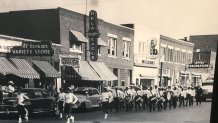
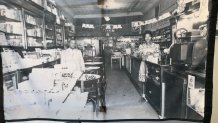
Old black and white pictures inside the Greenwood Cultural Center in Tulsa, Oklahoma, gives a small glimpse into Tulsa’s historical Black Wall Street.
Picture of band marching on Greenwood Avenue. Courtesy: Greenwood Cultural Center
“Black Wall Street was a thriving Black-owned business district that housed hundreds of Black-owned businesses,” Greenwood Cultural District Program Director Michelle Brown said. “There were grand hotels, movie theaters, there were restaurants, doctors and attorneys.”
Black Owned Business during Black Wall Street days of Tulsa. Courtesy: Greenwood Cultural Center
The interstate running across Greenwood Avenue sits where J. Kavin Ross’s great grandfather owned a business on Black Wall Street.
“He had a juke joint on Greenwood called Isaac Evitts Zulu Lounge,” J. Kavin Ross said.
Ross is a Greenwood District historian who has been recording the memory of what was once a rich Black community.
“This house is just one example of the kind of homes,” Ross said pointing to one lone house still standing from that era. “These weren’t shacks or shotgun homes. These were nice homes and they were well built and built by African Americans who were a part of this community.”
The Black Wall Street and Greenwood District covered more than 35 city blocks. An estimated 10,000 Black people lived in the area. Black Wall Street was successful because of the oil industry and farming money. Black people couldn’t shop in white-owned stores during this time. So, they spent their money in their own community which helped support and build up the community.
“It was a powerful scene,” Ross said. “People would walk up and down the corridor of Greenwood. Especially at night time and the nightlife. You had grocery stores, savings and loans, hotels, law offices, photography, anything you could think of.”
Things took a tragic turn in May 1921. A young Black man was accused of assaulting a white woman in a downtown elevator. That event started the Tulsa Race Massacre that sent mobs of white men into Black Wall Street who destroyed the area and killed hundreds of Black people.
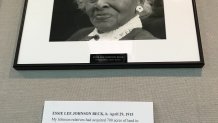
“These are individuals willing to come forward and tell their stories decades later,” Brown said showing a wall of pictures of survivors inside the Greenwood Cultural Center.
Many of their survival stories have been documented.
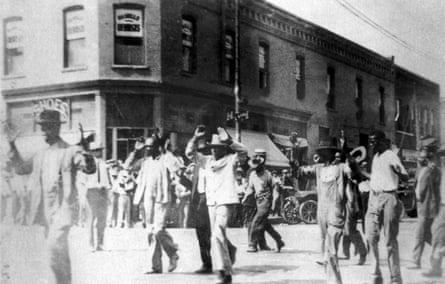
“People running through the streets of the Greenwood District simply running for their lives,” Brown recalled of a survivor’s story. “They’ve talked about the fires. They talk about seeing planes flying over the Greenwood District dropping turpentine bombs on the community.”
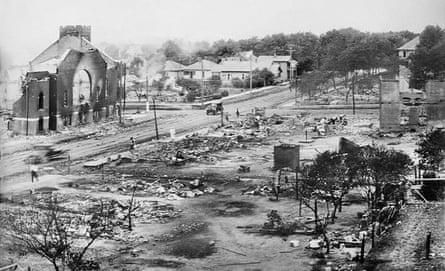
Pictures also show proof of the devastation.
“Some of the photographs it looks as if this was a war zone,” Brown said. “Survivors returned to the Greenwood District looking for their homes and businesses where they stood and found nothing but ashes.”
It’s estimated around 300 Black people were killed during the destruction of Black Wall Street.
“It was economically devastating but also mentally, emotionally, and spiritually traumatizing to the Black community,” Brown said.
There was a period afterward where Black Wall Street made a comeback.
“Greenwood continued to build and continued to build and in fact it got much larger and much bigger were at that time in the ’30s, ’40s, and ’50s it was having a second renaissance at that time,” Ross said.
But once segregation ended the black dollar started to leave Black Wall Street.
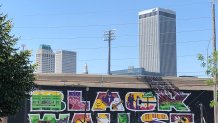
Black Wall Street mural with downtown Tulsa in the background.
“It wasn’t until the 1960s when Black folks were able to go in white stores to spend their green dollars that’s when Greenwood suffered its next attack and the businesses started to leave and started to decay,” Ross said.
Now Tulsa’s Black Wall Street is hoping to one day return to its former glory.
“Greenwood is a shell of its former self,” Ross said.
Viola Ford Fletcher smiles as her mind burrows back in time more than a hundred years. “We were happy then,” she says wistfully. “Before this happened, we had children in the neighbourhood to play with. We had schools, churches, hospitals, theatres and anything that people enjoyed. It was a strong community.”
“This” refers to the 1921 Tulsa race massacre, when a white mob descended on the neighbourhood of Greenwood, home to a business district known as Black Wall Street, killing an estimated 300 people and looting and burning businesses and homes. Thousands were left homeless and living in a hastily constructed internment camp.
For most Americans it is the stuff of history books and museum exhibits, as foreign and faraway as Charles Lindbergh or the Wall Street crash. For Fletcher, it is a childhood scar that never went away.
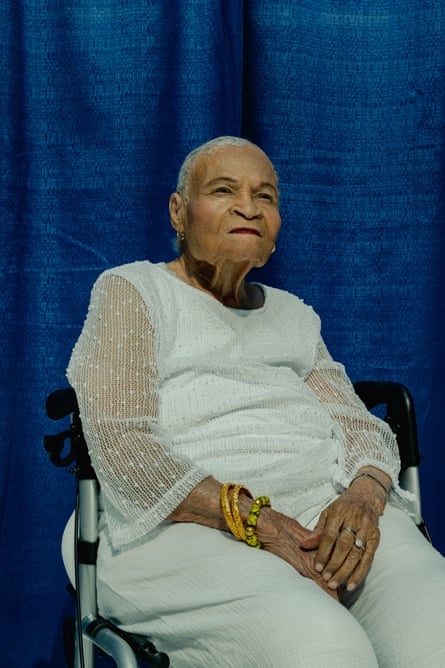
Now 109 and still dressing to the nines with earrings and bracelets, she is the oldest living survivor of the massacre. In 2021, the year of its centenary, “Mother Fletcher” and her brother, Hughes “Uncle Red” Van Ellis, testified to the US Congress to push for reparations and travelled to Ghana, where they were treated like royalty.
Now Fletcher is thought to have become the world’s oldest author with Don’t Let Them Bury My Story, a memoir that recounts the impact of the massacre on her life and advocates for racial justice. “I’ve enjoyed life so far, so I think if I can do it at this time, I should,” she says.
I remember seeing people running and being shot, falling dead, houses burning and noise
Viola Ford Fletcher
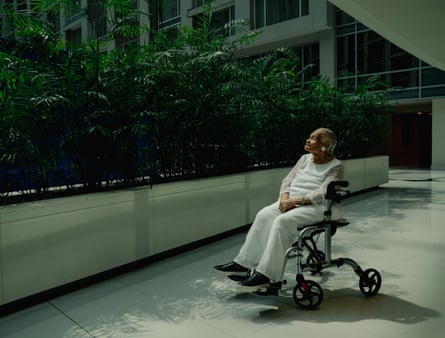
Her debut book tour took her to New York for the first time (“I think all the people in the United States is in New York!”) and then on an Amtrak train for the first time (“That was really history for me, I thought it was very nice”) to Washington, where on Juneteenth she is resplendent in white and speaking to the Guardian from a wheelchair in the cavernous atrium of a business hotel.
She is joined by an attentive grandson, Ike Howard, 56, chief foundation officer of the Viola Ford Fletcher Foundation, which operates in the US and Ghana. His “constant prodding” persuaded Fletcher to overcome her fears and tell her story, he says, and they wrote the book together with Van Ellis, now 102, contributing a foreword.
Fletcher was born before the first world war on 5 May 1914 in Comanche, Oklahoma. Her parents were sharecroppers before moving to the prosperous Greenwood neighbourhood of Tulsa. On the night of 31 May 1921, she was a carefree seven-year-old girl with a favourite toy – a rag doll – and future full of possibilities. Then she was woken by her family and told they had to leave at once.
Part of Greenwood district burned in race riots, Tulsa, Oklahoma, in June 1921. Photograph: Universal History Archive/Universal Images Group/Getty Images
She recalls: “I remember seeing people running and being shot, falling dead, houses burning and noise – guns shooting. We were advised to get out of town before we were all killed. So my mother and father gathered six children and we were loaded into a horse-drawn cart and we got out of town safely.”
There are some things that time doesn’t heal, at least not completely. More than a century later, Fletcher speaks about living through the massacre every day and not being able to sleep at night. Howard explains: “At midnight, she’s awake. Three o’clock in the morning, she’s awake. She goes to sleep when the sun is high in the sky.”
The family was forced to move from farm to farm and Fletcher lost her chance at education beyond the fourth grade. She recalls: “They would sharecrop. We wasn’t able to go to school. The days we should be in school was time to harvest a crop or something. The family kept moving from one neighbourhood to another. I didn’t know where we were going. Being a child, they didn’t tell us everything. We had to follow.”
Viola Fletcher, 109, known as ‘Mother Fletcher’, the oldest survivor of the Tulsa race massacre. Photograph: Shuran Huang/The Guardian
Fletcher married her husband, Robert, in 1932 and moved to California to work as an assistant welder in the shipyards during the second world war. “During the war time, when my brothers were in service, I worked at a shipyard and helped build ships. I worked there until the war was over.”
Later she and Robert returned to Oklahoma, where Fletcher became a domestic worker serving white families (she did not retire until was 85). She gave birth to two sons and a daughter and now has more than 20 great-grandchildren. Her life has spanned a century of civil rights struggles, with all their victories and setbacks.
Fletcher was 94, for example, when Barack Obama was elected the US’s first Black president. She recalls: “It was wonderful to see that. Before then I probably didn’t notice about the presidents and all of that. I should know all the presidents but I don’t. But with that one I naturally learned that this was our first.”
Two years ago Fletcher travelled to Washington for the first time to ask that her country acknowledge what happened in Tulsa in 1921. She testified to a House of Representatives judiciary subcommittee considering legal remedies and received a standing ovation. She laughs: “I enjoyed it. There were portions I didn’t quite understand but I guess I said something that they wanted to hear.”
There has never been any direct compensation from the city of Tulsa or the state of Oklahoma for massacre survivors or their descendants. Racial disparities, compounded by gentrification and urban planning, persist in Tulsa today.
Last year a judge in Oklahoma issued an order allowing Fletcher, Van Ellis and another survivor, Lessie Benningfield Randle, to continue seeking damages under state nuisance laws. The lawsuit argues that, in the years after the massacre, city and county officials actively thwarted the community’s effort to rebuild in favour of overwhelmingly white parts of Tulsa.
Let us have our day in court. If we win, we win. If we lose, we lose. But at least the situation will be reconciled to some degree
Viola Ford Fletcher’s grandson Ike Howard
Howard, sporting a colourful T-shirt and gold chain necklace, comments: “Now the court case hangs in the balance because the judge hasn’t given us a decision. On her 109th birthday we were in court. I don’t think the judge knew that it was her birthday but you would take that personal: they burn down your house, they run you out of town, then they have a court date on your 109th birthday.
“It makes it feel like they’re waiting for you to die so the case can just go away. We’re stronger together so it would be wise just to go ahead. Let us have our day in court. If we win, we win. If we lose, we lose. If we settle, we settle. But at least the situation will be reconciled to some degree.”
Also in 2021, Fletcher made her first trip to Africa. She and her brother met the Ghanaian president, Nana Akufo-Addo, as well as the vice-president, three kings and a group of ambassadors. They were granted royal Ghanaian names and subsequently citizenship. She says: “I was looking to see who could be some of our ancestors.”
“I remember seeing people running and being shot, falling dead, houses burning and noise – guns shooting. We were advised to get out of town before we were all killed,” says Fletcher. Photograph: Science History Images/Alamy
Fletcher, who still lives in Tulsa, and her brother, based in Denver, Colorado, make a formidable team. Van Ellis, who served in an all-Black battalion during the second world war, has been at her side throughout the book tour. Wearing a grey suit with blue pinstripes and an “Army veteran 1939-1945” cap, he comments: “We always stuck together. You have a family and you stick together, you can always make it through.
“She and I went through all this. We went through 1921: I was only five months old: that was a bombing. I served in the United States army: that was a bombing. I was in the 234th AAA gun battalion down in Burma. I survived that bombing so I would call myself blessed.”
But like his sister, Van Ellis was robbed of school and career opportunities by the massacre; he has previously said his family were “made refugees in our own country”. He eventually became a handyman in Oklahoma City, working odd jobs in construction and as a painter and plumber.
He reflects: “If I had lived in Tulsa I would probably had a chance to get a good education and a decent job. But we had to work from sunup to sundown to make a living and feed our families.”
Fletcher recently co-published her memoir Don’t Let Them Bury My Story with her grandson, Ike Howard. Photograph: Shuran Huang/The Guardian
For decades, Van Ellis recalls, the massacre was a taboo subject in Tulsa, unspoken by neighbours, untaught in schools and uncommemorated by any memorial. “We were taught not to talk about it. They said, ‘Don’t talk about it. If you talk about it, your family is liable to get killed. Your dogs, your cats.’ You could not talk about. I don’t know why but that’s what they said. ‘Don’t talk about it.’”
He was relieved when the conspiracy of silence came to an end and the city began to confront its past, including a search for the unmarked mass graves of victims and visit by Joe Biden for the centenary. “You have to live. You can’t stop. You have to keep going ahead. Do your best in the world,” Van Ellis says.
Having fought for the US overseas, he hopes the book will play at part in achieving justice at home after all these years. “This is a new world to me – I didn’t think it would ever happen. It’s exciting and it’s history. Let the world know. It’s been 102 years so I’m proud I’m living to tell about it.”
Van Ellis, who has seven children, 10 grandchildren and 14 great-grandchildren, remains cautiously optimistic about the future of the country he served. “I saw little changes but it could be better. I saw some changes and I think I’m going to get better. I love America and I love people in America.”
And he fully intends to live for another 28 years. His secret? Spinach. Van Ellis, a palpably indomitable spirit, paraphrases: “I’m Popeye the Sailor Man / I’ll eat my spinach and fight to the finish / I’m Popeye the Sailor Man!”
Consciousness, spirituality, biography, sexuality, androgyny, futurism, space, the arts, science, astrology, democracy, humor, books, movies and more