
July 9, 2023
—Crazy Alert! Oklahoma Superintendent says about infamous Tulsa massacre, “Let’s not tie it to skin color…” Back in 1921 the good white people of Tulsa, Oklahoma went on a rampage, slaughtering hundreds of Black people and burning to the ground the Greenwood District, often referred to as “Black Wall Street,” because it was such a prosperous Black-owned area. Oklahoma’s new statewide Superintendent of Public Schools came to office on the promise of ending the teaching of critical race theory, and when he was asked in a public forum how a teacher should deal with the Tulsa massacre, he said, “Let’s not tie it to the skin color and say that the skin color determined that.” Exactly. Moms For Liberty couldn’t have said it better.
The Hartmann Report (thomhartmann+the-saturday-report@substack.com)
Remembering Tulsa’s Black Wall Street
Black Wall Street was a thriving Black-owned business district that housed hundreds of Black-owned businesses
By Vince Sims • Published June 18, 2020 • Updated on June 19, 2020 (nbcdfw.com)

Old black and white pictures inside the Greenwood Cultural Center in Tulsa, Oklahoma, gives a small glimpse into Tulsa’s historical Black Wall Street.
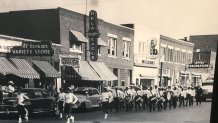
“Black Wall Street was a thriving Black-owned business district that housed hundreds of Black-owned businesses,” Greenwood Cultural District Program Director Michelle Brown said. “There were grand hotels, movie theaters, there were restaurants, doctors and attorneys.”
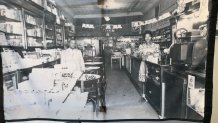
The interstate running across Greenwood Avenue sits where J. Kavin Ross’s great grandfather owned a business on Black Wall Street.
“He had a juke joint on Greenwood called Isaac Evitts Zulu Lounge,” J. Kavin Ross said.
Ross is a Greenwood District historian who has been recording the memory of what was once a rich Black community.
“This house is just one example of the kind of homes,” Ross said pointing to one lone house still standing from that era. “These weren’t shacks or shotgun homes. These were nice homes and they were well built and built by African Americans who were a part of this community.”
The Black Wall Street and Greenwood District covered more than 35 city blocks. An estimated 10,000 Black people lived in the area. Black Wall Street was successful because of the oil industry and farming money. Black people couldn’t shop in white-owned stores during this time. So, they spent their money in their own community which helped support and build up the community.
“It was a powerful scene,” Ross said. “People would walk up and down the corridor of Greenwood. Especially at night time and the nightlife. You had grocery stores, savings and loans, hotels, law offices, photography, anything you could think of.”
Things took a tragic turn in May 1921. A young Black man was accused of assaulting a white woman in a downtown elevator. That event started the Tulsa Race Massacre that sent mobs of white men into Black Wall Street who destroyed the area and killed hundreds of Black people.
“These are individuals willing to come forward and tell their stories decades later,” Brown said showing a wall of pictures of survivors inside the Greenwood Cultural Center.
Many of their survival stories have been documented.
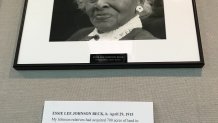
“People running through the streets of the Greenwood District simply running for their lives,” Brown recalled of a survivor’s story. “They’ve talked about the fires. They talk about seeing planes flying over the Greenwood District dropping turpentine bombs on the community.”
Pictures also show proof of the devastation.
“Some of the photographs it looks as if this was a war zone,” Brown said. “Survivors returned to the Greenwood District looking for their homes and businesses where they stood and found nothing but ashes.”
It’s estimated around 300 Black people were killed during the destruction of Black Wall Street.
“It was economically devastating but also mentally, emotionally, and spiritually traumatizing to the Black community,” Brown said.
There was a period afterward where Black Wall Street made a comeback.
“Greenwood continued to build and continued to build and in fact it got much larger and much bigger were at that time in the ’30s, ’40s, and ’50s it was having a second renaissance at that time,” Ross said.
But once segregation ended the black dollar started to leave Black Wall Street.
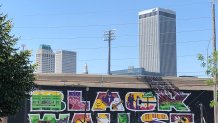
“It wasn’t until the 1960s when Black folks were able to go in white stores to spend their green dollars that’s when Greenwood suffered its next attack and the businesses started to leave and started to decay,” Ross said.
Now Tulsa’s Black Wall Street is hoping to one day return to its former glory.
“Greenwood is a shell of its former self,” Ross said.