
From Wikipedia, the free encyclopedia
| The Third of May 1808 | |
|---|---|
| Artist | Francisco Goya |
| Year | 1814 |
| Medium | Oil on canvas |
| Dimensions | 268 cm × 347 cm (106 in × 137 in)[1] |
| Location | Museo del Prado, Madrid |

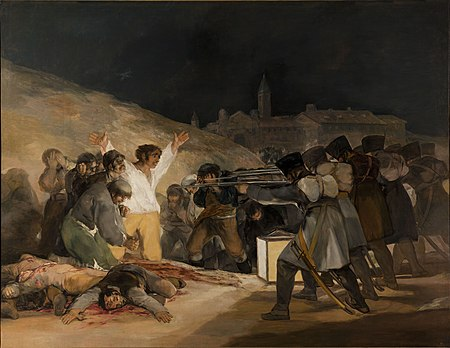
The Third of May 1808 (also known as El tres de mayo de 1808 en Madrid or Los fusilamientos de la montaña del Príncipe Pío,[2] or Los fusilamientos del tres de mayo)[1] is a painting completed in 1814 by the Spanish painter Francisco Goya, now in the Museo del Prado, Madrid. In the work, Goya sought to commemorate Spanish resistance to Napoleon‘s armies during the occupation of 1808 in the Peninsular War. Along with its companion piece of the same size, The Second of May 1808 (or The Charge of the Mamelukes), it was commissioned by the provisional government of Spain at Goya’s suggestion.
The painting’s content, presentation, and emotional force secure its status as a ground-breaking, archetypal image of the horrors of war. Although it draws on many sources from both high and popular art, The Third of May 1808 marks a clear break from convention. Diverging from the traditions of Christian art and traditional depictions of war, it has no distinct precedent, and is acknowledged as one of the first paintings of the modern era.[3] According to the art historian Kenneth Clark, The Third of May 1808 is “the first great picture which can be called revolutionary in every sense of the word, in style, in subject, and in intention”.[4]
The Third of May 1808 inspired Gerald Holtom‘s peace sign and a number of later major paintings, including a series by Édouard Manet, and Pablo Picasso‘s Massacre in Korea and Guernica.
Background
Main article: Peninsular War
Napoleon I of France declared himself First Consul of the French Republic on November 10, 1799, and crowned himself Emperor in 1804. Because Spain controlled access to the Mediterranean, the country was politically and strategically important to French interests. The reigning Spanish sovereign, Charles IV, was internationally regarded as ineffectual. Even in his own court he was seen as a “half-wit king who renounces cares of state for the satisfaction of hunting”,[5] and a cuckold unable to control his energetic wife, Maria Luisa of Parma.[6] Napoleon took advantage of the weak king by suggesting the two nations conquer and divide Portugal, with France and Spain each taking a third of the spoils, and the final third going to the Spanish Prime Minister Manuel de Godoy, along with the title Prince of the Algarve. Godoy was seduced, and accepted the French offer. He failed, however, to grasp Napoleon’s true intentions, and was unaware that his new ally and co-sovereign, the former king’s son Ferdinand VII of Spain, was using the invasion merely as a ploy to seize the Spanish parliament and throne. Ferdinand intended not only that Godoy be killed during the impending power struggle, but also that the lives of his own parents be sacrificed.[5]
Under the guise of reinforcing the Spanish armies, 23,000 French troops entered Spain unopposed in November 1807.[7] Even when Napoleon’s intentions became clear the following February, the occupying forces found little resistance apart from isolated actions in disconnected areas, including Zaragoza.[8] Napoleon’s principal commander, Marshal Joachim Murat, believed that Spain would benefit from rulers more progressive and competent than the Bourbons, and Napoleon’s brother Joseph Bonaparte was to be made king.[9] After Napoleon convinced Ferdinand to return Spanish rule to Charles IV, the latter was left with no choice but to abdicate, on March 19, 1808, in favor of Joseph Bonaparte.
Although the Spanish people had accepted foreign monarchs in the past, they deeply resented the new French ruler. A French agent in Madrid wrote that “Spain is different. The Spaniards have a noble and generous character, but they have a tendency to ferocity and cannot bear to be treated as a conquered nation. Reduced to despair, they would be prepared to unleash the most terrible and courageous rebellion, and the most vicious excesses.”[10] On May 2, 1808, provoked by news of the planned removal to France of the last members of the Spanish royal family, the people of Madrid rebelled in the Dos de Mayo Uprising. A proclamation issued that day to his troops by Marshal Murat read: “The population of Madrid, led astray, has given itself to revolt and murder. French blood has flowed. It demands vengeance. All those arrested in the uprising, arms in hand, will be shot.”[11] Goya commemorated the uprising in his The Second of May, which depicts a cavalry charge against the rebels in the Puerta del Sol square in the center of Madrid, the site of several hours of fierce combat.[12] Much the better known of the pair, The Third of May illustrates the French reprisals: before dawn the next day hundreds of Spaniards were rounded up and shot, at a number of locations around Madrid. Civilian Spanish opposition persisted as a feature of the ensuing five-year Peninsular War, the first to be called guerrilla war.[9] Irregular Spanish forces considerably aided the Spanish, Portuguese, and British armies jointly led by Sir Arthur Wellesley, who first landed in Portugal in August 1808. By the time of the painting’s conception, the public imagination had made the rioters symbols of heroism and patriotism.[13]
Like other Spanish liberals, Goya was placed in a difficult position by the French invasion. He had supported the initial aims of the French Revolution, and hoped for a similar development in Spain. Several of his friends, like the poets Juan Meléndez Valdés and Leandro Fernández de Moratín, were overt Afrancesados, the term for the supporters—collaborators in the view of many—of Joseph Bonaparte.[14] Goya’s 1798 portrait of the French ambassador-turned-commandant Ferdinand Guillemardet betrays a personal admiration.[15][16] Although he maintained his position as court painter, for which an oath of loyalty to Joseph was necessary, Goya had by nature an instinctive dislike of authority.[17] He witnessed the subjugation of his countrymen by the French troops.[18] During these years he painted little, although the experiences of the occupation provided inspiration for drawings that would form the basis for his prints The Disasters of War (Los desastres de la guerra).[15]
In February 1814, after the final expulsion of the French, Goya approached the provisional government with a request to “perpetuate by means of his brush the most notable and heroic actions of our glorious insurrection against the Tyrant of Europe”.[19] His proposal accepted, Goya began work on The Third of May. It is not known whether he had personally witnessed either the rebellion or the reprisals,[12] despite many later attempts to place him at the events of either day.[20]
More at: https://en.wikipedia.org/wiki/The_Third_of_May_1808