
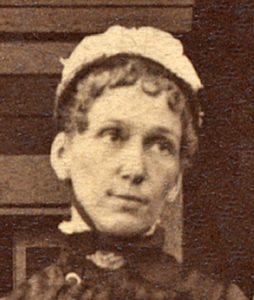
Mrs. Josephine Curtis Woodbury (image from longyear.org)
CHAPTER XXIII
JOSEPHINE CURTIS WOODBURY AND THE ROMANTIC SCHOOL—BIRTH OF THE PRINCE OF PEACE—MRS. EDDY WITHDRAWS HER SUPPORT—”WAR IN HEAVEN”
Mrs. Eddy’s absence from Boston made it possible for some of her ambitious leaders there to exercise a stronger personal influence than they could ever have done had she been at her old headquarters in Commonwealth Avenue. This opportunity was seized, and abused, so Mrs. Eddy thought, by one of her most prominent aids, Josephine Curtis Woodbury.
Mrs. Woodbury had been associated with Mrs. Eddy since 1879, and had been one of her foremost healers and teachers. She had written a great deal for the Journal, had preached and lectured as far west as Denver, had organised classes and church societies, and had conducted a Christian Science “academy” at the Hotel Berkshire, in Boston.
Mrs. Woodbury was clever, self-confident, given to theatrical display, ready with her tongue and pen, and she possessed an amazing personal influence over her adherents. In short, she was the only Christian Scientist in Boston who ever bade fair to rival Mrs. Eddy in personal prominence. Like Mrs. Eddy, she was ambitious, and delighted in leadership. She, too, could send her students hither and yon, and keep them dancing attendance upon her telegrams. Some of them lived in her house and went to Maine with her in the summer; they sat spellbound at her lectures, and put their time and goods at her disposal.
Mrs. Woodbury’s group of students and followers were, on the whole, very different from the simple, rule-abiding Christian Scientists who had been taught directly under Mrs. Eddy’s personal supervision. Mrs. Eddy’s own people never got very far away from her hard-and-fast business principles, while Mrs. Woodbury’s students were distinctly fanciful and sentimental, and strove to add all manner of ornamentation to Mrs. Eddy’s stout homespun. There were two or three musicians among them, and a young illustrator and his handsome wife, and most of them wrote verses. Some of Mrs. Woodbury’s students went abroad with her, and acquired the habit of interlarding the regular Christian Science phraseology with a little French. Mrs. Woodbury and her students lived in a kind of miracle-play of their own; had inspirations and revelations and premonitions; kept mental trysts; saw portents and mystic meanings in everything; and spoke of God as coming and going, agreeing and disagreeing with them. Some of them affected cell-like sleeping-chambers, with white walls, bare except for a picture of Christ. They longed for martyrdom, and made adventures out of the most commonplace occurrences. Mrs. Woodbury herself had this marvel-loving temperament. Her room was lined with pictures of the Madonna. When she went to Denver to lecture on Christian Science in 1887, her train was caught in a blizzard; in relating this experience, she describes herself as “face to face with death.” Her two children fell into the water on the Nantasket coast; Mrs. Woodbury “treated” them, and they recovered. She writes upon this incident a dramatic article entitled “Drowning Overcome.”
Mrs. Woodbury and her students thus succeeded in giving to Mrs. Eddy’s homely “Science”—pieced together in dull New England shoe towns and first taught to people who worked with their hands—an emotional colouring which was very distasteful to Mrs. Eddy herself. Never was any woman less the religieuse. “Discovering and founding” Christian Science had been her business, performed, in spite of all her flightiness, in a businesslike manner, and her success was eminently a businesslike success. With yearnings and questings and raptures, Mrs. Eddy had little patience, and Mrs. Woodbury’s romantic school, with its spiritual alliances, annoyed her beyond expression.
Meanwhile, Mrs. Woodbury’s students inevitably found their miracle. In June, 1890, Mrs. Woodbury gave birth to a son whom her followers believed was the result of an “immaculate conception,” and an exemplification of Mrs. Eddy’s theory of “mental generation.” Mrs. Woodbury named her child “The Prince of Peace,” and baptised him at Ocean Point, Me., in a pool which she called “Bethsada.” “While there,” writes Mrs. Woodbury, “occurred the thought of baptising little Prince in a singularly beautiful salt pool, whose rocky bottom was dry at low tide and overflowing at high tide, but especially attractive at mid-tide, with its two feet of crystal water. A crowd of people had assembled on the neighbouring bluffs, when I brought him from our cottage not far away, and laid him three times prayerfully in the pool and when he was lifted therefrom, they joined in a spontaneously appropriate hymn of praise.”
Mrs. Woodbury would not permit the child, who was called Prince for short, to address her husband as “father,” but insisted that he address Mr. Woodbury as “Frank” and herself as “Birdie.” The fact that he was a fine, healthy baby, and was never ill, seemed to Mrs. Woodbury’s disciples conclusive evidence that he was the Divine principle of Christian Science made manifest in the flesh. It was their pleasure to bring gifts to Prince; to discover in his behaviour indications of his spiritual nature; and they professed to believe that when he grew to manhood he would enter upon his Divine ministry.
Six months before the birth of Prince, Mrs. Woodbury paid a visit to Mrs. Eddy, and she seems to imply that the venerable leader oracularly foretold the coming of her child. “In January,” writes Mrs. Woodbury, “I enjoyed a visit with my ever-beloved Teacher, who gave comfort in these words, though at the moment they were not received in their deeper import: ‘Go home and be happy. Commit thy ways unto the Lord. Trust him, and he will bring it to pass.’ ” This may have suggested to the faithful the visit of Mary to Elizabeth; but if there was any miracle-play of this sort in progress, Mrs. Eddy had certainly no intention of playing Elizabeth to Mrs. Woodbury’s Mary. When word was brought her of the birth of Mrs. Woodbury’s “little Immanuel,” as he was often called, she was far from being convinced. “Child of light!” she exclaimed indignantly. “She knows it is an imp of Satan.” In the libel suit which Mrs. Woodbury later brought against her Teacher, a letter to her from Mrs. Eddy was read in court, in which Mrs. Eddy said: “Those awful reports about you, namely that your last child was illegitimate, etc. I again and again tried to suppress that report; also for what you tried to make people believe; namely, that that child was an immaculate conception, . . . and you replied that it was incarnated with the Devil.”
Mrs. Eddy was the more vexed with Mrs. Woodbury because she herself had undoubtedly taught that in the future, when the world had attained a larger growth in Christian Science, children would be conceived by communion with the Divine mind; but she probably had no idea that any one of her students, ambitious to “demonstrate over material claims,” would actually attempt to put this theory into practice. She was wise enough, moreover, to see that such extravagant claims would bring Christian Science into disrepute, and she vigorously denounced Mrs. Woodbury’s zeal.
Besides her school in Boston, Mrs. Woodbury had a large following in Maine, where she usually spent the summer. In 1896 Fred D. Chamberlain began a suit against her for the alienation of his wife’s affections—his wife being a pupil of Mrs. Woodbury’s. At this time, the Boston Traveller, in discussing Mr. Chamberlain’s charge, took up the question of the claims that were made for Mrs. Woodbury’s son, Prince. The Traveller asserted that some of Mrs. Woodbury’s students had been induced against their will to buy stock in an “air-engine” which Mr. Woodbury was exploiting, and published interviews with George Macomber and H. E. Jones, both of Augusta, Me., who stated that their wives had believed that Mrs. Woodbury’s child was immaculately conceived, had desired to make presents to it, and had urged their husbands to buy stock in the air-engine. The Traveller also made the statement that Evelyn I. Rowe of Augusta had applied for a divorce from her husband upon the ground of non-support, saying that he gave all his earnings toward the education and support of Mrs. Woodbury’s son, Prince, whom Mr. Rowe believed to have been immaculately conceived. After the publication of this, Mrs. Woodbury promptly sued the Traveller for criminal libel, and lost her case.
All this notoriety brought matters to a crisis between Mrs. Woodbury and Mrs. Eddy. Although Mrs. Eddy had found Mrs. Woodbury very useful, she had long distrusted her discretion, and had endeavoured in various ways to put a check upon her. Mrs. Woodbury had first become a member of Mrs. Eddy’s church in 1886. When the Mother Church was reorganised, it was necessary, in order that Mrs. Eddy might cull out such persons as were distasteful to her, for all the old members to apply for admission and be voted upon, just as were the new candidates. Mrs. Woodbury was admitted only upon the condition that she would undergo a two years’ probation, and she had some difficulty in getting back even upon those terms. Several months before her admission on probation, she wrote to Mrs. Eddy, begging her to use her personal influence in her behalf. To this petition Mrs. Eddy replied:
Continue reading “The Life of Mary Baker G. Eddy” by Georgine Milmine