“I’m here, manifesting.”
–Young woman on cell at Montclair Village Peet’s, overheard by Steve Koppman

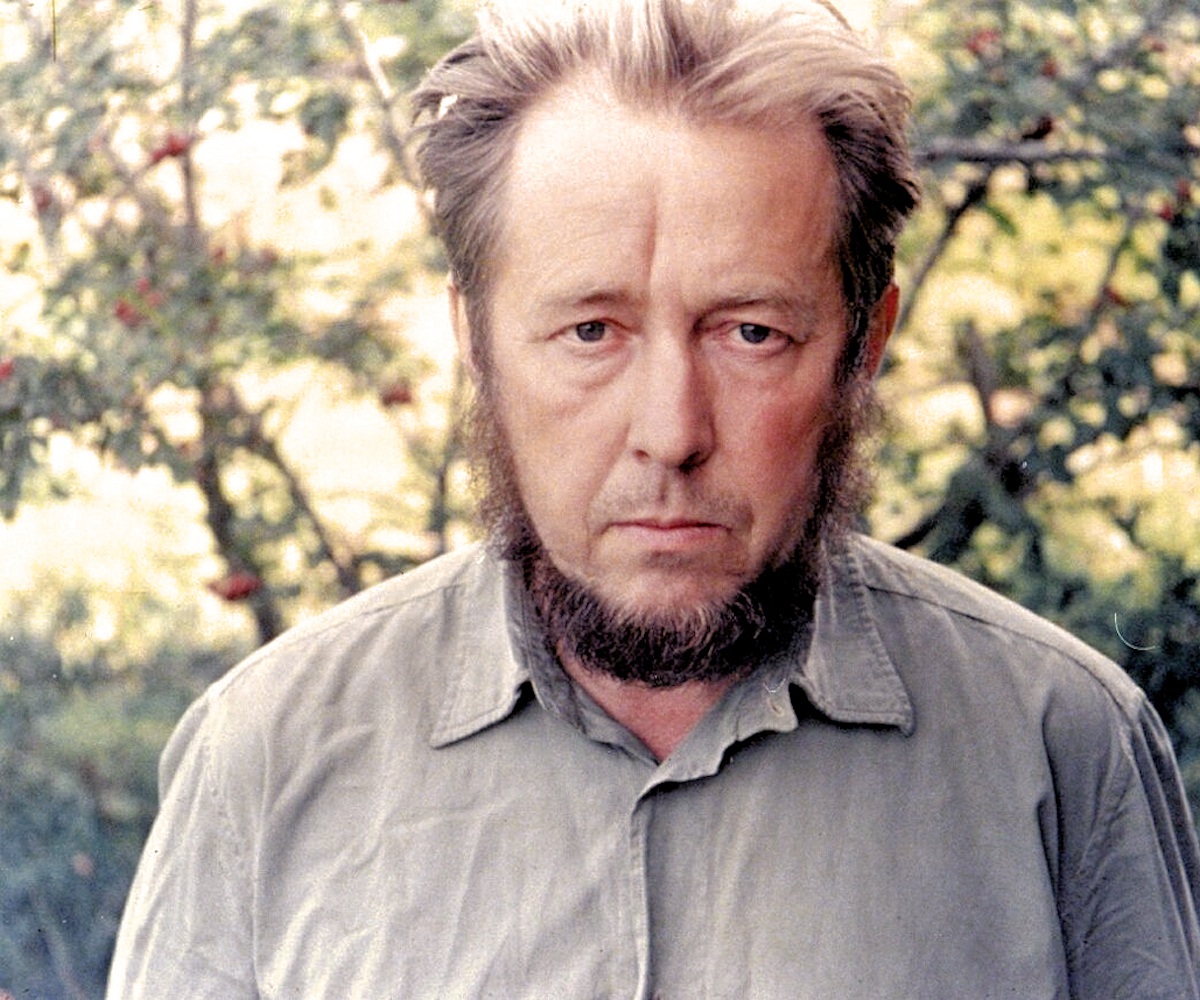
Jordan B. Peterson quotes Aleksandr Solzhenitsyn as saying that “…the line dividing good and evil cuts through the heart of every human being.” After viewing the entirety of Peterson’s Bible Series – posted by Mike below – I remembered that I had a copy of the first volume of The Gulag Archipelago, which includes Parts I and II, and decided it was high time to read at least that much.
What follows (from Part I, pp. 167-168) is the passage from which Peterson drew the above quotation. But first a little context: When the passage starts, Solzhenitsyn has just been arrested and is being forced marched, with seven other prisoners, “from the army counterintelligence center to the counterintelligence headquarters of the front.”
“I smiled in pride that I had been arrested not for stealing, nor treason, nor desertion, but because I had discovered through my power of reasoning the evil secrets of Stalin, I smiled at the thought that I wanted, and still might be able , to effect some small remedies and changes in our Russian way of life.
“But all that time my suitcase was being carried by others.*
“And I didn’t even feel remorseful about it! And if my neighbor, whose sunken cheeks were already covered with a soft two-week growth of beard and whose eyes were overflowing with suffering and knowledge, had then and there reproached me in the clearest of clear Russian words for having disgraced the honor of a prisoner for appealing to the convoy for help and had accused me of haughtiness, of setting myself above the rest of them, I would not have understood him! I simply would not have understood what he was talking about. I was an officer!
“And if seven of us had to die on the way, and the eighth could have been saved by the convoy, what was to keep me from crying out: ‘Sergeant! Save me. I am an officer!’
“And that’s what an officer is, even if his shoulder boards aren’t blue!†
“And if they are blue? If he has been indoctrinated to believe that even among other officers he is the salt of the earth? And that he knows more than the others and is entrusted with more responsibility than others and that, consequently, it is his duty to force a prisoner’s head between his legs, and then to shove him like that into a pipe…
“Why shouldn’t he?
“I credited myself with unselfish dedication. But meanwhile I had been thoroughly prepared to be an executioner. And if I had gotten into an NKVD school under Yezhov, maybe I would have matured just in time for Beria…
“So let the reader who expects this book to be a political exposé slam its covers shut right now.
“If it were only all so simple! If only there were evil people somewhere insidiously committing evil deeds, and it were necessary only to separate them from the rest of us and destroy them. But the dividing line between good and evil cuts through the heart of every human being. And who is willing to destroy a piece of his own heart?
“During the life of every heart this line keeps changing place; sometimes it is squeezed one way by exuberant evil and sometimes it shifts to allow enough space for good to flourish. One and the same human being is, at various stages, under various circumstances, a totally different human being. At times he is close to being a devil, at times to sainthood. But his name doesn’t change, and to that name we ascribe the whole lot, good and evil.
“Socrates taught us: Know thyself!
“Confronted by the pit into which we are about to toss those who have done us harm, we halt, stricken dumb: it is after all only because of the way things worked out that they were the executioners and we weren’t.
“If Malyuta Skuratov had summoned us, we, too, probably have done our work well!
“From good to evil is one quaver, says the proverb.
“And correspondingly, from evil to good!”
________
* Solzhenitsyn is the only officer in the group of forced-marching prisoners; the rest are enlisted men (plus one German POW), who, because such things are expected, take turns carrying Solzhenitsyn’s suitcase…
† Blue shoulder boards were worn only by the officers of the secret police of the USSR, variously called, during its long and checkered history: the Cheka, OGPU, NKVD, NKGB, MGB, KGB…

Did you miss today’s Rainbow Radio?
Listen to it at your convenience…

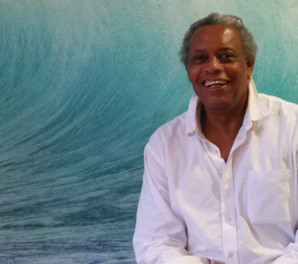
Calvin Harris is a Native of Los Angeles and a former student at Prosperos School on Ontology in Santa Monica. He loves humanity and as being a native of Los Angeles he has had a world of experience in diversity and all the wonderful colors of the rainbow that make up the human spirit
Calvin is one who has surrounded himself with this richly textured community of contradictory and diverse individuals with a passion for life and a flair for success, innovation, and creativity. In his vocation, he performs the roles of mentor, teacher, storyteller, or loving friend.Those that seek him out, are those ready to make a change, find their way through adversity, clamity, and confusion. And those that have the courage to participate and engage in the processes that will bring about their change, their piece, their happiness.

Tune in this Saturday at KX935.com and click listen now to hear the show live. Or check back later if you are busy and play it at your leasure as a podcast! Either way, I think you will find the show and guests features very interesting and fun!

Whirling Dervishes by Diaz (Wikimedia Commons)
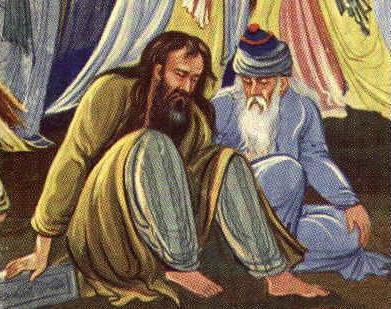
Rumi and Shams together in a detail from “Dervish Whirl” by Shahriar Shahriari (RumiOnFire.com)
Rumi is a 13th-century Persian poet and Sufi mystic whose love for another man inspired some of the world’s best poems and led to the creation of a new religious order, the whirling dervishes. His birthday is today (Sept. 30).
With sensuous beauty and deep spiritual insight, Rumi writes about the sacred presence in ordinary experiences. His poetry is widely admired around the world and he is one of the most popular poets in America. One of his often-quoted poems begins:
If anyone asks you
how the perfect satisfaction
of all our sexual wanting
will look, lift your face
and say,
Like this.*
The homoeroticism of Rumi is hidden in plain sight. It is well known that his poems were inspired by his love for another man, but the queer implications are seldom discussed. There is no proof that Rumi and his beloved Shams of Tabriz had a sexual relationship, but the intensity of their same-sex love is undeniable.
 |
|
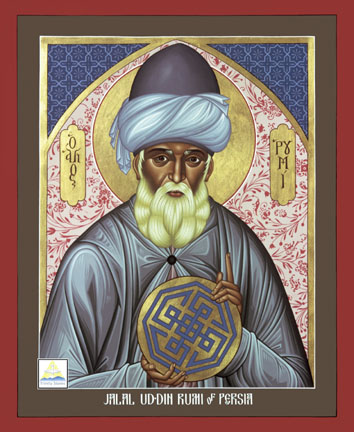
“Rumi of Persia”
by Robert Lentz
|
Rumi was born Sept. 30, 1207 in Afghanistan, which was then part of the Persian Empire. His father, a Muslim scholar and mystic, moved the family to Roman Anatolia (present-day Turkey) to escape Mongol invaders when Rumi was a child. Rumi lived most of his life in this region and used it as the basis of his chosen name, which means “Roman.” His full name is Jalal ad-Din Muhammad Balkhi-Rumi.
His father died when Rumi was 25 and he inherited a position as teacher at a madrassa (Islamic school). He continued studying Shariah (Islamic law), eventually issuing his own fatwas (legal opinions) and giving sermons in the local mosques. Rumi also practiced the basics of Sufi mysticism in a community of dervishes, who are Muslim ascetics similar to mendicant friars in Christianity.
On Nov. 15, 1244 Rumi met the man who would change his life: a wandering dervish named Shams of Tabriz (Shams-e-Tabrizi or Shams al-Din Muhammad). He came from the city of Tabriz in present-day Iranian Azerbaijan. It is said that Shams had traveled throughout the Middle East asking Allah to help him find a friend who could “endure” his companionship. A voice in a vision sent him to the place where Rumi lived.
 |
| Meeting of Rumi and Shams 16th-17th century folio (Wikimedia Commons) |
Rumi, a respected scholar in his thirties, was riding a donkey home from work when an elderly stranger in ragged clothes approached. It was Shams. He grasped the reins and started a theological debate. Some say that Rumi was so overwhelmed that he fainted and fell off the donkey.
Rumi and Shams soon became inseparable. They spent months together, lost in a kind of ecstatic mystical communion known as “sobhet” — conversing and gazing at each other until a deeper conversation occurred without words. They forgot about human needs and ignored Rumi’s students, who became jealous. When conflict arose in the community, Shams disappeared as unexpectedly as he had arrived.
Rumi’s loneliness at their separation led him to begin the activities for which he is still remembered. He poured out his soul in poetry and mystical whirling dances of the spirit.
Eventually Rumi found out that Shams had gone to Damascus. He wrote letters begging Shams to return. Legends tell of a dramatic reunion. The two sages fell at each other’s feet. In the past they were like a disciple and teacher, but now they loved each other as equals. One account says, “No one knew who was lover and who the beloved.” Both men were married to women, but they resumed their intense relationship with each other, merged in mystic communion. Jealousies arose again and some men began plotting to get rid of Shams.
One winter night, when he was with Rumi, Shams answered a knock at the back door. He disappeared and was never seen again. Many believe that he was murdered.
Rumi grieved deeply. He searched in vain for his friend and lost himself in whirling dances of mourning. One of his poems hints at the his emotions:
Dance, when you’re broken open.
Dance, if you’ve torn the bandage off.
Dance in the middle of the fighting.
Dance in your blood.
Dance, when you’re perfectly free.
Rumi danced, mourned and wrote poems until the pressure forged a new consciousness. “The wound is the place where the Light enters you,” he once wrote. His soul fused with his beloved. They became One: Rumi, Shams and God. He wrote:
Why should I seek? I am the same as he.
His essence speaks through me.
I have been looking for myself.
After this breakthrough, waves of profound poetry flowed out of Rumi. He attributed more and more of his writings to Shams. His literary classic is a vast collection of poems called “The Works of Shams of Tabriz.” The Turkish government refused to help with translation of the last volume, which was finally published in 2006 as The Forbidden Rumi: The Suppressed Poems of Rumi on Love, Heresy, and Intoxication
Rumi went on to live and love again, dedicating poems to other beloved men. His second great love was the goldsmith Saladin Zarkub. After the goldsmith’s death, Rumi’s scribe Husan Chelebi became Rumi’s beloved companion for the rest of his life. Rumi died at age 66 after an illness on Dec. 17, 1273. Soon his followers founded the Mevlevi Order, known as the whirling dervishes because of the dances they do in devotion to God.
(jesusinlove.blogspot.com)