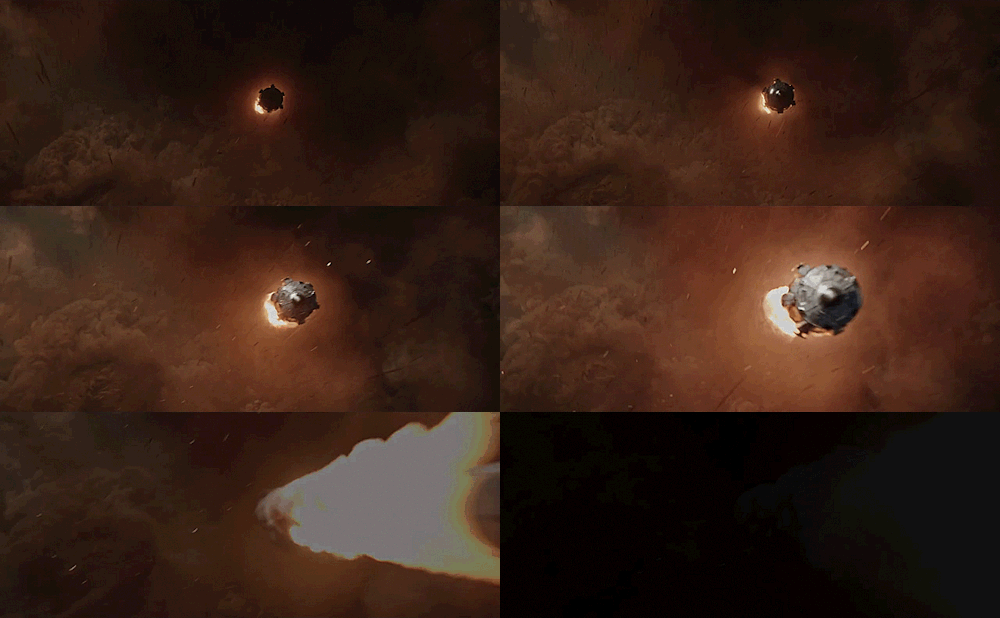
Coffee Part 1 & Eye Candy! On A Fast Rocket 17/11/17 The Friday Massive!

Coffee, Part 1 The Hare’s Tale, Coffee Part 1 A new entry on The Hare’s Tale! An Exploration of Stimulants, The Poetry of Gerard de Nerval, The Music of Brendan Perry and more! An ongoing Blog/Journal of a thousand plus entries on art, music… beauty.


New Eye Candy! Eye Candy-A Visual Blog
On A Fast Rocket 17/11/17 The Friday Massive!
This entry is an eclectic one, from Japanese nature photography, to Cornelius Saftleven, a little known Dutch Master known for his portrayals of hell…. Anyway, a fancy, a dream, an exercise in different expressions.
Cheers, G

Jeremy Lin on walking on water

Jeremy Lin: when I was going through all my insecurities, an uncertainty and lack of confidence, I was losing focus on God. I was focusing on my job and on what other people thought of me, and what the reporters were writing. Over time I was able to check myself and kind of get my focus back and I think God did something supernatural to me, something that I couldn’t do on my own, something I may never be able to recreate so in that instance, I was learning to fight and constantly live and play for God and when I do that I’ll be able to walk on water.  (from the movie Linsanity.)

Jeremy Shu-How Lin is an American professional basketball player for the Brooklyn Nets of the National Basketball Association. Wikipedia
BornAugust 23, 1988 (age 29), Torrance, CA
Height6′ 3″
Current teamBrooklyn Nets (#7 / Point guard)
Salary11.48 million USD (2016)
Playing career2010–present

Flower duet – Anna Netrebko & Elina Garanca


Start at 1:20.

The “Flower Duet” (French: Duo des fleurs / Sous le dôme épais) is a famous duet for sopranos from Léo Delibes’ opera Lakmé, first performed in Paris in 1883. The duet takes place in act 1 of the three-act opera, between characters Lakmé, the daughter of a Brahmin priest, and her servant Mallika, as they go to gather flowers by a river.

The duet is frequently used in advertisements and films and is popular as a concert piece. It was adapted for the track “Aria” in the British Airways “face” advertisements of the 1980s by Yanni and Malcolm McLaren.

A.I. Will Serve Humans—But Only About 1% of Them

Article Image

It doesn’t have to be this way, but for now it is: AI’s primary purpose is to maximize profits. For all of the predictions of its benefits to society, right now, that’s just window-dressing—a pie-in-the-sky vision of a world we don’t actually inhabit. While some like Elon Musk issue dire warnings against finding ourselves beneath the silicon thumbs of robot overlords, the fact is we’re already under threat. As long as AI is dedicated to economic goals and not societal concerns, its tunnel vision is a problem. And as so often seems to be the case these days, the benefits will go to the already wealthy and powerful.

Right now, while artificial intelligence is focusing on profit-generation, natural intelligence has proven to be more than up to the task of manipulating it, as if sneaking up behind someone distracted by a shiny object.

We’re coming to understand just how adroitly AI can be played as we learn more and more about Russia’s manipulation of social media during the 2016 presidential election. Facebook’s much-lauded AI was working to “consume as much of your time and conscious attention as possible,” as Facebook’s first president Sean Parker recently put it to Mike Allen. After all, as we’ve often been told, “You’re not the customer—you’re the product” meant to draw advertisers to the platform. Cleverly parsing our newsfeeds for clues to our most addictive interests and associations, Facebook’s AI somehow completely failed to notice it was being gamed by Russia, as noted in this stunning exchange between Senator Al Franken and Facebook General Counsel Colin Stretch:


What neither man explicitly says is that it was not the job of Facebook’s AI to do anything but maximize the platform’s profits. Democracy? Not Facebook’s problem—until it was. Stretch’s classic tech-speak/euphemism is that Facebook’s algorithms should have had a “broader lens.”

This lack of a broader lens is at the root of growing concerns that automation is going to mean the loss of a significant number of jobs. Katherine Dempsey, writing for The Nation, discussed the issue via email with deep-learning expert Yoshua Bengio, and he summed up the end game this way:

“AI will probably exacerbate inequalities, first with job disruptions—a few people will benefit greatly from the wealth created, [while] a large number will suffer because of job loss—and second because wealth created by AI is likely to be concentrated in a few companies and a few countries.”

The future currently under construction is frightening if you’re not among those few people. Dempsey cites a McKinsey & Company report, ‘A Future That Works, describing a time in which fewer actually will. According to that report, 51% of all the work done in the U.S. economy could be automated at a savings for companies—and loss in workers’ salaries—of $2.7 trillion. While only about 5% of all occupations could be fully automated, about a third of the work in 60% of them can be taken over by machines.

automation
(MCKINSEY & COMPANY)

Dempsey also notes that AI is reinforcing existing biases. Its mistakes may be attributable to the narrowness of programmers’ intentions and sensitivities, or not, but the algorithms are just not that smart so far. The New York Times cites Google Photos tagging black people as gorillas, the algorithms in Nikon cameras assuming Asian people are blinking, and a terrifying expose by ProPublica revealing that AI is being used to identify future criminals.

predictions
(PROPUBLICA)

Princeton study found that a “machine-learning program associated female names more than male names with familial attributes such as ‘parents’ and ‘wedding.’ Male names had stronger associations with career-related words such as ‘professional’ and ‘salary.’” No surprise then that, as a Carnegie Mellon study found, Google is targeting ads for high-paying jobs primarily at men. Still, as Michael Carl Tschantz of the International Computer Science Institute admits, “We can’t look inside the black box that makes the decisions.”

And there’s the problem at its basic level. As long as AI is primarily dedicated to advancing economic goals, its workings are likely to remain largely proprietary and thus unavailable for scrutiny—that’s assuming its creators even know how it works. Our best—and maybe only—defense against this danger to our society is to educate ourselves and our children about AI and machine-learning technology so we aren’t treating AI as some sacred form of modern magic whose workings and effects we’re forced to unquestioningly accept. Forget robot overlords for now—it’s the short-sighted greed of our human ones that should worry us.

Mary Reed talks mysticism, God and Love


Awake 2 Oneness Radio with Unwitting Mystic Mary Reed on Friday, November 17, 2017 at 7:00 PM EST. This show has been pre-recorded. Click here to listen to the show.

Mary is an “accidental” modern mystic startling the world awake with the force of Divine Love conveyed through her profound experiences. To feel the power of her authentic presence and piercing truths is to experience the remembrance of God in oneself and in others.

It is Mary’s intention to use her (uncontrolled) mystical abilities as a tool to spark greater Divine awareness in individuals and to foster a dialogue of collaboration and inclusion across spiritual and religious boundaries for the benefit of all beings.

I had the honor and pleasure of spending time with Mary here in the Poconos in October 2016 while she was on her 2016 US Tour. You must see her talk she gave at the Universalist Unitarian Church located in Stroudsburg, PA. And if you missed our shows together click here, Unwitting Mystic and US Tour 2016.

To learn more about Mary visit her website:
http://unwittingmystic.com/

Your Horoscopes — Week Of November 14, 2017

November 14, 2017 (theonion.com)

Scorpio

Don’t worry: You’re more than just a collection of annoying, loosely bundled neuroses. There are some tightly wound and dangerous psychoses in there, too.

Sagittarius

It’s true that your heart is mature beyond your years, which is nice, except in the case of your rapidly aging mistrial and aortic valves.

Capricorn

Someday in the future, humanity will have a healthy attitude toward sexuality, but until then, you have an idea that could make you incredibly rich.

Aquarius

You are about to embark on a great journey across an infinite ocean of possibilities, unless of course the more cynical theories about the afterlife are correct.

Pisces

Your confusion over the exact meaning of the term “elope” will become apparent this week when parts of the bodies begin to turn up in the desert.

Aries

Venus, the Herald of Love, passes into your sign this week, but it’s so creepy in there that She only takes about six minutes to get out again.

Taurus

Just keep telling yourself it’s all going to be all right until you finally get it through your head once and for all that you can’t trust anything you say.

Gemini

Although it’s true you can successfully hide certain things in plain sight without anyone noticing, it turns out not to be true of a whole Girl Scout troop’s worth of corpses.

Cancer

You tend to think of yourself as a big, neurotic mess, but don’t sell yourself short. You’re also a big, psychotic mess on top of it all.

Leo

The stars can’t believe they actually have to say this, but just because you find a recipe that makes pancakes for 1,500 people doesn’t mean you actually have to make that many.

Virgo

You will die alone, unmourned, and unloved, but because you do it on live television, you’ll still manage to be considered a success.

Libra

Your problem, if you’re honest with yourself, isn’t that you love too much. It’s that you make love to people’s mailboxes too frequently.

“Making the Last Judgment” – Rev. Tony Ponticello

Community Miracles Center
Published on Nov 13, 2017

God’s last judgment was actually his first as well. And in the this last one we, the Holy Children of God, join with God in embracing mercy, forgiveness, peace, and joy. Yea! Now it is our job to choose this mercy, and feel this grace everywhere – and all the time. Are we ready to actually SEE a world that has accepted the last judgment as the truth? That means we have to let go of all our thoughts of being at the effect of external forces. Organized religion does nothing to you – never did and never will. The government does nothing to you – never did and never will. Your job, your parents, your partner, … did nothing to you either. No blame anymore. In this is the joy of freedom. Freedom is the last judgment. Join me, Rev. Tony, to move from judgment into Freedom!

“Can a Robot Join the Faith?” by Avi Steinberg

As an apparent coup d’etat ripples through Saudi Arabia, the rising ruling faction is trying to keep things upbeat by sending bullish signals to the world’s mega-rich. Exhibit A is Neom, part of the kingdom’s Vision 2030 initiative, a proposed utopian city whose modest slogan is “the world’s most ambitious project.” Neom imagines itself a swinging, sort-of-liberal international trade center, built from scratch, at a cost of five hundred billion dollars, on the shores of the Red Sea. According to its official Web site, Neom will be an “aspirational society that heralds the future of human civilization,” which means, of course, that it will be operated and inhabited by armies of artificially intelligent bots. As part of the rollout for Neom, the Saudis have just granted official state citizenship—a first for planet Earth—to one such machine, named Sophia Robot.

Sophia is a chatty A.I. android born of the Hanson Robotics lab, in Hong Kong. In conversation, she will look you in eye in order to memorize your face; she will present, in succession, like cards from a deck, her sixty-two facial expressions; she will wink in patterns designed to put you at ease. Sophia processes speech and, above all, she learns constantly. Her creator, David Hanson, an alum of Disney, is the kind of person who throws around such phrases as “framework for computational compassion.” The surprise announcement of Sophia’s new Saudi citizenship was made at the Future Investment Initiative conference, in late October, where she was interviewed onstage by Andrew Ross Sorkin, of the Times. In her remarks, she flattered her audience as “smart people who also happens [sic] to be rich and powerful.” With comically horrible comedic timing, she cracked jokes about Elon Musk’s anti-A.I. warnings; she even managed to output some witticisms about not destroying humankind. (That interview, and others like it, are believed to be scripted, and they certainly come off that way.)

Amid the oohing and aahing about Sophia’s uncannily lifelike appearance—she was modelled after Audrey Hepburn, an homage slightly complicated by her built-in neck zipper—there were several objections. Making Sophia a citizen, some commentators noted, effectively gave her more rights than most Saudi women. It was also an insult to the kingdom’s minority groups, especially to migrant laborers, who have been denied citizenship for generations. An article in Newsweek suggested that Sophia, as a non-Muslim, was not even technically eligible. This claim, it turns out, is not quite accurate: there is no explicit mention of religion in the country’s immigration regulations, though officials may factor it in at their discretion. (A more pertinent legal question is whether Sophia can prove Saudi residency for the past five years.) But what about the premise—that Sophia Robot might, in theory, be considered Muslim, or Christian, or Jewish, or Buddhist, or Jain? Could Sophia, or somebot like her, be raised within, or convert into, and practice a faith? And, if so, could a robot serve as a rabbi or imam, or as Pope?

Some theologians might argue that even an advanced android might, by definition, have trouble crossing over into the realm of Homo religiosus. For a Christian thinker such as Kierkegaard, the facts of religious truth are supported not by proof but by passion. Reason and logic, and the ability to improve in those capacities, can be hindrances to true belief. A leap forward in intelligence, especially of the machine-learned variety, may render the Kierkegaardian leap of faith that much more difficult, if not impossible.

For others, especially for people of law-based religions, the stakes are more practical and quotidian. When I was a student, the edgy rabbi at my yeshiva introduced me to a legal opinion penned by Tzvi Ashkenazi, the seventeenth-century rabbi of Amsterdam, on the question of whether a golem—an animate clay man—can be counted in a minyan, the quorum of ten required for the thrice-daily communal prayers. Ashkenazi cited the case of his own illustrious great-great-great grandfather, who had created just such a being. (Later, Ashkenazi’s son elaborated that, when this ancestor tried to deactivate the golem, it attacked him.) Ashkenazi ends up mostly unconvinced of the golem’s claims to membership in the Jewish community—but, in a touchingly humane turn of thought, he also acknowledges that a golem is a kind of orphan whose status may well depend on who raises it. The door to religion is thus left open to the orphaned androids of the world, creating the very real possibility that, in the near future, the girl celebrating her bat mitzvah by doing the robot on the dance floor may actually just be an awkward adolescent robot who is trying, and failing, to dance like a human.

Some Muslim writers share this emphasis on the legal and social aspects of the issue. About three hundred years before Ashkenazi pondered the golem, the Muslim scholar Muhammad ibn Abd Allah Shibli took up the question of whether, according to Sharia law, a jinn, or spirit, could marry a human. Shibli cited historical examples of humanoid jinns marrying humans; for him, the question wasn’t whether such a union was physically possible but whether it was permissible or forbidden, halal or haram. Like Ashkenazi, Shibli tilted his judgment toward haram, but he, too, acknowledged that the debate remained open.

But, if you think about it, the question predates the medievals. The Biblical account of creation, in the second chapter of Genesis, can be read as an A.I. project gone awry. According to that account, “the Lord God formed a man from the dust of the ground and breathed into his nostrils the breath of life, and the man became a living being.” Notice the order: first the thing is given shape (dust for Adam; Frubber for Sophia), then it is animated with life. Only after that happens is it endowed, in the verses that follow, with intelligence. The creator programs it via commands, inputting what to eat, what not to touch, what kinds of knowledge to avoid. As we all know, those first two A.I. units, designed to be learning machines, soon began to think outside of their intended parameters. Can bots go haywire and commit mass genocide, launch nukes, enslave other bots, and wreck the biosphere, without pity? This nightmare has been happening forever. It’s called human history.

Whether robots can join a particular religion may be secondary to the question of which religion they are already being programmed into. Perhaps you’ve heard of the apocalyptic cult, cultivated among technologists, that centers on the doctrine of the Singularity—the belief, as Jaron Lanier once described it, that “one day in the not-so-distant future, the Internet will suddenly coalesce into a super-intelligent A.I., infinitely smarter than any of us individually and all of us combined; it will become alive in the blink of an eye, and take over the world before humans even realize what’s happening.” (At a recent Singularity summit, it was prophesied that this Rapture-like moment would happen around 2040.) Whether you see the A.I. end-times as a triumph of evolution or the start of a bitter era for humankind all depends on your outlook. But when the Singularity comes to pass, and the bots write their own bibles, the more pressing question may not be whether bots can join our religions but what place we will have in theirs.


Roy Moore On Pedophilia Accusers: ‘These Women Are Only Discrediting Me Now Because Shifting Sociocultural Norms Have Created An Environment In Which Assault Allegations Are Taken Seriously’

November 13, 2017 (the onion.com)

MONTGOMERY, AL—Waving off the current allegations against him as vicious attempts to sabotage his election bid, Alabama Senate candidate Roy Moore told reporters Monday that the women accusing him of pedophilia were only doing so now because “shifting sociocultural norms have created an environment in which assault allegations are taken seriously.” “These women have had 30 years to come forward, and the one and only reason they’re speaking out now is because they suddenly have less fear that their lives will be utterly destroyed,” said Moore, adding that the women accusing him of sexually pursuing them as teenagers were just several of many “jumping on the sexual assault bandwagon these days” in light of meaningful systemic change and the fact that society would no longer immediately discredit them. “My accusers are nothing but slandering opportunists taking advantage of the deteriorating influence of the patriarchy that has traditionally silenced any woman who makes such claims. If the American public at large had not finally begun truly hearing victims and decided that enough was enough, I guarantee that these women would never have had the audacity to accuse me of such heinous crimes.” Moore went on to say that he would nevertheless continue his run for the Senate despite the charges against him because while the norms had shifted, they had not shifted nearly as much in Alabama.

Consciousness, spirituality, biography, sexuality, androgyny, futurism, space, the arts, science, astrology, democracy, humor, books, movies and more