I, Robot is a collection of science fiction short stories by American writer Isaac Asimov. The stories originally appeared in the American magazines Super Science Stories and Astounding Science Fiction between 1940 and 1950 and were then compiled into a book for stand-alone publication by Gnome Press in 1950, in an initial edition of 5,000 copies. The stories are woven together by a framing narrative in which the fictional Dr. Susan Calvin tells each story to a reporter (who serves as the narrator) in the 21st century. Although the stories can be read separately, they share a theme of the interaction of humans, robots, and morality, and when combined they tell a larger story of Asimov’s fictional history of robotics.
Several of the stories feature the character of Dr. Calvin, chief robopsychologist at U.S. Robots and Mechanical Men, Inc., the major manufacturer of robots. Upon their publication in this collection, Asimov wrote a framing sequencepresenting the stories as Calvin’s reminiscences during an interview with her about her life’s work, chiefly concerned with aberrant behaviour of robots and the use of “robopsychology” to sort out what is happening in their positronic brain. The book also contains the short story in which Asimov’s Three Laws of Robotics first appear, which had large influence on later science fiction and had impact on thought on ethics of artificial intelligence as well. Other characters that appear in these short stories are Powell and Donovan, a field-testing team which locates flaws in USRMM’s prototype models.
The collection shares a title with the 1939 short story “I, Robot” by Eando Binder (pseudonym of Earl and Otto Binder), but is not connected to it. Asimov had wanted to call his collection Mind and Iron, and initially objected when the publisher made the title the same as Binder’s. Isaac Asimov was heavily influenced by the Binder short story. In his introduction to the story in Isaac Asimov Presents the Great SF Stories (1979), Asimov wrote:
It certainly caught my attention. Two months after I read it, I began ‘Robbie’, about a sympathetic robot, and that was the start of my positronic robot series. Eleven years later, when nine of my robot stories were collected into a book, the publisher named the collection I, Robot over my objections. My book is now the more famous, but Otto’s story was there first.
Under The Skin #36
Beyond Conspiracy – The Terrifying Truth Of Corporate Power
Having spent years investigating some of the wealthiest people on the planet, journalist and broadcaster Jacques Peretti joins me to discuss the secret billion dollar deals that we never hear about but which are changing our world and revolutionising everything we do.
Unf*ck Yourself From The Modern World with my new book Recovery
Get it here in US: http://tinyurl.com/ydcwz3kd
Australia: https://t.co/Ri1XSonD2X
UK: http://tinyurl.com/ycs8gu6b
To see me on my Re:Birth tour go to https://russellbrand.seetickets.com/t…
Listen to my Under The Skin podcast here https://itunes.apple.com/au/podcast/u…
Subscribe to the Trews here: http://tinyurl.com/opragcg
Alan Watts, early 1970s (Image courtesy of Everett Collection)
Although he wrote beautifully and authored a number of books, Watts was a remarkably charismatic speaker and delivered some of his most compelling ideas in lectures, the best which were eventually published as Eastern Wisdom, Modern Life: Collected Talks 1960–1969 (public library).
In a talk titled “Swimming Headless,” Watts explores the psychological dimensions of Taoist philosophy and its emphasis on cultivating the mental discipline of not categorizing everything into gain and loss. Learning to live in such a way that nothing is experienced as either an advantage or a disadvantage, Watts argues, is the source of enormous empowerment and liberation.
He illustrates this notion with an ancient Chinese parable, brought to life in this lovely animation by Steve Agnos and the Sustainable Human project:
The whole process of nature is an integrated process of immense complexity, and it’s really impossible to tell whether anything that happens in it is good or bad — because you never know what will be the consequence of the misfortune; or, you never know what will be the consequences of good fortune.
In the book adaptation, the parable makes the same point in slightly more refined language:
Once upon a time there was a Chinese farmer whose horse ran away. That evening, all of his neighbors came around to commiserate. They said, “We are so sorry to hear your horse has run away. This is most unfortunate.” The farmer said, “Maybe.” The next day the horse came back bringing seven wild horses with it, and in the evening everybody came back and said, “Oh, isn’t that lucky. What a great turn of events. You now have eight horses!” The farmer again said, “Maybe.” The following day his son tried to break one of the horses, and while riding it, he was thrown and broke his leg. The neighbors then said, “Oh dear, that’s too bad,” and the farmer responded, “Maybe.” The next day the conscription officers came around to conscript people into the army, and they rejected his son because he had a broken leg. Again all the neighbors came around and said, “Isn’t that great!” Again, he said, “Maybe.”
The farmer steadfastly refrained from thinking of things in terms of gain or loss, advantage or disadvantage, because one never knows… In fact we never really know whether an event is fortune or misfortune, we only know our ever-changing reactions to ever-changing events.
There are some physics controversies that no amount of physics research can answer. Why is doing string theory scientific despite its lack of empirical predictions? How should we interpret quantum mechanics? What is the nature of time and space? What constitutes fundamental physics? One can answer these questions dogmatically by appealing to textbooks or by making rough and ready pronouncements, but the issues behind them can often be significantly clarified by the sort of systematic, critical reflection that philosophy practices. Philosophy comes in several traditions. Three of these—known as ‘analytic,’ ‘pragmatic’ and ‘continental’—have paid particular attention to physics. This ebook illustrates the philosophy of physics in action, and how it can help physics, by using four examples from physics to exhibit the aims and value of these philosophical approaches.
Physicists face an array of different kinds of challenges. Some involve research—measuring a key parameter, elaborating a theory, or solving some other research puzzle. Other challenges have to do with securing equipment, materials or funding. Yet a third set of problems stems from questions that no amount of physics expertise or resources can make go away. Examples include the following: Why is doing string theory scientific despite its lack of empirical predictions? How to interpret quantum mechanics? What is the nature of time and space? What constitutes fundamental physics? Controversies about these and similar issues have recently riled not only physics but also affect how outsiders view the discipline.
These kinds of controversies arise because physics is a highly complex activity made possible by inherited concepts and convictions that sometimes collide with each other or with developments or discoveries in a way that cannot be resolved by more laboratory research. These clashes can often be handled in a rough and ready practical way by scientists, but the issues behind them also can often be significantly clarified by critical reflection. Because philosophy is the systematic process of critical reflection, this kind of controversy is a place where physics and philosophy overlap, so we can call this third category of issues ‘philosophical challenges’. Examining a few such philosophical challenges is a good way to illustrate what philosophy of physics is about, and its value for physicists.
To get an idea of how this overlap can happen, think of the realm of physics as like a giant workshop, a specialized and regulated environment where it is possible to create and study things and events—Higgs bosons, rare isotopes, superfluids—that do not appear, or appear crudely and rarely, in the surrounding world. Inside the workshop, we can be in near-complete control of the things and events we stage to try to understand ‘the complicated array of moving things’, as Richard Feynman says at the beginning of his lectures on physics. Inside the workshop, we can make sure that the results are general and do not depend on features of the world outside. Inside the workshop, researchers can put questions to nature, in Galileo’s words, or question it like a court witness, in Immanuel Kant’s. Nature is silent to those who would understand it unless it is probed. But there are no blank or formless questions; questions are always ‘from somewhere’, given specific form by the particular inherited concepts and practices that make meaningful both the questions and the responses. This inheritance consists of certain fundamental and generally unquestioned assumptions about matters taken for granted in the scientific quest for knowledge. Questions arise when mismatches occur between what is found in the world and physicists’ expectations, and the answers may call into doubt aspects of the inheritance. Physics grows by answers that modify the workshop traditions—by the introduction of new concepts, such as the Higgs field, that change the tradition—or by seeking out and discovering some piece of evidence that the tradition says should be there: the Higgs field itself.
Philosophers of physics—and to some degree, all philosophers of science, though I will focus here only on philosophers of physics—are interested in the interactive activity of the workshop. But philosophers pay attention to this process differently than physicists do. I’ll ignore the ignorant and half-witted remarks about philosophy that I’ve encountered by physicists who should have known better, and get right to it: philosophers seek to understand, not what physicists know, but how they know it. They study the back-and-forth cycle of interpretation and inquiry, which they call ‘the hermeneutic circle’, in a technical way. Philosophers investigate matters taken for granted in the workshop, such as the role of the tradition, different manners of questioning, the changing practices and assumptions of those who question, the nature of inquiry, and the way of life that finds it important to inquire into nature. This makes for enormous differences between physics and philosophy, and means that physics and philosophy of physics have different concepts, methods, standards, interests and literature. It also ensures that philosophy of physics is as alive, relevant and as full of active questions as physics itself.
There is a danger that philosophers may try to make the workshop interactions fit a single image or model. They may fall victim to the temptation, for instance, to try to capture what is happening in the workshop in terms of a characterization like ‘realism’ or ‘instrumentalism’ or ‘nominalism’ or ‘idealism’, and then try to shoehorn what they see of workshop activity into it. This is not only a bad way to inquire into something, but can lead physicists to suspect the wrong-headedness or irrelevance of philosophy. The first duty of a philosopher, like that of any scientist, is to look and describe rather than judge and prescribe. When this happens, it can help resolve the philosophical challenges mentioned above.
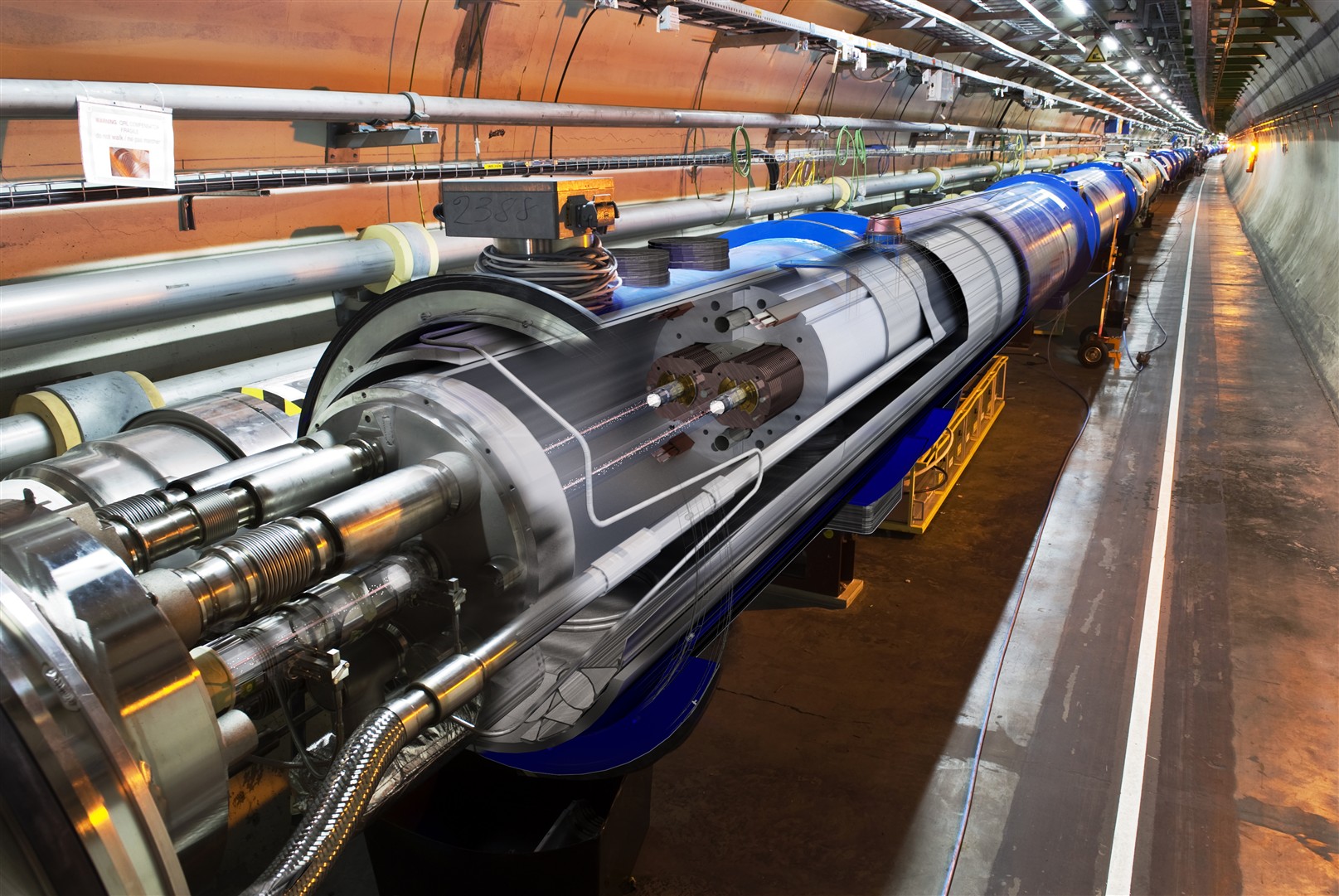
Recent measurements from the Large Hadron Collider show a discrepancy with Standard Model predictions that may hint at entirely new realms of the universe underlying what’s described by quantum physics. Although repeated tests are required to confirm these anomalies, a confirmation would signify a turning point in our most fundamental description of particle physics to date.
Quantum physicists found in a recent study that mesons don’t decay into kaon and muon particles often enough, according to the Standard Model predictions of frequency. The authors agree that enhancing the power of the Large Hadron Collider (LHC) will reveal a new kind of particle responsible for this discrepancy. Although errors in data or theory may have caused the discrepancy, instead of a new particle, an improved LHC would prove a boon for several projects on the cutting edge of physics.
The Standard Model
The Standard Model is a well-established fundamental theory of quantum physics that describes three of the four fundamental forces believed to govern our physical reality. Quantum particles occur in two basic types, quarks and leptons. Quarks bind together in different combinations to build particles like protons and neutrons. We’re familiar with protons, neutrons, and electrons because they’re the building blocks of atoms.
The “lepton family” features heavier versions of the electron — like the muon — and the quarks can coalesce into hundreds of other composite particles. Two of these, the Bottom and Kaon mesons, were culprits in this quantum mystery. The Bottom meson (B) decays to a Kaon meson (K) accompanied by a muon (mu-) and anti-muon (mu+) particle.
The Anomaly
They found a 2.5 sigma variance, or 1 in 80 probability, “which means that, in the absence of unexpected effects, i.e. new physics, a distribution more deviant than observed would be produced about 1.25 percent of the time,” Professor Spencer Klein, senior scientist at Lawrence Berkeley National Laboratory, told Futurism. Klein was not involved in the study.
This means the frequency of mesons decaying into strange quarks during the LHC proton-collision tests fell a little below the expected frequency.
“The tension here is that, with a 2.5 sigma [or standard deviation from the normal decay rate], either the data is off by a little bit, the theory is off by a little bit, or it’s a hint of something beyond the standard model,” Klein said. “I would say, naïvely, one of the first two is correct.”
To Klein, this variance is inevitable considering the high volume of data run by computers for LHC operations. “With Petabyte-(1015 bytes)-sized datasets from the LHC, and with modern computers, we can make a very large number of measurements of different quantities,” Klein said. “The LHC has produced many hundreds of results. Statistically, some of them are expected to show 2.5 sigma fluctuations.” Klein noted that particle physicists usually wait for a 5-sigma fluctuation before crying wolf — corresponding to roughly a 1-in-3.5-million fluctuation in data.
These latest anomalous observations do not exist in a vacuum.
“The interesting aspect of the two taken in combination is how aligned they are with other anomalous measurements of processes involving B mesons that had been made in previous years,” Dr. Tevong You, co-author of the study and junior research fellow in theoretical physics at Gonville and Caius College, University of Cambridge, told Futurism. “These independent measurements were less clean but more significant. Altogether, the chance of measuring these different things and having them all deviate from the Standard Model in a consistent way is closer to 1 in 16000 probability, or 4 sigma,” Tevong said.
Extending the Standard Model
Barring statistical or theoretical errors, Tevong suspects that the anomalies mask the presence of entirely new particles, called leptoquarks or Z prime particles. Inside bottom mesons, quantum excitations of new particles could be interfering with normal decay frequency. In the study, researchers conclude that an upgraded LHC could confirm the existence of new particles, making a major update to the Standard Model in the process.
“It would be revolutionary for our fundamental understanding of the universe,” said Tevong. “For particle physics […] it would mean that we are peeling back another layer of Nature and continuing on a journey of discovering the most elementary building blocks. This would have implications for cosmology, since it relies on our fundamental theories for understanding the early universe,” he added. “The interplay between cosmology and particle physics has been very fruitful in the past. As for dark matter, if it emerges from the same new physics sector in which the Zprime or leptoquark is embedded, then we may also find signs of it when we explore this new sector.”
The Power to Know
So far, scientists at the LHC have only observed ghosts and anomalies hinting at particles that exist at higher energy levels. To prove their existence, physicists “need to confirm the indirect signs […], and that means being patient while the LHCb experiment gathers more data on B decays to make a more precise measurement,” Tevong said. “We will also get an independent confirmation by another experiment, Belle II, that should be coming online in the next few years. After all that, if the measurement of B decays still disagrees with the predictions of the Standard Model, then we can be confident that something beyond the Standard Model must be responsible, and that would point towards leptoquarks or Zprime particles as the explanation,” he added.
To establish their existence, physicists would then aim to produce the particles in colliders the same way Bottom mesons or Higgs bosons are produced, and watch them decay. “We need to be able to see a leptoquark or Zprime pop out of LHC collisions,” Tevong said. “The fact that we haven’t seen any such exotic particles at the LHC (so far) means that they may be too heavy, and more energy will be required to produce them. That is what we estimated in our paper: the feasibility of directly discovering leptoquarks or Zprime particles at future colliders with higher energy.”
Quantum Leap for the LHC
Seeking out new particles in the LHC isn’t a waiting game. The likelihood of observing new phenomena is directly proportional to how many new particles pop up in collisions.
“The more the particle appears the higher the chances of spotting it amongst many other background events taking place during those collisions,” Tevong explained. For the purposes of finding new particles, he likens it to searching for a needle in a haystack; it’s easier to find a needle if the haystack is filled with them, as opposed to one. “The rate of production depends on the particle’s mass and couplings: heavier particles require more energy to produce,” he said.
This is why Tevong and co-authors B.C. Allanach and Ben Gripaios recommend either extending the LHC loop’s length, thus reducing the amount of magnetic power needed to accelerate particles, or replacing the current magnets with stronger ones.
According to Tevong, the CERN laboratory is slated to keep running the LHC in present configuration until mid-2030s. Afterwards, they might upgrade the LHC’s magnets, roughly doubling its strength. In addition to souped-up magnets, the tunnel could see an enlargement from present 27 to 100 km (17 to 62 miles).
“The combined effect […] would give about seven times more energy than the LHC,” Tevong said. “The timescale for completion would be at least in the 2040s, though it is still too early to make any meaningful projections.”
If the leptoquark or Z prime anomalies are confirmed, the Standard Model has to change, Tevong reiterates.
“It is very likely that it has to change at energy scales directly accessible to the next generation of colliders, which would guarantee us answers,” he added. While noting that there’s no telling if dark matter has anything to do with the physics behind Zprimes or leptoquarks, the best we can do is seek “as many anomalous measurements as possible, whether at colliders, smaller particle physics experiments, dark matter searches, or cosmological and astrophysical observations,” he said. “Then the dream is that we may be able to form connections between various anomalies that can be linked by a single, elegant theory.”
By Susan Audrey, Shift Team Writer (theshiftnetwork.com)
Have you ever encountered a stranger who radiated such love and acceptance that you were magnetically drawn to them?
I once sat across from a man at a spiritual retreat who had a way about him I immediately wanted to emulate….
He was grounded and sure of himself –– in a humble way. He was compassionate, and there was a lightness about him, in his personality and even his appearance. It’s as if his beautiful presence was emanating an actual visible luminosity.
When the two of us completed the exercise we were doing with the group, I asked him what his secret was…
Did he spend a year in an ashram?
Did he meditate six hours a day?
Was he a mystic?
Some sort of Guru?
“I’m no longer afraid of death,” he answered. “I’m not afraid to die.”
Wow, I thought. Wouldn’t that be nice.
My further inquiries revealed this man had no terminal illness; in other words, he had no reason to hurry up the acceptance of the inevitable.
I was in awe and have thought of his graceful acceptance often.
Then…
Years later, I heard a friend, a Sufi, mention the Sufi practice of “dying before you die.”
She explained that in this tradition, this powerful phrase means to reconnect with the light within or one’s higher self or soul, while still alive, not waiting for this connection, (also considered a reconnection with the Beloved or Divine) to occur only at life’s end.
I found both perspectives –– the acceptance of physical death and the reconnection with the Beloved while still living –– intriguing and inspiring, as they each appeared to carve a path toward a more peaceful, sacred and fulfilling experience of life.
(And below I’m sharing 7 Sufi practices which can help you along on this powerful path.)
If you’re unfamiliar with it, Sufism is the mystical belief and practice which many believe originated in Islam (others believe it comes from the early Christian mystics of Syria and Egypt) in which practitioners seek to find the truth of divine love and knowledge through direct personal experience of the Beloved.
And renowned mystic-scholar Andrew Harvey has taught about the rapturous, though at times difficult, path of the Sufi for decades.
In his younger years, he undertook a 10-year-long exploration and explication of Rumi and Sufi mysticism in Paris with a group of French Sufis under the guidance of Eva De Vitray-Meyerovitch, the translator of Rumi into French.
Andrew has been known to claim that one cannot define the mystical Islamic belief and practice of Sufism.
Yet, in the spirit of its experiential nature, he assures us that we can know it for ourselves in our own broken heart, our passion for the Divine, our cries for transformation, and our hunger for a world renewed in the divine light.
And, as Andrew has passionately shared, “It is a way to the heart of hearts, to the utmost direct intense experience of one’s sacred identity.”
Yet, how can we –– whether a practicing Sufi or not –– enliven and enrich our experience of the Divine, and our spirituality, by tapping into this heart of hearts and experiencing our own sacred identity (or die before dying)?
Here are 7 Sufi-inspired practices that can draw you closer to your inner light for a more fulfilling and embodied experience of the sacred self we all hold within us:
1. Remember your connection with the Divine in the breath.
When you sit in meditation, with each breath, invite the remembrance that the Divine is present in all things.
2. Imagine a place in your heart for the Divine.
Sufi tradition believes that the innermost chamber of the heart belongs to the Divine and is representative of our oneness with the Divine. Invite yourself to focus on this place of unity within your own heart as you meditate or light a candle to honor this sacred place within.
3. When you are depressed, return to the Divine.
Many traditions, including Sufism, see our depression as a cutting ourselves off from our nurturing inner life, our connection to the Divine. We have only to return to this connection –– let the Divine essence back in –– through meditation or prayer, to help lift the clouds of our darkness.
4. Look to your nighttime dreams for wisdom and share your dreams with others.
Traditionally, Sufi’s look to their nighttime dreams for wisdom and guidance to help them along their spiritual path. There is also an emphasis on the value of sharing dreams with others –– versus self-interpretation. And, it is part of tradition to seek a final, “perfect” interpretation for a dream throughout one’s lifetime.
To gain important insights into your waking life and spiritual evolution, share your nighttime dreams with others (who you feel will safely and compassionately hold them). Looking to your dreams for guidance in this way can provide a portal to your inner life and help deepen your connection to the Divine.
5. Open to love without expectation.
It has been said that “Sufi love” is the highest form of human love. A Sufi’s devotion to the Divine includes a love that has no conditions or expectations. In the spirit of this unconditional love, one sees the “face of God” or the Divine in oneself and in everyone.
If we, as laymen, were to embrace and express this form of love, what would it be like? Invite yourself to approach a day, even an hour, in which you look for the light, the spark of the Divine, in those you encounter, and take note of the feelings that arise in your heart.
6. Honor the Divine Feminine within yourself and the greater world.
Honoring the sacredness of the Divine Feminine (the innate feminine qualities that belong to both men and women and hold our spiritual power and potential) is central to Sufism, according to Andrew Harvey.
As we remember and honor the birth, life, death attributes of the feminine, we open to the natural transformations that occur within ourselves, nature and all of life and are better able to see the sacredness in our existence. As many traditions teach, seeing this sacredness in life can not only nourish our spiritual life and enrich our daily existence but can inspire in us a greater care for others and the Earth.
Read the poetry of Rumi.Rumi is the supreme Sufi, according to Andrew. “Through his poetry, we have the most gorgeous and intense explosion of Sufi passion, love and knowledge that the world has been given.” (You can listen to Andrew read Rumi’s poetry and tell stories illuminating the way of the Sufi in the video below.)The way of the Sufi is a sacred devotional path from which we can discover many perspectives and practices to deepen and enliven our spiritual life, whether we are a practicing Sufi or not.I now wonder, though I didn’t ask, if the man with the incredibly luminous presence at the spiritual retreat might have discovered the beauty in connecting with the light of the Divine before death –– like the Sufi practice of dying before death –– to come to terms with his own impermanence.
In the video below, Andrew will show you that the treasure of the mystic knowledge of our sacred divine energy is for all of us. Each of us is the divine keeper of the treasure and has access to it.
We need only find our own way to it… and we can, if we try, weep, love and dare enough.
Mystic-Scholar Andrew Harvey on Rumi
PS – Inspired by the words and video above? If so, I invite you to download mystic-scholar Andrew Harvey’s free hour-long audio, Discovering the Sufi Way of the Beloved:
“The worst enemy of creativity is self-doubt,” said Sylvia Plath. There’s a way to access our wisdom… through our gut. Asking a simple binary question solves most creative decisions.
2. When is it enough?
“Growth for the sake of growth is the ideology of the cancer cell,” says Edward Abbey. When we’re called to make decisions of consequence, more creates confusion, it buries signal under a mountain of noise, where options become a distraction and a delaying tactic that prevents us from making clarity around why and what should be our course of action.
History doesn’t exactly repeat itself, but it does run in cycles. One of the most robust theories of such cycles was articulated by economic historian Carlota Perez, in her influential book Technological Revolutions and Financial Capital: The Dynamics of Bubbles and Golden Ages (Edward Elgar, 2002). It suggests that humanity can get through the current period of upheaval and economic malaise and enter a new “golden age” of broad economic growth, if the world’s key decision makers act in concert to help foster one.
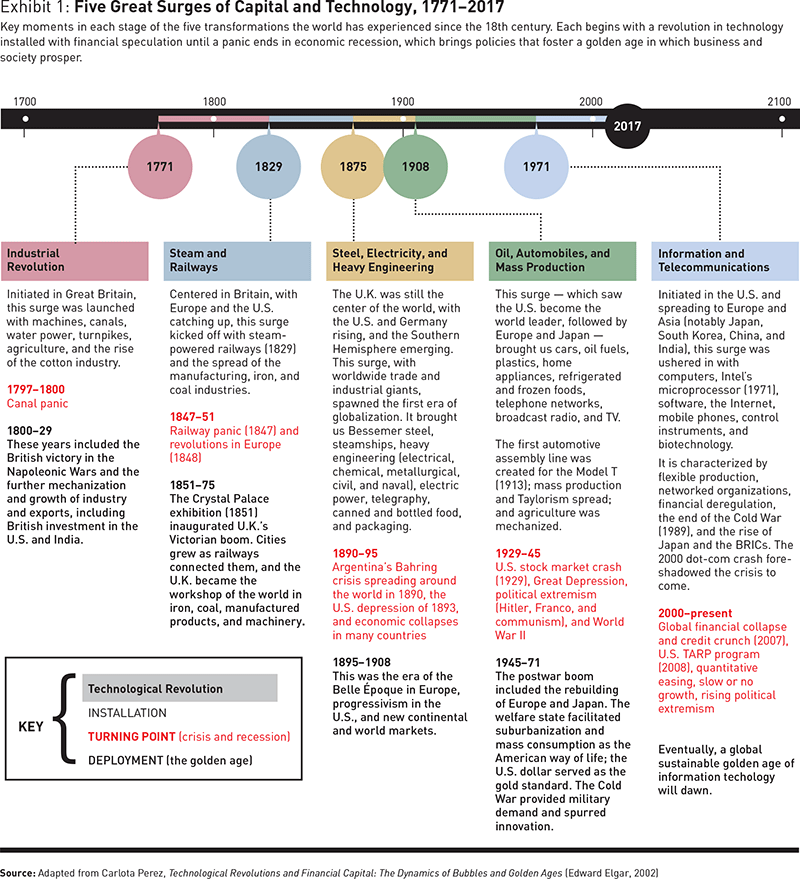
This may seem far-fetched, but it’s happened four times before. We are in the midst of the fifth great surge (as Perez calls them) of technological and economic change since the Industrial Revolution. The last one, the age of oil, automobiles, and mass production, lasted most of the 20th century and still shapes many people’s attitudes. Our current surge started around 1970 and has rolled out information and communications technology around the world: It is the age of the computer and the Internet (see Exhibit 1).
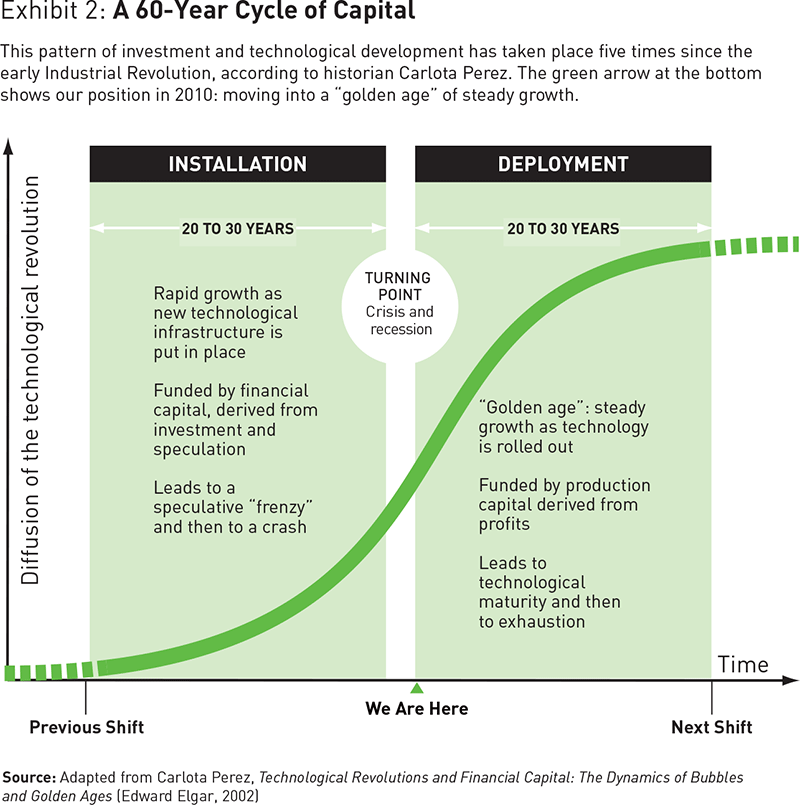
Each of these surges follows the same broad pattern. First, there is a wave of major new technologies, leading to dramatic changes in industrial production and daily life. For about 20 to 30 years, in a period that Perez calls installation, these technologies are funded largely by speculative investment chasing rapid returns. This age of widening wealth disparity leads to a bubble, which bursts in spectacular fashion, and is followed by a crisis period that Perez calls the turning point. This phase of economic and social turbulence has varied in length from two years to 17. Many efforts to get back to normal are made, usually involving the regulation of financial excesses or the stimulation of production and employment. When the crisis ends, the third part of the cycle begins; it consists of 30 years or so of stable economic growth, with a high level of genuine return on investment, and an economy funded by production capital, not speculation. Perez calls this period deployment. It is experienced as a golden age: a wave of prosperity, lifting everyone’s fortunes, including those who felt left behind just a few years before. Eventually, the technological opportunities reach exhaustion, markets become saturated, and the cycle starts all over again (see Exhibit 2).
Of course, these are broad observations, and nothing guarantees that the pattern will continue. But its overall logic is compelling. To Perez, the dramatically powerful technologies of Wall Street, Silicon Valley, and Industry 4.0 have provoked, in effect, a worldwide economic revolution, starting in the 1970s, challenging the equally powerful technologies of the fourth surge: oil, automobiles, and mass production. To turn the corner from crisis to golden age would require a major economic and political consensus: an intelligent global policy framework giving a convergent direction to investment and innovation, ensuring the growth of profitability and jobs around the world, including most major national economies. Not an easy task!
The participants in this roundtable were three longtime observers of the Perez hypothesis — including Carlota Perez. We met recently to consider this question: Given today’s political turbulence, after at least 10 years of being in the crisis phase, what would have to happen for a new golden age to begin?
—Art Kleiner
Causes of the Current Crisis
KLEINER:Carlota, according to your theory, we’re now about 45 years into a surge that began in the early 1970s. That’s the longest such cycle we’ve seen — and the longest period of crisis. PEREZ: It’s probably also the deepest transformation of everyday life, and the one that has gone the furthest globally. Also, given our longer life span, the older generation has taken longer to hand over power — in this case, to younger digital natives. Even after 40 years, the information and communications technology (ICT) revolution is far from complete. It hasn’t fully changed our way of life, as previous technological revolutions had done. And it has brought a dangerous political shift, the separation of the interests of major global corporations from interests of the national societies where they are based.
To turn the corner from crisis to golden age would require a major economic and political consensus.
During the golden age of mass production, in the 1950s and early 1960s, the interests of business and society converged. With the welfare state and suburbanization, working-class people in many Western countries could become homeowners and consumers. Therefore, when companies paid high salaries and high taxes, it all contributed to increasing domestic demand. Government support for education and health services freed up discretionary cash for people to spend on consumer products. High demand for these products created conditions for growth and profit. It was a robust positive-sum game, a super win-win between business and the majority of the population, resulting in good profits and decent livelihoods.
Then, in the 1970s, the mass production revolution hit a maturity ceiling. New products were less viable; productivity fell; markets were saturated. The welfare state became unsustainable, and national solidarity broke down. Since then, many businesses have seen their cost advantage and their customer demand migrate abroad, away from their home countries. Low salaries no longer harm business as in the past, so living standards have been declining for decades. This, together with unemployment from offshoring, goes far in explaining the Brexit referendum and the fervor of the U.S. elections in 2016.
JOHNSON: A factor that may intensify those tensions is the nature of today’s technology. We have an amazing arsenal of innovations on the threshold of realization: synthetic biology, quantum computing, blockchain, drones, autonomous vehicles, and private-citizen space travel. Potential breakthroughs are dangled before us.
But as Kentaro Toyama, the former Microsoft research director, says: “Technology is not the answer…. In project after project…information technology amplified the intent and capacity of human and institutional stakeholders, but it didn’t substitute for their deficiencies.”
The key question is the intent with which we deploy this new arsenal of technologies. And in a capitalist economy, there are two critical issues. Does an endeavor aim to increase productivity, and thus create wealth? And does it then aim to distribute that wealth among the many, rather than concentrate it among the few?
PEREZ: Those two things — wealth creation and distribution — must be combined. The new technology giants, like Google, Facebook, and Apple, along with others developing robotics and similar technologies, will comprise the highest-productivity sectors. That’s understood. But they won’t lead us to a more decent society unless they encourage distribution. Otherwise, they are unacceptable monopolies. It’s not just redistributing income that’s needed, but also fostering multiple novel job-creating activities, which historically have been associated with changes in lifestyles. (In the fourth surge, suburban living led to new jobs in retail and many other services.)
JOHNSON: I think the choice facing society is between closed economies, highly concentrated and unequal, and open economies, with decentralized ownership. But how willing are governments and large commercial institutions to break through their institutional lock-in to address these problems?


 The whole process of nature is an integrated process of immense complexity, and it’s really impossible to tell whether anything that happens in it is good or bad — because you never know what will be the consequence of the misfortune; or, you never know what will be the consequences of good fortune.