More than 11,000 scientists in 153 nations have endorsed a newly published statement on climate change — and it’s extremely gloomy.
“The climate crisis has arrived and is accelerating faster than most scientists expected,” the authors wrote. “It is more severe than anticipated, threatening natural ecosystems and the fate of humanity.”
Climate Emergency
The statement, published on Tuesday in the journal BioScience, includes decades’ worth of hard data and scientific analysis on climate trends to support the authors’ claims. It also includes a slew of concrete actions humanity could take to address climate change, from replacing fossil fuels with renewables to reducing meat consumption.
“We declare clearly and unequivocally that planet Earth is facing a climate emergency,” the scientists wrote. “To secure a sustainable future, we must change how we live. [This] entails major transformations in the ways our global society functions and interacts with natural ecosystems.”
First, this year marks the 40th anniversary of the first world climate conference. And just one day prior to the statement’s publication, the United States officially notified the United Nations that it’s leaving the Paris Climate Agreement — potentially humanity’s best hope of avoiding the disaster foreshadowed by the authors.
YELLOW SPRINGS, OH—In an attempt to extricate himself from the moribund lifestyle of his rural town, Catholic priest Father James Callahan found himself seriously considering child molestation this week as a possible avenue of being transferred to a different parish. “There’s just nothing interesting going on here, and while I’d welcome the chance to relocate, I don’t want to wait the usual five years, so I figure I’ll be accused of something with an altar boy and be packing my bags in no time,” said Callahan, who normally has no sexual predilections towards children, but after submitting several fruitless requests for transfer, decided on what he believed was the quickest way to get himself placed in a more sophisticated, urban environment. “The nearest city to here is Dayton and that’s still half an hour away, so I’m kind of going up the walls here. I’d love to end up somewhere where you can get decent sushi, but honestly, even going someplace warm for the winter would be worth being involved with a congregant’s child.” Callahan later elaborated that if he eventually got bored at the new parish, he could most likely keep on molesting kids until he was posted to a sweet gig in Rome.
Last year, for Bastille Day, I posted Three Scenes from Jacques Tati‘s classic film MonOncle. A few nights ago, I found that it’s now up, in its entirety, on You Tube – an absolutely gorgeous print, with very clear subtitles and great sound.
The story-telling is elliptical, the plot minimal, and the dialogue fairly hard to follow – even with the good subtitles. But all that’s beside the point – or rather the several true points – of this film, which are, to name just a few: the dazzling cinematography; the timing and pacing; and, as I put it last year, “the whimsical humor and run down dignity” of France in those days, and indeed of Jacques Tati himself, who moves through the variegated urban and industrial landscape with the grace of a dancer and the touch of a clown. What’s more, as Tom Keogh puts in a review posted at the Famous Clowns website, “…Tati also employs his trademark techniques with sound and production design to achieve the indefinable, comic genius of his films: the rhythmic clacking of footsteps, the cartoon-panel distance of his camera frame from the heart of the action. (Why are funny things funnier when seen from a few extra feet away?)…“ Then, of course, there’s the musical score by Alain Romans and Franck Barcellini, also whimsical and humorous, which functions as an almost constant counterpoint to – and indeed an often snarky commentary on – the main action of the film.
Well worth a viewing…
_____________
Update: Drat! Some espèce de bachi-bouzouk took it down! Still, available on Amazon for sale or rent (link). Worth a few bucks? I’d say so (but, then again, I would!). Also, lots of short clips, etc, continuing up on You Tube (link).
The Torlonia family assembled one of the world’s most important private collections of statuary. It will go on display in Rome in March, a prelude to a grand tour.
An Aladdin’s cave of classical art: Some of the 96 restored statues and busts from the Torlonia Collection in Rome that will be on public view for the first time in March. The collection, dating from the fifth century B.C. to the fourth century A.D., includes, in the foreground, a kneeling warrior and Aphrodite.Credit…Lorenzo de Masi/Fondazione Torlonia
ROME — Several of this city’s finest museums bear the names of the aristocratic families who once built majestic palazzi and stuffed them full of priceless art: the Borghese, the Barberini, the Doria Pamphilj, and more still.
But one of the world’s most precious private collections — that of the Torlonia family — has remained out of bounds, unseen by the public and known to most scholars only through its catalog, published in the late 19th century. It includes scores of busts and a veritable who’s who of classical mythology, dating from the fifth century B.C. to the fourth century A.D. Eventually the collection would swell to 620 statues depicting Greek and Roman gods, goddesses and mythical heroes, as well as portraits of Roman emperors. The catalog’s author, Pietro Ercole Visconti, described the sculptures as “an immense treasure of erudition and art, amassed in silence over the course of many, many years.”
Statue of a resting goat, Greek marble, Torlonia Collection.Credit…Lorenzo de Masi/Fondazione Torlonia
Inaccessibility fueled its mystique, and the Torlonia Collection became the stuff of legend.
After decades of negotiations and false starts, the public will be able to decide whether reality lives up to the myth when 96 statues go on display at the Palazzo Caffarelli, part of the Capitoline Museums here, in March. The exhibition, “The Torlonia Marbles. Collecting Masterpieces,” will be open for a nine-month stint, a prelude to a grand tour.
On a warm October morning, a small group of visitors, including reporters for The New York Times, had a preview of the collection in the ground-floor former granary on Via della Lungara where the Torlonia Collection was installed around 1875.
Sculptures lined the walls and peppered the floors of several brightly lit rooms that for the past three years have served as a restoration laboratory.
At a news conference after the viewing, Italy’s culture minister, Dario Franceschini, told reporters that he still felt a little giddy.
“You come out feeling stunned by so much beauty, such stupefying quality,” he said.
The art historian Salvatore Settis, the co-curator of the exhibition with Carlo Gasparri, and a former director of the Getty Research Institute in Los Angeles, played the consul Cicero on the tour for Mr. Franceschini, Mayor Virginia Raggi, sundry culture ministry authorities and their respective retinues.
Relief of a ship and port scene, Greek marble, Torlonia Collection.Credit…Lorenzo de Masi/Fondazione Torlonia
Passing through a leafy courtyard in a beehive of residential rentals owned by Torlonia family companies, Mr. Settis took a sharp right through a nondescript door and into an Aladdin’s Cave of classical art.
He paused before a relief of a ship tied to a mooring block in a harbor, found at the site of the artificial ancient Roman harbor of Portus. “It’s only been studied from photographs, no one has ever seen it,” Mr. Settis told the minister.
Many pieces of the collection were well known without having been viewed, he told reporters.
“When I first entered the warehouse, I recognized dozens of pieces that I’d read about but had never seen,” he said.
An early classical statue of a divinity, the so-called Hestia Giustiniani, probably a second-century A.D. Roman copy of a Greek bronze statue circa 470 B.C., in the Torlonia Collection.Credit…Lorenzo de Masi/Fondazione Torlonia
Students of classical art would have probably recognized the so-called Hestia Giustiniani, or a bust that has been identified as portraying Euthydemus of Bactria. The collection also includes a restoration by the Baroque-era sculptor Gian Lorenzo Bernini of a Greek statue depicting a resting goat. It was as though Bernini was “competing with antiquity,” Mr. Settis said of the sculptor’s integration of the work. The curator said that he thought other works in the collection would gain fame once they were known, including the bust of a third century A.D. matron, her hand wrapped in a fine veil.
In the case of the port scene, the restoration brought to light some of the traces of color that originally adorned the surface. Brightly painted sculptures were common in antiquity, but the color rarely survived the passage of time and the tastes of later collectors, who liked their marble sparkling white.
Restoration of the sculptures — some Greek originals, others Roman copies of Greek statues as well as Roman originals — began three years ago.
“The works were not in critical condition, but they were very dirty,” mostly layers of dust that had settled over the years, Mr. Settis explained. The restoration, which was commissioned by the Torlonia family and sponsored by the Bulgari jewelry company, was carried out under the watchful eye of culture ministry experts to “return them to the splendor of antiquity,” the curator said.
In a video on the website of the Torlonia Foundation, the chief restorer, Anna Maria Carruba, frees a statue from a papier-mâché shell imbued with a solvent, and then gently cleans the surface with soft sponges and a toothbrush.
“This has been the most wonderful restoration commission of my life,” she told Ms. Raggi, the mayor, explaining how her team had documented each individual intervention on the statues over the centuries. Ms. Carruba has been working for a decade on the Torlonia Collection.
Elena Cagnoni, a restorer, working on the Torlonia Vase, a neo-Attic Roman creation and one of the largest known antique vases.Credit…Lorenzo de Masi/Fondazione Torlonia
Different eras used different materials to restore and integrate classical works, and these often left visible traces, she explained. “We’ll do the same, only our materials are more suitable,” she said.
The collection was formed in the 19th century when the Torlonia began acquiring antiquities as befitting Rome’s noble families.
The first lot acquired by the family, at public auction, belonged to the 18th-century restorer and sculptor Bartolomeo Cavaceppi, and included ancient statues and sarcophagi, along with terra cotta vases and bronzes that ended up decorating some of the Torlonia family villas. In 1825, the Torlonias acquired 270 works amassed by the 17th-century nobleman and art collector Vincenzo Giustiniani, an admirer of Caravaggio. At the same time, the collection swelled with works found during excavations on Torlonia properties around Rome. In 1866, the family bought the Villa Albani with its collection. It can be visited by appointment.
In 1875, Prince Alessandro Torlonia decided to found a museum on the Via della Lungara. The collection was open only to small groups of visitors, while scholars had sporadic access. In more recent decades, negotiations between the family and the Italian culture authorities to find a suitable showcase for the works never panned out.
In 2014, a descendant, Prince Alessandro Torlonia, created a foundation to promote the collection. Two years later, he and Mr. Franceschini signed an accord to exhibit part of it. The prince died in 2017, but the foundation carried on his wishes.
A group of restored statues: in the foreground two statues of Isis in marble and in the background busts of emperors.Credit…Lorenzo de Masi/Fondazione Torlonia
As the Torlonia sculptures are a “collection of collections,” Mr. Settis explained, the exhibit in the Palazzo Caffarelli will showcase both the collection and the collecting practices of the Roman nobility from the 15th century on.
Under the terms of the accord the 96 statues on show in Rome will travel to museums around the world, though they have not been chosen yet.
The restoration laboratory, which includes a makeshift photo studio, takes up just a portion of the many rooms where the collection is stored. In the dark, sculptures wait for their turn to be scrubbed.
Statue of a Bacchante, ready for her close-up.Credit…Lorenzo de Masi/Fondazione Torlonia
To this viewer, the most striking were the dozens of busts: expressive and moving portraits of long dead Romans, famous and not.
“Is there another Augustus?” asked Jean-Christophe Babin, chief executive of Bulgari, referring to the first Roman emperor.
Mr. Settis said the Torlonia had collected some 180 busts, making it one of the biggest collections of Roman portraiture in the world. Some are of “great quality,” he said.
Italian officials are now seeking a site where the collection can be permanently displayed, so that the Torlonia, like other noble families, will have a museum of their own.
“This is a story with a happy ending,” Mr. Settis said.
The Torlonia Collection, in a former granary, includes a restored statue of Meleagrus, a hero from Greek mythology.Credit…Lorenzo de Masi/Fondazione Torlonia
Elisabetta Povoledo has been writing about Italy for nearly three decades, and has been working for The Times and its affiliates since 1992. @EPovoledo • FacebookA version of this article appears in print on Oct. 29, 2019, Section C, Page 1 of the New York edition with the headline: The Stuff of Legend Sees the Light of Day. Order Reprints | Today’s Paper | Subscribe
By Cassandra Landry Oct. 24, 2019 (SFchronicle.com)
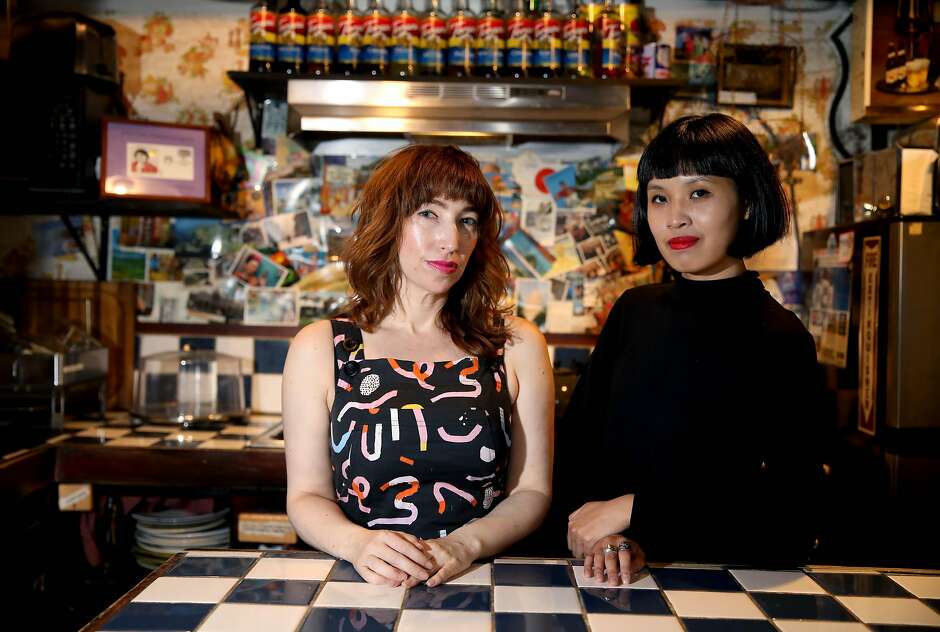
Melissa Graeber (left) and Helen Tseng at the S.F. studio where they host the “Astral Projection Radio Hour,” a weekly radio show about astrology, spirituality and witchcraft.Photo: Yalonda M. James / The Chronicle
It’s a Tuesday, and I’m standing on the curb outside one of San Francisco’s remaining magic portals.
An errant pigeon, buffeted toward my head by a sudden gust of wind, thrusts out its scaly talons like an airplane seeking a runway. Iron gates screak and clang, a bus wheezes as it rumbles past. The air is all hot pavement, ghosts of cigarettes past and cinnamon. There’s a wet, formative gurgle as someone down the block hocks a magnificent wad of phlegm into the street. (Ah. The incantations of the city!)
Through this portal (another clang for good measure), up a flight of stairs and down the burrowing hallways of this gallery-treehouse-work space, I’ve arrived at the heart of the Secret Alley, the cozy Mission headquarters of community radio station BFF.fm. I’m here to listen in on its witchiest DJs: Shewolfe (“lupine shapeshifter and spatial conjurer with advanced degrees in talismanic magic and sacred geometries,” reads an early bio) and Beatrix Gravesguard (“snackstrologer, scholar of ancient curses and head counselor at the home for wayward witches”).
Helen Tseng and Melissa Graeber, respectively, have hosted the station’s “Astral Projection Radio Hour,” a show devoted to the playfully occult and mystically inclined corners of life, every week for the past five years. The duo are also co-authors of “The Astrological Grimoire: Timeless Horoscopes, Modern Rituals, and Creative Altars for Self-Discovery,” which came out in the spring.
The book is less of a collection of horoscopes and more a choose-your-own-adventure guide to intuition organized by astrological sign. It’s well-designed, expansively considered and approachable — yet it still emits a low hum of mystery when you page through it.
Astrology “has re-entered popular culture as an inclusive and intersectional tool for self-reflection, as part of a growing DIY spiritualism,” the book opens. “In an era where few things remain constant, the night sky is a reliable presence with a powerful narrative, eternally reminding us of the vast and awe-inspiring mysteries of the universe and our deep subatomic kinship with its beginnings.”
This — the spiritualism created in our own image, the search for a toehold of understanding in this crazy world — is why I’ve come to the Astral Projection doorstep. That search may not be new, but it has begun to feel urgent.
Helen Tseng and Melissa Graeber work at the Secret Alley in San Francisco, Calif., on Tuesday, October 1, 2019. They are the hosts of the Astral Projection Radio Hour, a weekly radio show about astrology, spirituality and witchcraft that records at the Secret Alley in the Mission.Photo: Yalonda M. James / The Chronicle
Nestled in the BFF.fm studio — half activist bunker and half library of your quirky great-uncle with eclectic tastes — Tseng sits at a soundboard, bathed in bright light from a desk lamp. “I think spirituality redefines itself as needed,” she says. “And the search for self (is) prioritized now. A lot of my curiosity comes from fear, and wanting to be in control of a situation that I know I can’t control. Maybe spirituality is making peace with that … making peace with not being able to know.”
In earlier iterations of the show, when the term “witch” was beginning to take on empowering connotations in the mainstream (2013 was declared The Year of the Witch by Vulture-ordained “Terry Gross of witches” Pam Grossman), the two put on a kind of performance as they chatted between music sets. They adopted new voices and read tweets from the 86-year-old Official Witch of Salem, Laurie Cabot.
“It’s Tuesday, wear yellow,” Graeber intones, imitating their past shows.
“Keep a ball of lint in your pocket,” Tseng says.
As the weeks passed and the episodes racked up, their shared curiosity around tarot and astrology (and cats and environmental dread) became natural avenues to explore. “We both work in creative fields. You kind of hit those ruts where you just need to shake your snow globe,” Tseng says. “Reframe, refresh.”
On the day I’m sitting in, they discuss menopause narratives, the resurgence of the “monstrous feminine” and a recent article about Millennials who moved in with nuns in Burlingame. Graeber, who has been fascinated with astrology since she was young, writes the show’s “snackoscopes,” bite-size horoscopes that suggest snacks, as well as soundtrack moods to pair with the movements of your personal universe. They’re peacefully encouraging and a little cheeky.
“I think we had this two-pronged fear of both ‘the real astrologers’ and the people of science and reason writing us off forever because we made a thing that’s based in this kind of hokey pseudo-science,” Tseng says, of publishing their book. “But it’s not meant to be a counter to rational thought or science: It’s meant as a separate way to see the world.”
Stressful times can lead to seeking solace outside the mainstream. When the mainstream is the stressor, something like astrology, which offers observations and analysis based on the position of various planets at the time of your birth, can be a balm. A cosmic “Hang in There” cat poster.
And maybe the Bay Area still digs a little mysticism. Dropping your sun sign into a conversation about work-life balance doesn’t seem so out of place in 2019. Over the past year, I’ve come to expect it.
So why exactly have these rituals, pulled from astrology, tarot, reiki or general “witchiness,” become so alluring? Have we grown more open-minded? Or simply more desperate?
“We’re in a period where we’re hungry for archetypes and narratives,” Graeber says of the larger embrace of mystical calling cards. “Astrology, tarot, the Enneagram, they all offer us stories. Historically, when we’re collectively in uncertain or unstable times, those kinds of paths tend to pop up. People want answers.”
And as with anything, when we want them, we’re usually willing to pay for them.
In April, the New York Times described Bay Area venture capitalists hovering around the “$2.1 billion ‘mystical services’ market,” betting on the surging popularity of astrology apps and Instagrammable tarot decks.
Crystals, touted by celebrities like Gwyneth Paltrow and Mary-Kate and Ashley Olsen, have found their way into skin care and water bottles and fueled exploitative mining operations in places like Myanmar and the Democratic Republic of Congo. Paired with dwindling affiliations to conventional religions, our relationship to astrology has evolved from a parlor trick into a very real road map to self-improvement and a way to cope with our current reality.
“Plenty of times, I’m like, tarot’s bulls—,” Graeber says, slipping her headphones back over her ears. “But then I pull the same card three times on three separate occasions.”
She shrugs. “If it works, it works.”
The Mission District studio where Melissa Graeber and Helen Tseng host the “Astral Projection Radio Hour.”Photo: Yalonda M. James / The Chronicle
My version of staring into the existential snarl of my own soul usually involves ruminating about normal life things, Googling them in increasingly specific phrasings and realizing that a) not only am I the only one who can answer what I’m asking, but b) the answer might not even exist.
At the end of last year, I had begun to, well, flail. Nothing that couldn’t be explained by low-grade burnout, or politics, social media consumption, boredom, or any combination thereof. I was approaching 30 and amused to discover I had become a surly who-am-I-what-is-life cliche.
Around this time, a very smart friend mentioned that she’d been for an astrology reading. Apparently, there was what amounted to a celestial rave going down in my sun sign. (Shout-out to my Capricorns.) I booked a reading and found myself in the neat, sunny San Francisco office of a woman named Sarah Fontaine.
We went through my birth chart, a printout featuring a wheel with a little spirograph at its center, studded with numbers and signs of the zodiac. We talked about habits, meditation and the aforementioned flailing, which I learned could be mostly thanks to a planetary transit dubbed the “Saturn return” — a cosmic rite of passage often associated with upheaval or personal change, marked by Saturn’s return to the same spot it held when you were born.
This will sound dramatic, but it was as if I could see the gears of self grinding away for the first time, like the Philip K. Dick short story “The Electric Ant,” where a man discovers a record of his subjective experience unspooling from a machine within his chest. Not only could I see the threads of my own life, I could see how long it might take for them to untangle. Did it tell me what I wanted to hear? Absolutely. I floated out of there, beatific.
I wanted to know what it was like to watch people have this realization, so about six months later, on a morning when Ocean Beach is swathed in fog and everyone’s hair is a little fuzzed from the mist, I visit Fontaine at home.
Astrology “has been a part of the way I look at the world since I was a teenager,” she says. “I don’t feel like it’s a belief system, really. I feel it’s the most nuanced modality for understanding the complexity of a person. It’s a hypothesis that I’m interested in working. As long as it works or I find it to be useful, I’ll use it. As soon as it doesn’t, it’s not like I’m wed to this thing.”
Fontaine avoided overtly advertising her readings until about five years ago, relying instead on word of mouth to generate clients while she ran a preschool out of her home and taught in high schools around San Francisco.
“I started asking bigger questions about my life as I approached 40,” she says. “What (did) I want to do with my time? When I got really honest with myself about that, it was helping people connect to themselves, and the mystery of all that is larger than themselves.”
These days, she’s a full-time translator to the skies, offering classes on both astrology and mindfulness meditation in addition to chart readings for individuals, couples and even families. (She’s also on Patreon, where she delivers horoscopes and essays on various topics.)
The growing popularity of astrology and mindfulness has brought in new clients, people who’ve never had a reading before and are open to it for the first time.
“It feels like more and more people are embracing a new simultaneous scientific and spiritual approach,” she says. “You see reflected what you need to see, but that’s not a bad thing. To me, it’s just another way of finding your own wisdom.”
Helen Tseng works the sound board at the studio.Photo: Yalonda M. James / The Chronicle
You’d think even a modest sampling of internet personality quizzes would put you off them forever, but I couldn’t quite resist the Enneagram. That mostly had to do with the way people talked about it — like a hallowed Myers-Briggs personality test with an eye toward spiritual growth instead of making your boss understand why you hate office pingpong tournaments.
A brief Enneagram primer: Nine interconnected “types” (ranging from the Reformer to the Peacemaker) span a spectrum of identities and form the diagram from which the model takes its name. Its origins are murky (some theories ascribe its foundation to the work of a fourth century monk), but the term “Enneagram of personality” is credited to a Bolivian philosopher named Óscar Ichazo in the post-WWII era. Interpretations of the theory flourished throughout the 1980s and ’90s and became a popular catalyst for discussion in Christian spiritual practice.
A test can be easily found online to determine where you best align, but most people can tell with just a quick glance of the summaries, which highlight the dominant fears, desires or motivations of each type.
“I don’t think we necessarily want to be put in boxes, (but we do) want help communicating who we are,” says spiritual director Dani Scoville. “Things like the Enneagram actually help move us beyond that ‘one size fits all’ mentality. It’s almost like the gateway into therapeutic work, a way where you can be empowered on your own to explore it.”
Scoville trained at the Spiritual Direction Institute at the Mercy Center, a ministry and retreat in Burlingame run by the Sisters of Mercy. Though she was the lone Millennial in her three-year program, she says the center’s broad, all-encompassing approach to spirituality is actually deeply in line with the way Millennials tend to think.
The best way to understand spiritual direction is to imagine therapy: Scoville’s directees, as they’re called, usually meet with her once a month and spend the hour examining different aspects of their spirituality through things like prayer, meditation, hiking, yoga, exploring their Enneagram type or astrological sign, or pulling a tarot card. It’s all good, and it all counts. Most of her clients are women, and all of them are Millennials. Many are “post-Christian,” Scoville explains, and looking to discern their spirituality outside of a rigid or conventional church setting. Often it’s the Enneagram, which remains popular among Christian communities, that forms a bridge.
Vibing with Enneagram types can feel, as Scoville puts it, like seeing your brain printed out for the world to see. It can be a shock, even an embarrassment, depending on what you feel it reveals about your world-view. (There’s a whole host of Instagram meme accounts devoted to this feeling. My personal favorite is @RudeAssEnneagram, run by a self-described foul-mouthed chaplain.)
“Everyone wants to know what they’re good at. Sometimes people approach the Enneagram like it’s going to be like Strengthfinders,” says Scoville of a management tool popular in Silicon Valley that highlights your strengths. “The Enneagram’s not a really great party trick because it ends up exposing how you’re protecting your ego,” she says. “You can’t go like, ‘Hey, so what’s your core fear? Being in love, being a failure, being worthless?’”
While my Enneagram type pegs me as both driven and image-conscious, with a dash of competitive hang-ups, it also provides insight on how I might channel those impulses into something more productive. (Or, in my case, loosen the death grip.) Once I began to see the same patterns, I couldn’t stop.
“For a very long time, I had this idea that working on myself was selfish. But doing the interior work is part of showing up well in the world,” Scoville says. “Maybe this is my very hopelessly optimistic heart, but I feel like when people are doing their inner work and they’re coming from a place of whole, abundant self, then they can think about showing up for other people.
“It’s a lifetime of work. It’s not a BuzzFeed quiz and now you’re this transcendent person,” she adds. “That work is hard, but it’s thrilling.”
It’s thrilling, I think, because so many of these rituals can be a form of sincere play (which people forget to mention when scoffing at their validity). It’s fun to think about your tiny, singular mark on the cosmic calendar, or how you relate to the elements. It’s fun to pull an ominous looking tarot card and guess at what it could mean in your story. And yes, it’s fun to realize you and your closest friends share the same crippling self-doubt or deeply held passion.
I do far less existential Googling these days. Not because I’ve had some kind of transcendent breakthrough, but because of the big answer at the heart of every one of these practices: The questions are the point.
Our mission is to encourage those of us willing to use laughter and humor to awaken our full (and fool) potential — so that more and more of us wake up laughing, and leave laughter in our wake.
There’s something funny — and not so funny — going on. Cellular biologist Bruce Lipton tells us crisis precipitates evolution. Looking at the multiple crises we are facing as a species as well as individually, we’d have to say the chances of precipitation are 100%. Fortunately, the technological tools are in place to create a world that works for everyone. We have the wherewithal, and now we need the aware-with-all. Now what is required is for us to cultivate two key human qualities — love and imagination — to evolve the “me OR you” civilization into a “me AND you” one.
Here are 10 guidelines to help you along your journey:
1. Be a FUNdamentalist — make sure the Fun always comes before the Mental. Realize that life is a situation comedy that will never be canceled. A laugh track has been provided, and the reason we are put in the material world is to get more material. Have a good “laughsitive” twice a day to ensure regularhilarity.
2. Remember, each of us has been given a special gift just for entering, so you are already a winner!
3. The most powerful tool on the planet today is Tell-a-Vision, in which I tell a vision to you and you tell a vision to me. That way, if we don’t like the programming we’re getting, we can change the channel.
4. Life is like photography — you use the negative to develop. No matter what adversity you face, be reassured: The Universe has us surrounded. Might as well surrender.
5. It’s true that as we go through life thinking heavy thoughts, thought particles tend to get caught between the ears and cause a condition called “truth decay.” So use mental floss twice a day, and when you’re tempted to practice “tantrum yoga,” remember what we teach in the Swami’s Absurdiveness Training Class: Don’t get even, get odd.
6. If we want world peace, we must let go of our attachments and truly live like nomads. That’s where I no mad at you and you no mad at me. That way, there’ll surely be nomadness on the planet. Peace begins with each of us. A little peace here, a little peace there, and pretty soon all the peaces will fit together to make one big peace everywhere.
7. I know great Earth changes have been predicted for the future, so if you’re looking to avoid earthquakes, my advice is simple: When you find a fault, don’t dwell on it.
8. There’s no need to change the world — all we have to do is toilet train the world and we’ll never have to change it again.
9. If you’re looking for the key to the Universe, I’ve got some good news and some bad news. The bad news: There is no key to the Universe. The good news: It was never locked.
10. Finally, everything I’ve told you is channeled. That way, if you don’t like it, it’s not my fault. But remember… Enlightenment is not a bureaucracy, so you don’t have to go through channels.
Along with serious works, writer Steve Bhaerman writes brilliant, insightful humor to heal hearts and free minds as cosmic comic Swami Beyondananda. His website is theWakeUpLaughingBlog.com.
“In my life, I have watched John Kennedy talk on television about missiles in Cuba. I saw Lyndon Johnson look Richard Russell squarely in the eye and say, ‘And we shall overcome’. I saw Richard Nixon resign and Gerald Ford tell the Congress that our long national nightmare was over. I saw Jimmy Carter talk about malaise and Ronald Reagan talk about a shining city on a hill. I saw George H.W. Bush deliver the eulogy for the Soviet bloc, and Bill Clinton comfort the survivors of Timothy McVeigh’s madness in Oklahoma City. I saw George W. Bush struggle to make sense of it all on September 11, 2001, and I saw Barack Obama sing ‘Amazing Grace’ in the wounded sanctuary of Mother Emanuel Church in Charleston, South Carolina.
These were the presidents of my lifetime. These were not perfect men. They were not perfect presidents, god knows. Not one of them was that. But they approached the job, and they took to the podium, with all the gravitas they could muster as appropriate to the job. They tried, at least, to reach for something in the presidency that was beyond their grasp as ordinary human beings. They were not all ennobled by the attempt, but they tried nonetheless.
And comes now this hopeless, vicious buffoon, and the audience of equally hopeless and vicious buffoons who laughed and cheered when he made sport of a woman whose lasting memory of the trauma she suffered is the laughter of the perpetrators. Now he comes, a man swathed in scandal, with no interest beyond what he can put in his pocket and what he can put over on a universe of suckers, and he does something like this while occupying an office that we gave him, and while endowed with a public trust that he dishonors every day he wakes up in the White House.
The scion of a multigenerational criminal enterprise, the parameters of which we are only now beginning to comprehend. A vessel for all the worst elements of the American condition. And a cheap, soulless bully besides. We never have had such a cheap counterfeit of a president* as currently occupies the office. We never have had a president* so completely deserving of scorn and yet so small in the office that it almost seems a waste of time and energy to summon up the requisite contempt.
Watch how a republic dies in the empty eyes of an empty man who feels nothing but his own imaginary greatness, and who cannot find in himself the decency simply to shut up even when it is in his best interest to do so. Presidents don’t have to be heroes to be good presidents. They just have to realize that their humanity is our common humanity and that their political commonwealth is our political commonwealth, too.
Watch him behind the seal of the President of the United States. Isn’t he a funny man? Isn’t what happened to that lady hilarious? Watch the assembled morons cheer. This is the only story now.”