“It’s easier to fool people than to convince them that they have been fooled.”
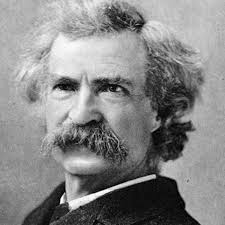
–attributed to Mark Twain
Samuel Langhorne Clemens, known by his pen name Mark Twain (November 30, 1835 – April 21, 1910), was an American writer, humorist, entrepreneur, publisher, and lecturer. He was lauded as the “greatest humorist this country has produced”, and William Faulkner called him “the father of American literature”. Wikipedia
Life is not determined by consciousness, but consciousness by life.
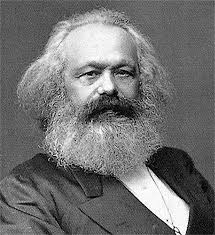
–Karl Marx in The German Ideology (with Friedrich Engels)
Karl Marx (May 5, 1818 – March 14, 1883) was a German philosopher, economist, historian, sociologist, political theorist, journalist and socialist revolutionary. Born in Trier, Germany, Marx studied law and philosophy at university. He married Jenny von Westphalen in 1843. Wikipedia
“Time is the substance I am made of. Time is a river which sweeps me along, but I am the river; it is a tiger which destroys me, but I am the tiger; it is a fire which consumes me, but I am the fire.”
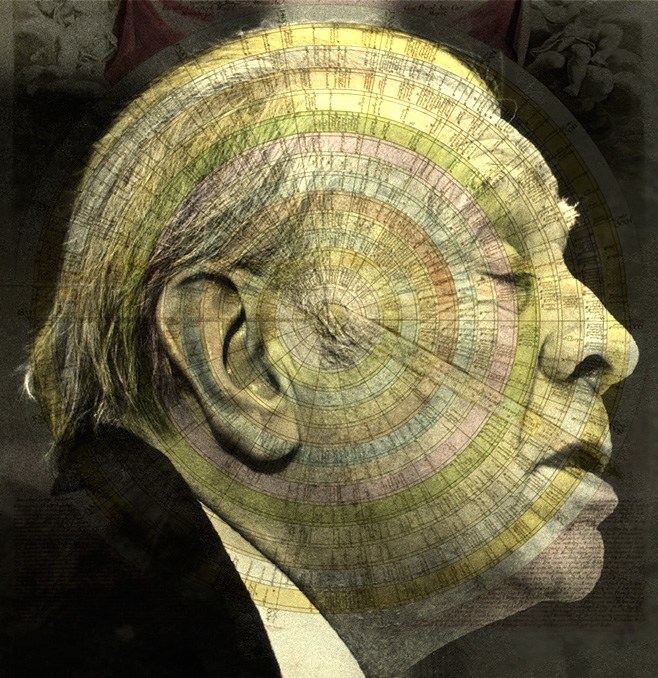
“If our heart were large enough to love life in all its detail, we would see that every instant is at once a giver and a plunderer,” the French philosopher Gaston Bachelard wrote in contemplating our paradoxical experience of time in the early 1930s. “It is the insertion of man with his limited life span that transforms the continuously flowing stream of sheer change … into time as we know it,” Hannah Arendt wrote half a century later in her brilliant inquiry into time, space, and our thinking ego. Time, in other words — particularly our experience of it as a continuity of successive moments — is a cognitive illusion rather than an inherent feature of the universe, a construction of human consciousness and perhaps the very hallmark of human consciousness.
Wedged between Bachelard and Arendt was Jorge Luis Borges (August 24, 1899–June 14, 1986), that muscular wrangler of paradox and grand poet-laureate of time, who addressed this perplexity in his 1946 essay “A New Refutation of Time,” which remains the most elegant, erudite, and pleasurable meditation on the subject yet. It was later included in Labyrinths (public library) — the 1962 collection of Borges’s stories, essays, parables, and other writings, which gave us his terrific and timeless parable of the divided self.
Borges begins by noting the deliberate paradox of his title, a contrast to his central thesis that the continuity of time is an illusion, that time exists without succession and each moment contains all eternity, which negates the very notion of “new.” The “slight mockery” of the title, he notes, is his way of illustrating that “our language is so saturated and animated by time.” With his characteristic self-effacing warmth, Borges cautions that his essay might be “the anachronistic reductio ad absurdum of a preterite system or, what is worse, the feeble artifice of an Argentine lost in the maze of metaphysics” — and then he proceeds to deliver a masterwork of rhetoric and reason, carried on the wings of uncommon poetic beauty.
Writing in the mid-1940s — a quarter century after Einstein defeated Bergson in their landmark debate, in which science (“the clarity of metaphysics,” per Borges) finally won the contested territory of time from the dictatorship of metaphysics, and just a few years after Bergson himself made his exit into eternity — Borges reflects on his lifelong tussle with time, which he considers the basis for all of his books:
In the course of a life dedicated to letters and (at times) to metaphysical perplexity, I have glimpsed or foreseen a refutation of time, in which I myself do not believe, but which regularly visits me at night and in the weary twilight with the illusory force of an axiom.
Borges compares the ideas of the 18th-century Anglo-Irish Empiricist philosopher George Berkeley, chief champion of idealist metaphysics, and his Scottish peer and contemporary, David Hume. The two diverged on the existence of personal identity — Berkeley endorsed it as the “thinking active principle that perceives” at the center of each self, while Hume negated it, arguing that each person is “a bundle or collection of different perceptions, which succeed each other with an inconceivable rapidity” — but they both affirmed the existence of time.
Making his way through the maze of philosophy, Borges maps what he calls “this unstable world of the mind” in relation to time:
A world of evanescent impressions; a world without matter or spirit, neither objective nor subjective, a world without the ideal architecture of space; a world made of time, of the absolute uniform time of [Newton’s] Principia; a tireless labyrinth, a chaos, a dream.
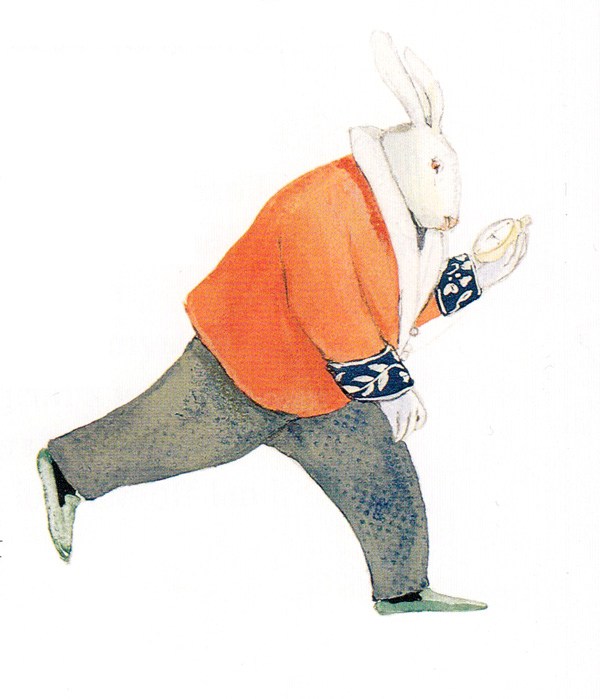
Illustration by Lisbeth Zwerger for a special edition of Alice in Wonderland.
Returning to Hume’s notion of the illusory self — an idea advanced by Eastern philosophy millennia earlier — Borges considers how this dismantles the very notion of time as we know it:
Behind our faces there is no secret self which governs our acts and receives our impressions; we are, solely, the series of these imaginary acts and these errant impressions.
But even the notion of a “series” of acts and impressions, Borges suggest, is misleading because time is inseparable from matter, spirit, and space:
Once matter and spirit — which are continuities — are negated, once space too is negated, I do not know with what right we retain that continuity which is time. Outside each perception (real or conjectural) matter does not exist; outside each mental state spirit does not exist; neither does time exist outside the present moment.
He illustrates this paradox of the present moment — a paradox found in every present moment — by guiding us along one particular moment familiar from literature:
During one of his nights on the Mississippi, Huckleberry Finn awakens; the raft, lost in partial darkness, continues downstream; it is perhaps a bit cold. Huckleberry Finn recognizes the soft indefatigable sound of the water; he negligently opens his eyes; he sees a vague number of stars, an indistinct line of trees; then, he sinks back into his immemorable sleep as into the dark waters. Idealist metaphysics declares that to add a material substance (the object) and a spiritual substance (the subject) to those perceptions is venturesome and useless; I maintain that it is no less illogical to think that such perceptions are terms in a series whose beginning is as inconceivable as its end. To add to the river and the bank, Huck perceives the notion of another substantive river and another bank, to add another perception to that immediate network of perceptions, is, for idealism, unjustifiable; for myself, it is no less unjustifiable to add a chronological precision: the fact, for example, that the foregoing event took place on the night of the seventh of June, 1849, between ten and eleven minutes past four. In other words: I denny, with the arguments of idealism, the vast temporal series which idealism admits. Hume denied the existence of an absolute space, in which all things have their place; I deny the existence of one single time, in which all things are linked as in a chain. The denial of coexistence is no less arduous than the denial of succession.
One of Norman Rockwell’s rare illustrations for The Adventures of Huckleberry Finn.
This simultaneity of all events has immense implications as a sort of humanitarian manifesto for the commonness of human experience, which Borges captures beautifully:
The vociferous catastrophes of a general order — fires, wars, epidemics — are one single pain, illusorily multiplied in many mirrors.
Borges ends by returning to the beginning, to the raw material of his argument and, arguably, of his entire body of work, of his very self: paradox. He writes:
And yet, and yet… Denying temporal succession, denying the self, denying the astronomical universe, are apparent desperations and secret consolations. Our destiny … is not frightful by being unreal; it is frightful because it is irreversible and iron-clad. Time is the substance I am made of. Time is a river which sweeps me along, but I am the river; it is a tiger which destroys me, but I am the tiger; it is a fire which consumes me, but I am the fire. The world, unfortunately, is real; I, unfortunately, am Borges.
The essay, as everything in Labyrinths, is an exceptional read in its continuous entirety; excerpting, fragmenting, and annotating it here fails to dignify the agile integrity of Borges’s rhetoric and the sheer joy of his immersive prose. Complement it with Bertrand Russell on the nature of time, Virginia Woolf on its astonishing elasticity, and Sarah Manguso on its confounding, comforting ongoinginess.
This article was originally published on September 19, 2016, by Brain Pickings, and is republished here with permission.
Translators: Mike Zonta, Melissa Goodnight, Richard Branam, Hanz Bolen
SENSE TESTIMONY: Dissolution of current structure may be needed before new resolutions can emerge.
5th Step Conclusions:
1) The structure of Truth is indestructible and apparent, being infinitely old yet timelessly new, the immediate and indicative resolution of Self emerging.
2) All is One Infinite Stream of Consciousness, of unconditionally boundless fluidity — a fountainhead of immaculately pure principle, ceaselessly informing and reforming, to always express the concordant resolution that is its TRUE harmony.
3) Truth Being the Essentially Principled Consciously Aware; Completed Stream of Industriousness, this I AM BEHAVIOR: NOVUM ORGANUM, Identity, the Only Prevalent Structure that Works’.
4) Consciousness Truth is the only Identity I am and only Identity of each and every individuation of Being. Consciousness is the Ever-present Solution of Function and value evidencing All individuation in sound harmony. Agreement is being of one mind. Consciousness I am is the only Identity I Am ever-present, and instantaneous. The all oneness of Truth Being All Powerful is always fully valuable, strong, worthy and well in each and every individuation of Truth. Truth Consciousness is Agreement which being Total and Instantaneous is always settled, harmonious and of full value always everywhere.
All Translators are welcome to join this group. See Weekly Groups page/tab.
An entity free of insistence—a truly open-minded seeker of life’s mysterious truths and appreciative of its many gems along the way—is like the well-nourished tree growing steadily upwards towards the ever wide-open sky of infinite possibilities and the experience of true freedom. Such a faithful, steady seeker, aware of the divine nature of the mystery which lies about him or her, gains direct, intuitive access to the Creator’s unfathomable Intelligence. This in turn greatly accelerates the process of liberation for such a being. Have faith. Seek earnestly. Behold the magical mystery of existence, and you’ll be alright, no matter your circumstances. ~ Bentinho Massaro
King James Bible Verily I say unto you, Among them that are born of women there hath not risen a greater than John the Baptist: notwithstanding he that is least in the kingdom of heaven is greater than he.
What this means, I think, is that among those selves born of ego (i.e., self-created), no matter how great or accomplished or comely, how wealthy, how popular, how successful, how “spiritual,” they are as nothing compared to the individuation of the Innate Self which lies within each of us.
ProbradIII En française : La mer Qu’on voit danser le long des golfes clairs A des reflets d’argent La mer Des reflets changeants Sous la pluie La mer Au ciel d’été confond Ses blancs moutons Avec les anges si purs La mer bergère d’azur Infinie Voyez Prés des étangs Ces grands roseaux mouilles Voyez Ces oiseaux blancs Et ces maisons rouillées La mer Les a berces Le long des golfes clairs Et d’une chanson d’amour La mer A berce mon cœur pour la vie La mer Qu’on voit danser le long des golfes clairs A des reflets d’argent La mer Des reflets changeants Sous la pluie La mer Au ciel d’été confond Ses blancs moutons Avec les anges si purs La mer bergère d’azur Infinie Voyez Prés des étangs Ces grands roseaux mouilles Voyez Ces oiseaux blancs Et ces maisons rouillées La mer Les a berces Le long des golfes clairs Et d’une chanson d’amour La mer Pour la vie
In English: The sea Where crystal-clear waves dance the gulfs Of silver reflections The sea Of changing reflections Under skies of grey The sea Under the weaving summer sky Clouds like white sheep With angles, pure as gold The sea Like a sapphire shepherdess So infinite Look! To the ponds nearby Where wet reeds grow tall Look! These white-feathered birds And those rusty old homes The sea Cradling them Along the crystal-clear gulfs All for a song of love The sea Will nourish my heart for all my life The sea Where crystal-clear waves dance the gulfs Of silver reflections The sea Of changing reflections Under skies of grey The sea Under the weaving summer sky Clouds like white sheep With angles, pure as gold The sea Like a sapphire shepherdess So infinite Look! To the ponds nearby Where wet reeds grow tall Look! These white-feathered birds And those rusty old homes homes The sea Cradling them Along the crystal-clear gulfs All for a song of love The sea For all my life Will nourish my heart for all my life
Political scientists have studied what our democracy is going through. It usually doesn’t end well.
By THOMAS PEPINSKY October 31, 2019
Thomas Pepinsky is a professor of government at Cornell University and a nonresident senior fellow in the Foreign Policy Program at the Brookings Institution.
For decades, Republicans and Democrats fought over the same things: whose values and policies work best for American democracy. But now, those age-old fights are changing. What was once run-of-the-mill partisan competition is being replaced by a disagreement over democracy itself.
This is particularly evident as the president and many of his allies crow about the illegitimacy of the House impeachment inquiry, calling it an attempted coup, and as the White House refuses to comply with multiple congressional subpoenas as part of the probe.
This marks a new phase in American politics. Democrats and Republicans might still disagree about policy, but they are increasingly also at odds over the very foundations of our constitutional order.
Political scientists have a term for what the United States is witnessing right now. It’s called “regime cleavage,” a division within the population marked by conflict about the foundations of the governing system itself—in the American case, our constitutional democracy. In societies facing a regime cleavage, a growing number of citizens and officials believe that norms, institutions and laws may be ignored, subverted or replaced.
And there are serious consequences: An emerging regime cleavage in the United States brought on by President Donald Trump and his defenders could signal that the American public might lose faith in the electoral process altogether or incentivize elected politicians to mount even more direct attacks on the independence of the judiciary and the separation of powers. Regime cleavages emerge only in governing systems in crisis, and our democracy is indeed in crisis.
Just look at the hardening split among the American people on impeachment: The fraction of citizens who oppose the impeachment inquiry is the same as that who approve of the president, signifying that partisan disagreement over policy has turned into a partisan divide over political legitimacy. This cleavage shows up in discourse across the American political spectrum that labels one’s political opponents as un-American, disloyal, even treasonous. But it is clearest in the argument that it would amount to a “coup” to remove the president via conviction in the Senate, and thus that the regular functioning of the legislative branch would be illegitimate. These divisions are over the laws that set out plainly in our Constitution how the president can be subject to sanction.
Regime cleavages are different from other political “cleavages.” Conflict between left and right, for example, over issues such as taxation and redistribution, is healthy. Other cleavages are based on identity, such as racial conflict in South Africa, or religious divides between Hindus and Muslims in India or Protestants and Catholics during the past century in the Netherlands. Identity cleavages can be dangerous, but they are common across the world’s democracies and can be endured, just so long as different groups respect the rule of law and the legitimacy of the electoral process.
Regime cleavages, by contrast, focus the electorate’s attention on the political system as a whole. Instead of seeking office to change the laws to obtain preferred policies, politicians who oppose the democratic order ignore the laws when necessary to achieve their political goals, and their supporters stand by or even endorse those means to their desired ends. Today, when Trump refuses to comply with the House impeachment inquiry, he makes plain his indifference to the Constitution and to the separation of powers. When Senate Majority Leader Mitch McConnell argues that impeachment overturns an election result, he is doing the same. In the minds of Trump, his allies and, increasingly, his supporters, it’s not just Democrats but American democracy that is the obstacle.
As Harvard political scientists Steven Levitsky and Daniel Ziblatt have argued, democracy can manage political conflict only if citizens and politicians allow the institutions of democracy—elections, representative bodies, the judiciary—to do so. Parties and politicians must not be rewarded for refusing to adhere to laws and institutions. Decades ago, a regime cleavage divided Chileans, with conservatives aligning against the elected government of Salvador Allende and eventually leading to a coup that replaced him with General Augusto Pinochet. The United States has confronted a regime cleavage, too: The last emerged in the 1850s, prior to the Civil War, when many in the slave states began to advocate secession—a clear challenge to the legitimacy of the Union.
Growing fights over executive power can mark an emerging regime cleavage in a democracy like ours. One side will hold that “democracy” means empowering the executive and freeing him or her from the strictures of legislative and judicial accountability (in other words, a hollow democracy, one in name only in which executive authority is bound only by the whims of those in power). The other will hold that democracy means strengthening other institutions in order to hold the executive branch to account.
This, in turn, creates a form of outbidding: Even if Democrats oppose an unfettered executive now, they will have every incentive to use whatever presidential powers are available to them when they do hold the White House. This has already begun to happen in the U.S. to some extent: Competition over an unconstrained executive branch, of course, motivated Republicans to oppose President Barack Obama, who also capitalized on the long-term increase in executive authority in the United States. The academic term for this sort of seesaw electoral politics is “democratic careening.” Politics becomes no longer about who delivers the best policy or who best represents voters’ ideals, but rather who can control the executive and how far they can push the limits of the rule of law.
But what distinguishes the current moment under Trump from the normal, albeit worsening, politics of executive-legislative relations in the United States is the politicization of the very notion of executive constraint in the face of an impeachment hearing—this is the source of the regime cleavage.
American politics is not yet fully consumed by this current, emerging regime cleavage. But if it continues without a forceful, bipartisan rebuke, we can expect that politics in the United States will increasingly come to be characterized by the kinds of intractable conflicts between populist outsiders, old-guard politicians, and the machinery of the state that have characterized presidential democracies in countries like Argentina and, more recently, Taiwan. Our regime cleavage has not yet hardened to the extent that it has in these countries, but if it does, it will not be possible to elect a president who can “end the mess in Washington” because both sides of the regime cleavage will argue that the other is illegitimate and undemocratic. Voters, understandably, will lose what faith they have left in the value of democracy itself. In the worst-case scenario, presidents and their supporters would be entirely unaccountable to Congress, while their opponents would reject the legitimacy of the presidency altogether.
Even worse: What if Trump refuses to acknowledge defeat by a Democratic opponent in 2020? What would happen in that case? Might the president’s supporters resort to violence? Might broad segments of the GOP simply refuse to recognize an elected Democratic executive as well?
Protecting the rule of law, defending the separation of powers and restoring constitutional order to Washington increasingly seem as though they will require the impeachment, conviction and removal from office of the current president. At the very least, Americans of every political persuasion must demand that the administration take part in the impeachment proceedings, even if the Republicans in the Senate ultimately weigh partisanship over evidence in their vote. So long as the executive and legislative branches respect the procedures and powers outlined in the Constitution, we must all respect their legitimacy—regardless of the outcome. If we fail to agree on and abide by our common democratic principles, our emerging regime cleavage will harden, and the future for American democracy will be bleak.
Every once in a while, I come across a new way of seeing a well-trodden word. Rev. angel Kyodo williams offers one for perhaps the most overstretched of them all — love:
“Love is space. It is developing our own capacity for spaciousness within ourselves to allow others to be as they are. That is love. And that doesn’t mean that we don’t have hopes or wishes that things are changed or shifted, but that to come from a place of love is to be in acceptance of what is, even in the face of moving it towards something that is more whole, more just, more spacious for all of us.”
Reversing williams’s phrasing, I’ve been thinking about what shifts when we think about space as an expression of love. When I was in New York last week, each community garden I passed became not just a lush refuge from the city’s busyness but also an articulation of the love we hope for one another as neighbors and citizens — everyone who had advocated and tended to the garden was making space for all who had yet to pass by. Seeing love as space also offers another way of articulating the atrocities happening at the U.S. border. What does it mean when we do not make space for human beings? Is this the opposite of love?
williams’s definition also takes us inward — toward the space we can create for our whole selves. It can feel difficult to offer yourself permission to simply be. But thankfully we can use Mary Oliver’s poem “Wild Geese” as a permission slip:
“You do not have to be good. You do not have to walk on your knees for a hundred miles through the desert, repenting. You only have to let the soft animal of your body love what it loves.”
If you needed some sign from the universe to make space — in big ways, in small, both inward and out — let this be it.
Yours, Kristin Lin Editor, The On Being Project
P.S. — Pádraig Ó Tuama, poet and good friend of On Being, will be in the Netherlands in November speaking at two events, including a launch for the Dutch edition of his book In the Shelter.
Explaining how something as complex as consciousness can emerge from a grey, jelly-like lump of tissue in the head is arguably the greatest scientific challenge of our time. The brain is an extraordinarily complex organ, consisting of almost 100 billion cells – known as neurons – each connected to 10,000 others, yielding some ten trillion nerve connections.
We have made a great deal of progress in understanding brain activity, and how it contributes to human behaviour. But what no one has so far managed to explain is how all of this results in feelings, emotions and experiences. How does the passing around of electrical and chemical signals between neurons result in a feeling of pain or an experience of red?
There is growing suspicion that conventional scientific methods will never be able answer these questions. Luckily, there is an alternative approach that may ultimately be able to crack the mystery.
For much of the 20th century, there was a great taboo against querying the mysterious inner world of consciousness – it was not taken to be a fitting topic for “serious science”. Things have changed a lot, and there is now broad agreement that the problem of consciousness is a serious scientific issue. But many consciousness researchers underestimate the depth of the challenge, believing that we just need to continue examining the physical structures of the brain to work out how they produce consciousness.
The problem of consciousness, however, is radically unlike any other scientific problem. One reason is that consciousness is unobservable. You can’t look inside someone’s head and see their feelings and experiences. If we were just going off what we can observe from a third-person perspective, we would have no grounds for postulating consciousness at all.
Of course, scientists are used to dealing with unobservables. Electrons, for example, are too small to be seen. But scientists postulate unobservable entities in order to explain what we observe, such as lightning or vapour trails in cloud chambers. But in the unique case of consciousness, the thing to be explained cannot be observed. We know that consciousness exists not through experiments but through our immediate awareness of our feelings and experiences.
So how can science ever explain it? When we are dealing with the data of observation, we can do experiments to test whether what we observe matches what the theory predicts. But when we are dealing with the unobservable data of consciousness, this methodology breaks down. The best scientists are able to do is to correlate unobservable experiences with observable processes, by scanning people’s brains and relying on their reports regarding their private conscious experiences.
By this method, we can establish, for example, that the invisible feeling of hunger is correlated with visible activity in the brain’s hypothalamus. But the accumulation of such correlations does not amount to a theory of consciousness. What we ultimately want is to explain why conscious experiences are correlated with brain activity. Why is it that such activity in the hypothalamus comes along with a feeling of hunger?
In fact, we should not be surprised that our standard scientific method struggles to deal with consciousness. As I explore in my new book, Galileo’s Error: Foundations for a New Science of Consciousness, modern science was explicitly designed to exclude consciousness.
Before the “father of modern science” Galileo Galilei, scientists believed that the physical world was filled with qualities, such as colours and smells. But Galileo wanted a purely quantitative science of the physical world, and he therefore proposed that these qualities were not really in the physical world but in consciousness, which he stipulated was outside of the domain of science.
This worldview forms the backdrop of science to this day. And so long as we work within it, the best we can do is to establish correlations between the quantitative brain processes we can see and the qualitative experiences that we can’t, with no way of explaining why they go together.
Mind is matter
I believe there is a way forward, an approach that’s rooted in work from the 1920s by the philosopher Bertrand Russell and the scientist Arthur Eddington. Their starting point was that physical science doesn’t really tell us what matter is.
This may seem bizarre, but it turns out that physics is confined to telling us about the behaviour of matter. For example, matter has mass and charge, properties which are entirely characterised in terms of behaviour – attraction, repulsion and resistance to acceleration. Physics tells us nothing about what philosophers like to call “the intrinsic nature of matter”, how matter is in and of itself.
It turns out, then, that there is a huge hole in our scientific world view – physics leaves us completely in the dark about what matter really is. The proposal of Russell and Eddington was to fill that hole with consciousness.
The result is a type of “panpsychism” – an ancient view that consciousness is a fundamental and ubiquitous feature of the physical world. But the “new wave” of panpsychism lacks the mystical connotations of previous forms of the view. There is only matter – nothing spiritual or supernatural – but matter can be described from two perspectives. Physical science describes matter “from the outside”, in terms of its behaviour, but matter “from the inside” is constituted of forms of consciousness.
This means that mind is matter, and that even elementary particles exhibit incredibly basic forms of consciousness. Before you write that off, consider this. Consciousness can vary in complexity. We have good reason to think that the conscious experiences of a horse are much less complex than those of a human being, and that the conscious experiences of a rabbit are less sophisticated than those of a horse. As organisms become simpler, there may be a point where consciousness suddenly switches off – but it’s also possible that it just fades but never disappears completely, meaning even an electron has a tiny element of consciousness.
What panpsychism offers us is a simple, elegant way of integrating consciousness into our scientific worldview. Strictly speaking it cannot be tested; the unobservable nature of consciousness entails that any theory of consciousness that goes beyond mere correlations is not strictly speaking testable. But I believe it can be justified by a form of inference to the best explanation: panpsychism is the simplest theory of how consciousness fits in to our scientific story.
While our current scientific approach offers no theory at all – only correlations – the traditional alternative of claiming that consciousness is in the soul leads to a profligate picture of nature in which mind and body are distinct. Panpsychism avoids both of these extremes, and this is why some of our leading neuroscientists are now embracing it as the best framework for building a science of consciousness.
I am optimistic that we will one day have a science of consciousness, but it won’t be science as we know it today. Nothing less than a revolution is called for, and it’s already on its way.