FRONTLINE investigates the promise and perils of artificial intelligence, from fears about work and privacy to rivalry between the U.S. and China. The documentary traces a new industrial revolution that will reshape and disrupt our lives, our jobs and our world, and allow the emergence of the surveillance society.
It’s Coming – Calvin’s Learning Circle The Cultural History Series .
By Calvin Harris
When I am asked about whether a person should take the Calvin’s Learning Circle Series of Cultural History classes or not. I say: “If you are interested in becoming a History Major or Scholar this course is not for you. But if you feel a curiosity to see and know how history has shaped your life; if you have a passion for the elements of change and inventiveness; or a playful sense of reinvention of your life; then these classes could speak to you.”
The Cultural History course will address people, places, dates, and events. Use of insightful tools such as group discussions, note-taking, and journaling will be encouraged, you can come upon life changing insights but in the end its really about you and what you do.
Let’s look a little closer, come along with me as we thrust back in time to a life beyond your imagination. To Life’s mission, call it Divine intention, call it Evolution.
Let’s see what people did to escape the now into a future different than what one was born into. Here is your chance to venture beyond the familiar and discover “Is it possible for the world to really be like the secret visions that have cajoled you since childhood?” Visions many would believe to be heresy.
In archetypal stories are you the mysterious stranger who turns up unconscious after the lightning storm of what the future could hold.If so this class will be like no other you have attended. Designed to reveal faces of the forgotten, to see those with awaken intuition: and instill a growing desire for the unusual, and to know the implacable hunter within you that has intrigued you like no other.
Cultural History #1- On-line 12 weeks, 2 hour weekly seminar – $175 – seminar spanning – January 12, 2020 through April 09, 2020. We will try and accommodate a morning and an evening class for your convenience. Registration now open and exact dates in progress. Sign up by going to: siteofcontact.net – Select the Learning Circles tab at the top of page – hit sale – then purchase and then finish the process by Writing Calvin a note telling him if you are interested in a morning or evening class at ialchemy1@gmail.com
You will receive notice of the Zoom Classroom entrance 1 week prior to start date. So, what do you have to loose, perhaps the restlessness of an idle state of mind.
Cultural History #3 returning student – On-line 12 weeks course, 2-hour Wednesday evenings Class 6-8 pm Pacific Time weekly start date – January 15, 2020 through April 02, 2020. Closed Class open only to students that have 1&2,
You will receive notice of the Zoom Classroom entrance 1 week prior to start date. So, what do you have to loose, perhaps the restlessness of an idle state of mind.
Life is a constant game of playing hide and seek with the truth.
It’s just too difficult to live in a completely honest world; the world without rationalizations, white lies, and half-truths. We can’t live in that world because it would be too painful. No one would get along with each other and most wouldn’t be able to cope with their own lives.
Today I want to talk about the lies we tell ourselves.
In my book, I refer to the “mask of rationalization” that blinds us to a better future. It blinds us to a better future because a better future requires discomfort.
Regardless of your definition of success, it won’t happen for you until you’re honest with yourself. You’ll never be honest with yourself one hundred percent of the time because it’s too painful. But if you find enough glimpses of honesty to act, you’ll move closer to whatever it is you’re looking for.
People who “make it” have that tough dialogue in their minds, expose the rationalizations, lies, and half-truths they tell to themselves.
Like I’ve said before, I don’t know what a better future means for you, but if you’re feeling stuck right now, my best bet is that you’re avoiding the truth in some shape or form.
You haven’t examined your life and had that tough conversation. You haven’t stood squarely at the fork in the road. Instead, you’re pretending like it’s not there.
Here are some of the common lies we tell ourselves to feel better in the present while at the same time sacrificing our futures.
1. I Need “X” to Feel “Y”
It’s hard to believe you already have everything you need to be happy. It’s easy to fall into the trap of thinking the next accomplishment or milestone will make you feel better. It doesn’t.
I thought when I wrote my first book I’d be content forever because I finally crossed it off my bucket list. The euphoria lasted a solid hour.
Then, I started worrying about how many copies it’d sell. The more I succeed the less full I feel, which is why I constantly remind myself that who I am right now and what I do at this moment is all I can hold onto.
When I create from a source of joy instead of neediness, my work does well. Each and every single time I push to make my work “popular” it fails. When I remember I write because I love to write, I just write. It doesn’t matter what happens after that, as long as I put the words on the page for the day.
Success comes as a by-product of being content and doing what you enjoy. It almost never happens the other way around. It’s one of the great paradoxes of life.
When it comes to your life, you’re probably thinking it needs to be fixed. You think something outside of you needs to happen to make you feel a certain way. Even if it does happen that way, the change still happened inside of you.
I wrote a book about changing from the inside out. Sure, there are sections about actions you can take, but for the most part, change happens when you change the way you view yourself and what you need to be happy, which is nothing…but your own permission.
2. The World Owes Me Something
When you question why you deserve something, sometimes it’s hard to come up with great answers.
You think you deserve success and wealth — why? What have you done to warrant either? How long have you worked for them? Have you worked for them?
You think you deserve great relationships — why? How well are you treating people? How much have you been working on yourself as opposed to wishing people fit into your definition of a good person?
We’re all self-centered. We want success, happiness, money, freedom, love, great health — we want it all. Wanting these things isn’t bad. It’s inescapable. But thinking they’re owed to you causes misery when you don’t get them.
You wouldn’t expect to make returns in the stock market without investing first, right?
Why would you expect a great return on your desires without a significant investment? Because you’re a human being — imperfect, hopeful, and forever flawed.
I’ve stopped trying to fight my humanness and my flaws. Instead, I try to be more aware of them.
When the success I want doesn’t happen when I want it to, I ask myself.
“Have I done all I can?” “Did I take shortcuts?” “Should I be patient and let things develop?”
This awareness centers me and calms me down — for about 5 seconds, a minute, an hour, or a day — then it’s back into the anxiety loop.
That’s okay. I’m not trying to cure myself. I’m trying to understand myself. Change is a process of self-awareness.
If you want to increase your awareness, think about whether or not you truly deserve what you think is owed to you.
3. There’s Nothing I Can Do
Yesterday a woman reached out to me. She told me she wondered if changing was still possible in her life at the age of 49. It’s a legitimate question.
When you live a certain way for a long period of time, you have a mountain of evidence against your case for change.
When you’ve been told over and over again in subtle ways that there’s a ceiling to what you’re capable of, it’s hard to believe you can do more.
I don’t know what happened to you or where you’re headed. But I do know this. Your past doesn’t have to dictate your future.
I spent the first five years of my 20’s getting in trouble and massively underachieving. I’ve spent the last five years living out my dream of becoming a writer, finding stability and sanity, and working harder than I’ve ever thought was possible for me.
The rock bottom moment is very real. I’ve had many of them. You can get fed up with living a certain way and change. You can do something about your situation. In fact, one of you will.
If one percent of people are truly ‘successful’, odds are at least one person who reads this is going to decide, “you know what, I’m ready. I can’t live like this anymore.”
I was talking to someone recently and in the middle of a perfectly civilized conversation about our impending doom they blurted out: “but you’re a socialist!”
Whoa. I’m not any of these things, capitalist, socialist, atheist, any-ist. I believe in three things only, disco, chocolate, and true love, and they’re all the same thing, really. My only role and goal when it comes to the world is to observe. And here’s what I see.
Capitalism and socialism might have been, once upon a time, in a mythical fairy tale of empires past, opposites — thesis and antithesis. I say “might” because I think even that is a tale told by wise old fools to keep children afraid of the dark. The genuine opposite (or maybe endpoint, if you want to think dynamically, not statically) of both pure capitalism and socialism are kleptocracy, oligarchy, authoritarianism — what results when political economies are run by and for tiny elites. We’ll come back to that.
The great lesson of the last century is very simple: first extreme socialism failed, and the Soviet empire fell. Now extreme capitalism is failing, and America is falling. Two mighty kingdoms — one single lesson: yesterday’s extremes have both failed. Cutthroat competition in every aspect of life soon becomes abuse. Enforced cooperation soon becomes unendurable. So what now? Well, surely not choosing sides in this textbook false dichotomy — which unfortunately is what many still hope to do — but transcending it.
Today capitalism and socialism are not opposites. They are complements. The global economy of this century must and will be built on new synthesis: capitalism and socialism working together, each strengthening the others’ weakness, a kind of yin and yang of human organization. We se this already at work in the world’s most successful societies, like Scandinavia or Canada.
In what specific way? Well, let’s examine reality for a moment. Capitalism is very, very good at providing people things like iPhones and craptastic summer blockbusters and dating apps and edible deodorant and designer diapers and reality TV. You might call them idle pleasures. Which I might not like, but the average person certainly does. And that’s fine. If.
If they have the basics of a genuinely good life first. What are those basics? The American right and left love to pretend as if there’s some kind of great debate, mystery, about it. There’s not. Aristotle, the Buddha, and Jesus all spelled it out millennia ago. Food, shelter, income, safety, security, opportunity. Today we might update that list with things that didn’t exist in their time, but are clearly in the same spirit: transportation, healthcare, education, environment, relationships, etc. If you think about it, no matter how much money you have, you can’t really buy such things unless a society has invested in them first.
These “things” are what I call “fundamental goods”. They are what makes a life good at its root. Through them, everyone can be happy, and grow into their potential — without them, no one can be, no matter what your latest self-help bestseller says. Without a few meals a day, a little bit of money in the bank, and your health, no amount of positive thinking can get you to happiness — nor should it. Human beings are not all born to be monks — they are born to dare, risk, defy, rebel, imagine, create. And to do all that, they need the basics. Without the basics, democracy can’t survive, society can’t cohere, people can’t flourish, and lives can’t be fully lived.
So. The two great systems of the past, learning to work together. Where do we see it happening? As I said, all over core Europe and Canada of course. There, capitalism and socialism are being mixed together in sophisticated and bold ways. Those societies are prospering because they are getting the formula of human possibility right: socialism provides the basics, and capitalism offers endless idle pleasures which only really count if you have the basics.
Where don’t we see it happening? Well, ironically, or maybe logically, in the two fallen empires of the past. America still clings to extreme capitalism, which has devolved into oligarchy — just as it has in Russia. Here, people have idle pleasures but not the basics — and for the simple reason that you can’t eat your iPhone, or educate your kids with Uber’s nonexistent benefits package, middle classes are choosing demagogues to topple the elites who have failed to provide working social contracts.
It’s a big world, and an endless future. But it’s also one with big problems. Demagoguery, extremism, inequality, instability, stagnation, mass extinction, climate change, the growing threat of war. Choose your apocalypse. These are the stakes of this troubled age.
If humanity is to survive, it’s going to have to grow. Up. It is going to have to mature beyond the simple, crude polarity of yesterday, and learn to synthesize its great lesson. Capitalism and socialism aren’t adversaries, opposites. They never really were — more yin and yang. Every thesis and antithesis yield ultimately only a new synthesis. The opposite of capitalism and socialism is oligarchy. And the new synthesis beyond oligarchy is social capitalism, or capital socialism. Whatever we call it, it is a system in which people are freer. Yes, really. In America, ironically, “freedom” has devolved to “you’ve got to compete like an animal for your life every single day of your life, or else die young.” In Soviet Russia, it devolved into much the same, by way of what was hoped to be the precise opposite: cooperate for your life, or else. But the point of synthesizing human organization beyond capitalism is that human beings no longer have to submit to those foolish non-choices, demands, little tyrannies.
For whenever we base a whole society upon one principle, value, or goal — whether it is brutal, heartless competition or cooperation — no matter how noble it may seem, that is what we have created — a kind of totalism, a little tyranny. Fealty to one thing and one thing only. That kind of a society then requires coercion, punishment, discipline — after all, what kind of a person would put an abstract ideal above his own childrens’ full bellies? Only an extremist. It cannot end up a free, thriving, and healthy place.
Human life is richer than that. And so to develop truly wealthy societies, we are learning today, that there is no one true way —or, if you like, that the one true way is that there are many things human lives need before abstract noble ideals, which count for nothing if one’s life is falling apart. Instead of puritanical ideals, there are many fundamental goods that societies must put first. Then democracy endures, freedom expands, and society itself matures.
MCLEOD GANJ, INDIA—Gripping the rim of the sink while staring at his reflection in his bathroom mirror, the Dalai Lama reportedly whispered, “New day, same bullshit,” Friday before slapping on a smile to go greet the masses. “If one more person asks me for spiritual guidance in the face of adversity, I’m going to blow my fucking brains out,” said the 14th Dalai Llama, sighing while checking his watch and reminding himself that he only needed to get through eight hours of congregating with throngs of devoted followers before he could return home to crash in front of the TV for the rest of the night. “It’s always something with these people. One of these days, some poor schmuck is gonna tell me how much I inspire him and I’ll snap. I’ll just start screaming and never stop. Pull it together, Tenzin, people are counting on you for spiritual leadership or whatever. God, I’m exhausted.” At press time, the Dalai Lama was laughing while discussing the beauty of divine benevolence in an interview with BBC News.
Winston Churchill As Prime Minister 1940-1945, Home Front: Churchill makes the victory broadcast on BBC radio, 8 May 1945. (Photo by Major Horton/ Imperial War Museums via Getty Images)
Roberts is the author of Leadership in War: Essential Lessons from Those Who Made History. He is also the bestselling author of Churchill: Walking with Destiny,The Storm of War: A New History of the Second World War, Masters and Commanders: How Four Titans Won the War in the West, 1941-1945, Waterloo: Napoleon’s Last Gamble and Napoleon: A Life, winner of the Los Angeles Times Book Prize for biography and a finalist for the Plutarch Award.
With the 2020 presidential election approaching, America is bracing to choose its next leader in a time of incredible change and upheaval. How can we recognize the kind of person we’ll need to lead us through these turbulent times? What are the qualities that a truly great American president needs? What can this person, regardless of political affiliation, learn from leaders of the past?
Energy
Many of the greatest leaders in history have been workaholics—Churchill is perhaps the most famous, though Margaret Thatcher, Helmuth von Moltke the Elder, and Marshal Ivan Konev are other examples. Churchill melded his life entirely around his job during the Second World War, taking only eight days’ proper holiday in the whole six years of conflict, six of those spent fishing in Canada and two swimming in Florida, but even on the latter trip he was attended by his red ministerial boxes and he read all the newspapers. Similarly, he was able to work almost throughout his two major bouts of pneumonia during the war. Energy is an almost demonic attribute, hard to characterize, and takes many forms. Churchill was undoubtedly energetic, and yet he often did not get out of bed until noon—and that was for a hot bath—although he had been hard working on his papers since before breakfast. “Concentration was one of the keys to his character,” recalled James Stuart, Winston Churchill’s chief whip. “It was not always obvious, but he never really thought of anything else but the job in hand.”
Ability to plan—and Adapt
A leader’s ability to plan meticulously is important, despite Moltke’s dictum that few plans last beyond the initial contact with the enemy. “Plans are worthless,” agreed Eisenhower. “Planning is everything.” It is often forgotten that one of the most successful war plans in modern history—Hitler’s blitzkrieg against the West that succeeded in knocking out France, Belgium, Luxembourg, and Holland in six weeks in May and June 1940—was not the original one. When the first set of plans fell into Allied hands by accident only days before the assault was due to be launched, Erich von Manstein drew up a new one. It was this plan B that featured the famous sickle-cut maneuver, in which concentrated armor cut the Allies off from their supply bases, the Maginot Line was skirted, the mountainous Ardennes forest—hitherto thought impassable—was used as a conduit, and the Germans broke through at Sedan in six days and reached the Channel coast at Abbeville in only ten. Few plan Bs in history have been so successful.
A Great Memory
For planning in particular and for leadership in general a good memory is useful, or failing that an excellent filing system. Churchill had a photographic memory, and not just for music-hall songs and Shakespeare. He would spend up to thirty hours memorizing his speeches and constantly practice them to make them word perfect, and would even make up ones he was not about to give but might be called upon to deliver sometime in the future. On occasion he would regale his entourage with speeches he would have given if he had been in the House of Commons at different periods of history. For a superb filing system one could hardly do better than Napoleon, who also had an excellent memory and who used his chief of staff, Marshal Berthier, to ensure that even in a carriage rattling along at full pace they were able to place geographically every unit in his army and send and receive messages as aides-de-camps rode up to the windows, grasp orders thrust through the windows, and rode off again to deliver them.
Luck
Although impossible to quantify or predict, leaders need to be lucky as well as brilliant. Before he appointed anyone to the marshalate, Napoleon also wanted to know whether his generals were lucky, and luck undoubtedly does play a large part in war leadership. The role of chance and contingency in history is worthy of an entire book in itself and undermines the Whig, Marxist, and Determinist theories of history in which mankind’s progress through time are set on any definable tramlines.
Understanding Public Sentiment
A great leader has to appreciate the political and economic terrain over which he is to campaign. Franklin Roosevelt might have wanted to bring the United States into World War Two earlier than he eventually did—such was the isolationist sentiment at the time—but in the 1940 election he still had to make his promise in Boston to American parents that ‘your boys are not going to be sent into any foreign wars,’ in order to retain the White House and face the storm that was to come. A leader has to be a realist, albeit one who appreciates the precise moment when it is possible to change public sentiment. In the event of course there was nothing foreign about the war that the Japanese unleashed on America in Hawaii on December 7, 1941. FDR had kept to the letter of his campaign promise.
In this area, Abraham Lincoln was also a supreme war leader, easily the equal of any of the nine in this book. His almost preternatural sense of what the Union would be able to accept politically, and when it would accept it, of what he could ask for and what he simply could not at any particular time, and his willingness to ride political storms, do necessary deals, sack underperforming or disloyal generals, and employ oratory of the Periclean quality of the Gettysburg Address and the two inaugural speeches, makes him second to none as a war leader in the American pantheon.
“Well-timed Unreasonableness”
“The reasonable man adapts himself to the world,” wrote George Bernard Shaw in Man and Superman, “the unreasonable one persists in trying to adapt the world to himself. Therefore all progress depends on the unreasonable man.” A talent for well-timed unreasonableness is another attribute of the great leader. Queen Elizabeth I refused to name her successor despite continuous prompting from her Privy Council, thus protecting her country from the danger of civil war. She also refused to ratify the Treaty of Edinburgh early in her reign, despite the pleadings of her closest counsellor Lord Burghley, until the threat posed by the dukes of Guise had finally diminished. Elizabeth I had many of the attributes of a great war leader, in her oratory, in her determination and as a fine picker of men.
Steady Nerves
Having steady nerves in a crisis cannot be underestimated, but can be learned. Basil Liddell Hart wrote in his 1944 book Thoughts on War that “the two qualities of mental initiative and a strong personality, or determination, go a long way towards the power of command in war—they are, indeed, the hallmark of the Great Captains.” Although Stalin had something approaching a mental breakdown when he heard about Operation Barbarossa on June 22, 1941, retiring to his dacha for days as the Red Army and Air Force were pounded on every front, by mid-October, when the Germans were at the gates of Moscow, his nerves had steadied enough for him to stay and fight it out. Charles de Gaulle’s behavior on August 25, 1944, when he attended the service of liberation in Notre-Dame while bullets were being fired within the cathedral itself, also showed rock-steady nerves. Margaret Thatcher during the Falklands crisis and after the IRA assassination attempt on her in October 1984, and Churchill throughout World War Two should similarly complete self-control in crisis moment, just as Napoleon had when his army retreated during the early stages of the Battle of Marengo. Such calm under pressure is the very quintessence of leadership.HISTORY
Inspiring Persistence
In October 1944 Patton defined leadership as a capacity for “telling somebody who thinks he is beaten that he is not beaten.” As wars are won by the victor of the last battle, the capacity for inspiring the losers of the penultimate battle is key. Here, the sheer doggedness of George Washington stands out supreme, alongside that of Churchill in 1940. Aside from the evacuation from Brooklyn across the East River in August 1776—where a weird combination of low mist and adverse wind direction somehow prevented the Royal Navy from scooping up a force that was down to only nine thousand—Washington enjoyed few successes in 1775 and 1776. As Churchill said of Dunkirk, “Wars are not won by evacuations,” but, also like Dunkirk, the sheer fact of survival and escape was in itself a victory for the American revolutionaries. Simply surviving the hardships of Valley Forge through the winter kept the cause alive and could not have been achieved without George Washington’s shining leadership by personal example. What Liddell Hart was to call “mental initiative and strong personality, or determination” was personified by Washington in that freezing winter of 1776–77, and in all the other leaders in this book. Except through heredity, one does not become a leader in the first place unless one has a strong personality.
Empathy
Understanding the psychology of others is an important part of leadership. Today it seems to be assumed that in order to lead one’s people one needs to have sprung from them, but that is not the case. Many of those who have exuded leadership ability hail from the leisured or moneyed class of their countries—Alexander the Great, Julius Caesar, Napoleon, Churchill, both Roosevelts, and John F. Kennedy among a long list of them—yet they all had a strong sense of what motivated soldiers and citizens who hailed from backgrounds far further down the social scale. A capacity to empathize is far more important than one’s class background. Churchill was born in a palace the grandson of a duke, went to one of the top schools in the country, and never took a bus in his life, but he could speak directly to the needs of what he called the cottage home. When commanding in the trenches of the Great War, he put his earlier campaigning experience to good use in always trying to ensure the men had their creature comforts, such as beer, fresh bread, and a good postal service to connect them with their families.HISTORY
Political Awareness
Leaders must have a sixth sense for politics, such as in the importance of having a feel for the coup d’œil, a sense of timing, an aptitude for observation, the gift of working out what is genuinely important as opposed to merely diversionary, a faculty for predicting an opponent’s likely behavior in differing scenarios. Of course opportunism can never be underestimated. “A statesman must,” in Otto von Bismarck’s phrase, “wait and listen until he hears the steps of God sounding through events; then leap up and grasp the hem of His garment.”
Sometimes, of course, having all these qualities is still not enough. Napoleon had a staggering number of impressive leadership qualities. He was able to compartmentalize his mind, plan meticulously with a well-trained staff under Marshal Alexandre Berthier, appreciate terrain and guess what was on the other side of the hill, time his attacks perfectly, exhibit steady nerves to his entourage, encourage esprit de corps, publish inspirational proclamations, control the news cycle, adapt to modern tactical concepts, ask the right questions, and show utter ruthlessness when necessary. His charisma was not artificially created, and until the end he enjoyed remarkable runs of good luck. Above all, perhaps, he was single-minded in spotting the moment when he could exploit a numerical advantage at the decisive point on the battlefield. Napoleon had all of these important leadership traits, but he still made the terrible error at Maloyaroslavets on October 25, 1812, of choosing the wrong direction by which to take his army out of Russia. However generous the sprites and fairies are when they gather around the great leader’s cradle with their gifts, there always seems to be a malicious one present to snatch back one gift from the cornucopia.HISTORY
If you want to know what will move hearts and command multitudes today and in the future, there is only one thing to do: Study the past. In May 1953 Churchill said, “Study history. Study history. In history lie all the secrets of statecraft,” and the same is true of statecraft’s vital subsection, war leadership. If there is one quality that all the great war leaders possessed, it is that which Lord St. Vincent ascribed to Horatio Nelson. St. Vincent did not much like his fellow admiral personally, but he readily admitted that Nelson “possessed the magic art of infusing his own spirit into others.” Great leaders are able to make soldiers and civilians believe that they are part of a purpose that matters more than even their continued existence on the planet, and that the leader’s spirit is infused into them. Whether it is a ‘magic art’ or ‘sinister genius’ can be decided by moralists, but in it lies the secret of successful leadership.
“At its best, poetic lore is like what may be heard of conversation in the dusk, from speakers far or hid, of which we get only a few broken murmurs. What is not gather’d is far more — perhaps the main thing.”
“One can’t write directly about the soul,” Virginia Woolf observed in her diary. “Looked at, it vanishes.” The same could be said of the soul of art, or perhaps of anything of substance and complexity — to write or speak about the meaning of a painting or a poem or a symphony is to flatten and impoverish its essence in some measure.
Common teachers or critics are always asking “What does it mean?” Symphony of fine musician, or sunset, or sea-waves rolling up the beach — what do they mean? Undoubtedly in the most subtle-elusive sense they mean something — as love does, and religion does, and the best poem; — but who shall fathom and define those meanings?
At its best, poetic lore is like what may be heard of conversation in the dusk, from speakers far or hid, of which we get only a few broken murmurs. What is not gather’d is far more — perhaps the main thing.
Grandest poetic passages are only to be taken at free removes, as we sometimes look for stars at night, not by gazing directly toward them, but off one side.
Do these apps truly promote Buddhist ideals or are they a product of a lucrative consumer industry?
Health benefits
As it is practiced in the U.S. today, mindfulness meditation focuses on being intensely aware, without any sort of judgment, of what one is sensing and feeling in the given moment. Mindfulness practice has been shown to counter the tendency in many of us to spend too much time planning and problem solving, which can be stressful.
Mindfulness practices, as pursued by the Buddhist apps, involve guided meditation, breathing exercises and other forms of relaxation. Clinical tests show that mindfulness relieves stress, anxiety, pain, depression, insomnia and hypertension. However, there have been few studies of mindfulness apps.
The current popular understanding of mindfulness is derived from the Buddhist concept of sati, which describes being aware of one’s body, feelings and other mental states.
In early Buddhist texts mindfulness meant not only paying attention but also remembering what the Buddha taught, so that one could discern between skillful and unskillful thoughts, feelings and actions. This would ultimately lead to liberation from the cycle of birth and death.
For example, the Buddhist text “Satipatthana Sutta” describes not only being mindful of breath and body, but also comparing one’s body to a corpse in a cemetery to appreciate the arising and ceasing of the body.
“One is mindful that the body exists, just to the extent necessary for knowledge and awareness. And one remains detached, grasping at nothing in the world,” the sutra reads.
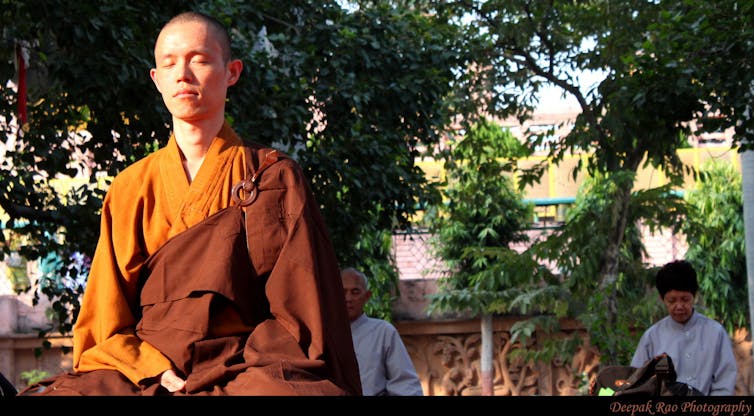
Buddhism encourages practitioners to move away from attachment to material things. Deepak Rao, CC BY-NC-ND
Here mindfulness enables one to appreciate impermanence, not become attached to material things and strive to attain greater awareness so that one can ultimately become enlightened.
Early Buddhist mindfulness practitioners were those who criticized mainstream societal values and cultural norms such as bodily beauty, family ties and material wealth.
Mindfulness apps, on the other hand, encourage people to cope with and accommodate to society. They overlook the surrounding causes and conditions of suffering and stress, which may be political, social or economic.
Americans spend over five hours each day glued to their mobile devices. Nearly 80% of Americans check their smartphones within fifteen minutes of waking up. The apps provide a way to do meditation while on the go.
There is no doubt that Buddhist apps are a reflection of real social distress. But, in our assessment, mindfulness, when stripped of all its religious elements, may distort understandings of Buddhism.
A core aspect of Buddhism is the concept of no-self: the belief that there is no unchanging, permanent self, soul or other essence. In promoting an individualistic approach to religion, then, Buddhist apps may well rub against the very grain of Buddhist practice.
Indeed, our findings show that Buddhist meditation apps are not a cure that relieves suffering in the world, but more like an opiate that hides the real symptoms of the precarious and stressful state in which many people find themselves today.
In that case, Buddhist apps, rather than curing the anxiety created by our smartphones, just make us more addicted to them and, in the end, even more stressed.
Jeff Inglis
Politics + Society Editor
Consciousness, sexuality, androgyny, futurism, space, the arts, science, astrology, democracy, humor, books, movies and more