How to Overcome Racism

Rabbi Michael Lerner By Rabbi Michael Lerner | June 10, 2020 (tikkun.org)
Protest for Justice, March for Peace

Dan Gaken

Protest for Justice, March for Peace

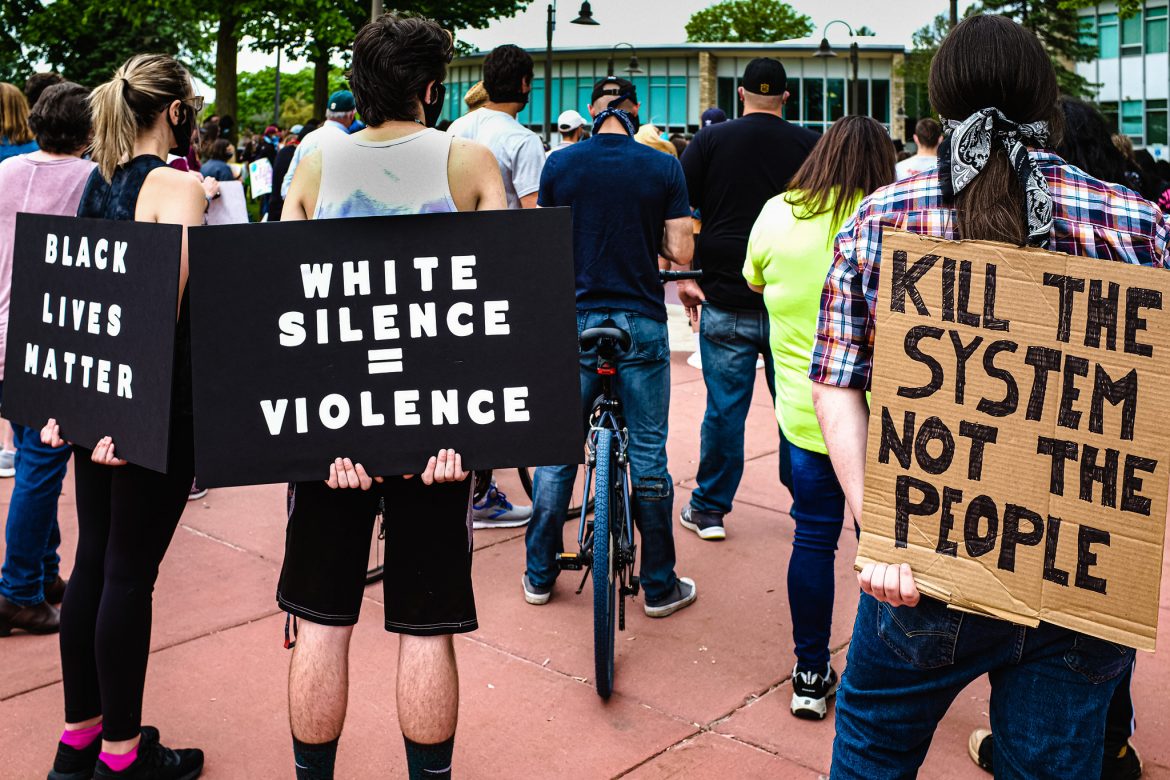
Many Americans have begun to understand that overcoming racism requires a transformation of the systems and teachings and structures of our society. Yet few have been willing to articulate exactly what changes are needed. Building on the platform of Black Lives matter, we at Tikkun, our movement for a society based on love and justice (see the book Revolutionary Love: a Political Manifesto to Heal and Transform the World), and our interfaith and secular humanist welcoming Network of Spiritual Progressives, put forward the program below as a starting point for discussion about what it would mean to change our societal arrangements to support the dismantling of racism in the 21st century. If after reading this article below you want to engage in a discussion of it, join our zoom based Torah study this coming Saturday morning where we will discuss these issues as part of the analysis of the assault on Moses for having a Black wife (or lover)–info for that at beyttikkun.org

Our anti-racist program includes creating an educational system and transforming media and the legal system so that undermining racist ideas and practices becomes one of their central goals. We will provide material support and champion those institutions and social practices that are most successful at fostering respect and caring for previous targets of racism. And we will foster education and public policies that help people understand why racism is counter to their interests and why solidarity with Black and Brown peoples and other groups that have been systematically excluded, marginalized, and targets of violence actually serves their interests and values.

If we want a loving and caring society that truly values the lives of Black and Brown peoples, and all people of color, we need to recognize and come to terms with how our country was founded and the impact of the past policies on the present. We also need to acknowledge and transform present day policies and practices that are discriminatory. The issues addressed in our Path to a World of Love and Justice are all relevant to the issues of institutional and individual racism in our society. Without a fundamental challenge to the economic and political practices of capitalist society there will always be some groups left out or left far behind, and those people will be encouraged by the most wealthy and powerful to find a scapegoat in some “other,” so it is unlikely that racism can be eliminated without this larger transformation. But, on their own, the policies we’ve suggested in the other parts of our program and even the emergence of a powerful transformative movement aimed at the goals of the New Bottom Line are inadequate to address the harm and trauma with which Black and Brown peoples live.

Even while celebrating those who have taken to the streets to protest racism, we are simultaneously witnessing at this time in history a continuation of the pervasive fear of black bodies and a denial that black lives matter; this is coupled with a rise of white terrorist and hate groups that no political party challenges, increasingly brutal and often racist police forces influenced by right-wing extremist worldviews, and the impotence of the news media and police to unveil the existence of underground hate groups that are becoming more visible and vocal. Today, blatant racism and violence, particularly against African Americans, Native Americans and Latin Americans, are manifesting in the form of extrajudicial police violence and killings, a school-to-prison pipeline that has resulted in more African American people in jails than were enslaved in the past in our country, the dumping of toxic waste and chemicals in communities where Black, Brown and low-income and poor white people live, unequal educational opportunities beginning before children even start kindergarten, and so much more.

Manifest destiny and American exceptionalism justified the genocide of Native Americans and deadens protest against present racist policies that keep Native Americans on reservations. These principles still inform and drive domestic and foreign U.S. policy resulting in oppression and violence at home and abroad. America’s ruling elite continues to use war to expand territory, to gain access to resources, and to increase its power. The military industrial complex leads to profits for private industry at the expense of the safety and welfare of Black and Brown communities at home and abroad.

Racism, however, is not only a structural problem built into the economic, political, and cultural heritage of our societal institutions, but also a psychological issue. It becomes particularly prominent when large numbers of people are alienated and in pain because they feel “dissed” by the society in which they live. They experience this pain because they buy into the ideology of the competitive marketplace with its insistence that we live in a meritocracy in which we “create our own reality” and hence we have no one to blame for the pain in our lives but ourselves. The resulting painful self-blaming is often dealt with through alcoholism, drug abuse, or other forms of addiction, but the pain remains.

In response to that pain, reactionary movements or leaders come forward and tell people that the reason for their pain is because of some “Other” (primarily African Americans or Latino/a, but also refugees of every sort, Muslims, LGBTQ people, feminists, Jews, or even all liberals or progressives). As Tikkun editor-at-large Peter Gabel puts it, racism and other forms of “othering” allow people to develop a “false self” in which they imagine themselves as worthy and powerful through seeing themselves as members of an idealized “white race” that provides them with a substitute sense of worth and value covering over their inner emptiness and sense of valuelessness. Yet because this sense of collective value is what Gabel calls “false” or imaginary, many people feel constantly under attack from an imaginary demonized “other” which in the historic context of the U.S. is African-American people, Latin, Muslims, Jews, or immigrants or refugees who they imagine are “taking over” and trying to recreate the experience of humiliation that already gives many white people deep pain and has led to the highest rate of suicides among middle aged white men. To undo this dynamic will take fundamental transformations in the way we organize our society so that people no longer feel humiliated. To move in this direction, we will need millions of people to be trained in empathic communication so they can help others dismantle their inner self-blaming, recognize that their alienation is caused by the values and daily operations of the competitive marketplace, and mobilize people to change that economic system. The Network of Spiritual Progressives offers such a training in what we call “prophetic empathy” on zoom (info and signing up to get information about the next training at spiritualprogressives.org/training).

Institutional racism is maintained also by the largely unconscious assumption of white supremacy that is internalized by many white people in white dominant societies around the world, though particularly in the U.S.. Overcoming the racism embedded in U.S. educational, legal and other systems requires white people to actively commit to becoming aware of the white supremacy that permeates their lives, exposing it, understanding how it diminishes the humanity of white people, and seeking to undo it.

We believe that the system of racism, sold to whites as “privilege,” actually hurts white people, divides them from people of color who are badly needed as allies to overcome poverty, homelessness, unfair distribution of wealth, and also demeans their own humanity and creates fear and distrust throughout their lives. No—this “privilege” of whites is actually a curse. We must not participate in a general demeaning of white people in this society or ignore the ways in which their lives have been negatively impacted by living in a society that uses racism to pit groups against one another. We refuse to perpetuate divisions based on race, class, gender, or ethnicity. We recognize that unity amongst all peoples, badly needed to overcome the variety of oppressions and distortions of living in a society based on selfishness and greed, cannot be fully achieved without dismantling racism. The vision of “a caring society” put forth in Rabbi Lerner’s book Revolutionary Love, would lift up all peoples. That requires not only a change in consciousness, but also a fundamental transformation of our economic and political systems. Keith Ellison, Attorney General of the State of Minnesota, who indicted the 4 policemen in Minneapolis who murdered George Floud, indorsed Rabbi Lerner’s book this way: “The caring society is the only realistic path for humanity to survive, and in Revolutionary Love Rabbi Lerner lays out a powerful and compassionate plan for building that caring society. I love this book. Please read it and join with others to build the movement that can enable these ideas to reshape our society that so badly needs this vision.” (To read the endorsements by Gloria Steinem, Cornel West, Medea Benjamin, Ariel Dorfman, Riane Eisler, Henry Giroux, and others, go to tikkun.org/lj).

Yet the transformation needed cannot be achieved by attempting to recreate socialist forms that speak to economic equality but miss the deeper transformations in how we relate to each other, to the Earth, and to our own inner development as loving and caring human beings. To address these systemic problems, we believe we need a New Bottom Line so that all our institutions are determined “successful” or “productive” or “rational” based on whether they prioritize the well-being and needs of the people who live in our country and the world and the planet itself, rather than whether they maximize money and power. And, in addition, we need to engage in specific activities and adopt particular policies that address the problems that constitute or unconsciously perpetuate racism.

AMONG THE STEPS A LOVING AND CARING SOCIETY WILL TAKE:
  • Reparations for slavery and the past destruction of Native American populations.
  • A guaranteed income for every adult in this society sufficient to pay for healthy food, housing in healthy living conditions, clothing, energy bills and transportation, and a “living wage” for all working people.
  • Global and Domestic Marshall Plan that re-directs monies from our Gross Domestic Product to communities that have suffered from unfair distribution of resources and wages, including white, black and brown working class people in the U.S. and around the world, and also “undocumented” workers and all migrant laborers who work in our fields, hotels, etc. who have then been deported to their native lands, separating and devastating families.
  • Equal funding for all public and private childcare centers, preschools and schools no matter where they are located in the U.S. or the income level of the families that are served by those schools. If wealthier parents are allowed to provide better schooling, better paid teachers, more options for study and for individualized attention at the schools which their children attend, their children will inevitably have greater resources than those who have gone to less funded schools. If parents know that the schools serving the poorest communities set the standards for what their own children will be offered in public and private schools, they will have a stronger incentive to make sure that all schools have these same benefits that are now primarily available to school districts with higher incomes and private schools partially financed by wealthy parents.
  • Higher level salaries for teachers who teach in communities with lower average incomes than the wealthier communities to ensure that all schools have highly qualified teachers.
  • Required courses at every level from 4th grade through college that explain to students the legacy of slavery, discrimination, classism, sexism, homophobia, anti-Semitism, and their ongoing impact on the lives of all of us today. Such courses will teach techniques to address racism, empathic communication, and insights that help in overcoming racism.
  • Media must dedicate at least one quarter of their prime time viewing to shows that aim to creatively challenging racist practices, prejudice and biases.
  • Create a truth and reconciliation commission to generate a highly visible public tribunal to put our country on a path toward truly facing and healing the legacy of slavery and the treatment and slaughter of Native Americans, and the ongoing discrimination we see today.
  • To help ensure that schools become learning environments for all children rather than school-to-prison pipelines for some, we support the adoption of restorative justice as a primary form of response to wrongdoing in schools and in the criminal justice system as a whole.
  • Funding for jobs, education, and housing for people being released from prison.
  • In recognition that many police departments have unequal policing that results in the loss of liberty and life for black and brown peoples all over this country, every community that has a police force which has faced significant numbers of complaints about systematic abuse or profiling of African Americans or other minority groups must establish a publicly-elected police review commission that has the power to fire both individual police and replace the leadership of that police force, and the ability to impose heavy civil fines or criminally indict police and police leadership for violating the civil rights of people within their jurisdiction.
  • Mandatory training for police officers in anti-racism, bias and prejudice and comprehensive screening and vetting of applicants to help ensure that police officers are not racist. Mandatory training in de-escalation and nonviolent responses when conducting stops and arrests.
  • Any surveillance equipment that police departments request must be reviewed by a civilian board that includes members of the communities that are and will be impacted. If body cameras are used, any tapes from those cameras must be made available to family and community members when an officer’s actions are in question.
  • A wholesale rethinking of policing including demilitarizing of police forces, reducing and eventually eliminating higher levels of surveillance, and creating more transparency, accountability and transformative and restorative policing and justice models.
  • Full access, guarantees and protections of the right to vote for all peoples through universal voting registration, automatic voting registration, pre-registration for 16-year-olds, same-day voter registration, voting day holidays, enfranchisement of formerly and currently incarcerated people, local and state resident voting for all undocumented people, and a ban on any disenfranchisement laws. Criminalization of all attempts by government or private organizations which seek to prevent people from voting, or from voting by mail, or by not providing adequate voting places for people of color or poor people, or undermining voting by mail, or who come up with other ways to prevent voting by people of color or other disenfranchised populations.
  • In recognition that poor and disempowered communities often bear the brunt of environmental devastation and destruction, we promote the Environmental and Social Responsibility Amendment to the U.S. Constitution that, among other things, mandates that all corporations with incomes of greater than $50 million a year have to prove, once every five years, a satisfactory history of environmental and social justice to a jury of ordinary citizens who can hear testimony from people throughout the world who are impacted by that corporations practices.
  • These are places to start. We must also encourage public celebrations of communal solidarity and caring for others not yet fully part of our communites. Through music, dance, art, rituals, and other paths that speak to the heart, we shall create a new ethos of caring across all racial, gender, religious, and national lines and unite the human race to take on our most serious challenge: repairing the environment from two hundred years of abuse.

ABOUT RABBI MICHAEL LERNER

Rabbi Michael Lerner

Rabbi Michael Lerner holds a Ph.D. in philosophy (1972) and a second Ph.D. in psychology (1977), is editor of Tikkun www.tikkun.org, executive director of the Institute for Labor and Mental Health, rabbi of Beyt Tikkun Synagogue-Without-Walls in Berkeley, chair of the international Network of Spiritual Progressives, and author of 12 books, most recently Revolutionary Love published by the University of California Press (more info about this book at www.tikkun.org/lj). Lerner was recently described by Professor Cornel West of Harvard U. as “one of the most significant prophetic public intellectuals and spiritual leaders of our generation” and Keith Ellison, Attorney General of the State of Minnesota, says: “The caring society is the only realistic path for humanity to survive, and in Revolutionary Love Rabbi Lerner lays out a powerful and compassionate plan for building that caring society.” Talking about his book Revolutionary Love, Gloria Steinem, a founding editor of Ms. Magazine, says “Michael Lerner takes the universal qualities wrongly diminished as ‘feminine’—caring, kindness, empathy, love—and dares to make them guides to a new kind of politics that can challenge the cruelty, competition, and dominance wrongly elevated as ‘masculine.’ Revolutionary Love opens our minds and hearts to a fully human way of living and governing.”

Cornel West: What It Means to Be Human

Ed Mays This talk is an edited for Free Speech TV version of the Collins Distinguished Speakers’ Lecture given April 26, 2019 at the University of Oregon titled “Race Matters…A Timely Discussion on the Fabric of America. ” The increase of racist incidents in Baltimore, Ferguson, Charlottesville and nationwide, alongside movements such as Black Lives Matter and Standing Rock, has made the need for conversations on race in the United States today one of continued urgency. Dr. Cornel West published the book ‘Race Matters’ in 1993 following the Los Angeles riots, which examined the crisis of black leadership in the United States. “We need to take a critical look at ‘We the People’ through the lens of these complicated issues and make connections about the deep questions of quality of life in this country,” he said. Cornel West is currently Professor of the Practice of Public Philosophy at Harvard University, with a joint appointment in the Harvard Divinity School and the Department of African and African American Studies. He is an ardent political activist, a keen social critic, and a prolific writer. Author of 20 books, his publications include Race Matters (1993); The Future of the Race (1996), written with Dr. Henry Louis Gates, Jr.; and The Rich and the Rest of Us: A Poverty Manifesto (2014), written with Tavis Smiley. Thanks to the Collins Fund Camera by Pirate TV contributor, Todd Boyle *************************** Pirate TV is a 58 minute weekly TV show that provides the book talk and lecture content for Free Speech TV. Pirate TV challenges the Media Blockade, bringing you independent voices, information and programming unavailable on the Corporate Sponsor-Ship. These posts are for YouTube and are usually longer than the broadcast versions. You will notice that I don’t monetize my videos. I’m irritated by constant interruptions as I’m sure are you, and I would like to have a say over sponsorship. If you would like to pitch in to support this work, consider a donation: http://www.edmaysproductions.net/pira… or PayPal: PirateTVSeattle@gmail.com

License

Creative Commons Attribution license (reuse allowed)

Paideia

From Wikipedia, the free encyclopedia

In the culture of ancient Greece and later of the Greco-Roman world at large, the term paideia (also spelled paedeia) (/paɪˈdeɪə/;[1] Greek: παιδεία, paideía) referred to the rearing and education of the ideal member of the polis or state. It incorporated both practical, subject-based schooling and a focus upon the socialization of individuals within the aristocratic order of the polis. The practical aspects of this education included subjects subsumed under the modern designation of the liberal arts (rhetoricgrammar, and philosophy are examples), as well as scientific disciplines like arithmetic and medicine. An ideal and successful member of the polis would possess intellectual, moral and physical refinement, so training in gymnastics and wrestling was valued for its effect on the body alongside the moral education which the Greeks believed was imparted by the study of musicpoetry, and philosophy. This approach to the rearing of a well-rounded Greek male was common to the Greek-speaking world, with the exception of Sparta where a rigid and militaristic form of education known as the agoge was practiced.

The idea of paideia

The Greeks considered paideia to be carried out by the aristocratic class who tended to intellectualize their culture and their ideas. The culture and the youth were “moulded” to the ideal of kalos kagathos, “beautiful and good.”

Greek paideia is the idea of perfection, of excellence. The Greek mentality was “to be always pre-eminent”; Homer records this charge of King Peleus to his son Achilles. This idea is called arete. “Arete was the central ideal of all Greek culture.”[2]

In the Iliad, Homer portrays the excellence of the physicality and courage of the Greeks and Trojans. In The Odyssey, Homer accentuates the excellence of the mind, or wit, that was also necessary for winning. Arete is a concomitant of what it meant to be a hero and a component of warfare that was necessary in order to succeed. It is the ability to “make his hands keep his head against enemies, monsters, and dangers of all kinds, and to come out victorious.”[3]

This mentality can also be seen in the Greeks’ tendency to reproduce and copy only literature that was deemed the “best”, in the Olympic games, and in literature, with competitions in poetry, tragedy, and comedy. “Arete” was infused in everything the Greeks did. The mentality of arete can be stretched even further to the competing paideias of the Greek philosophers Isocrates and Plato, who both created highly influential schools in Greece. Although both rejected the current polis education, their rivalry of rhetoric and science for leadership in the realm of education and culture became one that they could not overcome.[4] In AntidosisIsocrates was compelled to defend himself against accusations that education makes people depraved, a charge that Socrates and Plato openly discuss in Republic. In Isocrates introductory speech Against the Sophists, it is clear that he has Plato‘s ‘prospectuses’ Gorgias and Protagoras, before him, and is deliberately trying to set up his own ideal of paideia in contrast to theirs.[4]

In modern discourse, the German-American classicist Werner Jaeger, in his influential magnum opus Paideia (3 vols. from 1934; see below), uses the concept of paideia to trace the development of Greek thought and education from Homer to Demosthenes. The concept of paideia was also used by Mortimer Adler in his criticism of contemporary Western educational systems, and Lawrence A. Cremin in his histories of American education. Later in 2013, as a theoretical extension to the Contact hypothesis, the application of the concept of Paideia to cultural heritage management was introduced by Dr. Fabio Carbone, an Italian Scholar, that suggests cultural awareness of local communities (know yourself) will lead to a more effective intercultural dialogue with others and reduces prejudice and hostility towards tourists.”[5]

The golden mean

The Greeks described themselves as “Lovers of Beauty”, and they were very much attuned to aesthetics. They saw and appreciated beauty in nature. They noticed a particular proportion called the golden ratio (roughly 1.618) and its recurrence in many things. They spoke of the need for balance as the golden mean—choosing the middle and not either extreme—and believed that beauty was not in the superficialities of color, light, or shade, but in the essence of being, expressed in structure, line, and proportion.

The Greeks sought balance in all aspects of human endeavor and experience. The Golden Mean is the cultural expression of this principle throughout the Greek paideia: architecture, art, politics, and human psychology.

Isocrates’ influence

Isocrates helped in making Athens one of the leaders in Greece through his paideia. Isocrates‘ goal was to construct a practice of education and politics that gave validity in the democratic deliberative practice while remaining intellectually respectable.[6] He wanted to elevate his Athenian audience to the level of philosophia by making them apply, in particular, a principle of intellectual consistency to their lives. The fundamental aspects of his paideia was achievement of consistency on the individual, the civic, and the panhellenic level.[6] Isocratean paideia became crucial to the survival of the polis through the identification of rhetorical with political excellence and the elevation of the Isocratean audience to the status of philosophy.

Psychonautics

From Wikipedia, the free encyclopedia

Psychonautics (from the Ancient Greek ψυχή psychē “soul, spirit, mind” and ναύτης naútēs “sailor, navigator” – “a sailor of the soul”)[1] refers both to a methodology for describing and explaining the subjective effects of altered states of consciousness, especially an important subgroup called holotropic states, including those induced by meditation or mind-altering substances, and to a research cabal in which the researcher voluntarily immerses themselves into an altered mental state in order to explore the accompanying experiences.[2]

The term has been applied diversely, to cover all activities by which altered states are induced and utilized for spiritual purposes or the exploration of the human condition, including shamanismlamas of the Tibetan Buddhist tradition,[3] sensory deprivation,[1] and archaic/modern drug users who use entheogenic substances in order to gain deeper insights and spiritual experiences.[4] A person who uses altered states for such exploration is known as a psychonaut.

Etymology and categorization

The term psychonautics derives from the prior term psychonaut, usually attributed to German author Ernst Jünger who used the term in describing Arthur Heffter in his 1970 essay on his own extensive drug experiences Annäherungen: Drogen und Rausch (literally: “Approaches: Drugs and Inebriation”).[1][5] In this essay, Jünger draws many parallels between drug experience and physical exploration—for example, the danger of encountering hidden “reefs.”

Peter J. Carroll made Psychonaut the title of a 1982 book on the experimental use of meditationritual and drugs in the experimental exploration of consciousness and of psychic phenomena, or “chaos magic“.[6] The term’s first published use in a scholarly context is attributed to ethnobotanist Jonathan Ott, in 2001.[7]

Definition and usage

Clinical psychiatrist Jan Dirk Blom describes psychonautics as denoting “the exploration of the psyche by means of techniques such as lucid dreamingbrainwave entrainmentsensory deprivation, and the use of hallucinogenics or entheogens“, and a psychonaut as one who “seeks to investigate their mind using intentionally induced altered states of consciousness” for spiritual, scientific, or research purposes.[1]

Psychologist Dr. Elliot Cohen of Leeds Metropolitan University and the UK Institute of Psychosomanautics defines psychonautics as “the means to study and explore consciousness (including the unconscious) and altered states of consciousness; it rests on the realization that to study consciousness is to transform it.” He associates it with a long tradition of historical cultures worldwide.[8] Leeds Metropolitan University is currently the only university in the UK to offer a module in Psychonautics.[citation needed]

American Buddhist writer Robert Thurman depicts the Tibetan Buddhist master as a psychonaut, stating that “Tibetan lamas could be called psychonauts, since they journey across the frontiers of death into the in-between realm.”[3]

Categorization

The aims and methods of psychonautics, when state-altering substances are involved, is commonly distinguished from recreational drug use by research sources.[1] Psychonautics as a means of exploration need not involve drugs, and may take place in a religious context with an established history. Cohen considers psychonautics closer in association to wisdom traditions and other transpersonal and integral movements.[8]

However, there is considerable overlap with modern drug use and due to its modern close association with psychedelics and other drugs, it is also studied in the context of drug abuse from a perspective of addiction,[2] the drug abuse market and online psychology,[9] and studies into existing and emerging drugs within toxicology.[4]

Methods

The San Pedro cactus (Echinopsis pachanoi) has been used for healing and religious divination in the Andes Mountains region for over 3000 years.[10]

These may be used in combination; for example, traditions such as shamanism may combine ritual, fasting, and hallucinogenic substances.

Works and notable figures

See also: Psychedelic literature

Aldous Huxley (1894–1963)

Timothy Leary (1920–1996)Two iconic psychonautical researchers and advocates of the 20th century.

One of the best known psychonautical works is Aldous Huxley‘s The Doors of Perception.[11][12][13][14] In addition to Ernst Jünger, who coined the term, the American physician, neuroscientist, psychoanalyst, philosopher, writer and inventor John C. Lilly is another well-known psychonaut.[15] Lilly was interested in the nature of consciousness and, amongst other techniques, he used isolation tanks in his research.[16]

Philosophical- and Science-fiction author Philip K. Dick has also been described as a psychonaut for several of his works such as The Three Stigmata of Palmer Eldritch.[12] Another influential psychonaut is the psychologist and writer Timothy Leary.[13] Leary is known for controversial talks and research on the subject; he wrote several books including The Psychedelic Experience. Another widely known psychonaut is the American philosopherethnobotanist, lecturer, and author Terence McKenna.[17][18] McKenna spoke and wrote about subjects including psychedelic drugs, plant-based entheogensshamanismmetaphysicsalchemylanguage, culture, technology, and the theoretical origins of human consciousness.

More at: https://en.wikipedia.org/wiki/Psychonautics

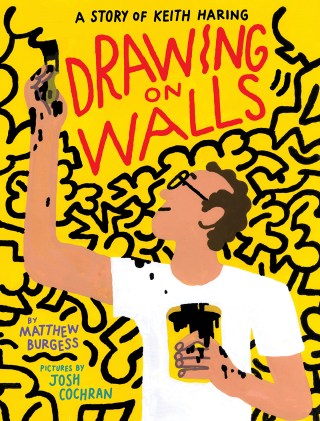
Drawing on Walls: An Wondrous Illustrated Homage to Keith Haring, His Irrepressible Art of Hope, and His Beautiful Bond with Children

By Maria Popova (brainpickings.org)

drawingonwalls_haring.jpg?fit=320%2C421

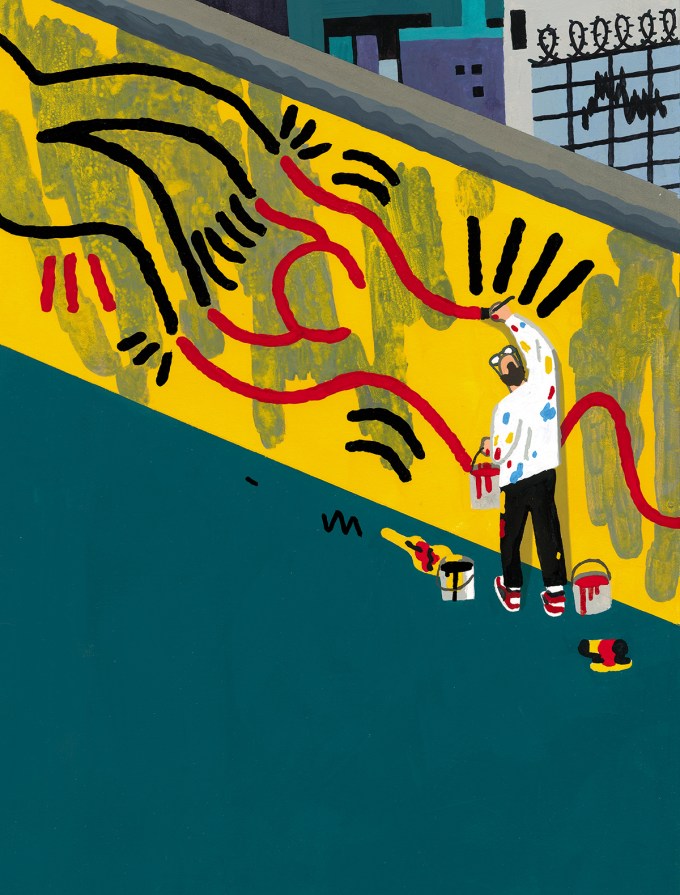
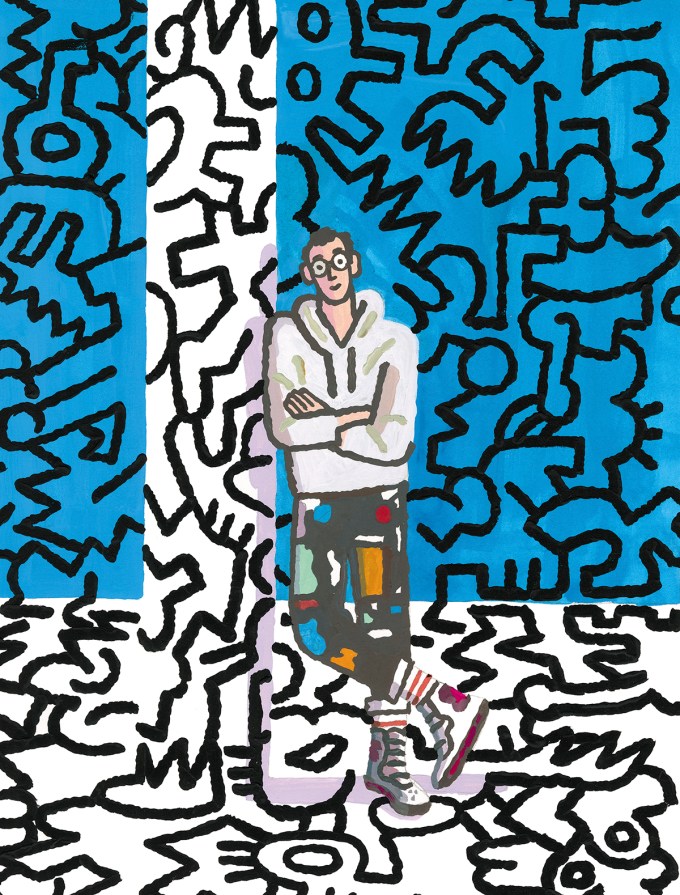
Growing in Bulgaria, one of my most cherished objects was also one of the first fragments of American culture to enter our home after the fall of the Berlin Wall and the rise of the Iron Curtain — a small square desk calendar in a clear plastic clamshell, containing twelve illustrated cards, each vibrantly alive with tiny black-contoured figures dancing in various jubilant formations amid a festival of primary colors. I would look up to savor its mirth between math equations and domestic disquietudes. However gloomy a day I was having, however sunken my child-heart, these figures would transport me to a buoyant world of sunlit possibility. I knew nothing about their creator beyond the name on the back of the clamshell: Keith Haring (May 4, 1958–February 16, 1990). I knew nothing about the bittersweet beauty of his courageous life, nothing about the tenacious activism behind his art, nothing about the enormous uninterrupted chain of human figures bonded in kinship, which he had painted on the remnants of the very wall whose collapse had placed this miniature monument to joy on my desk.

drawingonwalls_haring16-1.jpg?resize=680%2C895

Nearly three decades later, having traded Bulgaria for Brooklyn by some improbable existential acrobatics, I encountered Haring’s work again in a magnificent mural he had painted for a young people’s club in New York City in the final year of his twenties, not long before his death, which my friends at Pioneer Works had resurrected and brought to our neighborhood. The same rush of irrepressible gladness poured into the grownup heart from twenty-five-foot wall as had poured into the child-heart from the five-inch calendar. I grew attuned to the echoes of his sensibility bellowing down the corridor of time, reverberating strongly in the work of established artists in my own community.

Long before he moved to Brooklyn in pursuit of his own calling, poet Matthew Burgess had a parallel experience of Haring’s world-expanding art, which he first encountered on the cover of a Christmas record at fourteen, living behind the Golden Curtain of suburban Southern California as a budding artist and young gay man trying to find himself. “For those of us who grew up before the internet became ubiquitous, a bright fragment from the outer world can feel like an important discovery — and a call,” Burgess writes in the author’s note to what became his serenade to the artist who opened minds and world of possibility for so many.

drawingonwalls_haring4.jpg?resize=680%2C447
drawingonwalls_haring22.jpg?resize=680%2C453

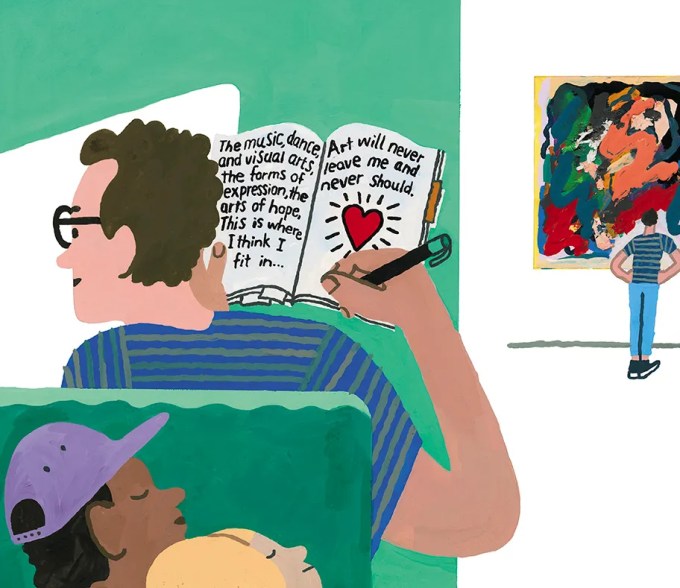
A decade into teaching poetry in public schools, Burgess encountered Haring’s work afresh in a retrospective at the Brooklyn Museum. After mesmeric hours in the galleries, he wandered into the museum bookshop and went home with a copy of Haring’s published journals, which he devoured immediately. On its pages, he realized that the special native sympathy between children and Haring’s art is not an accident of his line and color but at the very center of his spirit. In an entry from July 7, 1986, Haring writes:

2e292385-dc1c-4cfe-b95e-845f6f98c2ec.pngChildren know something that most people have forgotten. Children possess a fascination with their everyday existence that is very special and would be very helpful to adults if they could learn to understand and respect it.


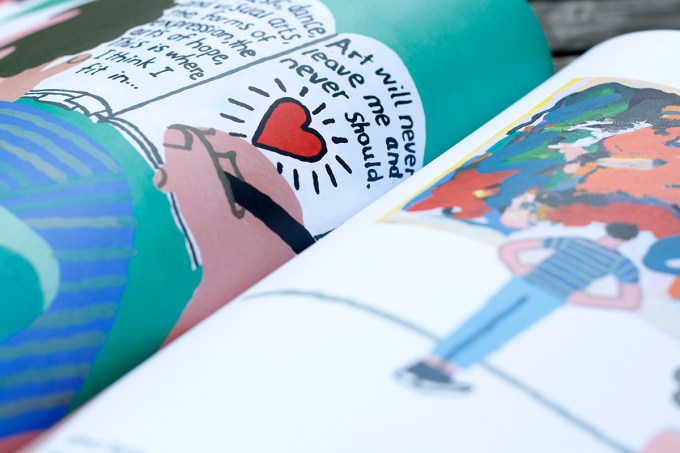
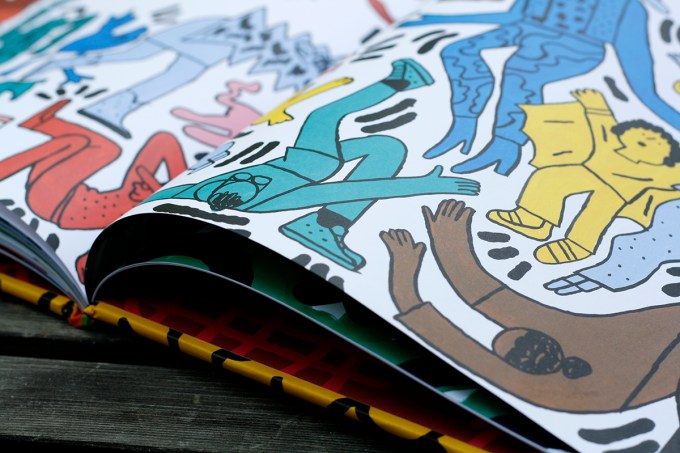
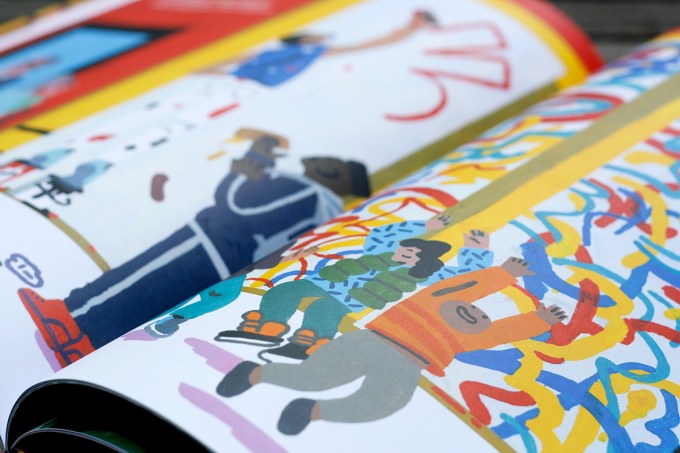
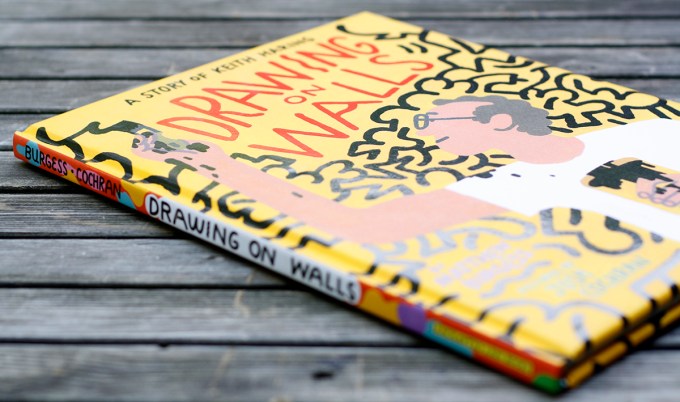
Having previously composed Enormous Smallness — the wondrous picture-book biography of E.E. Cummings, another artist who so passionately believed that “it takes courage to grow up and become who you really are” — Burgess was impelled to invite young people into Keith Haring’s singular art and the large heart from which it sprang. And so Drawing on Walls: A Story of Keith Haring (public library) was born — a splendid addition to the most inspiring picture-book biographies of cultural heroes.

drawingonwalls_haring23.jpg?resize=680%2C451

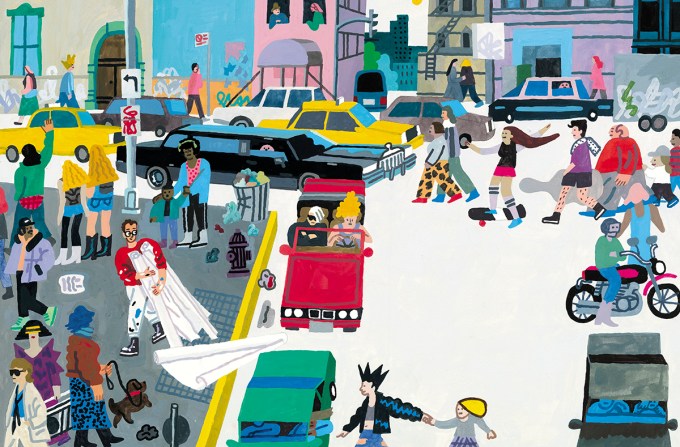
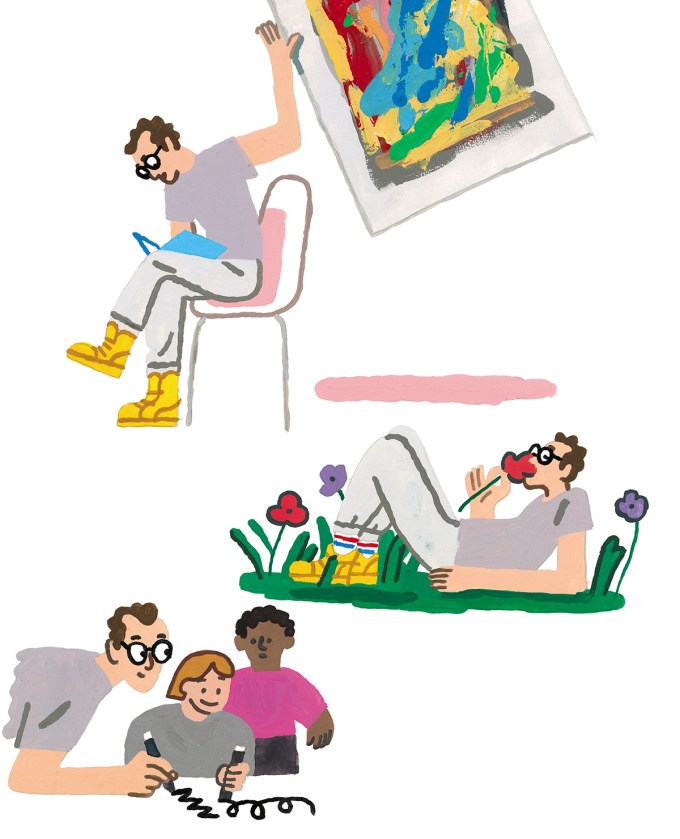
Burgess’s tender words, harmonized by muralist and illustrator Josh Cochran’s ebullient art, follow the young Keith from his childhood in small-town Pennsylvania, drawing at the kitchen table with his dad and dipping his little sister’s palms in paint to make her a mobile of handprints, to his improbable path to New York City.

drawingonwalls_haring5.jpg?resize=680%2C447

One fateful day, home for the holidays from Pittsburg, where he had gone to study commercial art but had grow disillusioned with the prescriptive form, hungry “to be spontaneous and free,” Haring chanced upon The Art Spirit — Robert Henri’s 1923 masterwork, which would go on to influence generation of artists as sundry as Georgia O’Keeffe and David Lynch. “Rise up if it kills you,” Henri had written to O’Keeffe’s best friend. “I’m for the person who takes the bit in his teeth & goes after what he believes in.” Henri’s book — an invitation, an incantation, to “do whatever you do intensely” — invigorated the young artist to take the bit of his own talent and unexampled creative vision in his teeth and go toward that intensity.

After hitchhiking across the country with his treasured copy of The Spirit of Art, he went to New York City.

drawingonwalls_haring25.jpg?resize=680%2C453

At twenty, he enrolled in the School of Visual Arts. (Cochran, whose illustrations bring Haring’s life to life in a rare acrobatic triumph of honoring another artist’s art in art that is both deliberately referential and thoroughly original, now teaches at the School of Visual Arts — a lovely testament to Robert Henri’s conviction that “all any man can hope to do is to add his fragment to the whole.”)

drawingonwalls_haring6.jpg?resize=680%2C588
drawingonwalls_haring24.jpg?resize=680%2C453
drawingonwalls_haring7.jpg?resize=680%2C447
drawingonwalls_haring26.jpg?resize=680%2C453

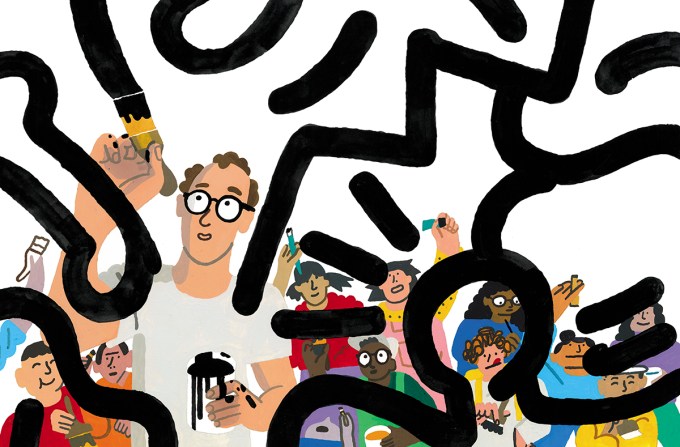
One day, he foraged some rolls of paper lying in the gutter between the bustling New York sidewalk and the bustling New York street, and spontaneously “began making bigger and bigger pictures.”

drawingonwalls_haring27-1.jpg?resize=680%2C453
drawingonwalls_haring13.jpg?resize=680%2C447
drawingonwalls_haring30-1.jpg?resize=680%2C432

Burgess writes:

2e292385-dc1c-4cfe-b95e-845f6f98c2ec.pngKeith especially liked painting on the floor by the open door where the sunlight poured in.

People passing on the street would stop to watch or talk with him about what he was making. Keith loved it!

He didn’t believe that some people understand art while others don’t — or that art should be hidden away in galleries, museums, and private collections.

Keith wanted to communicate with as many people as possible. “The public has a right to art… Art is for everybody.”

drawingonwalls_haring33.jpg?resize=680%2C453
drawingonwalls_haring14.jpg?resize=680%2C447

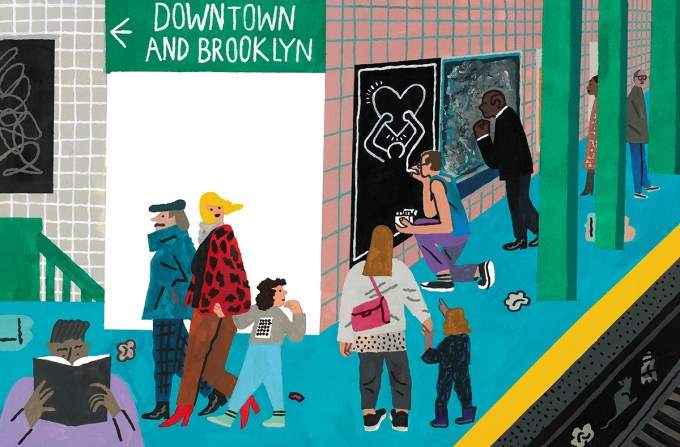
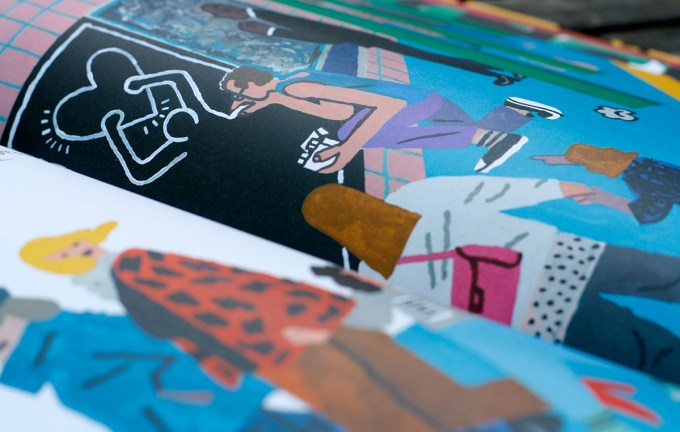
Tracing Haring’s inviting self-discovery on vacant subway billboards and graffiti-populated walls, Burgess affirms this credo by spontaneously breaking into his own art-form — the delightful surprise of the book’s sole verse:

2e292385-dc1c-4cfe-b95e-845f6f98c2ec.pngMaybe it makes them smile,
maybe it makes them think,
maybe it inspires them to draw
or dance or write or sing.

drawingonwalls_haring31.jpg?resize=680%2C453

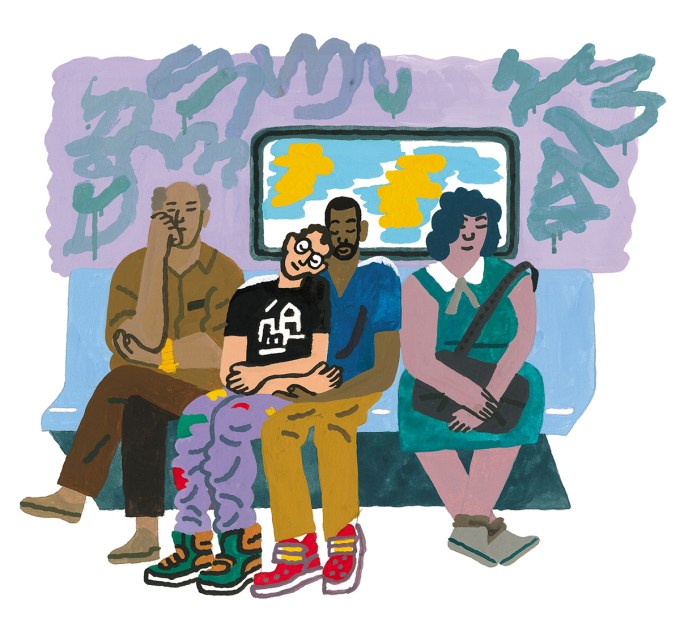
Meanwhile, we see the bower of the young artist’s imagination grow decorated with the experiences of a life fully lived — he falls in love, starts a club in a church basement on St. Mark’s Place with his friends, discovers the vibrant graffiti culture of Alphabet City, listens to his boyfriend’s music as he paints and they cook together.

drawingonwalls_haring9.jpg?resize=680%2C644

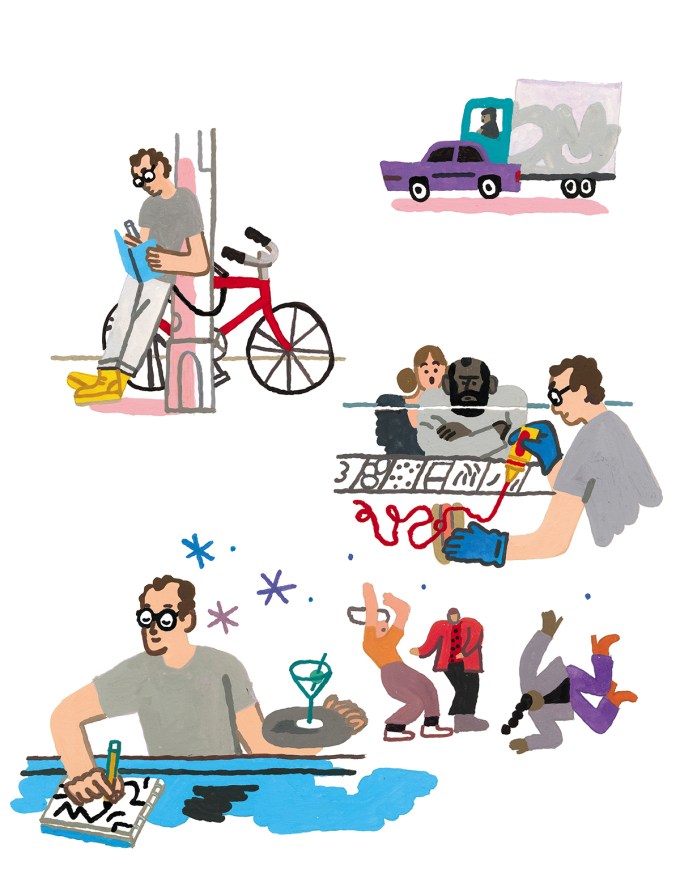
Like artist Agnes Martin and the astonishing array of employments by which she sustained herself as she revolutionized art, he takes a series of odd jobs to survive in New York — bike messenger and sandwich-maker and gallery assistant in Soho and wildflower picker in Jersey and always, always his favorite: drawing with children at a Brooklyn daycare.

drawingonwalls_haring10.jpg?resize=680%2C895
drawingonwalls_haring11.jpg?resize=680%2C839

All the while, he keeps drawing on walls, savoring that small, enormous moment when a stranger pauses mid-stride in this unstoppable city for a colorful moment of unbidden wonder. Burgess writes:

2e292385-dc1c-4cfe-b95e-845f6f98c2ec.pngFor Keith, this was what art was all about — the moment when people see it and respond.

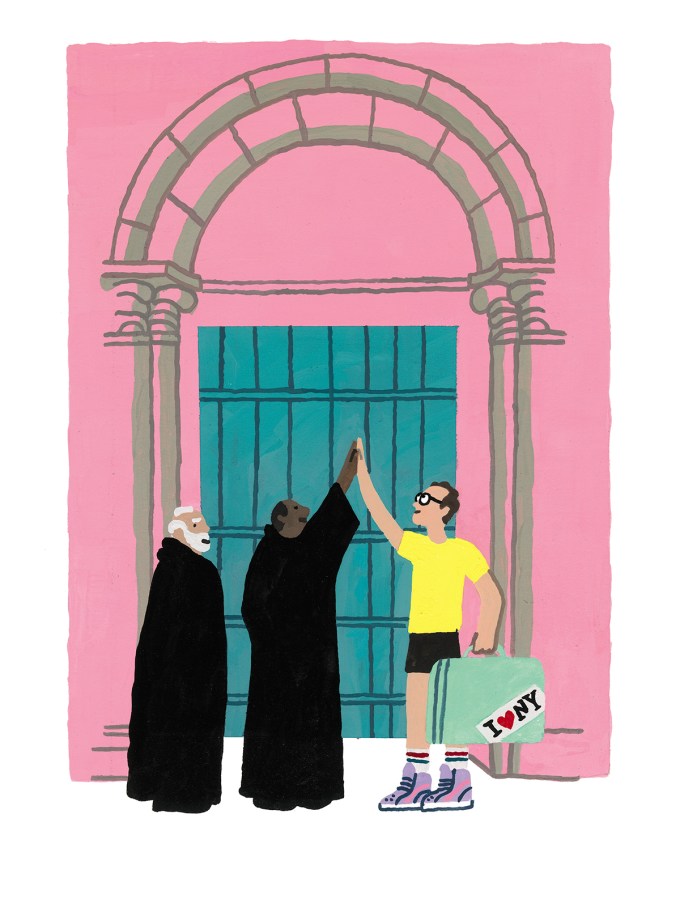
At last, four years after leaping into the glorious uncertainty of life as a young artist in New York City, his big breakthrough came — a major solo exhibition at a Soho gallery. It tipped a Rube Goldberg machine of opportunities and invitations, making the world his canvas — from the wall of an Italian monastery to the Berlin Wall to the wall.

drawingonwalls_haring18.jpg?resize=680%2C899

Burgess writes:

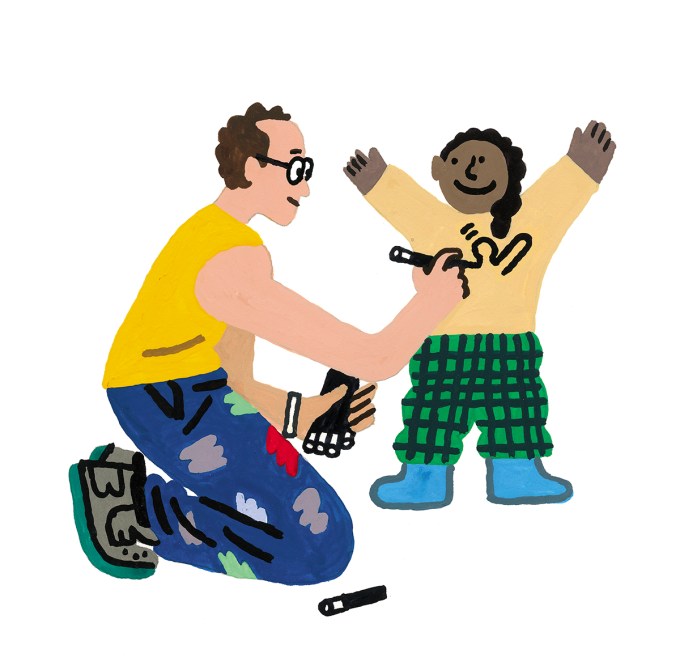
2e292385-dc1c-4cfe-b95e-845f6f98c2ec.pngBut no matter how busy he became or where in the world he went, he always made time for children.

Keith understood kids and they understood him.
There was an unspoken bond between them.

And since children often asked him to draw on their t-shirts, skateboards, and jeans, he always kept a black marker handy.

drawingonwalls_haring15.jpg?resize=680%2C662
drawingonwalls_haring34.jpg?resize=680%2C453

In the remaining seven years of his life, as the art world grew to lavish Haring with recognition and plaudit, his drawings would come to cover the walls of orphanages and hospitals and daycare centers. When he spent five days painting the wall of a Chicago high school together with its 500 students, one walked up to him and said, with that special way children alone have of seeing into the heart of things and naming what is there without self-consciousness or pretense:

2e292385-dc1c-4cfe-b95e-845f6f98c2ec.pngI can tell, by the way you paint, that you really love life.

Not long after that, Haring’s vivacity was stamped with the four letters that would spell certain death for so many young people of his generation. But even his AIDS diagnosis didn’t stifle his exuberant love of life — it only amplified it. Burgess quotes Haring’s diary:

2e292385-dc1c-4cfe-b95e-845f6f98c2ec.pngI appreciate everything that has happened, especially the gift of life I was given that has created a silent bond between me and children. Children can sense this “thing” in me.

drawingonwalls_haring17.jpg?resize=680%2C895

KeithHaring_painting.jpg?resize=680%2C522

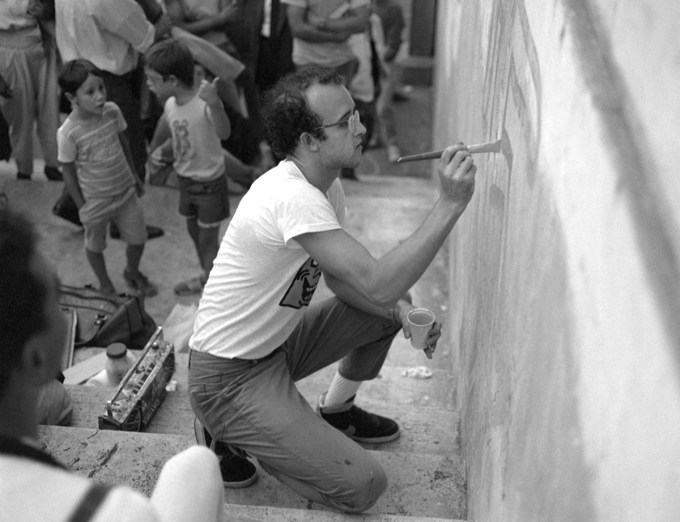
Keith Haring painting a wall at the Palaexpo Museum in Rome, 1984. (Photograph by Stefano Fontebasso de Martino; featured with permission.)

drawingonwalls_haring20.jpg?resize=680%2C402
drawingonwalls_haring21.jpg?resize=680%2C453

Drawing on Walls radiates that singular thingness with its sensitive, courageous homage to an artist whose short life cast a widening pool of light on so many, rippling across space and time. Complement it with Maya Angelou’s lovely verses of courage for kids, illustrated by Haring’s contemporary Jean-Michel Basquiat, and with the picture-book biographies of Wangari MaathaiMaria MitchellAda LovelaceLouise BourgeoisE.E. CummingsJane GoodallJane JacobsJohn LewisFrida KahloLouis BraillePablo NerudaAlbert EinsteinMuddy Waters, and Nellie Bly, then revisit E.E. Cummings — the subject of Burgess’s first picture-book biography — on the courage to be yourself.

Unlearning Race in 2020? Thomas Chatterton Williams

Rebel Wisdom As tensions rise over racial divisions throughout the western world, books like ‘White Fragility’ and ‘How to Be An Anti-Racist’ have flown to the top of the bestseller lists. These frame race as central to our understanding of the world. In his book, ‘Unlearning Race, Self-Portrait in Black and White’, Thomas Chatterton Williams takes a very different tack, attempting to understand his own mixed race background and arguing that we should move away from seeing racial categories as primary and fixed. What does he make of this new focus on race, and how does identity politics wall us off from each other? You can listen to podcast versions of our films on Spotify or Apple Podcasts by searching ‘Rebel Wisdom’ or download episodes from our Podbean page: https://rebelwisdom.podbean.com/ To support Rebel Wisdom, and get member benefits including regular Q&As with the interviewees from our films for our members, check out: https://www.rebelwisdom.co.uk/plans

License

Creative Commons Attribution license (reuse allowed)

Dave – Black (Live at The BRITs 2020)

Santan Dave Feb 8, 2020 Stream & Download Psychodrama: https://SantanDave.lnk.to/Psychodrama Psychodrama on Apple Music: https://SantanDave.lnk.to/Psychodrama… Psychodrama on Spotify: https://SantanDave.lnk.to/Psychodrama… Psychodrama on YouTube Music: https://yt.be/music/Psychodrama Psychodrama on Amazon Music: https://SantanDave.lnk.to/Amazon Psychodrama on iTunes: https://santandave.lnk.to/iTunes Follow Dave: http://instagram.com/santandavehttp://twitter.com/santandave1http://facebook.com/santandave1 Snapchat – davem1st © Dave / Neighbourhood Recordings 2019

Music in this video

Learn more

Listen ad-free with YouTube Premium

Song

Black (Live From The BRIT Awards, London 2020)

Artist

Dave

Licensed to YouTube by

UMG (on behalf of Neighbourhood); Warner Chappell, AMRA, BMI – Broadcast Music Inc., PEDL, Kobalt Music Publishing, and 3 Music Rights Societies

“Black” by Dave

Look, black is beautiful, black is excellent
Black is pain, black is joy, black is evident
It’s working twice as hard
As the people you know you’re better than
‘Cause you need to do double what they do
So you can level themBlack is so much deeper than just African-American
Our heritage been severed, you never got to experiment
With family trees
‘Cause they teach you ’bout famine and greed
And show you pictures of our fam’ on their knees
Tell us we used to be barbaric
We had actual queensBlack is watchin’ child soldiers gettin’ killed by other children
Feelin’ sick, like, oh shit, this could have happened to me
Your mummy watchin’ tellin’ stories about your dad and your niece
The blacker the berry the sweeter the juice
A kid dies, the blacker the killer, the sweeter the news
And if he’s white you give him a chance
He’s ill and confused
If he’s black he’s probably armed
You see him and shootLook, black is growin’ up around the barbershop
Mummy sayin’, stay away from trouble, you’re in yard a lot
Studying for ages, appreciating the chance you got
‘Cause black is in your blood
And you ain’t even got the heart to stopBlack is steppin’ in for your mother
Because your father’s gone
And standin’ by your children
When you haven’t proven karma wrong
Black is doin’ all of the above then goin’ corner shoppin’
Tryna help a lady cross the road to have her walkin’ offBlack is growin’ up around your family and makin’ it
Then being forced to leave the place you love
Because there’s hate in it
People say you fake the shit
Never stayed to change the shit
But black is being jealous, you’d be dead if you had stayed in itBlack is strugglin’ to find your history or trace the shit
You don’t know the truth about your race
‘Cause they’re erasing it
Black has got a sour fuckin’ flavour, here’s a taste of it
But black is all I know
There ain’t a thing that I would change in itLook, black ain’t just a single fuckin’ colour
Man there’s shades to it
Her hair’s straight and thick but mine’s got waves in it
Black is not divisive, they been lyin’ and I hate the shit
Black has never been a competition
We don’t make this shit
Black is deadlyBlack is when you’re freezin’ in your home
And you can’t get sleep but never feelin’ empty
‘Cause you got 20 cousins in your country living stress-free
Walkin’ for their water, daughter wrapped inside a bed sheet
Black is distant, it’s representin’ countries
That never even existed while your grandmother was livin’
Black is my Ghanaian brother readin’ into scriptures
Doing research on his lineage
Finding out that he’s EgyptianBlack is people namin’ your countries on what they trade most
Coast of Ivory, Gold Coast, and the Grain Coast
But most importantly to show how deep all this pain goes
West Africa, Benin, they called it slave coastBlack is so confusing, ’cause the culture?
They’re in love with it
They take our features when they want and have their fun with it
Never seem to help with all the things we know would come with it
Loud in our laughter, silent in our sufferingBlack is bein’ strong inside and facing defeat
Poverty made me a beast, I battled the law in the streets
We all struggled
But your struggle ain’t a struggle like me
Well how could it be when your people gave us the odds that we beat?
I mean, fuckin’ hell
What about our brothers that are stuck in jail?
That couldn’t bust a bell, they held a bird and gotta live with itBlack is being guilty until proven that you’re innocent
Black is sayin’
Free my fuckin’ niggas stuck inside in prison cells
They think it’s funny, we ain’t got nothin’ to say to them
Unconditional love is strange to them, it’s amazing ’em
Black is like the sweetest fuckin’ flavour
Here’s a taste of it
But black is all I know
There ain’t a thing that I would change in it

Source: Musixmatch
Songwriters: Dave / Mathias / Jimmy / TimmyBlack lyrics © Kobalt Music Services Ltd Kms

This Pandemic. It’s Systemic

How our Connected Crises are Creating a Mass Movement for Social Healing and Collective Liberation

Joshua Gorman

Joshua Gorman · Jun 23 · Medium.com

We thought we were living in the middle of one crisis; then it became two, then three, and it spiraled on. From Covid-19 to massive job losses and economic uncertainty, to nationwide and global Black Lives Matter protests sparked by police violence and racial injustice, we are experiencing a crisis of the whole system. Our structures are failing or broken; for many they’ve been designed that way from the beginning. We are tired of suffering, of living without dignity, freedom, and breath. We know that life is sacred and we all belong. We’re at a tipping point. The old is dying, and the new is being born. When we look back on this defining chapter in our history, if we continue to rise and mobilize together, to love and heal together, to bridge and build together, we may find that we made the great transition to a just and flourishing world.

“We will be someone else’s ancestors one day. If we do this right they will inherit not our fear but our bravery.” -Valarie Kaur

“Imagine winning. This is your sacred task.” -Aurora Levins Morales

Charlotte’s Tryon Street | Black Lives Matter street mural |Rep. Alma S. Adams (Via Twitter)

A Convergence of Crises

“This is a hard time to be alive. It’s a time of concurrent crises. …In a sense, the world has been on fire for a while now. The climate crisis and global warming say that, the fevers induced by the pandemic say that, and now the fires incited by the history of racism, injustice and exclusion say that.” -Michael Meade

“Here is what my research has taught me. It’s possible for crisis to catalyze a kind of evolutionary leap.” -Naomi Klein

Covid-19 grew into a global pandemic that shook the foundations of our lives and shut down the world. Country by country, it spread around the globe and closed economies, transportation systems, schools, stores and life as we knew it. In the United States of America, our world’s wealthiest and “most advanced” country, we found ourselves caught off guard, and living under the misguided and disastrous leadership of our current President. We now hold the highest number of coronavirus infections and fatalities in the world: 2 million confirmed cases and climbing, 120,000 deaths and counting, and disproportionately impacting communities of color and our most poor and vulnerable populations by statistics that are greater than 6 to 1. We thought we were living in the greatest moment of challenge and change in a generation, and then we discovered that the plot was only getting thicker.

With our economy slowed down, travel suspended, and the consumption habits of our American lives radically reduced, we found ourselves in an economic recession, one that is still unfolding and the full extent of which is still unknown. More than 28 million people are unemployed, with ongoing uncertainty around when jobs will reopen, and many more are on furlough unsure if they will be invited to return. Some of our most essential workers — farm workers, construction workers, care providers — are trapped by our broken immigration system and stranded without any form of government assistance or healthcare. As the direct impact of Covid-19 continues to hit us, the stimulus checks are not enough, food banks are running short on supplies, child hunger is spiking across the nation, and the fate of our collective future feels tattered and worn. Our economy is shaking — built on a house of cards, ballooning debt, and a widening chasm between everyday people and the billionaires on Wallstreet getting richer even amidst our crisis— and it could all come crashing down upon us.

On May 25, 2020, George Floyd was cruelly and inhumanely murdered by a white police officer in Minneapolis pressing his knee to his neck for over eight minutes. The atrocity was caught on video and broadcast to a captive nation that was quarantined at home and paying close attention. It was yet another blatantly racist killing of an unarmed Black man, the latest in the long and tragic history of racial injustice in this country. The outrage spread like wildfire across our nation and around the world. Hundreds of thousands of Americans have taken to the streets in protest, standing up for the sacredness of Black lives and demanding justice, action and accountability. Amidst fires, curfews, violent confrontations with the police, and authoritarian threats from the President, the grief and rage has boiled over. The spirit of freedom and liberation has ignited in the hearts and minds of people everywhere. Young people, families, health care workers, and caring citizens of all backgrounds are rising up together and letting their voices and demands for justice be heard.

As if what is happening in the foreground was not enough, in the backdrop of it all is the ever-present and looming threat of climate change, mass species extinction, resource depletion and widespread environmental destruction. With the hottest temperatures ever recorded in the Arctic and rising, devastating wildfires increasing, and climate-related superstorms becoming the norm — the future of our blue-earth home and the life-support systems we depend on are hanging in the balance. In many ways our current challenges may just be a preparation for the massive disruption and survival challenges still to come. Slowing down our economy has shown us the power of nature to regenerate and how we can live with a smaller ecological footprint; yet we are far from changing our lifestyles and taking the collective action to make the shift to a clean, just, and green economy for all.

Poet and mythologist Michael Meade writes, “The word crisis comes directly from the ancient Greek healers, who used the word to describe a turning point in a disease.” It’s when a patient either gets sicker and begins to die, or starts to heal and begins a path of recovery. As we navigate this connected set of crises — a health crisis, an economic crisis, a racial justice crisis, an ecological crisis, a human and culture crisis — it’s clear that we’re at an unprecedented moment of reckoning.

If we continue to live in the way that we’ve been living, we won’t survive. But if we change course and respond to the opportunity of these crises together, we can create a world where we all thrive.

David Crow | Financial Times

A Deeper ‘Pandemic’

“Historically, pandemics have forced humans to break with the past and imagine their world anew. This one is no different. It is a portal, a gateway between one world and the next.” -Arundhati Roy

“This pandemic / Is systemic / Global pandemic / Endemic Systemic No Equality” -Aisha Fukushima

Author and activist Arundhati Roy has named the Covid-19 pandemic as a portal from one world to the next. While the portal is still open, what has changed is the depth of its transformative potential and the meaning of the word “pandemic.”

As we continue to navigate the health concerns of the coronavirus, and while the reopening debates rage on and we prepare for the coming second wave, a deeper, wider, at-the-heart-of-our-culture pandemic has opened up and is riveting us all. Racism and its 400 year history of inequity that ravages on today is our pandemic. Our underfunded schools and the hundreds of thousands of children without equal access is our pandemic. Economic disparity in all its forms, the ever-increasing wealth gap, poverty and homelessness is our pandemic. Loneliness, isolation, suicide and our mental health crisis is our pandemic. Materialism, consumerism, and our culture of overwork and fatigue is our pandemic. The unfathomable loss of biodiversity, the devastation of our natural ecosystems, the endless pollution and waste generated by our way of life on this planet is our pandemic. Our lack of meaning, morals, a sense of the sacred and a larger purpose is our pandemic.

When we search for the root cause of our interrelated crises, we discover a worldview based on separation, competition, endless growth, and exploitation. Every culture has a story made up of core beliefs and assumptions. It shapes the way we think and act and guides how we build and construct our social reality. It’s the water we swim in, an operating system running us all. The dominant culture and structures we live in today follow the rules built into the DNA of our system of capitalism and the neoliberal mindset that has colonized our lives and world.

Dr. Martin Luther King, Jr. named this radical — meaning “getting to the root” — analysis in his own words over half a century ago:

“We must rapidly begin the shift from a “thing-oriented” society to a “person-oriented” society. When machines and computers, profit motives and property rights are considered more important than people, the giant triplets of racism, materialism, and militarism are incapable of being conquered.”

Going even further, he wrote:

“The black revolution is much more than a struggle for the rights of Negroes. It is forcing America to face all its interrelated flaws — racism, poverty, militarism, and materialism. It is exposing the evils that are rooted deeply in the whole structure of our society. It reveals systemic rather than superficial flaws and suggests that radical reconstruction of society itself is the real issue to be faced.”

There is a sickness at the heart of our culture that infects us all. It lives in our minds and bodies. It pervades our systems and structures. It shows up in how we treat each other and how we live our everyday lives.

How do we heal the soul of our culture and create systemic change? How do we shift our society from a story of separation and othering, to a story of interconnectedness and belonging? Can we apply the same energy and emergency responses we’ve used to address the Covid-19 pandemic to root out and dismantle the deep patterns of patriarchy, racism, sexism, ableism, exploitation, colonization and all of the cultural codes that are causing this Great Sickness?

The doctor is here, and it’s not Dr. Fauci this time; it’s our own inner knowing and collective sense. Our prognosis is clear: we are sick and we need a Great Healing.

May 5, 2020 | The Morunga Express

A Mass Movement for Social Healing & Collective Liberation

“King’s response to our crisis can be put in one word: revolution. A revolution in our priorities, a reevaluation of our values, a reinvigoration of our public life and a fundamental transformation of our way of thinking and living that promotes a transfer of power to everyday people and ordinary citizens.” -Cornel West

“We don’t want a normal or a new normal. We want a revolution. We want a moral revival. We want a transformation.” -Rev. Dr. William J. Barber

There’s no vaccine for the sickness we are facing, but the medicine we need lies within us and between us. From the depths of our crises and souls, a movement is rising that holds the power to heal and liberate us all.

We see it powerfully in the protests and marches on the streets as hundreds of thousands of Americans — and people around the world — rise up to end the long history of racism and to honor the lives taken of George Floyd, Breonna Taylor, Ahmad Arbery, Tony McDade, and countless more. Black-led movements — rooted in a long history of organizing and movement-building — are leading the way to #defundpolice, invest in our communities, and fundamentally transform our policing and justice systems. White people are looking harder and deeper at their privilege and complicity, engaging in the essential work of undoing racism internally and externally, vocally inviting their family and friends to show up for racial justice so that we can end the myth and structures of white supremacy once and for all. People of all colors, faiths, generations and backgrounds are rising in solidarity for Black freedom, justice, joy and beauty.

This movement is rising from all of the places we are experiencing pain and injustice, and from our deep care and love for the world. We see it in our health care workers, who amidst their long hours of caring for others related to Covid-19 and beyond, are simultaneously working to bring about health equity and transformation to our health care systems. It lives in our communities, neighborhoods, and mutual aid networks, and in all of the ways we are showing up with kindness and care for our collective well-being. We see it in our impassioned teachers, educators and parents who are working to transform our inequitable school systems and to raise a generation that embodies the ways of a new world.

It lives in our next economy movements that are building local and cooperative businesses, shifting money away from extractive systems and into regenerative models to create an economy that works for all and our planet. It flows in our efforts to end mass incarceration and to bring restorative justice to our schools and communities. We see it in the Poor People’s Campaign and our Just Transition movements, and in all of our efforts working to end poverty and ensure that everyone has housing, a livelihood, and what we need to live a life of health, dignity and opportunity.

Our farmers, permaculturists, and backyard gardens are part of this movement. We see it in our immigration and right to citizenship movements, ensuring that people who were born here and immigrated here have the same rights and care as the rest of us. We witness it in the beauty and power of our Queer and Trans movements in their stand for human dignity and the inherent right to love and be loved as we truly are. It lives in our Native and Indigenous peoples movements fighting for sovereignty, protecting their lands and waters, defending the Sacred, and revitalizing their cultures and languages as they work to heal from the ravages of colonization and erasure.

We see it in the people and communities that are practicing the deep work of healing and vulnerability, who are tenderly caring for the wounds of history and healing the trauma in our bodies — personal, collective, and generational — creating lives of wellness, wholeness, and connection. It continues to rise in our women’s movements, in the power of #MeToo, and in every workplace, leadership position, political office, and social setting where women are leading the way. We see it in the young people of these times, stepping forward with such power and purpose, rooting in the wisdom of their ancestors and elders, taking their place on the front lines with a courage and creative fire that is carrying us to places we’ve never traveled before.

A movement of movements is rising, flowing from a long history, stretching wide and deep, intersecting, cross-pollinating, building in power and momentum. To some they seem like disconnected struggles, but they are united by a common struggle for freedom, rooted in our love for justice and life, and part of a deep social healing and collective liberation that connects us all.

Black Lives Matter protest June 3, 2020, in London. (CNS/Reuters/Hannah McKay)

Let’s be clear: understanding that our movements and peoples are all connected is not a cause for some type of simple rah-rah-rah, happy dance and celebration. It’s not an excuse to sit back, relax and wait for some inevitable liberation; nor is it an excuse to bypass the ways that we are complicit with the oppression of the past and present. It’s a call for us to engage more fully, deeply and broadly; to come together in solidarity on behalf of each other’s struggles and liberation. It’s an opportunity to participate in the deep healing work that’s inevitable in our coming together, and to learn how to show up in service and with humility. We see this clearly in the ways that white and non-Black people of color are using their bodies as shields at protests, ensuring they are the first to get arrested and protecting Black lives from further harm.

Systemic insight allows us to understand that structural racism is at the root of our capitalistic economy, which is at the root of our climate crisis, and therefore the work for Black liberation is fundamentally tied to the work for climate justice and protecting our planet. While we engage in our connected struggles and movements, our current movement moment asks us to show up powerfully for the sacredness of Black lives and liberation. Michelle Alexander writes:

“Our only hope for our collective liberation is a politics of deep solidarity rooted in love. In recent days, we’ve seen what it looks like when people of all races, ethnicities, genders and backgrounds rise up together, standing in solidarity for justice, protesting, marching and singing together, even as SWAT teams and tanks roll in. We’ve seen our faces in another American mirror — a reflection of the best of who we are and what we can become. These images may not have dominated the media coverage, but I’ve glimpsed in a foggy mirror scenes of a beautiful, courageous nation struggling to be born.”

Abraham Joshua Heschel once declared that “The very future of this nation depends on how we respond to the legacy of Martin Luther King, Jr.” That legacy is the work of building a Beloved Community where we all belong and thrive together. Its a legacy of ending white supremacy, racism, poverty, and systemic oppression in all its forms, and “creating a qualitative change in our souls, and a quantitative change in lives.”

We are closer than ever before, yet there is still so much to heal and transform. Just as this has been the work of generations, this will be the work of our lifetime and generations to come. We need to continue preparing for the long haul as we keep mobilizing and keep the pressure on. Alicia Garza, co-founder of #BlackLivesMatter, reminds us:

“It takes organizing. Protest to up the ante. Public and private pressure. Electoral organizing strategies. Telling new stories about us and what we are fighting for. We gotta stop looking for easy answers and instead join the hard work. Please and thank you. Be good to yourselves. This is a marathon that no one wants to run.”

Some say that we were made for these times. Whatever your perspective, we are alive at this pivotal moment and we all have a role to play: marching on the streets, organizing in our communities, storytelling and writing songs for the revolution, making art, preparing food, caring for others, mentoring and teaching, donating funds, sharing your heart, gifts and medicine however you are able to. This is a time of mass awakening and we all are being called to show up and become something we have never been before.

We are hospicing the old and midwifing the new. We are disrupting, dismantling, defunding, and decolonizing the life-destroying forces in our society while we reboot, rebuild, reimagine, and regenerate the life-serving forces of our world.

This pandemic. It’s systemic. And so are our movements. So are our hopes, dreams, and actions. So is our deep love and care for this world. This river is mighty and these times are momentous. We are part of something sacred, healing and beautiful. May we find our way together.


Joshua Gorman is writer, changemaker, youth worker, community builder, founder of Generation Waking Up, and organizer at Thrive East Bay in Oakland, CA. Find him on MediumFacebookTwitter, and Instagram.

Sign up for his updates here.

Check out the Medicine for These Times series hosted by Thrive.

Link to Resources for Taking Action & Going Deeper

Acknowledgements

This piece arose within an ecosystem of thinkers, feelers, creatives and change makers. My deep gratitude for feedback, support and inspiration extends to a wide web including Cherine Badawi, Aryeh Shell, Armando Davila, Sunshine Michelle Coleman, Bethsaida Ruiz, David Dean, Jean Milam, Manuel Manga, Arthur Romano, Ramon Gabrieloff-Parish, Darcy Ottey, Ann-Ellice Parker, Taj James, Brenda Salgado, Akaya Windwood, Staci Haines, john a. powell, Joanna Macy, Sonya Renee Taylor, and countless more.

References

Alexander, Michelle. America, This Is Your Chance. NY Times.

Barber, William J. The Only Way We Make It Through Is Together. People. 2020.

Fukushima, Aisha. Pandemic. 2020.

Garza, Alicia. Ending Police Violence Is A Long Game. Twitter. 2020.

Kaur, Valarie. See No Stranger: A Memoir and Manifesto of Revolutionary Love. 2020.

King, Martin Luther. Beyond Vietnam. 1967.

Klein, Naomi. “Coronavirus Capitalism”: Naomi Klein’s Case for Transformative Change Amid Coronavirus Pandemic. Democracy Now. 2020

Meade, Michael. Humanity At A Tipping Point. 2020.

Morales, Aurora Levins. V’ahavta. 2016.

Roy, Arundhati. The Pandemic Is A Portal. Financial Times. 2020.

Taylor, Keeanga-Yamahtta. How Do We Change America? The New Yorker. 2020.

West, Cornel. The Future of America Depends on How We Respond. MSNBC. 2020.

Joshua Gorman

WRITTEN BY

Joshua Gorman

Writer, Speaker, Community Builder, Changemaker @generationwakingup @thriveeastbay https://joshuagorman.com

The History of “Whole”

Health leads to whole: OP (Old Prussian) kailustikan, health, Gr (Greek) koilu, the beautiful.

–Partridge’s Origins: A Short Etymological Dictionary of Modern English

What does whole mean?

Definitions for whole (hoʊl)

Here are all the possible meanings and translations of the word whole.

Princeton’s WordNet:

  1. whole(noun)all of something including all its component elements or parts”Europe considered as a whole”; “the whole of American literature”
  2. whole, unit(adj)an assemblage of parts that is regarded as a single entity”how big is that part compared to the whole?”; “the team is a unit”
  3. whole(adj)including all components without exception; being one unit or constituting the full amount or extent or duration; complete”gave his whole attention”; “a whole wardrobe for the tropics”; “the whole hog”; “a whole week”; “the baby cried the whole trip home”; “a whole loaf of bread”
  4. whole(adj)(of siblings) having the same parents”whole brothers and sisters”
  5. unharmed, unhurt, unscathed, whole(adj)not injured
  6. hale, whole(adj)exhibiting or restored to vigorous good health”hale and hearty”; “whole in mind and body”; “a whole person again”
  7. solid, unanimous, whole(adverb)acting together as a single undiversified whole”a solid voting bloc”
  8. wholly, entirely, completely, totally, all, altogether, whole(adverb)to a complete degree or to the full or entire extent (`whole’ is often used informally for `wholly’)”he was wholly convinced”; “entirely satisfied with the meal”; “it was completely different from what we expected”; “was completely at fault”; “a totally new situation”; “the directions were all wrong”; “it was not altogether her fault”; “an altogether new approach”; “a whole new idea”

Wiktionary:

  1. whole(Noun)Something complete, without any parts missing.Etymology: From hool, from hal, from hailaz (compare Low German heel/heil, Dutch heel, German heil, Danish hel), from kóhₐilus, coel ‘omen’, Breton kel ‘omen, mention’, Old Prussian kails ‘healthy’, Albanian gjallë ‘alive, unhurt’, Old Church Slavonic cĕlŭ ‘healthy, unhurt’, Ancient Greek koîlu ‘good’). Related to hale, health, and heal.
  2. whole(Noun)An entirety.Etymology: From hool, from hal, from hailaz (compare Low German heel/heil, Dutch heel, German heil, Danish hel), from kóhₐilus, coel ‘omen’, Breton kel ‘omen, mention’, Old Prussian kails ‘healthy’, Albanian gjallë ‘alive, unhurt’, Old Church Slavonic cĕlŭ ‘healthy, unhurt’, Ancient Greek koîlu ‘good’). Related to hale, health, and heal.
  3. whole(Adverb)in entirety; entirely; whollyI ate a fish whole!Etymology: From hool, from hal, from hailaz (compare Low German heel/heil, Dutch heel, German heil, Danish hel), from kóhₐilus, coel ‘omen’, Breton kel ‘omen, mention’, Old Prussian kails ‘healthy’, Albanian gjallë ‘alive, unhurt’, Old Church Slavonic cĕlŭ ‘healthy, unhurt’, Ancient Greek koîlu ‘good’). Related to hale, health, and heal.
  4. whole(Adjective)entire.I ate a whole fish.Etymology: From hool, from hal, from hailaz (compare Low German heel/heil, Dutch heel, German heil, Danish hel), from kóhₐilus, coel ‘omen’, Breton kel ‘omen, mention’, Old Prussian kails ‘healthy’, Albanian gjallë ‘alive, unhurt’, Old Church Slavonic cĕlŭ ‘healthy, unhurt’, Ancient Greek koîlu ‘good’). Related to hale, health, and heal.
  5. whole(Adjective)sound, uninjured, healthy.He is of whole mind, but the same cannot be said about his physical state.Etymology: From hool, from hal, from hailaz (compare Low German heel/heil, Dutch heel, German heil, Danish hel), from kóhₐilus, coel ‘omen’, Breton kel ‘omen, mention’, Old Prussian kails ‘healthy’, Albanian gjallë ‘alive, unhurt’, Old Church Slavonic cĕlŭ ‘healthy, unhurt’, Ancient Greek koîlu ‘good’). Related to hale, health, and heal.

Webster Dictionary:

  1. Whole(adj)containing the total amount, number, etc.; comprising all the parts; free from deficiency; all; total; entire; as, the whole earth; the whole solar system; the whole army; the whole nation
  2. Whole(adj)complete; entire; not defective or imperfect; not broken or fractured; unimpaired; uninjured; integral; as, a whole orange; the egg is whole; the vessel is whole
  3. Whole(adj)possessing, or being in a state of, heath and soundness; healthy; sound; well
  4. Whole(noun)the entire thing; the entire assemblage of parts; totality; all of a thing, without defect or exception; a thing complete in itself
  5. Whole(noun)a regular combination of parts; a system

Chambers 20th Century Dictionary:

  1. Wholehōl, adj. sound, as in health (so in B.): unimpaired: containing the total amount, number, &c.: all: not defective: complete: in mining, as yet unworked.—n. the entire thing: a system or combination of parts.—adv. wholly.—adjs. Whole′-col′oured, all of one colour; Whole′-foot′ed (coll.) unreserved; Whole′-heart′ed-souled, noble: hearty, generous; Whole′-hoofed, having undivided hoof; Whole′-length, giving the whole figure, as a portrait: full-length.—n. a portrait or statue giving the whole figure.—ns. Whole′nessWhole′sāle, sale of goods by the whole piece or large quantity.—adj. buying and selling in large quantities: extensive.—n. Whole′sāler, one who sells by wholesale.—adjs. Whole′-skinned, having an unbroken skin: unhurt: safe in reputation; Whole′some, healthy: sound: salutary: (Shak.) prosperous.—adv. Whole′somely.—ns. Whole′somenessWhole′-stitch, a lace-making stitch used in filling.—adv. Wholly (hō′li), completely, altogether.—n. Wholth, wholeness, soundness.—Whole number, a unit, or a number composed of units, an integral number.—UponOnthe whole, generally speaking, to sum up.—With whole skin, safe, unscathed. [A.S. hál, healthy; Ice. heill, Ger. heil. By-form hale (1).]

Editors Contribution:

  1. wholeHaving the complete element or facet.The whole business is represented at the management meeting and it is so clear teamwork and unity makes the plan work.Submitted by MaryC on February 9, 2020  

(Courtesy of Hanz Bolen, H.W., M., and definitions.net)

SUNDAY NIGHT TRANSLATION GROUP – 6/28/20

Translators:  Mike Zonta, Melissa Goodnight, Richard Branam, Hanz Bolen, Sarah Flynn

SENSE TESTIMONY:  Individual rights to earn a living can conflict with individual responsibility to maintain their health.

5th Step Conclusions:

1)  Consciousness, the only Individual, is entitled to all that is, can lay claim to all that is; can rest secure in its infinite livelihood and boundless health, which are its indisputable due.

2) One Infinite Consciousness is expressing as all individuation — generously endowing every living formulation, with limitless supportive and sustaining capacity, that perfectly reflects the inherent ability, for outpicturing universal principle of Wellbeing.

3)  Truth is complete, perfect, omnipresent existence maintaining its wholeness always.

4) Truth I Am is the ever-present Generosity, Knowingly maintaining and sponsoring abundant Well Being, Harmony, Beauty Instantaneously and powerfully for one and all.

5) Truth is Absolutely indivisible Priori Principle; Iso=Morphed emotional exponential, surging fruitfully exercised Solemn Engagement, the only answer; Principled certainty satisfactory of Being Consciousness Aware Androgynous Identity, this whole, healthy, sound, and complete resource, mannerism is beautifully Living.


All Translators are welcome to join this group every Sunday at 7 p.m. Pacific time. Zoom link:
https://us02web.zoom.us/j/652387027

Consciousness, spirituality, biography, sexuality, androgyny, futurism, space, the arts, science, astrology, democracy, humor, books, movies and more