I have good news and good news. July will finally give us some much-deserved cosmic relief.
This is the 1st month of the year that does not feature apocalyptic Saturn-Pluto conjunctions, Capricorn stelliums, eclipses, or Venus and Mercury retrograde at the same time.
Sometimes, no more “bad news” is all we need. And July should not disappoint.
Yes, we have an eclipse on July 5th, yes, Mercury is still retrograde for the first part of the month, but as we move into mid-July, the skies clear up. No more eclipses. No more Venus and Mercury retrograde. And even the Jupiter-Pluto conjunction subsides (we will have a third ‘hit’ in November, but until then, let’s get on with life).
July 1st, 2020 – Saturn In Capricorn
On July 1st, Saturn moves back into Capricorn to take care of some unfinished business.
Saturn in the same sign with Pluto is not the best news of the month, however, Saturn will not conjunct any planet (except for the Moon) while in Capricorn, so there are no more new “Saturn conjunct Pluto” developments, but rather tying up loose ends.
July 5th, 2020 – Lunar Eclipse In Capricorn
On July 5th, 2020 we have a Lunar Eclipse at 13° Capricorn. This is a South Node Eclipse so it is connected to our past.
The Eclipse is opposite Mercury retrograde and trine Uranus. All these aspects are separating. It’s like the Moon has “had enough” and it is now ready to move on.
Sometimes letting go of the past is difficult, but this is NOT one of those occasions. This is the very last eclipse in the Cancer/Capricorn axis. We are now truly ready to let go of what has become so obviously outmoded and out of date. Time to move on to greener pastures!
July 11th, 2020 – Chiron Goes Retrograde
On July 11th, 2020 Chiron stations retrograde at 9° Aries. Chiron is a symbol for healing.
When Chiron is direct, we try to find healing on the outside. We go to the doctor, to the shaman, to the spiritual teacher, to the therapist. We find teachers and mentors.
When Chiron is retrograde, we look for healing inside – we become our own medicine.
July 12th, 2020 – Mercury Goes Direct
Some good news! On July 12th, 2020 Mercury finally goes direct at 5° Cancer, and life goes back to normal.
Although we still have 5 retrograde planets (Jupiter, Saturn, Neptune, Pluto and Chiron), keep in mind that when slow-moving planets are retrograde, that’s more or less business as usual.
Slow-moving planets are retrograde 40-45% of the time, that’s why they are not so disruptive. However, Mercury, Venus, or Mars retrograde ARE disruptive.
Last month we had both Venus and Mercury retrograde. June has been a very challenging month. July looks much better. Thank you, Mercury!
July 20th, 2020 – New Moon In Cancer
On July 20th, 2020 we have the 2nd New Moon in Cancer of the year, and the first “uneclipsed” New Moon in Cancer since 2017.
Life slowly comes back to normal, at least in the area of your life ruled by Cancer. This is not an easy New Moon because it is opposite Saturn. However, with Saturn, we know where we stand. We know that if we play by the rules, we’re fine.
And sometimes… especially in disruptive, unprecedented times, better the devil you know (Saturn) than the devil you don’t (North Node).
July 22nd, 2020 – Sun In Leo
On July 22nd, the Sun enters Leo, its favorite sign. No matter what your Sun sign is, this is the best time of the year to embody Sun’s qualities.
There’s no coincidence that in the Leo season everyone goes on holiday. The Sun is in Leo, that’s why. Similarly, we get more studious and responsible in September, when we are in the Virgo season. More interested in relationships in October (Libra season). And so on.
There’s another reason why Sun in Leo is such a great transit. We’ve been fire-deprived for a while now. All slow-moving planets are in Earth or Water signs.
When there is a Fire imbalance we feel that we’ve lost our compass. The Leo Fire is the Fire of Spirit, what makes us feel alive. No fire, no drive, no motivation to get things going.
The Sun in Leo will be in a sign-based trine to Mars in Aries and sign-based sextile to Venus in Gemini. The last week of July will be especially social, so you want to get yourself out there.
July 27th, 2020 – Jupiter Sextile Neptune
On July 27th Jupiter is sextile Neptune. This is a beautiful aspect between the two “spiritualists” of the zodiac, Jupiter (religion and spirituality in a social sense, e.g. going to church or to yoga classes) and Neptune (spirituality in a transcendental sense, being one with the Source, art, unconditional love).
It is time to find a higher meaning to what has been going on. Because there IS a higher meaning. Always.
Last week, my family and I attended an interfaith rally in Los Angeles in defense of Black life. We performed a group ritual in which we made noise for nine minutes to mark the last moments of George Floyd’s life. My wife, my oldest daughter, and I played African drums to mark those nine minutes with the rhythm of a beating heart. Da-dum, da-dum, da-dum, over and over again.
While we drummed, I realized how difficult it is to keep up any physical activity for nine minutes straight. Most of us can’t even sit completely still on our butts for nine minutes; if you’ve ever meditated, you understand why they refer to sitting as practice.
As I struggled to maintain my posture and keep up the rhythm, I thought about the level of commitment it takes to hold someone down for nine minutes straight. The realization horrified me. The cop who has been charged with murdering George Floyd had to have been deeply committed to taking his life. The police officer had so many chances to let up the pressure, to let George live. Yet the officer made the choice not to.
To spend nine minutes taking the life-breath from another person: That is what white supremacy does to white people. That is what white supremacy does to the rest of us too. White supremacy robs each of us of our humanity. It causes white people to view Black people as less than human. Every one of those cops watching George die was convinced that the man pinned to the ground was less than human, was in some way disposable.
Otherwise, how could they hold him down for nine whole minutes? How could they bring themselves to do it? You can’t have climate change without sacrifice zones, and you can’t have sacrifice zones without disposable people, and you can’t have disposable people without racism.
During the street protests and marches of the past two weeks, many people carried signs that read “Racism Is Killing Us.” It’s no exaggeration to say that racism and white supremacy harm all of us, because in addition to robbing us of our humanity, racism is also killing the planet we all share.
An idea—a long-overdue realization—is growing in the environmental movement. It goes something like this: “We’ll never stop climate change without ending white supremacy.” This argument has entered the outdoor recreation and conservation space thanks to the leadership of Black, Indigenous, and other people of color in the climate justice movement. The idea has taken on new force as folks in the mainstream environmental movement do our best to show up for George Floyd, Breonna Taylor, Tony McDade, and all the Black people still living and subject to police violence.
I know that a lot of people are struggling with the thought that addressing the environmental crises must involve dismantling white supremacy. At Sierra Club meetings, some people hear me say something like that and think, “Damn, fighting climate change wasn’t hard enough already? Now we have to end racism and white supremacy too? Seriously, man?”
I get that feeling of being overwhelmed. It’s a lot to carry. It’s a lot to hold. We all have enough to do without feeling like we’re taking on even more.
But I want to share another lens from which we can view this moment. I really believe in my heart of hearts—after a lifetime of thinking and talking about these issues—that we will never survive the climate crisis without ending white supremacy.
Here’s why: You can’t have climate change without sacrifice zones, and you can’t have sacrifice zones without disposable people, and you can’t have disposable people without racism.
We’re in this global environmental mess because we have declared parts of our planet to be disposable. The watersheds where we frack the earth to extract gas are considered disposable. The neighborhoods near where I live in Los Angeles, surrounded by urban oilfields, are considered disposable. The very atmosphere is considered disposable. When we pollute the hell out of a place, that’s a way of saying that the place—and the people and all the other life that calls that place home—are of no value.
In order to treat places and resources as disposable, the people who live there have to get treated like rubbish too. Sacrifice zones imply sacrificed people. Just think of Cancer Alley in Louisiana. Most of the towns there are majority Black, and nowadays they call it Death Alley, because so many Black folks have died from the poison that drives our extractive economy. Or think of the situation in the Navajo Nation, where uranium mines poisoned the wells and the groundwater and coal plants for decades poisoned the air. Or consider the South Side of Chicago, where I used to live, which for years was a dumping ground of petroleum coke (a fossil fuel byproduct) and where residents are still struggling against pollution-related diseases. I’ve lived in a lot of places, and just about every place I’ve ever lived has been targeted by big polluters as a dumping ground.
Devaluing Black and Indigenous people’s lives to build wealth for white communities isn’t new. White settlers began that project in the 15th century, when they arrived in North America. Most Native peoples of North America lived in regenerative relationships with the land; they were careful to take no more than the land could sustain. The settlers had another ethic: They sought to dominate and control. They cleared the old-growth forests and plowed the prairies to make room for their wheat and their beef. They nearly drove the bison to extinction in a calculated scorched-earth tactic that was part of a larger ethnic-cleansing agenda. As the Potawatomi author and scientist Robin Wall Kimmerer put it in a recent essay, “the Indigenous idea of land as a commonly held gift [was replaced] with the notion of private property, while the battle between land as sacred home and land as capital stained the ground red.”
How could the white settlers bring themselves to do it?
They did it by telling a certain story about Native peoples, a story that said Native peoples were less “civilized” than white settlers and therefore deserved to be terrorized and pushed from their lands. This Doctrine of Discovery was a religious belief for many European settlers. The doctrine said that any land “discovered” by Christians was theirs because of the inherent inferiority of non-Christian peoples. Eventually, this pernicious idea made its way into US law. In 1823, the US Supreme Court, in the case of Johnson v. M’Intosh, ruled that “the principle of discovery gave European nations an absolute right to New World lands.”
It’s no secret that our country was built on a foundation of enslavement of Black people, the theft of Native land, and near genocide of Indigenous people. US institutions, from our government to Ivy League colleges, were built on a foundation of stolen labor and stolen bodies. The compound interest on the profits from that enslavement became the basis of intergenerational wealth for white communities—the intergenerational wealth that perpetuates race-based economic inequality to this day.
But the past isn’t past. Structural racism continues 150 years after the abolition of slavery, only in new forms. As Michelle Alexander wrote in her best-selling book, The New Jim Crow, white supremacy has evolved over generations. After slavery came the debt-servitude of sharecropping. After the Jim Crow era was brought down by the civil rights movement, the prison industrial complex and the war on drugs (read: the war on Black people) rose in its place.When a kid in East Oakland gets asthma from car pollution because her neighborhood is surrounded by freeways, that is white supremacy.
How does this all connect to today’s environmental crises? It’s all part of the same story of dehumanization. The pollution-spewing global mega-corporations that created Cancer Alley are just the latest evolution of the extractive white-settler mindset that cleared the forests and plowed the prairies. And just as the settlers had to believe and tell stories to dehumanize the people they killed, plundered, and terrorized, today’s systems of extraction can only work by dehumanizing people. Back then we had the Doctrine of Discovery, and today it’s the doctrine of neoliberalism that say it’s OK to value some lives more than others, that it’s OK for some people to have clean air while others struggle to breathe.
The crimes may be hiding in plain sight, but many white people are socialized to ignore how these systems of violence and inequality show up in our society. When it comes to racism, many white people are like fish swimming in water: White supremacy is so pervasive that it’s hard to even know that it’s there.
The richest people need for white supremacy to remain invisible so they can continue to plunder our planet. They need those sacrifice zones, and the racism that justifies them, or they’ll have nowhere to put their trash and pollution. In this way, white supremacy serves to divide white working people from Black working people. Today’s one-percenters are able to sacrifice whole communities using more or less the same methods the settlers used: By dividing people into racial categories and directing the worst of their abuse at the people at the bottom of a manufactured racial hierarchy. There’s a term for this: It’s called punching down.
This punching down usually comes in the form of blame. Media and popular culture often broadcast a twisted version of Black life and make it seem like communities of color have caused their own problems. Many people (at least half of Republicans, according to one poll) believe that poor people are poor because they are “lazy.” From there, it’s not much of a jump to believe that “some people” deserve to live next to a coal plant, that they deserve to die of cancer, that their children deserve to live with asthma.
Working-class whites are told a story that such a thing could never happen to them. Since the founding of this country, elites have conspired to divide poor and working people by race. Just think about Bacon’s Rebellion, when a wealthy white land-taker led a multiracial group of indentured servants and enslaved people on a mission of violence against local tribes. Afterward, frightened by the cross-racial uprising that had destroyed the state capitol, Virginia leaders began to offer more rights and privileges to white indentured servants to keep them from allying with enslaved African people and rising up against their rulers. They offered slightly better conditions to the white people they exploited, to keep them from seeing what they had in common with enslaved Africans and Indigenous peoples.
That same racist bargain—“You might be poor, but at least you’re not Black”—is alive and well in America today.
Now polluters tell low-income white families, “Only someone who doesn’t deserve anything better for themselves and their family would choose to live in such a polluted place as Cancer Alley.” If they just pull themselves up by their bootstraps, the story goes, white people can work themselves out of the poverty and environmental injustice they experience alongside Black people. Because, after all, at least they’re not Black.
In the Trump era, messages that blame Black folks for our own persecution come even from the White House. The Trump administration tries to explain away the fact that Black communities are dying at elevated rates from COVID-19 by pointing to preexisting health conditions, yet ignores that those health conditions are the result of generations of racism. The administration ignores the fact that the facilities that cause asthma are located in Black neighborhoods. It ignores the fact that living in a society that treats Black people as less than human causes stress on the heart, literally and metaphorically. According to the Harvard School of Public Health, “Being a person of color in America is bad for your health.” Put another way, Black folks’ only preexisting condition is being Black.
I’m still left wondering, how can they bring themselves to do it?I think the answer has to do with the stories a lot of white people tell themselves. Stories that often boil down to a notion that Black people are always guilty and the cops (or the corporation) are always right. Stories that take the form of “he shouldn’t have resisted arrest.”
If all of this seems too neat a narrative, I’d ask if you remember Hurricane Katrina. In the aftermath of the storm, Black people who were just out looking for essential supplies were described by the news media as “looting” a grocery store. White people who were doing the same thing were described as “finding” bread and water. I’d ask if you remember Eric Garner and Dylan Roof. Eric Garner was choked to death by police for selling “loosies,” or single cigarettes. Dylan Roof murdered nine Black people during a Bible study group at their church; after being arrested, the police bought him a meal at a Burger King on the way to the police station.
Are you with me?
By dividing us up into racial categories and economic classes, the one-percenters keep us from seeing that 99 percent of us share the same problems. By focusing their extraction and pollution on Black communities and working-class families, big polluters have bought the silence and collusion of white Americans.
But let’s be real: White privilege offers no escape from climate chaos. Nobody reading this is going to get a spot on the SpaceX shuttle to Mars (if you think so, that’s white supremacy messing with your head). Earth is the only planet we get. And, thanks to polluters who profit from exploiting Black and brown communities, we’re in the process of making it uninhabitable.Just as the settlers had to believe and tell stories to dehumanize the people they killed, plundered, and terrorized, today’s systems of extraction can only work by dehumanizing people.
When Amy Cooper, a white woman, has an encounter with a Black man birdwatching in Central Park and calls the police—that is white supremacy. She weaponized the police and used them to racially terrorize someone. She knew what she was doing. She knew her threat had power because her target, Christian Cooper, understood the historical relationship between the police and Black people.
When a petroleum pipeline corporation calls in the police to bash Indigenous water protectors at Standing Rock, that too is white supremacy. It’s like the Amy Cooper–Christian Cooper incident but on a systemic scale in which a fossil fuel company weaponizes the police to racially terrorize Indigenous peoples.
When a kid in East Oakland gets asthma from car pollution because her neighborhood is surrounded by freeways, that is white supremacy.
When the Dakota Access Pipeline is built through Native land because the neighboring white communities fought to keep it out of theirs, that is white supremacy.
When the United States pours carbon pollution into the air, knowing that people in countries that have contributed much less to the climate crisis will face the worst of the consequences, that is white supremacy.
When you come to see and understand these intersections between white supremacy and environmental destruction, you’ll find yourself at a crossroads. That crossroads will force you to decide which side you’re on.
You can choose—we as a society can choose—to live a different way. Indeed, we must. If our society valued all people’s lives equally, there wouldn’t be any sacrifice zones to put the pollution in. If every place was sacred, there wouldn’t be a Cancer Alley. We would find other ways to advance science and create shared wealth without poisoning anyone. We would find a way to share equally both the benefits and the burdens of prosperity.
If we valued everyone’s lives equally, if we placed the public health and well-being of the many above the profits of a few, there wouldn’t be a climate crisis. There would be nowhere to put a coal plant, because no one would accept the risks of living near such a monster if they had the power to choose.
Critics of the Black demand for justice and equality like to respond by saying “all lives matter.” It’s true; they do. In fact, that’s the very point of the chants and banners and signs in the streets. After centuries of oppression, the insistence on Black dignity is a cry for universal human rights. If Black lives mattered, then all lives would matter.
I know that what I’ve laid out here is a lot of dots to connect. I can imagine you thinking, “OK, so how do we end white supremacy then?”
I wish I had all the answers, but I don’t. The answer is for all of us to figure out together.
All I know is that if climate change and environmental injustice are the result of a society that values some lives and not others, then none of us are safe from pollution until all of us are safe from pollution. Dirty air doesn’t stop at the county line, and carbon pollution doesn’t respect national borders. As long as we keep letting the polluters sacrifice Black and brown communities, we can’t protect our shared global climate.
I also know that as long as police can take Black lives, then none of us are truly safe. I keep coming back to the murder of George Floyd, the nine minutes a cop took to bring the drumbeat of George’s heart to a standstill. I keep asking again and again, How could they bring themselves to do it?
And now I ask you, What will you bring yourself to do?
THE HEAVENS—In a kind gesture intended to address the man’s profound grief after his loss, God, Our Heavenly Father, reportedly sent a sympathy card Tuesday to 56-year-old Arizona resident Greg Harris after killing his wife. “Reaching out in this time of mourning to express My deepest condolences for you and everything I’ve taken from you,” wrote the Lord Almighty in a heartfelt note signed by several archangels that arrived at Harris’ home the evening after his wife lost a lengthy and painful battle with stage four nodular lymphoma. “After all that you have been through last year with Me taking your parents, I’m sure what you’re experiencing feels unbearable. But know that everything you and your remaining family has suffered is part of My divine plan. Thinking of you in this difficult time.” Sources confirmed that God went on to append a postscript assuring Harris that his wife was in a far better place with Him.
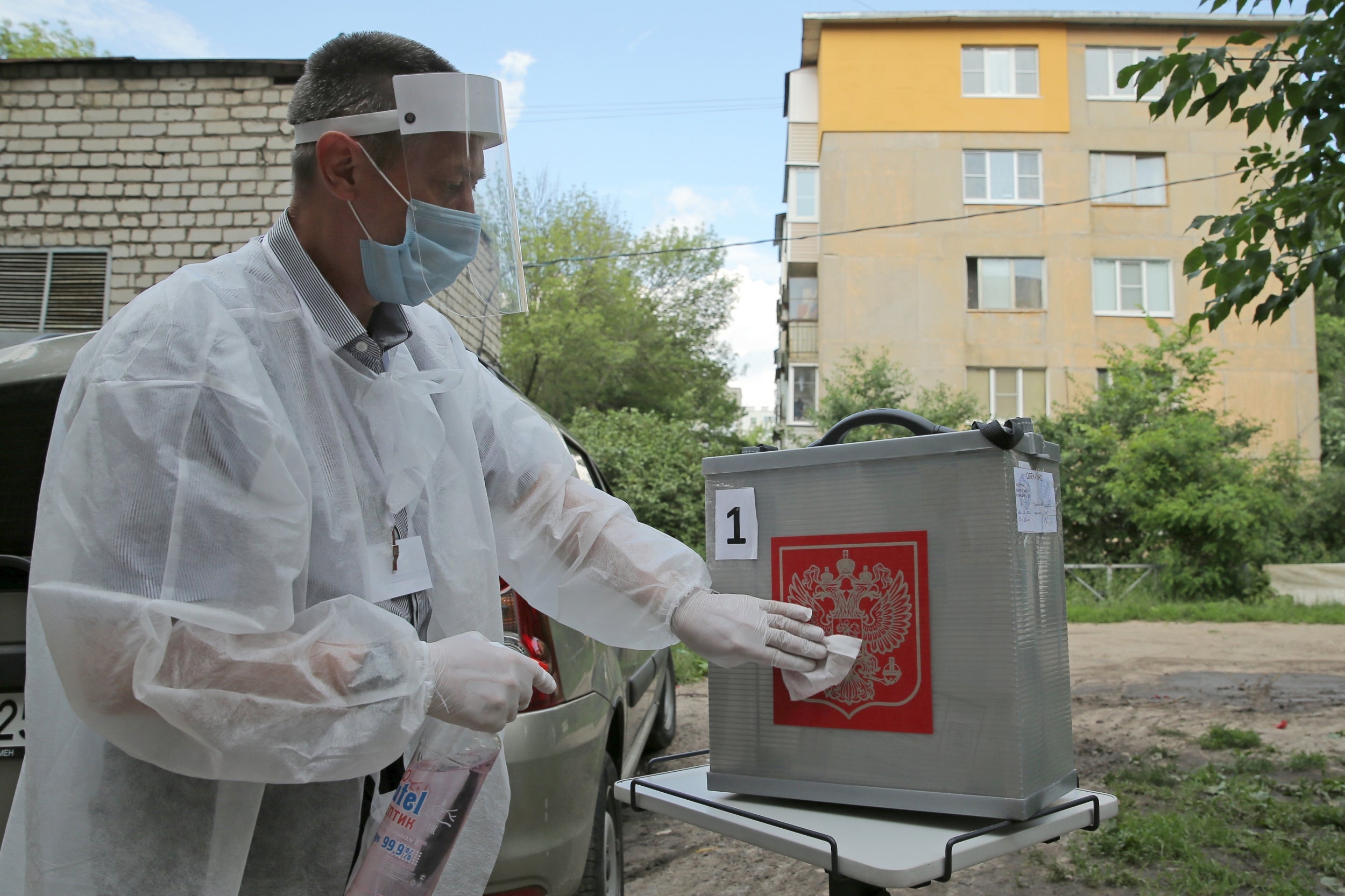
Oiled by the Kremlin’s election machine, the result of Vladimir Putin’s vote on constitutional reform – one that would allow him to rule until 2036 – was never in doubt.
But the decision by Russia’s election commission to publish “preliminary” live results five hours before polling closed was a novelty that shocked even the most cynical of observers.
The initial projection of 73 per cent in favour of amendments was broadly in line with exit polls published by state pollsters FOM and VTsIOM. They projected 70 per cent and 76 per cent respectively, also before the end of polling.
Opposition groups painted an altogether different picture. At 5.30pm local time (3.30pm GMT), their own exit polls projected a near tie in Moscow (47.76 per cent for, 52.24 against) and a heavy defeat for the president in his home city of St Petersburg (38.2 percent for, 61.8 per cent against).
The constitutional plebiscite was an unusual electoral exercise for Russia, with polling stretched over seven days and in the middle of a coronavirus pandemic. Authorities said the unprecedented measure was necessary to ensure safe voting.
For critics, it was a trick to boost turnout from a population tired of their longtime leader.
The vote is taking place in a tricky period for Mr Putin, who has lost much of his glow after a torrid few months of largely absent Covid-19 crisis management. According to Levada Centre, Russia’s most independent pollster, Mr Putin is still trusted by 59 per cent of Russians, but that figure is down 30 per cent from a post-Crimea high of three years ago.
In open polling, ie when Russians are asked to name the politicians they most trust themselves, support drops to 29 per cent. The figure is lowest among young voters, with less than one in 10 expressing affiliation.✕
This week’s ballot asked for a “yes” or “no” answer to 206 amendments in entirety, with the proposal to reset term limits buried deep amongst them. It was “technically impossible” to ask voters to go through the changes one by one, authorities claimed.
Invariably, official campaign literature focused on the other 205 amendments, targeting populist pressure points from marriage as a heterosexual union, to indexation guarantees for pensions and other social benefits. In his address to the nation on Tuesday, Mr Putin made no mention of the all-important clause on term limits.
On their part, officials claimed the vote to be Russia’s cleanest yet. Deputy elections chief Nikolai Bulayev talked about a “breakthrough” in the low number of complaints received.
Mr Putin said that election manipulation methods such as forced voting, “rounding errors” in counting and inflating turnout were “inadmissible”. But there was evidence of all methods being rolled out – and more.
On Thursday, the first day of voting, Pavel Lobkov, a journalist for the independent Dozhd television channel, reported he had managed to vote twice. He was later questioned by police for his efforts, with prosecutors now threatening criminal charges for “election fraud”.
A week earlier, a colleague from the same channel was taken in for questioning after he uncovered a corrupt scheme to register elderly voters for electronic voting. Some of the most egregious manipulations during the week were recorded in the northern capital of St Petersburg.
There, election officials were recorded by local journalists stuffing papers into the ballot box. At another polling station, an election observer claimed officials refused to give him access to voting numbers.
When journalist David Frenkel followed up on these claims a day later, he was seriously assaulted by a police officer and another unidentified man. He ended up in hospital with a broken shoulder bone.
The election monitoring group Golos reported a total of 1,500 separate infringements during the seven-day vote. Ella Pamfilova, Mr Bulayev’s boss at the election commission, dismissed the claims, and Golos as a “toxic and degraded” organisation.
Ilya Azar, the journalist who has become an unexpected alternative protest figurehead, has announced a protest for 6pm local time (4pm BST) in Pushkin Square. He was responding to a “coup d’etat”, he said in a Facebook post. But in an open admission of the impossibility of protesting in Russia, he said he would not be openly encouraging others to join him.
“Let every man decide for himself,” he said. “They should know 20,000 rouble [£230] fines and 30-day jail terms are very likely.”
Weltgeist Arthur Schopenhauer is one of the most influential German philosophers. His philosophy of the Will has influenced thinkers and scientists such as Sigmund Freud, Charles Darwin, Friedrich Nietzsche, and even Albert Einstein. In this video, the first in a series on the philosophy of Arthur Schopenhauer, we take a deep dive into the first part of Schopenhauer’s magnum opus: The World as Will and Representation. We look at Schopenhauer’s metaphysical system, his indebtedness to Immanuel Kant, and his philosophy of the Will. In subsequent videos we’ll discuss Schopenhauer’s ethics and aesthetics. If you want to be notified when these are uploaded, please subscribe to the channel.
Gaslighting is a form of psychological manipulation in which a person or a group covertly sows seeds of doubt in a targeted individual or group, making them question their own memory, perception, or judgment, often evoking in them cognitive dissonance and other changes including low self-esteem. Using denial, misdirection, contradiction, and misinformation, gaslighting involves attempts to destabilize the victim and delegitimize the victim’s beliefs. Instances can range from the denial by an abuser that previous abusive incidents occurred, to the staging of bizarre events by the abuser with the intention of disorienting the victim.
The term originated from the British play Gas Light (1938, but originally performed as Angel Street in the United States) and its 1940 and 1944 film adaptations (both titled Gaslight). The term has been used in clinical psychological literature,[1][2] as well as in political commentary and philosophy.[3]
The term originates in the systematic psychological manipulation of a victim by her husband in Patrick Hamilton’s 1938 stage play Gas Light,[4] and the film adaptations released in 1940 and 1944.[5] In the story, the husband attempts to convince his wife and others that she is insane by manipulating small elements of their environment and insisting that she is mistaken, remembering things incorrectly, or delusional when she points out these changes. The play’s title alludes to how the abusive husband slowly dims the gas lights in their home, while pretending nothing has changed, in an effort to make his wife doubt her own perceptions. He further uses the lights in the sealed-off attic to secretly search for jewels belonging to a woman whom he has murdered. He makes loud noises as he searches, including talking to himself. The wife repeatedly asks her husband to confirm her perceptions about the dimming lights, noises and voices, but in defiance of reality, he keeps insisting that the lights are the same and instead it is she who is going insane.[6]:8 He intends on having her assessed and committed to a mental institution, after which he will be able to gain power of attorney over her and search more effectively.[citation needed]
The term “gaslighting” has been used colloquially since the 1960s[7] to describe efforts to manipulate someone’s perception of reality. The term has been used to describe such behaviour in psychoanalytic literature since the 1970s.[8] In a 1980 book on child sexual abuse, Florence Rush summarized George Cukor‘s Gaslight (1944) based on the play and wrote, “even today the word [gaslighting] is used to describe an attempt to destroy another’s perception of reality.”[9]
Characteristics
Gaslighting involves a person, or a group of persons, the victimizer, and a second person, the victim. It can be either conscious or unconscious, and is carried out covertly such that the resulting emotional abuse is not overtly abusive.[10]
Gaslighting depends on “first convincing the victim that his thinking is distorted and secondly persuading him that the victimizer’s ideas are the correct and true ones”.[1]:45 Gaslighting induces cognitive dissonance in the victim, “often quite emotionally charged cognitive dissonance”,[11] and makes the victim question their own thinking, perception and reality testing, and thereby tends to evoke in them low self-esteem and disturbing ideas and affects, and may facilitate development of confusion, anxiety, depression and in some cases even psychosis.[1]:33–34 After the victim loses confidence in their mental capacities and develops a sense of learned helplessness,[12] they become more susceptible to the victimizer’s control.[1]:34 Victims tend to be people with less power and authority.[13]:7
The role of either victimizer or victim can oscillate within a given relationship, and often each of the participants is convinced that they are the victim.[14] When a group of people acts as the victimizer, gaslighting does its damage through the group members’ “small, often invisible actions that have power through their accumulation and reinforcement”.[15] Gaslighting has been used by individuals and groups for “attaining interpersonal and social control over the psychic functioning of other individuals and groups”.[1]:6
The illusory truth effect, a phenomenon in which a listener comes to believe something primarily because it has been repeated so often, may occur to a victim during gaslighting.[12]
Psychoanalytic explanation
In a 1981 article, psychoanalysts Victor Calef and Edward Weinshel argued that gaslighting involves the projection and introjection (the “transfer”) of psychic contents from the victimizer to the victim.[14] The psychic contents include affects, perceptions, impulses, resistances, fantasies, delusions, conflicts. The authors explored a variety of reasons why the victims may have “a tendency to incorporate and assimilate what others externalize and project onto them”, and concluded that gaslighting may be “a very complex highly structured configuration which encompasses contributions from many elements of the psychic apparatus”.[14]
Later, psychiatrist Theodore Dorpat described this “transfer” of the victimizer’s unconscious psychic contents as an example of projective identification.[16][1]:5–6, 40 For projective identification to be most effective, the victim would be unaware of being gaslighted. It becomes destructive when the victim as well identifies with the contents of the “transfer” (what has been projected). These effects however are cancelled when the victim becomes capable of disbelieving and disidentifying with the negative introjects that result from projective identification.
In personality disorders
Sociopaths[17] and narcissists[18] frequently use gaslighting tactics to abuse and undermine their victims. Sociopaths consistently transgress social mores, break laws and exploit others, but typically also are convincing liars, sometimes charming ones, who consistently deny wrongdoing. Thus, some who have been victimized by sociopaths may doubt their own perceptions.[17] Some physically abusive spouses may gaslight their partners by flatly denying that they have been violent.[2] Gaslighting may occur in parent–child relationships, with either parent, child, or both lying to the other and attempting to undermine perceptions.[19]
In psychiatry
Gaslighting has been observed between patients and staff in inpatient psychiatric facilities.[20]
In a 1996 book, Dorpat claimed that “gaslighting and other methods of interpersonal control are widely used by mental health professionals as well as other people” because they are effective methods for shaping the behavior of other individuals.[1]:45 He noted that covert methods of interpersonal control such as gaslighting are used by clinicians with authoritarian attitudes,[1]:xiii–xxi and he recommended instead more non-directive and egalitarian attitudes and methods on the part of clinicians,[1]:225 “treating patients as active collaborators and equal partners”.[1]:246
In romantic relationships
In interpersonal relationships, the victimizer “needs to be right” in order to “preserve [their] own sense of self“, and “[their] sense of having power in the world”; and the victim allows the victimizer to “define [their] sense of reality” inasmuch as the victim “idealizes [them]” and “seeks [their] approval“.[6]:3
The psychological manipulation may include making the victim question their own memory, perception, and sanity. The abuser may invalidate the victim’s experiences using dismissive language: “You’re crazy. Don’t be so sensitive. Don’t be paranoid. I was just joking! … I’m worried; I think you’re not well.”[3]
Psychologists Jill Rogers and Diane Follingstad said that such dismissals can be detrimental to mental health outcomes. They described psychological abuse as “a range of aversive behaviors that are intended to harm an individual through coercion, control, verbal abuse, monitoring, isolation, threatening, jealousy, humiliation, manipulation, treating one as an inferior, creating a hostile environment, wounding a person regarding their sexuality and/or fidelity, withholding from a partner emotionally and/or physically”.[21]
Gaslighting has been observed in some cases of marital infidelity: “Therapists may contribute to the victim’s distress through mislabeling the [victim’s] reactions. […] The gaslighting behaviors of the spouse provide a recipe for the so-called ‘nervous breakdown‘ for some [victims] [and] suicide in some of the worst situations.”[19][22]
In their 1988 article “Gaslighting: A Marital Syndrome”, psychologists Gertrude Zemon Gass and William Nichols studied men’s extramarital affairs and their consequences on their wives.[22] They described how a man may try to convince his wife that she is imagining things rather than admitting to an affair: “a wife picks up a telephone extension in her own home and accidentally overhears her husband and his girlfriend planning a tryst while he is on a business trip.” His denial challenges the evidence of her senses: “I wasn’t on the telephone with any girlfriend. You must have been dreaming.”[22]
Rogers and Follingstand examined women’s experiences with psychological abuse as a predictor of symptoms and clinical levels of depression, anxiety, and somatization, as well as suicidal ideation and life functioning. They concluded that psychological abuse affects women’s mental health outcomes, but the perceived negative changes in one’s traits, problematic relationship schemas, and response styles were stronger indicators of mental health outcomes than the actual abuse.[21]
Psychotherapist Stephanie Moulton Sarkis explained that it takes “a certain amount of cognitive dissonance to remain connected to a gaslighter” and that “the healthiest way to resolve cognitive dissonance” in such situations involves “leaving or distancing yourself from the gaslighter”.[13]:24–25
Signs and methods
As described by Patricia Evans, seven “warning signs” of gaslighting are the observed abuser’s:[23]
Withholding information from the victim;
Countering information to fit the abuser’s perspective;
Blocking and diverting the victim’s attention from outside sources;
Trivializing (“minimising”) the victim’s worth; and,
Undermining the victim by gradually weakening them and their thought processes.
Evans considers it necessary to understand the warning signs in order to begin the process of healing from it.[23]
The psychologist Elinor Greenberg has described three common methods of gaslighting:[18]
Hiding. The abuser may hide things from the victim and cover up what they have done. Instead of feeling ashamed, the abuser may convince the victim to doubt their own beliefs about the situation and turn the blame on themselves.
Changing. The abuser feels the need to change something about the victim. Whether it be the way the victim dresses or acts, they want the victim to mold into their fantasy. If the victim does not comply, the abuser may convince the victim that he or she is in fact not good enough.
Control. The abuser may want to fully control and have power over the victim. In doing so, the abuser will try to seclude them from other friends and family so only they can influence the victim’s thoughts and actions. The abuser gets pleasure from knowing the victim is being fully controlled by them.
An abuser’s ultimate goal, as described by the divorce process coach Lindsey Ellison, is to make their victim second-guess their choices and to question their sanity, making them more dependent on the abuser.[24] One tactic used to degrade a victim’s self-esteem is the abuser alternating between ignoring and attending to the victim, so that the victim lowers their expectation of what constitutes affection, and perceives themselves as less worthy of affection.[24][verification needed]
According to philosophy professor Kate Abramson, the act of gaslighting is not specifically tied to being sexist, although women tend to be frequent targets of gaslighting compared to men who more often engage in gaslighting.[3] Abramson explained this as a result of social conditioning, and said “it’s part of the structure of sexism that women are supposed to be less confident, to doubt our views, beliefs, reactions, and perceptions, more than men. And gaslighting is aimed at undermining someone’s views, beliefs, reactions, and perceptions. The sexist norm of self-doubt, in all its forms, prepares us for just that.”[3] Abramson said that the final “stage” of gaslighting is severe, major, clinical depression.[3] With respect to women in particular, philosophy professor Hilde Lindemann said that in such cases, the victim’s ability to resist the manipulation depends on “her ability to trust her own judgements”. Establishment of “counterstories” may help the victim reacquire “ordinary levels of free agency”.[26]
Psychotherapist Stephanie Moulton Sarkis, who observed gaslighting to be present in about 30–40% of the couples she treats, says that “Gaslighting is as likely to be done by men as women”[27] and that “as far as we know, the genders are represented equally”.[13]:27 She explains further that we tend to think gaslighters to be mostly men because “men are often more reluctant (perhaps embarrassed) to talk to someone about a female partner who is being emotionally abusive”.[13]:27
Children at the hands of unloving parents may become victims of gaslighting. Maternal gaslighting of daughters has received particular attention. In a section titled “Lying, Gaslighting, and Denial” in her best-seller Mothers Who Can’t Love: A Healing Guide for Daughters, therapist and author Susan Forward writes: “A severely narcissistic mother’s anger, criticism, and thoughtless dismissal of her daughter’s feelings are painful and destructive. And every daughter clings to the belief that if only her mother could see that behavior and its effects, she’d stop. Daughters try again and again to hold up a mirror, hoping that this time, things will be different. But severe narcissists stay true to form, responding to any confrontation with drama followed by deflection and a focus on your shortcomings. When that doesn’t produce the desired results, they turn to what may be their most frustrating and infuriating tool: denial. Confrontation makes them feel cornered, and when that happens, they can’t and won’t validate your experience or acknowledge their part in it. Rather, they rewrite reality and tell you that what you saw, you didn’t see, what you experienced didn’t happen, and what you call real is actually a figment of your imagination.” [28]:32-33
But both mothers and fathers may gaslight children. Psychologically abusive parents often put on a “good parent” face in public yet withhold love and care in private, leading children to question their own perceptions of reality and to wonder whether their parent is the good person everyone else sees or the much darker person that comes out when child and parent are alone. Manipulative parents may also “pit children against each other; … play favorites but persuade the unloved child it’s all his or her fault for not being more gifted, prettier, and otherwise more lovable.”[29]
Columnist Maureen Dowd was one of the first to use the term in the political context.[30][31] She described the Bill Clinton administration’s use of the technique in subjecting Newt Gingrich to small indignities intended to provoke him to make public complaints that “came across as hysterical”.[31][32]
In his 2008 book State of Confusion: Political Manipulation and the Assault on the American Mind, psychologist Bryant Welch described the prevalence of the technique in American politics beginning in the age of modern communications, stating:
To say gaslighting was started by the Bushes, Lee Atwater, Karl Rove, Fox News, or any other extant group is not simply wrong, it also misses an important point. Gaslighting comes directly from blending modern communications, marketing, and advertising techniques with long-standing methods of propaganda. They were simply waiting to be discovered by those with sufficient ambition and psychological makeup to use them.[33]
Journalist Frida Ghitis used the term “gaslighting” to describe Russia’s global relations. While Russian operatives were active in Crimea, Russian officials continually denied their presence and manipulated the distrust of political groups in their favor.[34]
Journalists at The New York Times Magazine, BBC and Teen Vogue, as well as psychologists Bryant Welch, Robert Feldman and Leah McElrath, have described some of the actions of Donald Trump during the 2016 US presidential election and his term as president as examples of gaslighting.[31][35][36][37][38] Journalism professor Ben Yagoda wrote in The Chronicle of Higher Education in January 2017 that the term gaslighting had become topical again as the result of Trump’s behavior, saying that Trump’s “habitual tendency to say ‘X’, and then, at some later date, indignantly declare, ‘I did not say “X”. In fact, I would never dream of saying “X”” had brought new notability to the term.[30]
Gaslighting is utilized by leaders and followers of sectarian groups to ensure conformity of any potentially deviating members.[39]
Gaslighting in the workplace is when people do things that cause colleagues to question themselves and their actions in a way that is detrimental to their careers.[40] The victim may be excluded, made the subject of gossip, persistently discredited or questioned to destroy their confidence. The perpetrator may divert conversations to perceived faults or wrongs.[41] Gaslighting can be committed by anyone and can be especially detrimental when the perpetrator has a position of power.[42]
In popular culture
The 2016 mystery and psychological thriller film The Girl on the Train explored the direct effects gaslighting had on the protagonist (Rachel).[31] During her marriage, Rachel’s ex-husband Tom was a violent abuser and victimizer. Rachel suffered from severe depression and alcoholism. When Rachel would black out drunk, he consistently told her that she had done terrible things that she was incapable of remembering.[43]
Gaslighting was the main theme of a 2016 plotline in BBC‘s radio soap opera, The Archers. The story concerned the emotional abuse of Helen Archer by her partner and later husband, Rob Titchener, over the course of two years, and caused much public discussion about the phenomenon.[44]
For several months during 2018, gaslighting was a main plotline in NBC‘s soap opera Days of Our Lives, as character Gabi Hernandez was caught gaslighting her best friend Abigail Deveroux after Gabi was framed for a murder Abigail had committed in the series.[45]
Deborah Voorhees Shear Horror Hamlet is an official Selection of 2015 Shakespeare film festival in Kenneth Branagh’s Shakespeare Film Festival in Stratford England, 2016 Elsinore Shakespeare Conference in Denmark, in the second round of the Harlem International Film Festival, will be included in a German documentary titled Wahnsinnswerke Hamlet on channel 3-Sat and has been added into the curriculum of BookheadEd Learning, LLC. Brooklyn hip-hop artist Devon Glover raps Hamlet’s “To Be Or Not To Be” soliloquy, first in Shakespeare’s language then he translates it into today’s speak. The Sonnet Man travels the world rapping Shakespeare’s sonnets and teaching children of all ages the Bard’s words. This music video has been created by director and editor Deborah Voorhees of Voorhees Films, which produced the quirky indie film Billy Shakespeare. For more information go to TheSonnetManNYC.com, BillyShakespeareTheMovie.com, and VoorheesFilms.com. The Sonnet Man’s show is produced by Broadway producer/playwright Arje Shaw, music produced by Daniel Lynas and background vocals by Daniel Lynas and Melissa Guttman.
A pioneering work in the movement to free art from its traditional bonds to material reality, this book is one of the most important documents in the history of modern art. Written by the famous nonobjective painter Wassily Kandinsky (1866–1944), it explains Kandinsky’s own theory of painting and crystallizes the ideas that were influencing many other modern artists of the period. Along with his own groundbreaking paintings, this book had a tremendous impact on the development of modern art.
Kandinsky’s ideas are presented in two parts. The first part, called “About General Aesthetic,” issues a call for a spiritual revolution in painting that will let artists express their own inner lives in abstract, non-material terms. Just as musicians do not depend upon the material world for their music, so artists should not have to depend upon the material world for their art. In the second part, “About Painting,” Kandinsky discusses the psychology of colors, the language of form and color, and the responsibilities of the artist. An Introduction by the translator, Michael T. H. Sadler, offers additional explanation of Kandinsky’s art and theories, while a new Preface by Richard Stratton discusses Kandinsky’s career as a whole and the impact of the book. Making the book even more valuable are nine woodcuts by Kandinsky himself that appear at the chapter headings.
This English translation of Über das Geistige in der Kunst was a significant contribution to the understanding of nonobjectivism in art. It continues to be a stimulating and necessary reading experience for every artist, art student, and art patron concerned with the direction of 20th-century painting.
All artists love what they give birth to — the poet loves his poems, the potter her pots, the painter her paintings — how then could God, who is the artist of everything, hate anything? — Thomas Aquinas
Thomas Aquinas (1225 – March 7, 1274) was an Italian Dominican friar, philosopher, Catholic priest, and Doctor of the Church. An immensely influential philosopher, theologian, and jurist in the tradition of scholasticism, he is also known within the latter as the Doctor Angelicus and the Doctor Communis. Wikipedia
Consciousness, spirituality, biography, sexuality, androgyny, futurism, space, the arts, science, astrology, democracy, humor, books, movies and more




.jpg)