The Voices of Birds and the Language of Belonging

by David G. Haskell

May 26th 2019 (emergencemagazine.org)

David Haskell enters the intricate and generative soundscape of the world of birds, inviting us to join in a practice of cross-species listening as a bridge to kinship.
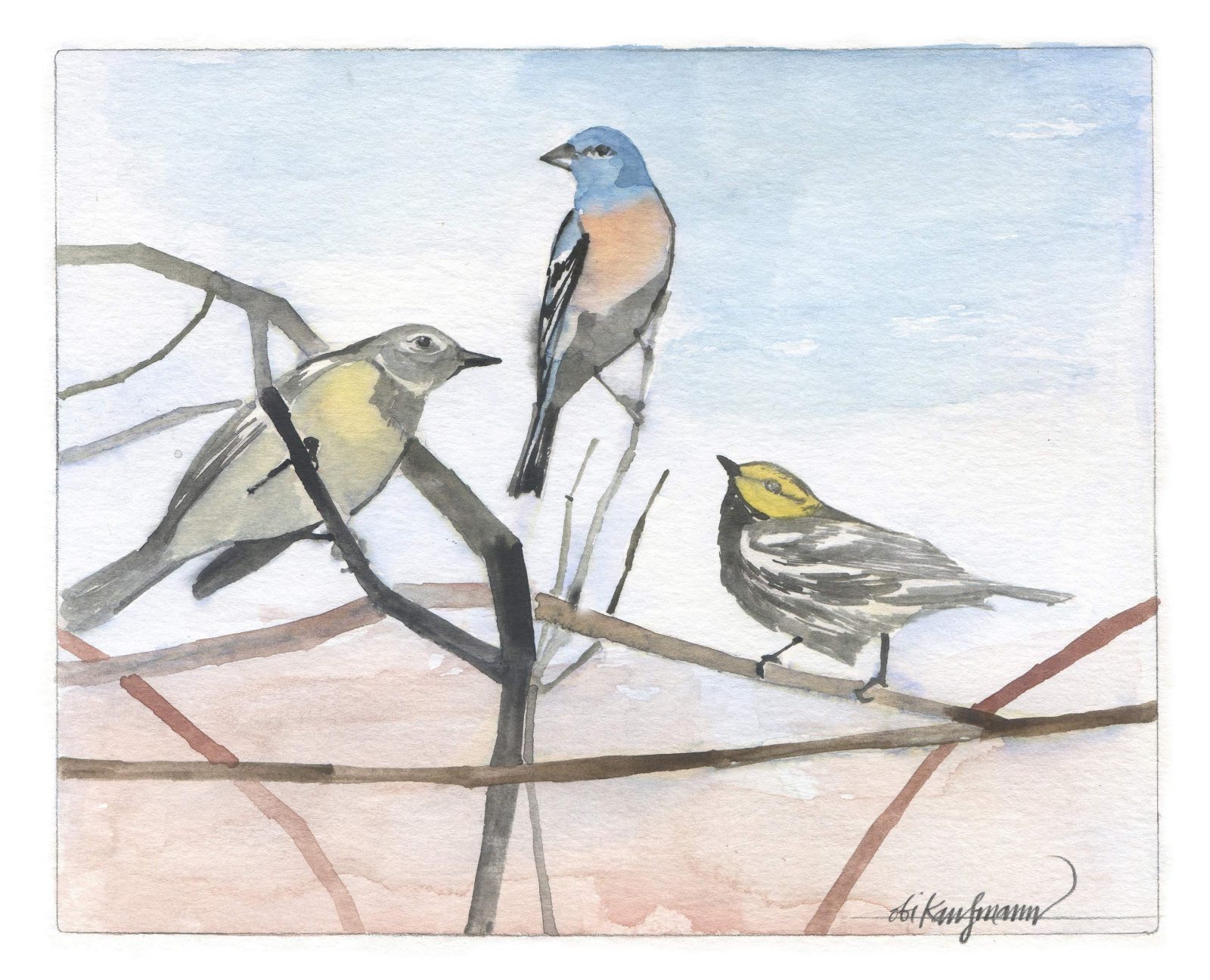
Illustrations by Obi Kaufmann

Listen to this StoryNarrated by David HaskellCONTRIBUTOR BIOS

FOR MILLENNIA, the language of birds has called us to cross divides. In the Qur’an, Solomon received a bounty and blessing when he was given the language of birds. Job exhorts us to hear the wisdom of the fowls of the air. News of the human world was carried into the divine ear by the speech of Norse Odin’s ravens and the bluebirds of the Taoist Queen of the West. In the voices of birds, we hear augury, portent, prophesy. We are drawn across boundaries into other places, other times.

Listen: an invitation. But it is hard to discern what is meant in this speech of our winged cousins. Birds inhabit flesh profoundly different from our own. Our inattention further muffles their language. We wall them out with bricks that keep us indoors, inside self-made worlds, and with presuppositions, closely guarded vaults of the mind. We’ve made ourselves a lonely place, so quiet.

Let in the sound.

Song spills from open beaks, flowing from the birds’ chests. There, at the confluence of windpipes, sitting directly over the heart, sits a sound-making organ of unique and marvelous design. This syrinx is only the size of a lentil or bean. Into this tiny space are interwoven a dozen rings of bone and two dozen muscles, all connected to membranes and lips of soft flesh. The muscles are among the fastest known, capable of contracting up to 200 times per second. As the exhale flows through, the syrinx’s lips squeeze and membranes tremble, imparting song to air. This sound is sculpted by precise tugs and tweaks from muscle and bone, on a timescale of milliseconds. Birds are quick-fingered jewelers of air, crafting dozens of ornamented gems every second. In their modulations of pitch, amplitude, and timbre we hear the vitality of their blood, muscle, and nerve.

But we do not hear as they do. For at least 300 million years, mammals and birds have been on separate evolutionary paths. Our common ancestors, amphibian-like creatures of swampy Paleozoic forests, had ears adapted to water. Their descendants, birds and mammals, each independently evolved ears adapted to air. Bird and mammal hearing, then, is grounded in two different architectures, more linear and direct in birds, segmented and coiled in mammals.

Bird and mammal brains also took divergent evolutionary tracks. Neurons are crammed into bird crania, giving their small brains as many nerve cells as much larger primates. The folds and layers of the forebrain have different geometries, hierarchically layered in mammals and clustered into nodes in birds. Avian brains and bodies also run several degrees warmer than mammals, stoking chemical reactions and thus speeding nerves.

All this manifests in different perceptions of sound. Birds are sensitive to rapid sonic changes and are tightly focused on the mid-registers. They attend not so much to relative pitches, but to the overall shape of the sound, the nuances among layers of sound frequencies. Or so it seems from the small number of studies that have sought to understand hearing from the birds’ perspective.

Here are parallel worlds of experience. The same sound vibration is received and understood in profoundly different ways by birds and mammals.

As we listen and seek to connect, we should remember and honor this difference. At the same time, let us not allow otherness to bar the door to kinship, curiosity, and imagination. There is a bridge. That bridge is made from the gift of our attention. Sometimes attention is focused into science, but mostly it is an opening to the languages of birds in the everyday.

What do we hear in the bird voices of our homes? Every species has a sonic signature, and individuals within species have their own unique voices. In this diversity of acoustic expression are embedded many meanings.

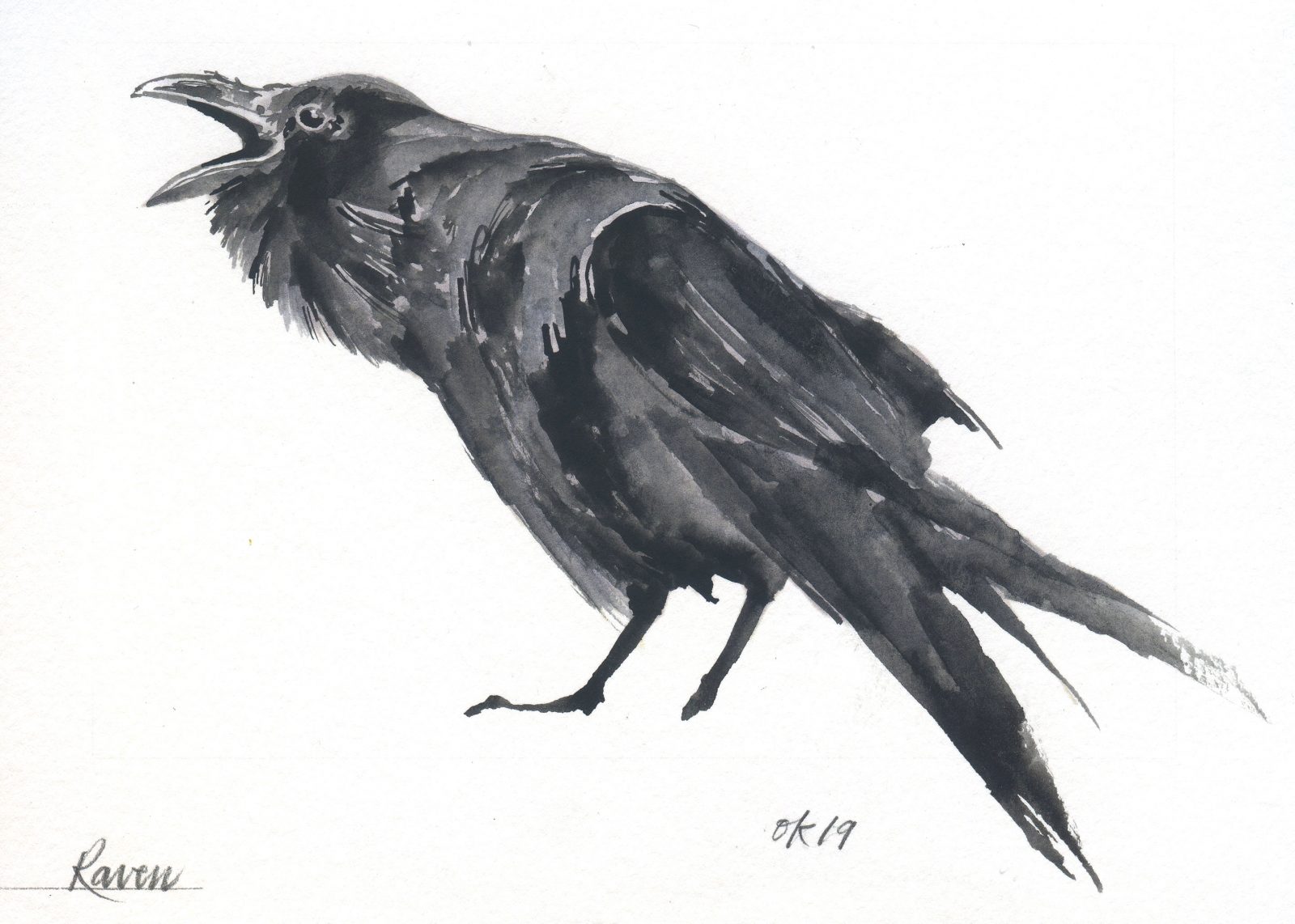
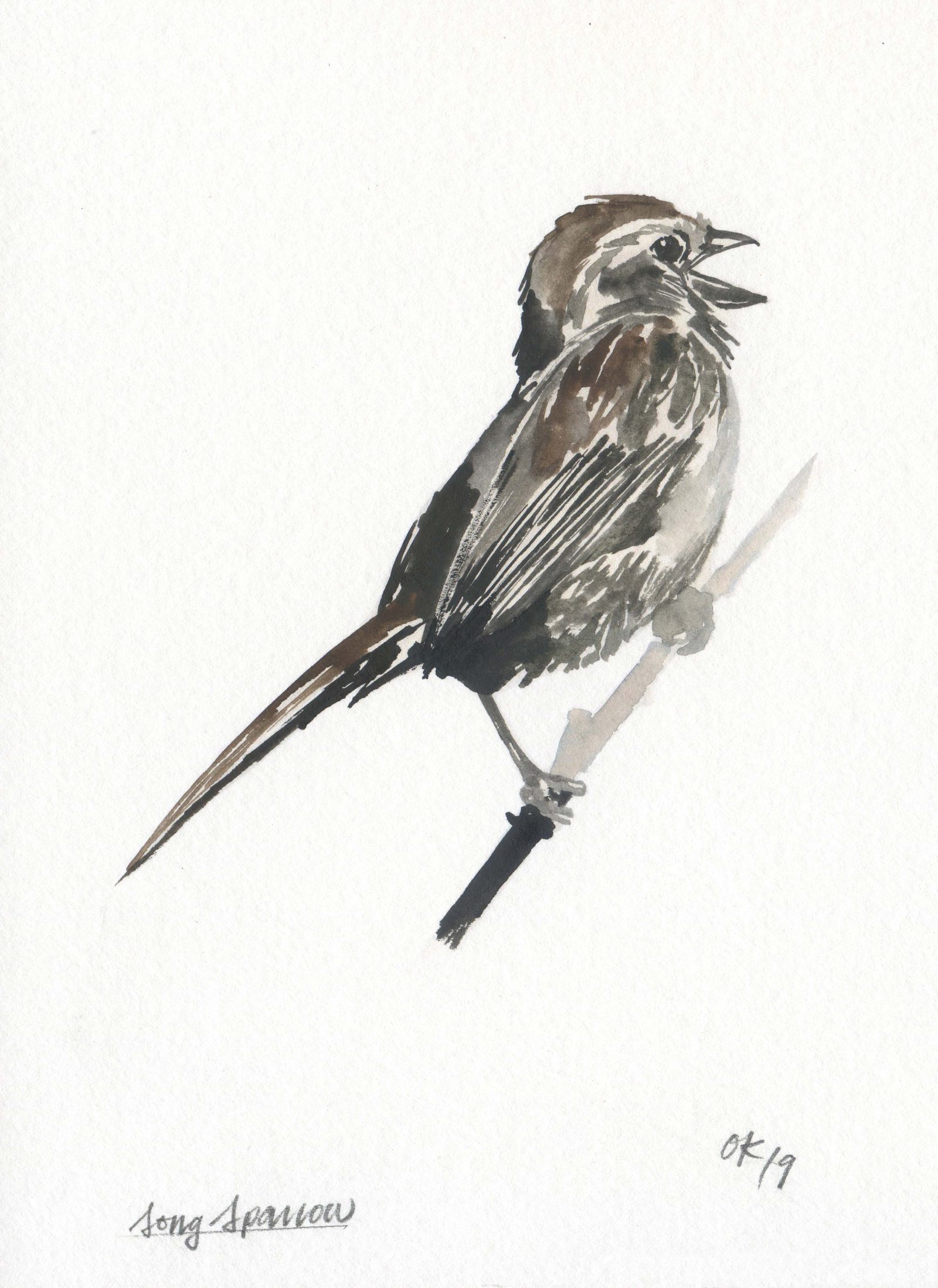
First, the particularities of species, each with its own cadence and tempo. House wren. Bald eagle. Song sparrow. Raven. By noticing and naming, we take the first step into friendship and understanding, crossing the gulf between species. Sound is a particularly powerful connector because it travels through and around barriers, finding us and calling us out of inattention. We walk across town and notice our avian cousins. Kinship and community are no longer just ideas, but are lived, sensual relationships.
Bird sounds reveal the polyrhythms of a living Earth.

Part of the language of birds, then, are the many meanings and messages that we hear in the community of avian voices. The rhythms of the year are scribed in air by ever-changing sounds. Arrivals and departures during migration: songbirds from the tropics, snow geese from the tundra, cranes from inland wetlands. In early summer, nestlings clamor at their parents. Chittering swallows signal their discovery of a hatch of river mayflies. From the winter underbrush, sparrows give quiet calls. Every species has its own tempo of sound-making through the year, tuned to the particularities of food plants and insects, refined by local weather. In these sounds we learn that there are not just four seasons, but dozens or hundreds. Bird sounds reveal the polyrhythms of a living Earth.

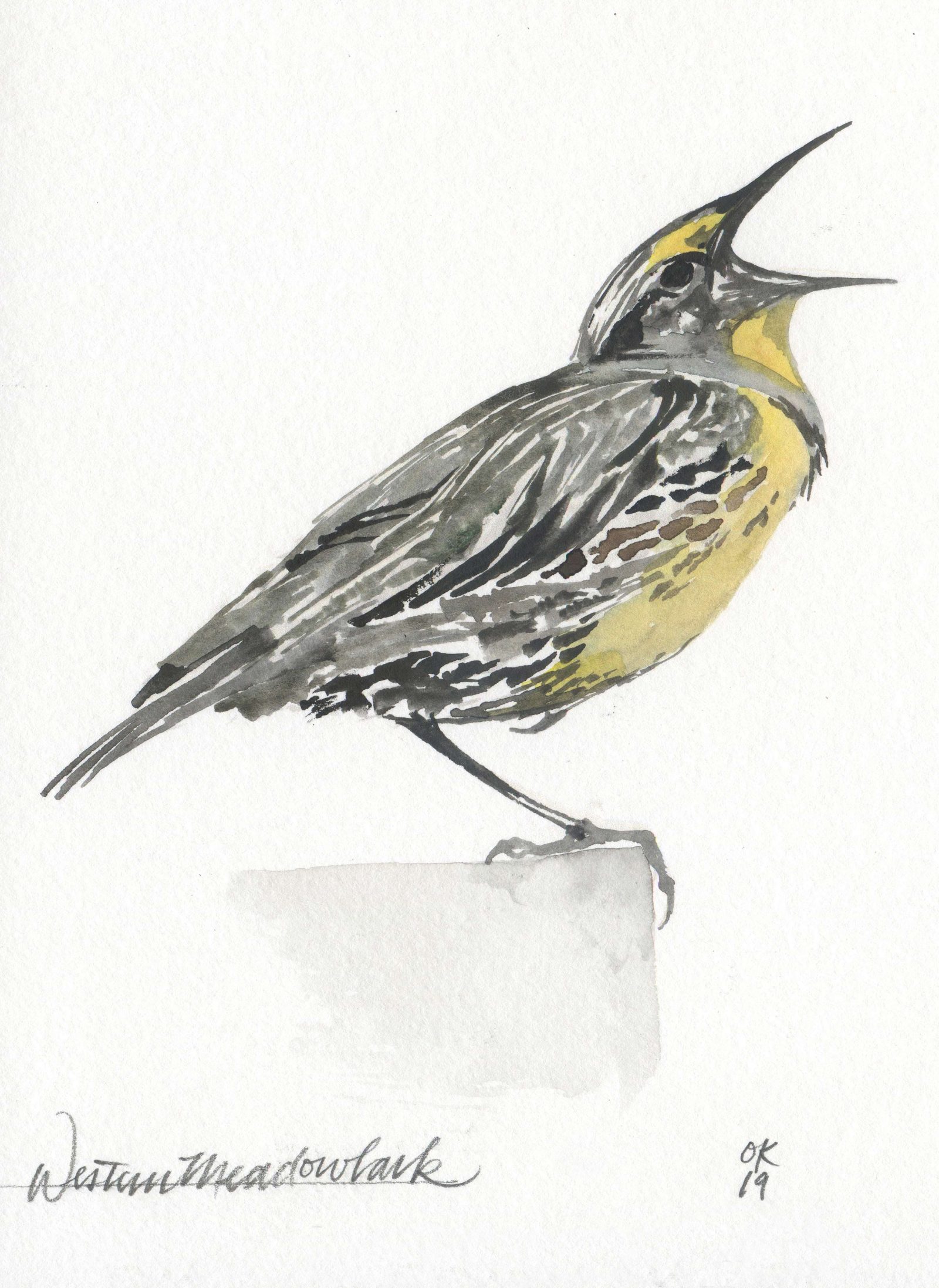
This language of bird species also discloses the physical diversity of the world. A gull’s call slices through the turbulent winds of the ocean shore. In a mossy forest, the ruffed grouse looses deep territorial calls that flow unimpeded by the dense vegetation. High in the mountains, bushtits call to one another with notes that cut through the whoosh of wind in spruce trees. On the open prairies, meadowlarks throw their lance-like song over the thick grasses. Every sound has its home.

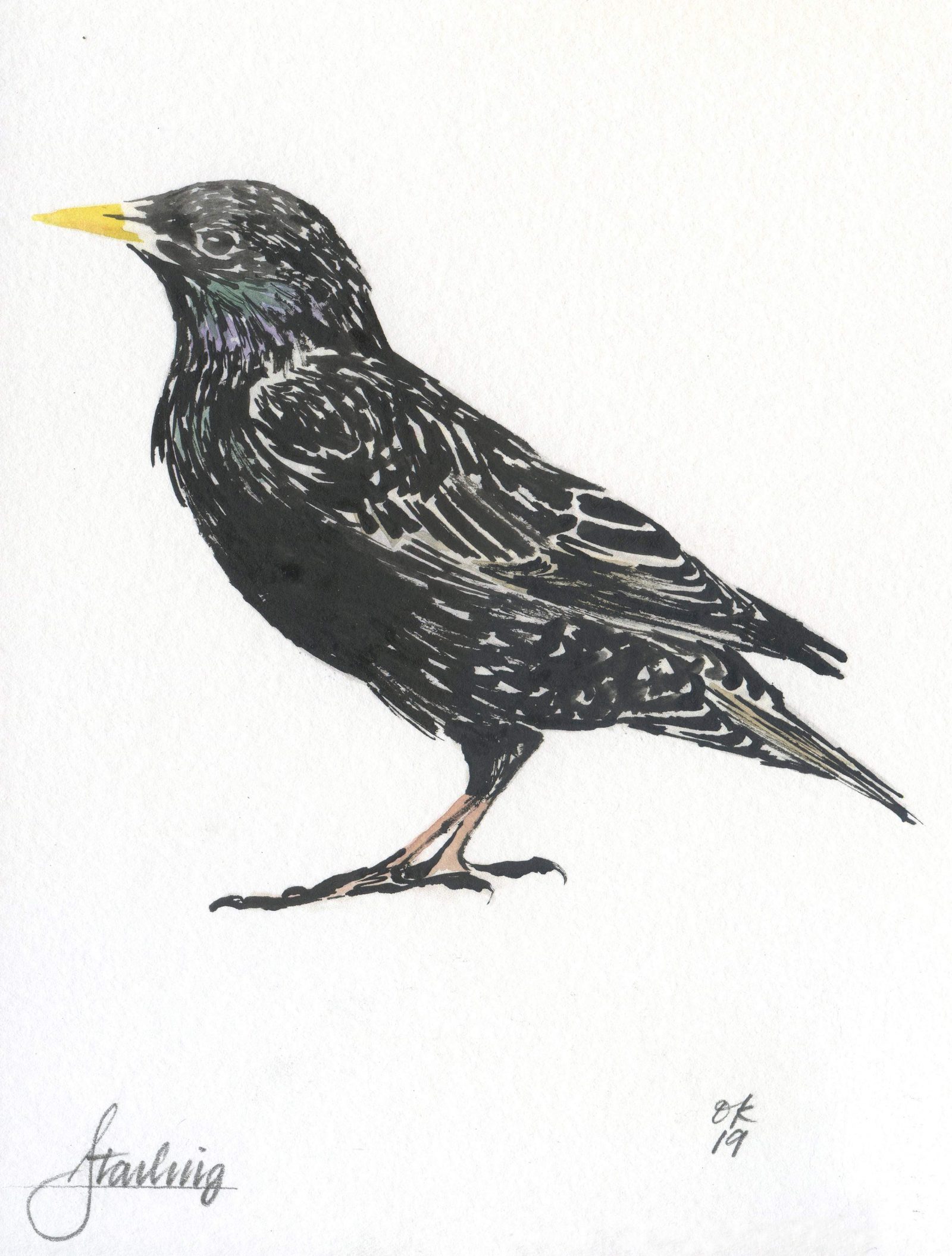
Into these homes comes the fossiliferous racket of industrialized humanity. We spread low-frequency rumbles and throbs over the world. Birds closest to the engine-borne mire must sing louder, higher, or they are driven out. A few, European starlings and house sparrows especially, exult in this new world, finding opportunities for sonic and ecological exploration and improvisation.

In attending to the sounds of bird species, our senses learn the language of belonging. Over time, this embodied knowledge of place tells us what is changing, what is gained, and what is lost.
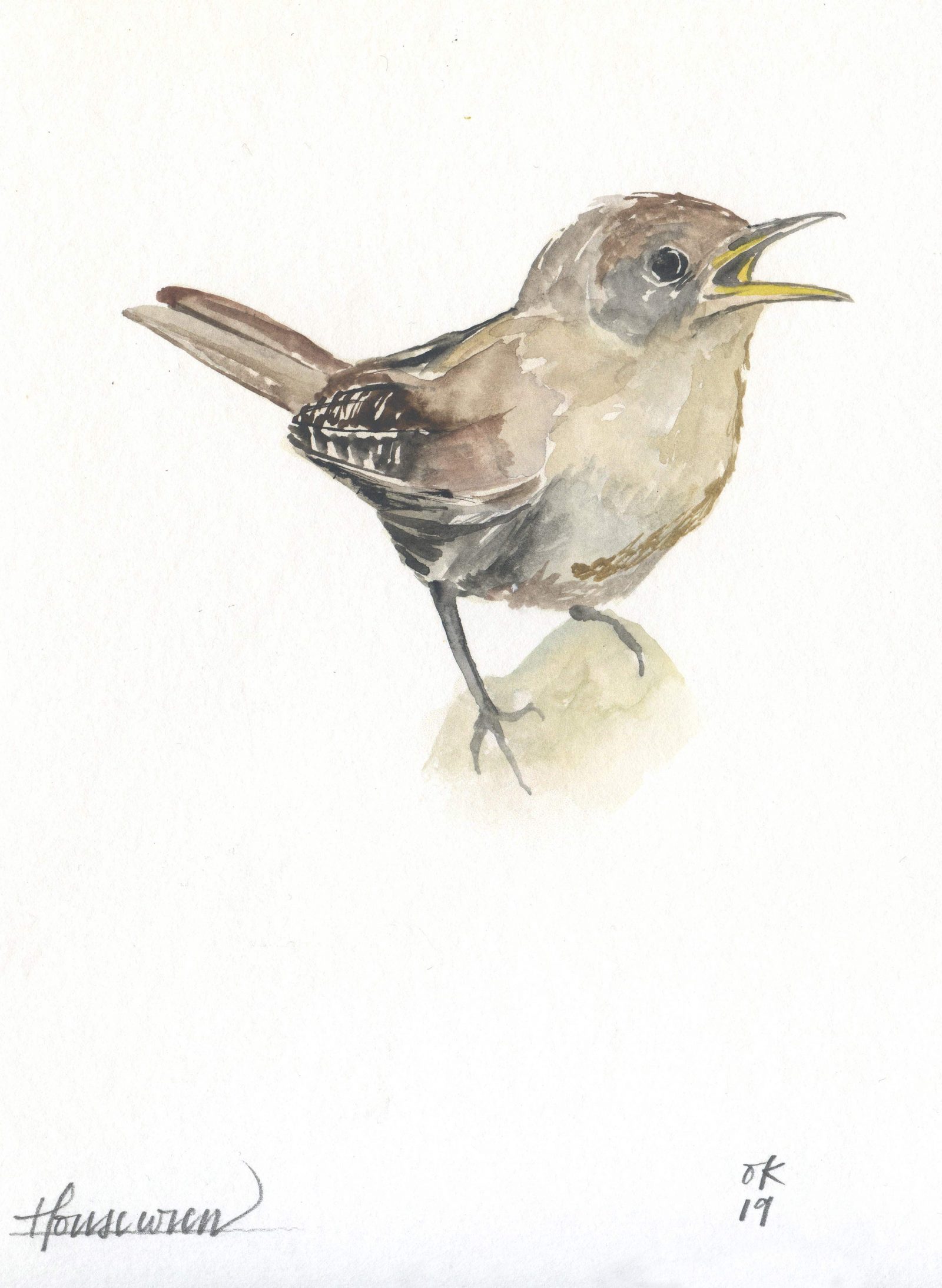
In coming years, our children, students, and friends will need our stories. In our listening to birds, we might gain something worth telling the future, tales whose meanings are now unforeseen: That ravens fell silent in the late summer heat, sandhill cranes passed in March but did not linger, orioles and flycatchers wove their summer songs into the tops of cottonwood trees, and warblers departed suburban fir boughs in December. These will be stories of continuity, of extinction, of blossoming, of changed tempo and texture. Coming generations depend on us to convey these living memories. We start in the present, by listening.

Within the stories told by the sounds of bird species are further riches. Every individual bird has its own acoustic signature. Listen and meet your locals. Some species reward our attention by quickly revealing sonic individuality. Over much of North America, the song sparrow is one such teacher. Every singing male has his own repertoire and style. Listen for a few minutes and the distinctiveness of their voices leaps into our consciousness.

The individuality of the voices of other species are harder for us to discern. Every flycatcher’s sneezy song seems the same to our untrained ears, but the birds know one another’s voices. Ravens, on the other hand, express themselves with such complexity that we’re overwhelmed. We’re tuned to the melodies of human music, and struggle with the multifarious shapes of raven croak and click and whistle. Unlike the song sparrow that sings in our human neighborhood day after day, schooling us with their whistled melodies, ravens range over huge territories, giving us only fleeting access to the internal dynamics of their speech.

Attentive bird-listeners hear the edges of meaning.

With some attention and perhaps the help of a recording device, we can hear the individuality of birds around our homes. But understanding the meanings embedded in these sounds is harder. In the human realm, I can learn the singular voices of people speaking in a foreign tongue, but I’ll completely fail to understand what they say and mean. How much more difficult is the task with creatures separated from us by hundreds of millions of years of evolution.

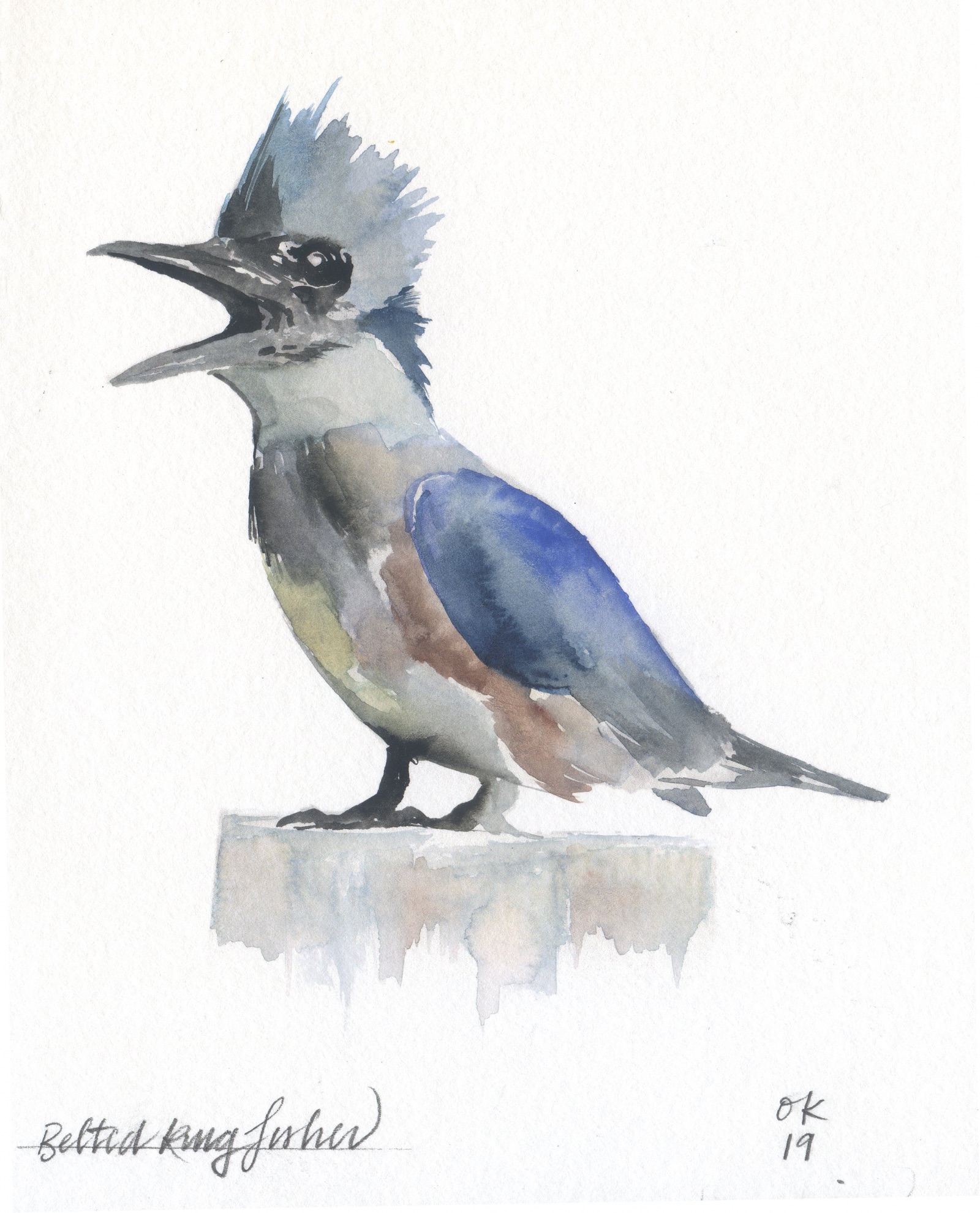
Yet, attentive bird-listeners hear the edges of meaning. Individuality in bird sounds is not random or accidental; it reveals the personality of each bird. In the society of chickadees, some birds have open and exploratory personalities, others are more careful and precise. The rattle of kingfishers and the wood thrushes’ evening song take on new inflections when birds court and pair. At the nest, we hear information flowing in a stream of sound between mated birds. No two phoebe nestlings beg for food in the same way. When sparrow youngsters babble and practice their songs, they explore acoustic spaces in ways that parallel human speech: improvisational, repetitive, refined by listening to elders. In the trees at dusk, crows warble softly to themselves as they preen. A raven’s call is filled with mocking irony as the bird mimics for its companions the call of a sandhill crane. Parrots laugh, causing those around them to frolic and play. As robins gather on a lawn, a blue jay screams a red-shouldered hawk call, a deception that the bird repeats with great gusto when humans walk under its tree. These are not the dead clankings of machines, nor are they the mere utilitarian grunts of feeding or social tokens of sexual union. These sounds are intricate, layered, responsive, generative, and humorous.

Laboratory studies reveal that bird utterances are imbued with understanding, full of representation, organized by rules, powered by creativity, and shaped by culture and context. Bird sound-making has internal grammatical rules. Their brains learn and innovate. Birds hear and remember nuances of sound, connecting abstract acoustic patterns to the physicality of their ecological and social worlds. They listen to the voices of other species and understand what is meant. Social interaction with kin and neighbors molds the shape of individual sounds and the organization of these parts into a whole.

These scientific studies, valuable as they are in expanding our understanding, have queried bird language in only a handful of species, often with the goal of testing whether specific rules of human grammar also manifest in birds. Thus far, science alone is insufficient to the task of hearing birds. A few dozen experiments conducted by a handful of researchers will not open the ears of the human species to the voices of our cousins. Language-learning is for everyone.

When we understand the meanings of a sound made by a bird, nerves in two different brains touch and signal. The link between nerve cells is made from vibrating air, a connection as strong and real as the chemical links among nerves in a single brain. Bird sounds, then, are sonic neurotransmitters that leap across species boundaries.
When we understand the meanings of a sound made by a bird, nerves in two different brains touch and signal.

This leap is creative. When bird and human minds connect, a new language is born. This expansive language weaves many species into a communicative whole, a web of listening and speech. Language-learning is indeed for everyone. It unites us. And so we return to the invitation offered to us by the birds around our homes. In their voices we hear the many rhythms of the seasons and the varied physicality of habitats. We learn the individual stories of each bird. We understand how our community is changing and what we should remember from this present moment. We hear and create Earth’s universal grammar.

Let’s answer the birds’ invitation, stepping outside to give them the simple gift of our attention. Listen. Wonder. Belong.
This recording includes a selection of sounds recorded by Gordon Hempton. For more information about Gordon Hempton and his library of sound recordings please visit www.soundtracker.com.

Marcus Aurelius on How to Keep Your Mental Composure and Emotional Equanimity When People Let You Down

By Maria Popova (brainpickings.org)

meditations_robinwaterfield.jpg?fit=320%2C496

The vast majority of our mental, emotional, and spiritual suffering comes from the violent collision between our expectations and reality. As we dust ourselves off amid the rubble, bruised and indignant, we further pain ourselves with the exertion of staggering emotional energy on outrage at how reality dared defy what we demanded of it.

The remedy, of course, is not to bend the reality of an impartial universe to our will. The remedy is to calibrate our expectations — a remedy that might feel far too pragmatic to be within reach in the heat of the collision-moment, but also one with profound poetic undertones once put into practice.

Walt Whitman understood this when, felled by a paralytic stroke, he considered what makes life worth living and instructed himself: “Tone your wants and tastes low down enough, and make much of negatives, and of mere daylight and the skies.” He spared himself the additional self-inflicted suffering of outrage at how his body failed him — perhaps because, having proclaimed himself the poet of the Body and the poet of the Soul, he understood the two to be one. He squandered no emotional energy on the expectation that his suddenly disabled body perform a counterpossible feat against reality to let him enjoy his beloved tree workouts and daily excursions to the river. He simply edited his expectations to accord with his new reality and sought to find his joy there, within these new parameters of being.margaretcook_leavesofgrass23.jpg?resize=680%2C864

Art by Margaret C. Cook from a rare 1913 edition of Whitman’s Leaves of Grass. (Available as a print.)

What is true of the poetics of our own body-soul is as true of the poetics of relationship, that beautiful and terrifying interchange between separate body-souls. Little syphons the joy of life more surely than the wasted energy of indignation at how others have failed to behave in accordance with what we expected of them.

Two millennia before the outrage culture of the Internet, the lovesick queer teenager turned Roman emperor and Stoic philosopher Marcus Aurelius (April 26, 121–March 17, 180) addressed this curious self-mauling tendency of the human mind with his characteristic precision of insight and unsentimental problem-solving in the notebooks that became his Meditations (public library) — a timeless book, newly translated and annotated by the British classics scholar Robin Waterfield, which Marcus Aurelius wrote largely for and to himself, like Tolstoy wrote his Calendar of Wisdom and Bruce Lee calibrated his core values, yet a book that went on to stake the pillars of the philosophical system of Stoicism, equipping countless generations with tools for navigating the elemental existential challenges of being human and inspiring others to fill the gaps of its unaddressed questions with exquisite answers of their own.marcusaurelius.jpg?w=680

Marcus Aurelius

Epochs before the birth of probability theory, Marcus Aurelius begins with a probabilistic-statistical consolation:

2e292385-dc1c-4cfe-b95e-845f6f98c2ec.pngWhenever a person’s lack of shame offends you, you should immediately ask yourself, “So is it possible for there to be no shameless people in the world?” It isn’t, and you should therefore stop demanding the impossible. He’s just one of those shameless people who must necessarily exist in the world. You should keep the same thought readily available for when you’re faced with devious and untrustworthy people, and people who are flawed in any way. As soon as you remind yourself that it’s impossible for such people not to exist, you’ll be kinder to each and every one of them. It’s also helpful immediately to consider what virtue nature has granted us human beings to deal with any given offense — gentleness, for instance, to counter discourteous people…

Millennia before William James lit the dawn of modern psychology with the radical assertion that our experience is what we “agree to attend to,” millennia before neuroscience came to locate the seat of consciousness in the qualia of subjective experience, Marcus Aurelius serves that classic Stoic cocktail of simply worded obvious truths that are difficult truths to live up to, earned by a thousand complexities of conduct to be practiced daily:

2e292385-dc1c-4cfe-b95e-845f6f98c2ec.pngThe things of the world cannot affect the soul; they lie inert outside it, and only internal beliefs disturb it.

4.jpg?resize=680%2C993

Light distribution on soap bubble from a 19th-century French science textbook. (Available as a print and as a face mask.)

From this follows a curious, infuriating fundament of our humanity: that no matter what another person does — to us or at us or near the self-membraned bubble of our being — our inner response to it lives in the realm of feeling, that sovereign source of light over which we alone have agency and dominion. Even more infuriatingly, Marcus Aurelius reminds us, our outrage at some entirely predictable misbehavior by a person known to misbehave is a failure not of the other but of our own powers of reason:

2e292385-dc1c-4cfe-b95e-845f6f98c2ec.pngYou’ll find that none of the people who make you lose your temper has done anything that might affect your mind for the worse; and outside of the mind there’s nothing that is truly detrimental or harmful for you… After all, you even had the resources, in the form of your ability to think rationally, to appreciate that he was likely to commit that fault, yet you forgot it and are now surprised that he did exactly that.

Observing that to explode with rage at the offender would make no positive difference to their conduct and would only further perturb your own soul, he instead offers a two-step process for dealing with the situation, telescoping into the broad existential perspective and then microscoping into your own innermost values:

2e292385-dc1c-4cfe-b95e-845f6f98c2ec.pngFirst, don’t be upset. Nothing happens that isn’t in accord with universal nature, and before long you won’t exist at all, just like [your heroes]… Second, fix your gaze on the matter at hand and see it for what it is, and then, keeping in your mind your obligation to be a good man and the demands of your humanity, go right ahead and do it, in the way that seems to you to be most just. But do it with kindness and modesty, and without dissembling.

This is but one manifestation of the central preoccupation of the Meditations — the lifelong project of learning to see clearly as the greatest self-defense against mental anguish. So much of our disappointment and rage, after all, stem from the clash between our misperceptions of things and the reality of things — they are the pain of disillusionment, inflamed in those moments when the veil of illusion is lifted or violently pierced to let us, finally, see reality.

Reaching across space and time, across cultures and civilizations, Marcus Aurelius prescribes the antidote:

2e292385-dc1c-4cfe-b95e-845f6f98c2ec.pngAlways define or describe to yourself every impression that occurs to your mind, so that you can clearly see what the thing is like in its entirety, stripped to its essence, and tell yourself its proper name and the names of the elements of which it consists and into which it will be resolved. Nothing is more conducive to objectivity than the ability methodically and honestly to test everything that you come across in life, and always to look at things in such a way that you consider what kind of part each of them plays in what kind of universe, and what value it has for the universe as a whole.

eclipse.jpg?resize=680%2C552

Total solar eclipse by Étienne Léopold Trouvelot, 1878. (Available as a print and as a face mask.)

Clarity of vision, he reminds us, is the basis of rightful action, and while our own rightful action may not be a guarantee of our contentment — or what the Romans shorthanded as “the good life” — it is our only assurance toward it:

2e292385-dc1c-4cfe-b95e-845f6f98c2ec.pngIf you carry out every present task by following right reason assiduously, resolutely, and with kindness; if rather than getting distracted by irrelevancies, you keep your guardian spirit unspoiled and steady, as though you had to surrender it at any moment; if you engage with the task not with expectations or evasions, but satisfied if your current performance is in accord with nature and if what you say and express is spoken with true Roman honesty, you’ll be living the good life. And there’s no one who can stop you doing so!

Complement with Seneca, another apostle of Stoicism, on the antidote to anxiety and Marcus Aurelius himself, in a different translation of his Meditations, on the key to living with presencethe most potent motivation for work, and how to begin each day, then revisit Ursula K. Le Guin’s magnificent more-than-translation of another ancient classic from the wisdom tradition of a different civilization, the Tao Te Ching. (One thing that has always troubled me about modern translations of ancient classics is that they present an opportunity to calibrate the inclusiveness of these teachings to our present hard-earned sphere of dignity without changing their message — an opportunity very few translators take, for it requires a formidably delicate balance between the rigors of scholarship and the responsibilities of a social conscience. Count on Le Guin, whose meditation on being “a man” remains the finest thing I have ever read on the history of gender in language, to leap at that opportunity and make something soaring.)

Scientist Exposes Why Your Reality is All a Lie | Donald Hoffman on Conversations with Tom

Consciousness is going to have this thing going on all the time of the exhilaration and the terror of going literally into the unknown where literally you don’t have concepts. All of your current concepts are inadequate.

–Donald Hoffman

Tom Bilyeu This episode is sponsored by Skillshare. The first 1000 people to use this link will get a free trial of Skillshare Premium Membership: https://skl.sh/tombilyeu03211​ Come back this Saturday (4/3) for a special video covering the very best of how to improve your longevity! Imagine waking up from a simulated reality where everything you know is interpreted and never truly experienced. Is it possible the reality you’ve known for the last few decades is no reality at all? In this episode, Donald Hoffman returns and takes a deeper dive with Tom to discuss the complexities of consciousness perceived in and out of spacetime. Donald shares the possibilities of consciousness and the infinite nature of theories that exist outside of the virtual reality headset he uses to describe the version of reality you may still be experiencing. Take the plunge into this conversation and challenge the consciousness of what you call your true self. Order Donald’s latest book, ‘The Case Against Reality’: https://www.amazon.com/Case-Against-R…​ SHOW NOTES: Consciousness | The theory of reality beyond the physical space and time [1:24​] Spacetime | Donald relates Grand Theft Auto to understanding reality beyond space time [7:48​] Testing Reality | Testable predictions of reality outside of space time and the fundamental nature of consciousness [10:40​] Conscious Agents | Donald introduces conscious agents using the Twitter model [16:00​] Conscious Illusion | How consciousness is not bound to the laws of physics and is created as needed in a simulation [22:00​] Evolution | Why evolutionary theory only exists in space and time within the VR experience [26:34​] The Unknown | The dark side of letting go to explore unknown concepts [33:40​] Spacetime Simulator | Donald takes us through how consciousness is explored [37:33​] Predicted Consciousness | Enjoying experience and predicting the realm of consciousness [49:57​] Girdles Down | The Girdles theorem and why everything can not theoretically be known [54:46​] A.I. Consciousness | How reductionism makes it possible to give rise to consciousness [1:03:54​] Created Consciousness | Donald explains the creation of consciousness from portals [1:10:29​] God Hypothesis | Donald’s hypothesis of science of God as agent of consciousness [1:15:05​] Asymptotic behavior | Long term behaviors from far away that use spacetime theory [1:26:07​] Alien Intelligence | Donald discusses alien intelligence and being in a simulator [1:31:22​] Living vs NonLiving | Being unplugged from VR game and notion of self [1:33:53​] Meditation | Donald shares how meditating to let go and have complete silence transforms his thoughts [1:46:20​] QUOTES: “ Science has not yet been studying objective reality outside of our space time virtual reality, that from an evolutionary point of view, was just evolved as a way for us to play the game of life, and stay alive long enough to reproduce, not to show us the truth.” [8:06​] “That’s what spacetime is. Spacetime, the sun and the moon, physical objects, everything that we see inside of space and time is just our visualization tool. The reality we’re interacting with is nothing like the visualization tool. There’s nothing like space and time. It’s a whole network of interacting conscious agents outside of space time, a vast social network. And we’ve made the rookie mistake of assuming that our headset, VR, our visualization tool, is the final reality.” [17:55​] “no matter how much consciousness explores its possibilities, it could never come to the end of its own possibilities. And so it’s in a never ending self exploration.” [31:22​] “And right now we’re sort of stuck on this little headset, three dimensions, small amount of color that we can see and so forth. Just, we thought it was the whole world. No, it’s just it’s a little headset.” [33:08​] “So the reason I’m doing this is because I can’t even imagine a specific color that I’ve never seen before, I can’t imagine in four dimensions. In other words, I take it as a given that I’m deeply, deeply limited in my imagination. And I need all the tools I can get to help me step outside of my headset and try to guess, the unfathomable outside of there.” [52:47​] “There seems to be reward for absolute silence, no concept whatsoever, and out absolute precision on the other hand. And there’s no reward for sloppy thinking in the middle.” [1:51:57​] “don’t hold on to anything dogmatically right as that’s the sort of the point explore and then be the first to kill off the things that you know really don’t make sense don’t don’t hold on to them so it’s an anti dogmatic point of view” [1:54:37​] FOLLOW (NAME): Website:http://www.cogsci.uci.edu/~ddhoff/​ Email: ddhoff@uci.edu Twitter: https://twitter.com/donalddhoffman?re…​ Instagram: https://www.instagram.com/donalddhoff…

How Love Will Defeat Hate | Russell Brand & Deeyah Khan | Under The Skin

Russell Brand Documentary filmmaker Deeyah Khan is determined to confront hate and prejudice by meeting some of the most extremist groups in the world. She has sat down with White Supremicists in the US and interviewed former Jihadists to further understand what drives people to join these groups. Her film “White Right: Meeting The Enemy” won an Emmy and is available on Netflix. We discuss the role politics, class, feminism and everything in between plays in relation to this issue. Listen to all the latest episodes of my Under The Skin podcast only on Luminary – sign up for free here: http://luminary.link/russell​ Check out more Under The Skin videos here: https://www.youtube.com/playlist?list…​ Subscribe to my channel here: http://tinyurl.com/opragcg​ (make sure to hit the BELL icon to be notified of new videos!) Listen to my Under The Skin podcast here: http://luminary.link/russell​ Get my book “Recovery” here: https://amzn.to/2R7c810​ Get my book “Mentors” here (and as an audiobook!): https://amzn.to/2t0Zu9U​ Instagram: http://instagram.com/russellbrand/​ Twitter: http://twitter.com/rustyrockets​ Produced by Jenny May Finn (Instagram: @jennymayfinn)

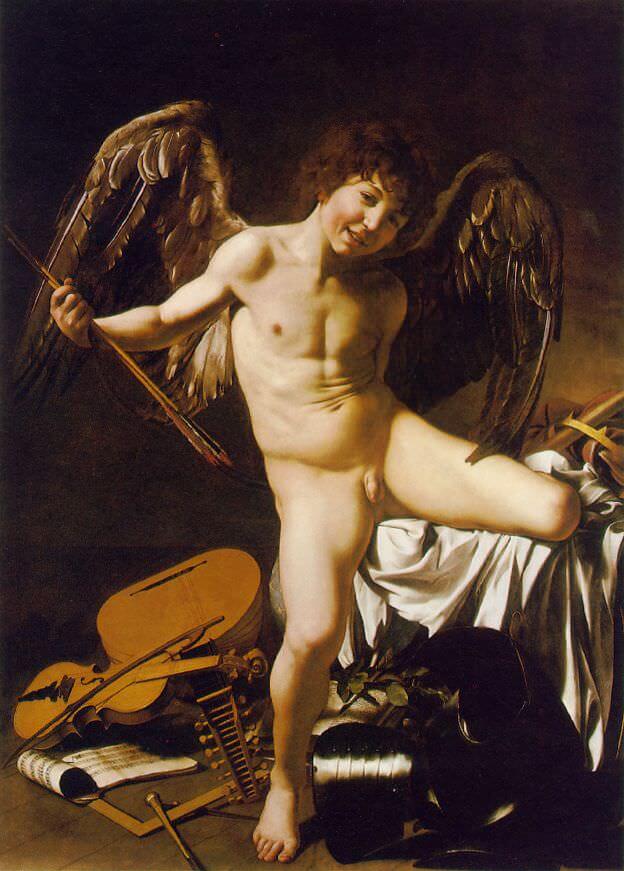
Amor Vincit Omnia

Gemäldegalerie, Staatliche Museen zu BerlinGoogle Arts & Culture

Amor Vincit Omnia

Painting by Caravaggio

Description

Amor Vincit Omnia is a painting by the Italian Baroque artist Caravaggio. Amor Vincit Omnia shows Amor, the Roman Cupid, wearing dark eagle wings, half-sitting on or perhaps climbing down from what appears to be a table. Wikipedia

Love’s contradictions: Catullus on the agony of infatuation

Love’s contradictions: Catullus on the agony of infatuation | Psyche

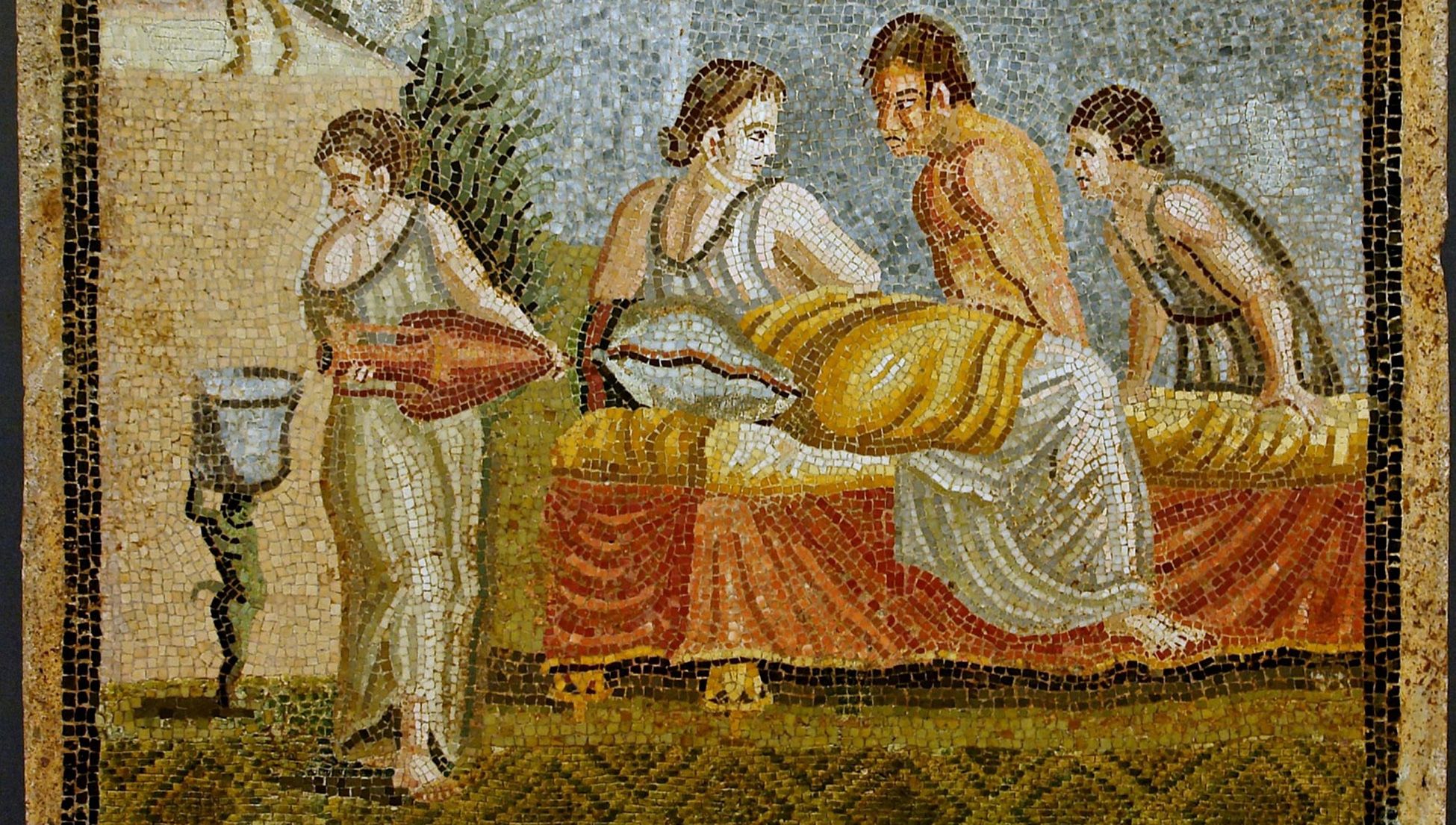
A Roman love scene, 1st century CE. From the Kunsthistorisches Museum, Vienna. Photo courtesy Wikipedia

Armand D’Angouris a professor of Classics and a fellow of Jesus College at the University of Oxford. His books include The Greeks and the New: Novelty in Ancient Greek Imagination and Experience (2011) and Music, Text, and Culture in Ancient Greece (2018), co-edited with Tom Phillips. His latest book is Socrates in Love: The Making of a Philosopher (2019).

Edited by Nigel Warburton

6 JANUARY 2021 (psyche.co)

I hate and love. If you ask me to explain
The contradiction,
I can’t, but I can feel it, and the pain
Is crucifixion.

Odi et amo: quare id faciam fortasse requiris.
Nescio, sed fieri sentio et excrucior.

This simple but heartfelt couplet (translation above by James Michie in 1969) is the best-known Latin love epigram – a short poem in elegiac metre – that survives from Ancient Rome. Composed by the poet Catullus around 55 BCE, number 85 of his book of 116 poems, it pithily encapsulates the searing conflict of emotions that he claims to be experiencing in the course of his affair with a younger married woman, who is addressed in other poems as his ‘girl’ (puella) and by the pseudonym ‘Lesbia’. But for such a short poem – just 14 words in Latin – it has raised a whole host of questions, and hundreds of pages have been written about it. What is the point of the poem? How should it be translated from the Latin? How does it relate to the poet’s life and feelings? Its psychology comes across as complex and strikingly modern, as does much of Catullus’s poetry; to some, the questions it raises might seem more suited to a post-Freud­ian examination of mental conflict than to the concerns of an ancient poet. We might recognise that the opposite emotions of love and hate can be simultaneously entertained; but how, after all, does that work?

In its original Latin, Poem 85 is a so-called elegiac couplet, in which a longer line (hexameter) is followed by a shorter one (pentameter). The words of the poem have been placed with care. The couplet is composed in a criss-cross pattern, beginning and ending with two verbs of intense emotional connotation: odi, ‘I hate’; and excrucior, ‘I’m racked’. The first line concludes with the quest­ioning requiris, ‘you ask’; the second opens with the answer nescio, ‘I don’t know’. The middle of the first line has faciam, ‘I do’; the middle of the second has its passive counter­part fieri, ‘is being done’ (related to fiat – literally, ‘let it be done’).

The couplet thus mimics by its shape the image of the poet being pulled apart in opposite directions, an image made explicit by the verb excrucior. That word (the root of our ‘excruciating’) will have evoked for Romans the noun crux (plural cruces). Although in the 1st millennium CE crux came to be heard almost exclusively to mean ‘cross’ with reference to the crucifixion of Christ, in Catull­us’s time it was more commonly used to signify the ‘rack’. This was the standard instrument of torture in the Roman world, to which unfort­unate victims were bound by their hands and legs so that their bodies might literally be pulled apart.

While Catullus remains utterly infatuated with Lesbia, she has proved to be
distress­ingly fickle to him

No less cruel and visible as a method of execut­ion in the Roman world was crucifixion. Catullus was in his teens when in 71 BCE the slave-revolt led by Spartacus was quelled, and he would probably have witnessed at first hand the gruesome sight of 6,000 captured slaves being nailed or strung up to die on wooden crosses along the Appian Way leading from Rome to Capua. What­ever the precise image intended by Catullus as a parallel to his own feeling of torment, what is evident is that the combination of hate and love, pulling him in different directions, is making him feel as if he is being ‘racked to death’: the ex of excruc­ior connotes a process leading towards expiry and extinction, as well as exten­sion – both in time and across space. Moreover, Catullus claims, there’s nothing he can do about it: he’s simply the object of this torturous and self-contradictory feeling. His response to someone who might wish to enquire (requi­ris) about what he’s ‘doing’ (faciam) is that he’s not ‘doing’ anything, but that he senses (sentio) it ‘being done’ (fieri) to him: the passive form of the verb corres­ponds to his own passiv­ity in the process he’s describing.

However, just before Catullus presents himself as the helpless victim of opposing emot­ions, the answer he gives to the imagined question is unequivocal: ‘I don’t know’. The implication of nescio (the negative of scio, ‘know’, whence comes our word ‘science’) has been overlooked by generations of translators from the Latin, who have rendered the word quare as ‘why’ or ‘the reason why’ rather than ‘how’ – even though it’s clear that Catullus does know, as do his read­ers, why or for what reason he’s prey to emotional conflict. For instance, one of the poem’s earliest English trans­lators, the poet Richard Lovelace (1617-57), renders it as:

I hate and love; would’st thou the reason know?
I know not, but I burn, and feel it so.

Similarly, the translator in the popular Loeb series, which prints classical texts with facing versions in straightforward English, in 1976 had it as:

I hate and love. Why I do so, perhaps you ask?
I know not, but I feel it, and I am in torment.

Such translations using ‘why’ followed by ‘I don’t know’ ask us to supp­ose that Catullus is claiming an inability to understand the reason for his painful emotional turmoil. Yet the poet has already made it abundantly clear, in several other poems describing his affair with Lesbia, that he knows the reason only too well: while he remains utterly infatuated with her, she has proved distress­ingly fickle to him, willing to be unfaithful not only to her husband but to her adult­erous liaison with the poet too. In Poem 72 (my translation), Catullus analyses the effect on him of Lesbia’s infidelity:

You used to say you had eyes for Catullus alone,
Lesbia, and would rather hold me in your arms than Jove.
My feelings for you then were not just vulgar lust,
but the kind of love a father feels for his children and their kin.
Now that I know your ways, my desire for you burns ever fiercer,
even though you’re far shabbier in my eyes, and flightier.
How can this be, you say: it’s because such hurtful treatment
is bound to make one desire one’s lover more, but like them less.

How is it possible, in terms of logic or emotion, to feel both hate and love towards the same person at the same time?

In the final couplet here, Catullus explains to the reader, in terms very similar to those he uses in Poem 85, the paradox of his feelings. The enquirer doesn’t need to ask the cause of the poet’s pain, here described as iniuria (‘hurtful treatment’) because it’s easy to understand: Catullus is wounded by Lesbia’s sexual intimacy with other lovers and hotly resents her behaviour; but his desire for her, perhaps intensified by the prospect of losing her to a love-rival, is even stronger.

The reader might still ask how such divergent feelings as love and dislike can coexist in a lover and be directed towards the same object – indeed, the final line above describes some­thing that feels like such an emotional contradiction, the combin­ation of desire with disliking. That divergence is, in Poem 85, yet more starkly expressed with ‘I hate and love’ (rendered more emphatically in translations that repeat the ‘I’: ‘I hate and I love’). But, again, Catullus would expect the reader to ask not ‘why’, but ‘how’; that is, how is it possible, whether in terms of logic or emotion, for someone to feel both hate and love towards the same person at the same time? Since Catullus knows, as do his readers, why he’s prey to these contradictory feelings, only in answer to the question ‘how’ can it be reasonable for him to follow up, as he does, with ‘I don’t know’. Having declared his ignorance of how the perplexing phenomenon of simultaneous opposing emotions can arise, he then abandons analysis and simply testifies to his own torment.

The correctness of the translation of quare as ‘how’ is confirmed by lexical data. In Catullus’s time and before (as found, for example, in passages written by Catullus’s older contemp­orary, the orator Cicero) quare is used to mean ‘how’ or ‘in what way’. It comes to mean ‘why’ in the course of the language’s hist­­ory; but given the compelling contextual and linguistic arguments for the understanding of what Catullus is asking in Poem 85, what explanation can there be for the persist­ent mistranslation of quare as ‘why’ rather than as ‘how’ in English? (Trans­lations into other languages such as Italian, German and French also tend to fluctuate between rendering quare as ‘why’ and ‘how’).

One answer must be that translators have been influenced by a later Latin couplet that’s as famous as Catullus’s, and indeed alludes to it. A satirical squib (number 32) composed by the poet Martial in the late 1st century CE, more than 100 years after Catullus’s death, uses the same couplet form:

I don’t like you, Sabidius, and I’m unable to say why:
All I can say is this: I don’t like you.

Non amo te, Sabidi, nec possum dicere quare:
Hoc tantum possum dicere: non amo te.

Nothing is known of the context of the epigram or of the implied feud between the poet and the otherwise unknown Sabidius. But the poem has won a firm, if anecdotal, place in the annals of Latin studies in England. The story (undoub­tedly apocryphal) is told how, as a student at Christ Church College, Oxford, the writer Thomas Brown (1662-1704) committed a misde­meanour and was sent for punishment to the college dean, a Dr Fell. The dean required Brown to trans­late some Latin verse on the spot, and opened a book of epigrams at random to present him with Martial’s couplet. After a moment’s thought, Brown recited, allegedly to the dean’s delight, his witty and memorable version of the poem:

I do not like thee, Doctor Fell,
The reason why I cannot tell;
But this I know, and know full well,
I do not like thee, Doctor Fell.

In the case of Martial’s epigram, ‘the reason why’ is a perfectly good translation of quare. But that later connotation of quare has too often been foisted on to Catullus’s much earlier epigram with insufficient thought. To do so obscures the poet’s own specific expression of philo­sophical and psychological perplexity. It also saddles him with an improbable admission of ignorance about his painful situation vis-à-vis Lesbia, of which various other poems of his show him too well aware. In short, in Poem 85 Catullus is not asking ‘why’, but ‘how’. Accordingly, my translation here proposes how the reader might correctly understand and enjoy this famous couplet:

I hate and love: perhaps you ask how both of these I do.
I don’t know, but I feel it, and I’m being torn in two.

Marxism and Buddhism

Life is suffering, whether you sit under a Bodhi Tree or stand with the workers. But do the two schools agree on the remedy?

Buddhist monks receive alms in Luang Prabang, Laos. Photo by Chris Stowers/Panos

Adrian Kreutz

is a graduate student in philosophy at the University of St Andrews in Scotland, and a foreign cooperative researcher at Kyoto University in Japan. Listen here

Brought to you by Curio, an Aeon partner

Edited by Sam Dresser

17 July 2019 (aeon.co)

Marxism and Buddhism might not seem to have much in common. The former is a materialist socioeconomic theory conceived by a 19th-century bearded guy from Trier in Germany, while the latter is a religion originating from orations delivered under a fig tree by a gaunt, peaceful, intimidating character in what is India today. Historically and geographically, they are as far apart as it gets, but the core of their philosophical analysis of the human condition is astoundingly close. It is so close, in fact, that Buddhist metaphysics can complement Marxist socioeconomic philosophy. As the anthropologist Claude Lévi-Strauss wrote in 1955: ‘Marxism and Buddhism are doing the same thing, but at different levels.’

At least since Tenzin Gyatso, His Holiness the 14th Dalai Lama of Tibet, commented on his Marxist inclination in 1993, it is evident that Buddhism and Marxism have something in common:

Of all the modern economic theories, the economic system of Marxism is founded on moral principles, while capitalism is concerned only with gain and profitability … The failure of the regime in the former Soviet Union was, for me, not the failure of Marxism but the failure of totalitarianism. For this reason, I still think of myself as half-Marxist, half-Buddhist.

And Marx himself knew something of Buddhism. In a letter to a friend, written in 1866, he described his own meditation practice:

I have become myself a sort of walking stick, running up and down the whole day, and keeping my mind in that state of nothingness which Buddhism considers the climax of human bliss.

So do Marxism and Buddhism really complement each other? How?

Central to both philosophies is a schema of ‘diagnosis and treatment’. They share a diagnosis: life is essentially suffering. For Marx, the chief catalyst of suffering is capitalism. Capitalism creates more suffering for the working class, whereas the bourgeoisie and the capitalists are comparatively well-off – but that doesn’t mean that capitalism does not create suffering on the side of the winners too, as I shall soon point out. For the Buddha, the transient and fleeting nature of life makes suffering inescapable. In modern Japanese, the gentle sadness associated with nature’s state of flux is called mono no aware. The Indo-Tibetan Buddhist term for the effects of the impermanence of nature is duḥkha, which might be translated as suffering, but sometimes painfrustrationsorrowmisery or dissatisfaction is more applicable. Duḥkha is the first of the Four Noble Truths that the original Buddha propounded right after his experience of enlightenment under the Bodhi Tree.

It is not difficult to see what is behind the concept of duḥkha: life is full of suffering – mental and physical – and in many cases there is little we can do about it. We get older and lose our physical and mental esprit, we lose the people we love, and the possessions we dearly hold on to will one day no longer be ours. All this is inevitable since the world is a world of impermanence and transience – anitya is the Buddhist term. We are plagued by anxiety caused by the fear of becoming ill, losing our job, losing a loved one, losing money, losing fame. The reality of suffering is an incontestable, ubiquitous truth.

This gets us to the second of the Noble Truths, which is trṣṇa, often translated as thirst, but perhaps better thought of as attachment. We are attached to our job, our family, our possessions and our selves. This is not necessarily a bad thing as it strengthens human relations and self-care, but it also causes suffering when paired with the impermanence of everything that we are attached to. So the cause of our suffering is not the nature of reality itself, but our attitude towards it. We cling to the erroneous idea that good things will go on forever and bad things will either never happen or, if they do, we will soon return to the good place.

According to Marx’s Das Kapital (1867), there is more to duḥkha than the impermanent nature of reality. There is this socioeconomic system that fosters a mechanism of competition between individuals in the quest for accumulated wealth to which the people that produce it have only limited access or no access at all. Through this process, the majority of people are abused, controlled and mistreated, alienated from their human essence – not to mention the exploitation of nature and its resources. Marx saw that capitalism generates an extra amount of unnecessary duḥkha: it keeps people in poverty (relative to the value of their labour), it keeps people unemployed (to nurture competition and to tie the workers to the capitalist), it plays with the health of people (by forcing them to work under harmful circumstances, having to fear pecuniary injury when medical care is necessary) and, above all, it alienates people from the essence of their human existence (by the division of labour and long working hours). Social inequality and horrendous living conditions lead to crime, violence and hatred – this is no surprise. Crime, poverty, alienation and exploitation cause suffering, but not exclusively on the side of the exploited workers. Capitalists live in constant fear of losing their status and their money, so they have to work hard to protect it – what you own, in the end, owns you.

App-based mindfulness practice has become the newest balm for the stressed-out capitalist

For Buddhists, the source of suffering lies in a conflict between how we take reality to be and how reality really is. To get rid of suffering, then, is to apprehend reality as it really is – this is being in the mode of enlightenment. According to Marx, there is an extra source of suffering in the mode of production. So, for him, the point is to change this awful mode of production to something better. But as with enlightenment, it is hard to see the problem in the first place, and the capitalist system does everything to hide its malevolence behind the welcoming curtains of consumer culture.

From a Buddhist perspective, the capitalist motor is fuelled by humankind’s deepest vice: its trṣṇa. Marx understood that the whole economic system is based on consumption, and marketing agencies know how to push trṣṇa to the realms of utter perversion, thereby warranting a continuum of consumption and labour. The worker is the hamster, consumer culture is the hamster wheel. People are tricked into believing that Furbies, iPads and all those other pointless goods and services are necessary for a happy and fulfilled existence. A sense of ‘meaning’ has been replaced with instant, short-term, on-demand happiness.

Buddhists know about the elusiveness of happiness. Given the inevitable transience of life, the Buddhist goal is not to be happy 24/7, but to live a meaningful life. Life for the worker becomes meaningful, Marx says, in that it helps the worker to, more or less directly, reduce the suffering in someone else, since capitalism drives the worker to specialisation, and not everybody will become a nurse, doctor, social worker, teacher etc.

Capitalism evolved around the human desire for a meaningful existence, but it offers only short-term happiness. Why, then, are we still thirsty for pointless consumer goods? Because we are made to believe that the possession of those goods defines us. The psychologist Philip Cushman in 1990 accurately described the ping-pong game between conspicuous consumption and the source of suffering, which is the trṣṇa for a true self: ‘Capitalism treats humans as empty vessels, never complete, never one, without a stable identity, needing to be filled with commodities.’ Consumer culture is supposed to fill a lacuna – a sense of self, of identity, of essence – gouged into the human psyche by the alienating working conditions found under capitalism. This ping-pong game is a psychological perpetuum mobile that oscillates between taking away an experience of self-identity (by division of labour, poverty and unemployment), and substitutes it with consumption. This liminal state contributes to the continuous generation of capital.

The consumerist mentality is not the remedy. Unfortunately, Buddhism in the form of watered-down app-based mindfulness practice and yoga in Lululemon Athletica spandex has become the newest balm for the stressed-out capitalist. The most famous Marxist academic of our time, Slavoj Žižek, once said that ‘the “Western Buddhist” meditative stance is arguably the most efficient way for us to fully participate in capitalist dynamics while retaining the appearance of mental sanity’.

We are, of course, more than empty vessels. But what are we? Marx’s concept of the self is a matter of considerable debate among Marx scholars. The social psychologist Erich Fromm in 1961 wrote that ‘Marx did not believe, as do many contemporary sociologists and psychologists, that there is no such thing as the nature of man; that man at birth is like a blank sheet of paper, on which the culture writes its text.’ Yet, there must be a self, otherwise we could not be alienated from it, but is it an empty vessel that asks for refuelling?

In 1845, Marx wrote of his fellow Young Hegelian, Ludwig Feuerbach, that he ‘resolves the essence of religion into the essence of human nature. But the essence of man is no abstraction inherent in each single individual. In reality, it is the ensemble of the social relations.’ There is no central property of the self, only relations. According to Marx’s historical materialism, the social relations that determine the self are, as we know, determined by the ‘mode of production’. Consequently, when the ‘mode of production’ changes, so does human nature.

Meanwhile, according to Buddhist philosophy, there is no self as entity, but only as a loose set of relations. In the circles of later Buddhism, one technical term has been of major significance: svabhava. It is frequently translated as self-being, but for our purposes can be thought of as substance. What is a substance? This is hard to define, and philosophy has said a great deal about it. Let us just think of a substance as a uniform, self-sufficient, necessary, unchangeable, fundamental thing-in-itself. Prominent examples of a substance are God, the world-soul, mind and matter.

For the Buddhists, there is nothing with svabhava, nothing with substance. So, the self has no svabhava either. We can unfurl the idea svabhava-less-ness, or sunyata (emptiness), with a metaphor. But first, consider an immediate rejoinder: it is easy to think of the Buddhist picture described above as hopelessly nihilistic. But denying that there is a substance to the self, in a deep metaphysical sense, does not imply that there is no such thing that functions as a self. In fact, Buddhists did not want to eliminate the self once and for all, and neither did Marx. Without anything that functions as the self, there would be nothing that suffers under capitalism or from being thrown into the transient world. Hence, Marx’s complicated sociopolitical analysis would be pointless, and Buddhism somehow unmotivated. There has to be something that functions as the locus of suffering. For that, let us turn to the Buddhist notion of sunyata (emptiness).

If something is empty of substance, then it is relations that define the thing. In other words, everything is what it is in virtue of bearing certain relations to other things and, as those things are related to other things, ultimately in virtue of bearing relations to everything else. Everything stands in a unique set of relations to other things, which thereby individuates it without its having to assume a unique and individual substance. You stand in countless relations to your parents, spouse, but also to your car and bank account. The impression that there are such things as houses, selves, spouses, bank accounts, hammers and so on, all independent of a network of relations, is actually a conceptual illusion. This, in short, is the Buddhist notion of emptiness. The notion of emptiness includes the notion of self. The self, too, is empty in that it is exclusively defined by its relations, not some underlying substance. This is the idea of no-self.

There is nothing – so to speak – to stick consumer goods to, like sticky notes on a refrigerator

This relationalism is beautifully invoked in the metaphor of Indra’s net. Here is how the religion scholar Francis H Cook described it in 1977:

Far away in the heavenly abode of the great god Indra, there is a wonderful net which has been hung by some cunning artificer in such a manner that it stretches out infinitely in all directions. In accordance with the extravagant tastes of deities, the artificer has hung a single glittering jewel in each ‘eye’ of the net, and since the net itself is infinite in dimension, the jewels are infinite in number. There hang the jewels, glittering like stars in the first magnitude, a wonderful sight to behold. If we now arbitrarily select one of these jewels for inspection and look closely at it, we will discover that in its polished surface there are reflected all the other jewels in the net, infinite in number. Not only that, but each of the jewels reflected in this one jewel is also reflecting all the other jewels, so that there is an infinite reflecting process occurring.

This idea of interdependence emphasises the communitarian aspect of human life – and should serve as the metaphysical fundament of Marxist philosophy. The Marxist idea of the self is defined by its biological, psychological and economic relations to others, indeed all others inside the animate and inanimate world. Just like the net metaphor suggests, this creates a universal interdependence, or ‘interbeing’ as the Buddhist monk Thich Nhat Hanh called it in the 1960s. For Buddhists, this picture of the self and reality is available through meditation.

The idea that the self is defined in terms of others reveals the illusiveness behind the metaphor of the empty vessel. People are not empty vessels because we are not vessels at all – there is no such thing as a vessel. This really is the point of the idea of no-self: there are relations, but no vessels. Once one realises the true nature of emptiness, there is nothing – so to speak – to stick consumer goods to, like sticky notes on a refrigerator; the ping-pong game between consumption and alienation should stop with this insight. Why? Because there is, from a Buddhist metaphysical perspective, no refrigerator.

The realisation of interbeing and emptiness (two sides of one coin) generates compassion, according to the Buddhists. If it is true that I am in interbeing with the people around me, I would rather abstain from harming them. Otherwise, I would end up harming myself though the mediate effects of my actions. Capitalism obfuscates this interdependence by fostering a reckless, and mythical, individuality, but in Marxist thought interdependence is omnipresent. So, the Buddhist metaphysics of emptiness and its concept of the empty self can, and should, serve as a foundation for the Marxist picture. The goal is a ‘nirvana of society’, as the Dalai Lama says.

A society based on the Buddhist ideal of compassion is one where Marxism could finally be implemented. In fact, there have already been several attempts to politicise Buddhism. What Thich Nhat Hanh calls Engaged Buddhism is one example; Uchiyama Gudō (1874-1911), a Soto Zen priest who advocated socialist movements during the Meiji era, is another. Perhaps the most outspoken Buddhist-Marxist was Girō Seno’o (1890-1961), a Japanese Nichiren Buddhist who in the 1930s advocated Revitalised Buddhism, which combined Marxist economics with Pure Land Buddhism. Seno’o is even said to have argued that ‘the capitalist system generates suffering and, thus, violates the spirit of Buddhism’.

Let’s call the Marxist socioeconomic system that is grounded in Buddhist metaphysics Compassionate Marxism. The focus of Compassionate Marxism has to be on ahimsā – nonviolence. Only then can Marxism be immune to totalitarian and authoritarian abuse, and hence no longer prone to repeat its history. Whether Marx himself taught that revolution is necessarily violent, or if there is a possibility of a peaceful transformation, is a vexed question. During the 1844-49 period, Marx held that violent revolution is indeed necessary, given the stringent structure of the bourgeois system. But if it is the economic circumstances that necessitate a turn towards something communist, and not totalitarian, then nonviolent revolution might be possible given the right political interventions.

Humanity is not evil because the economic system is; the economic system is evil because humanity is

The feasibility of the Marxist project is grounded in the benevolent communal nature of the human being. Some might argue that the idea that once humanity realises its interconnectedness it would turn away from cruelty and towards compassion is wishful thinking – a justified objection. The 18th-century German philosopher Immanuel Kant understood cruelty and hatred to be each individual’s fault and deeply ingrained in the nature of human existence. This thought is widespread today, and studies in clinical psychology support it. But for Marx, it is the socioeconomic conditions that are to blame for cruelty, hatred and crime. The human, he would hold, is inherently benevolent and compassionate. Who has got it right?

I think we should all be realistically inclined enough to understand that it is likely Marx fell prey to the Swimmer’s Body Illusion: the swimmer has a perfect body not because she is a swimmer; she is a swimmer because she has the perfect body for swimming. Accordingly, humanity is not evil because the economic system is; the economic system is evil because humanity is. In the end, we are the atoms of economics, the agents of trade. Economics is dependent on us, not vice versa. History indicates that communal projects – such as the North American Phalanx, a secular utopian socialist commune in New Jersey in the 1840s – are susceptible to hatred, mistrust, bribery and fraud. In the 1960s and ’70s, the Milgram experiment and the Stanford prison experiment both suggested that we live under the tyranny of capitalism because we are either inherently tyrannical beings or because we simply obey. The capitalist system just suits our nature. All signs indicate that we don’t have the capacities for universal benevolent compassion, uncontaminated by a proclivity to evil, hatred and competition. We cannot all live like monks, even if this would ensure that one’s basic material needs would be looked after by the community.

But can’t we be both tyrannical and interconnected? Buddhist practice could help us overcome the evil aspects of our nature and promote the compassionate side within us. The socioeconomic system of Compassionate Marxism could be the breeding ground for compassion, and compassion the motor of a socioeconomic system with low duḥkha. Working on the inner Tyrannosaurus would benefit those suffering from Capitalism, which, according to Marx and Buddha, is everyone. The problem with Left-activists is that they see the evil as being exclusively caused by the socioeconomic system (this was Marx’s problem too), without understanding how these factors operate within us. ‘Social change requires inner change – becoming less selfish,’ says the Dalai Lama. The question is not who we are – we are malevolent creatures, as far as I can tell. The question is who we want to be.

Thinkers and theoriesPolitical philosophyComparative philosophy

Tom Campbell and Bruce Lipton: Two Scientists “See the Same World”

Tom Campbell Tom Campbell, physicist (formerly with NASA), and Bruce Lipton, biologist (author of The Biology of Belief), discuss what they have discovered about reality from their unique perspectives. This is an uplifting and insightful interview by Chuck and Karen Robison of What If It Really Works. Produced by Keith Warner and Donna Aveni of MBT Events. This video has been edited from the original format to comply more fully with Tom’s YouTube channel requirements. Tom Campbell here — If you find something of significant value in our videos, please consider supporting their production through our Patreon account — or through a one-time donation……the links are in the description below…thank you! ** LINKS https://www.Patreon.com/mybigtoe​ Tom’s Patreon ** https://bit.ly/39lwhen​ One time donation link thru PayPal (no PayPal account required) https://my-big-TOE.com​ Tom’s website https://mbtevents.com​ Tom’s events, online events, programs, and binaural beats. https://mbtevents.com/future-events-1https://www.facebook.com/LoveCaringHe…​ Donna’s MBT Outpouring * https://twitter.com/TomCampbell_MBT​ Twitter https://www.instagram.com/tomcampbellmbt​ Instagram https://CUSAC.org​ 501 c 3 Center for the Unification of Science and Consciousness Supporting the completion of Quantum Physics Experiments http://www.brucelipton.com​ Bruce Lipton’s website ** Tom Campbell here…I and MBT Events hope you liked this video — we now have well over a thousand hours of free video on this user-friendly ad-free YouTube channel. Though these videos are free to our viewers, they represent many thousands of hours in production and editing, and many thousands of dollars invested in video and audio equipment along with the required computers, and software to store and process the raw video into finished products. So far, all of this content has been funded directly out of our own pockets. Be assured, we will always continue to do what we can — it is our life, our purpose — a labor of love that we will continue to pursue as best we can. However, those pockets are not as deep as they used to be, thus, we are now seeking to augment our resources with support from our viewers. If you find something of significant value in our videos, please consider supporting their production through our newly created Patreon account — or through a one-time donation……the links are in the description above…thank you!

Stewart Brand portrayed as tech futurist and publisher in ‘We Are as Gods’

Jessica Zack April 15, 2021 Updated: April 17, 2021 (SFChronicle.com)

Stewart Brand, writer and founder of Whole Earth Catalog, portrait inside the Mirene, a converted 1912 tugboat where he and his wife Ryan Phelan call home in Sausalito.Photo: Stephen Lam, The Chronicle

For a devoted futurist like Stewart Brand, who is famous for his projections about technology and the environment, looking at his own past doesn’t necessarily come naturally.

Given his fame as creator of the iconic 1960s DIY handbook Whole Earth Catalog (described by Steve Jobs as “Google in paperback form”), and later as an influential technologist at the forefront of the personal computing revolution, numerous filmmakers have asked the Marin cyberculture legend to make a movie about his life. But Brand never wanted to waste precious time or energy on nostalgia. He said no to the idea of a biopic — until filmmakers Jason Sussberg and David Alvarado approached Brand in 2017.

Now their fascinating docu-portrait “We Are as Gods” is screening at this year’s San Francisco International Film Festival, available to stream through Sunday, April 18.

“We pitched Stewart the idea that instead of just looking backward, we’d create a portrait of the futurist as already living in a future” others can’t yet quite see, said Sussberg in a video interview from his San Francisco home.

“We Are as Gods” directors David Alvarado (left) and Jason Sussberg.Photo: Brendan Hall / Structure Films

Sussberg and Alvarado, based in Brooklyn, N.Y., had already made a short film in 2014 for Time magazine about “de-extinction,” Brand’s late-in-life passion project promoting the use of biotech to bring back extinct species — like the passenger pigeon, the American chestnut tree, even the woolly mammoth.

They planned to make Brand’s zeal for genetic engineering central to their proposed feature-length documentary. To their surprise, over an extended conversation with Brand at Skywalker Ranch following a screening of their last film, “Bill Nye: Science Guy,” Brand said yes.

In “We Are as Gods,” the two filmmakers travel with Brand, now 82, to Siberia, where he’s attempting, with geneticist George Church, to “re-wild” the ecosystem, and to west Texas, where his Long Now Foundation is building a 10,000-year clock inside a mountain to foster long-term thinking.

Stewart Brand tours a seed bank in Siberia in a scene from “We Are as Gods.”Photo: Brendan Hall / Structure Films

“Looking forward and looking back are pretty connected, actually,” Brand said during a recent afternoon on Sausalito’s waterfront.

He and his wife, Ryan Phelan, welcomed The Chronicle onto the Mirene, a 64-foot 1912 tugboat they’ve called home at Waldo Point Harbor, Sausalito, for almost 40 years. There Brand explained that when he launched his 1980s think tank, Global Business Network, he started to consider himself a “professional futurist.”

Stewart Brand, Whole Earth Catalog founder, walks on a ramp from the Mirene.Photo: Stephen Lam, The Chronicle

“I got really interested in what the French call the longue durée, the long view of things,” he said. “You can only feel even remotely comfortable thinking about the future if you have a lot of knowledge of the deep past.”

It’s a very Brand-ian answer, both surprising and philosophical, to the question of what it felt like to watch his life’s high and low points unfurl onscreen in the new film. (Brand is candid in “We Are as Gods” about battling depression in the ’70s.)

Ryan Phelan, wife of Stewart Brand, speaks in an interview aboard the Mirene in Sausalito.Photo: Stephen Lam, The Chronicle

There’s a lot of life to pack into the 94-minute film that gives audiences a whirlwind tour through his irreverent mind and numerous incarnations.

Brand was a self-described “free-range kid” from Illinois who studied biology at Stanford with notorious doomsayer Paul Ehrlich. He pioneered LSD use with Ken Kesey and co-produced the 1966 Trips Festival. In 1968 Brand launched the Whole Earth Catalog with an iconic cover photo of Earth from space, and a slogan: “We are as gods and might as well get good at it.”

Brand pivoted to technology after seeing promise and the cool factor in early Stanford gamers’ excitement. (“Ready or not, computers are coming to the people,” he wrote in Rolling Stone in 1972.) He put on the first Hackers Conference, and founded the proto-Facebook online community the Well during the dial-up modem days of the mid-’80s.

Stewart Brand communes with people at the Whole Earth Truck Store in Palo Alto.Photo: Courtsey of Stewart Brand

“I think Stewart is naturally pulled toward things on the fringe of what could be a possible future, and then he rushes toward it, obsesses about it and feeds off the excitement for about five years, and then gets bored and moves on to the next thing,” Alvarado said. “That pattern was so interesting to us, and a through line in the film.”

Brand has never shied away from controversy, especially when it comes to his belief in using technology to save our planet. The film includes footage of him taking heat from Peter Coyote and others for following his techno-optimism to dangerous lengths. It’s a criticism he and Phelan counter persuasively and with heart.

“I’ve been a conservationist since the 1950s, and I saw the environmental movement go down some primrose paths that blinded them to some important capabilities,” says Brand, referring to the knee-jerk environmental backlash against any kind of technological intervention in nature.

“But only by trying new stuff can you maybe find a better solution. Think of the alternative – trying nothing?”

Brand is all too aware where complacency leads on a planet that’s growing hotter, more flammable and less habitable by the year.

Stewart Brand on the Furthur bus with the Merry PrankstersPhoto: Ted Streshinsky

While still a true futurist, Brand admits to feeling more reflective in his 80s. He’s been working closely with his biographer, John Markoff, and spent hundreds of hours with Alvarado and Sussberg.

The filmmakers were so overwhelmed with material they said they easily could have made “an entire film about each part of Stewart’s life,” and revealed they’re planning on launching a podcast “so we can go into even more detail.”

In one of the most captivating sections in “We Are as Gods,” 28-year-old Brand became so fixated on the need for humankind to see a photo of the whole Earth from space that he hitchhiked across the country selling buttons for a quarter each that said, “Why haven’t we seen a photograph of the whole Earth yet?”

He was confident that if NASA released the image, people would appreciate the Earth’s fragility and do more to protect it.

“The image of the mushroom cloud from 1945 on dominated everybody’s thinking about the world,” Brand says. “It’s a really simple image, and as a symbol it was a powerful framing device.

“What’s interesting is there is so far not one iconic image of climate change. If I could devise one, I would gladly do it.”

“We Are as Gods” is available to stream for $12 as part of the San Francisco International Film Festival through Sunday, April 18. sffilm.org

©Copyright 2021 Hearst Communications, Inc.

Consciousness, spirituality, biography, sexuality, androgyny, futurism, space, the arts, science, astrology, democracy, humor, books, movies and more