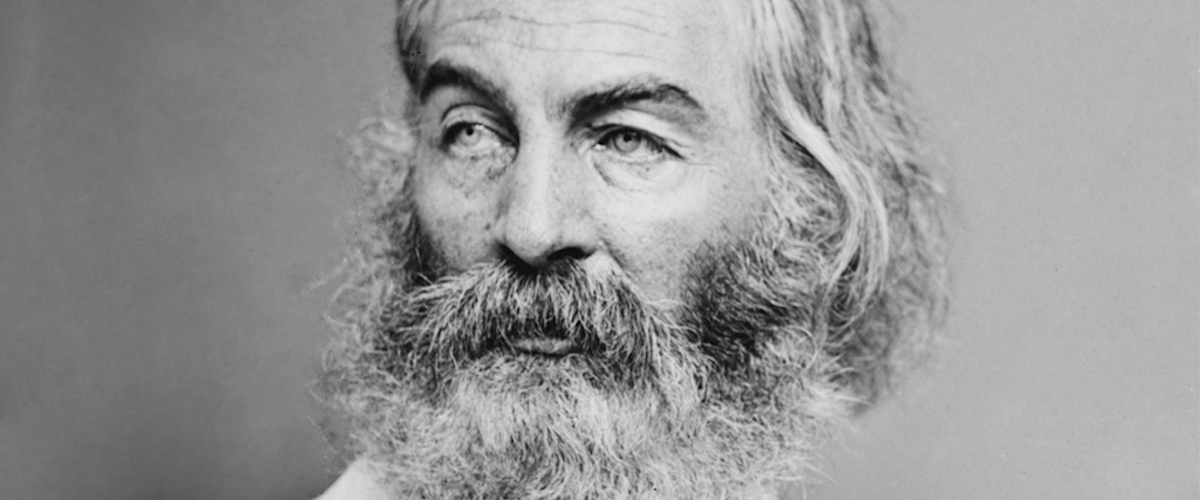
How the American Civil War Gave Walt Whitman a Call to Action

Mark Edmundson on the Great American Poet as Defender of Democracy

VIA HARVARD UNIVERSITY PRESS

By Mark Edmundson

April 16, 2021 (lithub.com)

Walt Whitman did all he could to advance the fortunes of his own book, Leaves of GrassHe reviewed it himself, not once but three times.

“An American Bard at last,” he crowed. Whitman, the New Yorker, was commercially minded. Quickly, he got to work on a new edition. He wrote more poems and published them a year later in the edition of 1856This volume is short and squat, a quarto, not an expansive folio like the 1855. It looks to be loaded with compact muscle.

Whitman did something memorable to the 1856 volume, which he published himself, something that Emerson probably never fully forgave him for. He took a line from the moving letter that Emerson sent him to celebrate the first edition of Leaves and embossed it in gold on the spine of the book.

“I greet you at the beginning of a great career, R. W. Emerson,” the binding says. Whitman neglected to ask Emerson’s permission, and, we’re told, the Sage of Concord was quite angry with the American Bard. Emerson did regain his equanimity—in which he put considerable stock—though this was not the last time that he would grow unhappy with the pupil who turned out to be more than a pupil. In the new book, Whitman included a long letter to Emerson, in which he addressed him as “master.” Perhaps that helped calm the sage down.

The 1856 volume didn’t do what Whitman hoped—none of his volumes really did. He wanted his books to pass into the hands of “the people.” He wanted the people he celebrated to read and enjoy the celebration. That didn’t happen in 1855 or 1856 or in 1860, when the third volume of Leaves came out.

At the end of his life, at the close of a birthday celebration in Camden, New Jersey, that moved Whitman to tears, he still mourned the fact that his work had never really reached what he thought of as his true audience. Maybe this is so because Whitman presents insurmountable conceptual and metaphorical difficulties. Perhaps it’s also that his vision, though cogent and reasonably consistent, remains far out ahead of us. All through his life, Whitman kept trying.

Whitman published other notable poems in the 1855 edition, especially the ones that would be titled “There Was a Child Went Forth,” “The Sleepers,” and “Boston Ballad.” After 1855 came the strange and moving elegy “When Lilacs Last in the Dooryard Bloom’d,” as well as “Crossing Brooklyn Ferry,” “Out of the Cradle Endlessly Rocking,” and “As I Ebb’d with the Ocean of Life.” Whitman also composed some wonderful short poems, such as “I Saw in Louisiana A Live-Oak Growing,” “When I Heard the Learn’d Astronomer,” and “A Noiseless Patient Spider.”

Virtually all of Whitman’s poems have at least one or two memorable lines. Yet much of his work after 1855, and almost all of it after 1865, has something of a programmatic air. It’s as though Whitman is writing commentary on Song of MyselfHe had experienced an astonishing vision. But what exactly did the vision mean? What were its implications? And maybe most important, how might he and his country live it out?

Not long after the 1856 edition came out, Whitman moved back to Brooklyn with his mother and extended family, to live in a basement apartment. The family had to rent out the top floor to keep itself even marginally solvent. Whitman wrote poems and some journalistic pieces for a few dollars here and there. He still composed constantly. Walt turned almost every consequential experience into words. But gradually his studied and happy indolence turned into aimlessness: loafing became lassitude. His interest in writing poems dwindled.

Almost every day, Whitman traveled from Brooklyn, usually by ferry, to Manhattan. There he spent his time at a below-ground Broadway establishment called Pfaff’s. The restaurant was the meeting place for a group of American artists, actors, journalists, actresses, and writers, who thought of themselves as Bohemians. The man who brought the Bohemian life over from Paris was a Nantucket born and raised writer and editor named Henry Clapp. Clapp had been to Paris, where he’d lived for a couple of years on the Left Bank, acquiring a French mistress and learning to live the sensuous, lazy life of French cafes and theater. Clapp was the main figure at the long table under Broadway, where the Bohemians gathered.

Pfaff, the proprietor, was German, rotund, gregarious, and hospitable. He seems to have loved filling his restaurant with the fast and slightly scandalous figures who came to sit with Clapp, shoot the breeze, indulge in duels of wit, and plan great futures for themselves. Among the wits, Clapp was preeminent. Of his rival editor Horace Greeley (my ancestor, I was told as a boy), Clapp said, he’s a “self-made man who worships his creator.”

Perhaps it’s also that his vision, though cogent and reasonably consistent, remains far out ahead of us.

Women as well as men sat at the long table: among them Ada Clare, the “Queen of Bohemia,” and Adah Menken, the most notorious actress of the day, who rode onto the stage wearing a nude body stocking in a play based on Byron’s BeppoWhitman sat at the long table too—though there was little of the wit about him. He was prone to quiet conversation with the Bohemians sitting closest, but more than that, he was inclined to listen. Whitman was as devoted a listener as he was an observer. Everyone who knew him at Pfaff’s seems to have liked him.

The primary Bohemian, Clapp was an early champion of Whitman’s work, and never ceased in his admiration for the poet or his willingness to help publicize him. Whitman drank at Pfaff’s, but not very much. It seems a beer would last him through the night. He occasionally had a glass of champagne. His abstemious ways and relative silence didn’t stop him from becoming a figure there. He was known as the author of a scandalous volume—the erotic side of Whitman’s poetry had been excoriated in a dozen ways by at least a dozen reviewers. He also dressed the part of the avant-garde artist: slouch hat, open shirt, pants tucked into high boots. His beard had gone richly aflower. He looked like someone to reckon with, which in his way he was.

But Whitman didn’t spend all his time at Pfaff’s sitting at the long table and listening to the wits vie with each other for Clapp’s approval. There was another table closer to the center of the tavern that Whitman also favored. This one was populated by young men, whose company Whitman apparently relished as much as he did that of the wits. Was it what we would call a gay culture that Whitman was involved in? It’s not certain.

For some time, Whitman had been drawn to the company of males, usually young and working class. He listed their names in his journals, walked with them, talked with them, hugged and kissed them, and occasionally slept with them. Was there sex involved? None of Whitman’s behavior was unusual for midcentury America, where intense same-sex friendships arose between men and women alike.

Many women approached Whitman with romance in mind. He fended them off, usually with some charm. But he pursued intimate relations with men quite frequently. Were they ever consummated? Of Whitman’s prominent critics, Richard Poirier seems most certain that Whitman led a thriving sexual life during his Broadway days. David Reynolds, the author of a comprehensive volume on Whitman and his cultural milieu, is far less certain. On the matter of Whitman and homosexual sex, he’s an agnostic, as am I.

Many of the men Whitman befriended during his days at Pfaff’s were stage drivers. They drove horse-drawn wagons ferrying passengers and freight up and down Broadway. Broadway could be chaotic: few traffic regulations, little enforcement of those that existed, busy people hustling in all directions. Accidents were common, fights between the drivers frequent. Many of the drivers got hurt, some of them badly. Whitman, who often rode up on the box with them as they banged their ways up and down Broadway, was a loyal friend. When they were injured, he visited them in the hospital. He sat by their bedsides, talked with them, joked, offered them tobacco and other small gifts. He also did one of the things he did best: he listened.

Whitman could sit by the hour at a driver’s bed, learning about who he was, where he came from, what his dreams were, and where his problems lay. The drivers liked and respected Whitman, and in the hospital, his connections with them strengthened. There was sometimes a forced, nearly hysterical quality about the revelry at Pfaff’s during the late 1850s. America was moving closer to war. Many of the regulars pretended to ignore the coming cataclysm, but not Whitman. He worried for his nation. He had appointed himself its personal bard, and he believed that the welfare of any nation, but especially a democracy, was much in the hands of its poets.

Whitman was furiously committed to the idea of Union. The United States must stay one and whole. If it did not, the democratic ideal might go down as a failure. Whitman did all he could in his poems and journalism to fight for national unity. In this, he was much like Lincoln: Whitman detested slavery, but the prospect of disunion was his principal anxiety. Lincoln said that if he could save the Union without freeing a single slave, he would do so. Whitman the citizen and journalist would have concurred: though as we’ve seen, Whitman the visionary nurtured other aspirations about race in democratic America.

America was moving toward crisis, and the denizens of Pfaff’s, Whitman included, were dealing with it in their various ways. Whitman wrote and brooded, brooded and wrote, and braced himself for the moment when his beloved Union would undergo major challenge. Walt saw Lincoln for the first time on Tuesday, February 19, 1861, when the president went to New York, on the way to Washington, DC, for his inauguration. Whitman was one of a crowd of 30,000 gathered on Broadway to get a look at the president-elect. Walt saw Lincoln leave his carriage, mount the steps of the Astor Hotel, turn, take a slow, melancholy look around, then disappear behind closed doors. Lincoln did not speak a word to the crowds that had gathered to see him. (Or so Whitman says—others claim he made brief remarks.) Whitman was on the top of a stagecoach when he saw Lincoln, the man who would fascinate and move him for the next four years and beyond.

Looking back, Whitman recalled how “two or three shabby hack barouches [four-wheeled horse-drawn carriages] made their way with some difficulty through the crowd, and drew up at the Astor House entrance. A tall figure step’d out of the centre of these barouches, paus’d leisurely on the sidewalk, look’d up at the granite walls and looming architecture of the grand old hotel—then after a relieving stretch of arms and legs, turn’d round for over a minute to slowly and good-humoredly scan the appearance of the vast and silent crowds.”

A handful of states had already left the Union by the day that Whitman saw Lincoln arrive in New York, and before long, Southern troops fired on Fort Sumter. War was on. The next two years were among the worst of Walt’s life. He was too old to fight: he was now in his forties, and all the beefsteak, champagne, and butter he’d consumed at Pfaff’s had made him portly. Whitman had been terrified by the idea of Civil War—he hated the thought of the states being at deadly odds with each other. (The states being in tension with one another was fine with Walt: he wanted as much diversity and even opposition as possible, without fracture.)

Whitman was furiously committed to the idea of Union.

Once war came, Whitman became a fierce proponent of Northern victory. Lincoln called for mass enlistment, and Whitman wrote a poem—not one of his best—seconding the call. Whitman continued to write poetry and some journalism from the start of the war through to 1862, but these were among his worst days.

He simply did not know what to do with himself. What should the bard of America do when his nation was split and its citizens were off trying to kill one another? Whitman rambled and wrote a little, wrote some and rambled. But he was living with no sense of purpose. The casualty reports rolled in, and what had seemed like it would be a short war went on and on. The new recruits who marched out of New York City to fight the Rebs left with ropes tied around the barrels of their rifles, each planning to drag a Confederate recruit back home with him. Matters didn’t go as planned. The soldiers who enlisted on the Union side generally couldn’t imagine the war would last four months—it would continue for four years. Whitman, lost in a purgatory of his own, had no sense what to do.

Then one day, everything changed. George Whitman, Walt’s younger brother, had enlisted at Lincoln’s first call for volunteers. He was one of the men who’d gone off with a rope around his rifle. George was an anomaly in the Whitman family: sane, affectionate, decent, unimaginative, and practical. Walt loved him deeply, as he loved all his family, and was perpetually anxious about George’s fate. After every major battle George fought in, and there were plenty of them, the Whitman family searched through the casualty reports for his name. George emerged from one engagement after another unharmed.

Then came the Battle of Fredericksburg, which left 13,000 Union soldiers dead or wounded in a single day. The Whitmans knew that George was deployed near the battle site and began searching the newspapers for word of him. The New York Tribune carried news of a First Lieutenant George Whitmore of the 51st New York, George’s regiment, who’d been wounded. How badly, the paper didn’t say. Surely this could be a transcription or a printing error, the Whitmans thought: this could be their George. Almost immediately, Walt was off to find his brother and make sure he was all right.

Whitman was a resourceful traveler, and in only a few days, he made it to the front lines, found George’s regiment, and then, in short order, George. George was fine. A piece of shrapnel had sliced into his cheek, but he was well and in his usual high spirits. (How George emerged from the Whitman family as healthy, hearty, and relatively commonplace as he was is no small mystery.)

Whitman was fascinated by life in the camp, and quickly made friends with the soldiers. (Whitman, true to the persona of Song, was about as gregarious and friendly as it was possible for an inwardly attuned individual to be.) He ate with the soldiers, sharing their rations; he learned about the battles they’d fought and about their backgrounds and their aspirations for life after the war. He liked them a great deal—no surprise, Whitman cherished the company of everyday young American men—and apparently the soldiers took quickly to Walt. George was already well regarded in the regiment: he was reliable, brave, and good-humored.

He did for the soldiers much of what he’d done for the Broadway stage drivers when they were hurt.

Walt’s spirits, depressed for months, began to rise. On the first day at camp, Walt saw something that shocked and fascinated him. An engagement was recently over, and there outside the surgical tent, he saw a hill of amputated arms and legs. The surgeons were still at work, and Walt, not terribly squeamish, no stander above men and women in their distress, went into the field hospital and even into the surgeons’ tent and watched and wondered. He gave what help he could— Whitman wasn’t a trained nurse, but he assisted with basic tasks, like moving the wounded soldiers from place to place.

When he could, he sat with the wounded men and talked with them and joked and—compassionate (and authentically modest) bard that he was—he listened. He did for the soldiers much of what he’d done for the Broadway stage drivers when they were hurt. Not far away the formidable nurse Clara Barton was working headlong to help the fallen. Whitman watched Barton in amazement, and understood he could never do what she with her nurse’s training could. But slowly an idea seemed to gather in him.

He was feeling alive for the first time in months. It wasn’t enough to write poems about the war; it wasn’t enough to write journalistic pieces, though Whitman wrote some effective dispatches from the camps. He wanted to do more, and now he saw what, given his talents and his heart’s inclination, he might contribute.

__________________________________
Song of Ourselves

Excerpted from Song of Ourselves: Walt Whitman and the Fight for Democracy. Used with the permission of the publisher, Harvard University Press. Copyright © 2021 by the President and Fellows of Harvard College. All rights reserved.

Mark Edmundson
Mark Edmundson

Mark Edmundson is University Professor at the University of Virginia. He teaches courses in Romantic and Modern Poetry, Shakespeare, and Nineteenth Century Philosophy. He has published eight books, including TeacherLiterature against Philosophy, Plato to DerridaThe Death of Sigmund Freud and The Fine Wisdom and Perfect Teachings of the Kings of Rock and Roll. His essays have appeared in many publications including The New York TimesThe New RepublicThe NationRaritanThe Yale ReviewNew Literary HistoryAmerican Literary History and The London Review of Books. He has held fellowships from the Guggenheim Foundation, the National Endowment for the Humanities, and the Commonwealth Center for Literary and Cultural Change. He has been awarded the Daniels Family Distinguished Teaching Professorship at the University of Virginia, for excellence in undergraduate teaching.

The first blockchain-based democracy awakens

Dear Humans,

A truly decentralized experiment, with members coming from all four corners of the Earth ? to assert their right to having a political voice, a Universal Basic Income, and true digital sovereignty.

Here’s a quick intro video:

We know that’s a lot to unpack, so we’ll walk you through the basics below:

Proof of Humanity

Joining Proof of Humanity is the first step to participate in the DAO, and we highly encourage you to register!

In order to join, you need to make a video of yourself with your Ethereum wallet (here’s a short tutorial on how to get one), certifying that you are a unique human being and that you are not yet a part of the Proof of Humanity registry. You will also need to make a deposit which will be returned to your wallet once you are approved.

After submitting your profile, someone who is already in the list needs to vouch for you. If you know anyone from our team, please reach out to us either by replying to this e-mail or directly on our social media, and we will gladly vouch you in. If you don’t, our amazing community has organized this crowdvouching group on Telegram to help. 

Here’s more detailed information about the registration process.


$UBI?

An inalienable right to liquidity, to be bestowed upon every Human on Earth. This is already redefining everything we knew about decentralized, digital economies, and we have a thriving market on Uniswap with over 1 million USD in our liquidity pools!


Proof of Humanity DAO

Ok, so we have a registry of unique Humans, and Universal Basic Income on the blockchain. Now what? 

That is for us to build together. The “Proof of Humanity DAO” (the official name will be decided by the community) is a decentralized democracy, governed by everyone who is a member of the registry. It’s an opportunity to create new, deeply deliberative and participatory governance systems, as well as to fund public goods using innovative methodologies! We also need to continuously adapt our token issuance rates and registration requirements over time. And last but not least, there are 4,000,000.00 $UBI in our common pool, to support projects that will benefit humanity. Anyone may submit a proposal on how to allocate these funds. Here’s a Twitter thread with more info.

This is an unprecedented political experiment, which drastically expands the locus of possibility for democracy. We want you, who has been with us all along, to be a part of it. 

It has been a long and fascinating journey, but we are only getting started. Thank you for being there for us over the years.

Be well, and stay in touch.

The Democracy Earth team

Democracy Earth Foundation is a 501(c)(3) nonprofit in San Francisco, California. Democracy.EarthOn twitter.
Donate: opencollective.com/democracyearth

$UBI contract:

BTC Support:

The misinformation virus

Lies and distortions don’t just afflict the ignorant. The more you know, the more vulnerable you can be to infection

Elitsa Dermendzhiyska

is a science writer and social entrepreneur working at the intersection of technology, research and mental health. She is the editor of the mental health anthology What Doesn’t Kill You: 15 Stories of Survival (2020). She lives in London.Listen here

Brought to you by Curio, an Aeon partner

Edited by Marina Benjamin

16 April 2021 (aeon.co)

There’s a new virus in town and it’s not fooling around. You can catch it through face-to-face contact or digitally – that is, via a human or bot. Few of us possess immunity, some are even willing hosts; and, despite all we’ve learned about it, this virus is proving more cunning and harder to eradicate than anyone could have expected.

Misinformation isn’t new, of course. Fake news was around even before the invention of the printing press, although the first large-scale journalistic sham occurred in 1835, when the New York Sun published six articles announcing the discovery of life on the Moon (specifically, unicorns, bat men and bipedal beavers). Consider, too, early modern witch hunts, or those colonial myths that depicted slaves as a different species; the back-and-forth volleys of anti-Jewish and anti-German propaganda during the world wars, McCarthyism’s Red Scare, even communism’s utopian narratives. History teems with deceit.

What’s different today is the speed, scope and scale of misinformation, enabled by technology. Online media has given voice to previously marginalised groups, including peddlers of untruth, and has supercharged the tools of deception at their disposal. The transmission of falsehoods now spans a viral cycle in which AI, professional trolls and our own content-sharing activities help to proliferate and amplify misleading claims. These new developments have come on the heels of rising inequality, falling civic engagement and fraying social cohesion – trends that render us more susceptible to demagoguery. Just as alarming, a growing body of research over the past decade is casting doubt on our ability – even our willingness – to resist misinformation in the face of corrective evidence.

The classic experiments to correct misinformation date to the late 1980s. Subjects were given news briefs from the scene of a fictional warehouse fire, one of which mentions a closet with volatile materials – cans of oil paint and gas cylinders – others report ‘thick, oily smoke’, ‘sheets of flames’ and ‘toxic fumes’ that put the firefighters’ lives at risk. A further brief cites the police investigator on the case stating that the closet was, in fact, empty, before the report ends with the fire finally put out.

Having read the briefs, subjects had to answer a series of questions meant to probe their grasp of the correction made by the police investigator. It seems a simple test yet, across a multitude of studies, people repeatedly fail it. In one experiment, as many as 90 per cent of the subjects linked the fire’s toxic nature or intensity to the cans of oil paint and gas cylinders, despite none being found in the closet. More surprisingly, when asked directly, most of these participants readily acknowledged the empty closet. Researchers have reported similar results many times, including using blatantly direct retractions (‘there were no cans of paint or gas cylinders’). Yet no matter how clear the correction, typically more than half of subjects’ references to the original misinformation persist. What’s remarkable is that people appear to cling to the falsehood while knowing it to be false. This suggests that, even if successfully debunked, myths can still creep into our judgments and colour our decisions – an outcome referred to in the literature as ‘the continued influence effect’.

Why does this happen? According to Jason Reifler, professor of political science at the University of Exeter, we tend to take incoming information at face value, ‘because the existence of human society is predicated on the ability of people to interact and [on] expectations of good faith.’ Moreover, myths can take on subtle, crafty forms that feign legitimacy, making them hard to expose without careful analysis or fact checks. This means that those of us too dazed by the job of living to exert an extra mental effort can easily succumb to deception. And once a falsehood has slipped in and become encoded in memory – even weakly – it can prove remarkably sticky and resistant to correction.

One of the most common explanations for the continued influence effect puts it down to a gap in our mental model, or the story we tell ourselves about what happened. If the myth fits the ‘logic’ of events, its retraction leaves a hole, and the cogs of the story no longer click into place. We need the cans of oil paint and the gas cylinders: what would otherwise explain the billows of smoke and the force of the blaze? Remove the volatile materials from the closet, and the causal chain of events in our head unravels. If we aren’t to lose coherence, it makes sense to hold on to both the actual fact and the fitting falsehood – but keep them separate, compartmentalised, so that they don’t clash. This might be why, as studies show, we could be well aware of the truth, yet still allow the myth to creep in elsewhere and corrupt tangential judgments.

Older people might be particularly vulnerable to misinformation that’s repeated when retracted

Another reason why misinformation resists correction is repetition. Once something gets repeated often enough – sensational claims on social media; urban legends passed from one bored timewaster to another – it can trick us into taking it as true merely because of its familiarity. The illusory truth effect, as it’s known, suggests that the easier to process and more familiar something is, the more likely we are to believe it. Which is exactly what repeating a misleading claim does – getting it to go down smooth by strengthening the neural pathways linked to it.

This can pose a challenge for corrections that work by repeating the original misinformation. Consider, this retraction to a myth prone to ensnare hopeful new mothers: ‘Listening to Mozart will not boost your child’s IQ.’ The tiny ‘not’ mid-sentence is all that sets the myth and its correction apart – and it’s easy to imagine that as time passes and memory fades, that ‘not’ will wash away, leaving Mozart’s symphonies and smarter babies linked together in memory, and making the myth more familiar. Could this cause the correction to fail or even backfire?

In 2017, Stephan Lewandowsky, a cognitive scientist at the University of Bristol, and two colleagues from the University of Western Australia set out to investigate this possibility. They measured their test subjects’ beliefs in 20 myths and 20 facts, then corrected the myths in a way that repeated them twice more. Right away, as well as 30 minutes later, the correction significantly reduced subjects’ beliefs in – and references to – the false statements. However, after only a week, belief ratings crept back up to almost double their corrected levels.

Because memory declines with age, older people might be particularly vulnerable to misinformation that’s repeated when retracted. Indeed, in a similar study with older adults, Lewandowsky’s team found that, after three weeks, subjects aged over 65 ended up re-remembering most of the successfully corrected myths as facts. Again, though, no backfire effects occurred – that is, where the correction actually increases belief in the myth – and, despite some contrary earlier evidence, researchers now believe such effects to be rare, if they exist at all. And although repeated mentions of a myth can strengthen it, one repetition during correction seems safe and even desirable as it makes the myth more pliant by activating it in memory.

In recent years, as misinformation has wormed its way into large swathes of society, scientists have been looking for the most effective methods to counter it. Recently, Lewandowsky spearheaded The Debunking Handbook 2020, an online collection of best practice by 22 of the most active researchers in the field. The contributors nominated more than 50 relevant findings and more than 30 practical recommendations, rating them on their importance and the strength of the available evidence. To successfully debunk a myth, the authors conclude, it helps to provide an alternative causal explanation to fill the mental gap that retracting the myth could leave. Counterarguments work too, as they point out the inconsistencies contained in the myth, allowing people to resolve the clash between the true and the false statement. Another strategy is to evoke suspicion about the source of the misinformation. For example, you might be more critical of government officials who reject human-caused global warming if you suspect vested business interests behind the denialist claims.

The most vaccine-hesitant subjects ended up even less willing to vaccinate than they were before the study

Some researchers, however, question the practical significance of debunking strategies devised in a lab. As Reifler put it to me: ‘Are the “positive” effects of interventions we are seeing real effects, in terms of creating long-lasting changes in the accuracy of people’s beliefs? Or is this just a momentary “I’m accepting it because I was told it – and you could’ve told me the exact opposite thing and I’d have believed that?”’ In a world where both media and online platforms have turned into hotbeds of misinformation, Reifler’s question sounds especially urgent. John Cook, a climate change communication researcher at George Mason University in Virginia, told me: ‘I could develop the perfect message that debunks the myth completely. And, even if I could get that message to the right person, what happens if they just go home and turn on Fox News and get five hours of misinformation thrown at them? That particular message will be wiped out.’

It can get worse. Suppose the perfect message does find a person in need of disabusing, and even succeeds in fixing their false beliefs: will that person’s attitudes and behaviour change accordingly? If you tell people that 97 per cent of climate scientists agree about the reality of global warming, studies show that you’ll likely increase their perception of expert consensus on the subject. But whether this greater awareness translates into action – say, support for carbon-reduction policies – remains unclear. The evidence is mixed, and the question has sparked ‘substantial debate and disagreement’ among researchers, says James Druckman, professor of political science at Northwestern University in Illinois. Yet even in studies that do find a knock-on effect on intentions, that effect is small. In other words, you can deliver the facts to people, you can even get them to accept those facts – and it still might not change a thing.

One worrying demonstration of this possibility comes from the realm of vaccines. In a 2016 study, Reifler worked with the political scientist Brendan Nyhan at Dartmouth College in New Hampshire, testing two approaches to debunk the myth that flu vaccines actually cause the flu – a myth partly responsible for low vaccination rates and thousands of preventable deaths from seasonal influenza in the US. One subject group saw official corrective materials from the US Centers for Disease Control and Prevention, while another group received information about the risks of not vaccinating. This latter group showed no change in myth beliefs, whereas in the correction group the myth beliefs substantially declined, even among the most sceptical subjects. It seemed that the correction had worked – and brilliantly. But what ultimately interested Reifler was less the participants’ beliefs and more their intentions to vaccinate – and, across the sample, these didn’t budge at all. The most vaccine-hesitant subjects ended up even less willing to vaccinate than they were before the study.

When I talked to Reifler, he couldn’t name any research that showed that communicating the safety of vaccines (or highlighting the dangers of refusing them) had a positive effect on people’s intentions to vaccinate. At this point in our interview, I faltered. It just seemed too absurd that in a matter of life and death, information potentially key to survival could still be ignored. I asked Reifler if he found this disappointing. He said he was used to it. ‘My entire career is filled with work that is depressing. My usual joke is that if it’s bad for the world, it’s probably good for my research.’

To fully grasp the pernicious nature of the misinformation virus, we need to reconsider the innocence of the host. It’s easy to see ourselves as victims of deception by malicious actors. It’s also tempting to think of being misinformed as something that happens to other people – some unnamed masses, easily swayed by demagoguery and scandal. ‘The problem is that people are sheep,’ one friend said to me. I’ve heard this sentiment echoed time and again by others, the implication always being that they and I were not like those other, misinformed people. No: we were educated, had been taught to think, immune to dupery. But, as it turns out, misinformation doesn’t prey only on the ignorant: sometimes, those who seem least vulnerable to the virus can prove its keenest hosts, and even handmaidens.

Startling evidence for this possibility comes from Dan M Kahan, professor of law and psychology at Yale University who has been studying how ordinary people evaluate complex societal risks. One strand of his research is trying to shed light on the sometimes dramatic disparity between public opinion and scientific evidence. Together with a small group of researchers, in 2010 Kahan set out to demystify this disparity in relation to global warming. At the time, despite widespread consensus among climate scientists, only 57 per cent of Americans believed that there was solid evidence for global warming, and just 35 per cent saw climate change as a serious problem. ‘Never have human societies known so much about mitigating the dangers they face but agreed so little about what they collectively know,’ Kahan wrote.

One standard explanation, which Kahan calls the ‘science comprehension thesis’, holds that people have insufficient grasp of science, and are unlikely to engage in the deliberate, rational thinking needed to digest these often complex issues. It’s a plausible explanation, yet Kahan suspected that it doesn’t tell the whole story.

Asking for people’s take on climate change is also to ask them who they are and what they value

In the 2010 study, published in Nature in 2012, Kahan and his collaborators measured subjects’ science literacy and numeracy, and plotted those against the participants’ perceived risk of global warming. If the science comprehension thesis was right, then the more knowledgeable the subjects, the more they’d converge towards the scientific consensus. Surprisingly, however, the data revealed that those who scored high on hierarchy and individualism – the hallmark values of a conservative outlook – exhibited the opposite pattern: as their science literacy and numeracy increased, their concern for climate change actually declined. What explains this seeming paradox?

Kahan argues that rather than being a simple matter of intelligence or critical thinking, the question of global warming triggers deeply held personal beliefs. In a way, asking for people’s take on climate change is also to ask them who they are and what they value. For conservatives to accept the risk of global warming means to also accept the need for drastic cuts to carbon emissions – an idea utterly at odds with the hierarchical, individualistic values at the core of their identity, which, by rejecting climate change, they seek to protect. Kahan found similar polarisation over social issues that impinge on identity, such as gun control, nuclear energy and fracking, but not over more identity-neutral subjects such as GMO foods and artificial sweeteners. In cases where identity-protective motivations play a key role, people tend to seek and process information in biased ways that conform to their prior beliefs. They might pay attention only to sources they agree with and ignore divergent views. Or they might believe congruent claims without a moment’s thought, but spare no effort finding holes in incongruent statements: the brightest climate-change deniers were simply better than their peers at counter-arguing evidence they didn’t like.

This hints at a vexing conclusion: that the most knowledgeable among us can be more, not less, susceptible to misinformation if it feeds into cherished beliefs and identities. And though most available research points to a conservative bias, liberals are by no means immune.

In a 2003 study, Geoffrey Cohen, then a professor of psychology at Yale, now at Stanford University, asked subjects to evaluate a government-funded job-training programme to help the poor. All subjects were liberal, so naturally the vast majority (76 per cent) favoured the policy. However, if subjects were told that Democrats didn’t support the programme, the results completely reversed: this time, 71 per cent opposed it. Cohen replicated this outcome in a series of influential studies, with both liberal and conservative participants. He showed that subjects would support policies that strongly contradict their own political beliefs if they think that others like them supported those policies. Despite the social influence, obvious to an outsider, participants remained blind to it, and attributed their preferences to objective criteria and personal ideology. This would come as no surprise to social psychologists, who have long attested to the power of the group over the individual, yet most of us would doubtless flinch at the whiff of conformity and the suggestion that our thoughts and actions might not be entirely our own.

For Kahan, though, conformity to group beliefs makes sense. Since each individual has only negligible impact on collective decisions, it’s sensible to focus on optimising one’s social ties instead. Belonging to a community is, after all, a vital source of self-worth, not to mention health, even survival. Socially rejected or isolated people face heightened risks of many diseases as well as early death. Seen from this perspective, then, the impulse to fit our beliefs and behaviours to those of our social groups, even when they clash with our own, is, Kahan argues, ‘exceedingly rational’. Ironically, however, rational individual choices can have irrational collective consequences. As tribal attachments prevail, emotions trump evidence, and the ensuing disagreement chokes off action on important social issues.

Recently, public disagreement has spilled over to the idea of truth itself. The term ‘post-truth’ became the Oxford Dictionaries Word of the Year in 2016, and came to characterise that year’s US presidential election and the Brexit referendum. In a 2017 paper, Lewandowsky argued that we’ve gone ‘beyond misinformation’: ‘The post-truth problem is not a blemish on the mirror,’ he wrote. ‘The problem is that the mirror is a window into an alternative reality.’ In this other reality, marked by the global rise of populism, lies have morphed into an expression of identity, a form of group membership. In the US, the UK, Germany, Austria, Italy, Poland, Brazil and India, populists have captured a growing disenchantment with the status quo by pitting ‘the people’ against ‘the elites’, and attacking so-called elitist values – education, evidence, expertise.

In the populist story, lying takes on the trappings of anti-establishmentarianism, undermining truth as a social norm. This is the misinformation virus at its most diabolical: a point where health (in this case, of the body politic) ceases to matter – as was so graphically demonstrated during the storming of the US Capitol this January – and the host consents to being infected. (The one good thing to come out of that ‘insurrection’ is that tough action was swiftly taken against the peddlers of misinformation with Twitter banning the then president Donald Trump and suspending thousands of QAnon-related accounts.)

It’s probably easier to change what we think others think than what we ourselves do

It’s easy to despair over all the cognitive quirks, personal biases and herd instincts that can strip our defences against the ever-evolving misinformation machinery. I certainly did. Then, I found Elizabeth Levy Paluck. She is a psychologist at Princeton University who studies prejudice reduction – a field in which a century of research appears to have produced many theories but few practical results. In 2006, she led an ambitious project to reduce ethnic hostilities in the Democratic Republic of Congo. She blended a number of prominent theories to create a ‘cocktail of treatments’: a radio drama, in which characters from different communities modelled cooperation and mutual trust; a talk show whose host read audience letters replete with messages of tolerance, and who encouraged listeners to put themselves in the shoes of outgroup members. Nothing worked. After a year of broadcasting, prejudice remained as entrenched as ever.

For Paluck, this was ‘an empirical and theoretical puzzle’, prompting her to wonder if beliefs might be the wrong variable to target. So she turned to social norms, reasoning that it’s probably easier to change what we think others think than what we ourselves do. In 2012, Paluck tested a new approach to reducing student conflict in 56 middle schools in New Jersey. Contrary to popular belief, some evidence suggests that, far from being the product of a few aggressive kids, harassment is a school-wide social norm, perpetuated through action and inaction, by bullies, victims and onlookers. Bullying persists because it’s considered typical and even desirable, while speaking up is seen as wrong. So how do you shift a culture of conflict? Through social influence, Paluck hypothesised: you seed supporters of a new norm and let them transmit it among their peers. In some schools, Paluck had a group of students publicly endorse and model anti-bullying behaviours, and the schools saw a significant decline in reported conflicts – 30 per cent on average, and as much as 60 per cent when groups had higher shares of well-connected model students.

I’ve wondered recently if, like school violence, misinformation is becoming part of the culture, if it persists because some of us actively partake in it, and some merely stand by and allow it to continue. If that’s the case, then perhaps we ought to worry less about fixing people’s false beliefs and focus more on shifting those social norms that make it OK to create, spread, share and tolerate misinformation. Paluck shows one way to do this in practice – highly visible individual action reaching critical mass; another way could entail tighter regulation of social media platforms. And our own actions matter, too. As the Scottish biologist D’Arcy Wentworth Thompson said in 1917, ‘everything is what it is because it got that way’. We are, each and every one of us, precariously perched between our complicity in the world as it is and our capacity to make it what it can be.

Information and communicationValues and beliefsCognition and intelligence

How to Tell the Difference Between Your True Self and Your Everyday Self

Spiritual teacher Deepak Chopra shows you how to be your true self. Discover a sense of deep purpose and inner peace with the all-new Oprah & Deepak 21-Day Meditation Experience.

Deepak Chopra

Photo: Paleo-Christian/Bridgeman/Getty Images   

By Deepak Chopra (Oprah.com)

It’s important to be yourself. We’re all told that, and it’s true—we know the damage done by being false to ourselves and to others. But I’d like to suggest that to “be yourself” goes much deeper. Most people don’t know how much wisdom and power resides in the self, which is not the everyday self that gets mixed up with all the business of life, but a deeper self, which I call, for simplicity’s sake, the true self.

The true self isn’t a familiar term to most people, although it is close to what religion calls your soul, the purest part of yourself. But religion depends upon faith, and that’s not the issue here. You can actually test if you have such a true self. How? You know that sugar is sweet because you can taste it. Likewise, the true self has certain qualities that belong to it the way sweetness belongs to sugar. If you can experience these qualities, repeat them, learn to cultivate them and finally make them a natural part of yourself, the true self has come to life.

The trick is distinguishing what is your true self and what is not. If we had a switch that could turn off the everyday self and turn on the true self, matters would be much simpler. But human nature is divided. There are moments when you feel secure, accepted, peaceful and certain. At those moments, you are experiencing the true self. At other moments, you experience the opposite, and then you are in the grip of the everyday self, or the ego-self. The trouble is that both sides are convincing. When you feel overwhelmed by stress, crisis, doubts and insecurity, the true self might as well not exist. You are experiencing a different reality colored by the state of your mind.

At those dark, tough moments, try to get some outside perspective about what is happening. The qualities of the everyday self and the true self are actually very different:

1. The true self is certain and clear about things. The everyday self gets influenced by countless outside influences, leading to confusion.

2. The true self is stable. The everyday self shifts constantly.

3. The true self is driven by a deep sense of truth. The everyday self is driven by the ego, the unending demands of “I, me, mine.”

4. The true self is at peace. The everyday self is easily agitated and disturbed.

5. The true self is love. The everyday self, lacking love, seeks it from outside sources.

Look at the qualities of the true self: self-reliant, evolutionary, loving, creative, knowing, accepting and peaceful. Whenever anyone is in crisis, whether the problem is a troubled marriage or difficulties at work or over money, they will make the best decisions if they utilize these qualities.

Sadly, we are more likely to be driven by selfishness, panic, uncertainty, impulsiveness, survival instincts and other qualities associated with the ego-self. That’s how society trained us. We measure our worth by our achievements and possession. Money and status feed the ego, and society rewards those who play the game of getting and spending with skill and drive.

But look at the faulty choices millions of people make. They choose material rewards in the hope that money can buy happiness, or at least all the nice trappings of a happy life. They plunge into careers that offer success but end up with little inner fulfillment. Doesn’t it make sense instead that the foundation for every choice should be the true self? The true self understands what you really want and what you really need to be joyful. It creates a much stronger, more expansive foundation for your life than any the ego-self can provide, since that is rooted in fear and insecurity.

Once you begin to recognize and encourage the qualities of the true self, your life will begin to change. You’ll make better choices. You’ll expand your awareness. You’ll discover and encourage your purpose. You’ll challenge yourself to meet new goals.

The greatest spiritual secret in the world is that every problem has a spiritual solution, not because every prayer is answered by a higher power, but because the true self, once discovered, is the source of creativity, intelligence and personal growth. No external solution has such power. The true self is the basis for being deeply optimistic about how life turns out and who you really are, behind the screen of doubt and confusion. The path to it isn’t simply inspiring; it’s the source of solutions that emerge from within.

Deepak Chopra, MD, is the author of What Are You Hungry For?: The Chopra Solution to Permanent Weight Loss, Well-Being, and Lightness of Soul, founder of The Chopra Foundation and co-founder of The Chopra Center.

Read more: https://www.oprah.com/inspiration/deepak-chopra-the-difference-between-the-true-self-and-everyday-self#ixzz6sJdxPM2S

(Submitted by Suzanne Deakins, H.W., M.)

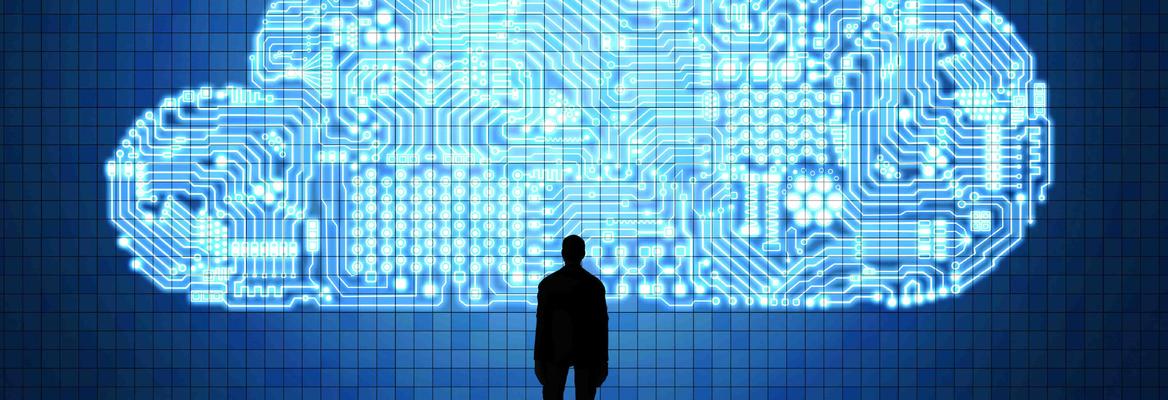
The self in the cloud

Our identity is made up of both the inside and the outside

The Self in the Cloud

Charlie Huenemann
Issue 96, 14th April 2021 (iai.tv)

Charlie Huenemann 

| Professor of philosophy at Utah State University1,505 wordsRead time: approx. 8 mins

Our identity is not just about our internal memories, beliefs, hopes and fears. We are made up equally of our environment, of things outside ourselves – for example, by how we react to people and places. With this in mind, the dream of uploading ourselves to the cloud has a fatal flaw. We can upload our inner selves to the cloud, but we are nothing without the outside world in which we live and the people in it, writes Charlie Huenemann.

We will turn to the possibility of uploading our ethereal souls to supercomputers in just a moment, but first let’s talk about keys and locks. A key is an ingenious little device with a handle (or bow) and a blade with some particular series of cuts in it. One could provide a very precise mathematical description of those cuts, and one might wish to do so because that specific series of cuts — exactly those, in that sequence — is what makes a key that particular key and no other. For this reason, we might well suppose that the shape of the key is the essence of the key, so that one need not look beyond the key itself to find its essence.

But this isn’t quite right. For there is a reason each key has the shape it has, and that reason has to do with some specific lock. That lock has some complementary configuration (often involving some number of little pegs of various lengths) which will allow a cylinder to turn only if the key, with its corresponding shape, is inserted into the keyhole. That is why each key has the shape it has: because of its relationship to some lock. If the lock is lost, the key’s shape doesn’t really matter anymore. It might as well have a different shape, for it is now just a decorative piece of metal, perhaps to be hung on a necklace or glued onto a piece of art. What was essential to it is no longer essential, for its relationship to other things in the world has been altered. It is not its intrinsic shape, but its relation to other things – or the lack of such relations – that determines what the essence of a particular key is.

Just as keys have the shapes they have because of the locks they fit, people have the selves they have because of the lives they fit.

Okay, now to selves and consciousness. Many scientists and philosophers have taken an approach to selves that resembles the first approach we took to keys. What is essential to a self is internal to that self: our memories, our beliefs, our attitudes and desires and hopes and fears, and so on. These are the cuts in our blade, and for each person the cuts are here or there, deeper or shallower, and it is these differences that make us so different from one another. Some scientists and philosophers hope that they will find some kind of explanatory correlation between the cuts of our blades and the configurations of our neurons, believing that there must be a clear connection between the two. Other scientists and philosophers (well, mainly philosophers) believe no such connection can be found, because we are dealing with very different sorts of shapes: shapes of the subjective or semantic or meaningful sort, as opposed to shapes of the more geometrical sort. These philosophers will argue that even if we were to know the full architecture of some particular brain, we still could not possibly know whether it was the brain of a cobbler or a prince. The only way to know whose brain it is would be to be it, somehow. Then we would know it “from the inside”— an inside we can never see with our eyes, no matter how acute our vision.

But these scientists and philosophers are forgetting about locks. Just as keys have the shapes they have because of the locks they fit, people have the selves they have because of the lives they fit. My memories and beliefs are shaped by what I have experienced, but they are also tuned to the people I ordinarily meet, what I take to be their expectations of me, and networks of obligations and responsibilities I negotiate on a daily basis. My attitudes, desires, hopes, and fears are quite fluid, adapting to my circumstances and the attitudes of others around me. I am the particular self I am because of my on-going, changing relationships to people around me, as well as to the culture, economics, and politics of my time and place.

Indeed, this is where the key-and-lock analogy breaks down, for keys and locks are relatively stable over time. Lives are rivers in constant change and flow. We fit into them because we are able to shape-shift as the circumstances of life require. A better picture would be of a lock undergoing continuous change, reflected in a corresponding and continuous change in the shape of the key; but at that point one wonders why we would want to employ the key-and-lock analogy in the first place. Still, it’s handy, so let’s go with it.

Simon Blackburn, Colin Blakemore, Mary Midgley set out in search of the self.

Just as a key’s shape loses its meaningfulness when its lock is taken away, a human self unravels when its life is taken away. In a powerful and insightful essay, Lisa Guenther explores the effects of solitary confinement on a human being and establishes that without a social world to plug into, a human being undergoes a torturous loss of self; even one’s sense of reality becomes unhinged when there is no one else around to confirm it or push back against it. As Guenther writes, “our ‘here’ is intertwined with their ‘there’”, and who we are is intertwined with who they are. That is to say, more simply, that the key loses its shape when there is no corresponding lock.

We are not islands, as John Dunne wrote:No man is an island entire of itself; every manis a piece of the continent, a part of the main;if a clod be washed away by the sea, Europeis the less, as well as if a promontory were, aswell as any manner of thy friends or of thineown were; any man’s death diminishes me,because I am involved in mankind.And therefore never send to know for whomthe bell tolls; it tolls for thee.

“Any man’s death diminishes me”: and not just out of deeply sympathetic sorrow or because of our common plight, but because of the fact that my being consists in his, in part; his seeing me lends me something that can be seen. As Descartes should have said, cogitamus, ergo sumus: “We think, therefore we are”.

A neural net, installed on whatever substrate, will not capture a self unless that neural net is giving and taking in a larger network of neural nets.

We might use this insight to understand what we look for as we try to expose instances of deception. If I suspect Alice or Bob to be imposters, I may well ask them things only Alice or Bob would know; but as we know from watching spy movies, imposters will excel at recounting such trivia. What will be more telling, and nearly impossible for any imposter to achieve, are the ways in which Alice and Bob should interact with us, and how they should reply to our jokes or respond to our stories. The distinctive ways in which Alice and Bob should change in response to our changes is what will tell us whether we really have Alice and Bob, or some imposters. What is telling is the way they fit into our lives, and how we fit into theirs. Alice and Bob will have to be absolute wizards at picking locks, if they are to succeed.

Now I fear that this is going to make being uploaded into the cloud a decidedly difficult affair, and not merely because of difficulties in coding. Ordinarily, the strategy is that moving a self into the cloud should be “only” a matter of figuring out the program that governs the behavior of one’s neural net, and reinstalling that program on some other machine’s components. It is philosophically the same as having a key copied, even though the blade may have something like 100 billion cuts. But without the corresponding lock, the key will be lost. A neural net, installed on whatever substrate, will not capture a self unless that neural net is giving and taking in a larger network of neural nets, a virtual archipelago of selves defining their boundaries through incessant bickering and chattering negotiations. No angel without its choir, as it were.

We cannot go anywhere alone, it turns out, and this will include any trips to the cloud. To paraphrase the songwriting wit Tom Lehrer, we must all go together when we go; or at the very least we must travel with enough companions to allow for decent conversation. For if there is no we, there will be no me.

Related Videos:

catw thumbnail

Consciousness and the world

FF Ep1

Beyond Us: Knowledge

How to die thumbnail

How to die before you die

Artboard 1

AI and the future of the mind

Rational Animal Thumbnail2

The rational animal

Mercury Becomes An Evening Star

by Astro Butterfly (astrobutterfly.com)

On April 18th, 2021, the Sun and Mercury are conjunct at 29° Aries, and Mercury transforms from a Morning Star into an Evening Star. 

Each planet has two phases: Morning Star (when the planet rises before the Sun) and Evening Star (when the planet rises after the Sun). 

These two distinct “star phases” are very important and reveal insights that we cannot get from the sign or house placement alone

Let’s say your Mercury is in Gemini. People with Mercury in Gemini are known for their curiosity and fresh approach to life.

However, if Mercury is an Evening Star, then Mercury has slightly different qualities, which may complement or even contradict the qualities of the sign.

The planetary star phases and synodic cycles were very important concepts in traditional astrology. Back in the day, our ancestors got all their information from the most important source: the sky itself.

Modern astrology has somehow ‘forgotten’ about planetary cycles, but fortunately, we are slowly bringing this concept back, giving it the importance it deserves. 

The Venus star type – the Venus Morning Star and Venus Evening Star – is by far the most popular topic, but ALL planets have Morning and Evening phases. 

Every time a planet is conjunct the Sun, it transforms either from a Morning star into an Evening Star or vice versa. 

Let’s Take Mercury 

We have two types of Mercury-Sun conjunctions: one when Mercury is retrograde, and one when Mercury is direct. 

  1. When Mercury is retrograde, Mercury transforms from an Evening Star into a Morning Star 
  2. When Mercury is direct, it is so fast that it overtakes the Sun, transforming from a Morning Star into an Evening Star.

The current Mercury cycle started on February 8th, 2021 with the Mercury retrograde-Sun conjunction at 20° Aquarius.  

On April 18th, 2021 we have the 2nd Sun-Mercury conjunction of the cycle – this time Mercury is direct. We are now in the middle of the current Mercury cycle.

Just like we have Full Moons, the Sun-Mercury conjunction on April 18th, 2021 is the “Full Moon” or “Full Mercury” part of the cycle.  

Mercury now starts to rise after the Sun, transforming from a Morning Star into an Evening Star. Mercury becomes less daring and curious and more efficient and contemplative. 

At the time of the conjunction, you will receive important insights (Mercury) about yourself and your purpose in life (the Sun). This is a time of alignment and clarity.

If you’ve been feeling confused about whether or not to take on an opportunity, or start a new project, the Sun-Mercury cazimi-conjunction will bring you the clarity and confidence you need. 

From April 8th, 2021 until the end of the current Mercury cycle on May 30th, Mercury is an Evening Star.

Mercury Evening Star is less interested in dreaming and strategizing, and more interested in implementation and follow-through. 

Your Natal Mercury Star Phase

Mercury conjunct Sun and the Mercury cycle also influence your natal chart.

We are all born during a specific phase of the Mercury cycle, and this phase, or this Mercury star type, influences our thinking and communication style. 

To find out what your Mercury star type is, look whether Mercury is before or after the Sun in your natal chart. 

Mercury can only be found in the sign before the Sun, the same sign with the Sun, or in the sign after the Sun. So if you’re a Virgo Sun, your Mercury can only be in Leo, Virgo or Libra. 

If you’re a Virgo Sun and your Mercury is in Leo, you’re a Mercury Morning Star, because Leo comes before Virgo. If your Mercury is in Libra, you’re a Mercury Evening Star, because Libra follows Virgo. 

If your Mercury is in the same sign as the Sun, look at the degree. If Mercury is at an earlier degree than the Sun, it is a Morning Star. If it is at a later degree, then it is an evening star. 

What does it mean for a planet to be a Morning Star or an Evening Star? 

Mercury Morning Star has Gemini-like qualities, while Mercury Evening Star has Virgo-like qualities.

Mercury Morning Star is more independent, more curious, innovative, but may lack experience. 

Mercury Evening Star is more organized, more fluent, more experienced, but of course, may lack the enthusiasm and the curiosity of Mercury morning star. 

The 4 Mercury Star Phases

There are two subtypes for each Mercury star phase, so we have a total of 4 different Mercury star phases. Each of these types will, of course, influence our personality in distinct ways. 

  • If Mercury is Morning Star and Retrograde, then the person is extremely curious, has a beginner’s mind and a vivid imagination. Famous Mercury Retrograde Morning Star people are Steve Jobs, J. R.R. Tolkien, George Lucas, Princess Diana, and Lady Gaga. 
  • If Mercury is Morning Star and Direct, it is close to the Sun, so it ‘borrows’ Solar qualities. It is idealistic, intuitive and visionary. People with this star type have an abstract, rather than a concrete, fact-based mind. They can quickly process information and be very mentally prolific, but may lack attention to detail. Famous Mercury Direct Morning Stars are Michelangelo, Mark Twain, Lewis Carroll, and Maya Angelou.  
  • If Mercury is an Evening Star and Direct, Mercury is now familiar with the “Solar” agenda, and is concerned with follow-through and implementation. People with this star type are efficient and have a strong sense of purpose. Elon Musk, Martin Luther King, Mother Teresa, Gandhi, Oprah are all Mercury Direct Evening Stars. 
  • If Mercury is Evening Star and Retrograde it is contemplative and artistic. They can become icons in their area of excellence. Examples of Mercury Retrograde Evening Stars: Gabriel Garcia Marquez, Salvador Dali, and Madonna. 

What is your Mercury star phase?

Group Of Hunky Cardinals Appeals To Pope To Relax Celibacy Requirement

Jun 21, 2012 Mitt Romney spends most of a factory visit yelling at employees to work harder, the deep, orange sun beautifully sets on Topher Grace’s career, and a man on the verge of self-realization instead turns to God. It’s the week of June 11th, 2012. Subscribe to The Onion on YouTube: http://bit.ly/xzrBUA​ Like The Onion on Facebook: http://www.fb.com/theonion​ Follow The Onion on Twitter: http://www.twitter.com/theonion

A Very Prosperos Sunday

“SPONTANEITY THROUGH CONVERSATION”

Right click “Open Image in New Tab” for larger view.

Sunday, April 18 at 11 a.m. Pacific time

Here’s the link: https://us02web.zoom.us/j/332275676

RELEASING THE HIDDEN SPLENDOUR WORKSHOP

Richard Hartnett, H.W,. M.

Event on April 18, 2021: Releasing the Hidden Splendour workshop facilitated by Richard Hartnett, H.W., M. and Rick Thomas, H.W., M. will be held on Sunday, April 18 at 3 p.m. Pacific time.  Open to all students of RHS. 

Here’s the link:  https://us02web.zoom.us/j/82448721437?pwd=UGFVQ3dmTitOTW10V3ZSazhwUlViZz09

Rick Thomas, H.W., M.

SUNDAY NIGHT TRANSLATION GROUP

Online via Zoom @ 6:30 to 8:30 p.m. Pacific time.  If you are a Translator, please join our meetings from your computer, tablet or smartphone.  Link:  https://us02web.zoom.us/j/816612022

Consciousness, spirituality, biography, sexuality, androgyny, futurism, space, the arts, science, astrology, democracy, humor, books, movies and more