On April 26th, 20219 we have a Full Moon at 7° Scorpio. The Full Moon is opposite Uranus in Taurus, square Saturn in Aquarius and trine Mars in Cancer.
Full Moons in Scorpio are intense by definition (we are dealing with Scorpio energy after all) and this one is no exception.
Mars in a water sign will fuel our emotions even more, while Uranus will seek an outlet for them, despite Saturn’s effort to keep us in check.
This combo is dynamite. But when there is tension, when there is friction, things happen. And change is always a good thing, even if it may not always feel that way.
Taurus Vs Scorpio – Freedom Bears Consequences
The Full Moon is a Sun-Moon opposition, so it is a reflection of the qualities of the opposite sign.
The Full Moon in Scorpio is a reflection of what is going on in Taurus.
At the Full Moon in Scorpio, the Sun is conjunct Uranus in Taurus (and opposite the Moon).
Sun conjunct Uranus = a desire to be free, independent, autonomous, to depend on nothing and no one.
Scorpio, on the other side of the axis, is pretty much the opposite.
Scorpio is covenants. Scorpio is debt. Freedom bears consequences, and everything we do has a ripple effect. We all pay our dues sooner or later. What goes around always comes around.
In our desire to be free and not having to worry about the future, we want to own stuff. But the more we own, the more we pile up, and the more we become a slave of our possessions. Stuff needs to be put into use. Money needs to circulate.
What’s no longer in use needs to be repurposed, recycled, or disposed of.
Stuff cannot just exist in a vacuum, and nothing lasts forever, as much as we want to freeze the status quo and defy the laws of nature.
The only constant is change.
Full Moon In Scorpio – We’re In This Together
Taurus is “mine” and Scorpio is “ours”. Of course, owning stuff is an absolutely necessary process in our development. If you don’t have food in the fridge, you starve. If you don’t have warm clothes, you get sick.
Taurus teaches us to become self-autonomous and to take care of ourselves. However, once we achieve this goal, from a certain point onwards, we realize that we can only go so far on our own.
There comes a point – always – when we’re better off joining forces, or merging with another entity – a project, a person, a community.
And this merging always comes at the expense of our personal freedom. But that’s not necessarily a bad thing, and evolution-wise, it is absolutely necessary.
Happy couples may miss their bachelor years, but overall, they find more value in the intimacy of the relationship.
Being part of a community may mean you have to turn your volume down when you listen to music – but it also means there is a neighbor there to rely on.
Full Moon In Scorpio – What Goes Around Comes Around
Scorpio is associated with transformation, letting go, and purging. When you say “Scorpio” you automatically think of “what do I need to let go of?”.
But here we miss the incredible transformational potential Scorpio can offer.
Scorpio is not just about letting go. In autumn, when the leaves fall from the trees, the tree does just not let go of useless, dry leaves.
These dry leaves go back to the earth and transform into nutrients. They don’t just go away. They don’t just die.
If it wasn’t for the leaves falling down and feeding the three through winter, the tree would dry out. Without trees, we wouldn’t have oxygen. Life on earth would cease to exist.
The process of transformation from one state of being to another is so very feared, by all of us – but it is a normal, and absolute necessity of life.
Just because things are no longer the way they used to be, just because they change their status, their properties, doesn’t mean they cease to exist. They simply become something else.
The Full Moon in Scorpio is a great opportunity to ask yourself:
What do I cling to? What freedom can I find by letting go of what is mine?
Where am I stuck? What can I repurpose so I can move forward?
Who am I no longer willing to be? Who am I becoming?
Tal Dotan Ben-Soussanis the director of the Research Institute for Neuroscience, Education and Didactics (RINED) – Paoletti Foundation. As a neuroscientist and bio-psychologist, she has published numerous articles on neuroplasticity, mindfulness, movement and meditation, and she coordinates international conferences integrating theoretical, methodological and practical approaches on various topics, such as silence, logic and neuro-education. She lives in Assisi, Italy.
Edited by Christian Jarrett
April 21, 2021 (psyche.co)
William James, the father of Western psychology, in 1902 defined spiritual experiences as states of higher consciousness, which are induced by efforts to understand the general principles or structure of the world through one’s inner experience. At the core of his view of spirituality is what we might call ‘connectedness’, which refers to the fact that individual goals can be truly realised only in the context of the whole – one’s relationship to the world and to others.
Traditionally, this spiritual state has been described as divine, achievable through contemplative and embodied practices, such as prayer, meditation and rhythmic rituals. Indeed, this higher state of consciousness and connection has been reported in many spiritual traditions, ranging from Buddhism to Sufism and Judaism to Christianity. However, recent neuroscientific research shows that the same state can be achieved by secular practices too. Scientific and creative epiphanies with their accompanying ecstatic states characterised by a sense of unity and bliss are similar to religious experiences, with both involving a higher state of presence and observation. Many geniuses, such as Albert Einstein and the mathematician Srinivasa Ramanujan, reported spiritual-like states during their revelations or breakthroughs. But these don’t have to be the rare experiences of a chosen few. They can be reached in daily life. As the Nobel laureate and poet Czesław Miłosz put it: ‘Description demands intense observation, so intense that the veil of everyday habit falls away and what we paid no attention to, because it struck us as so ordinary, is revealed as miraculous.’
I’m a neuroscientist and, among other things, I study the way that spiritual states are reflected in the brain and other parts of the body. Spiritual practices have been shown to be closely linked to self-awareness, empathy and a sense of connectedness, all of which can be correlated with the frequency of brainwaves as measured by electroencephalogram (EEG). Studies using EEG have demonstrated how ‘fragmented’ or out of step our whole brain activity can be much of the time, suggestive of conflicts between our behaviour, thinking, feeling and communication. On the other hand, expert meditators demonstrate more ‘harmonious’ brain waves, which could be indicative of greater synchrony or connectivity within and across different neural areas. In short, spirituality, similar to love, has physiological effects in the brain and body, and EEG provides a window on these changes.
What’s more, research suggests that we can do more than just measure this kind of activity. We can also train our brains to behave in a more ‘aware’ way by engaging in activities that facilitate greater connection or neural synchronisation. Higher synchronisation – imagine a large group of brain cells singing together – has been found following the practice of different contemplative paradigms, such as meditation and prayer (creating, as it were, slower ocean waves, now growing calmer and calmer). One way of interpreting this is that neuronal synchronisation enhances our brain ‘harmony’ or ‘integrity’ – achieving a state in which the brain works in a more congruent way, adopting a more global perspective. Other findings point to the psychological consequences of this state – greater neuronal synchronisation tends to enable a greater ability to makemoral judgments and problem-solve creatively.
Neuronal synchronisation also correlates with feeling more self-connected, which can, in turn, further increase empathy, creativity and social effectiveness. In two words, it’s associated with greater self-awareness, which has many practical benefits. For instance, the psychologist and author of Insight (2017) Tasha Eurich wrote in the Harvard Business Review in 2018 that people with greater self-awareness are more confident, make sounder decisions, build stronger relationships and communicate more effectively. The self-aware also receive more promotions, have more satisfied employees, and achieve more profitable companies.
We can transcend the here and now to create a more ‘spherical’ life that changes our focus from basic needs and fears to values
You might be concerned that taking a neuroscientific approach to profound, ineffable spiritual experiences is reductionist. But another perspective is that the scientific exploration of such experiences could reveal the mechanisms enabling us all to achieve these states even in the most mundane moments, such as waiting in traffic. Scientific discovery could turn seemingly subjective experiences into unified (and unifying) understanding. Simply put, I’ve seen how spirituality can be experienced in the lab! Let me share some examples with you.
Most of my research over the past two decades is linked to a movement meditation called Quadrato Motor Training (QMT) that demands both coordination and mindfulness. Practitioners alternate between dynamic movements and static postures, while dividing their attention between their body in the present moment and its location in space. QMT requires a connection between the ‘external’ world and the inner realm by requiring the participant to be intentionally aware of both inner and outer ‘worlds’ simultaneously.
In our research, we found that QMT improved cognitive flexibility. For example, in thinking about a simple glass, most people will associate it with the act of drinking. But following QMT training, additional ‘worlds of content’ can open up – the glass can be viewed as ‘the holy grail’ or a hat. In fact, our study showed that a seven-minute QMT session increased cognitive flexibility by 25 per cent, compared with other simpler kinds of movement or verbal training. What’s more, EEG measures showed that the enhanced cognitive flexibility associated with QMT training was also accompanied by increased brain synchronisation of the kind previously related to relaxation, attention and a flow state. Some might say QMT also fosters spirituality.
What else helps to produce neural synchronisation? Well, perhaps surprisingly, being in a space similar to a sensory-deprivation chamber, with little external stimulation, also impacts on neuronal synchronisation. Such was the idea behind the OVO chamber (uovo is Italian for ‘egg’, describing the space’s shape), created by Patrizio Paoletti, one of the leading teachers of meditation, based on his ‘Sphere Model of Consciousness’ (stated briefly, the model describes a spherical matrix that maps on to our subjective experiences, ranging from ordinary automatic habits to higher states of consciousness achieved in contemplative practices; see figures 1 and 2 below).
Figure 1: Sphere Model of ConsciousnessFigure 2: The OVO chamber, created by Patrizio Paoletti, is in the shape of an egg, based on his Sphere Model of Consciousness
My colleagues and I have found that OVO-immersion leads to increased neuronal synchronisation in the insula, a brain area related to empathy as well as bodily self-awareness. In turn, this was found to be accompanied by an increased sense of ‘absorption’ (akin to that feeling you get when overwhelmed by the beauty of a sunset, as you fully and voluntarily engage your attention in the experience). Absorption is also closely related to spirituality, meditation and empathy, likely because all involve openness to self-altering experiences and voluntarily increasing awareness.
When we lose it, for instance, what exactly are we losing? Nothing less than our selves
Although most of us don’t have access to an external ‘egg’ chamber, we can place ourselves at the centre of our own ‘sphere’ in daily life. By rooting ourselves, listening to our highest aspirations, and paying closer attention to our breathing, to the people we love and to the present moment, we can transcend the here and now to create a more ‘spherical’ life that changes our focus from basic needs and fears to values. This is further accompanied by an intentional shift toward a clear ‘goal’ state, represented by the centre of our inner sphere in Paoletti’s model. In this sense, spirituality can be seen as actions that are not separate from daily life, but rather congruently connected to its different aspects – the body, family, career, friendship, relationships, finance and society.
As well as finding Paoletti’s Sphere Model of Consciousness useful in my neuroscience research, I also use it as a practical instrument with which to observe myself. As spirituality is closely related to one’s state of consciousness, self-awareness and neuronal synchronisation, the more one’s consciousness is elevated, the more one feels the connectedness of things. Imagine you’re out driving and notice the sun setting. Is your next thought about the traffic, or are you awed by the glorious sunset and the daily planetary dance we all share? Now imagine the same drive. Someone recklessly cuts you off and zooms away. Is your first reaction to get upset and start chasing them – risking yourself and others? Or do you remain calm, with your heart rate the same as before the car overtook you?
In both examples, the latter option involves engaging a more mature, present part of ourselves in the current once-in-a-lifetime moment – being fully connected to the experience of the sights, the sounds and the scents. This is the kind of experience some call spirituality, namely the interconnectedness of being. In contrast, each time we react involuntarily, we aren’t anchored in our centre, but controlled by a more automatic state not chosen by us, and therefore we’re less connected both within ourselves and to the greater good.
For me, a big part of spirituality is overcoming daily challenging situations with calm and care. When we lose it, for instance, what exactly are we losing? Nothing less than our selves. We all lose it sometimes, but we can lose it less often by continually reconnecting to our best selves and to each other.
Recently, while preparing for an online conference, I shared some of my data showing increasingly greater levels of relaxation among novice, intermediate and expert meditators. My curious 17-year-old daughter said: ‘Mom, I know how to meditate. I’m an intermediate practitioner, right?’ I replied: ‘Well, as you see by these graphs, there is a big difference between knowing how to meditate and actually practising it regularly. Imagine some stairways you can climb to reach the sky. You have the means to get there, but now you need to keep climbing.’
As a neuroscientist, knowing that brain change is possible (even among grown-ups) keeps me optimistic and motivated in my research. Through simple non-invasive techniques, we can all train and monitor our spirituality and, in turn, live more vibrantly.
This Idea was made possible through the support of a grant to Aeon+Psyche from the John Templeton Foundation. The opinions expressed in this publication are those of the author and do not necessarily reflect the views of the Foundation. Funders to Aeon+Psyche are not involved in editorial decision-making.
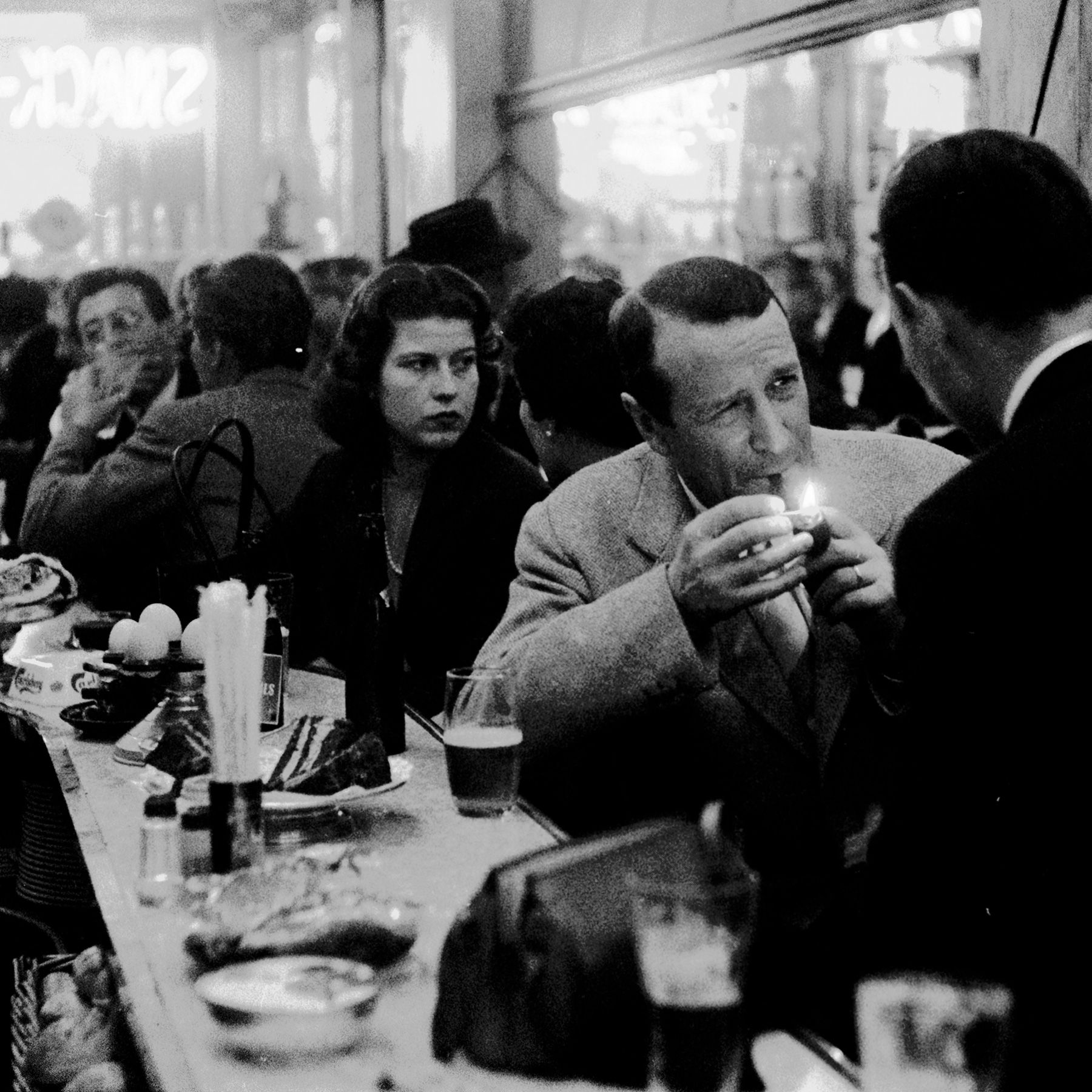
Georges Simenon in Paris, October 1956. Photo by Philippe Le Tellier/Paris Match/Getty
The best detectives seem to have almost supernatural insight, but their cognitive toolkit is one that anybody can use
by Ivar Fahsing
April 21, 2021 (psyche.co)
Ivar Fahsingis a detective chief superintendent and associate professor at the Norwegian Police University College in Oslo, and has 15 years’ experience as a senior detective in the Oslo Police department and at the National Criminal Investigation Service of Norway. His co-authored books include Organized Crime (2010) and The Routledge International Handbook of Legal and Investigative Psychology (2019), and he is currently co-authoring the UNPOL manual on investigative interviewing in cooperation with the Norwegian Centre of Human Rights.
Edited by Christian Jarrett
Need to know
A criminal investigation is a complex, multifaceted problem-solving challenge. Detectives must make critical decisions rapidly – sometimes involving life and death, based on limited information in a dynamic environment of active and still-evolving events. Detectives are responsible and empowered under the law to make judgment calls that will dramatically affect the lives of those involved. The stakes are high, the settings are ugly, and there’s no room for error.
Detectives are often portrayed as misanthropic masterminds. They seem to possess almost mythical personal gifts that the average person can only dream of. I’m sorry to disappoint you, but this isn’t entirely true. Not all detectives are masterminds, and you actually don’t need to be a detective to think like one. A few tools and methods can improve your inner detective, help you find facts, and learn to better understand the relationship between them.
Most of us, whether we’re highly educated or not, have never actually learnt how to think and make safe judgments under pressure. Yet good thinking is important for every aspect of life. Learning how to think like an expert detective can boost your incisiveness and creativity. It can make you less judgmental and a better listener. Honing your detective-thinking skills could help you solve everyday issues, such as planning the perfect vacation or choosing the best job candidate.
I am a university academic, but I’m also a real-life detective myself – more specifically, I’m a detective chief superintendent at the Norwegian Police University College. I’ve worked on some of the worst crimes in Norway for 30 years. These days, I spend much of my time teaching police detectives and other investigators how to make safer decisions in serious and complex matters – and I’m going to share some of the basics with you in this Guide.
When I first started as a police officer, none of my fellow detectives, police academy teachers or criminal investigation department bosses were seemingly able, nor interested, in telling me in practical terms how to think like a detective. Instead, they talked about attitude, talent and experience. Most of all, they liked talking about old cases they’d solved. They never spoke about the cases they failed to solve or the next challenge. The most crucial tool of any successful investigator – namely, sharp reasoning skills – was also never mentioned. We were all very keen on formulating mental profiles of offenders. Yet, strangely, the idea of profiling the effective detective was almost taboo. It’s as if the ability to think like an expert detective was taken for granted.
In fact, what might at first seem akin to a supernatural gift is mostly a metacognitive skill, which means the ability to think about thinking. Anyone can learn to improve their metacognitive skill, but it doesn’t come easily. For most of us, it goes against our instincts. Consider the common cognitive bias known as WYSIATI or ‘what you see is all there is’, described by the Nobel Prize-winning psychologist Daniel Kahneman in his bookThinking, Fast and Slow (2011). WYSIATI refers to the fact that we typically make our judgments according to the information we have readily available – no matter how incomplete it is. We find it difficult to appreciate that there are still many things we don’t know. Another bias known as ‘confirmation bias’ compounds WYSIATI, and describes our tendency to seek out more evidence to support our existing beliefs or judgments.
Imagine what happens when you meet someone new. It typically takes less than a second to establish an impression of a complete stranger. Immediately, we decide whether they’re empathic and courteous or dominant and hostile, and whether we like them or not. What’s more, we do all this based on gut feeling and incomplete information such as facial features, how the person’s dressed, or how they talk. When we make everyday decisions, our mind often considers only the first information at hand. Regardless of its quality and quantity, the only thing it tries to do with the information is to build a coherent story. ‘He is nice!’, ‘She is not!’ That’s it. The story doesn’t have to be accurate, complete or reliable; it only has to be coherent for us to feel confident in our judgment.
Making decisions this way is easy, comfortable and intuitive, but unfortunately it also fuels feelings of overconfidence and exaggerated competence. Regardless of our social class or our so-called intelligence, we are all by nature ‘cognitive misers’ – that is, we have a tendency to solve problems in superficial and effortless ways rather than via more sophisticated and effortful ways. If not addressed deliberately, this overconfidence, and the gap between one’s initial ideas and reality (see figure above), can lead even the most trusted experts astray.
As a homicide detective, I began to notice how my more skilled colleagues were different from the others. It wasn’t apparent at first. They never spoke loudly nor did they frown at how obvious things were. They didn’t voice their opinion any more than others; they didn’t jump to conclusions. Rather, they observed, asked questions, and calmly kept on digging. This detached involvement and the ability to keep digging are the main attributes that set expert detectives apart from the rest of the crowd. Hence, not making a decision is the best decision a good investigator can make. For some of us, it will be hard, and it might take some practice. It seems counterintuitive to walk away from a problem you want to solve. Forcing your mind to take a step back is not easy.
However, when you get the hang of this way of thinking, you’ll find it helpful in many everyday situations and problems, big or small. For instance, it might help you become less judgmental in social settings, have the patience to acquire more information, and end up a better reader of people. Thinking like a detective will encourage you to continuously analyse any problem until the time is right to start fixing it. When done correctly, over time, your patient approach will also build your trustworthiness and integrity.
In fact, I would go so far as to say that when making any important life decisions where it would be hazardous to jump to conclusions – eg, when buying a new home, hiring a new employee or planning a career move – it’s wise to adopt the same detachment and patient approach as used by expert detectives. Keep in mind that your brain will invariably try to convince you that your first impression is right. So, to activate your inner detective, you will have to make a conscious effort to dig deeper into all the available information, and try to do a more systematic and thorough analysis of the strengths and weaknesses of various conclusions before making your decision. In the next section, I’ll show you the practical steps involved in applying a detective’s mindset to any investigation in your life.NEED TO KNOWWHAT TO DOKEY POINTSLEARN MORELINKS & BOOKS
What to do
Step 1: Assume nothing and find out what you really know
To think like an expert detective, you have to embrace a so-called ‘investigative mindset’. The terms ‘possibly’ and ‘could’ should be your watchwords as they are in every real investigation and at every crime scene. In detective handbooks, this is called the ABC principle:
Assume nothing
Believe nothing
Challenge and check everything
Nothing should be taken for granted or accepted at face value. Expert detectives will always take a sceptical approach to any information or evidence. All stories are possible, until they are not. Always ask yourself ‘What do I know?’ and ‘What do I not know?’ Doing this is sometimes very hard, but even just attempting to slow down your otherwise conclusion-jumping brain will prove helpful. Keep reminding yourself: correlation does not imply causation. Hence, the safest way to test any hypothesis is to try to disprove it. Suppose you think your house keys are lost or stolen. In this situation, it might be a good idea to double-check and eliminate all other options before you decide to change your locks. The only true investigative mantra was formulated in 1890 by Arthur Conan Doyle’s fictional detective Sherlock Holmes. It goes like this: ‘[W]hen you have eliminated the impossible, whatever remains, however improbable, must be the truth.’
It might sound pretty straightforward, but believe me, it’s not. There’s a reason why Sherlock Holmes is considered a genius. The hardest thing is to resist our automatic assumptions and deep-seated need for closure.
Step 2: Identify all the possible explanations
In the Sherlock Holmes novels, our titular hero continuously assails Dr Watson, a man of science, about the merits of deductive logic. In fact, strictly speaking, Holmes’s favoured logical approach is not deduction, which is reasoning on the basis of known facts, but rather what is known as abductive logic, which is the cognitive process of identifying the best possible explanation for a given set of observations. Abductive reasoning is widely recognised as a powerful mechanism for hypothetical reasoning in the absence of complete knowledge. It’s generally understood as reasoning from effects to causes. Only rarely does Holmes engage in the deduction of which he speaks so highly.
A familiar and typical application of abductive reasoning is when a doctor makes a medical diagnosis: given a set of symptoms, what is the diagnosis that would best explain most of them? As a general rule – and due to our conclusion-loving brain – there will always be more alternative explanations than you first realised. A wise doctor won’t leap to make the first diagnosis that springs to mind, but will consider many alternatives to see which best matches the presentation before them.
Similarly, criminal investigations are abductive and not deductive. In most cases, the police don’t find a crystal-clear and indisputable CCTV picture of the suspect while he commits a crime. We’ll typically have a greyish, blurred image of a person leaving or entering a dark alley just before, or just after, a crime was committed. Our initial interpretation of the picture might tell us that this potential offender is a relatively tall man in his 40s wearing a short dark jacket and black or blue jeans. The description can, in essence, fit half the city’s population. Hence, to identify a suspect, you have to come up with all the possible interpretations, then cross-check your blurred picture with a number of other sources of information such as witness statements, motives, fingerprints or mobile-phone activity, to find a suspect and rule out other potential candidates.
Similarly, you should always create a short outline of all the possible alternative explanations you can think of for the situation you’re trying to solve. Based on your alternatives, your next important step is to make a plan for the information you need to test your different explanations, including how you’ll get hold of the required information. This will be your investigation plan.
Step 3: Test the alternative explanations and narrow your investigation
Now’s the time to start the real investigation. This is when the Sherlock Holmes mantra about eliminating the impossible kicks in. Try to eliminate as many explanations or lines of inquiry as you can. Just like in science, theories can be truly tested only through falsification. To be able to keep track of all your alternative explanations and information needs, you’ll need to take a methodical approach. Without it, there’s a huge risk you’ll become a slave to your first and best idea. My colleagues and I designed a model to help. It’s in no way perfect, but probably far better than no model at all. We’ve called this the 6-Cs approach:
First of all – what do you know? Collect the available information and check the facts. Are they relevant, accurate and reliable? Connect the dots. Do different sources say the same? Find out what you don’t know. Next, construct all possible solutions and hypotheses. What does the available information allow for? What do we need to check, and what can be cross-checked? What can be ruled out? What remains possible? Now, consider what information you need the most in order to test your remaining hypotheses? Before you implement your plan, always consult somebody you trust, to help narrow the scope of your investigation by repeating this process from step one.
Let’s apply this to a fictional example based in the world of the animated movie Zootopia (aka Zootropolis) (2016): officer Judy is called to Zootopia Town Hall after mayor Lionheart was found lifeless on the floor in the canteen with a deep wound to his head. Beside him is a large candleholder covered in blood marked with fingerprints. Officer Judy takes photos and secures the candleholder, and soon after she finds that the blood is Lionheart’s and that the fingerprints belong to the assistant mayor Dawn Bellwether. Bellwether is called for an interview, but denies any knowledge of, or involvement in, the incident.
From the animated film Zootopia. Image courtesy of Disney
Now, imagine you’re assisting officer Judy on this case: what’s your first idea or suspicion? Write that down. Like me, you probably suspect Bellwether of a deliberate attack or even attempted murder of mayor Lionheart by hitting him over the head with a heavy candleholder. To think like a detective, what’s critical at this point is not to jump to conclusions but to start digging.
This is the first step – assume nothing. We need more information. To paraphrase Holmes: data, data, data: you can’t make bricks without clay. Ask yourself, what do we not know? What other sources of information are available? What alternative explanations might fit the evidence?
First, assuming that the fingerprints are related to the episode, Bellwether might accidentally have hit the mayor. Second, perhaps Lionheart was the one who attacked Bellwether, and she hit him in a lawful act of self-defence. These alternatives should definitely be investigated. Third, perhaps Bellwether found the mayor on the floor after somebody else had attacked him and she touched and moved the bloody candleholder. This hypothesis should also be added to your investigation plan. Fourth, although it might seem unlikely, maybe Bellwether and Lionheart were involved in an earlier incident where the mayor cut himself, such as during cooking or decorating, and Bellwether subsequently moved the candleholder with his blood on it. Furthermore, we can’t yet exclude that someone is trying to frame Bellwether by staging the event. Is that possible? Does she have enemies? If the answer is yes, you have yet another hypothesis that should be addressed. Now, since our investigation rests solely on the conclusion of a fingerprint expert, we should also double-check if another independent expert will come to the same conclusion. Sadly, in real life, there are plenty of examples of botched forensic evidence leading to wrongful convictions. Finally, we must check whether Bellwether hit mayor Lionheart but was somehow not in complete control of her faculties while she did so, hence her lack of memory for the incident.
Use a mind map
As you can see, there are more alternative options than you perhaps thought of in the beginning. To assist our fragile minds, we need practical methods and information-handling tools to keep track of our investigations. This will help your brain be more accurate, and reduces the risk of it jumping to premature conclusions. So you should keep track of your investigation using a matrix or a ‘mind map’ that lists the upcoming sources of further information against all the alternative explanations for the crime scene (see table below). This will also create transparency, allowing for a second opinion on your ideas and judgments, and you’ll gradually see if information from different sources narrows your investigation.
As each new nugget of information is obtained, you mark on the matrix what it means for each of the different possible explanations or hypotheses. The judgment symbols in the matrix have three different codes: the green plus-sign means that the explanation is supported; a red minus-sign means that an incoming fact opposes the hypothesis, whereas N/A means that the information doesn’t inform or have any bearing upon the hypothesis. The hypotheses that attract the most opposition or minus symbols can gradually be dismissed, while you move forward with the ones that receive more support. Your investigation should document all relevant hypotheses identified in the case, and the inquiry should seek to disprove each one. The last remaining hypothesis is probably the strongest theory but, as a true detective, you should ideally leave it up to others to make the final judgment.
All this nitty-gritty crosschecking is what ‘digging deep’ looks like. You can measure your investigation’s quality on both axes of the matrix: a glance at your number and range of hypotheses will tell you if you have gone wide enough to capture the true potential solution, and your investigative actions will tell you whether you’ve dug deep enough to find the facts to prove or disprove the different hypotheses. In other words, you need to consider both the breadth and the depth of your inquiry.
Recruit a ‘devil’s advocate’
As a rule, in any investigation there will always be something you’ve forgotten or don’t know everything about. That is why an open-minded and critical friend, like Dr Watson in the Sherlock Holmes stories, is so indispensable. As Holmes said: ‘You have a grand gift of silence, Watson. It makes you quite invaluable as a companion.’ He is the so-called ‘devil’s advocate’. Dr Watson’s role is not to solve the case, but to be sceptical and point to things that Holmes might have overlooked or misunderstood.
Remember that evidence, new perspectives or insights can be found where you least expect them. That’s why all expert detectives should demonstrate empathy, be humble, ask questions, and develop their listening skills. Investigative interviewing is done by gently holding back your own opinion, asking open-ended questions, and using silence and active listening techniques such as nodding and humming. This extends to listening to your devil’s advocate. Receptivity to alternative views is a crucial skill not only for detectives, but for any decision-maker in the modern era. In a world where complexity increases constantly, there’s no room for lone wolves.NEED TO KNOWWHAT TO DOKEY POINTSLEARN MORELINKS & BOOKS
Key points
We aren’t born detectives or good decision-makers. Your ‘cave-man’ or ‘cave-woman’ brain will constantly try to fool you into quick-and-dirty decisions.
There’s one cognitive bias in particular that makes it difficult to think like a detective: ‘What you see is all there is.’ The antidote is to resist jumping to conclusions and to seek out more information.
Step back and establish what you currently know. Try to defer forming any conclusions. Instead, use what you already know as the starting point for a systematic investigation. What don’t you know, and how can you find it out?
Identify all the possible explanations and write them down.
Think again – there’s always something you will have forgotten.
Use a mind map to keep track of incoming information, and whether it supports or contradicts the various possible explanations. Look for patterns without jumping to conclusions. Ensure your investigation has sufficient breadth (number of lines of inquiry) and depth (incoming evidence).
Appoint a competent devil’s advocate to look at the case from a critical perspective and raise objections before or during implementation.
Be curious, patient and a good listener.
Practise: your brain needs training like any other muscle. Embrace doubt, start digging, stay humble, and continue educating yourself.
NEED TO KNOWWHAT TO DOKEY POINTSLEARN MORELINKS & BOOKS
Learn more
Rising complexity
Managing a major investigation or in fact any modern project today is fundamentally different than it was 30 years ago. According to the management scholars Gökçe Sargut and Rita Gunther McGrath, complexity has gone from something found mainly in large systems, such as cities, to something that affects almost everything we do: the life we live, the jobs we have, and the projects or organisations we run. As a consequence, the gap between our first idea and reality has almost exploded. Most of this increase stems from the information-technology revolution of the past few decades. Phenomena that used to be hidden, constant or separate are now tangible, interconnected and interdependent. Complex systems interact in unexpected ways. New patterns form, and the outlier is often more significant than the average. Making matters even worse, our analytical tools haven’t kept up with these developments. Collectively, we know a good deal about how to navigate complexity but this knowledge hasn’t been transformed into effective tools. Some predict that artificial intelligence might be our salvation, while others see it as our downfall.
What this rising complexity means in practice is that, whenever you’re confronted by a real-life dilemma that involves abductive reasoning – such as working out why a product launch failed, why your kid is struggling at school, or why your smartphone has stopped working – it’s more important than ever that you learn how to think more systematically. More like a detective.
Thinking like a detective is a skill that takes practice
Thinking the detective way won’t always guarantee a solution to your problem. There are still a number of circumstances involved that you can’t control as an investigator. There are always things you don’t know and perhaps won’t ever know. That said, using the approach I’ve outlined will help you handle the complexity inherent in almost all investigations or other difficult decisions. If you learn how to systematically shift focus and rewrite your understanding, you’ll increase the chance of discovering a quick and simple solution to your problem. In more complex and high-risk matters, following the expert-detective approach will help you reduce the risk of prematurely jumping to conclusions and therefore avoid serious blunders on your way. With practice, we can adjust the brain’s automatic wiring, unveil our inner detective, and improve our decision-making. This is like any other skill. The more you practise, the better you’ll get.NEED TO KNOWWHAT TO DOKEY POINTSLEARN MORELINKS & BOOKS
Links & books
To develop your thinking skills, you need regular training and feedback. Can you solve the three switches puzzle hosted by Guardian News on YouTube? Clue: it helps to start thinking like a detective.
When it comes to examining your existing beliefs, perspective is everything. Are you prone to defending your viewpoint at all costs, like a soldier, or are you spurred on by curiosity, like a scout? In her TED talk ‘Why You Think You’re Right – Even If You’re Wrong’ (2016), the rationalist Julia Galef examines the motivations behind these two different mindsets and how they shape our interpretations of information. When your steadfast opinions are tested, Galef asks: ‘What do you most yearn for? Do you yearn to defend your own beliefs, or do you yearn to see the world as clearly as you possibly can?’
In this blog post for the UK’s Foreign, Commonwealth and Development Office, Gisle Kvanvig and I told the story of how, building on the work of British experts, we used the idea of a detective mindset to inform a new, more ethical approach to interviewing and investigation techniques in, for example, law enforcement. Following this approach, officers are trained to handle the interview room much like a crime scene where accurate, reliable and actionable information can be collected for the purpose of investigating the case.
The bookBlackstone’s Senior Investigating Officers’ Handbook (5th ed, 2019) by Tony Cook is a unique one-stop guide to all the processes and actions involved in conducting major investigations, presented in a clear and understandable fashion.
For my PhD thesisThe Making of an Expert Detective:Thinking and Deciding in Criminal Investigations (2016), I drew on theoretical frameworks developed in social and cognitive psychology to examine the degree to which individual and systemic factors can compensate for inherent biases in criminal detectives’ judgments and decision-making.
The bookThe Routledge International Handbook of Legal and Investigative Psychology (2019), edited by the psychologists Ray Bull and Iris Blandón-Gitlin, explores contemporary topics in psychological science, applying them to investigative and legal procedures. Featuring contributions from recognised scholars from around the globe (including myself), it brings together current research, emerging trends, and cutting-edge debates in a single comprehensive and authoritative volume.
The bookSuperforecasting: The Art and Science of Prediction (2015) by the political scientist Philip E Tetlock and the author Dan Gardner offers a deeper insight into prediction, drawing on decades of research and the results of a massive, US government-funded forecasting tournament. The Good Judgment Project involves tens of thousands of ordinary people – including a Brooklyn filmmaker, a retired pipe-installer, and a former ballroom dancer – who set out to forecast global events. Some of the volunteers have turned out to be astonishingly good. These ‘superforecasters’ have beaten other benchmarks, competitors and prediction markets. They’ve even beaten the collective judgment of intelligence analysts with access to classified information.
‘Correlation does not imply causation’: for decades, this mantra was invoked by scientists in order to avoid taking positions as to whether one thing caused another, such as smoking and cancer, or carbon dioxide and climate change. But today, that taboo is dead. The causal revolution has (seemingly) cut through a century of confusion, and placed cause and effect on a firm scientific basis. The Book of Why (2018) by the computer scientist Judea Pearl and the science writer Dana Mackenzie explains causal thinking to general readers, showing how it allows us to explore both the world that is and the worlds that could have been. It is the essence of human and artificial intelligence. And just as these scientific discoveries have enabled machines to think better, The Book of Why explains how we too can think better.
Have you ever misplaced something you were just holding? Completely blanked on a famous actor’s name? Walked into a room and immediately forgot why? Neuroscientist Lisa Genova digs into two types of memory failures we regularly experience — and reassures us that forgetting is totally normal. Stay tuned for a conversation with TED science curator David Biello, where Genova describes the difference between common moments of forgetting and possible signs of Alzheimer’s, debunks a widespread myth about brain capacity and shares what you can do to keep your brain healthy and your memory sharp. (This virtual conversation was part of an exclusive TED Membership event. Visit ted.com/membership to become a TED Member.)
ARIES (March 21-April 19): Blogger Emma Elsworthy wrote her “Self-Care List.” I’ll tell you a few of her 57 action items, in hopes of inspiring you to create your own list. The coming weeks will be a perfect phase to upgrade your focus on doing what makes you feel healthy and holy. Here are Elsworthy’s ideas: Get in the habit of cooking yourself a beautiful breakfast. Organize your room. Clean your mirror and laptop. Lie in the sunshine. Become the person you would ideally fall in love with. Walk with a straight posture. Stretch your body. Challenge yourself to not judge or ridicule anyone for a whole day. Have a luxurious shower with your favorite music playing. Remember your dreams. Fantasize about the life you would lead if failure didn’t exist.
TAURUS (April 20-May 20): Some traditional Buddhist monks sit on city streets in Asia with a “begging bowl” in front of them. It’s a clay or iron container they use to solicit money and food from passers-by who want to support them. Contemporary American poet Mariannne Boruch regards the begging bowl as a metaphor that helps her generate new poems. She adopts the attitude of the empty vessel, awaiting life’s instructions and inspiration to guide her creative inquiry. This enables her to “avoid too much self-obsession and navel-gazing” and be receptive —“with no agenda besides the usual wonder and puzzlement.” I recommend the begging bowl approach to you as you launch the next phase of your journey, Taurus.
GEMINI (May 21-June 20): Gemini-born Paul Gauguin (1848–1903) is today regarded as an innovative and influential painter. But his early years provided few hints that he would ultimately become renowned. As a teenager, he attended naval preparatory school, and later he joined the French navy. At age 23, he became a stockbroker. Although he also began dabbling as a painter at that time, it wasn’t until the stock market crashed 11 years later that he made the decision to be a full-time painter. Is there a Gauguin-like turning point in your future, Gemini? If so, its early signs might show itself soon. It won’t be as dramatic or stressful as Gauguin’s, but I bet it will be quite galvanizing.
CANCER (June 21-July 22): A research team found that some people pray for things they are reasonably sure God wouldn’t approve of. In a sense, they’re trying to trick the Creator into giving them goodies they’re not supposed to get. Do you ever do that? Try to bamboozle life into offering you blessings you’re not sure you deserve? The coming weeks will be a favorable time for you to dare such ploys. I’m not guaranteeing you’ll succeed, but the chances are much better than usual that you will. The universe is pretty relaxed and generous toward you right now.
LEO (July 23-Aug. 22): In 2013, the New Zealand government decided to rectify the fact that its two main islands had never been assigned formal names. At that time, it gave both an English and Māori-language moniker for each: North Island, or Te Ika-a-Māui, and South Island, or Te Waipounamu. In the spirit of correcting for oversights and neglect, and in accordance with current astrological omens, is there any action you’d like to take to make yourself more official or professional or established? The coming weeks will be a favorable time to do so.
VIRGO (Aug. 23-Sept. 22): Author Grant Morrison observes that our heads are “big enough to contain every god and devil there ever was. Big enough to hold the weight of oceans and the turning stars. Whole universes fit in there!” That’s why it’s so unfortunate, he says, if we fill up our “magical cabinet” with “little broken things, sad trinkets that we play with over and over.” In accordance with astrological potentials, Virgo, I exhort you to dispose of as many of those sad trinkets and little broken things as you can. Make lots of room to hold expansive visions and marvelous dreams and wondrous possibilities. It’s time to think bigger and feel wilder.
LIBRA (Sept. 23-Oct. 22): Libran author bell hooks (who doesn’t capitalize her name) has a nuanced perspective on the nature of our pain. She writes, “Contrary to what we may have been taught, unnecessary and unchosen suffering wounds us, but need not scar us for life.” She acknowledges that unnecessary and unchosen suffering does indeed “mark us.” But we have the power to reshape and transform how it marks us. I think her wisdom will be useful for you to wield in the coming weeks. You now have extra power to reshape and transform the marks of your old pain. You probably won’t make it disappear entirely, but you can find new ways to make it serve you, teach you and ennoble you.
SCORPIO (Oct. 23-Nov. 21): I love people who inspire me to surprise myself. I’m appreciative when an ally provides me with a friendly shock that moves me to question my habitual ways of thinking or doing things. I feel lucky when a person I like offers a compassionate critique that nudges me out of a rut I’ve been in. Here’s a secret: I don’t always wait around passively hoping events like these will happen. Now and then I actively seek them out. I encourage them. I ask for them. In the coming weeks, Scorpio, I invite you to be like me in this regard.
SAGITTARIUS (Nov. 22-Dec. 21): “Where did last year’s lessons go?” asks Gillian Welch in her song “I Dream a Highway.” Now I’m posing the same question to you — just in time for the Remember Last Year’s Lessons Phase of your cycle. In my astrological opinion, it’s crucial for you to recollect and ruminate deeply on the breakdowns and breakthroughs you experienced in 2020; on every spiritual emergency and spiritual emergence you weathered; on all the scary trials you endured and all the sacred trails you trod.
CAPRICORN (Dec. 22-Jan. 19): Capricorn painter Henri Matisse had a revolutionary influence on 20th-century art, in part because of his raucous use of color. Early in his career he belonged to the movement known as Fauvism, derived from the French term for “wild beasts.” During his final years, he invented a new genre very different from his previous work: large collages of brightly colored cut-out paper. The subject matter, according to critic Jed Perl, included “jungles, goddesses, oceans and the heavens,” and “ravishing signs and symbols” extracted from the depths of “Matisse’s luminosity.” I offer him as a role model for you, Capricorn, because I think it’s a perfect time to be, as Perl describes Matisse, both “a hard-nosed problem-solver and a feverish dreamer.”
AQUARIUS (Jan. 20-Feb. 18): “The guiding motto in the life of every natural philosopher should be, ‘Seek simplicity, but distrust it.’” Aquarian philosopher Alfred North Whitehead wrote that, and now I’m proposing that you use it as your motto in the coming weeks, even if you’re not a natural philosopher. Why? Because I suspect you’ll thrive by un-complicating your life. You’ll enhance your well-being if you put greater trust in your instinctual nature and avoid getting lost in convoluted thoughts. On the other hand, it’s important not to plunge so deeply into minimalism that you become shallow, careless, or unimaginative.
PISCES (Feb. 19-March 20): In ancient Greek comic theater, there was a stock character known as the “eiron.” He was a crafty underdog who outwitted and triumphed over boastful egotists by pretending to be naive. Might I interest you in borrowing from that technique in the coming weeks? I think you’re most likely to be successful if you approach victory indirectly or sideways—and don’t get bogged down trying to forcefully coax skeptics and resisters. Be cagey, understated, and strategic, Pisces. Let everyone think they’re smart and strong if it helps ensure that your vision of how things should be will win out in the end.
Homework: I’m in the mood for you to give me predictions and past life readings. Send your psychic insights about my destiny. Truthrooster@gmail.com.
“If our heart were large enough to love life in all its detail, we would see that every instant is at once a giver and a plunderer,” wrote the French philosopher Gaston Bachelard as he contemplated our paradoxical experience of time in the early 1930s just as Einstein, Gödel, and the rise of relativity had begun revolutionizing our understanding of time. “Time is the substance I am made of,” Borges proclaimed a generation later in his exquisite 1944 refutation of time. “Time is a river which sweeps me along, but I am the river; it is a tiger which destroys me, but I am the tiger; it is a fire which consumes me, but I am the fire.”
If Borges’s words sound like a song lyric, it is because there is something singularly musical about our perception of time — we speak of our daily rhythms, abide by the metronomic ticking of the clock, and feel the flow of time like one feels the flow of a melody. It is perhaps unsurprising, then, that the elusive and indomitable nature of time preoccupied not only the twentieth century’s greatest philosophers, scientists, and writers, but also one of its greatest musicians: Eunice Kathleen Waymon, better known as Nina Simone (February 21, 1933–April 21, 2003).
Nina Simone, 1969
On October 26, 1969, at the Philharmonic Hall in New York City, Simone performed a version of “Who Knows Where the Time Goes,” written by the English folk-rock singer-songwriter Sandy Denny and popularized by Judy Collins. The version was released a year later on her live album Black Gold and was later included in The Essential Nina Simone.
Simone, who was at least as devoted to civil rights as she was to music, considered this “a reflective tune” that “goes past all racial conflict and all kinds of conflicts,” for it deals with the supreme unifying force of all human existence: the shared experience of time’s inescapable flow. She introduced her cover with a beautiful, simple, profound prefatory meditation on time — please enjoy:
Sometime in your life, you will have occasion to say, “What is this thing called time?” What is that, the clock? You go to work by the clock, you get your martini in the afternoon by the clock and your coffee by the clock, and you have to get on the plane at a certain time, and arrive at a certain time. It goes on and on and on and on.
And time is a dictator, as we know it. Where does it go? What does it do? Most of all, is it alive? Is it a thing that we cannot touch and is it alive? And then, one day, you look in the mirror — you’re old — and you say, “Where does the time go?”
WHO KNOWS WHERE THE TIME GOES
Across the morning sky, all the birds are leaving How can they know that it’s time to go? Before the winter fire, I’ll still be dreaming I do not count the time
Who knows where the time goes? Who knows where the time goes?
Sad, deserted shore, your fickle friends are leaving Ah, but then you know that it’s time for them to go But I will still be here, I have no thought of leaving For I do not count the time
Who knows where the time goes? Who knows where the time goes?
But I am not alone as long as my love is near me And I know it will be so till it’s time to go All through the winter, until the birds return in spring again I do not fear the time
Who knows where the time goes? Who knows where the time goes?
COLUMBUS, OH—Smiling while recalling the “fantastic little outing,” local woman Olivia Curtis told reporters that she enjoyed hiking with her neighbors through a densely forested ravine Tuesday despite failing to locate the missing child they were searching for. “It was so nice just to get out into nature, get some fresh air, and get to know some of the folks from our neighborhood a little better, even if we never did find that little girl,” said Curtis, who noted that the three-hour jaunt through the wooded area behind their houses had brought members of the makeshift search party closer together than any block party or backyard barbecue ever had. “While no one saw any sign of the kid, we did see a few chipmunks, not to mention some beautiful cherry trees that were in bloom and just about at their peak. Obviously, it’s horrible for anyone’s daughter to go missing like that, but at least we had great company! Plus, Doug and Barb, who were right next to Cheryl and I in the human chain, invited us over to watch the Cavs tonight, which should be a blast. And the best part is that we get to do it all over again at first light tomorrow!” While stressing that time spent with friends was priceless on its own, Curtis acknowledged that finding the child whom no one had heard from or seen in five days “sure would be the icing on the cake.”
Consciousness, spirituality, biography, sexuality, androgyny, futurism, space, the arts, science, astrology, democracy, humor, books, movies and more







 Sometime in your life, you will have occasion to say, “What is this thing called time?” What is that, the clock? You go to work by the clock, you get your martini in the afternoon by the clock and your coffee by the clock, and you have to get on the plane at a certain time, and arrive at a certain time. It goes on and on and on and on.