

PHOTO: SALK INSTITUTE

“What’s your Sun sign?”. Everyone knows their Sun sign, even people who don’t ‘believe’ in astrology.
Your first experience of astrology was probably Sun-sign astrology, or the horoscope. With time, you learned Astrology is much more complex, and that the Sun is just a tiny part of the bigger picture of your chart.
But is the Sun really just one of the many elements of the natal chart? Is the Sun really just ‘another’ Mercury, Venus or Jupiter?

The Sun, especially – and ironically – for those of us who know a lot of astrology, is the big elephant in the room.
We get so distracted by planets, aspects, houses, asteroids, that we forget just how important the Sun is.
Of course, this is not an invitation to go back to horoscopes… not that there is no value in them. Sun-sign horoscopes are specific enough to be reasonably accurate.
This is an invitation to look at the Sun in a way you never looked before. This is an invitation to get to the bottom of what the Sun can offer us in terms of astrological information and guidance.
It is BIG: The Sun is 99% of our solar system. 99% of the mass of the solar system is the Sun. The Moon, the Earth, even the giants Jupiter and Saturn and the other planetary bodies make just 1% of the mass of our solar system. Sometimes we forget just how big, how dominant the Sun is.
It gives LIGHT: The Sun gives light to all the other planets. The Moon, and all the planets are reflecting the Sun’s light. We know the Moon reflects the Sun’s light, but we forget that all the other planets do that as well. We couldn’t see Venus or Jupiter if we didn’t have the Sun. The Sun helps us see what is otherwise impossible to perceive.
It is the CENTER: All planets, and everything here on Earth, revolves around the Sun. The Sun is a central, overarching life-generating principle. The Sun is our framework, and gives us direction, meaning, and purpose. In astrology, planetary cycles are a reflection of how different planetary archetypes unfold in time and space.
Unfortunately, in modern astrology, these important concepts have been neglected or lost. It’s only recently that some modern astrologers have started to talk about day and night charts. It’s only recently that we have rediscovered the Sun-Venus cycle, with its Morning and Evening star phases.
Fortunately, this ancient knowledge is now coming back, thanks to the work of amazing astrologers like Michael Ofek.

Michael Ofek has spent years researching through ancient astrology text and has come with a revolutionary theory about the Sun and the concept of light in general.
Unhappy with the conflicting information we often find in modern astrology, Michael has reverse-engineered all the important pillars of astrology (signs, houses, cycles) in terms of the light-dark relationship.
According to his theory, everything goes back to the Sun.
The 12 signs are the fundamental expression of the relationship between the Sun and the Earth. The Earth takes 365 days to go around the Sun. In a year we have 12 lunar cycles, so that’s how we got the 12 Solar archetypes, or the 12 signs of the zodiac.
The ascendant – or the 1st house – is where the Sun rises. That’s why the 1st house is the house of Self – because this is where the Sun is birthed, this is where life becomes ‘visible’. The Descendant is where the Sun sets. The Midheaven is where the Sun is at the highest point in the sky, and the IC, the lowest point. From the 4 angles we get the 12 houses. If the signs are derived from the yearly solar cycle, the houses are derived from the daily solar cycle.
We are all familiar with the Sun-Moon cycle, or the Lunar cycle. The Moon is new, then it begins to increase in size, then it’s full, then decreases in size, and then becomes new again. And the cycle repeats. Not only the Moon, but all the other planets have a similar relationship with the Sun.
Just like the New Moon is different from the Full Moon, we have archetypal variations of how every planet acts in a certain phase in relation to the Sun. Venus morning star is different from Venus evening star.
A Sun-Mars opposition (when Mars is at the highest possible distance from the Sun) is different from Sun conjunct Mars. The further away a planet is from the Sun, the more independent it becomes, because it moves further from the source.
The Sun is so big, so predictable, that we take it for granted. We are so used to its light and warmth, to its presence, that we forget just how important it is.
But everything we are, everything we have comes from the Sun. And this is something we need to remind ourselves.
The Sun and its light is the precondition of our ability to see and make sense of the world. If there is no light on an object, we can’t see it. And ‘seeing’ physically is analogical to seeing mentally, intellectually.
The Sun is at the heart of astrology. Essentially, astrology is the story of light.
The day when the light will disappear, all life on earth will disappear. The Sun is the socket by which we are connected to the electricity of life. And this is something we need to recognize, understand, and reconnect with again, because the Sun lives in all of us.
Michael has recorded a talk for the Age Of Aquarius Community, called “The Role of the Sun“.
In the webinar, Michael talks about the crucial role the Sun plays in astrology, and shares an original theory about the Sun and its light that is like nothing you’ve heard before. If you’re a big-picture thinker, and like learning new theories, Michael’s insights will blow your mind!
Since this is such an important topic, we are happy to make accessible Michael’s incredible insights as a standalone webinar at a very accessible price.
The webinar is suited for intermediate or advanced astrology students.
You can learn more about the webinar here:

“Our origins are of the earth. And so there is in us a deeply seated response to the natural universe, which is part of our humanity,” Rachel Carson wrote as she reflected on science and our spiritual bond with nature a decade before she interleaved her training as a scientist and her poetic reverence of nature, nowhere deeper than in her tender love of birds, to compose Silent Spring — the epoch-making book that catalyzed the modern environmental movement and inspired the creation of Earth Day.
Two generations later, ornithologist and wildlife ecologist J. Drew Lanham — another scientist with a poet’s soul and the courage to fully inhabit both worlds — explores the abiding relationship between knowledge and mystery, between scientific truth and human meaning, throughout The Home Place: Memoirs of a Colored Man’s Love Affair with Nature (public library).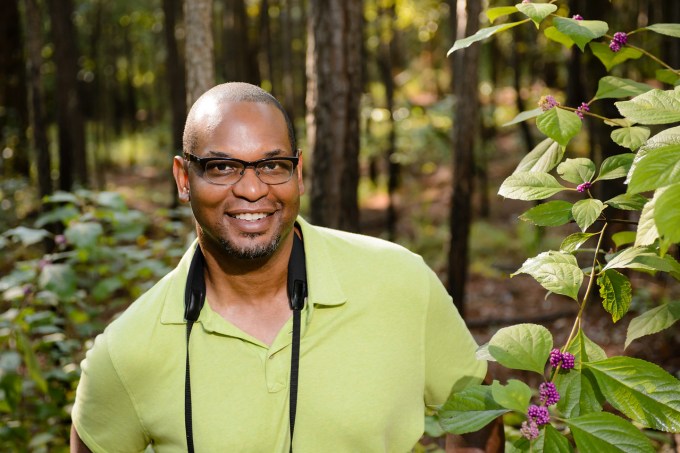
J. Drew Lanham (Photograph: Clemson University)
Lanham — a self-described “man in love with nature,” “a seeker and a noticer,” “a wildling, born of forests and fields” who worships every bird he sees — was raised in large part by his grandmother, a woman of ample wisdom and ample superstition, whose ravishing love of nature inspired Lanham’s own and whose sometimes comical, sometimes concerning antiscientific beliefs inspirited him to get closer to the truth of things through science. His love of nature never left him but, in a testament to Richard Feynman’s timeless Ode to a Flower, was only magnified by the lucidity of his scientific training.
In consonance with poet Diane Ackerman’s lovely notion of living as an “Earth ecstatic” where others might subscribe to a particular religion, Lanham writes:
Evolution, gravity, change, and the dynamic transformation of field into forest move me. A warbler migrating over hundreds of miles of land and ocean to sing in the same tree once again is as miraculous to me as any dividing sea.
Praise Song for Dawn by Maria Popova. (Available as a print, benefitting The Nature Conservancy.)
A century after quantum theory originator and Nobel laureate Max Planck argued that “science cannot solve the ultimate mystery of nature [because] we ourselves are part of nature and therefore part of the mystery that we are trying to solve” — a sentiment Carl Sagan would later echo in his own singular poetics — Lanham adds:
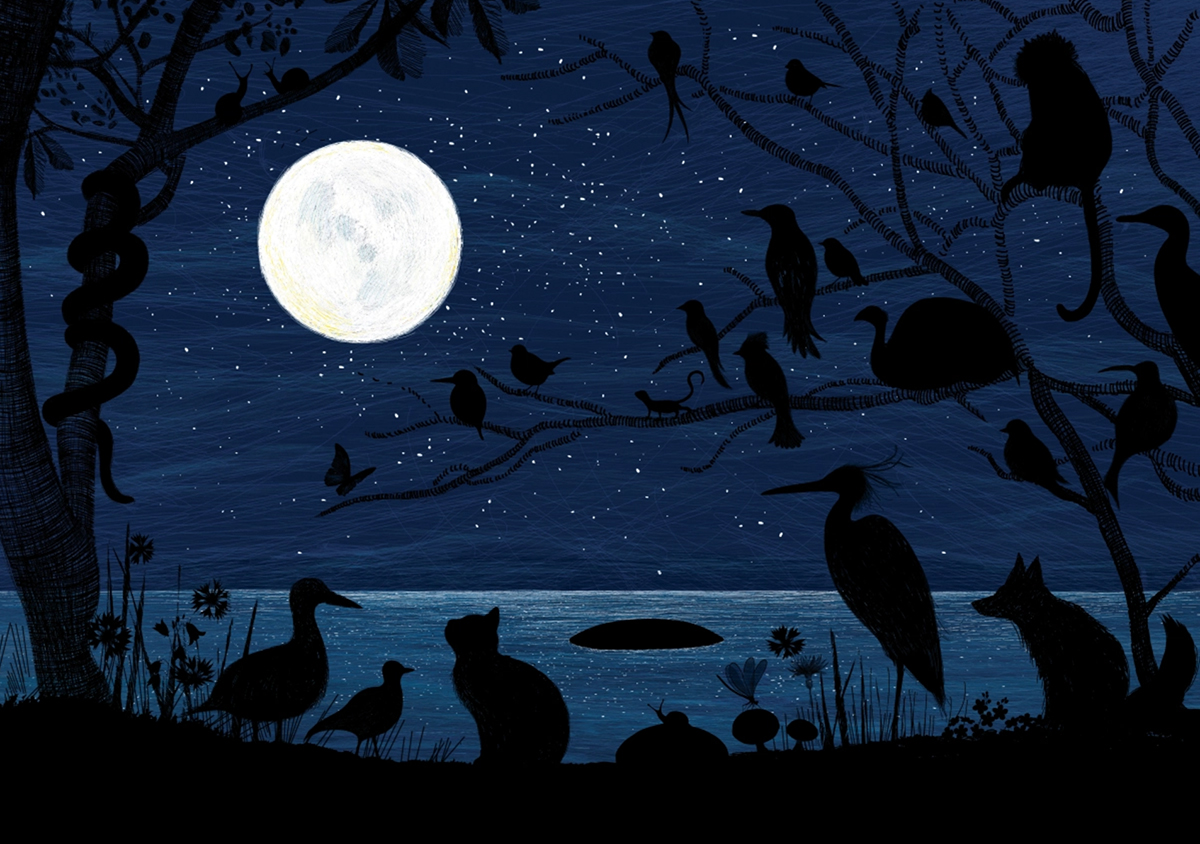
Art from The Blue Hour by Isabelle Simler
One of the wonders of being human is that as much as we may be creatures among creatures, never alone in the web of life, there lives within each of us a parallel wilderness of presences and possible identities comprising the ecology of being we call personhood. Walt Whitman — a poet with a scientist’s soul — knew this when he described himself as a “kosmos” containing a multitude of identities and inheritances, creaturely, cosmic, and cultural. Lanham knows this in taxonomizing the Linnaean poetics of his own personhood:
I’m a man of color — African American by politically correct convention — mostly black by virtue of ancestors who trod ground in central and west Africa before being brought to foreign shores. In me there’s additionally an inkling of Irish, a bit of Brit, a smidgen of Scandinavian, and some American Indian, Asian, and Neanderthal tossed in, too. But that’s only a part of the whole: There is also the red of miry clay, plowed up and planted to pass a legacy forward. There is the brown of spring floods rushing over a Savannah River shoal. There is the gold of ripening tobacco drying in the heat of summer’s last breath. There are endless rows of cotton’s cloudy white. My plumage is a kaleidoscopic rainbow of an eternal hope and the deepest blue of despair and darkness. All of these hues are me; I am, in the deepest sense, colored.
I am as much a scientist as I am a black man; my skin defines me no more than my heart does.
This integrated view of his interior ecology informs his integrated view of human society and our relationship with nature:
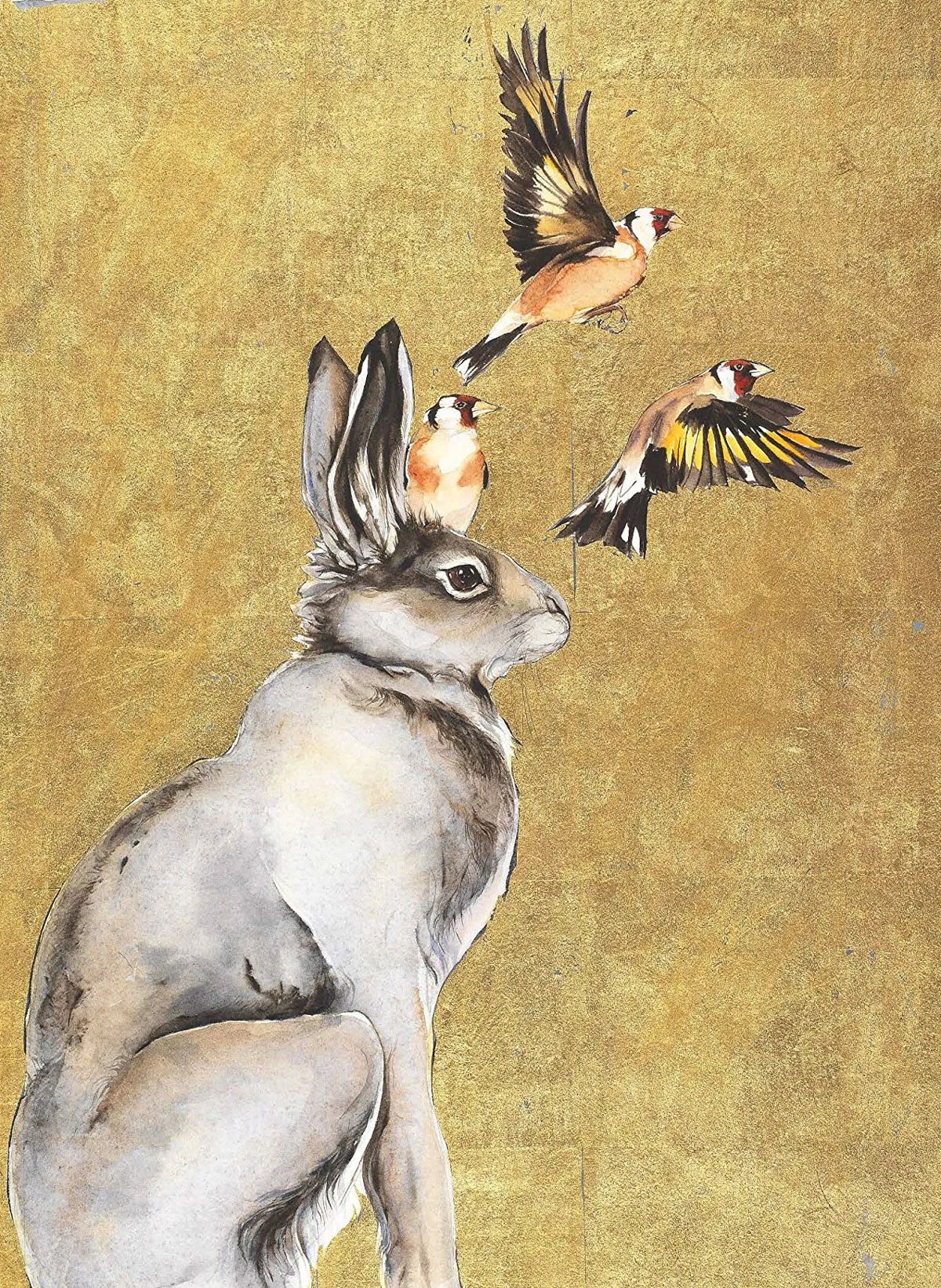
Art by Jackie Morris from The Lost Words by Robert MacFarlane — a visual dictionary of poetic spells resisting the erasure of nature’s language from our cultural lexicon.
Complement with Thoreau on nature as prayer, his modern-day counterpart Sy Montgomery on what a lifetime of working with nonhuman animals taught her about the living holiness of nature, and astrophysicist Marcelo Gleiser on how to live with mystery in the age of knowledge, then savor this marvelous illustrating rewilding of the human spirit.
David V Johnson is deputy editor at Stanford Social Innovation Review. Previously, he was senior opinion editor at Al Jazeera America, and he has also written for The New York Times and USA Today, among many publications. He lives in Berkeley, California.
23 August 2019 (aeon.co)
Edited by Sam Haselby

François-Henri Pinault and Salma Hayek attend the 2019 Met Gala. Photo by Dimitrios Kambouris/Getty Images
After the Notre-Dame Cathedral in Paris nearly burned down in April, the French luxury-goods magnate François-Henri Pinault was celebrated for committing €100 million to reconstruct what he called ‘this jewel of our heritage’ and ushering in a flood of donations from other benefactors and companies. Though an impressive figure in the abstract, Pinault’s commitment reflected only 0.3 per cent of his family fortune. If he instead had the average net wealth for a French household and donated 0.3 per cent of his fortune, his commitment would total about €840. Not an insignificant sum for an average Frenchman, but who would refuse to give that sum if it garnered the praise and notoriety that followed Pinault’s donation?
We live in an age of excessive praise for the wealthy and powerful. The upper echelons of society bathe in a sea of honours, awards and celebrity. We see it in the glossy magazines and at the so-called ideas festivals, where billionaires are fawned over for their bons mots. We applaud philanthropists for their largesse, even if their charity will do little ultimate good for society, and even if their conduct in acquiring their fortune was reprehensible. We commend them for dabbling in politics or pushing school reform, before we see any results, and even if we have reason to doubt the good that they will do.
To criticise our praise for the wealthy and powerful as excessive inevitably raises the question of meritocracy. To what extent do we live in a meritocracy, and is that a good or a bad thing? Meritocracy is a form of social organisation that is founded on praise and blame. People signal who deserves power and status by praising them for their character, their talent, their productivity and their actions, and who merits demotion in status and power by blaming them for their vices, their ineptitude and their failings. Insofar as people’s assessments of praise and blame are accurate, they will promote those deemed better up in the hierarchy of power and status, and demote those deemed worse down. Better people will do better things with their superior power and status. When the system works, we have an aristocracy – rule by the finest people. Or so thinkers from Aristotle onward have thought.
This system doesn’t work and can’t work on its own terms. Assessments of praise and blame tend to reflect existing hierarchies of power and status, thereby reifying them. This is because praise and blame have as much to do with the person judging as the person being judged. If everyone in a meritocracy wants to get ahead, assessments of praise and blame will be influenced by whatever helps people to get ahead – namely heaping praise on the powerful and respected, and castigating those without power and status. This is obviously true with meritocracies that most people explicitly reject, such as white supremacy and patriarchy – hierarchies drawn along racial and gender lines. These systems have persisted despite the baseless moral judgments on which they are grounded, because those living within the system are incentivised to see such judgments as legitimate. Meritocracies in general convince those within the system to echo the moral assessments on which they are based as objective and justified, when in fact they are shaped not by objective criteria but by the qualities of the powerful. Praise and blame are ideological blinders that uphold the legitimacy of the meritocratic hierarchy. If we take a more critical look at ourselves and our moral assessments, we will be better able to remove those blinders.
The smog of praise that permeates the upper echelons of society is a product of perverse incentives. As individuals, we tend to praise others and to court praise, because we want to win good will from others and receive confirmation of others’ good will. What’s more, we have an even stronger incentive to praise people who are wealthy and powerful, because winning their goodwill secures their premium support, and the wealthy and powerful are, in turn, more readily able to court praise from others. The more elite someone is, the more likely he is to crowd-surf on the praise of the many lesser folks seeking his favour. And insofar as our age of massive inequality creates people who are wealthier and more powerful, to that extent will the wave of excessive praise swell. We can even anticipate this tendency generating a negative feedback loop: praise of the wealthy and powerful affirms that they are good people deserving their fortune, which can, in turn, augment their wealth and influence, which thereby attracts even more praise.
The effects of excessive praise on conduct are also worth concern. Praising people, even those who deserve praise, can actually have a negative effect on their behaviour. There are many psychological studies demonstrating that people are susceptible to moral compensation. That is, when people feel that they have engaged in good behaviour, they also feel that it gives them licence to act badly in the future. The converse also holds: when people feel that they have engaged in bad behaviour, they also feel that they should make up for it by acting better in the future. If these studies hold up, they appear to upend the social consequences of praise and blame: praising people excessively can lead them to act badly, while blame puts them on notice and reinforces good behaviour. And insofar as this effect is more likely to influence wealthy and powerful people – those who can, thanks to their resources and influence, do more – it magnifies the harm of their bad conduct.
Meritocracies try to establish objective criteria to justify social hierarchies. Nowadays, entry into the elite often has to do with having the right résumé: Oxbridge or Ivy League degrees, a stint at the best consulting firm or investment bank, service in politics or government, writing a book or giving a TED talk about your work. These résumé items are supposed to establish the talent, judgment and character of the people in question. People with such résumés receive respect and esteem – even though their accomplishments are the predictable consequences of being born into the right family, knowing the right people, and swimming with the current. For the ambitious – and meritocracies feed ambition – these résumé items are primarily credentials for acquiring greater power and status. There is no reason for the public to accept such credentials as being an objectively valid base for praise.
If we want to foster a truly democratic society – a society in which we treat each other as equals – we must rein in such excessive praise and the perverse incentives that encourage it. We should aim for the opposite extreme, toward withholding praise and being more circumspect about the wealthy and powerful, to restore balance. As Justice Louis Brandeis, who witnessed our previous Gilded Age, might have said: ‘We may have democracy, or we may have praise showered on the heads of a few, but we can’t have both.’
Sean Kim With everything that has happened in 2020, the question of whether we live in a simulation has come up once or twice. Our guest today, Donald Hoffman, goes a step further, proving that the reality we see is false. Donald Hoffman is a cognitive psychologist, author of The Case Against Reality, TED speaker, and professor at the University of California Irvine. Subscribe to the podcast: https://buff.ly/2PycRL1
We were not programmed to know the entire truth.
–Donald Hoffman
Read a Book a Week – it’s free: https://pulsing.com Sponsor the podcast: http://bit.ly/growthsponsor #donaldhoffman #lexfridman #impacttheory ✔ Subscribe on YouTube: http://bit.ly/38bZNAY ✔ Subscribe on Apple Podcast: https://buff.ly/2PycRL1 ✔ Subscribe on Spotify: https://bit.ly/growth-minds ✔ Subscribe on Google Podcast: https://buff.ly/2tua5hb Connect with Sean ► Follow on Instagram: http://www.instagram.com/heyseankim ► Follow on Twitter: http://www.twitter.com/heyseankim ► Like on Facebook: http://www.facebook.com/seankim
Space-time is doomed.
–Donald Hoffman
Sean is an entrepreneur, investor, and host of Growth Minds. He is currently the CEO of Rype, the world’s leading platform to learn languages online, a Columnist at Inc. Magazine, and contributor for The Huffington Post, Fast Company, Entrepreneur Magazine, TIME Magazine, The Next Web, and more.
“MIami and New Orleans are gone.”
–Brad Johnson
Katie Halper Brad Johnson (@climatebrad) discusses climate (from minute 46:00 to minute 126:00). Also, writer, Bad Faith podcast co-host and former Bernie Sanders Press Secretary Briahna Joy Gray Briahna Joy Gray joins Katie and Leslie Lee to talk about the news of the week. ***Please support The Katie Halper Show *** On Patreon https://www.patreon.com/thekatiehalpe… Follow Katie on Twitter: https://twitter.com/kthalps
BuddhaAtTheGasPump If you would like to ask a question during the interview, please use the form at the bottom of http://batgap.com/future-interviews/u…. The live-streamed version will be taken down at the end of the interview, and the permanent version will be posted about a week later. Richard Tarnas is a professor of psychology and cultural history at the California Institute of Integral Studies in San Francisco, where he founded the graduate program in Philosophy, Cosmology, and Consciousness. He teaches courses in the history of ideas, archetypal studies, depth psychology, and religious evolution. He frequently lectures on archetypal studies and depth psychology at Pacifica Graduate Institute in Santa Barbara and was formerly the director of programs and education at Esalen Institute in Big Sur, California. He is the author of The Passion of the Western Mind, a history of the Western world view from the ancient Greek to the postmodern widely used in universities. His second book, Cosmos and Psyche: Intimations of a New World View, received the Book of the Year Prize from the Scientific and Medical Network and is the basis for the upcoming documentary series The Changing of the Gods. He is a past president of the International Transpersonal Association and served on the Board of Governors for the C. G. Jung Institute of San Francisco.
Epistemology, Socrates (reasonandmeaning.com)

The Delphic Tholos
I know that I know nothing – 5 interpretations
© Paul Bonea (Reprinted with Permission)
A good friend of Socrates, once asked the Oracle at Delphi “is anyone wiser than Socrates?”
The Oracle answered “No one.”
This greatly puzzled Socrates, since he claimed to possess no secret information or wise insight. As far as Socrates was concerned, he was the most ignorant man in the land.
Socrates was determined to prove the Oracle wrong. He toured Athens up and down, talking to its wisest and most capable people, trying to find someone wiser than he was.

What he found was that poets didn’t know why their words moved people, craftsmen only knew how to master their trade and not much else, and politicians thought they were wise but didn’t have the knowledge to back it up.
What Socrates discovered was that none of these people knew anything, but they all thought they did. Socrates concluded he was wiser than them, because he at least knew that he knew nothing.
This at least is the story of the phrase. It’s been almost 2500 years since its longer form was initially written. In that time, it has caught a life of its own and now has many different interpretations. [Here are five of them.]
One interpretations of the phrase asks if you can be 100% certain if a piece of information is true.
Imagine this question: “Is the Sun real?”
If it’s day time, the answer is immediately obvious because you can simply point your hand at the Sun and say: “Yes, of course the Sun is real. There it is.”

But then, you will fall into something called the infinite regress problem. This means every proof you have, must be backed up by another proof, and that proof too must be backed up by another one.As you go down the infinite regress, you will reach a point where you have no proof to back up a statement. Because that one argument can’t be proven, it then crashes all of the other statements made up to it.

French philosopher Rene Descartes went so far with the infinite regression, that he imagined the whole world was just an elaborate illusion created by an Evil Demon that wanted to trick him.
As the Evil Demon scenario shows, the infinite regression will often go so far down it will challenge whether any of the information entering your brain is real or not.
Thus, if all the information you’re receiving through the senses is an illusion, then by extension you know nothing.
Counterarguments: Descartes came up with the phrase “I think, therefore I am”. This puts a stop to the infinite regress since it’s impossible to doubt your own existence because simply by thinking, you prove that your consciousness exists.
Another philosophical counter argument is that some statements do not require proof in order to be called true. These are called self-evident truths, and include statements such as:
These self-evident truths act as foundations stones that allow knowledge to be built upon.
Socrates never left behind any written texts (mostly because he hated writing, saying it would damage our memory). All of the things we know about Socrates comes mostly from Plato, and to a lesser extent, Xenophon.
However, Plato wrote his philosophy in dialogue form and always used Socrates as the voice for his own ideas. Because of this, it’s almost impossible to separate the true Socrates from Plato.
One interesting interpretation of “I know that I know nothing”, is that the phrase could actually belong to Plato, alluding to one of his ideas: the theory of forms.
According to theory of forms, the physical world we live in, the one where you can read this article on a monitor or hold a glass of water, is actually just a shadow.
The real world is that of “ideas” or “forms”. These are non-physical essences that exist outside of our physical world. Everything in our dimension is just an imitation, or projection of these forms and ideas.

Another way to think about the forms, is to compare something that exists in the real world vs. its ideal version. For instance, imagine the perfect apple, and then compare it to real world apples you’ve seen or eaten.

The perfect apple (in terms of weight, crunchiness, taste, color, texture, smell etc.) only exists in the realm of forms, and every apple you’ve seen in real life is just a shadow, an imitation of the perfect one.
That being said, the theory of forms does have some major limitations. One of them is that a human living in the physical / shadow realm, you can never know how an ideal form looks like. The best you can do is to just think what a perfect apple, human, character, marriage etc. look like, and try to stick to that ideal as much as possible.
You’ll never know for sure what the ideal looks like. In this sense, “I know I know nothing” can mean “I only know the physical realm, but I know nothing about the real of forms”.
A more straightforward interpretation is that you can never be sure if a piece of information is correct. Viewed from this perspective, “I know that I know nothing” becomes a motto that stops you from making hasty judgement based on incomplete or potentially false information.
This interpretation is also connected with the historical context in which Socrates (or Plato) uttered the phrase. At the time, Pyrrhonism was a philosophical school that claimed you cannot discover the truth for anything (except the self-evident such as 2+2=4).
From the Pyrrhonist point of view, you cannot say for sure if a statement is correct or false because there will always be arguments for and against that will cancel each other out.

For instance, imagine the color green.
A Pyrrhonist would argue that you cannot be sure this is the color green because:
A non-philosopher would just say “it’s green dammit, what more do you need?” and close the problem.
What makes Pyrrhonists different is that instead of saying “yes this is a color, and that color is green”, they will simply say “yes, this is a color, but I’m not sure which so I’d rather not say.”

For Pyrrhonists however, such a position was not just a philosophical exercise. They extended this way of thinking to their entire lives so it became a mindset called epoché, translated as suspension of judgement. This suspension of judgement then led to the mental state of ataraxia, often translated as tranquility.
From the Pyrrhonist point of view, people cannot achieve happiness because their minds are in a state of conflict by having to come to conclusions in the face of contradictory arguments.
As a result, Pyrrhonists chose to suspend their judgement on all problems that were not self-evident, hoping that thus they will achieve true happiness.
Ultimately, from the Pyrrhonist perspective, “I know that I know nothing” can mean “truth cannot be discovered”.
A more conventional approach to the phrase is to simply view it as a self-referential paradox. The most well-known self-referential paradox is the phrase “this sentence is a lie”.

Pair of drawing hands by M.C. Escher
When it comes to science and knowledge, paradoxes function as indications that a logical argument is flawed, or that our way of thinking will produce bad results.
A more interesting overview of self-referencing paradoxes is the book Gödel, Escher, Bach: An Eternal Golden Braid by Douglas Hofstader. This book explores how meaningless elements, (such as carbon, hydrogen etc.) form systems, and how these systems can then become self-aware through a process of self-reference.
Socrates lived in a world that had accumulated very little knowledge.
As a fun fact, Aristotle (who was born some 15 years after Socrates died), was said to be the last man on Earth to have known every ounce of knowledge available at the time.
From the perspective of Socrates, any knowledge or information he did have was likely to be insignificant (or even completely false) compared to how much was left to be discovered.

From such a position, it’s easier to say “I know that I know nothing” rather than the more technical truth: “I only know the tiniest bit of knowledge, and even that is probably incorrect”.
The same principle still applies to us, if we compare ourselves to humans living 200-300 years in the future. And unlike Socrates, we have a giant wealth of information to dive in whenever we want.
_______________________________________________________________________
My brief reflections – I have always interpreted the Socratic limitation on knowledge as Socrates’ recognition that there was so much he didn’t know. And he was wiser than others in precisely this way—he was aware of his own ignorance. That’s how, correctly or not, I taught the issue to generations of students.
[For more see below from Wikipedia
https://en.wikipedia.org/wiki/I know_that_I_know_nothing ]
The phrase, originally from Latin (“ipse se nihil scire id unum sciat“[2]), is a possible paraphrase from a Greek text (see below). It is also quoted as “scio me nihil scire” or “scio me nescire“.[3] It was later back-translated to Katharevousa Greek as “[ἓν οἶδα ὅτι] οὐδὲν οἶδα“, [èn oîda óti] oudèn oîda).[4]
This is technically a shorter paraphrasing of Socrates’ statement, “I neither know nor think that I know” (in Plato, Apology 21d). The paraphrased saying, though widely attributed to Plato’s Socrates in both ancient and modern times, actually occurs nowhere in Plato’s works in precisely the form “I know that I know nothing.”[5] Two prominent Plato scholars have recently argued that the claim should not be attributed to Plato’s Socrates.[6]
Evidence that Socrates does not actually claim to know nothing can be found at Apology 29b-c, where he claims twice to know something. See also Apology 29d, where Socrates indicates that he is so confident in his claim to knowledge at 29b-c that he is willing to die for it.
That said, in the Apology, Plato relates that Socrates accounts for his seeming wiser than any other person because he does not imagine that he knows what he does not know.[7]
… ἔοικα γοῦν τούτου γε σμικρῷ τινι αὐτῷ τούτῳ σοφώτερος εἶναι, ὅτι ἃ μὴ οἶδα οὐδὲ οἴομαι εἰδέναι.
… I seem, then, in just this little thing to be wiser than this man at any rate, that what I do not know I do not think I know either. [from the Henry Cary literal translation of 1897]
A more commonly used translation puts it, “although I do not suppose that either of us knows anything really beautiful and good, I am better off than he is – for he knows nothing, and thinks that he knows. I neither know nor think that I know” [from the Benjamin Jowett translation].
Whichever translation we use, the context in which this passage occurs should be considered; Socrates having gone to a “wise” man, and having discussed with him, withdraws and thinks the above to himself. Socrates, since he denied any kind of knowledge, then tried to find someone wiser than himself among politicians, poets, and craftsmen. It appeared that politicians claimed wisdom without knowledge; poets could touch people with their words, but did not know their meaning; and craftsmen could claim knowledge only in specific and narrow fields. The interpretation of the Oracle’s answer might be Socrates’ awareness of his own ignorance.[8]
Socrates also deals with this phrase in Plato’s dialogue Meno when he says:[9]
καὶ νῦν περὶ ἀρετῆς ὃ ἔστιν ἐγὼ μὲν οὐκ οἶδα, σὺ μέντοι ἴσως πρότερον μὲν ᾔδησθα πρὶν ἐμοῦ ἅψασθαι, νῦν μέντοι ὅμοιος εἶ οὐκ εἰδότι.
[So now I do not know what virtue is; perhaps you knew before you contacted me, but now you are certainly like one who does not know.] (trans. G. M. A. Grube)
Here, Socrates aims at the change of Meno’s opinion, who was a firm believer in his own opinion and whose claim to knowledge Socrates had disproved.
It is essentially the question that begins “post-Socratic” Western philosophy. Socrates begins all wisdom with wondering, thus one must begin with admitting one’s ignorance. After all, Socrates’ dialectic method of teaching was based on that he as a teacher knew nothing, so he would derive knowledge from his students by dialogue.
There is also a passage by Diogenes Laërtius in his work Lives and Opinions of Eminent Philosophers where he lists, among the things that Socrates used to say:[10] “εἰδέναι μὲν μηδὲν πλὴν αὐτὸ τοῦτο εἰδέναι“, or “that he knew nothing except that he knew that very fact (i.e. that he knew nothing)”.
Again, closer to the quote, there is a passage in Plato’s Apology, where Socrates says that after discussing with someone he started thinking that:[7]
τούτου μὲν τοῦ ἀνθρώπου ἐγὼ σοφώτερός εἰμι· κινδυνεύει μὲν γὰρ ἡμῶν οὐδέτερος οὐδὲν καλὸν κἀγαθὸν εἰδέναι, ἀλλ᾽ οὗτος μὲν οἴεταί τι εἰδέναι οὐκ εἰδώς, ἐγὼ δέ, ὥσπερ οὖν οὐκ οἶδα, οὐδὲ οἴομαι· ἔοικα γοῦν τούτου γε σμικρῷ τινι αὐτῷ τούτῳ σοφώτερος εἶναι, ὅτι ἃ μὴ οἶδα οὐδὲ οἴομαι εἰδέναι.
I am wiser than this man, for neither of us appears to know anything great and good; but he fancies he knows something, although he knows nothing; whereas I, as I do not know anything, so I do not fancy I do. In this trifling particular, then, I appear to be wiser than he, because I do not fancy I know what I do not know.
It is also a curiosity that there is more than one passage in the narratives in which Socrates claims to have knowledge on some topic, for instance on love:[11]
How could I vote ‘No,’ when the only thing I say I understand is the art of love (τὰ ἐρωτικά)[12]
I know virtually nothing, except a certain small subject – love (τῶν ἐρωτικῶν), although on this subject, I’m thought to be amazing (δεινός), better than anyone else, past or present[13]

Jakub Ferencik · 4 days ago · (Medium.com)
Locke was an important British philosopher of the 17th century. He contributed to
His influence is hard to underplay. In this blog post I will cover one of his key arguments for Life, Liberty, and Property.

Before I get into that … I will quickly do some housekeeping. I wanted to start a brief series about political philosophy covering key arguments of thinkers from John Locke, Jean-Jacques Rousseau, Immanuel Kant, and many more.
I realize that a lot of work has already been done on these thinkers but I thought that Medium might need a little bit of a boost of political philosophy, so why not?
This series will be very short, however, and will seek to cover each thinker within 500 words. Let me know in the comments whether you find these beneficial!
So, let’s get into one of Locke’s most famous works, his Second Treatise of Government.
Inorder for Locke’s argument for life, liberty, and property in his Second Treatise of Government to be valid, he must first establish a number of premises.
Most importantly, he must validate that citizens naturally deserve the rights of life, liberty, and property, which is by no means a self-evident point as his writing suggests. If these rights are not self-evident and primarily upheld by states, as Hannah Arendt later argued, then his argument for life, liberty, and property falls apart.
Not only does Locke need to assume that these rights are natural and self-evident, but he must also defend our ability to reason about these rights. If reason is flawed, as it was deemed in Europe throughout most of Christendom ‒ from the writing of Augustine of Hippo until the writings of Thomas Aquinas, but even during the Protestant Reformation ‒ then Locke would not be able to validate his argument. Indeed, the inherent ability to reason is central to justifying the inherent goodness of the binding laws of the state of nature.
Therefore, the primary obligation citizens have to uphold in the state of nature is due to their ability to reason; in the words of Locke, the law “teaches anyone who takes the trouble to consult it.”
That is not to say that Locke believes that humankind is without faults. Instead, because of the “poor shape” humankind is in, it must sacrifice whatever “privileges” it found in the state of nature for what it can gain in society. Therefore, in any given polity, Locke assumes that this contract between the government and the people guarantees life, liberty, and property. This is how in a state of nature, legitimate power comes into force, according to Locke.
The obvious and necessary question, then, is why citizens would give up their freedom in the state of nature for the utilitarian subjugation they acquire in society? For Locke, the answer is “obvious.” In his words, yes, the state of nature can provide an “unrestricted right” to property or “possessions,” however, citizens are not “assured” that they will be able to keep them because of the possibility of “invasion by others.” Therefore, citizens have no other choice but to join society.
Tosummarize, in order for Locke’s argument for life, liberty, and property to be valid, he must justify our self-evident claim to these rights. Furthermore, if reasoning is inherently flawed, then there is no purpose in discussing justifications for life, liberty, and property.
Therefore, Locke also assumes our natural ability to reason in order to defend the crux of his argument that defines classical liberalism.
? I love connecting with fellow thinkers. Find me on Twitter, Facebook, Goodreads, or Instagram.
ALSO, here’s a link to MY BOOK if you wish to purchase it! I appreciate the support.
I’d love it if you’d share the article on Facebook/TWITTER if you want your friends to benefit from it in some way at all.
Until next time, keep reflecting!
Author of “Up in the Air: Christianity, Atheism & the Global Problems of the 21st Century” on AMAZON | Exploring Ethical Living | IG: jakub.ferencik.official
Jason Ward · Jan 3 · (Medium.com)
The true story of a group of teens who were stranded on a remote island for over a year
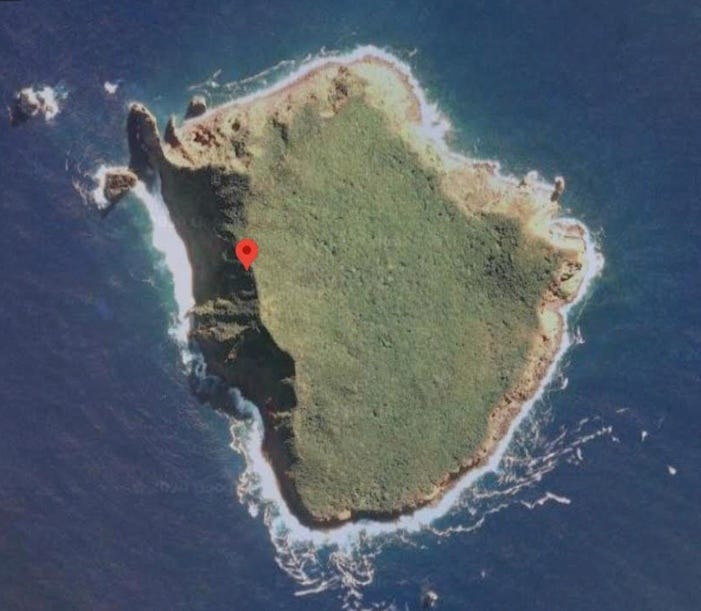
Ten years after William Golding released Lord of the Flies, six teenage boys found themselves stranded on a real desert island. Like in the book, there were no adults and it was up to them to survive.
In the novel, things famously went badly with the boys reverting to savagery and even murder. Golding was trying to make a point that humans, stripped of civilization, were still beasts at heart and would regress to a more primitive state.
So what happened when the scenario occurred in real life? Reassuringly for humanity, things turned out very differently.
On the 18th June 1965, six Tongan boys between the ages of 15 and 18 decided to have an adventure. They wanted to escape their strict Catholic school boarding school, St Andrew’s College, located in the Tongan capital of Nuku’alofa and sail off in search of a better life.
The friends were: Sione, Kolo, David, Stephen, Luke and Mano. In an interview years later Mano explained that the group was “bored” and thought they might sail to New Zealand. Things went wrong pretty quickly.
The boys had barely prepared for the trip. They didn’t even have a boat, so they “borrowed” one from a local fisherman they disliked. Their provisions were a few coconuts, two sacks of bananas, and a small gas burner. Unfortunately, they neglected to include things like a compass or a map.
In the early evening, the boys slipped out of the harbor. They sailed five miles north of the island, did some fishing, and then fell asleep. It had been calm and peaceful when they had dozed off but during the night a storm hit. The storm broke the anchor rope, as well as destroying the sail and rudder.
They were now adrift in a vast ocean with no food or water. For the next eight days, the vessel drifted. They tried to fish but without success. Using the hollowed-out coconuts, they managed to catch some rainwater, which was shared equally in the mornings and evenings.
As the boat drifted in a south-westerly direction, it started to disintegrate and the boys were forced to bail water. On the eighth day, after drifting for roughly 200 miles, they spotted ‘Ata island.
Forced to abandon ship, the six young men spent the next 36 hours swimming to the island, using planks salvaged from their disintegrating boat.
Mano swam ashore first but was too weak from lack of food or water to stand. He called to the others and they all managed to make it ashore. For the first three months, they lived in a cave that they’d hollowed out of a cliff-face. They caught sea birds for meat and also drank their blood and eggs.
Desperate for proper food and water, the boys started to explore the island. One day they came across the ruins of Kolomaile village in a volcanic crater. The village had been deserted for a century but the friends found feral chickens, wild taro and bananas. Rainwater was caught in hollowed-out tree trunks.
With their immediate survival taken care of, the boys set about making the place more homely. They split into teams of two and drew up a roster for gardening, kitchen and guard duty. Stephen built a fire that was maintained for the rest of their time on the island. Kolo managed to build a guitar out of coconuts, salvaged wood and wire.
Whenever there was a disagreement, unlike in the Lord of the Flies, the boys took a time out, staying separate for a few hours until calm.
Things were occasional mishaps, however. One day, Stephen fell off a cliff and broke his leg. His friends made the perilous descent and carried him back up. They managed to set and splint his leg and, being young, it healed quickly.
At one point they built a raft and tried to escape but it broke apart on the reef. This was actually a good thing, as the boys thought they were in Samoa and planned to sail south. Which would have taken them into the open ocean.
Whenever they saw a vessel they lit signal fires but four vessels sailed past without seeing them. On the 11th September, 15 months after they had become marooned, a new boat arrived.
Peter Warner was the son of one of the richest men in Australia. He was groomed to take over the family business but had other plans. When he was 17, he ran away to the sea in search of adventure. After five years of travelling the world, he finally returned home to an angry father and a job. Peter still kept a boat, however, and frequently took long trips.
It was on one such trip that brought him to ‘Ata island. Through his binoculars, he noticed strange burnt patches on the otherwise green cliffs. Spontaneous fires are rare in the tropics and he was intrigued.
It was then he saw a naked young man with hair down to his shoulders. More naked youths appeared and started yelling. The first one dived into the water and swam toward Warner’s boat.
Warner would later recount that when the boy made it to his vessel, he said, in perfect English, “My name is Stephen. There are six of us and we reckon we’ve been here 15 months.” The other five had soon swum over and clambered aboard.
Peter Warner found their story unlikely, so he called Nuku’alofa and relayed what Stephen had said. The radio operator soon replied: “You found them! These boys have been given up for dead. Funerals have been held. If it’s them, this is a miracle!”
By the time Captain Warner found the six teens, their camp was well established. They had food, fire, music, a small gym and even a badminton court. It was a far cry from the savagery predicted by William Golding.
Upon return to Nuku’alofa, they were examined by a local doctor, who was amazed at their overall health. He was also impressed by how well they had set Stephen’s now perfectly healed leg.
Then the police boarded Warner’s vessel and promptly arrested the six boys. The fisherman who owned the boat they had “borrowed” was still fuming over the theft and upon learning of their return had immediately pressed charges.
Again, it was Warner to the rescue. Knowing the boys’ ordeal was an interesting one, he sold the Australian rights to the story to a TV channel in Sydney. He kept the world rights. The channel paid him £150 which he used to pay the irate fisherman. Charges were dropped and the boys were free.
When Warner and the six young men returned to their home island of Haʻafeva, the entire population of 900 people turned out to welcome them back. Warner was declared a national hero.
King Taufa‘ahau Tupou IV invited the Australian for an audience. He thanked Warner for rescuing six of his subjects and granted him the right to trap lobster in his waters.
Warner returned to Sydney and quit his job. He had some money saved and so he bought a brand new fishing boat. Once again, the sea and a craving for adventure called to him. And he knew six young men who shared his outlook on life.

Warner contacted the six Tongans and offered them jobs as crew on his new boat. He promised them excitement and exploration on the high seas. This time with a compass and map.
They all accepted.
WRITTEN BY
Freelance Writer, Author. Lives in Asia. www.jasonwardwriter.com Or email: thewordofward@gmail.com Top writer in History and Culture.
Outstanding stories objectively and diligently selected by 40+ senior editors on ILLUMINATION