What Renaissance?

Humanism did not replace Scholasticism, nor is it clear that ideas like the Renaissance help us understand history at all

Detail from Lippo Memmi’s Triumph of St Thomas Aquinas (1323, full image below) shows Averroes (Ibn Rushd), whom medieval philosophers saw as the commentator on Aristotle and who remained central to many different areas of philosophy until the end of the 16th century. Fresco from the Santa Caterina d’Alessandria church in Pisa, Italy. Courtesy Wikipedia

Henrik Lagerlund is professor of the history of philosophy at Stockholm University and a member of the Rotman Institute of Philosophy in Canada. He is series editor of Studies in the History of Philosophy of Mind (2002-); editor-in-chief of the Encyclopedia of Medieval Philosophy (2010); and co-editor of Causal Powers in Science: Blending Historical and Conceptual Perspectives (2021). He is also the author of Skepticism in Philosophy: A Comprehensive, Historical Introduction (2020).

31 May 2021 (aeon.co)

Edited by Sam Dresser

Aeon for Friends

Find out more

Renaissance philosophy started in the mid-14th century and saw the flowering of humanism, the rejection of scholasticism and Aristotelianism, the renewal of interest in the ancients, and created the prerequisites for modern philosophy and science. At least, this is the conventional story. But, in fact, there was no Renaissance. It is an invention by historians, a fiction made in order to tell a story – a compelling story about the development of philosophy, but nevertheless a story. In fact, all periodisation is ‘mere’ interpretation. This view is called historiographical nihilism.

Historiography was for a long time simply the writing of histories. Sweden, for example, had a royal historiographer, which was a formal appointment at the Royal Court. For a period in the late 17th century, the position was held by the philosopher Samuel Pufendorf (1632-94). He wrote several books in Latin on the history of Gustav II Adolf’s war efforts in Europe during the Thirty Years’ War, as well as one about Queen Christina’s abdication. Recently, historiography has become more a study of how history is written. In the second sense, it is the works of the historians and their methods that are the object of study, and not history itself. A historiographer doesn’t write histories, but develops theories about how history is written.

Nihilism, of course, has been given many meanings and has been interpreted in many different ways by philosophers throughout history. In the context of historiography, it means the rejection of, or – in a slightly weaker form – the scepticism towards historiographical concepts such as periodisation, but also other concepts pertaining to the development of a ‘theory’ of history; consequently, it implies that there can’t be only one method of history but many.

Historiographical nihilism has nothing against using periodisation in history and philosophy as a heuristic tool or for pedagogic purposes, but it reminds us that, as such, they’re always false, and when we study the details of history, it will become obvious that such grand statements as the outline of a period such as the Renaissance are futile and empty. The arbitrariness of assigning the term ‘Renaissance philosophy’ to a period in time can be easily seen if we have a look at the historical development of the term itself.

Sign up to our newsletter

Updates on everything new at Aeon.

DailyWeekly

See our newsletter privacy policy here

Renaissance philosophy is often presented as a conflict between humanism and scholasticism, or sometimes it’s simply described as the philosophy of humanism. This is a deeply problematic characterisation, partly based on the assumption of a conflict between two philosophical traditions – a conflict that never actually existed, and was in fact constructed by the introduction of two highly controversial terms: ‘humanism’ and ‘scholasticism’. A telling example of how problematic these terms are as a characterisation of philosophy in the 16th century can be found in Michel de Montaigne (1533-92). He was critical of a lot of philosophy that came before him, but he didn’t contrast what he rejected with some kind of humanism, and his sceptical essay An Apology for Raymond Sebond (1580) wasn’t directed at scholastic philosophy. In fact, both these terms were invented much later as a means to write about or introduce Renaissance philosophy. Persisting with this simplistic dichotomy only perverts any attempt at writing the history of 14th- to 16th-century philosophy.

One of the first attempts at writing a history of philosophy in a modern way was Johann Jacob Brucker’s five-volume Historia critica philosophiae (1742-44) published in Leipzig. He didn’t use the terms ‘Renaissance’ or ‘humanism’, but the term ‘scholastic’ was important for him. The narrative we still live with in philosophy, for the most part, was already laid down by him. It’s the familiar narrative that emphasises the ancient beginning of philosophy, followed by a collapse in the Middle Ages, and an eventual recovery of ancient wisdom in what much later became called ‘Renaissance philosophy’.

The US philosopher Brian Copenhaver, one of the foremost scholars of our time, develops this idea in his contribution to The Routledge Companion to Sixteenth-Century Philosophy (2017). In ‘Philosophy as Descartes Found It: Humanists v Scholastics?’, he explains how Brucker’s ideal was developed from Cicero and called by him ‘humanitatis litterae’ or ‘humanitatis studia’. For Brucker, these terms signified the works of the classical authors and the study of them. The Latin he used for the teaching of the classical authors was ‘humanior disciplina’. Brucker sees himself as completing a project he claims was started by Petrarch in the mid-14th century: a cultural renewal that would save philosophy from the darkness of scholasticism.

As we’ve come to know more about the period referred to by Brucker as the Middle Age, it has become clear that it’s simply wrong to call it a decline. It is instead extraordinarily rich philosophically, and should be celebrated as hugely innovative. It’s by no means a ‘dark age’. Quite the contrary. So the view that emerges in Brucker stems from a lack of knowledge and understanding of the philosophy of that time.

If it’s a period, then there has to be a reason for why it’s a period. It has to be united by something

The use of the term ‘humanism’ to signify a coherent movement was first introduced in the 19th century, around the same time as the advent of the term ‘Renaissance’. Crucially, neither were initially used in connection with philosophy. Rather, they were used by art historians, especially prominent among them Jacob Burckhardt in his great work, Die Kultur der Renaissance in Italien (1860). Later, John Addington Symonds’s magnificent work in seven volumes, Renaissance in Italy (1875-86), also made use of ‘humanism’ and ‘Renaissance’ as a means to discuss a particular era in the history of art. Both terms were formed in the tradition of Brucker and were intended to capture something new – to make clear a clean break from the supposed darkness and ignorance of the Middle Ages. They were conceptions of certain perceived historical developments or movements in art, and not formed to fit philosophy. Indeed, they still don’t fit well.

One of the most prominent 20th-century scholars of Renaissance thought was the German American philosopher Paul Oskar Kristeller (1905-99). His writings make clear the difficulty of pinpointing what exactly the period of Renaissance philosophy is. In his book The Classics and Renaissance Thought (1955), he notes that Renaissance humanism is ‘a broad cultural and literary movement, which in its substance was not philosophical, but had important philosophical implications and consequences.’ He is also unable to find a philosophical core to this ‘movement’, but rather a shared belief in the value of humanity and humanistic learning, as well as the revival of ancient learning.

It’s questionable that there ever really was a ‘movement’ other than in the mind of 19th- and early 20th-century historians. After all, the shared beliefs that Kristeller identifies are not unique to ‘humanists’. Such beliefs were certainly prevalent during the 8th and 9th centuries when the English scholar Alcuin (c735-804) set about organising teaching in the empire of Charles the Great, as well as in the 12th century when Aristotle and Avicenna were being translated into Latin. The people of these times had an equal interest in reviving ancient learning. Similar beliefs were present. This way of thinking can also be found in the early Arabic philosophical tradition among the Syriac Christians who translated ancient philosophy into Arabic earlier in the history of philosophy.

Aware of the problem, Kristeller proposes in the same book that Renaissance philosophy is ‘that period of Western European history which extends approximately from 1300 to 1600, without any preconceptions as to the characteristics or merits of that period, or of those periods preceding and following it.’ It makes little sense, at least in my mind, to call this a period in the history of philosophy. If it’s a period, then there has to be a reason for why it’s a period. It has to be united by something – likely some core thought. But it is not. Hence Renaissance philosophy is only an arbitrary designation. It makes more sense to talk about ‘the long Middle Ages’, which began with the reintroduction of philosophy in the 8th century and continues into the Enlightenment. The French historian Jacques Le Goff suggested something similar in 1988, stretching the ‘Middle Ages’ even further, but it’s ultimately a recognition that periodisation itself is hopeless.

A more recent and also more nuanced view of what Renaissance philosophy might be is expressed by Copenhaver and Charles Schmitt in Renaissance Philosophy (1992). In their introduction, they write that:

The customary divide between the Middle Ages and the Renaissance is particularly artificial for intellectual history, including the history of those ideas and thinkers called ‘philosophy’ and ‘philosophers’. Much of the most admired, most discussed, and most characteristic philosophy of the Renaissance was indeed ‘medieval’ philosophy, which flourished in the 16th century … The works of Thomas Bradwardine and William of Heytesbury and the logical writings of Paul of Venice were all printed, read, and discussed well into the 16th century. On a broader front, the writings of Averroes (Ibn Rushd), whom medieval philosophers called the commentator on Aristotle, remained central to many different areas of philosophy until the end of the 16th century.

They have largely dropped the division between ‘humanists’ and ‘scholastics’, at least in theory, if not in the thinkers they choose to cover. It’s not quite admitting that there’s nothing that is ‘Renaissance philosophy’, but it certainly leans in that direction.

Triumph of St Thomas Aquinas (1323) by Lippo Memmi. Courtesy Wikipedia

To illustrate how precarious it can be to construct or, for that matter, to compare historical concepts across time developed in different contexts, it might be useful to ponder an example from ‘scholastic’ philosophy. Medieval, or ‘scholastic’, philosophy is often shown to have interest for contemporary philosophers by reference to the problem of universals. A prominent position in this debate is nominalism. It was called that already at the time, and defended in slightly different versions by such prominent philosophers as Peter Abelard (1079-1142) and William Ockham (c1285-1347). It’s often assumed that their views are, if not the same, then at least very similar to contemporary nominalism. As such, it’s a view that holds, primarily, that all that exists are individuals, and that there are no abstract entities or universals outside the mind. As it stands, however, this isn’t quite sufficient as a characterisation of medieval nominalism since, on such a definition, a thinker we wouldn’t normally think of as a nominalist would become a nominalist – namely Thomas Aquinas (1225-74), who also holds that everything that exists is individual, and that universals exist only in the mind.

To distinguish such different thinkers as Aquinas and Ockham from one another on this point, one has to become much more detailed and give a philosophically more sophisticated reading of their texts, which incorporates much more in the characterisation than the simple idea that nominalism means that only individuals exist. One has to specify what they mean by individuation, what cognition is and how it works, etc. It’s in the details of their respective philosophical views that one finds the difference between them, and only then can one see what it would mean to call Aquinas a realist and Ockham a medieval nominalist. The thought that one can simply compare concepts developed in different contexts and in different times leads to the wrong conclusion, and generates a false picture of these thinkers in which they suddenly look similar when, in fact, they’re not.

It seems also more valuable and interesting that there are differences between contemporary nominalism and medieval nominalism, rather than seeing them as exactly the same thing. The difference can teach us something about philosophy, while an identity cannot. We don’t need to remake the historically given philosophical position to make them relevant, since it’s exactly the difference, and our detailed understanding of the historical position, that makes them interesting philosophically.

Following up on this discussion of nominalism, a clearer statement about the metaphysics of history can further guide us towards a firmer understanding of historiographical nihilism. A similar metaphysics of the history of philosophy can be found in the Canadian philosopher Claude Panaccio’s book Récit et reconstruction: Les fondements de la méthode en histoire de la philosophie (2019), meaning ‘Story and Reconstruction: The Foundations of the Method in the History of Philosophy’. According to this metaphysics, concrete individuals such as Plato, Bertrand Russell, and the city of Stolkholm, and individual events, such as the death of René Descartes, are basic to the ontology. Meanwhile, philosophical views, doctrines, ideas and thoughts are not basic, and are instead construed as expressions of written or spoken utterances, which according to this metaphysics are events.

There are no meanings or universal concepts other than those formed by the historian

The basic elements of study for the historian are singular events of linguistic utterances. These come to the historian usually through manuscripts or books, which contain the expressions of ideas or thoughts of the individual philosophers. For the historian of philosophy, humans or places are referred to only in so far as they are connected to utterances. They can hence figure in explanations of these utterances.

On this view, then, history of philosophy becomes a domain of linguistic events given by space and time, and it’s in this way that it’s available to the historian of philosophy. It’s impossible, on such a view of history, to see a plausible singular development of history; instead, it contains breaks and discontinuities. Any order to this domain can be given to it only by the historian. In fact, I think one can say that it becomes the task of the historian to provide the domain of history of philosophy with an order and a structure: that is, a narrative or interpretation.

Obviously, the historical data, the concrete individual things and the individual events, mainly, the linguistic events, can’t be interpreted or understood any which way. The utterances are in a language, and as such they have meaning to the historian, a meaning that’s constructed from the language and the time and place of the utterance. There are, however, no meanings or universal concepts other than those formed by the historian, and each reader or historian will construct their own meaning from which he or she can build an interpretation.

In a certain sense, historiographical nihilism falls out of this metaphysics. Any narrative constructed by the historian will be just that, a construction. In the same way, any division of history into periods will be, to some extent, arbitrary and up to the historian, since there are no general concepts or universals in history that can be discovered by the historian; they are instead formed out of the singular events studied by him or her. The ‘Renaissance’ or ‘Renaissance philosophy’ is exactly such a formation.

Following this conception of the metaphysics of history, it seems plausible that history of philosophy can be done either from what might be called ‘the top down’ or ‘the bottom up’. A top-down approach gives us a powerful narrative and is quite common among historians, particularly in the history of ideas. It’s an approach that’s prone to divide history into periods. On such an approach, we assume and start off with general concepts that we fit together into a historical narrative, along with texts and historical events. An example of this approach can be found in the historian Arthur O Lovejoy’s book The Great Chain of Being (1936). The intellectual historian’s task, according to him, is to find so-called unit-ideas that explain the revolutions and the flow of intellectual history. The historian clears away the irrelevant circumstances, the idiosyncratic commitments and the beliefs of philosophers to properly identify the unit-idea.

In his book, Lovejoy exemplifies this with ‘the great chain of being’, which he identifies in Plato and traces into modern philosophy. It involves three principles, namely of plenitude, of continuity, and of linear gradation. The first principle says that the Universe is full, that is, that anything that’s really possible will at one point be actual. The second says that the Universe is a continuously connected series of events. The third says that it contains a hierarchy from the most basic existence all the way up to God.

Another take, which seems opposed, is the bottom-up approach to the history of philosophy. On such a view one has to look primarily at the historical data first, that is, the individual things, people or individual events (linguistic utterances) that make up history. This approach aims to build a narrative or a story from the ground up, based on these data, but it worries less about how to fit the data into a plausible narrative. It should, as much as possible, let the data suggest a narrative. The historian’s access to the data, however, comes to him or her through filters, which he or she will have to bracket or compensate for in various ways to be able to come as close to the data as possible. A filter can be a classical language or a text in manuscript or in several manuscripts where the actual text first has to be constructed, but a filter is also the historian’s own presuppositions, prejudices, education, etc, which he or she has to be aware of and which threaten to distort his or her interpretation of the data. Historiographical concepts and periodisation, which have become standard interpretations or tools of the trade, are other such filters. They’re part of a heritage that the historian needs to be sceptical towards. These filters will have an effect on the constructed interpretation of the linguistic utterances. The historian also needs imagination and experience to guide him or her in the construction of a plausible narrative.

Perhaps a bottom-up approach can be questioned, since we, and the historian too, take a lot of things for granted all the time. It’s impossible to do the history of philosophy without certain presuppositions, which simply can’t be bracketed, since we have to assume something. The idea isn’t to reject all that has been done by others, but to emphasise that it’s only from individual utterances, however these are available to the historian, that an interpretation can be plausibly built, and that any generalised characteristics about a period or age will have to be built from a detailed study of the text that makes these individual utterances available.

Historiographical nihilism urges us to reject or be extremely sceptical of historical generalisations and historiographical concepts. They can have their use in a pedagogic context or as heuristic tools, but they won’t help the scholar or historian him- or herself. The most obvious example of this is attempts at periodisation in the history of philosophy and any suggestion of a period called ‘Renaissance philosophy’. Obviously, a period can be arbitrarily designated ‘the 16th century’ or ‘these philosophers’ followed by an enumeration, but then one has emptied the word ‘Renaissance’ of its meaning, and this is exactly the point of historiographical nihilism.

History of ideasHistoryThinkers and theories

The fascinating science of pleasure goes way beyond dopamine

The fascinating science of pleasure goes way beyond dopamine | Psyche

Photo by Nyani Quarmyne/Panos Pictures

Dean Burnettis a neuroscientist and author. His books include The Idiot Brain (2016), The Happy Brain (2018) and Psycho-Logical: Why Mental Health Goes Wrong, and How to Make Sense of It (2021). He lives in Cardiff, Wales.

Edited by Christian Jarrett

May 31, 2021 (psyche.co)

If you’ve been a neuroscientist for two decades and counting, you take notice when your field begins popping up in the mainstream discourse. While this is usually a good thing (it’s mostly helpful when one’s field receives public attention), it can also go too far, introducing confusion and misunderstanding into an already complex matter.

Case in point: dopamine, one of the many, many chemicals (aka neurotransmitters) found in the human brain, where it has many functions. However, if you were to go solely by the context in which dopamine is mentioned in much of modern culture, you’d be forgiven for concluding that it has just one fundamental, very specific, function in the human brain – producing happiness and pleasure.

‘Here’s How To Boost Your Dopamine Levels’; ‘Simple Tips To Get Your Dopamine Flowing’; ‘The New Trend For Dopamine Fasting’; ‘This [Website/App/Device/Activity] Is Compelling Because It Manipulates Your Dopamine System’: these are just a few examples from online news stories and blogs, out of tens of thousands. The overall message from such articles is consistent and clear: the more dopamine there is in your brain, the more pleasure you experience, and the happier you will be.

To be fair, it’s by no means a bad thing if people are more aware of the biological workings of their brains, and dopamine is indeed an integral component in the neuroscience of how we experience happiness.

Our ability to experience pleasure, as in the fundamental sensation of something being enjoyable or ‘nice’, is a product of what’s known as the ‘reward pathway’, a small but crucial circuit found deep within the brain. As you might suspect, dopamine is the main neurotransmitter involved in the function of the reward pathway. Hence why it’s often called the dopamine reward pathway. So, if the activity of dopamine in the brain makes a vital contribution to the sensation of pleasure, and pleasure is a key aspect of happiness, then it stands to reason that boosting your dopamine levels will make you happier, right?

There’s a superficial logic to this way of looking at things. Unfortunately, the logic doesn’t hold given the daunting complexity and interconnectedness of our brains. There’s a wealth of evidence to demonstrate that simply ‘boosting your dopamine’ doesn’t automatically result in happiness. And it comes via research into Parkinson’s disease.

Parkinson’s disease is a neurodegenerative disorder that develops when the substantia nigra, a region of the midbrain involved in movement coordination (among other things), starts to die. Similar to the reward pathway, dopamine also plays a vital role in the function of the substantia nigra. The go-to therapy for Parkinson’s disease is the drug levodopa, which masks the symptoms of Parkinson’s by increasing the availability of dopamine in the brain, thus compensating for the loss of the substantia nigra.

Dopamine is to happiness what petrol is to a car: integral to making it work, but if you fill your car with petrol till it’s leaking out the windows, it wouldn’t help anyone

Basically, levodopa directly boosts dopamine levels. If increasing dopamine levels in the brain automatically led to pleasure and happiness, then levodopa should be one of the most popular recreational drugs in history. But that’s not the case at all. Taking levodopa is actually quite unpleasant, hence why you don’t see Parkinson’s patients in a constant state of euphoria.

Clearly, a blanket increase in dopamine doesn’t trigger a corresponding increase in happiness. It makes you feel worse, if anything. This isn’t to say that dopamine isn’t a key biological contributor to our ability to feel happy; it’s just that there’s so much more to it than that. You could say that dopamine is to happiness what petrol is to a car; it’s an integral part of making it work, but if you were to literally fill your car with petrol, to the point where it’s leaking out the windows, that wouldn’t help anyone.

The truth is that the action of the reward pathway, and therefore our experience of happiness and pleasure, is determined by so many more factors than just how much dopamine is sloshing around in our brains. Yes, dopamine is necessary for the reward pathway to function, but many other chemicals are involved in various ways.

Endorphins, the brain’s natural opiates, are an obvious example. The opiate class of drugs (heroin, morphine, etc) interact with the opioid receptors in the brain and nervous system that the endorphins lock on to. Both endorphins, and the associated drugs that mimic them, stimulate activity in the reward pathway, inducing a sense of euphoria. This is why drugs that mimic endorphins are such potent narcotics. Again, the story is complicated, though. Rather than inducing pleasure or ‘making us happy’, the primary biological role of endorphins (and opiate drugs) seems to be more to do with preventing or managing pain.

Oxytocin, a neuropeptide, is another brain chemical that’s often mentioned in the context of happiness. Regularly referred to as ‘the cuddle hormone’ or ‘the love hormone’, oxytocin receives attention for the potent roles it plays in interpersonal relationships and human bonding. It’s released in response to positive social experiences and acts directly on the reward pathway neurons, which contributes to us feeling good about interacting with others in beneficial ways. Oxytocin levels are especially high during sexual or reproductive activity, which helps to explain why our lovers and offspring can be such a potent source of happiness.

Saying that, oxytocin doesn’t just ramp up positive emotional encounters. It seems to amplify all emotional encounters, even the negative ones. So, once again nuance is required, and calling it a ‘happiness-producing chemical’ is clearly not the whole story.

Serotonin is yet another brain chemical involved in happiness. It’s the neurotransmitter that’s targeted by the most commonly prescribed modern-day antidepressants, so surely it has an important role in making us happier? Well, not quite. It’s more of a mood and emotion modulator. Its presence means the neurological systems that control mood are better able to do their job. It essentially makes it easier for our brains to experience happiness and pleasure. If achieving happiness was the goal of a video game, serotonin wouldn’t be the hero, it would be the wizened old man handing out healing potions and power-ups. Helpful, sure, but indirectly.

There are yet more brain chemicals, lesser-known in the mainstream (but technically more important in the brain), that also have important roles in our experience of happiness. For example, glutamate is seldom mentioned in the trendy articles about wellbeing, despite being the most abundant and major excitatory neurotransmitter in the mammalian brain. Maybe that’s why it doesn’t get much media attention – it does too much for any one particular function to be attributed to it. However, one of these functions is activating the reward pathway. Indeed, the drug ketamine stimulates parts of the glutamate system, which could explain why it’s so potent and yet another popular narcotic. Researchers are also investigating the potential of ketamine as an antidepressant, further pointing to the role of glutamate in happiness.

Reducing happiness to a matter of basic chemicals – especially just one – is inaccurate and overly reductionist

Last but not least, consider the important role in happiness of GABA (gamma-Aminobutyric acid), the most common and potent inhibitory neurotransmitter in the human brain. While the majority of other neurotransmitters are excitatory, meaning they cause more activity in the neurons they interact with, GABA does the opposite – it suppresses or shuts down the activity in the neurons that it comes into contact with. GABA is like a red traffic light. If anything, this makes it more important; imagine a city traffic system that had only green lights.

Thus far I’ve suggested that pleasure, via activation of the reward pathway, is a core part of happiness, so it might seem odd for GABA, an inhibitory chemical, to play a role. But bear in mind that happiness can be caused by the absence of stress, or other negative emotions, leaving us happier by default. Indeed, among many of the neural areas that GABA ‘shuts down’ are those involved in stress and negative emotions. Moreover, a loss of GABA activity from brain regions involved in emotion, such as the amygdala, is thought to contribute to a number of anxiety disorders. Benzodiazepines, such as diazepam (originally marketed as Valium), work primarily by inducing the activity of GABA. Same goes for their chemically very similar, but even more potent predecessors, barbiturates. The fact that both benzodiazepines and barbiturates cause us to experience pleasure and are highly addictive (especially the latter) strongly suggests that GABA, despite shutting things down, can readily turn up our happiness.

I’m not arguing that these various brain chemicals, particularly dopamine, don’t have important, even crucial, roles to play in our experience of happiness. They clearly do. And maybe it’s good that our cultural view of happiness and wellbeing is gradually becoming more scientific in nature, rather than spiritual or ideological or anything else less tangible, and thus far more open to interpretation (and beneficial manipulation).

But there’s also the old maxim of a little knowledge being a dangerous thing. What concerns me isn’t so much the number of people insisting that dopamine is an important factor in how happiness works in our brains. I’m more troubled by the frequent implication, with varying degrees of extremity, that it’s the only factor at work; that dopamine is to happiness what the flow of hot water is to a shower.

As I’ve hopefully illustrated, this just isn’t the case. Insisting otherwise, whether intentionally or not, is unhelpful. And the thing is, even all that I’ve said here, as complex and as confusing as it might have seemed at times, is only one facet of a much bigger picture. It’s more helpful to look at the whole system, no matter how much we might want to break it down into individual components.

What I’m getting at is that the experience of happiness is an integral part of our mental health and wellbeing, and reducing it to a matter of basic chemicals – especially just one – is inaccurate and overly reductionist. It also risks the same logic being applied to other aspects of the human psyche. When complex conditions are viewed purely in terms of basic chemical interactions, we risk ignoring the complex psychological and sociological factors that determine a person’s wellbeing.

A lot of time and effort has gone into moving away from such a reductionist approach to mental health. If we go back to it, nobody’s going to be happy. Regardless of how much dopamine there is in their brain.

You are that in which Pure Awareness is held and enabled

At the threshold between Pure Awareness and that Absolute Indescribable Formlessness, you begin to realize—against (or in addition to) what many of the enlightenment teachings state—that you are in fact not (just) Awareness, but rather that you HAVE Pure Awareness.

You are that in which Pure Awareness is held and enabled. You are the source of Pure Awareness. Pure Awareness is a power inside of you. Without you, no Awareness.

When I say “you” I mean Absolute Reality You. When I say that you are beyond Awareness, don’t assume I’m just talking of your everyday observer-sense consciousness… and that what I mean by The Absolute You must be what most call Awareness. No.

I’m saying that even that divine, non-dual, pure, Brahman/Awareness is not you; you are prior even to that.

Even Pure Awareness (the subtlest “I Am” at its purest level without location, individuation or attributes—like pure, awake and empty space) is still ‘witnessed’ by the only absolutely real “YOU” automatically due to its contrast or ‘difference’ with your Absolute Indescribable Formless Self/NoSelf/Reality.

You begin to realize that all that appears is unreal, and that that which can never appear (you) is the only thing that’s real, out of which all that appears is hallucinated to be. That which appears to be is actually not, and that which appears not, is.

~ Bentinho Massaro

May be an image of nature

Jews as the chosen people

From Wikipedia, the free encyclopedia

Maybe the Jews have been chosen for a very particular reason and for a very particular time. The reason: to end the centuries-old cycles of hatred and violence and fear and blame. The time: now.

–Mike Zonta, BB editor
Part of a series on
Jews and Judaism
EtymologyWho is a Jew?
hideReligionGod in Judaism (names)Principles of faithMitzvot (613)HalakhaShabbatHolidaysPrayerTzedakahLand of IsraelBritBar and Bat MitzvahMarriageBereavementPhilosophyEthicsKabbalahCustomsSynagogueRabbi
showTexts
showCommunities
showPopulation
showDenominations
showCulture
showLanguages
showHistory
showPolitics
CategoryPortal
vte
Part of a series on
Jewish philosophy
showHellenistic
showMedieval
showModern
hideTopicsAngerChosen peopleEschatologyEthicsFaithGodHappinessHolocaustMessiahMicrocosm-macrocosmRighteousness
vte

In Judaism, “chosenness” is the belief that the Jews, via descent from the ancient Israelites, are the chosen people, i.e. selected to be in a covenant with God. The idea of the Israelites being chosen by God is found most directly in the Book of Deuteronomy[1][2] as the verb baḥar (בָּחַ֣ר (Hebrew)), and is alluded to elsewhere in the Hebrew Bible using other terms such as “holy people”.[3] Much is written about these topics in rabbinic literature. The three largest Jewish denominations—Orthodox JudaismConservative Judaism and Reform Judaism—maintain the belief that the Jews have been chosen by God for a purpose. Sometimes this choice is seen as charging the Jewish people with a specific mission—to be a light unto the nations, and to exemplify the covenant with God as described in the Torah.

This view, however, does not always preclude a belief that God has a relationship with other peoples—rather, Judaism held that God had entered into a covenant with all humankind, and that Jews and non-Jews alike have a relationship with God. Biblical references as well as rabbinic literature support this view: Moses refers to the “God of the spirits of all flesh”,[4] and the Tanakh (Hebrew Bible) also identifies prophets outside the community of Israel. Based on these statements, some rabbis theorized that, in the words of Nethanel ibn Fayyumi, a Yemenite Jewish theologian of the 12th century, “God permitted to every people something he forbade to others…[and] God sends a prophet to every people according to their own language.”(Levine, 1907/1966) The Mishnah states that “Humanity was produced from one man, Adam, to show God’s greatness. When a man mints a coin in a press, each coin is identical. But when the King of Kings, the Holy One, blessed be He, creates people in the form of Adam not one is similar to any other.” (Mishnah Sanhedrin 4:5) The Mishnah continues, and states that anyone who kills or saves a single human, not Jewish, life, has done the same (save or kill) to an entire world. The Tosefta, an important supplement to the Mishnah,[5] also states: “Righteous people of all nations have a share in the world to come” (Sanhedrin 105a).

According to the Israel Democracy Institute, approximately two thirds of Israeli Jews believe that Jews are the “chosen people”.[6]

In the Bible

According to the Bible, Israel’s character as the chosen people is unconditional[7]“For you are a holy people to YHWH your God, and God has chosen you to be his treasured people from all the nations that are on the face of the earth.”Prophet Amos as depicted by Gustave Doré

The Torah also says,”Now therefore, if you will obey my voice indeed, and keep my covenant, then you shall be a peculiar treasure unto me from all the peoples, for all the earth is mine.”[8]

God promises that he will never exchange his people with any other:”And I will establish My covenant between Me and you and your descendants after you in their generations, for an everlasting covenant, to be God to you and your descendants after you.”[9]

Other Torah verses about chosenness,

  • “And you shall be unto me a kingdom of priests, and a holy nation”[10]
  • “The Lord did not set his love upon you, nor choose you, because you were more in number than any people; for you were the fewest of all people; but because the Lord loved you, and because he would keep the oath which he had sworn unto your ancestors.”[11]

The obligation imposed upon the Israelites was emphasized by the prophet Amos:[12]“You only have I singled out of all the families of the earth: therefore will I visit upon you all your iniquities.”

Rabbinic views

Sometimes this choice is seen as charging the Jewish people with a specific mission—to be a light unto the nations, and to exemplify the covenant with God as described in the Torah. This view, however, does not always preclude a belief that God has a relationship with other peoples—rather, Judaism held that God had entered into a covenant with all humankind, and that Jews and non-Jews alike have a relationship with God. Biblical references as well as rabbinic literature support this view: Moses refers to the “God of the spirits of all flesh”,[13] and the Tanakh[14] also identifies prophets outside the community of Israel. Based on these statements, some rabbis theorized that, in the words of Natan’el al-Fayyumi, a Yemenite Jewish theologian of the 12th century, “God permitted to every people something he forbade to others…[and] God sends a prophet to every people according to their own language.”[15] The Mishnah states that “Humanity was produced from one man, Adam, to show God’s greatness. When a man mints a coin in a press, each coin is identical. But when the King of Kings, the Holy One, blessed be He, creates people in the form of Adam not one is similar to any other.”[16] The Mishnah continues, and states that anyone who kills or saves a single human, not Jewish, life, has done the same (save or kill) to an entire world. The Tosefta, a collection of important post-Talmudic discourses, also states: “Righteous people of all nations have a share in the world to come.”[17]

Most Jewish texts do not state that “God chose the Jews” by itself. Rather, this is usually linked with a mission or purpose, such as proclaiming God’s message among all the nations, even though Jews cannot become “unchosen” if they shirk their mission. This implies a special duty, which evolves from the belief that Jews have been pledged by the covenant which God concluded with the biblical patriarch Abraham, their ancestor, and again with the entire Jewish nation at Mount Sinai.[18] In this view, Jews are charged with living a holy life as God’s priest-people.

In the Jewish prayerbook (the Siddur), chosenness is referred to in a number of ways. The blessing for reading the Torah reads, “Praised are You, Lord our God, King of the Universe, Who has chosen us out of all the nations and bestowed upon us His Torah.” In the “Kiddush“, a prayer of sanctification, in which the Sabbath is inaugurated over a cup of wine, the text reads, “For you have chosen us and sanctified us out of all the nations, and have given us the Sabbath as an inheritance in love and favour. Praised are you, Lord, who hallows the Sabbath.” In the “Kiddush” recited on festivals it reads, “Blessed are You … who have chosen us from among all nations, raised us above all tongues, and made us holy through His commandments.” The Aleinu prayer refers to the concept of Jews as a chosen people:

“It is our duty to praise the Master of all, to exalt the Creator of the Universe, who has not made us like the nations of the world and has not placed us like the families of the earth; who has not designed our destiny to be like theirs, nor our lot like that of all their multitude. We bend the knee and bow and acknowledge before the Supreme King of Kings, the Holy One, blessed be he, that it is he who stretched forth the heavens and founded the earth. His seat of glory is in the heavens above; his abode of majesty is in the lofty heights.[19]

Further interpretations

The following section contains information from the Jewish Encyclopedia, originally published between 1901–1906, which is in the public domain.

According to the Rabbis, “Israel is of all nations the most willful or headstrong one, and the Torah was to give it the right scope and power of resistance, or else the world could not have withstood its fierceness.”[20]

“The Lord offered the Law to all nations; but all refused to accept it except Israel.”[21]

How do we understand “A Gentile who consecrates his life to the study and observance of the Law ranks as high as the high priest”, says R. Meïr, by deduction from Lev. xviii. 5; II Sam. vii. 19; Isa. xxvi. 2; Ps. xxxiii. 1, cxviii. 20, cxxv. 4, where all stress is laid not on Israel, but on man or the righteous one.[22]Monument to Maimonides in Córdoba, Spain

Maimonides states: It is now abundantly clear that the pledges Hashem made to Avraham and his descendants would be fulfilled exclusively first in Yitzchak and then in Yaakov, Yitzchak son. This is confirmed by a passage that states, “He is ever mindful of His covenant … that He made with Avraham, swore to Yitzchak, and confirmed in a decree for Yaakov, for Yisrael, as an eternal covenant.”[23][24]

The Gemara states this regarding a non-Jew who studies Torah [his 7 mitzvot][clarification needed] and regarding this, see Shita Mekubetzes, Bava Kama 38a who says that this is an exaggeration.[clarification needed] In any case, this statement was not extolling the non-Jew. The Rishonim explain that it is extolling the Torah.

Tosfos explains that it uses the example of a kohen gadol (high priest), because this statement is based on the verse, “y’kara hi mipnimim” (it is more precious than pearls). This is explained elsewhere in the Gemara to mean that the Torah is more precious pnimim (translated here as “inside” instead of as “pearls”; thus that the Torah is introspectively absorbed into the person), which refers to lifnai v’lifnim (translated as “the most inner of places”), that is the Holy of Holies where the kahon gadol went.

In any case, in Midrash Rabba[25] this statement is made with an important addition: a non-Jew who converts and studies Torah etc.

The Nation of Israel is likened to the olive. Just as this fruit yields its precious oil only after being much pressed and squeezed, so Israel’s destiny is one of great oppression and hardship, in order that it may thereby give forth its illuminating wisdom.[26] Poverty is the quality most befitting Israel as the chosen people.[27] Only on account of its good works is Israel among the nations “as the lily among thorns”,[28] or “as wheat among the chaff.”[29][30]

Modern Orthodox views

Rabbi Lord Immanuel Jakobovits, former Chief Rabbi of the United Synagogue of Great Britain (Modern Orthodox Judaism), described chosenness in this way:

“Yes, I do believe that the chosen people concept as affirmed by Judaism in its holy writ, its prayers, and its millennial tradition. In fact, I believe that every people—and indeed, in a more limited way, every individual—is “chosen” or destined for some distinct purpose in advancing the designs of Providence. Only, some fulfill their mission and others do not. Maybe the Greeks were chosen for their unique contributions to art and philosophy, the Romans for their pioneering services in law and government, the British for bringing parliamentary rule into the world, and the Americans for piloting democracy in a pluralistic society. The Jews were chosen by God to be ‘peculiar unto Me’ as the pioneers of religion and morality; that was and is their national purpose.”[31]

Modern Orthodox theologian Michael Wyschogrod wrote:

“[T]he initial election of Abraham himself was not earned. … We are simply told that God commanded Abraham to leave his place of birth and go to a land that God would show him. He is also promised that his descendants will become a numerous people. But nowhere does the Bible tell us why Abraham rather than someone else was chosen. The implication is that God chooses whom He wishes and that He owes no accounting to anyone for His choices.”[32]

Rabbi Norman Lamm, a leader of Modern Orthodox Judaism wrote:

“The chosenness of Israel relates exclusively to its spiritual vocation embodied in the Torah; the doctrine, indeed, was announced at Sinai. Whenever it is mentioned in our liturgy—such as the blessing immediately preceding the Shema….it is always related to Torah or Mitzvot (commandments). This spiritual vocation consists of two complementary functions, described as “Goy Kadosh”, that of a holy nation, and “Mamlekhet Kohanim”, that of a kingdom of priests. The first term denotes the development of communal separateness or differences in order to achieve a collective self-transcendence […] The second term implies the obligation of this brotherhood of the spiritual elite toward the rest of mankind; priesthood is defined by the prophets as fundamentally a teaching vocation.”[33]

Conservative views

The Jewish Theological Seminary of America, the main rabbinical seminary of Conservative Judaism

Conservative Judaism, views the concept of chosenness in this way:

“Few beliefs have been subject to as much misunderstanding as the ‘Chosen People’ doctrine. The Torah and the Prophets clearly stated that this does not imply any innate Jewish superiority. In the words of Amos (3:2) ‘You alone have I singled out of all the families of the earth—that is why I will call you to account for your iniquities.’ The Torah tells us that we are to be “a kingdom of priests and a holy nation” with obligations and duties which flowed from our willingness to accept this status. Far from being a license for special privilege, it entailed additional responsibilities not only toward God but to our fellow human beings. As expressed in the blessing at the reading of the Torah, our people have always felt it to be a privilege to be selected for such a purpose. For the modern traditional Jew, the doctrine of the election and the covenant of Israel offers a purpose for Jewish existence which transcends its own self interests. It suggests that because of our special history and unique heritage we are in a position to demonstrate that a people that takes seriously the idea of being covenanted with God can not only thrive in the face of oppression, but can be a source of blessing to its children and its neighbors. It obligates us to build a just and compassionate society throughout the world and especially in the land of Israel where we may teach by example what it means to be a ‘covenant people, a light unto the nations.'”[34]

Rabbi Reuven Hammer comments on the excised sentence in the Aleinu prayer mentioned above:

“Originally the text read that God has not made us like the nations who “bow down to nothingness and vanity, and pray to an impotent god”, […] In the Middle Ages these words were censored, since the church believed they were an insult to Christianity. Omitting them tends to give the impression that the Aleinu teaches that we are both different and better than others. The actual intent is to say that we are thankful that God has enlightened us so that, unlike the pagans, we worship the true God and not idols. There is no inherent superiority in being Jewish, but we do assert the superiority of monotheistic belief over paganism. Although paganism still exists today, we are no longer the only ones to have a belief in one God.”[35]

Reform views

Reform Judaism views the concept of chosenness as follows: “Throughout the ages it has been Israel’s mission to witness to the Divine in the face of every form of paganism and materialism. We regard it as our historic task to cooperate with all men in the establishment of the kingdom of God, of universal brotherhood, Justice, truth and peace on earth. This is our Messianic goal.”[36] In 1999 the Reform movement stated, “We affirm that the Jewish people are bound to God by an eternal covenant, as reflected in our varied understandings of Creation, Revelation and Redemption […] We are Israel, a people aspiring to holiness, singled out through our ancient covenant and our unique history among the nations to be witnesses to God’s presence. We are linked by that covenant and that history to all Jews in every age and place.”[37]

Alternative views

See also: Kabbalah § Distinction between Jews and non-Jews

Equality of souls

Rabbi Menachem Mendel Schneerson, the “Lubavitcher Rebbe”

Many Kabbalistic sources, notably the Tanya, contain statements to the effect that the Jewish soul is qualitatively different from the non-Jewish soul. A number of known Chabad rabbis offered alternative readings of the Tanya, did not take this teaching literally, and even managed to reconcile it with the leftist ideas of internationalism and class struggle. The original text of the Tanya refers to the “idol worshippers” and does not mention the “nations of the world” at all, although such interpretation was endorsed by Menachem Mendel Schneerson and is popular in contemporary Chabad circles. Hillel of Parich, an early Tanya commentator, wrote that the souls of righteous Gentiles are more similar to the Jewish souls, and are generally good and not egoistic. This teaching was accepted by Schneerson and is considered normative in Chabad.[38]

Different in character but not value

According to the author of the Tanya himself, a righteous non-Jew can achieve a high level of spiritually, similar to an angel, although his soul is still fundamentally different in character, but not value, from a Jewish one.[39] Tzemach Tzedek, the third rebbe of Chabad, wrote that the Muslims are naturally good-hearted people. Rabbi Yosef Jacobson, a popular contemporary Chabad lecturer, teaches that in today’s world most non-Jews belong to the category of righteous Gentiles, effectively rendering the Tanya’s attitude anachronistic.

Altruism

An anti-Zionist interpretation of Tanya was offered by Abraham Yehudah Khein, a prominent Ukrainian Chabad rabbi, who supported anarchist communism and considered Peter Kropotkin a great Tzaddik. Khein basically read the Tanya backwards; since the souls of idol worshipers are known to be evil, according to the Tanya, while the Jewish souls are known to be good, he concluded that truly altruistic people are really Jewish, in a spiritual sense, while Jewish nationalists and class oppressors are not. By this logic, he claimed that Vladimir Solovyov and Rabindranath Tagore probably have Jewish souls, while Leon Trotsky and other totalitarians do not, and many Zionists, whom he compared to apes, are merely “Jewish by birth certificate”.[40]

Righteous non-Jews

Nachman of Breslov also believed that Jewishness is a level of consciousness, and not an intrinsic inborn quality. He wrote that, according to the Book of Malachi, one can find “potential Jews” among all nations, whose souls are illuminated by the leap of “holy faith”, which “activated” the Jewishness in their souls. These people would otherwise convert to Judaism, but prefer not to do so. Instead, they recognize the Divine unity within their pagan religions.[41]

Isaac Arama, an influential philosopher and mystic of the 15th century, believed that righteous non-Jews are spiritually identical to the righteous Jews.[42] Rabbi Menachem Meiri, a famous Catalan Talmudic commentator and Maimonidian philosopher, considered all people, who sincerely profess an ethical religion, to be part of a greater “spiritual Israel”. He explicitly included Christians and Muslims in this category. Meiri rejected all Talmudic laws that discriminate between the Jews and non-Jews, claiming that they only apply to the ancient idolators, who had no sense of morality. The only exceptions are a few laws related directly or indirectly to intermarriage, which Meiri did recognize.

Meiri applied his idea of “spiritual Israel” to the Talmudic statements about unique qualities of the Jewish people. For example, he believed that the famous saying that Israel is above astrological predestination (Ein Mazal le-Israel) also applied to the followers of other ethical faiths. He also considered countries, inhabited by decent moral non-Jews, such as Languedoc, as a spiritual part of the Holy Land.[43]

Spinoza

Tractatus Theologico-Politicus

One Jewish critic of chosenness was the philosopher Baruch Spinoza.[44] In the third chapter of his Theologico-Political Treatise, Spinoza mounts an argument against a naive interpretation of God’s choice of the Jews. Bringing evidence from the Bible itself, he argues that God’s choice of Israel was not unique (he had chosen other nations before choosing the Hebrew nation) and that the choice of the Jews is neither inclusive (it does not include all of the Jews, but only the ‘pious’ ones) nor exclusive (it also includes ‘true gentile prophets’). Finally, he argues that God’s choice is not unconditional. Recalling the numerous times God threatened the complete destruction of the Hebrew nation, he asserts that this choice is neither absolute, nor eternal, nor necessary.

More at: https://en.wikipedia.org/wiki/Jews_as_the_chosen_people

Everything Is Waiting for You

Written and read by David Whyte

After Derek Mahon

Your great mistake is to act the drama
as if you were alone. As if life
were a progressive and cunning crime
with no witness to the tiny hidden
transgressions. To feel abandoned is to deny
the intimacy of your surroundings. Surely,
even you, at times, have felt the grand array;
the swelling presence, and the chorus, crowding
out your solo voice. You must note
the way the soap dish enables you,
or the window latch grants you freedom.
Alertness is the hidden discipline of familiarity.
The stairs are your mentor of things
to come, the doors have always been there
to frighten you and invite you,
and the tiny speaker in the phone
is your dream-ladder to divinity.

Put down the weight of your aloneness and ease into the
conversation. The kettle is singing
even as it pours you a drink, the cooking pots
have left their arrogant aloofness and
seen the good in you at last. All the birds
and creatures of the world are unutterably
themselves. Everything is waiting for you.

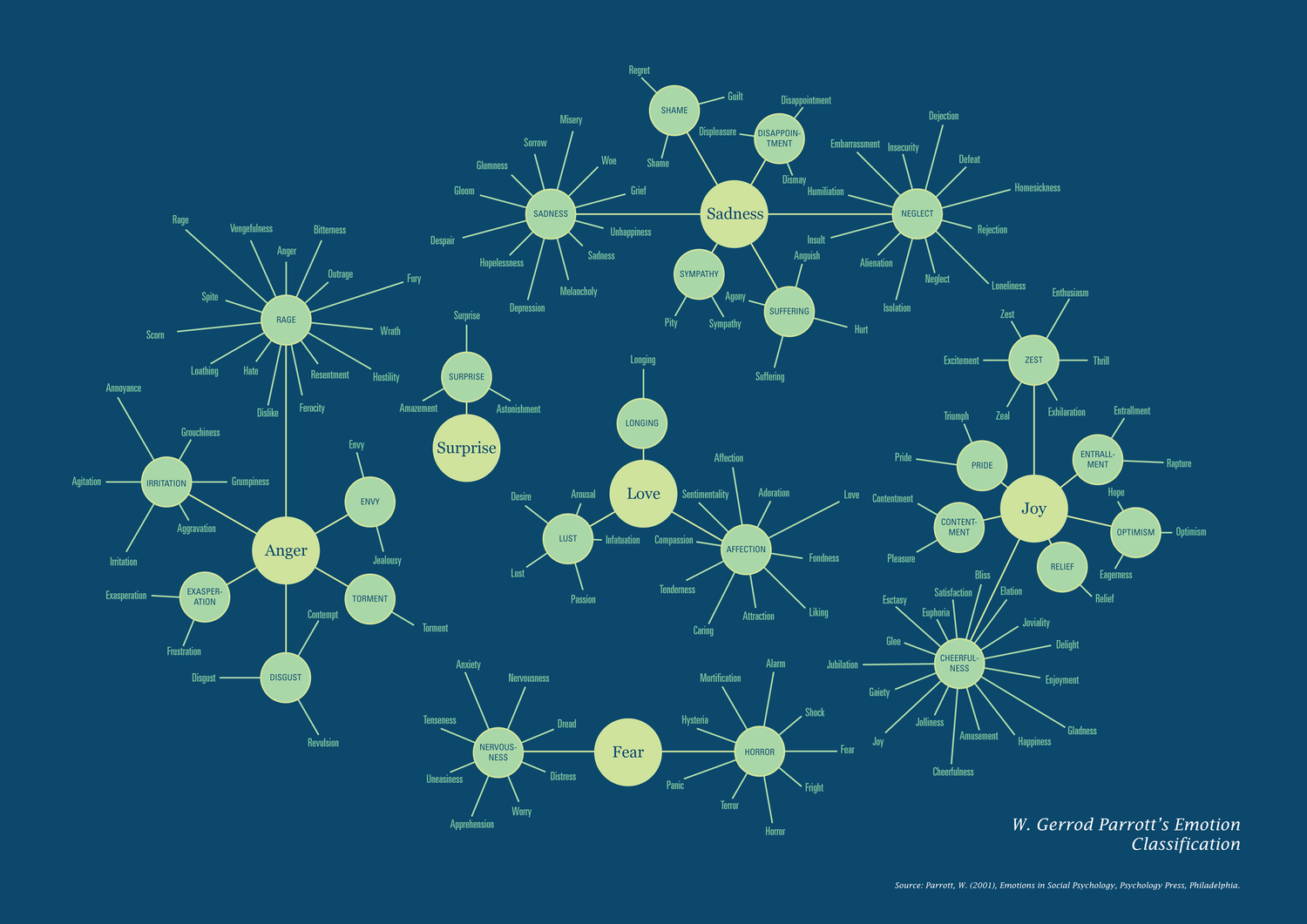
10 FEELINGS YOU MAY NOT HAVE HEARD OF…BUT HAVE PROBABLY FELT

Parrott_Model_b.png

Image credit: Pei-Ying Lin

JUNE 17, 2016 (alicehaddon.com)

Finding the words to express our feelings helps us make sense of ourselves.  And connect to others.

We know this because an unlucky few (10% of the population) suffer from a condition called Alexithymia – an inability to identify, distinguish or express their emotions.   And with this comes social detachment, alienation and decreased life satisfaction.  

But even without this difficulty, finding the right words to articulate our feelings can be difficult. Luckily Dr Tiffany Watt Smith has written the wonderful ‘Book of Human Emotions’ to help us. I’ve picked 10 feelings that I was delighted to find a word for.  See my other blog on this subject for more of my favourites.

1.  Ruinenlust:  A German word to describe feeling irresistibly drawn to crumbling buildings and abandoned places.  This is me all over, where I live has largely been dictated by this feeling.  I just didn’t know there was a word for it.

2.  Mututolypea: (Pronounced mah-tu-toh-leh-pee-a) an English word meaning an overbearing morning sorrow.  This word comes from the Roman Goddess of dawn ‘Mater Matuta’ and the Greek word for dejection ‘lype’. 

3.  Malu: This is one of those many experiences that we mistakenly think only we have or that signifies a lack of our own worth.  It’s an Indonesian word to describe that flustered feeling when we are in the presence of someone we hold in high esteem…when ‘the brain fogs over’ ‘sentences come out scrambled’ and ‘We may feel the overwhelming urge to run away’.

4.  Greng jai:  This is a Thai word meaning a reluctance to accept the offer of help from another because of the bother that it might cause them.

5.  Dolce Far Niente:  I love this one, it’s such an antidote to the dizzying imperatives to do more, achieve more, be more.  It’s an Italian expression translating as ‘the sweetness of doing nothing’ or the pleasure of doing nothing. 

6.  Cyberchondria:  This is the growing, but unfounded sense of concern about our symptoms that is fuelled by online ‘research’.

7.  Ringxiety: otherwise known as ‘phantom vibration syndrome ‘or playfully ‘fauxcellarm, this is the sense that your mobile phone is ringing when it’s not.

8.  Basorexia:  it’s not a romantic sounding word, but it means a sudden urge to kiss someone.  ‘Orexia’ stems from the Latin orexis meaning appetite.

9.  L’appel du Vide: From French, this literally translates as ‘the call to the void’ and describes that terrifying urge to leap of the cliff, the balcony, the platform.

10.  Abhiman:  (pronounced ab-ee-man) this is a Sanskrit word describing when the sorrow and shock from being hurt turns into a sense of self-pride or wounded dignity.

Our emotional lives can be bewilderingly complex, and although this complexity can’t be reduced to a few words, finding language means finding company.  And knowing that someone else, somewhere has felt it too, can be extremely comforting.

(Contributed by Suzanne Deakins, H.W., M.)

Thoreau on Nature and Human Nature, the Tonic of Wildness, and the Value of the Unexplored

By Maria Popova (brainpickings.org)

“We call it ‘Nature’; only reluctantly admitting ourselves to be ‘Nature’ too,” Denise Levertov wrote in her revelation of a poem “Sojourns in the Parallel World” a generation after history’s most poetic piece of legislature termed that parallel world “wilderness” and defined it as “an area where the earth and its community of life are untrammeled by man, where man* himself is a visitor who does not remain.”

Those of us who visit wild places the way others visit churches and concert halls visit because we return transfigured, recomposed, exalted and humbled at the same time, enlarged and dissolved in something larger at the same time. We visit because there we undergo some essential self-composition in the poetry of existence, though its essence rarely lends itself to words.artyoung_treesatnight1.jpg?resize=680%2C1074

Art from Trees at Night by Art Young. (Available as a print.)

That ineffable essence is what Henry David Thoreau (July 12, 1817–May 6, 1862) — who saw nature as a form of prayer — articulated with uncommon lucidity and splendor of sentiment in the final pages of Walden (public library | public domain), the record of the radical experiment in living he undertook a week before he turned twenty-eight.

He writes:

2e292385-dc1c-4cfe-b95e-845f6f98c2ec.pngWe need the tonic of wildness, — to wade sometimes in marshes where the bittern and the meadow-hen lurk, and hear the booming of the snipe; to smell the whispering sedge where only some wilder and more solitary fowl builds her nest, and the mink crawls with its belly close to the ground. At the same time that we are earnest to explore and learn all things, we require that all things be mysterious and unexplorable, that land and sea be infinitely wild, unsurveyed and unfathomed by us because unfathomable.

hasuikawase1.jpg?resize=680%2C1014

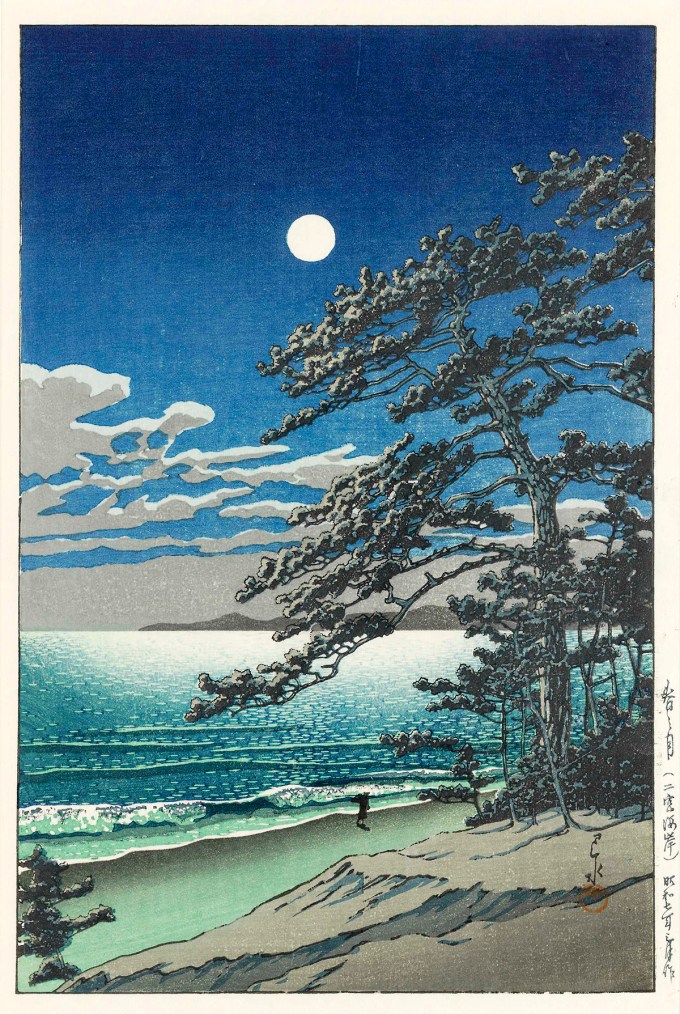
Spring Moon at Ninomiya Beach — one of Japanese artist Hasui Kawase’s vintage woodblock prints. (Available as a print.)

A century before Rachel Carson observed that because “our origins are of the earth… there is in us a deeply seated response to the natural universe, which is part of our humanity,” Thoreau adds:

2e292385-dc1c-4cfe-b95e-845f6f98c2ec.pngWe can never have enough of Nature. We must be refreshed by the sight of inexhaustible vigor, vast and Titanic features, the sea-coast with its wrecks, the wilderness with its living and its decaying trees, the thunder cloud, and the rain which lasts three weeks and produces freshets. We need to witness our own limits transgressed, and some life pasturing freely where we never wander.

We can never have enough of Nature because Nature is not something to have — it is something we are. Epochs after Thoreau, when we wade into the wilderness with our bodies and our minds, with a walking stick or a poem, we witness more than our limits transgressed. We witness our boundaries dissolved, in turn dissolving that most limited and damaging foundational falsehood upon which the whole of the consumerist-extractionist complex is built: that the rest of the living world is a parallel world, a place to visit and mine for experiences and resources with which to adorn and enrich our separate human world.PraiseSongForDawn_by_MariaPopova.jpg?resize=680%2C851

Praise Song for Dawn by Maria Popova. (Available as a print, benefitting The Nature Conservancy.)

It is naïve and impracticable to insist that course-correcting our presently catastrophic trajectory of nature-destruction — that is, of self-destruction — requires reverting to the rugged naturalistic self-reliance that even Thoreau himself could not sustain beyond his short-lived experiment at Walden Pond, a life without consumption or companionship. Whatever it does require must begin with the elemental recognition that these are not separate worlds existing in parallel, that there is no “environment” surrounding the centrality of the human animal in nature, that there is nothing that can be bad for nature yet good for us — an elemental fact rendered achingly countercultural every time I walk into my local grocery store and see the organic produce, the good-for-us stuff, plastic-wrapped over styrofoam trays that will take tens of thousands of years to decompose in the landfill, leeching unfathomable toxicity in the process. It is a small act of resistance to contact store management with an appeal for change — small but not negligible, and certainly not naïve. As Thoreau himself put it in the conclusion of Walden:

2e292385-dc1c-4cfe-b95e-845f6f98c2ec.pngIf you have built castles in the air, your work need not be lost; that is where they should be. Now put the foundations under them.

Complement with Robert Macfarlane and Jackie Morris’s lyrical illustrated rewilding of our relationship to nature, ornithologist and wildlife ecologist J. Drew Lanham on the spirituality of science, and poet Diane Ackerman’s lovely notion of the “Earth ecstatic,” then revisit Thoreau on the true value of a treethe long cycles of social change, and how to use civil disobedience as an instrument of change.

Citizen Science, the Cosmos, and the Meaning of Life: How the Comet That Might One Day Destroy Us Gives Us the Most Transcendent Celestial Spectacle

By Maria Popova (brainpickings.org)

On July 13, 1862, while a young experiment in democracy was being ripped asunder by its first Civil War, The Springfield Republican reported a strange and wondrous celestial sighting in the undivided sky, as bright as Polaris. Within days, two astronomers — Lewis Swift and Horace Parnell Tuttle — independently observed the phenomenon and determined it to be a colossal comet. Comet Swift-Tuttle — the largest Solar System object to periodically pass near Earth — is now known to return every 133 years, dragging in its long wake a dazzling annual gift: Each summer, as our lonely planet crosses the orbit of Swift-Tuttle and the debris shed by the icy colossus burn up in our atmosphere, the Perseid meteor shower streaks across the common sky, washing the whole of humanity with wonder.ellenhardingbaker_solarsystemquilt1.jpg?resize=680%2C564

19th-century Solar System quilt featuring a comet, designed and embroidered by Ellen Harding Baker over the course of seven years to teach women astronomy when they were barred from higher education in science. (Available as a print and a face mask, benefitting the endeavor to build New York City’s first public observatory.)

For millennia, the Perseids have lit up the summer sky in an annual celestial spectacle — one of the most staggering on Earth, with as many as 200 vibrant meteors per hour — that just befell the awestruck human animal without known cause or cosmic correlation. Some thought the streaks of light were debris from volcanic eruptions in faraway lands falling back to Earth. Others, including most scientists well into the nineteenth century, believed they were atmospheric phenomena like rainbows and lightning. Their cometic origins were unknown and comets themselves were a mystery. For astronomers — even for Caroline Herschel, who became the world’s first professional female astronomer thanks to her prolific and perilous comet-hunting — they were little more than a diversion, a flexing of tenacity, a competitive game of discovery that advanced personal reputations rather than elemental truth. More than a century before Carl Sagan and Ann Druyan shed light on the still-unsolved science of comets, very little was understood about these mysterious visitors from outer space. The poetic science writer Emma Converse — the Carl Sagan of her epoch — prophesied that someday, “with a powerful grasp, like that of Newton, some watcher of the stars shall seize the secret of cometic history.”meteors1.jpg?resize=680%2C891

One of French artist and astronomer Étienne Léopold Trouvelot’s stunning 19th-century paintings of celestial objects and phenomena. (Available as a print and as a face mask, benefitting the endeavor to build New York City’s first public observatory.)

That day began dawning in the small hours of November 13, 1833. Neighbors awoke neighbors with shouts of excitement as people gathered in the street to watch a rain of fire from beneath the invisible umbrella of the night. Shooting stars blazed across the dark sky at the breath-stilling rate of thousands, tens of thousands per minute. All of this was puzzling: It was November, not August; the meteors were falling at manyfold the rate of the annual summer Perseids; and, at so high a density, they seemed to be streaming from a single source far from Earth, challenging the accepted notion that meteors were atmospheric phenomena.DenisonOlmsted.jpg?resize=680%2C890

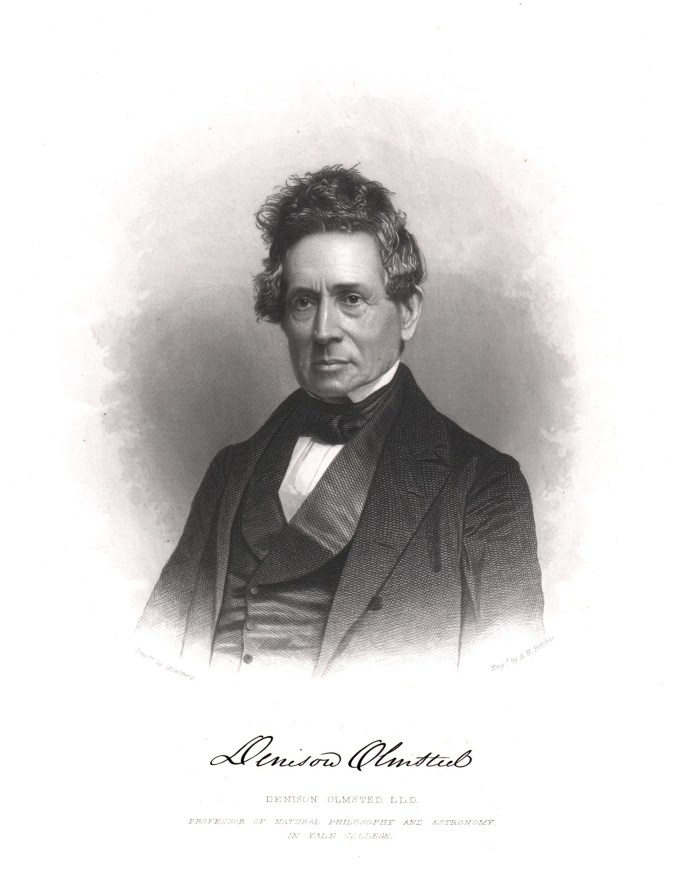
Denison Olmsted (Portrait by Reuben Son of Moulthrop. Smithsonian Libraries.)

Among the stunned spectators was the esteemed Yale mathematician, astronomer, and “natural philosopher” Denison Olmsted. (He couldn’t yet be called a “scientist” — the word was coined a year later for the polymathic Scottish mathematician Mary Somerville.) Like most of his colleagues, Olmsted had largely ignored meteors as uninteresting minor curiosities, irrelevant to astronomy and better left to meteorology. Now, he was seized with the sense that they might have cosmic origins and might therefore hold clues to the celestial mechanics of the universe. But he knew his personal observations that night hardly constituted data.

The following morning, two years after the polymathic astronomer John Herschel — the era’s most venerated patron saint of science — made his pioneering case for citizen science, Olmsted drafted a letter and sent it to the local newspaper in New Haven, appealing to ordinary people to help him “collect all the facts attending this phenomenon… with as much precision as possible” by reporting anything they could recall about the time, orientation, and speed of the shooting stars they had witnessed. The announcement was quickly reprinted in newspapers across the country and responses began pouring in.thomaswright_galaxies3.jpg?resize=680%2C977

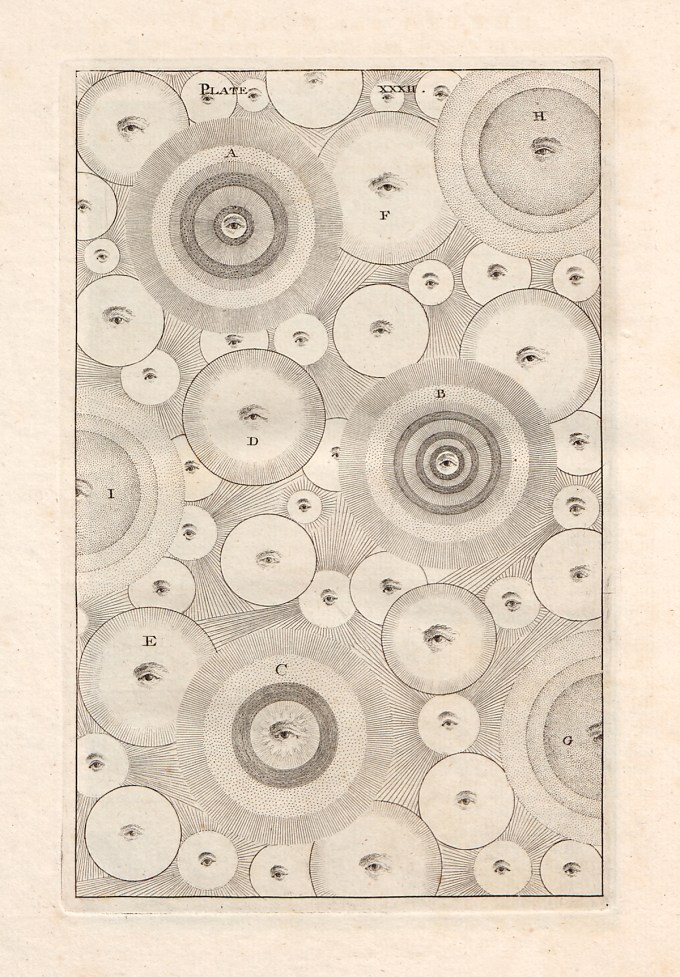
Art from Thomas Wright’s revolutionary 1750 book An Original Theory or New Hypothesis of the Universe. (Available as a print and as a face mask, benefitting the endeavor to build New York City’s first public observatory.)

Drawing on these observations, Olmsted was able to ascertain that the spectacle in Earth’s sky had cosmic rather than atmospheric origins and to locate its point of emergence — poetically known as radiant — in the constellation Leo. And so the Leonid showers ushered in the dawn of meteor science as a field of astronomy rather than meteorology.

But even with the origin point located, the cause of meteor showers remained a mystery. It took another generation to discover that fiery pageants like the Perseids and the Leonids are the debris of passing comets. Today, the Leonids are known to be the flotsam of Comet Tempel-Tuttle, visible from Earth every 33 years. It was independently discovered in 1865–1866, on its next passage after the 1833 triumph of citizen science, by the astronomers Wilhelm Tempel and Horace Parnell Tuttle — the same Tuttle who two years earlier had co-discovered the cometic originator of the Perseids, so named because in 1835, the Belgian astronomer and statistician Adolphe Quetelet — founder of Brussels Observatory and creator of the Body Mass Index scale — had located the radiant of the annual summer meteor showers in the constellation Perseus.IYCTE.Comet2000.jpg?resize=680%2C415

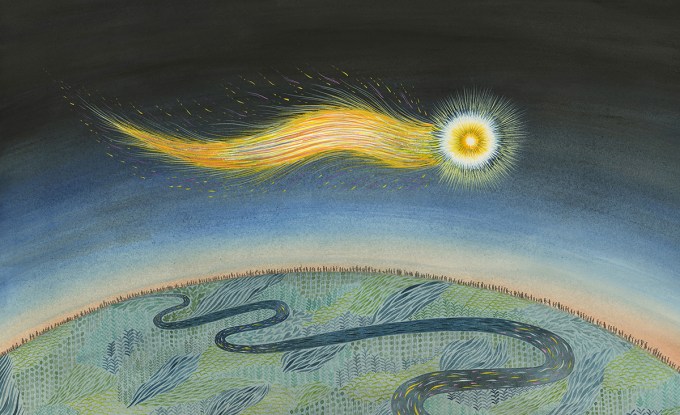
Art by Sophie Blackall from If You Come to Earth.

That fateful July of 1862, when newspaper reports of the strange celestial apparition that became Comet Swift-Tuttle interrupted for a moment the stream of death-tolls from the battlefields of the American Civil War, a young comet-hunter in another revolution-torn country elsewhere on the globe was also following the bright light advancing across the common sky — the Italian astronomer and historian of science Giovanni Schiaparelli, born the year the Perseids got their name.

Within a few years of obsessive scholarship, Schiaparelli arrived at a startling hypothesis: meteor showers might be the tails of passing comets. With astrophotography newly born and the instruments of science advancing rapidly in a Golden Age of telescopic astronomy, his hypothesis was proven correct, conferring upon comets a new aura of interest for science.comet5.jpg?resize=680%2C847

Art from Kometenbuch [The Comet Book], 1587. (Available as a print.)

As more and more came to be understood about these icy boomerangs from the outer reaches of the Solar System, the enormous and proximate Comet Swift-Tuttle — which comes closer to the Earth-Moon system than any other: a mere 130 kilometers at its perihelion, less than twenty times the distance between Europe and America — took on an ominous air, looming larger and larger in the popular imagination as a potential destroyer of Earth, invoking the same instincts that had prompted our Medieval ancestors to view comets as demonic omens before the birth of the scientific method and astronomy as we know it.

A calculation in the 1990s suggested that the comet’s passage on August 14, 2126 could result in a collision with Earth. By the end of the decade, Comet Swift-Tuttle was deemed “the single most dangerous object known to humanity,” given the damage it would inflict in case of actual collision — an impact many times more powerful than that of the asteroid that killed the dinosaurs, with a trillion times the energy of the Hiroshima atomic bomb.thomaswright4.jpg?resize=680%2C1019

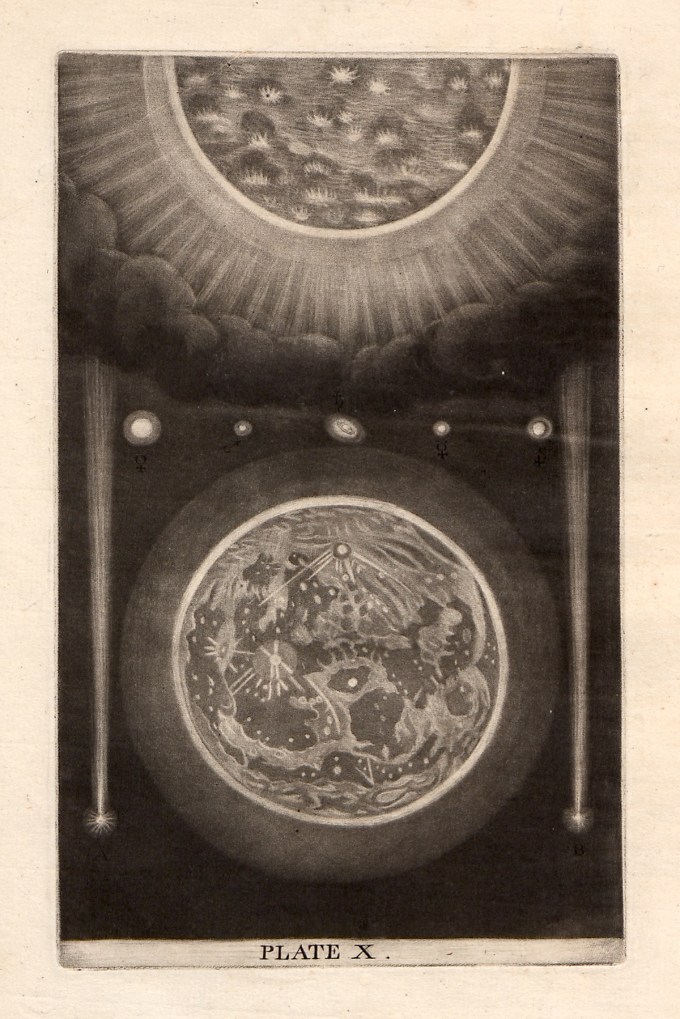
Our Sun and Moon in proportion to their diameters, alongside two comets, from Thomas Wright’s An Original Theory or New Hypothesis of the Universe. (Available as a print and as a face mask, benefitting the endeavor to build New York City’s first public observatory.)

But the threat turned out to reveal more about the workings of the human mind than about the workings of the universe, more reflective of our instinct to fear what we don’t fully understand than of a scientific reality. The 1990s were the dawn of a new Golden Age of science — one driven by digital computation and rapidly advancing data technologies.

Calculations of Comet Swift-Tuttle’s orbital period and tilt have been continually refined since its discovery in 1862, as scientists have peered backward in time with the telescope of scholarship to identify sightings and positions as early 69 BC, and have telescoped forward in spacetime with computational astrophysics to predict when and how close to Earth it will come in the future. We (“we,” if our species survives its plurality) can expect a close encounter with Comet Swift-Tuttle when it returns to the inner Solar System in the year 3044 — “close” being a relative proximity on the cosmic scale and a distant one million miles in the absolute.

Should these calculations too prove to be incorrect — for science is always improving and, as Richard Feynman astutely observed, “it is impossible to find an answer which someday will not be found to be wrong” — and should the comet one day shatter our lonely planet after all, it will have given us millennia of wonder and transcendence, slaking the human soul with its summer spectacle of otherworldly beauty.edmundweiss_leonid.jpg?resize=680%2C987

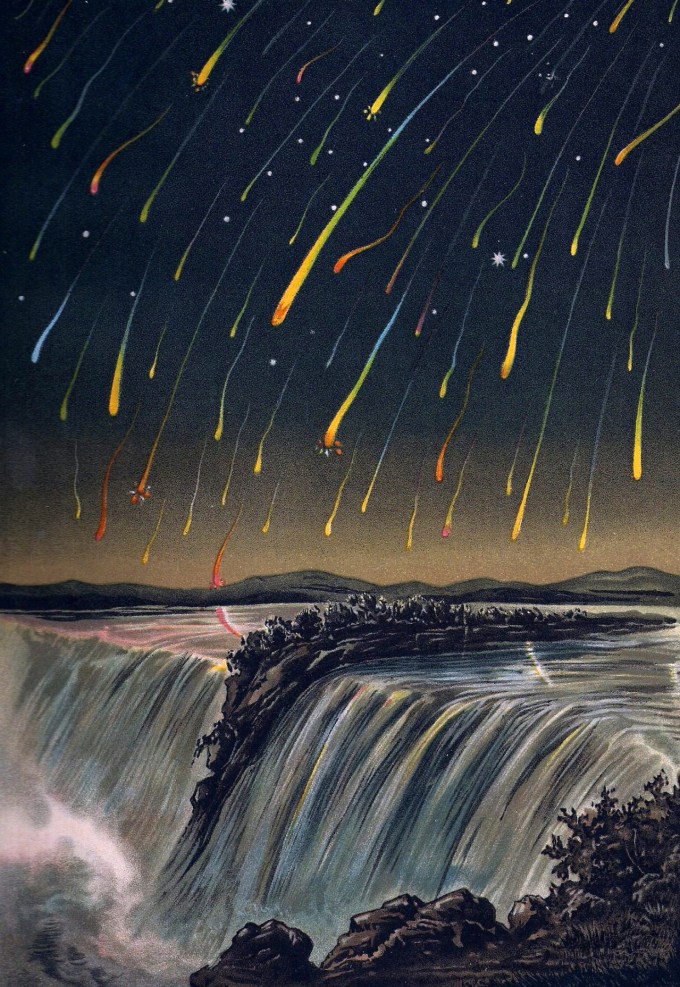
The Leonid meteor showers of 1833. Art by Edmund Weiss from Bilder Atlas der Sternenwelt [Image Atlas of the Star World], 1888. (Available as a print and as a face mask, benefitting the endeavor to build New York City’s first public observatory.)

I Measure Every Grief I Meet: Emily Dickinson on Love and Loss

By Maria Popova (brainpickings.org)

Grief is the shadow love casts in the light of loss. The grander the love, the vaster the shadow. So much of who we are — who we discover ourselves to be — takes shape in that umbral space as we fumble for some edge to hold onto, some point of light to orient by.

Because the price of living wholeheartedly (which is the only way worth living) is the heartbreak of many losses — the loss of love to dissolution, distance, or death; the loss of the body to gravity and time — and because loss leaves in its wake an experience so private yet so universal, the common record of human experience that we call literature is replete with reflections on grief: from Seneca’s 2,000-year-old letter to his mother about the key to resilience in the face of loss to Lincoln’s spare and melancholy consolation to Meghan O’Rourke’s memoir of mourning to Nick Cave’s soulful meditation on the paradox of bereavement. And yet, as Joan Didion wrote in her crowning classic on the subject, “grief turns out to be a place none of us know until we reach it.”

No writer, in my reading life, has charted the fractal reaches of grief with more nuance and precision than Emily Dickinson (December 10, 1830–May 15, 1886) — the poet laureate of love and loss, of the interplay between the two, the interplay between the beauty and terror of being alive as we drift daily toward “the drift called ‘the infinite.’”emilydickinson.jpg?resize=680%2C814

Emily Dickinson, daguerreotype, circa 1847. (Amherst College Archives & Special Collections)

In her 561st poem, included in her indispensable Complete Poems of Emily Dickinson (public library), Dickinson considers grief as an experience both profoundly intimate and profoundly universal. She composed it in 1862, as a tidal wave of grief was sweeping her war-torn country and as Dickinson herself was wading through the deepest, most mysterious mourning of her life, the shadow of some unnamed “terror” of the heart she underwent the previous year — a mystery that still puzzles scholars and one that animates a sizable portion of Figuring. The poem gives voice to the continual syncopation between these two scales of being, both absolute and relativistic, as we burrow in the hollow of our private losses and pass each other in the public square of human suffering:

245fed7c-1142-3d68-5fee-46804ad5765e.png

2e292385-dc1c-4cfe-b95e-845f6f98c2ec.pngI measure every Grief I meet
With narrow, probing, Eyes —
I wonder if It weighs like Mine —
Or has an Easier size.

I wonder if They bore it long —
Or did it just begin —
I could not tell the Date of Mine —
It feels so old a pain —

I wonder if it hurts to live —
And if They have to try —
And whether — could They choose between —
It would not be — to die —

I note that Some — gone patient long —
At length, renew their smile —
An imitation of a Light
That has so little Oil —

I wonder if when Years have piled —
Some Thousands — on the Harm —
That hurt them early — such a lapse
Could give them any Balm —

Or would they go on aching still
Through Centuries of Nerve —
Enlightened to a larger Pain –
In Contrast with the Love —

The Grieved — are many — I am told —
There is the various Cause —
Death — is but one — and comes but once —
And only nails the eyes —

There’s Grief of Want — and Grief of Cold —
A sort they call “Despair” —
There’s Banishment from native Eyes —
In sight of Native Air —

And though I may not guess the kind —
Correctly — yet to me
A piercing Comfort it affords
In passing Calvary —

To note the fashions — of the Cross —
And how they’re mostly worn —
Still fascinated to presume
That Some — are like My Own —

In her 793rd poem, composed sometime the following year, Dickinson revisits the multifaceted nature of grief with a personified taxonomy — grief, the skittish mouse; grief, the surreptitious thief; grief, the juggler of fragilities; grief, the self-indulgent reveler; grief, the grand silence:

bfa2bb7d-fd52-b79f-7acd-63f7445db87f.png

2e292385-dc1c-4cfe-b95e-845f6f98c2ec.pngGrief is a Mouse —
And chooses Wainscot in the Breast
For His Shy House —
And baffles quest —

Grief is a Thief — quick startled —
Pricks His Ear — report to hear
Of that Vast Dark —
That swept His Being — back —

Grief is a Juggler — boldest at the Play —
Lest if He flinch — the eye that way
Pounce on His Bruises — One — say — or Three —
Grief is a Gourmand — spare His luxury —

Best Grief is Tongueless — before He’ll tell —
Burn Him in the Public Square —
His Ashes — will
Possibly — if they refuse — How then know —
Since a Rack couldn’t coax a syllable — now.

In another poem written in 1862 — Dickinson’s most creatively fertile year, in which she processed her unnamed “terror” through her art, as all artists do — she dilates the contracted consciousness of mourning into a perspectival reminder that there is an other side to even the deepest pain; that everything, even the most all-suffusing emotion, passes and is overgrown with new experience; that the ache of loss is the twin face of love, each an equal and inseparable part of aliveness:

500688c1-5ee2-1a43-9816-946cd0657f52.png

2e292385-dc1c-4cfe-b95e-845f6f98c2ec.png‘Tis good — the looking back on Grief —
To re-endure a Day —
We thought the Mighty Funeral —
Of All Conceived Joy —

To recollect how Busy Grass
Did meddle — one by one —
Till all the Grief with Summer — waved
And none could see the stone.

And though the Woe you have Today
Be larger — As the Sea
Exceeds its Unremembered Drop —
They’re Water — equally —

Complement with Elizabeth Gilbert on love, loss, and how to move through grief as grief moves through you and a tender animated field guide to the counterintuitive psychology of how to best support a grieving friend, then revisit Dickinson’s stunning ode to resilience and the electric love letters in which she honed her dual capacity for love and loss.

Book: “Seven Brief Lessons on Physics”

Seven Brief Lessons on Physics

Seven Brief Lessons on Physics

by Carlo RovelliSimon Carnell (Translator), Erica Segre (Translator) 

All the beauty of modern physics in fewer than a hundred pages.

This is a book about the joy of discovery. A playful, entertaining, and mind-bending introduction to modern physics, it’s already a major bestseller in Italy and the United Kingdom. Carlo Rovelli offers surprising—and surprisingly easy to grasp—explanations of general relativity, quantum mechanics, elementary particles, gravity, black holes, the complex architecture of the universe, and the role humans play in this weird and wonderful world. He takes us to the frontiers of our knowledge: to the most minute reaches of the fabric of space, back to the origins of the cosmos, and into the workings of our minds. “Here, on the edge of what we know, in contact with the ocean of the unknown, shines the mystery and the beauty of the world,” Rovelli writes. “And it’s breathtaking.”

(Goodreads.com)

Consciousness, spirituality, biography, sexuality, androgyny, futurism, space, the arts, science, astrology, democracy, humor, books, movies and more