Free Will Astrology: Week of June 3, 2021

JUNE 1, 2021 AT 7:00 AM BY ROB BREZSNY

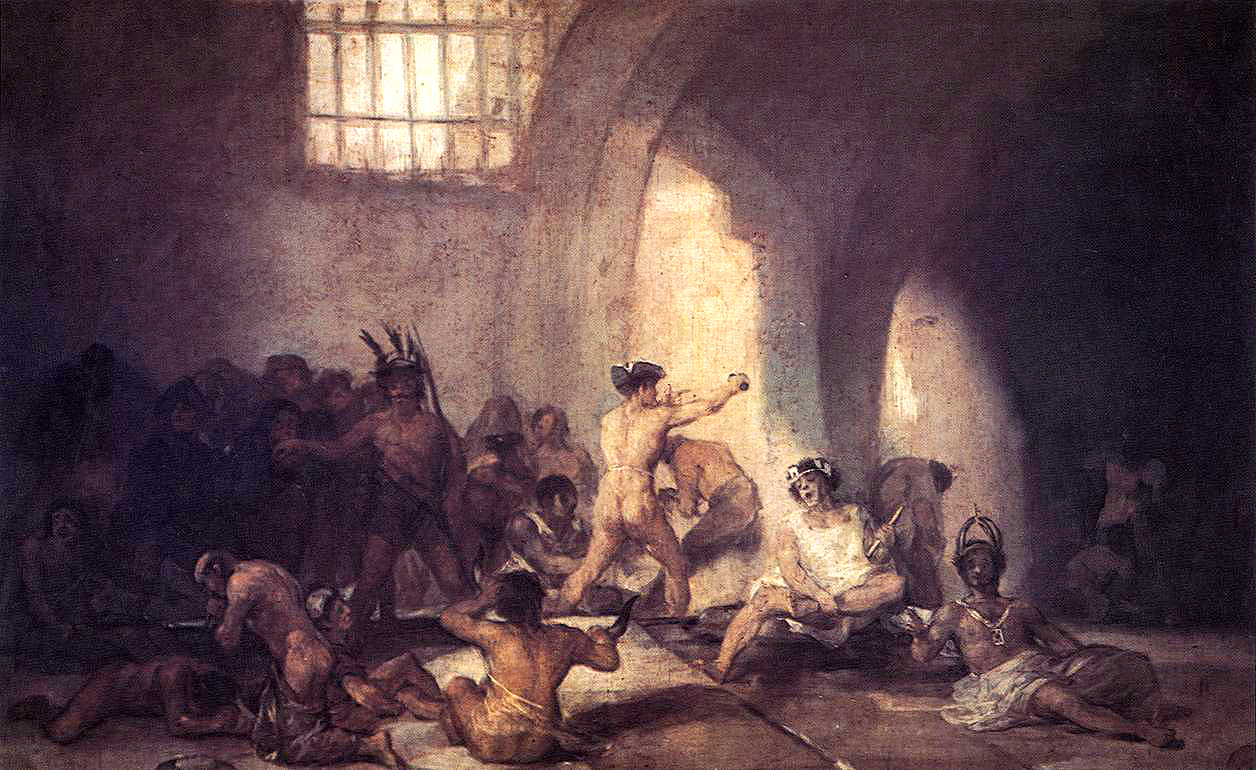
Goya’s “Casa de locos” or “Manicomio” (The Madhouse)

ARIES (March 21-April 19): “There is ecstasy in paying attention,” writes Aries author Anne Lamott. That’s always true for everyone, but it’s extra true for you Aries people. And it will be extra ultra especially true for you during the next twenty days. I hope you will dedicate yourself to celebrating and upgrading your perceptual abilities. I hope you will resolve to see and register everything just as it is in the present moment, fresh and unprecedented, not as it was in the past or will be in the future. For best results, banish all preconceptions that might interfere with your ability to notice what’s raw and real. If you practice these high arts with exhilarating diligence, you will be rewarded with influxes of ecstasy.

TAURUS (April 20-May 20): Your guiding wisdom comes from Taurus author Annie Dillard. She writes, “I think it would be well, and proper, and obedient, and pure, to grasp your one necessity and not let it go, to dangle from it limp wherever it takes you.” I suspect that Dillard’s approach will enable you to maintain a righteous rhythm and make all the right moves during the coming weeks. If you agree with me, your crucial first step will be to identify the nature of your “one necessity.” Not two necessities. Just the single most important.

GEMINI (May 21-June 20): “All I want to be is normally insane,” said actor Marlon Brando. Yikes! I have a different perspective. I would never want to be normally insane because that state often tends to be sullen and desperate and miserable. My preferred goal is to be quite abnormally insane: exuberantly, robustly, creatively free of the toxic adjustments that our society tells us are necessary. I want to be cheerfully insane in the sense of not being tyrannized by conventional wisdom. I want to be proactively insane in the sense of obeying my souls’ impulses rather than conforming to people’s expectations. I bring this to your attention, Gemini, because I believe the coming weeks will be a fruitful time for you to be my kind of insane.

CANCER (June 21-July 22): “It’s one thing to make a mistake, it’s another to become wedded to it,” advised author Irena Karafilly. Let’s make that one of your key truths in the coming weeks. Now is a good time to offer yourself forgiveness and to move on from any wrong turns you’ve made. Here’s a second key truth, courtesy of composer Igor Stravinsky: “I have learned throughout my life as a composer chiefly through my mistakes and pursuits of false assumptions, not by my exposure to founts of wisdom and knowledge.” Third key truth, from Sufi teacher Pir Vilayat Inayat Khan: “Don’t be concerned about being disloyal to your pain by being joyous.”

LEO (July 23-Aug. 22): According to my analysis of the astrological omens, the number of perfect moments you will experience during the next two weeks could break all your previous records. And what do I mean by “perfect moments”? 1. Times when life brings you interesting events or feelings or thoughts that are novel and unique. 2. Pivotal points when you sense yourself undergoing a fundamental shift in attitude or a new way of understanding the world. 3. Leaping out of your own mind and into the mind of an animal or other person so as to have a pure vision of what their experience is like. 4. An absolute appreciation for yourself just the way you are right now.

VIRGO (Aug. 23-Sept. 22): “There is strong shadow where there is much light,” wrote Virgo author Johann Wolfgang von Goethe (1749-1832). That’s a good metaphor for you these days. Since I suspect you are currently shining as brightly as you possibly can, I will urge you to become acutely aware of the shadows you cast. In other words, try to catch glimpses of the unripe and unformed parts of your nature, which may be more easily seen than usual. Now, while you’re relatively strong and vibrant, investigate what aspects of your inner world might need improvement, care and healing.

LIBRA (Sept. 23-Oct. 22): According to physicists, it’s impossible for a human being to suck water up through a straw that’s more than thirty-four feet long. So please don’t even try to do that, either now or ever. If, however, you have a good reason to attempt to suck water up a thirty-three-foot straw, now would be an excellent time to do so. Your physical strength should be at a peak, as is your capacity for succeeding at amazing, herculean tasks. How else might you direct your splendid abilities? What other ambitious feats could you pull off?

SCORPIO (Oct. 23-Nov. 21): Scorpio poet Ezra Pound had character flaws that bother me. But he also had a quality I admire: generosity in helping his friends and colleagues. Among the writers whose work he championed and promoted with gusto were twentieth-century literary icons James Joyce, T. S. Eliot, Marianne Moore, Hilda Doolittle, William Butler Yeats, Ernest Hemingway, William Carlos Williams and Robert Frost. Pound edited their work, arranged to get them published in periodicals and anthologies, connected them with patrons and editors, and even gave them money and clothes. In accordance with astrological omens, I encourage you to be like Ezra Pound in the coming weeks. Make an extra effort to support and boost your allies. Assist them in doing what they do well. To do so will be in your own best interest!

SAGITTARIUS (Nov. 22-Dec. 21): Poet Tess Gallagher praises those times “when desire has strengthened our bodies.” I want you to have an abundance of those moments during the coming weeks. And I expect that cultivating them will be an excellent healing strategy. So here’s my advice: Do whatever’s necessary to summon and celebrate the strong longings that will strengthen your body. Tease them into bountiful presence. Treasure them and pay reverence to them and wield them with gleeful passion.

CAPRICORN (Dec. 22-Jan. 19): “To live is so startling it leaves little time for anything else,” observed poet Emily Dickinson. That’s the truth! Given how demanding it is to adjust to the nonstop challenges, distractions and opportunities of the daily rhythm, I’m impressed that any of us ever get any work done. According to my astrological analysis, you Capricorns are now experiencing a big outbreak of this phenomenon. It’s probably even harder than usual to get work done, simply because life keeps bringing you interesting surprises that require your ingenuity and resourcefulness. The good news is that these surges of ingenuity and resourcefulness will serve you very well when the hubbub settles down a bit and you get back to doing more work.

AQUARIUS (Jan. 20-Feb. 18): Aquarius-born August Strindberg (1849-1912) was a masterful and influential playwright. He also liked to dabble in painting and photography. His approach in those two fields was different from the polish he cultivated in his writing. “I am an amateur and I intend to stay that way,” he testified about his approach in the visual arts. “I reject all forms of professional cleverness or virtuosity.” Just for now, Aquarius, I recommend you experiment with the latter attitude in your own field. Your skill and earnestness will benefit from doses of playful innocence, even calculated naiveté.

PISCES (Feb. 19-March 20): Which of the astrological signs feels the deepest feelings? I say it’s you Pisceans. You’re connoisseurs of deep feelings, as well as specialists in mysterious, multi-splendored, brushes-with-infinity feelings. And right now, you’re in the Deepest Feelings Phase of your personal cycle. I won’t be surprised if you feel a bit overwhelmed with the richness of it all. But that’s mostly a good thing that you should be grateful for—a privilege and a superpower! Now here’s advice from deep-feeling author Pearl Buck: “You cannot make yourself feel something you do not feel, but you can make yourself do right in spite of your feelings.”

Homework: Testify about how you redeemed the dark side. Newsletter@freewillastrology.com

Rewiring your life

A radical therapy based on eye movements can desensitise painful memories, heal hurts and aid transformation at warp speed

Human eye with sun reflect, close-up.

Photo by Guido Mieth/Getty

Deborah Korn is a psychotherapist, teacher, clinical consultant and researcher who has been on the faculty of the EMDR Institute for more than 27 years. She currently serves on the editorial board of the Journal of EMDR Practice and Research and is an adjunct training faculty member at the Trauma Research Foundation. She is the co-author, with Michael Baldwin, of Every Memory Deserves Respect (2021). She lives in Cambridge, Massachusetts.

1 June 2021 (aeon.co)

Edited by Pam WeintraubSYNDICATE THIS ESSAYTweet1576 Comments

Aeon for Friends

Find out more

Thirty years ago, in the summer of 1991, I travelled to Denver to visit my graduate school mentor, Andy Sweet. I had received my doctorate in clinical psychology in 1989, and Andy had taught me most of what I knew about working with people suffering from the effects of trauma. As we sat in his backyard, Andy said: ‘You need to trust me on this, Debbie. There’s this new therapy called eye movement desensitisation and reprocessing, EMDR for short, and it’s unique and potentially powerful.’ It looked and sounded wacky, but it was based on solid principles, and he was getting remarkable results. ‘I think that it’s going to change our field and bring relief to so many more trauma survivors. You should go and get trained in it … and you should run, not walk.’

So I did. I got trained in EMDR that year, studying with Francine Shapiro, its developer. She told us about her discovery four years earlier: she was walking in a park and found herself reflecting on some recent disturbing events in her life. As she thought about them, she became aware that her eyes were moving back and forth, left, right, left, right. And as her eyes moved, she was startled to realise that the negative emotional charge of her memories seemed to dissipate. She began to experiment, to explore the connection between ‘bilateral’ (left-right) eye movements and this ‘desensitisation’ of anxiety.

Shapiro developed a treatment procedure that asked patients to focus on the worst part of a traumatic memory while simultaneously watching her fingers move back and forth, left and right. In 1989, two years before my visit with Andy, she published the first EMDR controlled research study demonstrating the effectiveness of her method in the treatment of post-traumatic stress disorder (PTSD) in combat veterans and sexual assault survivors. Over time, clinical experimentation showed that other forms of bilateral stimulation (listening to tones alternating between each ear, or receiving alternating taps on the backs of one’s hands) basically worked as well.

And she had an exciting revelation: EMDR was more than a simple desensitisation strategy. Instead, it offered patients a chance to fully ‘reprocess’ their traumatic memories – to reconsider their experiences and come to fully know, feel, express and reflect on what previously had been too overwhelming to approach (let alone share with anyone else) and, in some cases, even too frightening to allow fully into their consciousness. I myself was astonished at how EMDR enabled my patients to seamlessly integrate other perspectives, including information that corrected misperceptions of the past, leading to spontaneous re-evaluations of their sense of worth, safety and control.

At the time of my introductory EMDR training, I was the clinical director of an inpatient psychiatric unit in southern New Hampshire treating women recovering from both acute and chronic trauma. Most had experienced horrible childhoods, with prolonged emotional, physical and sexual abuse and, as a result, were dealing with a range of psychiatric problems. Many had engaged in self-harm or had made attempts on their own lives. And most were struggling with hopelessness, unsure whether they’d ever be able to heal.

It was on this unit that I began using EMDR as a therapist. One of my first EMDR patients was Miriam, aged 23, who’d been extremely depressed, suicidal and unable to function for nearly two years following the loss of a pregnancy at eight months. In one unforgettable session, we used EMDR to target the moment when the doctor informed her that she’d lost her baby (coupled with the belief ‘I’m bad and don’t deserve to live’). As she processed the memory, she began to cry, accessing the grief that she’d buried deep inside. Miriam raged at God and at the boyfriend who’d left her after finding out that she was pregnant. And when she encountered a tidal wave of guilt, somehow blaming herself for ‘failing’ her baby, I asked her if, had the same thing happened to her best friend, she would have held her responsible or seen her as a failure too. She emphatically said: ‘Of course not! I would tell her that I understood her pain, and then I’d reassure her that she was not alone.’

Miriam continued to process, pausing and checking in after each 30- to 60-second set of eye movements, to respond to my question: ‘What do you notice now?’ As her eyes moved back and forth, I could sense the depression leaving her body and exiting my office. Her breathing relaxed and she sat up in her chair. After one more set of eye movements, she reported that she had spoken directly to her baby, in her mind’s eye, telling him how much she loved him and expressing sorrow about never having had the chance to hold him. When I invited her to imagine holding him in the present moment, she imagined cuddling and breastfeeding him, wrapping her arms in front of her as if holding a baby. She tearfully spoke of how she’d spent eight months dreaming about welcoming him into the world and then lost him.

Still new to EMDR, I feared that she was on the verge of plunging back into despair but I chose to trust the process. We continued with more sets of eye movements. And then, 50 minutes into our session, she once again sat up in her chair, and this time she actually smiled, the first smile I had ever seen on her face. Near the end of the session, when I asked her to think about the memory again, Miriam reported that her distress had moved, on a 0-10 scale, from a 9 to a 0. She said she could fully and completely endorse a new belief about herself – ‘It wasn’t my fault. I’m good and I have so much love to give.’ I had just experienced first-hand what my mentor Andy had described. I had witnessed transformation at warp speed.

EMDR was clearly more effective than ‘standard care’ in reducing the symptoms of PTSD

As I began to introduce more of my patients to EMDR, I saw similarly dramatic changes in the course of a week or even a single session. I had the privilege of bearing witness to their stories and accompanying them as they faced and resolved traumatic memories that had been haunting and harassing them for years. I watched them experience significant reductions in nightmares, flashbacks, depression, panic and suicidality. Over and over again, my patients reported a renewed sense of hope and possibility. Women new to the unit would hear about EMDR from other patients, and come to me saying: ‘I’ll have what she’s having!’

The most profound and lasting changes came as patients’ sense of self began to shift. They went from abject self-loathing to truly believing that they deserved to exist, that they were ‘good enough’ and ‘worthy of love’. Their nervous systems began to relax as they shifted out of states of hypervigilance, coming to deeply believe that ‘It’s truly over; I’m safe now.’ They began to see the world around them from an adult’s perspective rather than a child’s. I’d hear statements such as: ‘I see now that I have choices and I can take action.’ They began to move out of their isolation, saying: ‘I don’t have to be alone any more; there are other people like me; I matter and belong.’

What I was seeing in my small office on the Women’s Trauma and Dissociation Unit was soon reflected in published research studies – EMDR was an effective and efficient treatment for PTSD, significantly reducing or eliminating PTSD symptoms in as few as three 90-minute sessions in 85 per cent of sexual assault cases; and more than 75 per cent of traumatised combat veterans were free of PTSD in just 12 EMDR sessions. In yet another study, 100 per cent of single-trauma and 77 per cent of multiple-trauma survivors no longer met the diagnostic criteria for PTSD after an average of just six and a half 50-minute EMDR sessions, demonstrating that EMDR was clearly more effective than ‘standard care’ in reducing the symptoms of PTSD.

To say that I was elated by my discovery of EMDR would be a major understatement. I’d been feeling so frustrated with the limitations of the treatment models previously at my disposal. Teaching patients a raft of cognitive-behavioural coping skills (positive self-talk, distraction, challenging distorted thinking) and helping them to manage their symptoms seemed necessary but not sufficient. They were typically able to achieve some degree of short-term relief but a ‘cure’ for their complicated symptoms and deep distress seemed elusive to them and to me. Memories associated with fear, shame and helplessness would continue to get reactivated, requiring ongoing efforts at top-down, cognitive self-management.

More traditional ‘talk therapy’ models lacked the focus and the clear path to healing that I was looking for. I was discouraged by the idea put forth in many of these models that treatment needed to be long-term, sometimes very long-term, to be effective. I had so many patients showing up at my door reporting that they’d already been in therapy for years, sometimes with many different therapists, and with little or no relief. This didn’t really surprise me. I had concluded early on in my clinical work that many of my patients were unable to find words to fully describe their traumatic experiences or their current state of being – at least not at first. They were often inhibited by shame or too terrified to speak or even unaware of why they were feeling the way they were feeling. Their traumas existed for them in images and physical sensations and as a ‘felt sense’ at their core, but there were no words to describe them.

I needed an approach that went beyond talk, one that guided my patients back to their bodies and emotional experiences without overwhelming or re-traumatising them. EMDR was that tool. Today, it remains my primary psychotherapy orientation. Its theory offers me a practical and encouraging lens through which to view my patients’ difficulties, and its protocols have provided me with a tried-and-true method for helping people transform their lives efficiently and profoundly, in ways that withstand the test of time.

So that you can fully appreciate the power of EMDR therapy, I want to explain it in a more granular way. EMDR is an integrative psychotherapy because it incorporates other approaches, from the free association of psychoanalysis to the bottom-up processing of the new mind-body and experiential techniques popular today.

It is also a comprehensive psychotherapy, most closely aligned with the trauma treatment introduced (some would say re-introduced) by the psychiatrist Judith Herman in her groundbreaking book Trauma and Recovery (1992). Herman’s model is known as ‘phase-oriented trauma treatment’ because of its three interrelated phases: promoting stability and safety, processing the trauma, and reconnecting with others. While EMDR also embraces the idea of phases, it offers its own distinctive set of procedures and uniquely features bilateral stimulation as the mechanism for change.

EMDR therapy emphasises the role of the brain’s information-processing system in a wide range of mental health problems. It’s guided by the adaptive information processing (AIP) model, which suggests that psychological difficulties result from a failure to adequately process traumatic memories to the point of ‘adaptive resolution’. Under ordinary circumstances, we easily process and resolve challenging experiences – we talk, dream or write about them, reflect on them, and learn from them by drawing connections with information that already exists in our brain’s neural circuits. Disturbances get ‘neutralised’ and ‘moved into the past’, allowing us to carry on with life – perhaps, with a bit more wisdom, a bit more resilience, and certainly less fear and anxiety.

Figure 1. Components of experience

In overwhelming traumatic situations, normal, everyday information processing gets derailed. The traumatic memory, with all of its components – images and other sensory elements, emotions, physical sensations, impulses, thoughts and beliefs – gets ‘locked’ in the nervous system, unable to evolve or resolve. These inadequately processed memories lie in wait, getting reactivated, often unexpectedly, by internal or external ‘triggers’ – environmental or relational stressors, emotions, thoughts or sensory experiences such as sounds and smells – leading to painful psychological or body-based reactions. These might include intrusive images or flashbacks, anxiety or panic, hyper-reactivity or numbness, or feelings of shame. Patients might even experience extreme, out-of-the-blue negative reactions to seemingly benign situations, such as a friend not immediately returning a phonecall, or even positive events, such as receiving a compliment.

The brain returns to some kind of equilibrium, moving out of a perpetual ‘fight or flight’ or ‘shutdown’ mode

From the perspective of the AIP model, these out-of-proportion responses reflect a memory, locked in the brain at the time of some earlier trauma, that’s still throwing up red flags – days, months, years or even decades later. If the memory doesn’t get processed, there it remains, just beneath the surface – bearing influence, shaping decisions and reactions, and even interfering with one’s ability to function. As a result, people find themselves limited in their ability to respond adaptively to everyday challenges, still ‘stuck in the past’.

The AIP model argues that the brain’s information-processing system is no different than other body-based systems, such as the immune system; it’s functionally geared to prioritise survival and to move toward optimal health. When working properly, it operates like other systems in the body that spontaneously and reliably mobilise resources to heal a break or wound after an injury. In treating trauma, whether big or small, we’re treating an injured and malfunctioning brain.

Working from this perspective, the EMDR therapist strives to access memories associated with traumatic psychological injuries while simultaneously jumpstarting the brain’s stalled information-processing system. Bilateral stimulation, whether eye movements, tones or taps, is seen as the key to re-engaging that system, allowing it to desensitise and reprocess these trauma-based memories. The goal of EMDR is to help people fully process their traumatic memories so that they no longer cause symptoms and, ultimately, can be recalled without distress. In the end, the brain returns to some kind of equilibrium, moving out of a perpetual ‘fight or flight’ or ‘shutdown’ mode, and back into a more regulated state that permits more accurate thinking, more manageable emotions, and more relaxed and engaged social contact. As people unhook from the unsettling images, messages, beliefs, feelings and sensations associated with their traumatic memories, they’re suddenly able to think more calmly, clearly and creatively. They no longer feel compelled to respond in old, patterned ways. They no longer feel the need to withdraw from others, to avoid situations, to please everyone, or to dissociate from their everyday experiences. And they no longer need to turn to addictive, self-harming and unhealthy behaviours to soothe themselves and escape from pain.

As he was wrapping up his 14 months in treatment with me, John, who had been sexually abused by a childhood ‘family friend’, declared: ‘I finally feel like the “real me” has emerged. I’m not numb and hiding in a hole anymore, and I’m actually starting to understand what it means to feel fully alive and intimately connected to other human beings. I no longer see myself as bad or disgusting. And I trust that I’m ready to make good choices for myself.’ We celebrated his triumphant return to life together, with tears and tremendous joy.

Another client of mine, Katie, was a middle-aged, married woman with three adult children. Katie grew up in a family with a violent, verbally abusive, alcoholic father. Her mother, also a victim physically and verbally terrorised by her husband, regularly made excuses for his behaviour. Katie’s older brother unfortunately identified with his father, and often held Katie captive in their basement for hours, punching, berating and threatening her. She learned to survive by ‘leaving her body’ when things got bad, ignoring all of her own needs, never making waves, and focusing exclusively on trying to keep others happy. She used food to soothe her emotional pain, engaged in self-injurious cutting when food didn’t work, and struggled intensely with depression throughout her life. She developed significant digestive problems and high blood pressure. She described her nervous system as always on high alert, as she ‘waited for the next bomb to drop out of the sky’. When news outlets started reporting that immigrant children were being separated from their parents at the border and held in cages, she started experiencing intrusive images and nightmares about the aloneness and terror that she experienced as a child, and felt like she was ‘falling apart at the seams’. Katie had spent a lifetime holding her memories at bay, but now realised it was finally time to address them, and she came to me seeking help.

In EMDR therapy, we take a three-pronged approach to treatment, identifying and addressing past traumatic memories, present symptoms and triggers for distress, and goals for future functioning. Each of these becomes a target for processing. Before Katie and I could turn our attention to her traumatic past, we first needed to decrease her fear about facing the emotions and memories that she’d avoided for most of her life. We also had to deal with her concern that she would be unable to continue to function after opening the door to her past.

We did this by making sure that she had a good repertoire of skills and resources to help her stay ‘regulated enough’, securely grounded in the present and connected to me as we worked together. I explained that our goal was to help her maintain ‘dual attention’ – one foot always in the present while she gently dipped into the past. I suggested that she see herself as a passenger on a train, just watching the scenery go by, observing from a distance, not necessarily ‘reliving’ anything.

We also worked to strengthen her sense of safety and trust in our relationship; I reassured her that I would be there with her, moment by moment, as we addressed her past together. We then explored the connections between her reactions to current events in her life and various experiences in her childhood. Again and again, I would ask her to ‘float back’, following the current intrusive images, feelings and sensations she was experiencing to memories from her childhood. When she couldn’t identify earlier memories, we’d simply focus on current symptoms and triggers.

In each trauma-focused EMDR session, I’d help Katie ‘activate’ her memory by asking a standard set of questions, inviting her to identify the image, negative self-belief, emotions and sensations associated with our chosen target. We’d also identify what she’d prefer to believe about herself, setting a clear goal for the work ahead. Once the memory was activated, I’d introduce sets of bilateral stimulation, reminding Katie that there were no ‘supposed to’s and encouraging her to ‘just notice what comes up’ during each set, and to ‘let whatever happens happen’. After each set, I’d ask: ‘What’s coming up? What are you noticing?’ I might remind her that she was dealing with ‘old stuff’ or support her in expressing rage toward her perpetrator (out loud or in her imagination) or in offering comfort to her ‘younger self’. Processing would continue until the memory no longer carried any negative ‘charge’; at this point, I’d invite Katie to focus on her previously identified positive belief – the one she wanted to believe – and we’d continue processing until it felt completely true to her. We always left time to fully reorient to the present, to reflect on the experience, and to imagine tucking away, for the next time, any material that hadn’t been fully resolved.

EMDR was found to be the most cost-effective of the therapies evaluated

In the course of our treatment, Katie processed her terror and shame, feelings that she’d been carrying since childhood. She grieved for her ‘younger self’, recognising how alone and unprotected she’d been. She imagined bringing the young Katie into the present, soothing her, helping her to feel safe, and enveloping her in kindness and care. She imagined having supernatural strength and breaking free from her brother and her father as they pursued her. With every memory we processed, she reported feeling ‘lighter’ and more compassionate toward herself.

She discovered her ‘voice’ and, ultimately, found her own ‘real truth’ that was different from the watered-down, distorted story that she’d always told herself about her family of origin (‘it wasn’t that bad’) and current life (‘I have the ideal family now’). By the end of treatment, she was no longer depressed, and her PTSD symptoms were gone. She’d made new friends. Her physical health and daily self-care habits improved, and she started communicating differently with her husband and kids, expressing her needs and desires for the first time in her life.

Today, more than 30 randomised controlled trials substantiate the effectiveness of EMDR therapy for PTSD, taking the evidence far beyond anecdotal reports. Based on this research, EMDR therapy has been designated a top-tier, effective treatment for PTSD in the treatment guidelines of organisations around the world, including the World Health Organization (WHO), the International Society for Traumatic Stress Studies (ISTSS), and the US Department of Veterans Affairs and the US Department of Defense. EMDR does as well in the treatment of PTSD as other proven treatments, such as trauma-focused cognitive behavioural therapy, but often in fewer sessions and without the hours of homework that CBT demands. A recent meta-analysis compared 11 trauma therapies recommended for the treatment of PTSD in adults; EMDR was found to be effective and also the most cost-effective of the therapies evaluated.

In 2007, I consulted on a study funded by the US National Institute of Mental Health that evaluated the benefits of eight sessions of EMDR therapy for the treatment of PTSD compared with a similar period on Prozac. I was initially worried that eight sessions would be just a drop in the bucket and wouldn’t make a significant difference for those who’d experienced trauma in both childhood and adulthood. I even worried that the treatment might stir up memories that couldn’t be dealt with in the time that we had.

So I was truly delighted when we found not only that subjects did well in the short run but that they continued to get better and better even after treatment stopped, as if their brains’ information-processing system had truly been brought back online. Even those with extensive childhood trauma saw considerable gains in the eight sessions; for this group, EMDR was ultimately superior to Prozac in reducing both PTSD symptoms and depression when symptoms started in adulthood. By the end of treatment, all of those in the EMDR group with adult-onset traumas had lost their PTSD diagnosis, along with three-quarters of those with childhood trauma histories. At follow-up six months later, 89 per cent of the childhood abuse survivors had lost their PTSD diagnosis, and a third were completely asymptomatic. Our results were published in the highly respected Journal of Clinical Psychiatry.

Thirty years ago, when I visited Andy in Denver, it was the eye-movement component that led him to describe EMDR as ‘kinda wacky’. Currently, more than 35 randomised controlled trials have been published that demonstrate the positive effects of eye movements. We can now unequivocally report that eye movements reduce negative emotions, imagery vividness and emotional arousal, while enhancing memory retrieval and flexible thinking, but why?

Among the hypotheses, researchers have shown that the eye movements in EMDR activate the parasympathetic nervous system, leading to a slowing of breathing and heart rate, and a reduction in arousal; others have shown that the eye movements compete with the recall of traumatic memories, making them less vivid and emotional; others still have suggested that the eye movements activate the same neurological processes that occur during rapid eye movement (REM) sleep, when our most intense dreaming occurs, leading to less negative emotions, new associations between memories, increased cognitive flexibility, and improved insight.

Since Shapiro first took her walk in the park, a lot has changed in the practice of EMDR. It’s no longer regarded as a treatment for symptoms related just to discrete traumatic events. Neither is it viewed as applicable only in circumstances where the patient is dealing with the impact of ‘Big T’ traumas.

We now recognise that the definition of trauma needs to include the ‘little t’ traumas of everyday life – rejections, humiliations, failures and repeated, racially based microaggressions. Trauma might follow the loss of a job, the discovery of a partner’s infidelity, or a break-up or divorce. It’s often the larger context of an event – an individual’s autobiographical history and the reactions of others to the event – that determines whether a particular experience will lead to the development of PTSD or other significant mental health issues. We’ve also learned how to better prepare our patients for trauma-focused work, providing effective support to those who feel overwhelmed by present-day circumstances or particularly vulnerable and reluctant to address their complex trauma histories.

EMDR is now being used to treat people suffering from a range of disorders. It is no longer regarded as just a treatment for adults with identifiable traumas or those who meet strict criteria for a diagnosis of PTSD. There is mounting evidence supporting the use of EMDR therapy for the treatment of traumatised children, survivors of recent traumas, and those with complex post-traumatic stress disorder, most often diagnosed in patients with histories of prolonged and repeated trauma that started at an early age. And moving beyond obvious trauma-related disorders, there is now research that supports the use of EMDR with anxiety disorders, unipolar depressionpainaddictions, obsessive compulsive disorderbipolar disorder, and psychosis. EMDR is being used in inpatient and outpatient settings, medical hospitals, schools, prisons, the military, and in the field after major disasters and crises. After all, unprocessed trauma memories, still locked in the nervous system, can exacerbate, trigger or even cause many of these problems and disorders.

I tell all my patients: ‘I’m going to be with you every step of the way. I’m not going to let you drown’

And EMDR is being used to treat trauma resulting from neglect and deprivation. We now know that the consequences of childhood neglect, separation and emotional abuse – often referred to as attachment or developmental trauma – are usually more severe and far-reaching than those caused by other, more obvious and well-known forms of child abuse. Our therapy often targets the aloneness that survivors feel, as well as their belief that they simply don’t deserve to exist. We give them permission, as in Katie’s case, to imagine getting what they needed but never received or saying what they could never say to a perpetrator or someone who failed to protect them or act on their behalf. We invite them to step into their memory and acknowledge their ‘younger selves’, providing that much-needed, long-denied nurturance, comfort and validation. The healing that results can be profound.

Finally, EMDR is no longer regarded as a simple technique or protocol where therapists are encouraged to stay out of the way while the patient’s brain does the work; it has evolved into a comprehensive psychotherapy that emphasises the moment-to-moment attunement and collaboration, the relationship, between client and therapist. I tell all my patients: ‘I’m going to be with you every step of the way. I’m not going to let you drown.’ EMDR therapists strive to recognise and validate their patients’ wisdom, provide healthy perspectives, and keep them emotionally regulated during their sessions. We bear witness to their pain and meet them, again and again and again, with deep compassion, reminding them of their courage and strength, and helping them know that they’re not alone any more.

As I write this in the spring of 2021, the need for effective trauma treatment continues to grow. This has been a challenging time, with the COVID-19 pandemic, economic collapse, and both political and racial strife bringing trauma, adversity and loss to millions. In June 2020, according to the US Centers for Disease Control and Prevention, more than 40 per cent of adults in the US were reporting symptoms of depression or anxiety, a dramatic increase compared with the same period in 2019. During this time, my colleagues and I have been applying ‘early EMDR intervention’ protocols to effectively and efficiently treat first-responders and frontline workers, as well as those who have been on ventilators in the ICU and those who have suffered devastating losses of loved ones. For many with earlier trauma histories, such as my patient Katie, the stress, loneliness and grief brought on by pandemic-related upheavals have unearthed memories of previous suffering that we’ve needed to address too. But despite the daunting mental health picture we face, I remain deeply hopeful.

I feel excited and encouraged by the results that I consistently get with EMDR therapy. I’m inspired by all we continue to learn through research and clinical innovation. And I’m grateful to be part of a resilient and dedicated professional community committed to making a difference in the world.

For some, recovery is swift and EMDR truly seems like a too-good-to-be-true, miracle cure. For others, particularly those with complex trauma histories and neverending present-day challenges, the road is often harder and sometimes much longer. That said, I feel solidly optimistic and regularly say to all of my patients: ‘You are hurting, but you can recover and it’s not going to take a lifetime.’

To read more about trauma therapies, visit Psyche, a digital magazine from Aeon that illuminates the human condition through psychology, philosophical understanding and the arts.

Psychiatry and psychotherapyMental healthWellbeing

There is nothing so deep as the gleaming surface of the aphorism

There is nothing so deep as the gleaming surface of the aphorism | Psyche

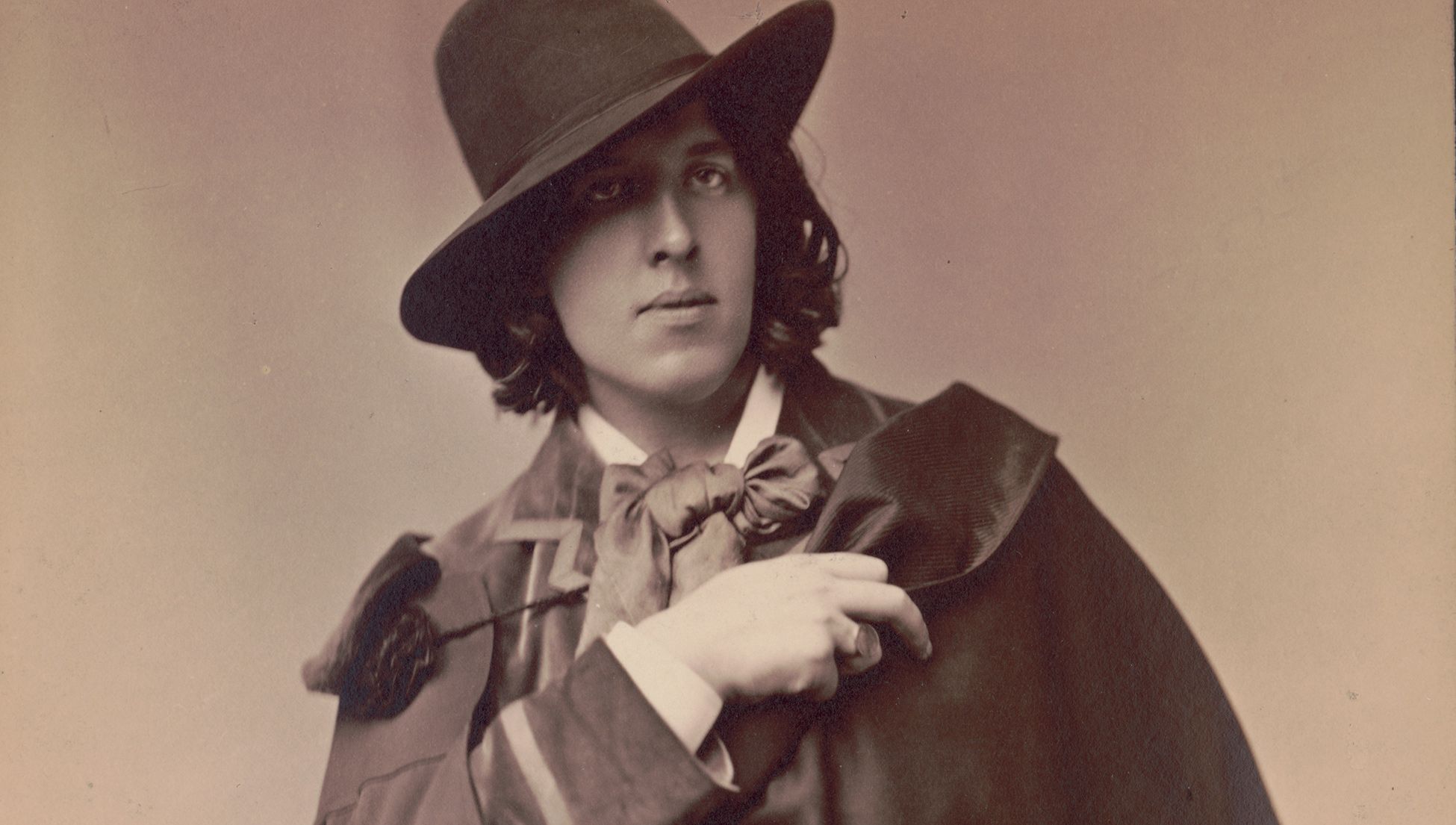
Oscar Wilde photographed by Napoleon Sarony, c1882. Photo courtesy the Library of Congress

Noreen Masudis a Leverhulme Early Career Fellow in the Department of English Studies at Durham University and an AHRC/BBC New Generation Thinker. She is the author of Hard Language: Stevie Smith and the Aphorism (forthcoming, 2021) and A Flat Place (forthcoming, 2023).

Edited by Sam Haselby

1 JUNE 2021 (psyche.co)

Neither the sun nor death can be looked at steadily.
– from Reflections: Or Sentences and Moral Maxims (1665) by François de La Rochefoucauld (1613-1680)

One should never listen. To listen is a sign of indifference to one’s hearers.
– from ‘A Few Maxims for the Instruction of the Over-Educated’ (1894) by Oscar Wilde (1854-1900)

At first glance, the form of the aphorism – a short text, of the sort that pops up everywhere from the Bible to Noël Coward – seems authoritative. It promises a universal truth, pithy wisdom, summed up with piercing snap. Aphorisms declaim their opinions, admitting no doubt. The poet W H Auden described them as ‘aristocratic’, signalling power, confidence and prestige. Many aphorists – La Rochefoucauld, for instance, the 17th-century nobleman who wrote maxims – were indeed wealthy or influential. Or Wilde, son of the philanthropist Sir William Wilde, whose poised, polished witticisms seem to bear the marks of his prosperous upbringing, and register an expectation to be heard and admired.

The critic Susan Sontag underlined the same point in her diary of 1980: ‘Aphorism is aristocratic thinking: this is all the aristocrat is willing to tell you; he thinks you should get it fast, without spelling out all the details.’ But this isn’t quite right. Part of the charm of the aphorism, and mystery, is that it doesn’t really expect its audience to ‘get it fast’, or even get it at all. Its slick form sets out to confound and stymie as much as educate.

One cannot dictate an aphorism to a typist. It would take too long.
– from Karl Kraus (1874-1936)

This mystical quality is partly, as Sontag notes, a power move. But why else might aphorisms not always want to be heard? What sort of speech, and by whom, might deliberately avoid being heard, registered or fully understood?

The association of the aphoristic and the powerful is so strong that we can simply fail to see aphoristic women and their work

The qualities that make aphorisms sound aristocratic also fit them, ironically, to the uses of the powerless. Aphorisms make their points quickly and strikingly. This makes them suited to the way that women and minorities have long had to speak. Women are interrupted more than men are in conversation. To be registered, the speech of the marginalised needs to be both brief and thunderous. As the author of the medieval work The Cloud of Unknowing put it: ‘Short prayer penetrates heaven.’ Advice circulates today, on social media, about the pithiest ways for women to complain or express themselves in a way that, in a patriarchy, might change minds.

If brevity and aphorisms lend themselves to fighting misogyny, why are so few aphorisms attributed to women (with exceptions, such as the poet Dorothy Parker)? Why is the form dominated by men? Perhaps short texts by women have tended, historically, to be anonymous – absorbed into the wider, less prestigious form of ‘proverb’, and circulated without attribution. If we read a line such as ‘A cat may look at a king’ in a collection from an 18th-century aphorist such as Vauvenargues or Chamfort, we’d admire its multilayered brilliance – yet, because it’s categorised as a ‘proverb’, we barely give it a second glance. The association of the aphoristic and the powerful is so strong that we can simply fail to see aphoristic women and their work.

Resistance to being seen, or heard, is a part of how aphorism works. Often, we’re so bowled over by the slickness of an aphorism that we don’t actually register what it’s saying. The sound of the sentence impresses us before our mind has caught up.

The most attractive sentences are not perhaps the wisest, but the surest and soundest.
– from the 1842 journal of Henry David Thoreau (1817-62)

The act of quoting aphorisms, giving voice to their ‘sureness and soundness’, is pleasurable. It often outweighs the meaning; we might barely notice when a glossy aphorism expresses a dull or incorrect idea.

The happiness of man is ‘I will’. The happiness of women is ‘He will’.
– from Thus Spoke Zarathustra (1883-85) by Friedrich Nietzsche (1844-1900)

Strangely, while aphorisms can be striking, the gloss of aphoristic form can offer an excuse to not actually listen to the texts. Aphorisms can offer a space in which one might express a serious message, but make it unhearable or unusable.

Many writers of aphorisms – while publishing and publicising other works – wrote aphorisms in secret, or left them unpublished. After Wilde and Nietzsche, aphorisms seem an offensively self-aggrandising, distinctly public form. But the German satirist Georg Christoph Lichtenberg wrote his aphorisms privately, and Blaise Pascal’s Pensées remained unpublished during the French philosopher’s life. Titling his aphorisms ‘Waste’, Kraus staged the discarding of his own aphorisms even as he published them.

If it’s screaming, it’s screaming into a pillow; if it’s release, it’s unscrewing a fizzed-up bottle a tiny, dramatic bit at a time

Aphorism, in other words, allows its speakers to use it as the site of an open secret. Pain, for instance. Everyone has it, most people want to talk about it, yet no one really wants to hear about it. Talking about one’s pain makes one boring and embarrassing. It imposes on the sympathy and energy of others. The pithy turn of aphorism, however, lets one talk about pain without making emotional demands. So when Auden wrote in 1956: ‘A suffering, a weakness, which cannot be expressed as an aphorism should not be mentioned,’ his point was partly about the importance of making the particular general – aphorisms tend to abstract into universal truths – but along with this abstraction comes a sanitising of individual suffering that relieves the listeners of having to sympathise. They can instead laugh, or nod along sagely.

I hoped I would go to sleep and fall into the street below. I never did. Even a cheap death is hard to come by.
– from The Naked Civil Servant (1968) by Quentin Crisp (1908-99)

Pain can, in this way, be safely expressed – especially structural pain, pain about which no individual can do anything – without inviting an accusation of moaning. One can speak without risking oneself.

Carefully polished speech, like the aphorism, signals an effort toward emotional regulation. Its affects have been managed, corralled. If it’s screaming, it’s screaming into a pillow; if it’s release, it’s unscrewing a fizzed-up bottle a tiny, dramatic bit at a time. Release occurs but is controlled. Boundaries are placed around the feeling; it can be expressed without placing demands on the listener.

We can sometimes assume that dialogue is always productive: that the marketplace of ideas weeds out bad ones. But there are also questions around dialogue, possibilities that it might not be useful: that logic isn’t enough to change people’s minds, or to override their instinctive allegiances.

How few things can be demonstrated! Proofs only convince the mind…
– from the Pensées of Pascal (1623-62)

When one loses faith in dialogue, speech can become indifferent to its audience. It doesn’t expect to change minds, but finds relief in the act of expression. The polished boundaries of aphorism signal that dialogue is unwelcome; no reply is necessary.

The brevity of aphorisms, then – refusing both explanation and dialogue – can either be a power move or in fact a lack-of-power move: a way of expressing oneself safely by remaining unheard. But what are the ethics of this mode of unhearable speech? Is aphorism a powerful venue for minoritarian speech – or a way of supporting the status quo, by refusing dialogic confrontation? Perhaps both. Aphorism makes explicit an urgent contemporary problem: that we live within political and plutocratic structures that are unthreatened even by the revelation of new information or insights. If I can’t change your mind, signals the aphorism, at least I can protect myself, and express myself, with hard rhetorical boundaries.

Jung on facing our own soul

C.G. Jung

“People will do anything, no matter how absurd, in order to avoid facing their own soul. One does not become enlightened by imagining figures of light, but by making the darkness conscious.”

― Carl Jung

People will do anything, no matter how absurd, in order to avoid facing their own Soul
“They’ll obsess over learning Yoga
“They’ll follow the strictest diet regime
“They’ll read all of world literature
“All because they can’t relate to themselves
“ll because they have no faith that anything within them could act as a guide.

–Uberboyo paraphrasing Jung

Uberboyo

Man Reminds Himself That Painful, Nauseating Side Effects Just Means That Triple Bacon Cheeseburger Working

Monday 7:00AM (theonion.com)

SHEBOYGAN, WI—Shrugging off that he had been bedridden for the better part of the day, local man Jamison Kelly reminded himself Monday that the painful, nauseating side effects just meant that the triple bacon cheeseburger he recently consumed was working. “My muscles are cramping, I’m sweating, and I have a piercing headache, but the most important thing is that the three beef patties with crispy bacon and extra cheese are doing exactly what they’re meant to be doing,” said Kelly, adding that he would be more concerned if the 1,500-calorie meal, which also included fries, a soda, and a milkshake, had no negative effects on his body. “Oof. I’m not going to lie, I’ve been in this foggy haze all day, and I took a nap this afternoon where I had insane dreams and sweat through my sheets. I know it’s going to be a rough 24 hours, but the whole point of even ordering a Bacon Beef Blast combo meal is to come out of it on the other side even stronger.” Kelly also told reporters that, especially because he knew he was ordering a triple bacon cheeseburger, he should have planned ahead and taken Tuesday off from work.

Tchaikovsky: Serenade for Strings / チャイコフスキー弦楽セレナーデ【小澤征爾 / サイトウ・キネン・オーケストラ】高音質

Yoshihiro Toba I. 01:51 II. 11:23 III. 15:23 IV. 24:54 Tchaikovsky: Serenade for Strings in C Major, op. 48 Saito Kinen Festival Matsumoto – 1992.9.5 (Recorded Live) Seiji Ozawa / The Saito Kinen Orchestra Nagano-ken Matsumoto Bunka Kaikan (Kissei Bunka Hall) Relevant footage. Brahms : Symphony No 1 https://youtu.be/jyL6QmdLg90 ——————————————————————- チャイコフスキー 弦楽セレナーデ サイトウ・キネン・フェスティバル松本 オープニングコンサート(生放送録画 S-VHS&DAT) 小澤征爾 / サイトウ・キネン・オーケストラ 1992年9月5日  長野県松本文化会館(キッセイ文化ホール) 関連動画 ブラームス 交響曲第1番 https://youtu.be/jyL6QmdLg90

Pluto in Aquarius 2023-2044: Power to the People

One of the most anticipated transits of the decade is Pluto in Aquarius.

Pluto enters Aquarius on March 23rd, 2023, retrogrades back into Capricorn on June 11th, 2023, and then back in Aquarius on January 21s, 2024. Pluto leaves Aquarius on January 19th, 2044.

Yes, you read that right – that’s 20 years of Pluto in Aquarius! Some of us might even be thinking “20 years! Will I even be alive in 2044?”. And as gloomy as this may sound, these are exactly the type of questions a Pluto transit usually triggers.

Every time Pluto enters a new sign (and this only happens once every 20 years on average), our lives, and society as a whole changes in unprecedented ways.

Pluto is still in Capricorn for a while, and some might say it’s too early to talk about Pluto in Aquarius. But perhaps now is the best time to talk about Pluto in Aquarius.

Saturn and Jupiter’s recent transit through Aquarius (2020-2023), have given us a good indication of what Aquarius themes are relevant in today’s world.

Pluto in Aquarius – We, The People

Pluto takes 248 years to go around the Sun. The last time Pluto was in Aquarius was between 1778 and 1798, a period of massive change all over the world.

The American constitution, still considered the pinnacle of democracy, was written when Pluto was in Aquarius.

The Constitution’s first three words – We the People – are perhaps the first modern expression of the Aquarius entity. This entity is not a king, a ruler, nor the government. This is exactly what the European settlers were running away from.

“We the people” is the people – an entity without a leader, an entity that self-governs and self-regulates according to the interests and well being of everyone inside.

In Aquarius, it is this plural entity that takes priority over the individual.

“We the People” is also a reminder that people’s representatives – rulers, governors, politicians, and policy makers – are here to represent and serve their citizens (an important principle that we will come back to later in this article).

Pluto in Aquarius

To understand Pluto in Aquarius, let’s remind ourselves what Pluto is, and what Aquarius stands for.

Pluto is the last planet in our solar system, the ‘final frontier’ of reality as we know it. Pluto is perhaps the most mysterious planet, because it holds the key to the unknown, to what’s on “the other side”.

Common keywords associated with Pluto are: power, depth, transformation, crisis, surrender, resilience, the big natural cycles of birth, death, and rebirth.

Pluto is the higher octave of Mars. Mars is the planet of personal will; when we take action and assert ourselves, that’s Mars. When you go to the grocery store, you act from your Mars, you take the action of going to the grocery store, to meet a personal need.

But if the council decides to close down the grocery store and build a warehouse for Amazon, there’s not much you can do. Of course, you can try to fight the council or sign petitions, but the council is a force greater than yourself, it is the sum of personal interests of multiple individuals.

Similarly, Pluto is the collective dimension of Mars, so it is the sum of all the wills of all the individuals, it is the life force itself.

Pluto is the power of nature. When our personal will (Mars) is aligned with the collective will (Pluto) all is fine… but when it’s not, the collective will, will simply crush our personal will.

Indeed, when Pluto strikes, we often feel we have no say and that we are at the mercy of powers greater than ourselves.

With Pluto, the secret is not to put up a stronger fight, since this is a battle we cannot win – but to surrender, and trust in the workings of the universe.

At the same time, Pluto doesn’t like wimps. So if you think that doing nothing and ‘going with the flow’ is a good way to keep Pluto happy, think again. Pluto wants you to get stronger and to put up a fight if necessary… but Pluto also wants you to know when to call it quits.

Pluto is a Mars that is more strategic, thinks long term, and understands how society works. Politicians, businesspeople, strategists, psychologists oftentimes have a strong Pluto in their chart, and it is exactly their ability to channel the raw force of Mars into long-term, complex projects that makes them successful.

Pluto’s role is to keep the engine of the universe going, by eliminating what can no longer sustain life. If something is rotten, Pluto will eliminate it, to leave space for healthy growth.

Knowing what’s rotten is a good thing. If your tooth rots, you go to the dentist and fix the problem… and save your other teeth. If you want your tree to grow healthy, you trim the dead branches.

At a personal level, Pluto will help you eliminate what is no longer working in your life, helping you build resilience and true personal power – a personal power based on a deep understanding of yourself and of your environment.

At a society level, Pluto will eliminate what’s corrupted and rotten, so that society can grow stronger and be more equipped to withstand difficult conditions.

What about Aquarius?

Aquarius is an Air sign, and we know that Air signs are concerned with communication and the intellect. If Gemini is our internal communication, and Libra, one-on-one communication, Aquarius is a collective sign, so it rules one-to-many and many-to-many communication. That’s why the internet and social media are ruled by Aquarius! Aquarius wants to bring the light of knowledge to as many people as possible.

“Communication” is not only verbal communication, but in general, the “distribution” of thoughts, words, energy, people, resources. It’s interesting that in the human body, Aquarius rules the circulatory system. Aquarius makes sure that information, resources, energy get distributed and shared where they are needed.

We all know that Aquarius rules friends and groups of people. But not only that. Organizations, committees, infrastructure, and councils are all Aquarius. Marketplaces, from the small farmers markets to Amazon, the stock exchange – the largest marketplace in the world – are Aquarius as well.

Because Aquarius rules groups of people, and society is a large group of people, we say that Aquarius rules society as a whole. Society is a sum of all the individuals, plus all the multiple interactions between these people. Society is the most complex Aquarius system out there.

Aquarius has two ruling planets: Saturn (the traditional ruler) and Uranus (the modern ruler). Saturn gives Aquarius an interest in policy-making, and a focus on building solid foundations for the future.

f the cardinal sign of Capricorn, the other Saturn-ruled sign, represents the executive power – the president, the prime minister or the CEO – Aquarius is the Congress, the Supervisory boards, the Unions, and all other entities where people get elected to represent a large group of people, and quality-control the executive power.

Aquarius is also ruled by futuristic Uranus, which gives Aquarius the drive to continuously challenge the status quo, make changes, and innovate. Uranus is the planet of the sky, so Aquarius is also connected with sky-related topics like broadbands, air transportation, astronomy, astrology, astronomy, electricity, reiki, intergalactic communication, and artificial intelligence.

Pluto in Aquarius will expose what is rotten (Pluto) in our society (Aquarius) so that we can build a better structure and infrastructure for everyone here on Earth.

Pluto in Aquarius will initially expose what is no longer working in our society, because this is how Pluto operates: it purges what’s toxic and no longer needed.

Like with any Pluto transit, it won’t be pretty at first.

But this process of a complete overhaul of the very fabric of society is very much needed – a process that will be totally worth the intrusive workings of Plutonic transformation. The result? A more resilient, autonomous society that can self-regulate and quickly adapt to circumstances.

Pluto in Capricorn Vs. Pluto In Aquarius

Pluto has been in Capricorn since 2008. 2008 is when we had the big economic crisis, so we had a Pluto in Capricorn experience pretty much straight away.

Oftentimes, Pluto’s ingress into a new sign comes to correct the flaws of the previous transit. Pluto’s transit in expansive Sagittarius has coincided with the housing and economic bubble, rising inflation and interest rates, production outsourcing, and over reliance on foreign trade.

Pluto in Capricorn has fixed the interest rates issues, but of course, has created different types of issues, like too much consolidation of power at the top.

When Pluto will ingress into Aquarius in 2023, it will most likely correct some of the excesses of Pluto in Capricorn.

The Capricorn Tower of Babel, the Capricorn house of cards, will most likely collapse, allowing for a reorganization and rescheduling of the centers of power, from the bottom up, rather than top-down.

If a country, or a business is ruled by a king, or an owner, all the decisions and everything that happens is pretty much one direction. From top to bottom. Aquarius is not just top down, but is also bottom up, left to right, right to left, and everything in between.

Pluto is the planet of power. With Pluto in Capricorn, the state/government/big institutions were ‘in charge’ and had all the power. Pluto in Capricorn is that Big Father that gives directives, but also looks after their children.

With Pluto in Aquarius there is no more Big Father. With Pluto in Aquarius, we will have to (by choice, or force) stop relying on Capricorn, top-down systems or parent figures.

In Aquarius, we the people have the power, with the opportunities and obligations that come with it.

Pluto in Aquarius – Society, Systems, Infrastructure

Aquarius rules all the systems, routes, and multiple, complex networks, and infrastructure.

Since we are in the process of migrating into the Age Of Aquarius, we have already noticed Aquarius’ archetype embedding itself into all of the aspects of our lives.

Our decisions are driven more and more from the bottom up. We are no longer sold vacation packages. Now we check Tripadvisor to learn other people’s experiences. We select our accommodation based on Airbnb’s feedback, and feedback systems used by companies like Airbnb and Uber discourage fraud and encourage ‘good behaviour’.

These platforms are not perfect, but they have definitely solved some of the problems of the previous systems, and now, most of us can’t imagine our lives without them.

All the big companies that have become successful in the last few decades have Aquarius qualities. Amazon, Google, Facebook, Airbnb, and Uber, are all platforms that facilitate the exchange of goods and information, that bring together demand and supply.

None of these companies produce anything palpable, yet they create value by offering an infrastructure to make information and services exchange more transparent, creating value in the process.

Of course, many of these companies are now also known for shady business practices, and this is something that Pluto in Aquarius will likely correct. Still, these are good examples to illustrate how society has, and will continue to shape under the new Aquarian operating model.

Pluto In Aquarius – The Circle Without The Dot

The good news is that Pluto should feel quite good in Aquarius.

Pluto has been assigned the rulership of Scorpio, and there is not much research on how Pluto ‘behaves’ in other signs.

Given that Pluto, the King of the Underworld, is pretty much the antithesis of the Sun, the light-giver, we can expect Pluto to express itself in a more dignified way when it is in signs where the Sun is NOT dignified: that is Libra (because the Sun is in fall in Libra), and Aquarius (because the Sun is in detriment in Aquarius).

Pluto’s role is to kill the ego (the Sun) so that it can find a power that goes beyond the superficial concerns of the Ego, and get to the bottom of consciousness itself. Scorpio, with its natural connection to the 8th house and planet Mars, has of course a natural affinity with the Plutonic process of transformation.

But so does Libra, and Aquarius. We can expect Pluto to feel quite good in a sign where the Sun doesn’t. This doesn’t mean we will not go through the trials and tribulations that Pluto always exposes us to.

Pluto in Aquarius will be as demanding and transformative as any other Pluto transit. It is just that Pluto behaves more naturally in the sign of Aquarius, and will put on less of a fight than Pluto in Leo, or Pluto in Cancer would.

Pluto In Aquarius – Power To The People

When you read the title of this write-up, “Pluto – Power to the people”, you perhaps rejoiced, thinking something along the lines of: “Great! no more power to the government, corrupt politicians, or greddy businesses … finally, power to ME”.

And the title is a bit ironic when we think of it this way, because “power to the people” doesn’t mean power to you, or to me, or to any other individual. It doesn’t mean that we get to do whatever we want.

It means exactly that: “power to the people”, to that autonomous entity where the majority decides. This means that on average, half of the time, this is not what YOU want – it is what the majority wants.

This concept is very difficult to grasp, because even when reading this, most of us still think “yes, of course, and what I want is what people want”. “I want equality, peace, justice etc, and of course this is what people want, too”.

The thought that power to the people is not necessarily a good thing for you, as an individual may be almost impossible to grasp. But it is something to keep in mind, as the Plutonian Aquarification begins to unfold.

Aquarius And The Fear Of Public Speaking

According to research, many people fear public speaking more than they fear death.

Researchers and historians have tried to explain why this happens. In the past, if you did something wrong, you were dragged in front of the tribe/village/small community, and the community would decide what to do with you.

In many cases, the community would decide to eliminate you, either by excluding you from it, which pretty much meant death, or by killing you straightaway.

Stoning is a good example of Aquarius “punishment”. It was not one individual that killed you, so the individual was exempt from personal responsibility. It was the people’s power, people coming together, that killed the ‘outcast’.

This may have been a practice that served its purpose back in the day, but we can easily see how “power to the people” can easily translate into “herd mentality”, and not something that we would look forward to now.

These examples may sound horrific, and of course, there is not all fear, gloom and doom, but we’re talking about Pluto here, so we all need to toughen up a bit for our own sake. Pluto will eventually empower you, but at first, it will kill your ego.

The Aquarification process can be very humbling, and especially so when Pluto transits Aquarius. Aquarius is the opposite sign from Leo, so it is everything Leo is not. If Leo is about “Me”, Aquarius is about “We”.

Leo encourages us to express our individuality, while Aquarius asks us to conform to the group. This is another Aquarian paradox. We all know Aquarius is ruled by Uranus, and Uranus is all about being original, eccentric, and a genius. So what does this have to do with conforming?

Pluto In Aquarius – “Normal” Is The New Cool

People with Aquarius energy are indeed original and unique… but perhaps a better world to describe the Aquarius energy is “liberated”.

In the safe, inclusive Aquarius container, people find the freedom to be themselves. This is not the same thing as trying to get people’s attention by dressing weird. Pluto doesn’t like wannabes, or people who try to be cool, because when we copy someone else it means we don’t know who we are, as an individual.

If someone dresses like Liberace to make a statement, that’s probably uncool by Pluto’s standards. Liberace was, of course, genuinely cool – because he was himself – and he was genuinely eager to show it to everyone (he had Pluto conjunct an out-of-bounds Venus and the Descendant).

If you genuinely want to wear a 1-meter yellow hat, then you are definitely cool, because this is who you are. Chances are, not many of us will start wearing yellow hats when Pluto is in Aquarius.

Perhaps the real you likes white t-shirts and jeans. When Pluto is in Aquarius, “normal is the new cool”. Normal not in the sense of boring, but in the sense of self-aware, authentic, breezy and relaxed. It is ok to be you, whoever you are.

Pluto In Aquarius – The Light At The End Of The Tunnel

“The light at the end of the tunnel” is such a common phrase, that it has lost its significance. Yet, it beautifully describes the silver lining of a Pluto transit. It is only in Pluto’s underworld that we can find the sacred light of pure consciousness, stripped of ego.

While Pluto always asks us to let go of something that we find it incredibly difficult to live without, while Pluto may want to break our ego, Pluto never wants to break our spirit.

Pluto in Aquarius will help you find your true power. Not a power that seeks to control, take advantage of, and win; but a power that seeks to express one’s truth in a way that serves the best interests of humanity at large.

The Aquarian ‘revolution’ will eventually democratize our society. Pluto in Aquarius is that freedom we can only find when we take responsibility for our lives and become fully autonomous.

Join The Age Of Aquarius

If you want to explore this Aquarian version of the future, there’s no better place than our Age Of Aquarius Community.

Age Of Aquarius is built on Aquarian values, such as inclusion, freedom, bias-free content, and collaboration.

If you want to deepen your knowledge of astrology, here you will find quality and varied content. If you’re interested in the Community aspect, this is a drama-free space, where people are eager to share, and are genuinely interested in you.

If you resonate with these values, join us here:

https://www.ageofaquarius.com/join

by Astro Butterfly (astrobutterfly.com)

Relationship as a Spiritual Practice: Terry Real in Conversation with Thomas Hübl

Thomas Hübl To find out more about Terry and Thomas’ work on mystical relationships, visit http://evolutionaryrelationships.com In this deep and uplifting dialogue, Thomas interviews therapist and author Terry Real about how relationship can be approached as a spiritual practice. Terry describes in detail how we can apply loving self-discipline to contain our inner child, heal old wounds, act with compassion, and move towards greater intimacy even during the most trying moments in our intimate relationships. Recorded at the Celebrate Life Festival in August, 2018. —– More Info about Thomas Hübl: http://www.thomashuebl.com

Debunking Stephen Hawking on God

When prejudice beats I.Q.

Michele Ramarini · Apr 14 · Medium.com

Stars in a galaxy.
Photo by Jeremy Thomas on Unsplash

Prof. Stephen Hawking needs no introduction. As a theoretical physicist and cosmologist, he significantly contributed to our knowledge of the universe. Besides being a huge bestseller, his A Brief History of Time was my first acquaintance with cosmology many years ago.

The God Hypothesis

And yet, the late professor had a blind spot when it came to the “God Hypothesis”. I am calling it that way on purpose because I am not going to talk about religion, spirituality, or any man-made image of the “Heavenly Father”. his piece is about philosophy, with the meaning of rational thinking and argumentation.

Hawking’s Atheism

Prof. Hawking’s atheism is well-known. He never shied away from stating his disbelief in the existence of a creator of the universe. Sadly, he did not stop at expressing a personal belief, to which we are all entitled in one way or the other:

“We are each free to believe what we want and it is my view that the simplest explanation is there is no God.”

He added seemingly apodictic assertions (affirmations that are considered beyond dispute, being self-evident or necessary), which cannot be disproven but cannot be proven true either:

“Spontaneous creation is the reason there is something rather than nothing, why the universe exists, why we exist. It is not necessary to invoke God to light the blue touch paper and set the universe going.”

And fell in a trap of his own making by uttering a platitude accompanied by a misrepresentation:

“Before we understand science, it is natural to believe that God created the universe. But now science offers a more convincing explanation.”

Sorry, Prof. Hawking. Not so fast.

The Grand Design

My rejection of Prof. Hawking’s views about God is based on one of his later works, The Grand Design, a book entirely dedicated to demonstrating that the laws of physics alone explain the origins of the universe, making the “God Hypothesis” superfluous.

Referring to questions such as: “What is the nature of reality? Where did all this come from? Did the universe need a creator?”, Hawking writes:

Traditionally these are questions for philosophy, but philosophy is dead. Philosophy has not kept up with modern developments in science, particularly physics. Scientists have become the bearers of the torch of discovery in our quest for knowledge. (p. 13)

Already in the second paragraph of the book, Prof. Hawking shows us how little appreciation he has for a field of knowledge that happens to be outside of his professional expertise.

Claiming that “philosophy is dead” is not only offensive to legions of philosophers and Philosophy students, who could all explain to him that philosophy is alive and well. It is also false. Philosophy is so well, in fact, that any freshman in the discipline should be able to identify no less than two blunders in that segment alone.

Is Philosophy Dead?

First, Prof. Hawking declares philosophy dead, not realizing that his endeavor is eminently philosophical by nature. Trying to prove that the laws of physics explain the existence of the universe is philosophy (dare I say metaphysics?), even when some very famous and very respected physicist believes it is science. Any scientific investigation back in time can only go as far as the Big Bang, never beyond it — note how I wrote beyond, and not before, a term that would instantly trigger physicists and materialists to overreact — where there is no natural world to research.

Second, he makes a serious mistake of epistemology: Prof. Hawking seems to imply that there is only one form of knowledge, the one he masters. That is not the case. We must establish a critical distinction: Physics (as well as all science) does not deal with the same kind of knowledge that is the realm of philosophy. Physics deals with facts, physical objects,and natural laws; philosophy deals with meanings and actions. Science studies the natural world as it presents itself to us and tries to identify the laws that govern it; philosophy studies something different entirely. One definition I like, by the Department of Philosophy of a U.S. university, is as follows:

“Philosophy is an activity people undertake when they seek to understand fundamental truths about themselves, the world in which they live, and their relationships to the world and to each other.”

Philosophy or Science?

Let me expound on this a little. One of the keenest minds of all time, the 18th-century Prussian philosopher Immanuel Kant, thus articulated the three questions philosophy was called to answerWhat can I know? What must I do? What may I hope? None of those questions can be answered by physics, nor by science as a whole. Not even the first of the three, despite it seemingly having to do with knowing the phenomenal (physical) world.

Kant himself explained why in his Critique of Pure Reason (1781). Our knowledge’s boundaries are not those imagined by Hawking (telescopes, microscopes, mathematical calculations, bright minds like his own, etc.), but those constitutive of what we are as humans. For example, any knowledge of the world we may ever achieve will always be mediated by our senses; there is no way around it. Hence, we cannot know a world beyond the sensible one and have no way of knowing if such a world — a supersensible world — does indeed exist. Can science refute the existence of such a world? No, and religious beliefs have nothing to do with it. Pure reason is all it takes.

There is another point to clarify that is often misunderstood by laymen. Science is not a doctrine, let alone a collection of truths. If it were, it would be awkwardly similar to a religious cult, wouldn’t it? Science is a method of investigation of the natural world, where natural is the defining word; it is called the scientific method for a reason.

M-Theory

It would be impossible to summarize the content of Hawking’s book in the space of a post. Luckily, it won’t be necessary. To achieve this piece’s aim, it will suffice to reject the authors’ conclusions, which I shall do shortly.

The body of the book consists of citations from ancient philosophers, creation myths, historical anecdotes, and, above all, Hawking’s introduction to the M-theory, a “network of theories” (p. 77) which he considers “the only candidate for a complete theory of the universe” (p. 228)

“According to M-theory, ours is not the only universe. Instead, M-theory predicts that a great many universes were created out of nothing. Their creation does not require the intervention of some supernatural being or god. Rather, these multiple universes arise naturally from physical law. They are a prediction of science. (p. 18)”

Unfortunately, what seems to escape the authors of this book is that anything they describe is not creation. It is something that follows creation, whatever meaning you want to give that loaded word. That’s not a scientific observation but a logical inference. And it is decisive.

Conclusion and Refutation

This is the authors’ conclusion, as expressed towards the end of the book:

Because there is a law like gravity, the universe can and will create itself from nothing in the manner described in Chapter 6. Spontaneous creation is the reason there is something rather than nothing, why the universe exists, why we exist. It is not necessary to invoke God to light the blue touch paper and set the universe going. (p. 227)

The whole paragraph is highly problematic from a philosophical standpoint. It is based on two colossal logical fallacies, and it leaves no doubt about how flawed the authors’ reasoning is.

  1. The authors would like us to believe that the “universe can and will create itself from nothing”. If we use Aristotle’s model of the four causes, we are supposed to believe that the universe is the efficient cause of itself. It is literally the same as asking us to believe that we can pull ourselves up by our bootstraps. Did that ever work?
  2. The authors aren’t really advocating for a universe that created itself from nothing, either. First, “there is a law like gravity”. How clever. Yet, a natural law is not nothing; it is something. May I also point out that there cannot be any natural law in the absence of a universe? What we call nature emerges with the Big Bang. Talking about laws of nature in the absence of nature — i.e. the universe — does not make any sense. Put another way: The word gravity comes from the Latin word gravitas, which substantivizes the adjective gravis, which means heavy. Referring to gravity in the absence of objects with mass, on which the force of gravity would act, is patently absurd.

Gravity as the Creator

To sum it up: In Hawking’s magical world, the universe is the efficient cause of itself, and gravity works in the void — possibly a quantum vacuum state, which is still something, not nothing — without any objects on which to exercise its force. How this bizarre explanation, that is anything but scientific (for starters, it is not falsifiable, like any other theory that tries to go beyond the so-called Big Bang), is in any way superior to the idea of a creator — which, of course, would need to be postulated as being eternal, existing outside of time and space, to avoid the contradictions of Hawking’s model — remains unsolved.

To be clear: I am not alone in finding fault in Hawking’s theory of “spontaneous creation”. Physicists and philosophers alike have criticized this approach, sometimes in harsh terms.

Paul Davies wrote: “The multiverse comes with a lot of baggage, such as an overarching space and time to host all those bangs, a universe-generating mechanism to trigger them, physical fields to populate the universes with material stuff, and a selection of forces to make things happen. Cosmologists embrace these features by envisaging sweeping “meta-laws” that pervade the multiverse and spawn specific bylaws on a universe-by-universe basis. The meta-laws themselves remain unexplained — eternal, immutable transcendent entities that just happen to exist and must simply be accepted as given. In that respect, the meta-laws have a similar status to an unexplained transcendent god.”

Final Thoughts

It is the lack of an agent operating outside the laws of nature to make every model of creation conceived by atheists so murky. In getting rid of the “God Hypothesis”, Prof. Hawking is left with a “Gravity Hypothesis”. But a law has no agency, and it does not seem plausible that it might “create” anything. Furthermore, a natural law outside or before nature is a contradictory concept. But that’s philosophy, and Prof. Hawking shows little sign of understanding this discipline.

I don’t know if something that resembles the most common definitions of God exists, and neither did Stephen Hawking. What I do know is that Prof. Hawking’s attempt at explaining the coming into existence of our universe by way of “spontaneous creation” is at the very least unconvincing. Speaking of the origin of the universe and why and how the so-called Big Bang occurred, “we don’t know” is the only honest answer.

The Apeiron Blog — Big Questions, Made Simple.

We know that Philosophy can seem complicated at times. To make things simple, we compile together the best articles, news, reading lists — and other free resources to guide you on your journey. To continue with us, follow us on Medium and sign up to our free mailing list.The Apeiron Blog

Exploring philosophy — to find truth & better ourselves along the way.Follow

Thanks to Jon Hawkins. 

WRITTEN BY

Michele Ramarini

Politics, society, religion. Unceremoniously.

The Apeiron Blog

The Apeiron Blog

An easy to read philosophical space that aims to elicit discussion and debate on matters of the universe.

Consciousness, spirituality, biography, sexuality, androgyny, futurism, space, the arts, science, astrology, democracy, humor, books, movies and more