
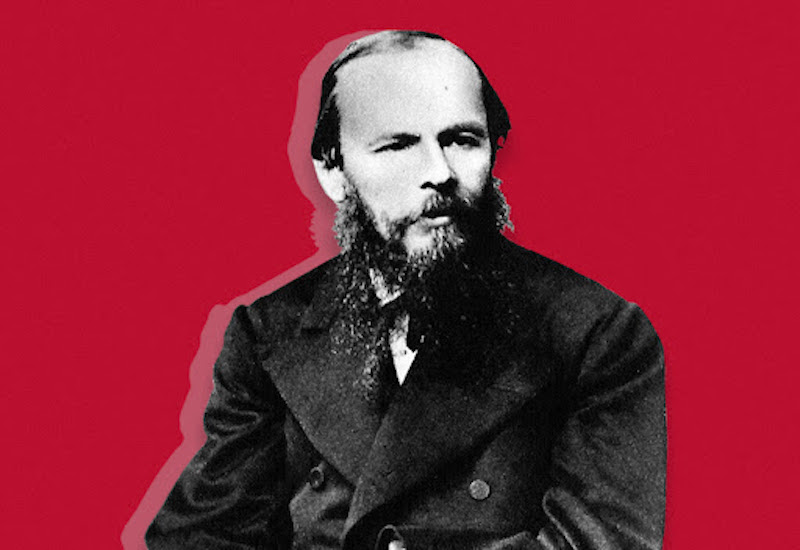
| Fyodor Dostoevsky was just like you: he read banned books. Unlike you (probably—and so far), he was arrested and sentenced to death for it. In the 1840s, the Russian novelist was part of a progressive group called the Petrashevsky Circle, whose primary purpose was to discuss literary and philosophical texts that had been banned by the government of Tsar Nicholas I. In April of 1849, Dostoevsky and other members of the group were arrested for their literary “activities,” which were decried as “anti-Russian.” They were sent to prison, and on November 16th, sentenced to death for crimes committed while at book club. On the morning of December 22nd, the prisoners were led in front of the firing squad, but at the last moment, the soldiers lowered their guns—a messenger had shown up with a commutation from the Tsar. After this little bit of theater, which Nicholas I had planned in advance, the prisoners were officially exiled and packed off to a prison camp in Siberia, where Dostoevsky would remain until February 14, 1854. The experience would inform his 1869 novel The Idiot, in which Prince Myshkin recounts an anecdote that hews very closely to Dostoevsky’s experience: a man is sentenced to death for “a political offense” and spared at the last moment. “The uncertainty and feeling of version for that new thing which would be and was just coming was awful,” Dostoevsky writes. But he said that nothing was so dreadful at that time as the continual thought, ‘What if I were not to die! What if I could go back to life—what eternity! And it would all be mine! I would turn every minute into an age; I would lose nothing, I would count every minute as it passed, I would not waste one!’ He said that this idea turned to such a fury at last that he longed to be shot quickly. Luckily for literature, he was not. |
| “The best way to keep a prisoner from escaping is to make sure he never knows he’s in prison.” |
| –FYODOR DOSTOEVSKY One Day in the Life of Ivan Denisovich |