The Capricorn Full Moon puts us in the director’s chair. We are in practical mode, making executive decisions and leading the way. We can suddenly make a lot of progress in any number of situations. Nonetheless, some of it can be slow going, as laying down the law can be a prelude to backlash and discord.
This theme is especially reflected in the Moon’s opposition to Mercury in Cancer (which joins the Sun). We may encounter creative viewpoints alongside raised emotions. But, it’s worth remembering that Cancerian outpourings are often healthier when they’re expressed openly, and tend to become troublesome when they’re suppressed, resulting in resentments brewing or stewing!
The Full Moon–Mercury connection is a focus on polar opposites. Whether we’re dealing with our own or someone else’s contrary feelings and arguments, it may seem temporarily impossible from such divided positions to imagine reaching a middle ground. Yet, understanding each side and what precipitates the swing between them may enable us to spot a compromise in the center. Failing that, we might just need to devote some energy to manage running between the extremes so we can keep heading towards the best result.
The great thing about Full Moon energy is that it really is just part of a cycle. Everything is intensified at this point, and the overall vista could soon look quite different. So, patience is a virtue to keep hold of as we navigate this intense terrain.
Considering the rather sensitive lineup, it might be useful to be cognizant of your words — and, in some cases, even with your thoughts. Some may be useful, but the mind can be a tricky apparatus, creating enormous stories from the smallest amount of information — in whatever forms that appear to us. Since the Moon sextiles Saturn in Pisces, it’s wise to keep our feet on the ground, stick to facts, and work within clear parameters. Sharing everyday food rituals can also lend everyone extra support.
Because the Moon happens to trine Jupiter, we may have some natural good fortune, even if we ought not push our luck! Jupiter is in pragmatic Taurus, a sign linked with the concept of capital — or, in a slightly broader sense, what we’re worth, what we earn, and what we own. It may well be that life becomes easier or more pleasurable because an investment pays off, a helpful job offer arrives, or a gift appears, for example. In this instance, there’s no need for debate; the most words we will use might be “thank you,” while we count our blessings!
Faithful, bountiful Jupiter also prompts us to look where we can be expansive, or generous, or both. We might be thinking about building for the future, despite resources being temporarily scarce. It could be that a cumulative effort, over time, will start to show obvious benefits. Since Saturn in Pisces is the Moon‘s dispositor, we are reminded to monitor where to draw the line to stop the tide or the drift in a certain situation before things get out of hand. Given these different focuses, a balancing act is to be performed — perhaps, especially, to address a matter where someone was treated unfairly. It can likely all be managed when we observe the truth of the situation and ask for signs towards a workable solution.
This article is from the Mountain Astrologer by Diana McMahon Collis
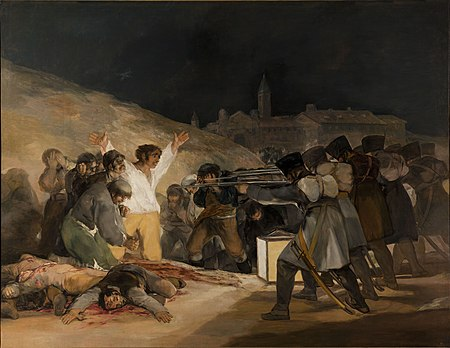
The Third of May 1808 (also known as El tres de mayo de 1808 en Madrid or Los fusilamientos de la montaña del Príncipe Pío,[2] or Los fusilamientos del tres de mayo)[1] is a painting completed in 1814 by the Spanish painter Francisco Goya, now in the Museo del Prado, Madrid. In the work, Goya sought to commemorate Spanish resistance to Napoleon‘s armies during the occupation of 1808 in the Peninsular War. Along with its companion piece of the same size, The Second of May 1808 (or The Charge of the Mamelukes), it was commissioned by the provisional government of Spain at Goya’s suggestion.
The painting’s content, presentation, and emotional force secure its status as a ground-breaking, archetypal image of the horrors of war. Although it draws on many sources from both high and popular art, The Third of May 1808 marks a clear break from convention. Diverging from the traditions of Christian art and traditional depictions of war, it has no distinct precedent, and is acknowledged as one of the first paintings of the modern era.[3] According to the art historian Kenneth Clark, The Third of May 1808 is “the first great picture which can be called revolutionary in every sense of the word, in style, in subject, and in intention”.[4]
Napoleon I of France declared himself First Consul of the French Republic on November 10, 1799, and crowned himself Emperor in 1804. Because Spain controlled access to the Mediterranean, the country was politically and strategically important to French interests. The reigning Spanish sovereign, Charles IV, was internationally regarded as ineffectual. Even in his own court he was seen as a “half-wit king who renounces cares of state for the satisfaction of hunting”,[5] and a cuckold unable to control his energetic wife, Maria Luisa of Parma.[6] Napoleon took advantage of the weak king by suggesting the two nations conquer and divide Portugal, with France and Spain each taking a third of the spoils, and the final third going to the Spanish Prime Minister Manuel de Godoy, along with the title Prince of the Algarve. Godoy was seduced, and accepted the French offer. He failed, however, to grasp Napoleon’s true intentions, and was unaware that his new ally and co-sovereign, the former king’s son Ferdinand VII of Spain, was using the invasion merely as a ploy to seize the Spanish parliament and throne. Ferdinand intended not only that Godoy be killed during the impending power struggle, but also that the lives of his own parents be sacrificed.[5]
Under the guise of reinforcing the Spanish armies, 23,000 French troops entered Spain unopposed in November 1807.[7] Even when Napoleon’s intentions became clear the following February, the occupying forces found little resistance apart from isolated actions in disconnected areas, including Zaragoza.[8] Napoleon’s principal commander, Marshal Joachim Murat, believed that Spain would benefit from rulers more progressive and competent than the Bourbons, and Napoleon’s brother Joseph Bonaparte was to be made king.[9] After Napoleon convinced Ferdinand to return Spanish rule to Charles IV, the latter was left with no choice but to abdicate, on March 19, 1808, in favor of Joseph Bonaparte.
Although the Spanish people had accepted foreign monarchs in the past, they deeply resented the new French ruler. A French agent in Madrid wrote that “Spain is different. The Spaniards have a noble and generous character, but they have a tendency to ferocity and cannot bear to be treated as a conquered nation. Reduced to despair, they would be prepared to unleash the most terrible and courageous rebellion, and the most vicious excesses.”[10] On May 2, 1808, provoked by news of the planned removal to France of the last members of the Spanish royal family, the people of Madrid rebelled in the Dos de Mayo Uprising. A proclamation issued that day to his troops by Marshal Murat read: “The population of Madrid, led astray, has given itself to revolt and murder. French blood has flowed. It demands vengeance. All those arrested in the uprising, arms in hand, will be shot.”[11] Goya commemorated the uprising in his The Second of May, which depicts a cavalry charge against the rebels in the Puerta del Sol square in the center of Madrid, the site of several hours of fierce combat.[12] Much the better known of the pair, The Third of May illustrates the French reprisals: before dawn the next day hundreds of Spaniards were rounded up and shot, at a number of locations around Madrid. Civilian Spanish opposition persisted as a feature of the ensuing five-year Peninsular War, the first to be called guerrilla war.[9] Irregular Spanish forces considerably aided the Spanish, Portuguese, and British armies jointly led by Sir Arthur Wellesley, who first landed in Portugal in August 1808. By the time of the painting’s conception, the public imagination had made the rioters symbols of heroism and patriotism.[13]
Like other Spanish liberals, Goya was placed in a difficult position by the French invasion. He had supported the initial aims of the French Revolution, and hoped for a similar development in Spain. Several of his friends, like the poets Juan Meléndez Valdés and Leandro Fernández de Moratín, were overt Afrancesados, the term for the supporters—collaborators in the view of many—of Joseph Bonaparte.[14] Goya’s 1798 portrait of the French ambassador-turned-commandant Ferdinand Guillemardet betrays a personal admiration.[15][16] Although he maintained his position as court painter, for which an oath of loyalty to Joseph was necessary, Goya had by nature an instinctive dislike of authority.[17] He witnessed the subjugation of his countrymen by the French troops.[18] During these years he painted little, although the experiences of the occupation provided inspiration for drawings that would form the basis for his prints The Disasters of War (Los desastres de la guerra).[15]
In February 1814, after the final expulsion of the French, Goya approached the provisional government with a request to “perpetuate by means of his brush the most notable and heroic actions of our glorious insurrection against the Tyrant of Europe”.[19] His proposal accepted, Goya began work on The Third of May. It is not known whether he had personally witnessed either the rebellion or the reprisals,[12] despite many later attempts to place him at the events of either day.[20]
Discover wisdom and guidance to face the climate emergency from the most influential spiritual and environmental leaders of our time, including the Dalai Lama, Greta Thunberg, Jane Goodall, Matthieu Ricard, Joanna Macy, Rebecca Solnit, and Paul Hawken.
When the Dalai Lama and Greta Thunberg spoke for the first time in January 2021, millions of people around the world took notice. “It is encouraging to see how you have opened the eyes of the world to the urgency to protect our planet, our only home,” the Dalai Lama wrote to Greta before their meeting.
A Future We Can Love shares the words of these two great figures, generations apart, bringing them into dialogue with dozens of visionary scientists, activists, and spiritual luminaries. These include Jane Goodall, environmentalist Paul Hawken, Buddhist teacher Matthieu Ricard, indigenous scholar and artist Lyla June, environmental activist and Buddhist scholar Joanna Macy, and writer, historian, and activist Rebecca Solnit. Through this world-changing conversation, readers embark on a four-part journey toward active hope in the face of the climate crisis: from knowledge of climate science through the capacity for change, to the will that is needed and the actions we can take. The book will help you:
– recognize interdependence as key to our well-being and as a lens for – understanding both the climate crisis and its solutions – clarify why feedback loops leave us no time to wait on climate action – comfort your climate anxiety and metabolize grief or burnout into wonderment and useful energy – develop your own rituals and practices for connecting to Earth and renewing hope – overcome common obstacles to speaking and acting clearly on behalf of the human and wild communities most affected by the climate crisis
A Future We Can Love inspires each of us to rise to the occasion to ensure a brighter future for generations to come.
DW Documentary Dec 4, 2019 Some say LSD produces hallucinations and lowers inhibitions. Others believe it makes people more capable, efficient and creative. In Silicon Valley, many even say LSD can be a tool for self-improvement. More and more people in Germany are discovering what’s known as microdosing in order to be the best they can be. Every three days, a 28-year-old man takes his LSD out of the freezer and slowly lets the ice cube containing the drug melt on his tongue. He’s taking ten micrograms of LSD. He learned about it online and says the allegedly harmless dose makes him feel more focused, productive and empathetic. The trend from Silicon Valley is an open secret at many innovative start-up companies. Paul Austin, who’s something of an LSD guru in Silicon Valley says, “People who responsibly take psychedelic drugs in microdoses will rule the job markets of the future.” But others are sceptical. They warn about self-medication, saying there’s no way of knowing the LSD’s concentration. If things go wrong, psychoses and persistent sensory disorders may follow. But this documentary shows there is more to it. After years of being locked away with the poisons, ‘acid’ is back and a hit among a new generation of researchers and doctors. Some say it can ease depression and anxiety. So is LSD good medicine? This film explores the past and present of a drug that was legal until the 1960s and was used by doctors to treat the blues and alcohol addiction. ——————————————————————– DW Documentary gives you knowledge beyond the headlines. Watch high-class documentaries from German broadcasters and international production companies. Meet intriguing people, travel to distant lands, get a look behind the complexities of daily life and build a deeper understanding of current affairs and global events. Subscribe and explore the world around you with DW Documentary.
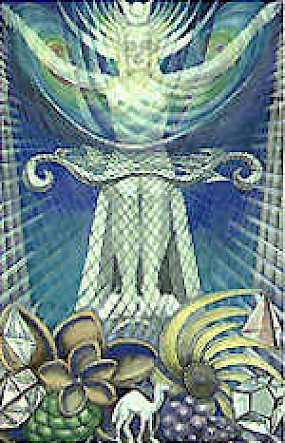
The Priestess (or High Priestess, Papess, Pope Joan, Isis) is numbered two. This is the representation of the Goddess. She is the complementary partner of the Magician, possessing all his skill and ability, but with far more insight and psychism. She is more subtle yet somehow far more noticeable.
She is almost always shown with the Lunar Crescent, conveying her natural affinity with the forces of Nature and natural cycles. The Magician generates his own power, whereas the Priestess draws upon the forces of life itself.
She sits between two pillars with veils suspended between them – it is the Priestess who allows us to penetrate the innermost secrets of life. She is also the bridge between our conscious and Higher selves, by teaching us through our dreams and our subconscious. It is in our subconscious that we hold the keys to the Universe.
The Astrology Podcast Jun 30, 2023 A look ahead at the astrological forecast for July of 2023, with astrologers Chris Brennan, Austin Coppock, and Kira Sutherland! This month Venus stations retrograde in the sign of Leo, and transiting Mars in Virgo opposes Saturn in Pisces. At the top of the episode we discuss the astrology of some recent stories in the news, largely focusing on the first Saturn station in Pisces and how that coincided with a string of notable ocean related stories. This episode is available in both audio and video versions below.
Matthew Stelzner Jun 29, 2023 This is the Year we Level Up In these coming months if you point your telescope towards Jupiter it won’t be hard to find Uranus nearby. The last time these two planets came together was from March of 2010 to March of 2011. Take a moment to consider those months to see if it was a time when you leveled up at the game of life. Was it a year when you broke free of the past and leapt confidently into the future? The level-up that occurred that year has now been all played out. Are you ready to take it to the next level, and show the universe your moves? Are you ready for your next quantum leap, your next moon-shot, your next consciousness upgrade? The previous conjunction happened during most of 1997. Consider that year also. Can you see ways that that was also a major level-up year for you, whether that be spiritually, creatively, career wise, or perhaps even cosmologically? Did your perception of your life, your place in the universe, and your sense of your own human potential expand during that year? If not, then recognize that every one of these conjunctions represents another opportunity to go quantum and fly to higher possibilities, but only if you want that ticket to ride. There are risks in getting on board starships, and you’re liable to break free of an ego constraint that you are not quite ready to let go of. Are you ready to see the world and your life from a radically expanded perspective? Are you ready for your eyes to go wide with awe and amazement, as you take in some new expanded understanding of what your future might look like? These potentials can be made manifest if there is a willingness to leap towards something that might be radically new and unexpected. Can you relax into the moment and let the upwinds carry you high so that you can see what may lay ahead? To check out more of my work, see my blog, and get information about my intuitive readings, visit my website at: http://stelz.biz/
Do you feel overwhelmed by the complex issues facing our world, not to mention your own personal problems? Spirituality is the key to staying grounded and hopeful — even for skeptics, says actor and author Rainn Wilson. He explains why it’s time for all of us to experience a spiritual shake-up and outlines two paths to tap into your innate wisdom, kindness and strength. The work begins within yourself. (This conversation, hosted by TED’s Carla Zanoni, was part of an exclusive TED…SHOW MORE
Translation is a 5-step process of “straight thinking in the abstract.” The first step is an ontological statement of being beginning with the syllogism: “Truth is that which is so. That which is not truth is not so. Therefore Truth is all there is.” The second step is the sense testimony (what the senses tell us about anything). The third step is the argument between the absolute abstract nature of truth from the first step and the relative specific truth of experience from the second step. The fourth step is filtering out the conclusions you have arrived at in the third step. The fifth step is your overall conclusion.
The claims in a Translation may seem outrageous, but they are always (or should always) be based on self-evident syllogistic reasoning. Here is one Translation from this week.
1) Truth is that which is so. That which is not truth is not so. Therefore Truth is all that is. Truth being all is therefore total, whole, complete, otherless, therefore one, therefore united, therefore harmonious, therefore orderly. I think therefore i am. Since I am and since Truth is all that is, therefore I am Truth. Since I am Truth, therefore I, being, am total, whole, complete, otherless, one, united, harmonious. Since I am Truth and since I am Consciousness, therefore Truth is Consciousness.
2) People with pelvic pain don’t want to get fucked (in any sense of the word).
Word-tracking: people: pleb, commoner as opposed to the aristocracy, mortal mortal: that which dies aristocracy: rule by the best pelvic: pelvis, sex, merging of male and female pain: threat fucked: sexual intercourse, disrespected respect: regard, admire
3) Truth being that which is right, correct is therefore flawless, perfect. Truth being perfect is therefore not guilty of any wrong-doing ’cause Truth can only be Right-doing. Therefore Truth is totally absolved, set free. Truth being whole, complete and perfect, is therefore wonderful. Truth being wonderful cannot at the same time be disrespected/fucked with. Therefore Truth is unfuckwithable. Truth being unfuckwithable, there can be no threat to Truth, therefore Truth is comfortable within its own skin, so to speak. Truth being one, there can be no merger of male and female as two separate entities. Therefore what Truth has joined together, no limited thought can rend asunder OR Truth is married in Its androgynous Self. Truth being one entity, one being, one knowing, one consciousness, therefore sexuality or malefemaleness in Truth is knowing and being known. Truth being one entity, cannot be divided between aristocracy (the best) and commoner (the rest). There cannot be a good, better and best in Truth. Therefore Truth/Good is common to all equally. Truth being all cannot be limited in time or space, therefore Truth is was never born and can never die. Therefore Truth is not mortal (that which dies) but immortal
4) Truth can only be Right-doing. Truth is totally absolved, set free. Truth is unfuckwithable. Truth is comfortable within its own skin, so to speak. What Truth has joined together, no limited thought can rend asunder Truth is married in Its androgynous Self. Sexuality or malefemaleness in Truth is knowing and being known. Truth/Good is common to all equally. Truth is not mortal (that which dies) but immortal
5) Sexuality, malefemaleness, in Truth is Knowing and Being Known.
The Weekly Invitational Translation Group invites your participation as well. If you would like to submit a Translation on any subject, feel free to send your weekly Translation to zonta1111@aol.com and we will anonymously post it on the Bathtub Bulletin on Friday.
Genius of the Ancient World | Episode 1 | BBC Select Jun 15, 2023 What happened in the 5th century BC changed your life. This was the time when three trailblazers – the Buddha, Confucius and Socrates – transformed our understanding of human potential, cutting us loose from gods, making us deciders of our own destiny. All survivors of childhood trauma, living thousands of miles apart, what was it about their time that created ideas that still shape our own lives? BBC Select is the new home for documentaries. Available in the U.S and Canada. Find out more and start your free trial: https://bit.ly/3kwM3bU
Consciousness, spirituality, biography, sexuality, androgyny, futurism, space, the arts, science, astrology, democracy, humor, books, movies and more