Léon-Joseph-Florentin Bonnat (French, 1833–1922) Jacob Wrestling the Angel, 1876 Pencil and black chalk on paper, 20 3/4 x 14 1/2 in. Signed and dated lower left: L’Bonnat. 1876 2002.30
This is either a highly finished study for, or a variant after, a painting that Bonnat exhibited at the Salon in 1876 (location unknown). With its emphasis on tensed musculature and the interaction of anatomical forms, this work illustrates perfectly how integral the numerous life drawings of nude male models (called académies because of their role as the most fundamental part of academic training) were to an artist’s formation of fully realized narrative compositions.
As an artist and a teacher, Bonnat was adamant in the fundamental importance of skillful drawing. In a letter translated and published in The American Magazine of Art in 1916, Bonnat declared: “Drawing and form: from those foundations we never stray; we cannot, we ought not to, because they are the conditions absolutely requisite to eternal beauty; and from antique art to contemporary, in passing through all the great epochs…it is by form and drawing alone that the world has been enriched with so many masterpieces.”
Jacob Wrestling the Angel illustrates the Biblical passage from Genesis 32:23-31 in which Jacob spends an entire night wrestling with a mysterious angel after crossing the river Jabbok with his family. This enigmatic combat has been variously interpreted as man’s struggle against God, against Satan, or against himself.
Stendhal syndrome, Stendhal’s syndrome or Florence syndrome is a psychosomatic condition involving rapid heartbeat, fainting, confusion, and even hallucinations,[1] allegedly occurring when individuals become exposed to objects, artworks, or phenomena of great beauty and antiquity.[2]
Stendhal syndrome was named after Marie-Henri Beyle (1783–1842), better known by his pen name, Stendhal.
The affliction is named after the 19th-century French author Stendhal (pseudonym of Marie-Henri Beyle), who described his experience with the phenomenon during his 1817 visit to Florence in his book Naples and Florence: A Journey from Milan to Reggio. When he visited the Basilica of Santa Croce, where Niccolò Machiavelli, Michelangelo and Galileo Galilei are buried, he was overcome with profound emotion. Stendhal wrote:
I was in a sort of ecstasy, from the idea of being in Florence, close to the great men whose tombs I had seen. Absorbed in the contemplation of sublime beauty . . . I reached the point where one encounters celestial sensations . . . Everything spoke so vividly to my soul. Ah, if I could only forget. I had palpitations of the heart, what in Berlin they call ‘nerves’. Life was drained from me. I walked with the fear of falling.[3]
Although psychologists have long debated whether Stendhal syndrome exists,[1] the apparent effects on some individuals are severe enough to warrant medical attention.[4] The staff at Florence’s Santa Maria Nuova hospital are accustomed to tourists suffering from dizzy spells or disorientation after viewing the statue of David, the artworks of the Uffizi Gallery, and other historic treasures of the Tuscan city.[1]
Though there are numerous accounts of people fainting while taking in Florentine art, dating from the early 19th century, the syndrome was only named in 1979, when it was described by Italian psychiatrist Graziella Magherini, who observed over a hundred similar cases among tourists in Florence. There exists no scientific evidence to define Stendhal syndrome as a specific psychiatric disorder; however, there is evidence that the same cerebral areas involved in emotional responses are activated during exposure to art.[5] The syndrome is not listed as a recognised condition in the Diagnostic and Statistical Manual of Mental Disorders.
“The day science begins to study non-physical phenomena, it will make more progress in one decade than in all the previous centuries of its existence.”
― Nikola Tesla
Nikola Tesla (July 10, 1856 – January 7,1943) was a Serbian-American inventor, electrical engineer, mechanical engineer, and futurist best known for his contributions to the design of the modern alternating current electricity supply system. Wikipedia
July is a BIG month! In July we have 2 major transits that only happen every 1.5 years on average: the Lunar Nodes change signs and Venus goes retrograde.
When big shifts like this happen, life gets busy. Changes arise. We shift our focus. In July, big things are coming your way!
Pluto (at the anaretic degree, 29° Capricorn) squares the Lunar Nodes for pretty much the entire month, inviting us to “break the generational cycle” and heal deeply ingrained behavioral patterns.
Chiron stationary retrograde will help us take ownership of our generational wounds. Our wounds are not our fault – they have been inflicted on us just like they have been inflicted on our parents, grandparents, great-grandparents and so on.
But just because our wounds are not our fault, this doesn’t mean we don’t have a responsibility – for ourselves and future generations – to heal them.
Venus retrograde, Pluto square the Nodes and Chiron retrograde all align to help us heal what we believed it’s unhealable. This month’s auspicious Full Moon and New Moon will offer us the support and resources we need.
Let’s take a look at the most important transits of the month:
July 1st, 2023 – Neptune Goes Retrograde
On July 1st, 2023 Neptune goes retrograde at 27° Pisces. When planets change direction, their energy is intensified.
When Neptune goes retrograde, everything “Neptune” – intuition, dreams, longing – gets awakened and becomes more vivid, providing us with valuable insights and messages.
Neptune is where we want to find a deeper connection and sense of unity with ourselves, with others and with the world at large. We are no longer satisfied with the mundane. We want to go beyond the physical. We long for something deeper.
When Neptune stations retrograde, follow your longing. See where it takes you.
July 3rd, 2023 – Full Moon In Capricorn
On July 3rd, 2023, we have a Full Moon at 11° Capricorn.
This is a positive Full Moon that is trine Jupiter, opposite Mercury, and sextile Saturn. The beneficial Jupiter-Saturn sextile is “put to work” by the Moon in Capricorn. Some longer-term projects are finally moving forward.
At the Full Moon in Capricorn, we may discover that we already have all the resources we need to succeed – so it’s more about taking a leap of faith and making things happen for real.
At the Full Moon in Capricorn, your hard work is finally paying off. But instead of doing what the Capricorn Moon does – work even harder, embark on even greater challenges, – don’t forget to pause and celebrate, even the smallest of wins.
Long-term success comes one step at a time. When we don’t celebrate the small wins along the way, we lose sight of the big goal and then we’re just too energy-drained to continue.
At the Full Moon in Capricorn, remember that your hard work is making a difference. And that every little thing that you do will eventually bring you, one step at a time, closer to your goal.
July 10th, 2023 – Mars Enters Virgo
On July 10th, 2023 Mars enters Virgo. When the planet of action enters the sign of diligence, perfectionism, and detail-orientation, it’s time to pull up our sleeves and get to work.
Mars in Virgo loves to do stuff – so the upcoming weeks are a great time to look at that area of your life that is a tangled mess and sort it out.
We all have that metaphorical messy cupboard that needs clearing out – what’s yours about? With Mars in Virgo, there’s never a better time to do what you’ve been procrastinating on for months. You’ll feel so much better afterward!
July 11th, 2023 – Mercury Enters Leo
On July 11th, 2023 Mercury enters Leo. That’s quite a change from Mercury in Cancer! If Mercury in Cancer is a sensitive, private, gut-instinct-driven Mercury, Mercury in Leo is loud, dramatic, playful and creative.
The word “intuition” is used to describe both the sign of Cancer and the sign of Leo – and while it’s true that both signs are intuitive, these are 2 different types of intuition.
Cancer’s intuition is driven by a sense of security and emotional comfort. When Mercury is in Cancer, the way we think, the way we communicate, our entire cognitive landscape – is motivated by the need to preserve and nurture what we already have.
With Leo, we have a different type of intuition. Leo is a fire sign that looks for inspiration in the outside world. While Mercury in Cancer reflects, ponders and is careful with what it says, Mercury in Leo is bold and brave. This is a very confident Mercury placement.
Mercury in Leo wants to roar the truth, it wants to make a statement. Mercury in Leo doesn’t care what you think. Mercury in Leo cares about presenting itself in the most authentic, truthful way possible. The result?
In the next couple of weeks, our thinking and communication will become more proud and confident. Speak out. Deliver that message. Roar the truth.
July 17th, 2023 – North Node Enters Aries, South Node enters Libra
On July 17th, 2023 the Lunar Nodes switch signs. The North Node leaves Taurus and moves into Aries, and the South Node leaves Scorpio and moves into Libra.
This is one of the most important transits of the year. When the Lunar Nodes change signs, something fundamental about our priorities and focus will shift.
The Lunar Nodes are our soul’s compass. They show us the overall direction in life (the North Node points towards the North, or the future, and the South Node towards the South, or the past). Our life is nothing else but a continuous pendulum between our past and our future.
When the Lunar Nodes change signs, they draw our attention to a different area of our life, asking us to integrate the lessons of the opposing signs – in this case, Aries and Libra.
Aries and Libra are the signs of “Me” vs “The other”. The upcoming 18-month transit will help us find the “middle ground” between showing up for ourselves and having healthy boundaries (Aries) and having mutually-beneficial relationships (Libra).
The Lunar Nodes will highlight a certain pair of houses in your natal chart (the houses where you have Aries and Libra) that need rebalancing.
July 17th, 2023 – New Moon In Cancer
On July 17th, 2023 we have a New Moon at 24° Cancer. The New Moon is trine Neptune (at 27° Pisces), sextile Uranus (22° Taurus) and opposite Pluto in Capricorn.
The New Moon in Cancer opposite Pluto will ask us to deal with themes surrounding power.
The opposition is a ‘projection’ aspect. At the New Moon in Cancer, we want to take an honest look at the role WE play as individuals, or how WE instigate power struggles, and where we tend to project our own lack of power and inner authority onto others.
Thankfully, the New Moon in Cancer has 2 great allies: Neptune and Uranus. A higher integration is now possible.
July 22nd, 2023 – Sun Enters Leo
Happy b-day to all Leos out there! On July 22nd, the Sun enters its favorite sign, Leo.
There is a certain magic to the Leo season. No matter what your Sun sign is, this is the best time of the year to embody Sun’s qualities: authenticity, confidence, courage, radiance, warmth, and generosity.
July 22nd, 2023 – Venus Goes Retrograde
On July 22nd, 2023 Venus goes retrograde at 28° Leo. This transit – like all Venus retrogrades – is hugely important. Venus only goes retrograde once every 1.5 years – and when it does, it impacts us in profound ways.
Venus is our subjective inner world. Venus is how we feel about things and people – what we like and dislike, what we value, what we find important and relevant.
We all know what we want, right? Well, most of the time. When Venus goes retrograde, all this subjective inner reality is up for review. Is that thing still important? Does that activity still bring us joy? Do we still love that person?
And while of course, some people have sudden changes of heart, they break up or experience a more “black and white” expression of Venus retrograde – Venus retrograde is not necessarily about going back to exes, or going bankrupt (Venus rules money too, since money is a framework we use to ‘value’ things).
Venus retrograde is here to help us pay attention to our inner world: what is still relevant? What it is not? What needs to change? What really matters to us?
Venus retrograde is a great time for self-reflection, contemplation, but also of deepening our relationships with others.
July 23rd, 2023 – Chiron Goes Retrograde
On July 23rd, 2023, Chiron, the wounded healer goes retrograde at 19° Aries.
Chiron retrograde invites us to take a closer look at our wounds. How do your – conscious and unconscious wounds – shape your life? Our Chiron wounds are not always obvious – but they sabotage our life in subtle ways. We don’t even know who we could be without our wounds!
Maybe we don’t start a new relationship out of a fear of abandonment. We don’t go for what you want out of an unconscious fear of embarrassment.
Chiron retrograde is our opportunity to take a look inside and make friends with our wounds. Before anything, Chiron wants us to OWN our wounds. Healing will eventually come, but the very first step is owning that wound – accepting that it’s part of who we are.
Many times, we go to great lengths to convince the world – and ourselves – that the wound doesn’t exist. If we have feelings of inferiority – we might brag about how self-confident we are, and look for circumstances when we behave in self-confident ways to “prove” our point.
It’s not that we are doing this on purpose – this is a largely unconscious process. That’s how the Chiron wound works initially – by overcompensation.
Overcompensation is the very first part of the healing process. But we don’t want to stop here. There are certain windows of opportunity – when we have a personal Chiron transit – or when Chiron changes direction (like it does now) when the healing portal opens.
Now that Chiron goes retrograde (the transit in effect a few days before, and a few days after the exact station) – purposefully look for feelings, thoughts, events that stir your wounds, and go deeper.
July 25th, 2023 – Pluto Square The Lunar Nodes
On July 25th, 2023, Pluto (at 29° Capricorn) squares the North Node (at 29° Aries) and South Node(at 29° Libra). Pluto squares the Nodes is a transit that evolutionary astrologers call a “skipped step”.
Pluto is at the midpoint of the two Lunar Nodes, so it’s with one foot in the past, and the other in the future. Pluto acts like a bridge, like an evolutionary step forward.
Pluto square the Lunar Nodes’ mandate is to heal generational wounds, and re-write healthier, more constructive behavioral patterns.
The North Node is the future. Who am I growing into? Who do I want to become? The South Node is our past. What’s in the baggage I carry? What’s a structural part of my identity – and what is not?
Pluto square the Lunar Nodes will help us understand the subtle ways our identity is shaped by our upbringing, by our family and our formative years. This transit is a huge opportunity to release karmic patterns that we’ve been carrying for decades.
July 28th, 2023 – Mercury Enters Virgo
On July 28th, 2023 Mercury enters Virgo. Virgo is Mercury’s favorite sign! Mercury in Virgo is the only planetary placement that is both in domicile and exaltation in the same sign.
That says quite a lot. The planet of thinking and communication just does very well in the analytical, organized sign of Virgo.
When Mercury is in Virgo, our communication is articulate and clear. Other people actually get us. Mercury in Virgo quickly grasps new concepts AND it also has the discernment and analytical capability to follow through complex mental tasks, one concept at a time.
No wonder the Virgo season in general is when children go back to school – and adults get back to work.
Mercury in Virgo is an excellent transit for any type of communication or mental activity. If you want to enroll in a new class, if you want to set up your website, or write that book – now is the time!
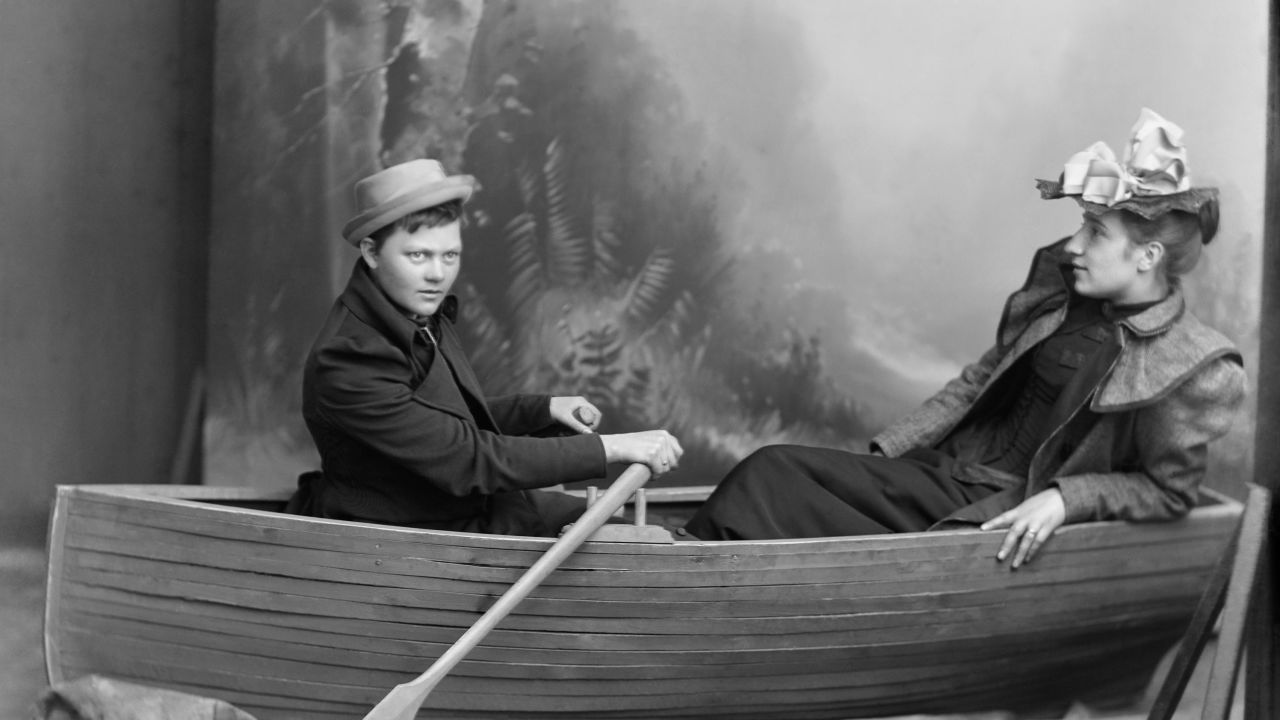
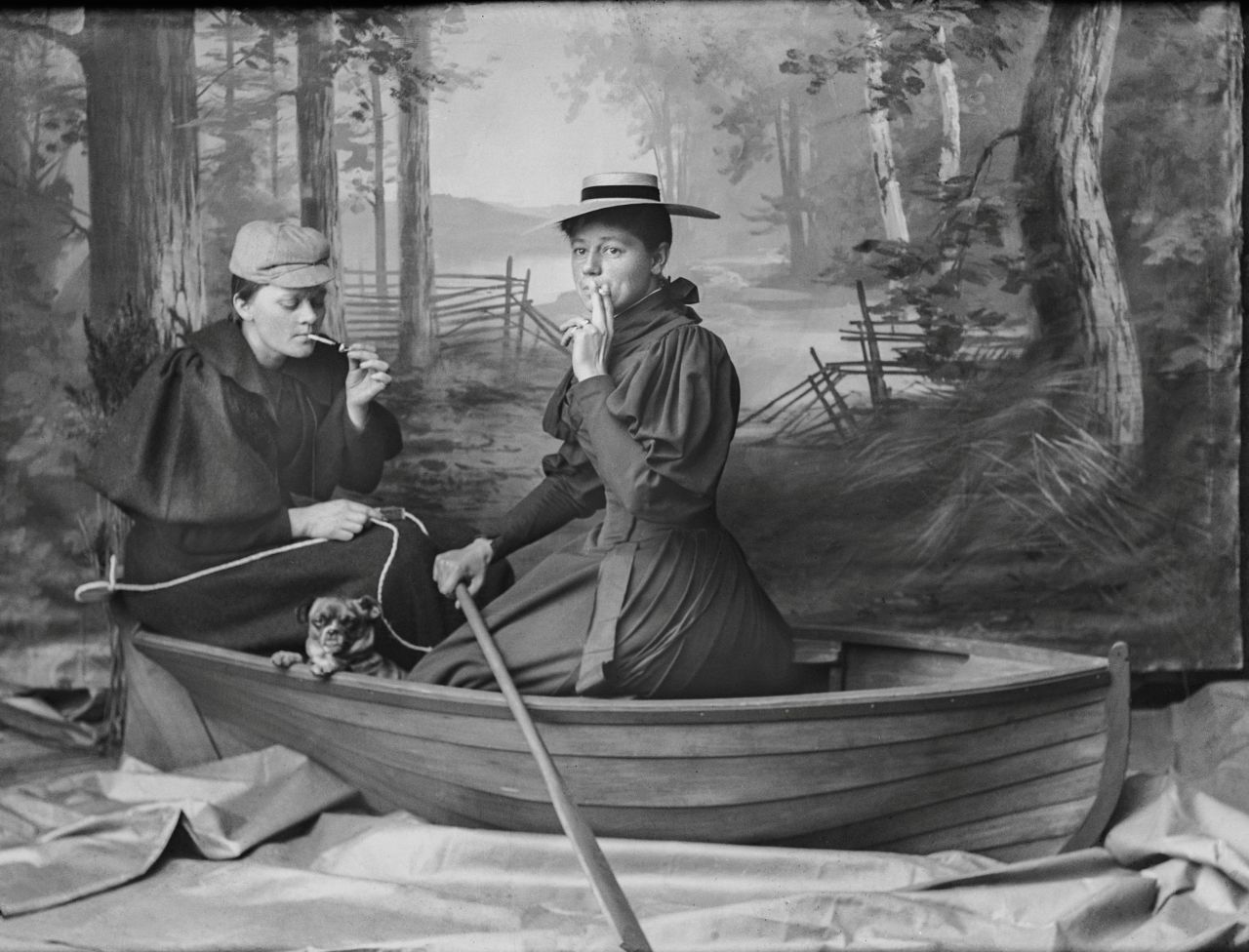
Marie Høeg and Bolette Berg posing in a rowboat in their studio. Their personal portraits, found in boxes marked ‘private,’ were first discovered in the 1980s. More images were discovered last year.Preus Museum–Norwegian Museum of Photography
Editor’s Note: Untold Art History investigates lesser-known stories in art, spotlighting unsung and pioneering artists you should know, as well as uncovering new insights into influential artworks that radically shift our understanding of them.
At the turn of the 20th century, the studio run by Norwegian photographers Bolette Berg and Marie Høeg had a secret second purpose. During the day, it operated as a conventional atelier where locals in the coastal town of Horten, Norway, could come have their portraits taken for pocket-sized cartes de visite, the era’s tradeable profile pictures. After hours, though, it became a clandestine gathering space for politically-minded women, as equality movements were burning brightly around the country.
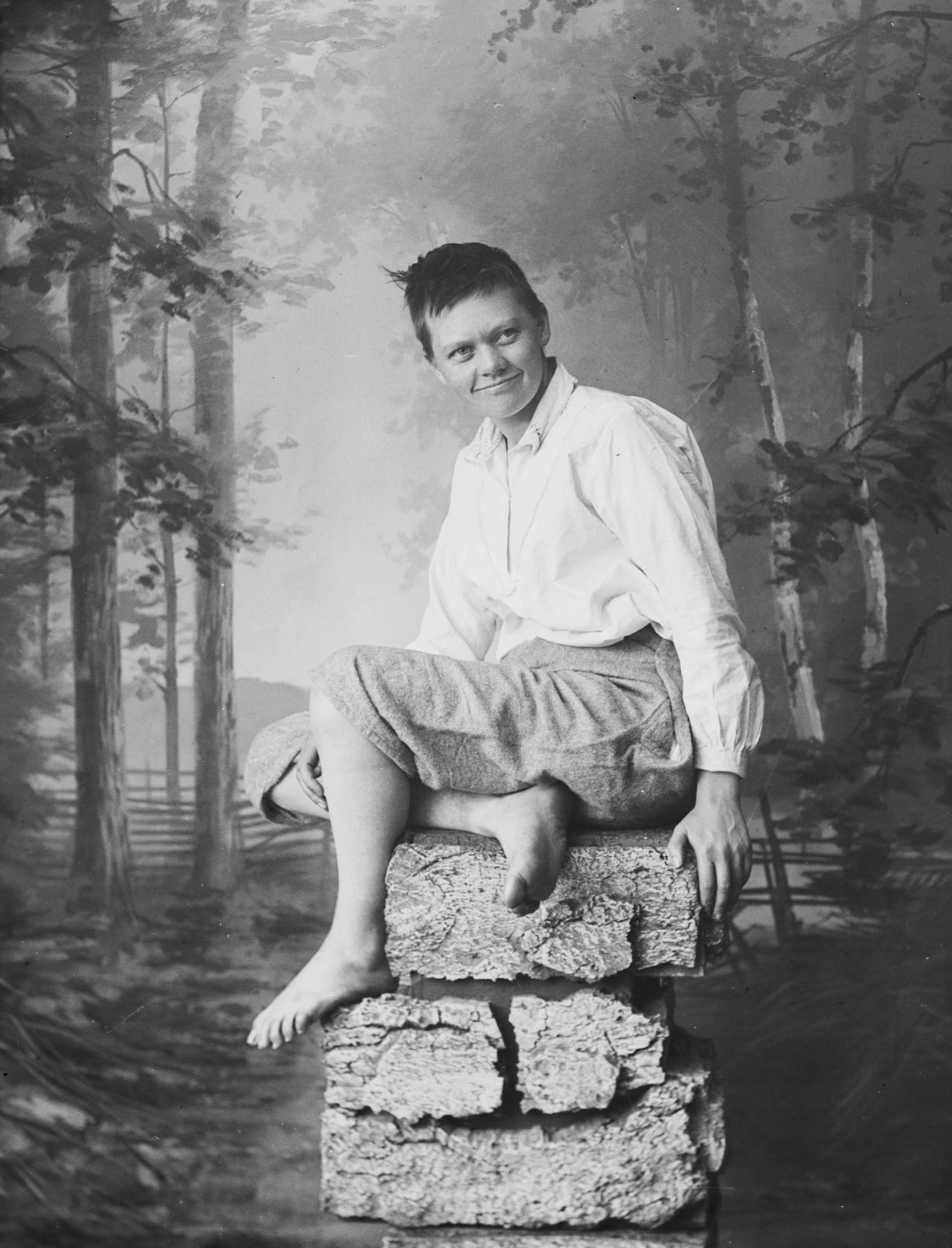
Berg and Høeg lived life on their own terms, both as romantic partners in a time of little LGBTQ visibility and as business partners running a studio and publishing company when women were highly restricted in their careers — and beyond. But decades after their deaths in the 1940s, another radical aspect of their lives resurfaced, tucked away in boxes of glass negatives marked “private”: the couple eschewing traditional gender norms in playful portraits they took of themselves and loved ones.
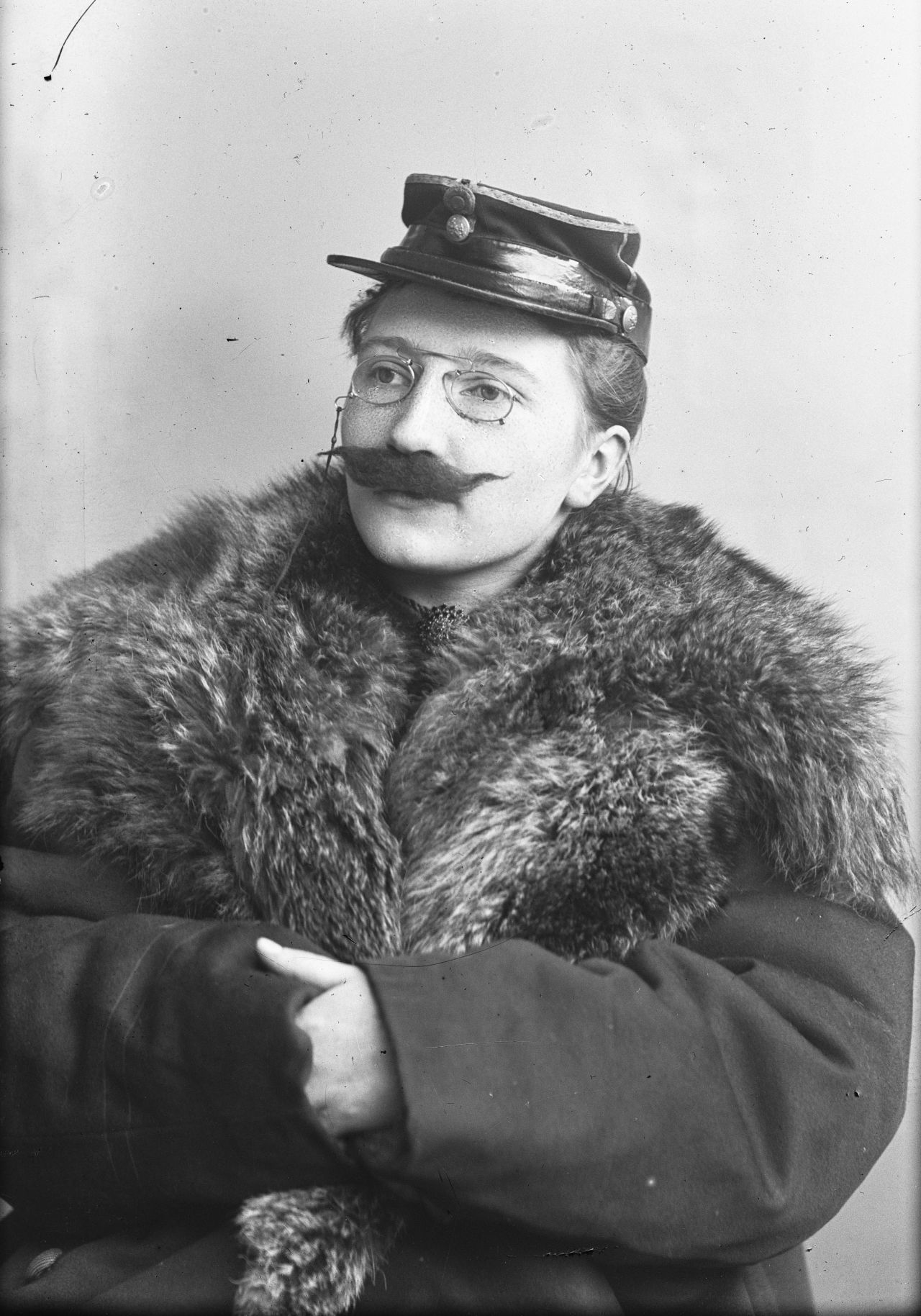
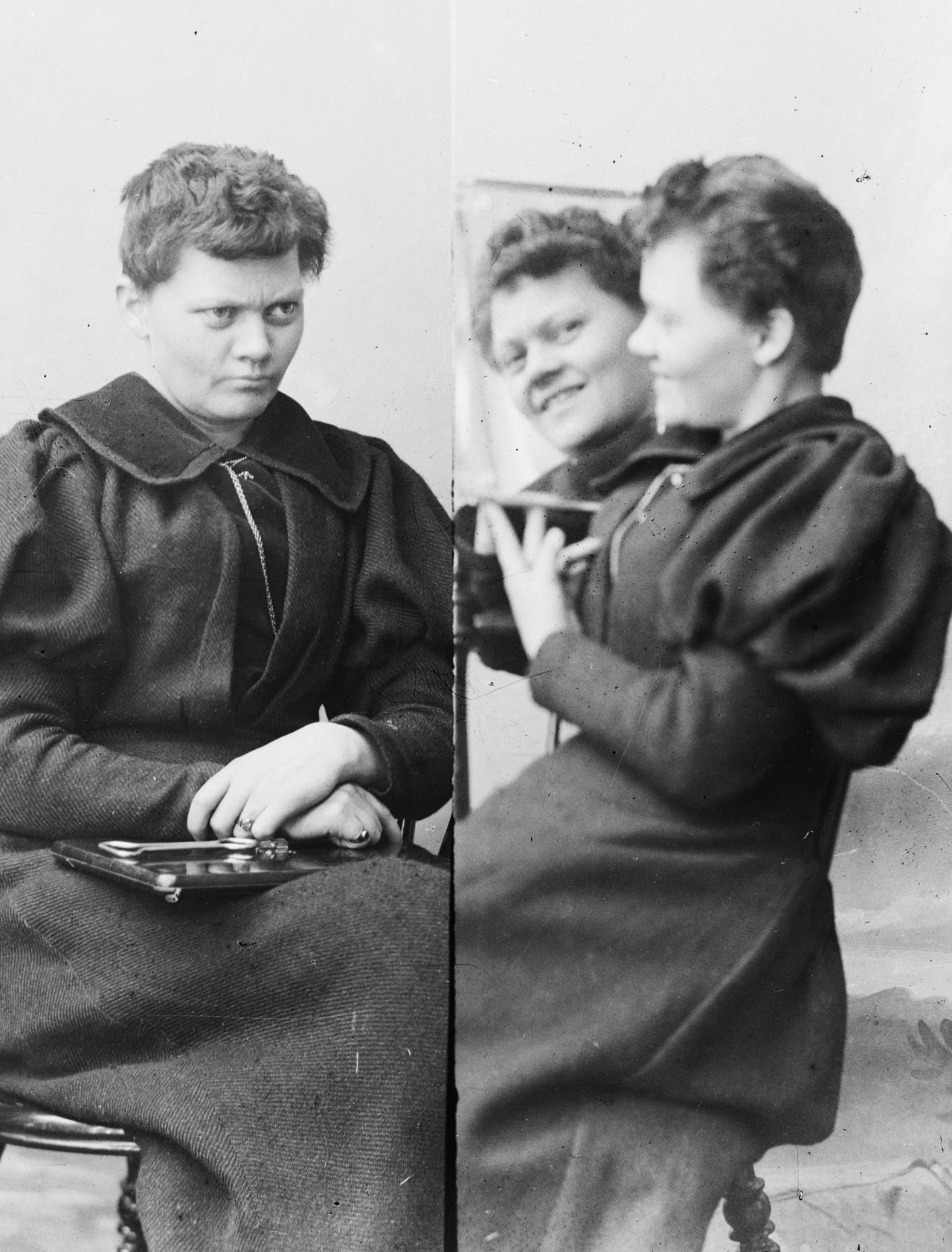
Bolette Berg pictured with a handlebar mustache. Little is known about Berg, and she has received less attention than Høeg, though they were lifelong creative, business and romantic partners.Preus Museum–Norwegian Museum of Photography
In the photos, Berg and Høeg dress up in womenswear and menswear, using props and painted backdrops to set their irreverent scenes. In one, Berg dons an oversized fur-lined wool coat, a mustache and spectacles, eyes glimmering with mischief. In another, Høeg and one of Berg’s sisters light cigarettes while sitting in a rowboat; a small dog peeking over the edge.
Bought at auction in the 1970s by the photographer Leif Preus, these personal negatives went unnoticed within his larger collection for years. But since the first exhibition of Berg and Høeg’s work was shown in the mid-1990s, the women have become cult figures in queer art history, and continue to gain wider international acclaim — most recently through the exhibition “Like a Whirlwind” at the major international festival PhotoESPAÑA, on view until August 24 in Madrid.
Høeg was an activist and community organizer who was described as coming into the “sleepy” town of Horten “like a whirlwind.”Preus Museum–Norwegian Museum of Photography
The couple’s self-portraits are striking because they were captured “in a way that seems so modern,” according to curator Kristin Aasbo, who works at the Preus Museum in Horten and has led research and exhibitions on the pair. (The museum, founded from Preus’ collection in 1976, was later acquired by the Norwegian government and now serves as the country’s national photography museum.) She loves their dynamic, apparent even in their solo portraits, when they are “having fun for the person behind the camera,” she said.
One of Aasbo’s favorite images features the couple in their prop boat, with Høeg ‘rowing’ its oars. It’s one of the only known photographs of the couple posing together.
“Both of them have their hands visible, and you can see there’s a ring on each of their fingers,” Aasbo noted. “It’s almost like a wedding photo, so I’m very fond of that.”
Energizing a town
Though much of Berg and Høeg’s lives remain a mystery, a handful of academics and curators have slowly pieced together some details from newspaper clippings and other documents of the era.
Høeg, who was from a family of fishermen, grew up in the small town of Langesund, and began photographing after traveling with her brother to Finland. It’s believed she met Berg, who was studying photography at the time, while in Finland; they relocated to Horten in 1894 to run their studio. Berg, born in Nannestad, was the daughter of a village priest, and one of six sisters — only one of whom ever married.
Høeg also bucked conventions, with her gender non-conforming style and an inherent magnetism, according to Aasbo. “Marie came to (Horten), this sleepy little town, and she just started making things move,” Aasbo said. “She smoked and she wore trousers — she was a very outgoing and outspoken woman.”
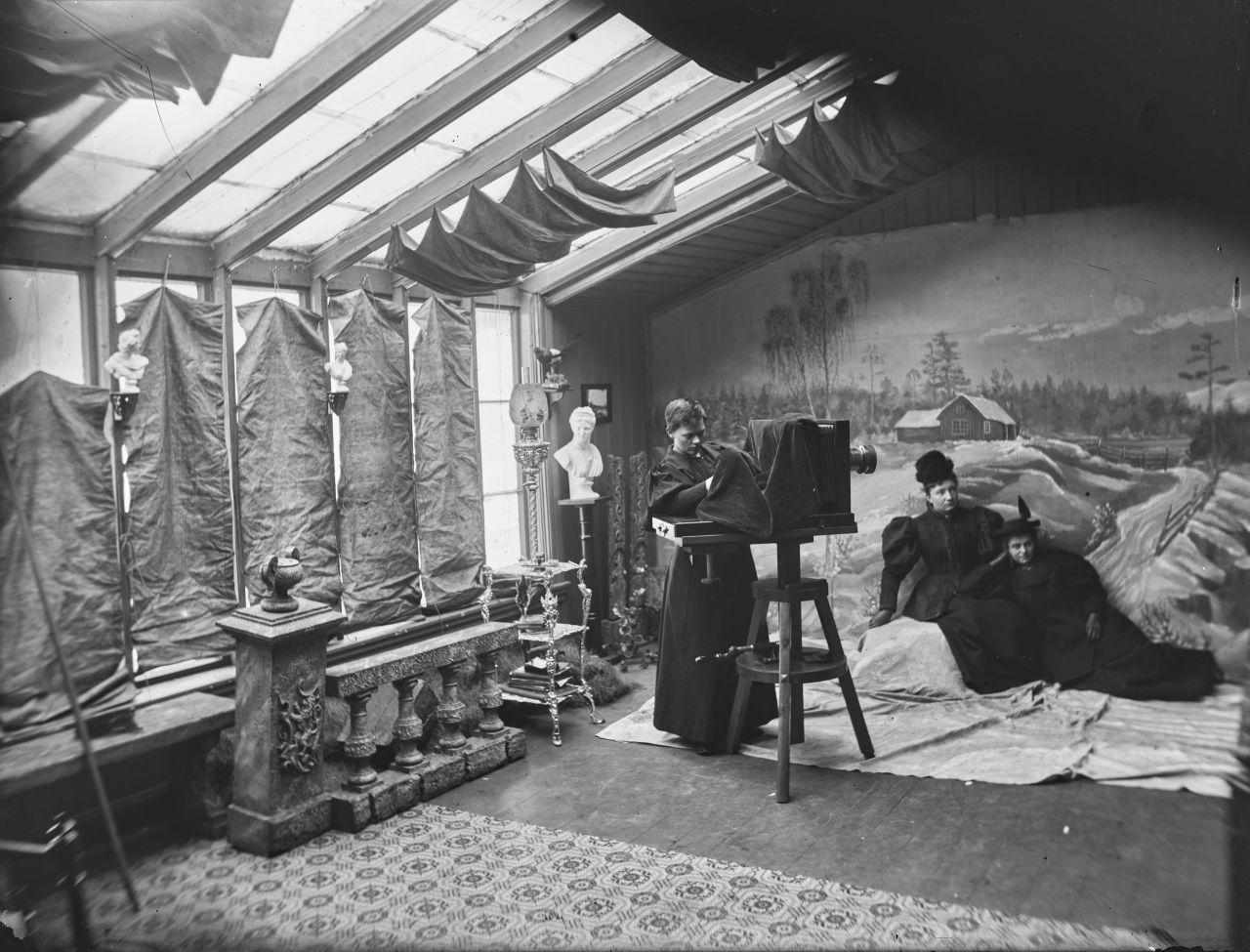
Høeg operating the camera and Berg photographing the scene in the couple’s atelier in Horten.Preus Museum–Norwegian Museum of Photography
One of Berg & Høeg’s most recognized images is often misidentified as a self-portrait of the pair. In the image, Høeg poses with one of Berg’s sisters, Ingeborg.Preus Museum–Norwegian Museum of Photography
At their studio, Berg & Høeg Fotoatelier, Høeg hosted the intentionally enigmatically named “Discussion Club,” where women in the community learned how to discuss politics during the suffrage movement — they were granted full rights to vote in 1913 — as well as meetings for a group called “the Sanitary Ladies,” which focused on environmental causes.
While at work, Berg and Høeg primarily produced the smaller cartes de visite and larger cardboard-mounted cabinet cards that were popular portrait options of the time. But they closed the business and moved to Oslo in 1903, shifting their focus to printing postcards of landscapes and Norwegian art as the postcard market was booming, as well as publishing books on art and society, including career-focused books for women.
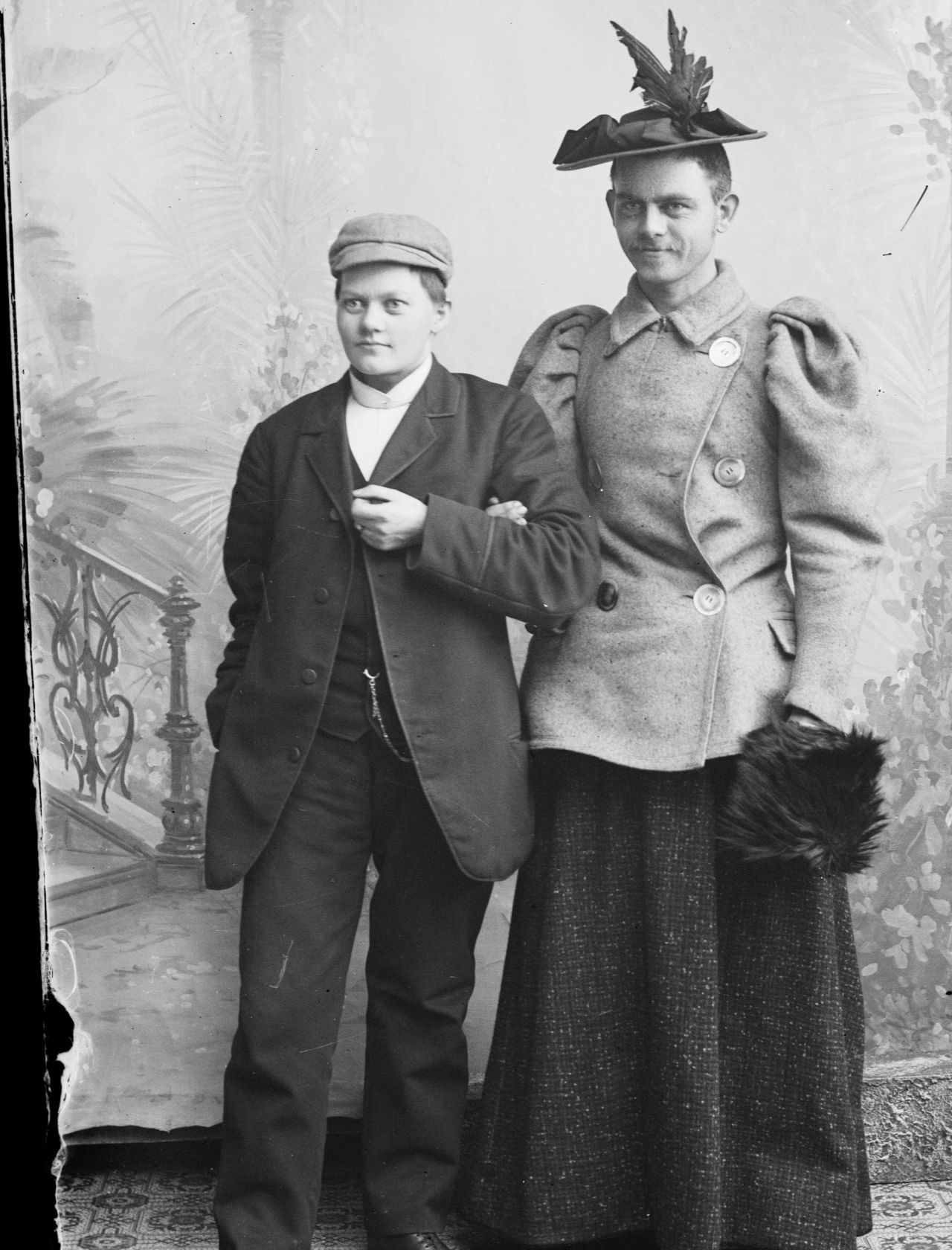
Høeg and her brother Karl pose in the studio in gender-nonconforming dress.Preus Museum–Norwegian Museum of Photography
“I see them as businesswomen,” Aasbo explained. “They were conscious about what was in the air at the moment, and then they found their way of life.”
The photographers’ relationship was likely an open secret, according to Aasbo.
“It was quite well known that they were living together as partners, as lovers,” she said. “They lived together their whole lives,” though some may have thought they were simply “best friends forever,” she said with a laugh.
An ongoing search
Exactly where the photographers’ negatives came from is another piece of the puzzle Aasbo is hoping to solve. Their whereabouts during the 30 years between their deaths and the auction in which Preus acquired them remains a question mark, though it’s believed Berg and Høeg left the boxes in their farmhouse in Lunner, where they often vacationed, and were only discovered after the home’s sale, she explained.
In a serendipitous moment, the museum acquired hundreds more of their negatives by accident last year, when they were discovered within a collection of work by the Norwegian photographers (and brothers) Thorvald and August Brunskow. And just like those purchased by Preus, among the batch of negatives was a small “private” box, containing more lively and intimate self-portraits. Altogether, there are now around 700 known negatives of Berg & Høeg’s work, some 80 of which chronicled their “private” lives.
Berg & Høeg’s public photography — consisting of studio portraits and landscapes — was quite conventional, but their personal portraits gave them the freedom to experiment,Preus Museum–Norwegian Museum of Photography
“It was just by chance that we got these,” Aasbo said of the recent acquisition. “It’s almost like there’s something bigger than us that wants us to find more on these ladies.”
The quietly radical images would have likely been controversial during Berg and Høeg’s lifetimes, and are exhibited with that context in mind today. Though some critics online have debated whether the designation “private” meant the photos should have remained out of the public eye, Aasbo has a different interpretation.
“I don’t think that ‘private’ means ‘don’t touch,’ I think that it means that it’s not a part of their business,” she said.
Aasbo is hoping to find more on their lives as their reputation grows. So far, their photographs have only exhibited in Europe, but will debut in the US next year at the gallery Wrightwood 569 in Chicago.
“It would have been wonderful for a diary to be discovered, but I don’t think we’ll find that,” she said “But we have grown so fond of these ladies… They get into your heart.”
In an astonishing talk and tech demo, neurotechnologist Conor Russomanno shares his work building brain-computer interfaces that could enable us to control the external world with our minds. He discusses the quickly advancing possibilities of this field — including the promise of a “closed-loop system” that could both record and stimulate brain activity — and invites neurohacker Christian Bayerlein onto the TED stage to fly a mind-controlled drone by using a biosensing headset.
JUNE 27, 2023 AT 7:00 AM BY ROB BREZSNY (newcity.com)
Photo: Taylor Heery
ARIES (March 21-April 19): Visionary author Peter McWilliams wrote, “One of the most enjoyable aspects of solitude is doing what you want when you want to do it, with the absolute freedom to change what you’re doing at will. Solitude removes all the ‘negotiating’ we need to do when we’re with others.” I’ll add a caveat: Some of us have more to learn about enjoying solitude. We may experience it as a loss or deprivation. But here’s the good news, Aries: In the coming weeks, you will be extra inspired to cultivate the benefits that come from being alone.
TAURUS (April 20-May 20): The eighteenth-century French engineer Étienne Bottineau invented nauscopy, the art of detecting sailing ships at a great distance, well beyond the horizon. This was before the invention of radar. Bottineau said his skill was not rooted in sorcery or luck, but from his careful study of changes in the atmosphere, wind and sea. Did you guess that Bottineau was a Taurus? Your tribe has a special capacity for arriving at seemingly magical understandings by harnessing your sensitivity to natural signals. Your intuition thrives as you closely observe the practical details of how the world works. This superpower will be at a peak in the coming weeks.
GEMINI (May 21-June 20): According to a Welsh proverb, “Three fears weaken the heart: fear of the truth; fear of the devil; fear of poverty.” I suspect the first of those three is most likely to worm its way into your awareness during the coming weeks. So let’s see what we can do to diminish its power over you. Here’s one possibility: Believe me when I tell you that even if the truth’s arrival is initially disturbing or disruptive, it will ultimately be healing and liberating. It should be welcomed, not feared.
CANCER (June 21-July 22): Hexes nullified! Jinxes abolished! Demons banished! Adversaries outwitted! Liabilities diminished! Bad habits replaced with good habits! These are some of the glorious developments possible for you in the coming months, Cancerian. Am I exaggerating? Maybe a little. But if so, not much. In my vision of your future, you will be the embodiment of a lucky charm and a repository of blessed mojo. You are embarking on a phase when it will make logical sense to be an optimist. Can you sweep all the dross and mess out of your sphere? No, but I bet you can do at least eighty percent.
LEO (July 23-Aug. 22): In the book “Curious Facts in the History of Insects,” Frank Cowan tells a perhaps legendary story about how mayors were selected in the medieval Swedish town of Hurdenburg. The candidates would set their chins on a table with their long beards spread out in front of them. A louse, a tiny parasitic insect, would be put in the middle of the table. Whichever beard the creature crawled to and chose as its new landing spot would reveal the man who would become the town’s new leader. I beg you not to do anything like this, Leo. The decisions you and your allies make should be grounded in good evidence and sound reason, not blind chance. And please avoid parasitical influences completely.
VIRGO (Aug. 23-Sept. 22): I rebel against the gurus and teachers who tell us our stories are delusional indulgences that interfere with our enlightenment. I reject their insistence that our personal tales are distractions from our spiritual work. Virgo author A. S. Byatt speaks for me: “Narration is as much a part of human nature as breath and the circulation of the blood.” I love and honor the stories of my own destiny, and I encourage you to love and honor yours. Having said that, I will let you know that now is an excellent time to jettison the stories that feel demoralizing and draining—even as you celebrate the stories that embody your genuine beauty. For extra credit: Tell the soulful stories of your life to anyone who is receptive.
LIBRA (Sept. 23-Oct. 22): In the Mayan calendar, each of the twenty day names is associated with a natural phenomenon. The day called Kawak is paired with rainstorms. Ik’ is connected with wind and breath. Kab’an is earth, Manik is deer, and Chikchan is the snake. Now would be a great time for you to engage in an imaginative exercise inspired by the Mayans. Why? Because this is an ideal phase of your cycle to break up your routine, to reinvent the regular rhythm, to introduce innovations in how you experience the flow of the time. Just for fun, why not give each of the next fourteen days a playful nickname or descriptor? This Friday could be Crescent Moon, for example. Saturday might be Wonderment, Sunday can be Dazzle Sweet, and Monday Good Darkness.
SCORPIO (Oct. 23-Nov. 21): From 998 till 1030, Scorpio-born leader Mahmud Ghaznavi ruled the vast Ghaznavid empire, which stretched from current-day Iran to central Asia and northwestern India. Like so many of history’s strong men, he was obsessed with military conquest. Unlike many others, though, he treasured culture and learning. You’ve heard of poet laureates? He had 400 of them. According to some tales, he rewarded one wordsmith with a mouthful of pearls. In accordance with astrological omens, I encourage you to be more like the Mahmud who loved beauty and art and less like the Mahmud who enjoyed fighting. The coming weeks will be a favorable time to fill your world with grace and elegance and magnificence.
SAGITTARIUS (Nov. 22-Dec. 21): About 1,740 years ago, before she became a Catholic saint, Margaret of Antioch got swallowed whole by Satan, who was disguised as a dragon. Or so the old story goes. But Margaret was undaunted. There in the beast’s innards, Margaret calmly made the sign of the cross over and over with her right hand. Meanwhile, the wooden cross in her left hand magically swelled to an enormous size that ruptured the beast, enabling her to escape. After that, because of her triumph, expectant mothers and women in labor regarded Margaret as their patron saint. Your upcoming test won’t be anywhere near as demanding as hers, Sagittarius, but I bet you will ace it—and ultimately garner sweet rewards.
CAPRICORN (Dec. 22-Jan. 19): Capricorn-born Johannes Kepler (1571-1630) was an astronomer and mathematician who was an instrumental innovator in the Scientific Revolution. Among his many breakthrough accomplishments were his insights about the laws of planetary motion. Books he wrote were crucial forerunners of Isaac Newton’s theories about gravitation. But here’s an unexpected twist: Kepler was also a practicing astrologer who interpreted the charts of many people, including three emperors of the Holy Roman Empire. In the spirit of Kepler’s ability to bridge seemingly opposing perspectives, Capricorn, I invite you to be a paragon of mediation and conciliation in the coming weeks. Always be looking for ways to heal splits and forge connections. Assume you have an extraordinary power to blend elements that no one else can.
AQUARIUS (Jan. 20-Feb. 18): Dear Restless Runaway: During the next ten months, life will offer you these invitations: 1. Identify the land that excites you and stabilizes you. 2. Spend lots of relaxing time on that land. 3. Define the exact nature of the niche or situation where your talents and desires will be most gracefully expressed. 4. Take steps to create or gather the family you want. 5. Take steps to create or gather the community you want.
PISCES (Feb. 19-March 20): I’d love you to be a deep-feeling, free-thinker in the coming weeks. I will cheer you on if you nurture your emotional intelligence as you liberate yourself from outmoded beliefs and opinions. Celebrate your precious sensitivity, dear Pisces, even as you use your fine mind to reevaluate your vision of what the future holds. It’s a perfect time to glory in rich sentiments and exult in creative ideas.
To be human is to suffer from a peculiar congenital blindness: On the precipice of any great change, we can see with terrifying clarity the familiar firm footing we stand to lose, but we fill the abyss of the unfamiliar before us with dread at the potential loss rather than jubilation over the potential gain of gladnesses and gratifications we fail to envision because we haven’t yet experienced them. Emerson knew this when he contemplated our resistance to change and the key to true personal growth: “People wish to be settled; only as far as they are unsettled is there any hope for them.” Rilke, too, knew it when he considered how great upheavals bring us closer to ourselves: “That is at bottom the only courage that is demanded of us: to have courage for the most strange, the most singular and the most inexplicable that we may encounter.”
When faced with the most transformative experiences, we are ill-equipped to even begin to imagine the nature and magnitude of the transformation — but we must again and again challenge ourselves to transcend this elemental failure of the imagination if we are to reap the rewards of any transformative experience.
In Transformative Experience (public library), philosopher L.A. Paul illustrates this paradox and examines how we are to unbind ourselves from it in a simple, elegant thought experiment: If you were offered the chance to become a vampire — painlessly and without inflicting pain on others, gaining incredible superpowers in exchange for relinquishing your human existence, with all your friends having made the leap and loving it — would you do it?
The trouble is, in this situation, how could you possibly make an informed choice? For, after all, you cannot know what it is like to be a vampire until you are one. And if you can’t know what it’s like to be a vampire without becoming one, you can’t compare the character of the lived experience of what it is like to be you, right now, a mere human, to the character of the lived experience of what it would be like to be a vampire. This means that, if you want to make this choice by considering what you want your lived experience to be like in the future, you can’t do it rationally. At least, you can’t do it by weighing the competing options concerning what it would be like and choosing on this basis. And it seems awfully suspect to rely solely on the testimony of your vampire friends to make your choice, because, after all, they aren’t human any more, so their preferences are the ones vampires have, not the ones humans have.
This hypothetical situation, she points out, is an apt analogue for our most important life decisions:
When you find yourself facing a decision involving a new experience that is unlike any other experience you’ve had before, you can find yourself in a special sort of epistemic situation. In this sort of situation, you know very little about your possible future, in the same way that you are limited when you face a possible future as a vampire. And so, if you want to make the decision by thinking about what your lived experience would be like if you decided to undergo the experience, you have a problem… You find yourself facing a decision where you lack the information you need to make the decision the way you naturally want to make it — by assessing what the different possibilities would be like and choosing between them. The problem is pressing, because many of life’s big personal decisions are like this: they involve the choice to undergo a dramatically new experience that will change your life in important ways, and an essential part of your deliberation concerns what your future life will be like if you decide to undergo the change. But as it turns out, like the choice to become a vampire, many of these big decisions involve choices to have experiences that teach us things we cannot know about from any other source but the experience itself.
Our minds, lest we forget, are prone to misleading us — just as people’s confidence in their beliefs is not a measure of the quality of evidence upon which those beliefs are founded, the cost-benefit estimations we make of an as-yet unknown state reflect the suppositions drawn from our current state and not the actual features of the potential and wholly unfamiliar state. When faced with a choice on one side of which lies life as we know it and on the other a transformative experience, we can’t imagine what life on the other side would be like — what we are currently missing — until after we’ve undergone the transformation. (Interestingly, an intuitive awareness of this is at the root of the psychology of our fear of missing out.) Paul writes:
You know that undergoing the experience will change what it is like for you to live your life, and perhaps even change what it is like to be you, deeply and fundamentally.
In many ways, large and small, as we live our lives, we find ourselves confronted with a brute fact about how little we can know about our futures, just when it is most important to us that we do know. For many big life choices, we only learn what we need to know after we’ve done it, and we change ourselves in the process of doing it. I’ll argue that, in the end, the best response to this situation is to choose based on whether we want to discover who we’ll become.
North Pacific Giant Octopus by photographer Mark Laita from his project Sea
Unless you’ve had the relevant experiences, what it is like to be a person or an animal very different from yourself is, in a certain fundamental way, inaccessible to you. It isn’t that you can’t imagine something in place of the experience you haven’t had. It’s that this act of imagining isn’t enough to let you know what it is really like to be an octopus, or to be a slave, or to be blind. You need to have the experience itself to know what it is really like.
This brings out another, somewhat less familiar fact about the relationship between knowledge and experience: just as knowledge about the experience of one individual can be inaccessible to another individual, what you can know about yourself at one time can be inaccessible to you at another time.
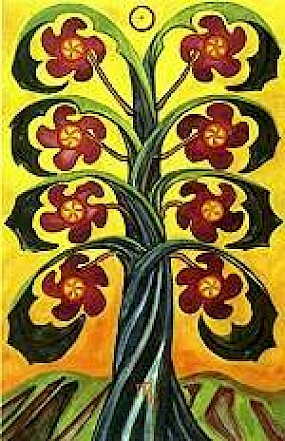
The Lord of Prudence is not quite as austere a card as it first sounds. It’s another of those Disks that works on more than one level. In the purely material and mundane sphere it indicates a period where financial resources must be carefully managed.
So long as it does not appear with cards like the Ten of Swords or the Five of Disks, there will not normally be any grave material problem. But there is a warning here that there may be unexpected expense, and good money management will enable us to fund whatever arises.
At the next level, the Eight of Disks can apply to a period where you enter into additional training in order to enhance your career projects. In this case look for cards like the Three of Disks, or the Ace, to indicate some new area of study. Then look for cards like the Universe, or the Sun to indicate the successful outcome of your efforts.
Finally in the spiritual area, when the Lord of Prudence comes up with cards like the Priestess, Death, the Moon, or the Hierophant, you’re approaching a period of rapid spiritual development – almost an initiation. In this case, this card is warning you to be alert for opportunities, ready to deal with stress and pressure, and to manage your energies thoughtfully and carefully. You can perhaps see the correlation which exists with regard to energy management between the material and spiritual definitions of the card – in either case energy must be regulated and respected in order for life to go smoothly and for you to get the best out of your experiences.
New Thinking Allowed with Jeffrey Mishlove Jun 27, 2023 Pierre Grimes, PhD, is a specialist in classical Greek philosophy. He is the founder of the American Philosophical Practitioners Association. He is also founder of the Noetic Society in the Los Angeles area. He is author of Philosophical Midwifery: A New Paradigm for Understanding Human Problems with Its Validation, Socrates and Jesus: A Dialogue in Heaven, and Unblocking: Removing Blocks to Understanding. He is also a decorated veteran of the second world war. In this 2018 interview, he points out that the Neoplatonists deviated from Plato’s original emphasis on the Self. He regards their interest in theurgy as a decadent development. However, he holds that there is a continuous Hellenic, philosophical tradition extending from the pre-Socratic philosophers through Plato and Aristotle to the Neoplatonists. He also suggests that the Buddhist philosophy of Nagarjuna may have been influenced by Sextus Empericus and the Pyrrhonist school of Greek philosophy. Edited subtitles for this video are available in Russian, Portuguese, Italian, German, French, and Spanish. New Thinking Allowed host, Jeffrey Mishlove, PhD, is author of The Roots of Consciousness, Psi Development Systems, and The PK Man. Between 1986 and 2002 he hosted and co-produced the original Thinking Allowed public television series. He is the recipient of the only doctoral diploma in “parapsychology” ever awarded by an accredited university (University of California, Berkeley, 1980). He is also the Grand Prize winner of the 2021 Bigelow Institute essay competition regarding the best evidence for survival of human consciousness after permanent bodily death.
Consciousness, spirituality, biography, sexuality, androgyny, futurism, space, the arts, science, astrology, democracy, humor, books, movies and more




 The trouble is, in this situation, how could you possibly make an informed choice? For, after all, you cannot know what it is like to be a vampire until you are one. And if you can’t know what it’s like to be a vampire without becoming one, you can’t compare the character of the lived experience of what it is like to be you, right now, a mere human, to the character of the lived experience of what it would be like to be a vampire. This means that, if you want to make this choice by considering what you want your lived experience to be like in the future, you can’t do it rationally. At least, you can’t do it by weighing the competing options concerning what it would be like and choosing on this basis. And it seems awfully suspect to rely solely on the testimony of your vampire friends to make your choice, because, after all, they aren’t human any more, so their preferences are the ones vampires have, not the ones humans have.