All posts by Mike Zonta

Nick Cave on Music, Mystery, and the Relationship Between Vulnerability and Freedom

By Maria Popova (themarginalian.org)

“Whatever inspiration is,” the Polish poet Wisława Szymborska observed in her superb Nobel Prize acceptance speech, “it’s born from a continuous ‘I don’t know.’” And yet, with our reflex for teleological thinking — that childish grab at “I know!” — we habitually cut ourselves off from the mystery that houses the most creative, and therefore the most vulnerable and alive, part of our own souls, forgetting what Carl Sagan’s ghost so poetically reminds us: that “the universe will always be much richer than our ability to understand it.”

Nothing restores our porousness and receptivity to that richness more readily than music — the backdoor of consciousness, through which something transcendent slips past all of our reasoned reservations, all of our guardedness and confusion, at once releasing us from the solitary confinement of the self and restoring us to ourselves, reminding us that we are always half-opaque to ourselves and this opacity shimmers with possibility.

One of William Blake’s paintings for The Book of Job, 1806. (Available as a print.)

These questions — the power of music, the power of porousness — animate Nick Cave, whom I see as a kind of sculptor of the spirit, turning the raw materials of life — a life that has not been easy — into something of transcendent beauty.

In Faith, Hope and Carnage (public library) — his long and luscious conversation with Seán O’Hagan — he considers how music parts the veil between the known world and the mystery of being:

I think music, out of all that we can do, at least artistically, is the great indicator that something else is going on, something unexplained, because it allows us to experience genuine moments of transcendence.

[…]

I think there is more going on than we can see or understand, and we need to find a way to lean into the mystery of things — the impossibility of things — and recognise the evident value in doing that, and summon the courage it requires to not always shrink back into the known mind.

In a passage evocative of Nathaniel Hawthorne’s contour of the edges of consciousness, he considers that “impossible” place where transcendence lives — “a semi-conscious place, a twilight place, a distracted place, a place of surrender” — the place where his dead son also lives, and the life-deep sorrow of the loss, and the portal to beauty the loss unlatched in his creative spirit:

There is another place that can be summoned through practice that is not the imagination, but more a secondary positioning of your mind with regard to spiritual matters… It is a kind of liminal state of awareness, before dreaming, before imagining, that is connected to the spirit itself. It is an “impossible realm” where glimpses of the preternatural essence of things find their voice. Arthur lives there. Inside that space, it feels a relief to trust in certain glimpses of something else, something other, something beyond.

One of Arthur Rackham’s rare 1917 illustrations for the fairy tales of the Brothers Grimm. (Available as a print.)

That otherness, that beyondness, is what we commonly call mystery — the realm of experience inaccessible to our analytical minds, unaccountable by reason, and yet a stratum of reality we touch beyond doubt in those rare transcendent moments, as palpable as a lover’s hand, as alive as prayer.

Nick reflects on the supreme portal our species has devised for accessing that realm:

Of all things, music can lift us closer to the sacred.

[…]

[Music] has the ability to lead us, if only temporarily, into a sacred realm. Music plays into the yearning many of us instinctively have — you know, the God-shaped hole. It is the art form that can most effectively fill that hole, because it makes us feel less alone, existentially. It makes us feel spiritually connected. Some music can even lead us to a place where a fundamental spiritual shift of consciousness can happen. At best, it can conjure a sacred space.

In that sacred space, we get to see the world more whole — not artificially, not as a pretty delusion, but with greater fidelity to the deeper reality. He weighs the robust salvation to be found in that space:

The luminous and shocking beauty of the everyday is something I try to remain alert to, if only as an antidote to the chronic cynicism and disenchantment that seems to surround everything, these days. It tells me that, despite how debased or corrupt we are told humanity is and how degraded the world has become, it just keeps on being beautiful.

But because there are no absolutes in beauty, everything we experience as beautiful is a projection of something we long for — a fragmentary fulfillment of our existential longing, or what C.S. Lewis called “the thing itself.” Every artist makes what they make out of the raw material of longing, conscious of it in varying degrees, codified in various forms. Nick considers his:

All my songs are written from a place of spiritual yearning, because that is the place that I permanently inhabit. To me, personally, this place feels charged, creative and full of potential.

[…]

Songs have the capacity to be revealing, acutely so. There is much they can teach us about ourselves. They are little dangerous bombs of truth.

Altarpiece by the Swedish artist and mystic Hilma af Klint, 1907. (Available as a print and as stationery cards.)

Self-revelation is the most vulnerable-making thing of which human beings are capable, and yet in that vulnerability we find our deepest freedom. Echoing Bob Dylan’s insistence that “you must be vulnerable to be sensitive to reality,” he adds:

My experience of creating music and writing songs is finding enormous strength through vulnerability. You’re being open to whatever happens, including failure and shame. There’s certainly a vulnerability to that, and an incredible freedom… To be truly vulnerable is to exist adjacent to collapse or obliteration. In that place we can feel extraordinarily alive and receptive to all sorts of things, creatively and spiritually… It is a nuanced place that feels both dangerous and teeming with potential. It is the place where the big shifts can happen. The more time you spend there, the less worried you become of how you will be perceived or judged, and that is ultimately where the freedom is.

Faith, Hope and Carnage is a joy in its wide-roaming entirety. Complement these fragments with the poetic physicist and pianist Alan Lightman on music as a language for the exhilaration of being alive and other superb writers, from Whitman and Woolf to Kurt Vonnegut and Oliver Sacks, on the singular power of music, then revisit Nick Cave on songwritingthe remedy for despair, and art as an instrument of self-forgiveness.
Syllogisms and Mysticism

Seekers of Unity Sep 10, 2020 Mystics are often seen as irrational. The word ‘mystical’ is oft employed disparagingly as a synonym for the vague, dubious and enigmatic. In this convo with Dr Justin Sledge, scholar of religion and philosophy and host of Esoterica, we challenge and debate this conception. Asking: What is Logic? How does it work? What are its Origins and History? Is it Discovered or Invented? Is there a common Logic among the Mystics? What of Alternative and Paraconsistent Logics? Does a Two Truths Doctrine make sense? Does logic require faith at some level? What happens when mystics take logic to its limits? To what degree, if any, are mystics beholden to or bound by logic? Can mystics give up on logic? All this and more…

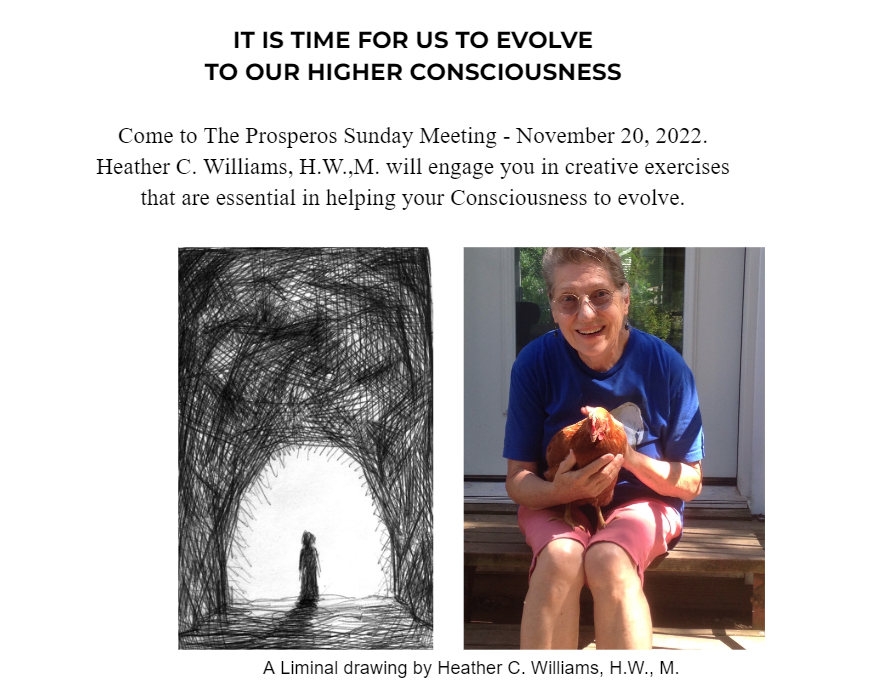
Sunday talk with Heather Williams, H.W., M., on November 20

Everyone is challenged with all the stuff happening in our world today. I hope and pray that you are doing well.

As you know, I love, practice and teach drawing as a simple, inexpensive way to mindfully connect our outer – physical, material self with our inner – formless True Self, Consciousness or Mind. Mindfully connecting these two selves is essential in moving forward in our lives. My Teacher, Thane said: “We have to learn to walk with one foot in the 3D world and one foot in the 4D world.” My friend Alex Gambeau (fellow Mentor and author of Finding the Unpredictable Good) said: “Be a servant to your Higher Self! This is how you release the Unpredictable Good!”

I invite you – to explore more of this – at my one hour Prosperos Sunday Meeting Talk!

(Remember to bring paper and pencil to draw out new insights through some of my creative exercises!) 

DATE: November 20, 2022

TIME: 11:00 am Pacific/Noon Mtn/1:00 pm Central/2:00 pm EasternLINK: https://us02web.zoom.us/j/332275676

LOVE IS KEY!

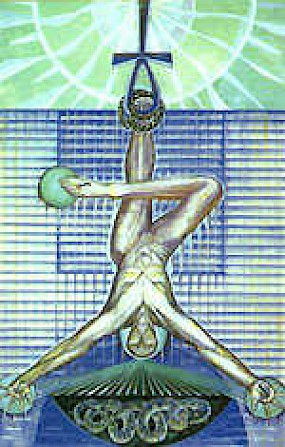
Tarot Card for November 14: The Hanged Man

The Hanged Man

The Hanged Man is numbered twelve and is depicted as a figure, usually male, hanging upside down from a tree or branch. He often has his hands behind his back, as though tied (though as you can see the Thoth interpretation moves away from this aspect of apparent helpnessness). Usually one leg is tucked behind the other to form a triangle shape. Strangely though, he tends to look quite happy and content with his situation.

Not a very popular card, the Hanged Man deals with sacrifice, delays and waiting – and also being bogged down and helplessness. We sacrifice every time we make a choice – reading this web page means you have sacrificed reading the alternatives. Since sacrifice can mean giving up one thing of value for another thing of equal or greater value, this card can easily be seen as representing the natural and normal function of disposing of something that no longer suits its purpose as well as its replacement will.

The Hanged Man is totally vulnerable, his attitude is “whatever will be, will be”. He accepts everything that happens with equanimity and courage – he is, after all, simply giving in to his destiny. He can sometimes represent the person who has waited too long, who is perhaps scared to change. We should endure with strength and inner peace, but also be courageous enough to take action when destiny calls.

The Hanged Man

(via angelpaths.com and Alan Blackman)

Edward Tufte on “users”

“There are only two industries that call their customers ‘users’: illegal drugs and software”

–Edward Tufte

Edward Rolf Tufte, sometimes known as “ET”, (born March 14, 1942) is an American statistician and professor emeritus of political science, statistics, and computer science at Yale University. He is noted for his writings on information design and as a pioneer in the field of data visualization. Wikipedia

Gnosticism – The Gospel of Mary Magdalene

ESOTERICA

Oct 7, 2022

227,753 views • Oct 7, 2022The (gnostic?) Gospel of Mary provide us a glimpse into a radically alternative form of ancient Christianity. One where inner, spiritual knowledge is the key to salvation, where women and men have equal standing based on their understanding of the message of the Savior and one where the soul must rise above the demonic gatekeepers of the physical cosmos rather than to believe in credal formulas or even the salvific power of the death and resurrection of Jesus. In this Gospel, Mary Magdalene is the true inheritor of the spiritual Gospel of Christ rather than Peter who attacks her solely based on her gender, despite her profound relationship with the Savior and her understanding of his secret teachings.

Universal Patterns in Nature with Jude Currivan

New Thinking Allowed with Jeffrey Mishlove • Nov 13, 2022 Jude Currivan, PhD, is a cosmologist and author of The Cosmic Hologram: In-Formation at the Center of Creation, CosMos (with Irvin Laszlo), The Eighth Chakra, The Wave, and The Thirteenth Step. Her newest book is The Story of Gaia. In this video from 2017, she notes that certain mathematical patterns are expressed throughout nature. For example, the way that galaxies evolve from variations in matter density in the early universe is equivalent to the way cities grow from changes in population density. The frequency and strength of earthquakes is mathematically similar to the frequency and strength of armed conflicts. She maintains that this information can be used, positively, to create situations that attract peaceful resolutions. New Thinking Allowed host, Jeffrey Mishlove, PhD, is author of The Roots of Consciousness, Psi Development Systems, and The PK Man. Between 1986 and 2002 he hosted and co-produced the original Thinking Allowed public television series. He is the recipient of the only doctoral diploma in “parapsychology” ever awarded by an accredited university (University of California, Berkeley, 1980). He is also the Grand Prize winner of the 2021 Bigelow Institute essay competition regarding the best evidence for survival of human consciousness after permanent bodily death. (Recorded on October 27, 2017)

Jouissance

From Wikipedia, the free encyclopedia

Jouissance is a French term meaning “enjoyment”, which in Lacanianism is taken in terms both of rights and property,[1] and of sexual orgasm. The latter has a meaning partially lacking in the English word “enjoyment”.[2] The term denotes a transgressive, excessive kind of pleasure linked to the division and splitting of the subject involved, which compels the subject to constantly attempt to transgress the prohibitions imposed on enjoyment, to go beyond the pleasure principle.[3]

In Lacanian psychoanalysis

Part of a series of articles on
Psychoanalysis
showConcepts
showImportant figures
showImportant works
hideSchools of thoughtAdlerianEgo psychologyJungianLacanianInterpersonalIntersubjectiveMarxistObject relationsReichianRelationalSelf psychology
showTraining
showSee also
 Psychology portal
vte

English editions of the works of Jacques Lacan have generally left jouissance untranslated in order to help convey its specialised usage.[4] Lacan first developed his concept of an opposition between jouissance and the pleasure principle in his Seminar “The Ethics of Psychoanalysis” (1959–1960). Lacan considered that “there is a jouissance beyond the pleasure principle”[5] linked to the partial drive. Yet according to Lacan, the result of transgressing the pleasure principle is not more pleasure, but instead pain, since there is only a certain amount of pleasure that the subject can bear.

Beyond this limit, pleasure becomes pain, and this initial “painful principle” develops into what Lacan calls jouissance.[6] Thus jouissance is suffering, epitomized in Lacan’s remark about “the recoil imposed on everyone, in so far as it involves terrible promises, by the approach of jouissance as such”.[7] Lacan also linked jouissance to the castration complex,[8] and to the aggression of the death drive.[9]

In his seminar “The Other Side of Psychoanalysis” (1969–1970), Lacan introduced the concept of “surplus-enjoyment” (French plus-de-jouir) inspired by Marx‘s concept of surplus-value: he considered objet petit a is the excess of jouissance, which has no use value, and which persists for the mere sake of jouissance.

Lacan considered that jouissance is essentially phallic, meaning that it does not relate to the “Other” as such. In his seminar “Encore” (1972–1973), however, Lacan introduced the idea of specifically feminine jouissance, saying that women have “in relation to what the phallic function designates of jouissance, a supplementary jouissance…a jouissance of the body which is…beyond the phallus“.[10] This feminine jouissance is ineffable, for both women and men may experience it, yet know nothing about it.[citation needed]

In philosophy and literary theory

The Slovenian philosopher Slavoj Žižek, a known Lacanian theorist, has adopted the term in his philosophy; it also plays an important role in the work of Julia Kristeva and Roland Barthes.

In his 1973 literary theory book The Pleasure of the Text, Barthes divides the effects of texts into two: plaisir (translated as “pleasure”) and jouissance. The distinction corresponds to a further distinction Barthes makes between “readerly” and “writerly” texts. The pleasure of the text corresponds to the readerly text, which does not challenge the reader’s position as a subject. The writerly text provides bliss, which explodes literary codes and allows the reader to break out of his or her subject position.

For Barthes plaisir is, “a pleasure… linked to cultural enjoyment and identity, to the cultural enjoyment of identity, to a homogenising movement of the ego.”[11] As Richard Middleton puts it, “Plaisir results, then, from the operation of the structures of signification through which the subject knows himself or herself; jouissance fractures these structures.”[12]

In feminist theory

The French feminist writer Hélène Cixous uses the term jouissance to describe a form of women’s pleasure or sexual rapture that combines mental, physical and spiritual aspects of female experience, bordering on mystical communion: “explosion, diffusion, effervescence, abundance…takes pleasure (jouit) in being limitless”.[13] Cixous maintains that jouissance is the source of a woman’s creative power and that the suppression of jouissance prevents women from finding their own fully empowered voice.[14][15] The concept of jouissance is explored by Cixous and other authors in their writings on Écriture féminine, a strain of feminist literary theory that originated in France in the early 1970s.

Other feminists have argued that Freudian “hysteria” is jouissance distorted by patriarchal culture and say that jouissance is a transcendent state that represents freedom from oppressive linearities. In her introduction to Cixous’ The Newly Born Woman, literary critic Sandra Gilbert writes: “to escape hierarchical bonds and thereby come closer to what Cixous calls jouissance, which can be defined as a virtually metaphysical fulfillment of desire that goes far beyond [mere] satisfaction… [It is a] fusion of the erotic, the mystical, and the political.”[16]

Many French feminists have resisted against translating the word jouissance claiming that “It is impossible to give an adequate translation of jouissance” and “not to assimilate it, but to retain its foreignness.”[17]

More at: https://en.wikipedia.org/wiki/Jouissance