1943 U.S. Army pamphlet on fascism

(Image from YouTube.com)

Heather Cox Richardson 

January 9, 2026 (Friday) Facebook post

Beginning in 1943, the War Department published a series of pamphlets for U.S. Army personnel in the European theater of World War II. Titled Army Talks, the series was designed “to help [the personnel] become better-informed men and women and therefore better soldiers.”

On March 24, 1945, the topic for the week was “FASCISM!”

“You are away from home, separated from your families, no longer at a civilian job or at school and many of you are risking your very lives,” the pamphlet explained, “because of a thing called fascism.” But, the publication asked, what is fascism? “Fascism is not the easiest thing to identify and analyze,” it said, “nor, once in power, is it easy to destroy. It is important for our future and that of the world that as many of us as possible understand the causes and practices of fascism, in order to combat it.”

Fascism, the U.S. government document explained, “is government by the few and for the few. The objective is seizure and control of the economic, political, social, and cultural life of the state.” “The people run democratic governments, but fascist governments run the people.”

“The basic principles of democracy stand in the way of their desires; hence—democracy must go! Anyone who is not a member of their inner gang has to do what he’s told. They permit no civil liberties, no equality before the law.” “Fascism treats women as mere breeders. ‘Children, kitchen, and the church,’ was the Nazi slogan for women,” the pamphlet said.

Fascists “make their own rules and change them when they choose…. They maintain themselves in power by use of force combined with propaganda based on primitive ideas of ‘blood’ and ‘race,’ by skillful manipulation of fear and hate, and by false promise of security. The propaganda glorifies war and insists it is smart and ‘realistic’ to be pitiless and violent.”

Fascists understood that “the fundamental principle of democracy—faith in the common sense of the common people—was the direct opposite of the fascist principle of rule by the elite few,” it explained, “[s]o they fought democracy…. They played political, religious, social, and economic groups against each other and seized power while these groups struggled.”

Americans should not be fooled into thinking that fascism could not come to America, the pamphlet warned; after all, “[w]e once laughed Hitler off as a harmless little clown with a funny mustache.” And indeed, the U.S. had experienced “sorry instances of mob sadism, lynchings, vigilantism, terror, and suppression of civil liberties. We have had our hooded gangs, Black Legions, Silver Shirts, and racial and religious bigots. All of them, in the name of Americanism, have used undemocratic methods and doctrines which…can be properly identified as ‘fascist.’”

The War Department thought it was important for Americans to understand the tactics fascists would use to take power in the United States. They would try to gain power “under the guise of ‘super-patriotism’ and ‘super-Americanism.’” And they would use three techniques:

First, they would pit religious, racial, and economic groups against one another to break down national unity. Part of that effort to divide and conquer would be a “well-planned ‘hate campaign’ against minority races, religions, and other groups.”

Second, they would deny any need for international cooperation, because that would fly in the face of their insistence that their supporters were better than everyone else. “In place of international cooperation, the fascists seek to substitute a perverted sort of ultra-nationalism which tells their people that they are the only people in the world who count. With this goes hatred and suspicion toward the people of all other nations.”

Third, fascists would insist that “the world has but two choices—either fascism or communism, and they label as ‘communists’ everyone who refuses to support them.”

It is “vitally important” to learn to spot native fascists, the government said, “even though they adopt names and slogans with popular appeal, drape themselves with the American flag, and attempt to carry out their program in the name of the democracy they are trying to destroy.”

The only way to stop the rise of fascism in the United States, the document said, “is by making our democracy work and by actively cooperating to preserve world peace and security.” In the midst of the insecurity of the modern world, the hatred at the root of fascism “fulfills a triple mission.” By dividing people, it weakens democracy. “By getting men to hate rather than to think,” it prevents them “from seeking the real cause and a democratic solution to the problem.” By falsely promising prosperity, it lures people to embrace its security.

“Fascism thrives on indifference and ignorance,” it warned. Freedom requires “being alert and on guard against the infringement not only of our own freedom but the freedom of every American. If we permit discrimination, prejudice, or hate to rob anyone of his democratic rights, our own freedom and all democracy is threatened.”
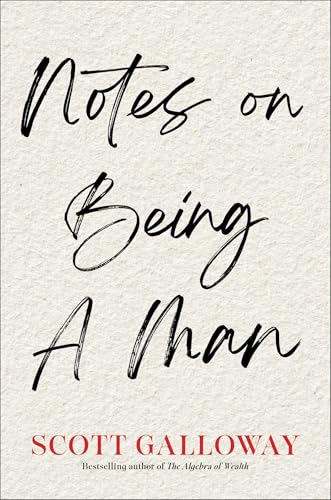

Book: “Notes on Being a Man”

Notes on Being a Man

Scott Galloway

Boys and men are in crisis. Rarely has a cohort fallen further and faster than young men living in Western democracies. Boys are less likely to graduate from high school or college than girls. One in seven men reports having no friends, and men account for three of every four deaths of despair in America. Even worse, the lack of attention to these problems has created a void filled by voices espousing misogyny, the demonization of others, and a toxic vision of masculinity. But this is not just a male issue: women and children can’t flourish if men aren’t doing well. As we know from spasms of violence, there is nothing more dangerous than a lonely, broke young man.

Scott Galloway has been sounding the alarm on this issue for years. In Notes on Being a Man, Galloway explores what it means to be a man in modern America. He promotes the importance of healthy masculinity and mental strength. He shares his own story from boyhood to manhood. He explores his parent’s difficult divorce, working through his anger and depression issues, trying to make money, and raising two boys. He shares the sometimes funny, often painful, lessons he learned along the way.

Some of these lessons include:

Being a good dad means being good to their mother.
Action absorbs anxiety.
Find what you’re good at—follow your talent.
Get out of the house.
Take risk and be willing to feel like an imposter. This is a key to professional success—and masculinity.
Acknowledge your blessings—and create opportunities for others. Be of surplus value.
Be kind. That’s the secret to success in relationships.

With unflinching honesty, Scott Galloway maps out an enriching, inspiring operator’s manual for being a man today.

About the author

Scott Galloway

Scott Galloway is a clinical professor of marketing at the New York University Stern School of Business, and a public speaker, author, and entrepreneur. He was named one of the world’s 50 best business school professors by Poets and Quants.

Robert Caro on power

Robert A. Caro

“But although the cliche says that power always corrupts, what is seldom said … is that power always reveals. When a man is climbing, trying to persuade others to give him power, concealment is necessary. … But as a man obtains more power, camouflage becomes less necessary.”

― Robert A. Caro, The Passage of Power

Robert Allan Caro (born 1935) is an American journalist and author known for his biographies of United States political figures Robert Moses and Lyndon Johnson. Wikipedia

Mark Twain and Voltaire on adjectives

Mark Twain
  • Google AI Overview

The advice “If you catch an adjective, kill it” (or “When you catch an adjective, kill it”) is famously from Mark Twain, though Voltaire also famously said, “The adjective is the enemy of the noun”. Both offered strong critiques of excessive adjectives, with Twain urging writers to eliminate weak ones for stronger nouns and verbs, and Voltaire calling them the noun’s adversary. 

  • Mark Twain: “When you catch an adjective, kill it. No, I don’t mean utterly, but kill most of them—then the rest will be valuable. They weaken when they are close together”.
  • Voltaire: “The adjective is the enemy of the noun”. 

Both writers championed clearer, more forceful prose by favoring strong nouns and verbs over descriptive fluff, a core principle in good writing. 

Portrait c. 1720s, the Musée Carnavalet

François-Marie Arouet, known by his nom de plume Voltaire (November 21, 1694 – May 30, 1778), was a French Enlightenment writer, philosopher, satirist, and historian. Famous for his wit and his criticism of Christianity and of slavery, Voltaire was an advocate of freedom of speech, freedom of religion, and separation of church and state. Wikipedia

Mark Twain was the pen name of Samuel Langhorne Clemens (November 30, 1835, – April 21, 1910), a Missouri-born author, essayist, and humorist. He’s known for his satirical wit, humorous prose, and vivid characters. His best-known works are The Adventures of Tom Sawyer (1876) and The Adventures of Huckleberry Finn (1885), both considered American classics. Twain’s other works include The Innocents Abroad (1869), Roughing It (1872), and Life on the Mississippi (1883). 

Book: “I Don’t Believe in Astrology: A Therapist’s Guide to the Life-Changing Wisdom of the StarsBook: “

Debra Silverman

Do you ever question if you’re fulfilling your purpose in life?
Are you happy with the path you’re on?
Are you being true to yourself?


Perhaps you, like many, are sceptical of astrology. Still, you cannot shake that restless voice of curiosity, wondering whether there’s some truth in it. I Don’t Believe in Astrology is here to help. Debra Silverman’s expertise will help you silence every doubt and find clarity through her system of the four elements – earth, air, water and fire – and understanding which of these is your core element.

Debra introduces astrology as the medicine for accepting our human nature, its idiosyncrasies and dilemmas. Through an application of both therapy and astrology, this breakthrough guide equips readers with tools that release self-judgement, inner criticism, negativity, and misunderstandingLearning to accept who you are and to love yourself unconditionally.

Debra teaches you how to step away from the struggle of your ego and see yourself with the calm objectivity of your soul. You will learn how to love what you see — not just your best qualities but everything about you. Most of all, you will cultivate compassion for others. Learn the meaning of the sun, moon, rising, and planetary signs. Using Debra’s method, combining the wisdom of astrology and psychology, you will remember the truth of your soul’s expression, seen through the eyes of self-love.

(Goodreads.com)

Pamela Hemphill refuses Trump January 6 pardon

A Mighty Girl 

“We were guilty, period.” One former Trump supporter, Pamela Hemphill, refused to be party to Trump’s attempt to downplay the significance of the violent insurrection of the U.S. Capitol which took place five years ago today on January 6, 2021. Hemphill formally rejected Trump’s pardon for her participation in the January 6th Capitol riot, asserting that a pardon “would be a slap in the face to the Capitol police officers, to the rule of law and to our whole nation.”

“The pardons just contribute to their narrative, which is all lies, propaganda,” continued the 72-year-old Hemphill from her home in Idaho. Her principled stance stands in stark contrast to the more than 1,500 other January 6th defendants who eagerly accepted clemency from the Trump administration, even those who assaulted police officers while attacking and ransacking the U.S. Capitol.

In 2021, Hemphill flew from Idaho to Washington D.C. to support Trump’s effort to overturn the results of the 2020 presidential election. Prosecutors said she pushed through police lines three different times as the crowd grew increasingly violent, encouraged fellow rioters to push their way inside the building, and was later seen inside the Capitol Rotunda. Court documents show she had posted on social media before the event, writing “it’s a WAR!” and that she was on her way to Washington. Hemphill pleaded guilty in January 2022 to a count of unlawful parading and was sentenced later that year to a term that included three years of probation. She served 60 days in jail, received 36 months of probation, and was ordered to pay $500 in restitution.

Hemphill’s journey to rejecting Trump began with her growing awareness of how she had been manipulated. “I didn’t realize that brainwashing was happening with Trump in 2016,” she said in an August 2024 interview. “This is how [my family] would talk to me. ‘Pam, you know, the Democrats… are trying to take over. They’re getting more aggressive.’ I tend to believe them. You know, I wasn’t doing my own research.” Hemphill admitted that Trump’s rhetoric on immigration and border security initially attracted her support. Her time in jail led to serious reflection about her actions.

After her release, she began spending time in online groups with other January 6 participants, where she realized “how much disinformation was being spread and how difficult it was to combat falsehoods with the truth.” Now, she says, her participation in January 6th is “like a scar that I have to carry for the rest of my life… It’s gonna be that shame(ful) feeling,” leading her to forever regret that she was “a part of that craziness, that cult.”

The cost of Hemphill’s moral stand has been considerable. She has received death threats since breaking with MAGA and faced persistent online harassment. Her choice to speak up hasn’t been easy, and she’s had to move residences because the movement she once supported has turned against her.

“I’m not going to be bullied by MAGA anymore,” she wrote on social media, noting that Trump supporters have allegedly gone so far as to call her probation officer trying to get her “in trouble” in the wake of her media appearances condemning the riot. Despite these challenges, Hemphill remains committed to honesty about what happened on January 6th, describing it as “the worst day in our history.”

Yet her stand has also drawn unexpected support. Former Vice President Mike Pence — who was inside the Capitol on January 6th when rioters chanted “Hang Mike Pence” and whom Trump criticized for certifying the election results — wrote Hemphill a letter in June expressing admiration for her decision to reject the pardon.

In an era when so many have chosen partisan loyalty over truth, Hemphill’s example offers a reminder that accountability begins with oneself. Out of more than 1,500 pardoned defendants, only two have rejected clemency out of conscience: Hemphill and Navy veteran Jason Riddle of New Hampshire. It’s proof that accountability can still prevail over complicity.

Kudos to Pamela Hemphill for her courage and integrity!

To inspire children and teens with stories of real-life girls and women who stood up for truth and justice throughout history, visit our blog post, “Dissent Is Patriotic: 50 Books About Women Who Fought for Change,” at https://www.amightygirl.com/blog?p=14364

For an excellent book for kids about the events of January 6th and the importance of respecting the electoral process, we recommend “Losing is Democratic: How to Talk to Kids About January 6th” for ages 7 and up at https://bookshop.org/a/8011/9798989493449 (Bookshop) and https://amzn.to/4e6KFbB (Amazon)

For powerful books for tweens and teens about girls living in real-life oppressive societies throughout history where rulers didn’t respect the rule of law, visit our blog post “The Fragility of Freedom: Mighty Girl Books About Life Under Authoritarianism” at https://www.amightygirl.com/blog?p=32426

To see more stories from A Mighty Girl, you can sign-up for A Mighty Girl’s free email newsletter at https://www.amightygirl.com/forms/newsletter

Thanks to The New York Times for sharing this image!

(Posted on Facebook.com)

Poem: The Way It Is

The Way It Is 


There’s a thread you follow.  It goes among things that change.  But it doesn’t change.

People wonder about what you are pursuing.You have to explain about the thread. 

But it is hard for others to see.

While you hold it you can’t get lost.

Tragedies happen; people get hurt or die; and you suffer and get old. 

Nothing you can do can stop time’s unfolding. 

You don’t ever let go of the thread. 

William Stafford (1914-1993)
American Poet 

AN OPPORTUNITY FOR DAILY REFLECTION BROUGHT TO YOU BY THE SCHOOL OF PRACTICAL PHILOSOPHY

Cover Song for the Second Law: A Poem for Beginnings

By Maria Popova (themarginalian.org)

You know the feeling, its scorching urgency, its icy impossibility: to press the undo button of life, to unwind the reel of experience and snip out the wrong turn, the wrong word, the wrong investment of the heart.

It can’t be done without bending the universe, without undoing the second law of thermodynamics.

Our relationship to time is the single most important relationship of our lives, the substrate upon which all other relationships graft. To keep it from being one of bondage, it is useful to imagine how time might work on other worlds, because these thought experiments give us scale models of different ways of orienting to time in this world. It is useful to remember that we can always begin again.

And so, a poem:

COVER SONG FOR THE SECOND LAW
by Maria Popova

Let time begin again
this one not a river
but a fountain
pouring in every direction
into a pool of itself
at the center
of the sunlit plaza
of the possible

and we

corpuscles of mist
gilded for a moment
before we drop
to wash the pennies
of the dead

and then begin again.

Couple with Hannah Arendt on forgiveness as the antidote to the irreversibility of life, then revisit Robin Jeffers’s epic poem “The Beginning at the End.”

The Trouble with Love

By Maria Popova (themarginalian.org)

Two centuries ago, a small group of brilliant and troubled young people trembling with the unprocessed traumas of their childhoods laid in their poems and letters and journals the foundational modern mythos of love. Although none but one of them lived past their thirties, they touched the lives of generations to come with their art and their ideas about life.

We call them the Romantics, keep quoting their poems in our vows and keep paging through their textbook for suffering.

Pulsating through our culture as unexamined dogma is their idea that there is a hierarchy of the affections and that romantic love sits at the top as the organizing principle of our emotional lives, the aim and the end of our existential longing. It is a religion that even people with extraordinary capacity for critical thinking in other domains of life tend not to question. And yet when we let our hearts be large enough and real enough, we discover that there is but a porous and permeable membrane between friendship and passion, that collaboration is a form of intimacy, that family can mean many different things and look many different ways; we discover that romantic love is overwhelmingly a relation not between complete human beings but between idealized selves and mutual projections — the most powerful prompt for fantasy the creative imagination has invented.

Illustration from An ABZ of Love

The Portuguese poet and philosopher Fernando Pessoa (June 13, 1888–November 30, 1935) offers a sobering antidote to the cult of romantic love in a passage from The Book of Disquiet (public library) — the posthumously published masterpiece that also gave us Pessoa on how to be a good explorer in the lifelong expedition to yourself and how to unself into who you really are. He writes:

Romantic love is a rarefied product of century after century of Christian influence, and everything about its substance and development can be explained to the unenlightened by comparing it to a suit fashioned by the soul or the imagination and used to clothe those whom the mind thinks it fits, when they happen to come along.

But every suit, since it isn’t eternal, lasts as long as it lasts; and soon, under the fraying clothes of the ideal we’ve formed, the real body of the person we dressed it in shows through.

Romantic love is thus a path to disillusion, unless this disillusion, accepted from the start, decides to vary the ideal constantly, constantly sewing new suits in the soul’s workshops so as to constantly renew the appearance of the person they clothe.

The standard romantic model is in this sense a warping of the deepest, truest kind of love — the kind Iris Murdoch so perfectly defined as “the extremely difficult realisation that something other than oneself is real… the discovery of reality.” Romantic love, Pessoa observes, is the flight from reality into fantasy, the projection of oneself onto the other:

We never love anyone. What we love is the idea we have of someone. It’s our own concept — our own selves — that we love.

[…]

The relations between one soul and another, expressed through such uncertain and variable things as shared words and proffered gestures, are deceptively complex. The very act of meeting each other is a non-meeting. Two people say “I love you” or mutually think it and feel it, and each has in mind a different idea, a different life, perhaps even a different colour or fragrance, in the abstract sum of impressions that constitute the soul’s activity.

Card from An Almanac of Birds: 100 Divinations for Uncertain Days, also available as a stand-alone print and as stationery cards, benefitting the Audubon Society.

Couple with Iris Murdoch on how to see more clearly and love more purely, then revisit Martha Nussbaum’s superb litmus test for how to know whether you really love a person and Simone de Beauvoir on how two souls can interact with one another in a meaningful way.