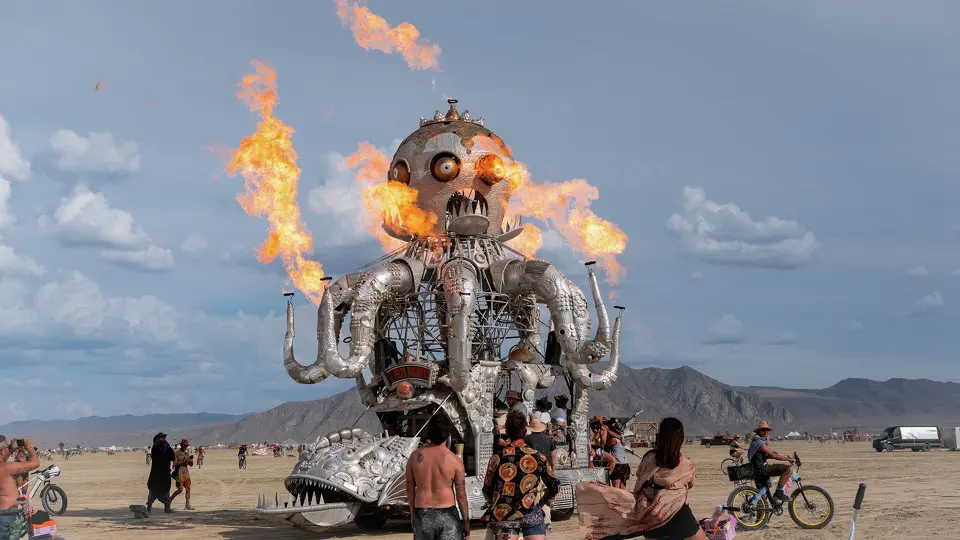
The El Pulpo Magnifico art installation at Burning Man. This year’s events have been battered by storms, mud and long delays, but many Burners say the hardships build camaraderie and are worth the effort. Martin Rodriguez/Courtesy of Burning Man
At this year’s Burning Man, battered by sandstorms, rain and hours-long traffic delays, some participants say the hardships are part of the experience. Others aren’t so sure.
“The weather this year is not easy,” said Kate Sledkova, 36, a Utah-based artist. “The first day, there were sandstorms. From the second day, it has been raining, and it is impossible to move.”
The desert festival in Nevada’s Black Rock City began Sunday, following a weekend of brutal storms that battered camps, tore down art installations and caused dozens of injuries. Yet Sledkova, attending her second Burning Man, said morale in her camp remains strong.
Her team installed two artworks — “Hand of Fate,” a 15-foot steel-and-polycarbonate hand, and “An Event Horizon,” a vortex of pulsing lights — both of which survived the storms. Pieces like the Ukrainian-built inflatable sculpture “Black Cloud” weren’t so lucky.
“Everyone is not sad despite the weather,” she said. “Real participants are ready for everything. We have respirators and rubber boots and we are in a great mood.”
Some expressed a similar sense of resilience. Vallejo residents Charles Mae Wanamaker (whose spouse is a Chronicle editor) and Hope Nastri said their camp had to rebuild three times.
“A lot of the newer people didn’t really take the time to research,” Wanamaker, 42, said. “I mean, you’re vacationing in a place where the world is trying to kill you.”
Online, frustration mounted. One Reddit user described being pummeled by 50 mph winds.
“I haven’t felt terror like that before,” they wrote Wednesday. “Rocks and pebbles sand-blasting my skin, hearing large objects whipping by me, unable to see even two feet in front of me … That’s going to stick with me for a long time.”
Though a stranger offered them shelter, they said swarms of mosquitoes drove them to abandon the festival.
“Despite meeting wonderful people and seeing old friends, the experience was a nightmare,” they wrote. “I quit my tenth Burn, and I absolutely made the right choice.”
Veterans agreed that experienced Burners know how to endure the low points.
“Everyone I was surrounded by was well prepared,” said Matthew F. Reyes, known on the Playa as motorbikematt, who volunteers on the festival’s live webcast team. “Burners tend to put themselves in risky situations and enjoy preparing accordingly. This year felt no different in that regard.”
Despite the widespread destruction caused by the storms, organizers stressed there are more than 1,100 placed theme camps — along with hundreds more unplaced camps — across the Playa. Most of them survived the extreme weather.
Still, repeated storms took their toll. “The uniquely bad grind this year was the timing and frequency of the storms,” Reyes said. “Our internal ‘Burner clock’ has been collectively reset.”
By midweek, vehicles were again entering the site, though muddy conditions forced intermittent gate closures and delays of up to eight hours each day. Organizers reminded attendees to keep electrical gear dry after a reported electrocution on Tuesday night resulted in one man being airlifted to a trauma center. (No update on the man’s condition was available as of Thursday.)
Despite the setbacks, about 70,000 people are expected through Monday, Sept. 1.
Many Burners believe the coming days — capped by Saturday’s climactic burn of the large wooden effigy of The Man — will redeem the festival again defined by Nevada’s unforgiving desert.
“The hardship definitely builds camaraderie,” Nastri said. “Everybody has a mid-week meltdown, that’s just expected. If you can overcome it, the thrill is really pretty amazing.”
Zara Irshad is the Chronicle’s Arts & Entertainment Engagement Reporter. She joined the Chronicle as a summer 2023 intern for the Datebook team. She is a recent graduate of UC San Diego, where she studied communications. She previously interned for the San Diego Union-Tribune and wrote for her campus newspaper, the Guardian, where she served as editor-in-chief. Irshad was part of the honors program for her major and double-minored in world literature and film studies.
Translation is a 5-step process of “straight thinking in the abstract” comparing and contrasting what seems to be truth with what you can syllogistically, axiomatically and mathematically (using word equations) prove is the truth. It is not an effort to change, alter or heal anything.
The claims in a Translation may seem outrageous, but they are always (or should always be) based on self-evident syllogistic reasoning. Here is one Translation from this week.
1) Truth is that which is so. That which is not truth is not so. Therefore Truth is all that is. Truth being all is therefore total, therefore whole, therefore sound, therefore healthy, therefore fit, therefore fitting, therefore appropriate, therefore proper, therefore right, therefore perfect. I think therefore I am. Since I am and since Truth is all that is, therefore I, being, am Truth. Since I, being, am Truth, therefore I, being, have all the attributes of Truth. Therefore I, being, am total, whole, sound, healthy, fit, fitting, appropriate, proper, right, perfect. Since I am mind (self-evident) and since I (being) am Truth, therefore Truth is Mind. (Two things being equal to a third thing are equal to each other.) Since Truth is Mind, therefore Mind has all the attributes of Truth. Therefore Mind is total, whole, sound, healthy, fit, fitting, appropriate, proper, right, perfect.
2) We elected a dictator.
Word-tracking: We: the people We the people: government of the people, by the people, for the people govern: to steer people: a community community: common, society, consociation elect: legend, choose, to set apart dictator: tyrant, absolute authority, imposing will on others will: to make decisions
3) Truth being all that is, there can be nothing other than truth. Therefore Truth is one. Truth being one, nothing can be dissociated or disconnected from one, therefore All is connected. Since to elect is to choose and since Truth is all that is, therefore the only choice, therefore only Truth can be elected. Since to will is to decide and since Truth is the only option, therefore Truth is the only will. Since a dictator imposes his will on others and since there are no others in Truth, therefore Truth imposes Its will on Itself.
4) Truth is one. All is connected. Only Truth can be elected. Truth is the only will. Truth imposes Its will on Itself.
5) Truth always elects Itself and dictates to Itself.
Weekly Invitational Translation Group invites your participation. If you would like to submit a Translation on any subject, feel free to send your weekly Translation to zonta1111@aol.com and we will anonymously post it on the Bathtub Bulletin on Friday.
Is it your lying, cheating ex-husband? Your sadistic high school gym teacher? Your boss who loves to humiliate people in meetings? The colleague who stole your idea and passed it off as her own?
In the pages of The Sociopath Next Door, you will realize that your ex was not just misunderstood. He’s a sociopath. And your boss, teacher, and colleague? They may be sociopaths too.
We are accustomed to think of sociopaths as violent criminals, but in The Sociopath Next Door, Harvard psychologist Martha Stout reveals that a shocking 4 percent of ordinary people—one in twenty-five—has an often undetected mental disorder, the chief symptom of which is that that person possesses no conscience. He or she has no ability whatsoever to feel shame, guilt, or remorse. One in twenty-five everyday Americans, therefore, is secretly a sociopath. They could be your colleague, your neighbor, even family. And they can do literally anything at all and feel absolutely no guilt.
How do we recognize the remorseless? One of their chief characteristics is a kind of glow or charisma that makes sociopaths more charming or interesting than the other people around them. They’re more spontaneous, more intense, more complex, or even sexier than everyone else, making them tricky to identify and leaving us easily seduced. Fundamentally, sociopaths are different because they cannot love. Sociopaths learn early on to show sham emotion, but underneath they are indifferent to others’ suffering. They live to dominate and thrill to win.
The fact is, we all almost certainly know at least one or more sociopaths already. Part of the urgency in reading The Sociopath Next Door is the moment when we suddenly recognize that someone we know—someone we worked for, or were involved with, or voted for—is a sociopath. But what do we do with that knowledge? To arm us against the sociopath, Dr. Stout teaches us to question authority, suspect flattery, and beware the pity play. Above all, she writes, when a sociopath is beckoning, do not join the game.
It is the ruthless versus the rest of us, and The Sociopath Next Door will show you how to recognize and defeat the devil you know.
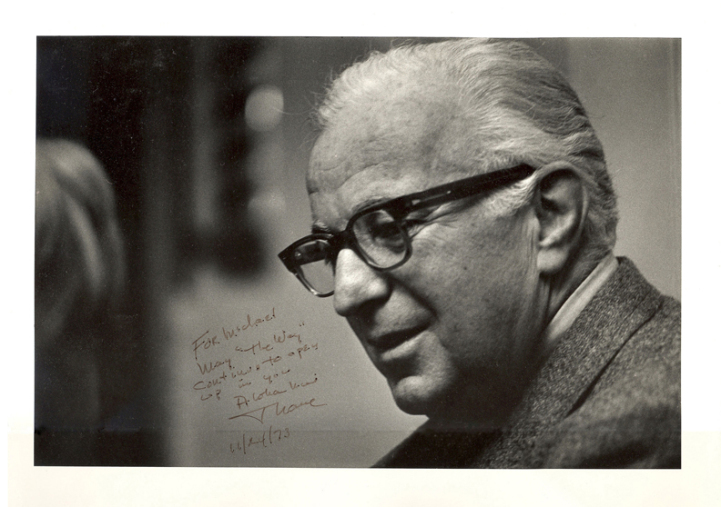
While a specific definition of romance from Thane Walker’s “Fourth Way” audiotape series cannot be found through public search results, information about his work with the Fourth Way provides clues to his probable perspective.
The Fourth Way, a system of spiritual self-development, suggests that true romance is not based on conventional, often ego-driven, ideas of love but on a profound, conscious connection that arises from deep inner work.
Here is an analysis based on what is known about Thane Walker and the Fourth Way:
About Thane Walker and the Fourth Way
The Prosperos: As a co-founder of the Prosperos in 1956, Thane Walker helped create a spiritual education program that blended mysticism and psychology with G. I. Gurdjieff’s Fourth Way teachings.
Consciousness and “the Work”: Gurdjieff’s Fourth Way is often referred to as “the Work,” and its main goal is to awaken one’s consciousness and develop the “True Essential Self”. This focus on inner transformation is central to understanding the Fourth Way’s view of human relationships.
Contrast with ordinary life: The Fourth Way emphasizes transcending the unconscious, mechanical behaviors of ordinary life. This is the starting point for understanding how true romance would differ from what people typically experience.
A Fourth Way interpretation of romance
Based on these core principles, a Fourth Way-informed definition of romance likely involves:
Conscious connection: Moving beyond a physical or emotional attraction, a Fourth Way romance would involve a conscious, aware connection between two individuals who are both working on their own inner development.
Absence of mechanical patterns: Instead of falling into conventional, ego-driven relationship patterns, a Fourth Way couple would consciously choose their actions and reactions, free from habitual or societal programming.
Intentionally suffering: Gurdjieff’s concept of “intentional suffering”—consciously working on overcoming one’s own mechanical flaws and weaknesses—would be part of the romantic dynamic. This is not about passive suffering but about active, deliberate effort toward self-perfection.
Honest self-observation: As the Fourth Way is built on the principle of self-observation and non-attachment, a romantic partnership would be a place for honest self-assessment, rather than a space to project idealized images onto a partner.
Higher state of Being: Rather than a means of personal gratification, the romantic relationship becomes a vehicle for both individuals to assist each other in reaching a higher state of consciousness.
In short, Thane Walker’s Fourth Way perspective would likely define true romance as a conscious, transformational journey undertaken by two self-observant individuals, rather than a mechanical or emotional attachment.
“The modern conservative is engaged in one of man’s oldest exercises in moral philosophy, that is the search for a superior moral justification for selfishness. It is an exercise which always involves a certain number of internal contradictions and even a few absurdities. The conspicuously wealthy turn up urging the character-building value of privation for the poor.” [
–John Kenneth Galbraith speech to U.S. Senate on December 18, 1973
John Kenneth Galbraith OC, also known as Ken Galbraith (October 15, 1908 – April 29, 2006 ), was a Canadian-American economist, diplomat, public official, and intellectual. His books on economic topics were bestsellers from the 1950s through the 2000s. As an economist, he leaned toward post-Keynesian economics from an institutionalist perspective. Wikipedia
Please note that the posts on The Blogs are contributed by third parties. The opinions, facts and any media content in them are presented solely by the authors, and neither The Times of Israel nor its partners assume any responsibility for them. Please contact us in case of abuse. In case of abuse, Report this post.
It is one of the most tantalizing questions at the intersection of neuroscience, physics, and philosophy: are our brains merely in the universe, or are they in some sense of the universe? The distinction matters. The former suggests a separation—mind as an isolated phenomenon, the body as a container. The latter implies an inseparability, that our cognition is woven into the very fabric of cosmic reality.
For centuries, science and philosophy have tugged between dualism and materialism. Descartes famously separated mind and matter, while Spinoza countered with a vision of a single substance—God or Nature—that encompassed both. Today, neuroscience charts synaptic firing, quantum physics traces entanglement, and cosmology unravels the deep time of the universe. Yet the question remains unresolved: does consciousness emerge from the brain like steam from a kettle, or does the brain act more like an antenna receiving signals already present in the cosmos?
Consider the astonishing structural parallels between neural networks and cosmic webs. The universe’s large-scale structure—filaments of galaxies linked by dark matter—has been compared visually and mathematically to the architecture of neurons and synapses. Both show clustering, hubs, and emergent complexity. The scale differs by 27 orders of magnitude, yet the patterns echo. Is this mere coincidence, or does it hint at a deeper principle of organization that spans from brain tissue to the cosmic frontier?
Evolutionary biology provides another layer. The human brain did not appear out of nowhere—it is the outcome of billions of years of planetary and cosmic history. The iron in our blood, the calcium in our bones, and the phosphorus in our DNA were all forged in the hearts of ancient stars. Carl Sagan’s old phrase—“We are star-stuff”—is not poetry but physics. To say the brain is embedded in the universe is to recognize that its very atoms were incubated in supernovae. Consciousness, then, may be less an anomaly and more a continuation of cosmic self-organization.
Information theory strengthens this case. John Wheeler’s famous dictum, “It from bit,” suggests that at the deepest level, reality might be informational. If the universe is structured as an information-processing system, then the human brain is simply a local instantiation of this universal dynamic—one way matter has learned to compute itself. By this view, the brain does not sit apart from the universe; it is the universe doing a very particular kind of work, compressing complexity into thought, memory, and imagination.
The idea resonates even with today’s artificial intelligence. Neural networks, though crude compared to biology, show how intelligence can emerge from patterned connectivity and feedback loops. If intelligence can arise in silicon as well as carbon, perhaps consciousness is not a rare aberration but a universal potential wherever complex networks evolve. Brains, galaxies, algorithms—they may be different stages of the same cosmic grammar.
Even the controversial question of quantum processes in cognition points to this embeddedness. While many neuroscientists reject the idea, physicists such as Roger Penrose and anesthesiologist Stuart Hameroff have speculated that consciousness may depend on quantum coherence in microtubules within neurons. If even partly true, it would mean our minds hinge on the same probabilistic, relational physics that governs the subatomic world—a far cry from a brain sealed off from the cosmos.
These scientific perspectives echo long-standing spiritual traditions. Hinduism’s concept of Brahman, Sufi mysticism’s sense of unity, or Indigenous cosmologies that see humans as kin to the stars—all articulate a vision of consciousness as inseparable from the wider cosmos. While science seeks mechanisms and traditions offer metaphors, both converge on the intuition that mind and universe are not strangers but kin.
Of course, skeptics rightly warn against overreach. Structural similarity between neurons and galaxies does not imply shared function. Cosmic webs are not “thinking,” and galaxies are not exchanging ideas across light-years. Yet to dismiss the resonances outright risks a different kind of hubris: the assumption that human cognition is a freak occurrence, sealed off from the very universe that birthed it.
The implications of a more embedded view are profound. If our brains are of the universe, then consciousness is not an accidental spark but a continuation of cosmic unfolding. That realization carries ethical weight. It suggests we are not masters standing apart from nature but expressions of it, woven from the same fabric as forests, rivers, and stars. In an era of ecological crisis, where humans act as though the Earth were a disposable backdrop, this recognition could re-anchor us in humility.
There is also a political dimension. Modern society is built on the idea of separation—man versus nature, nation versus nation, mind versus matter. If consciousness itself is proof of continuity rather than separation, it calls for a politics of interdependence. To harm the planet is to wound the conditions that make thought itself possible. To fragment humanity into antagonistic camps is to deny the universal embeddedness we all share.
Ultimately, the deepest argument may be experiential. The very act of wondering whether our brains are embedded in the universe is itself evidence. The universe has, through us, developed the capacity to ask about its own nature. In this sense, consciousness is not something floating within space-time—it is the cosmos folding back on itself in self-awareness.
Whether one leans toward materialist reductionism or cosmic holism, the deeper point is clear: the line we draw between brain and universe is far blurrier than we imagine. And perhaps the universe, in the final analysis, is not something “out there” at all—but the field in which every thought, memory, and dream arises. To speak of our brains as embedded in the universe may not just be speculation; it may be the most literal statement we can make.
ABOUT THE AUTHOR
Religion: Church of England/Interfaith. [This is not an organized religion but rather quite disorganized]. Views and Opinions expressed here are STRICTLY his own PERSONAL!
Quantum experiments show the past isn’t set in stone until it’s observed in the present—raising profound questions about memory, free will, and our role in shaping reality.
What if the past you think is fixed isn’t fixed at all? What if yesterday is not a closed book but a living script, waiting for today’s choices to finish writing it? At first glance, this sounds like mystical poetry or science fiction. But experiments in quantum physics are showing something astonishing: the way we observe the world now can reach back and determine what already happened.
This is more than a scientific curiosity—it strikes at the heart of how we understand memory, free will, and even our place in the universe. If time itself isn’t a one-way street, then the story of our lives may be far more fluid, creative, and participatory than we ever dared to imagine.
A few years ago, in a quiet Vienna lab, physicists performed an experiment that should have been impossible.
Two entangled photons, paired particles of light connected across space in ways Einstein once dismissed as “spooky action at a distance,” were sent on divergent journeys. One was measured right away. The other was delayed, forced through a long loop of fiber-optic cable.
By any reasonable logic, the first photon should have had no way of “knowing” what its twin would later encounter. And yet, when the results were compared, the earlier measurement appeared to be influenced by the later choice.
The future, it seemed, had reached back and changed the past!
This was not a one-off fluke. Variations of the experiment, known as the Delayed Choice Quantum Eraser, have been run and confirmed repeatedly in labs across the world. You can find summaries in journals like Nature and ScienceDirect that describe the setup in clinical detail, but the essence is profoundly simple and deeply unsettling: observation at one point in time appears to retroactively determine what happened at an earlier point.
To be clear, this doesn’t mean scientists have figured out how to send a message back to yesterday. Relativity still holds its iron grip: no information is traveling faster than light. But it does mean that our everyday sense of time as a one-way arrow, where the past is fixed, the present is immediate, and the future is open, may not be how reality actually works. Instead, the quantum realm suggests that what we call “the past” may not be fully settled until it is measured in the present.
In classical physics, cause always precedes effect. Drop a rock, and then it falls. Fire a bullet, and then it strikes a wall. But in quantum physics, the sequence doesn’t always line up so neatly. When a photon is forced into a situation where it can act either like a particle or like a wave, its choice is not determined until it is measured. Even more baffling, the way we choose to measure it can determine how it behaved in the past.
One version of the experiment splits a photon into two entangled twins. One is immediately measured, while the other travels toward a system that either preserves or erases the record of which path it took.
The twist is that the choice to preserve or erase comes after the first photon has already been measured. And yet, when the results are compared, the earlier measurement aligns with the later choice, as if the particle had somehow anticipated its partner’s future fate.
This undermines the very foundation of causality, which is arguably the bedrock of science itself. The idea that cause precedes effect is so deeply ingrained in our minds that we take it for granted not only in physics but in morality, politics, and spirituality.
Yet here is experimental evidence that suggests time doesn’t flow the way we think it does. Instead of a straight line, time at the quantum level may be something more like a web or a field, interconnected in all directions, past and future woven together in ways our common sense cannot grasp.
Some physicists see in this a hint that the universe is fundamentally holistic, bound across time just as it is across space. John Archibald Wheeler, who proposed the delayed-choice experiment in the 1970s, famously said that “no phenomenon is a phenomenon until it is an observed phenomenon.”
What he meant is that reality, at its most basic level, does not crystallize into definite form until it is touched by observation. That is not how rocks and trees appear to behave, but at the quantum level, it is precisely what experiments confirm.
The implications go further. If present choices can shape past outcomes, then our notion of time itself may be less a physical reality and more an emergent illusion.
Some physicists, like Carlo Rovelli in The Order of Timelink, argue that time exists only as a byproduct of how we, as conscious beings, measure change. In the raw mathematics of quantum mechanics, the equations don’t privilege past over future; they work just as well in reverse. It is only at the human scale, where we experience entropy and memory, that the arrow of time emerges.
For millennia, mystics and philosophers have intuited that reality might be less rigid than it appears. The Hindu concept of maya describes the world as an illusion shaped by perception. In Buddhism, the doctrine of dependent origination holds that events are not fixed but arise in interdependence, conditioned by observation and awareness.
Even in Christian mysticism, Meister Eckhart and The Gospel of Thomas both wrote of a God who exists outside time, for whom past and future are eternally present. Now, physics itself is hinting at the same possibility: that reality, at its roots, is not a machine running forward but a field of possibilities that only congeal when observed.
Of course, physicists are careful not to overstate what these experiments mean. No one is saying we can change history in the way science fiction imagines, or that we can send instructions to our younger selves.
But the deeper suggestion is more radical. If the past is not truly fixed until the present observes it, then the very fabric of reality is participatory. The observer is not a passive witness but an active agent in shaping the outcome. Wheeler himself described this as a “participatory universe,” where consciousness and observation play a constitutive role in reality itself link.
This brings us to the edge of science and philosophy, where questions about the role of mind in matter can no longer be shrugged off. Is consciousness itself entangled with the fabric of the cosmos?
Are we, by observing, actually helping to write the script of the universe? Or is the act of measurement simply another physical interaction, with no special role for awareness?
These debates remain unresolved, but the experiments themselves are no longer speculative. They are on the record, peer-reviewed, replicated, and undeniable.
For those of us who seek wisdom in the intersection of science and spirituality, this is where the conversation gets exciting.
If time is not a fixed arrow, then what does that mean for our experience of memory, intention, and even prayer? Many spiritual traditions teach that intention can ripple out in ways that defy linear causality.
Could the quantum fabric of reality provide a scientific window into how that might be possible? Studies on the so-called placebo effect, where belief itself produces measurable healing, already show that expectation can shape outcome in ways we don’t fully understand link.
Perhaps the delayed-choice experiments are the first hints of a much larger truth: that consciousness and matter are not separate but two sides of a deeper whole.
Skeptics argue that these interpretations go too far, and they are right to urge caution. The experiments are subtle, and their results are easy to misrepresent. But even the most conservative reading forces us to grapple with a universe where the line between past and present is not as solid as we once thought.
For centuries, science has chipped away at human certainties. Copernicus and Galileo showed that Earth is not the center of the cosmos. Darwin showed that humans are not the pinnacle of creation but part of the long unfolding of life. Freud suggested that our conscious will is not master of our own minds. Now, quantum physics is telling us that even time, the very stage on which all of history plays out, may not be what we think.
If the future can sculpt the past, then perhaps the present is not just where we happen to be, but the creative fulcrum of existence itself. In this moment, right now, the universe is crystallizing, not only out of what has already been but out of what might yet come. And that means we are not passive passengers on a ride from yesterday to tomorrow. We are participants, co-authors in the unfolding story of reality.
This is not only a scientific puzzle but an invitation to live differently. If reality is not fixed, then despair is not final. If the future can reach back into the past, then our present choices carry weight beyond what we imagine. Perhaps this is what mystics and visionaries have been trying to tell us all along: that we live in a universe of infinite possibility, and that our awareness matters.
In that light, the delayed-choice quantum eraser is not just a strange trick of physics. It is a reminder that reality is alive with mystery, that causality is not a prison but a dance, and that the deepest truths are not always found in what is already known, but in what is yet to be revealed.
Why does this matter? Because if reality is not fully settled until we engage with it, then our choices and awareness carry extraordinary weight. The delayed-choice experiments don’t give us the power to change history in the Hollywood sense, but they do suggest that the universe is far less mechanical—and far more responsive—than we once thought.
To know this is to live differently. It means despair is never absolute, the future is not locked in, and our awareness is not a passive spectator but an active force in shaping what is real. The science is telling us what mystics and poets have long intuited: that reality is alive with possibility, and that we are not just passengers in time—we are co-authors of it.
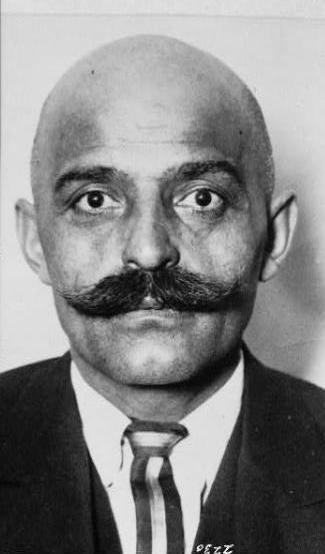
“It is very difficult also to sacrifice one’s suffering. A man will renounce any pleasures you like but he will not give up his suffering.”
~ Gurdjieff
George Ivanovich Gurdjieff (january 13, 1866 – October 29, 1949) was a philosopher, mystic, spiritual teacher, composer, and movements teacher. Born in the Russian Empire, he briefly became a citizen of the First Republic of Armenia after its formation in 1918, but fled the impending Red Army invasion of Armenia in 1920, which rendered him stateless. Wikipedia
The Florida Department of Transportation has ordered Miami Beach and at least eight other cities to remove rainbow-colored crosswalks, prompting local leaders and advocates to push back in defense of LGBTQ+ expression. What do you think?
“This will only make it more difficult to determine the sexual orientation of streets.”Mary Beth Holcroft, Jockey’s Apprentice
“Aw, but I was going to graffiti a slur over it!”Travis Levens, Goat Milker
“This sort of loud, flamboyant coloration has no place in Miami.”Bret Ruppelt, Overture Critic
Consciousness, spirituality, biography, sexuality, androgyny, futurism, space, the arts, science, astrology, democracy, humor, books, movies and more