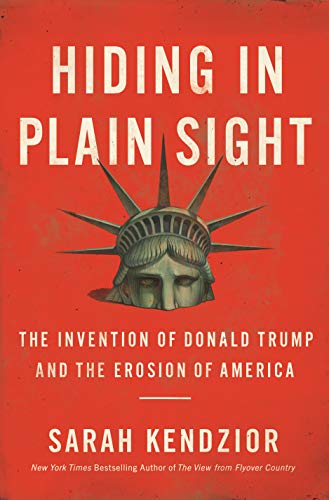
From New York Times bestselling author Sarah Kendzior comes the bitingly honest examination of the erosion of American liberty and the calculated rise to power of Donald Trump.
The rise of Donald Trump may have shocked Americans, but it should not have surprised them. His anti-democratic movement is the culmination of a decades-long breakdown of U.S. institutions. The same blindness to U.S. decline – particularly the loss of economic stability for the majority of the population and opportunity-hoarding by the few – is reflected in an unwillingness to accept that authoritarianism can indeed thrive in the so-called “home of the free”.
As Americans struggle to reconcile the gulf between a flagrant aspiring autocrat and the democratic precepts they had been told were sacred and immutable, the inherent fragility of American democracy has been revealed. Hiding in Plain Sight exposes this continual loss of freedom, the rise of consolidated corruption, and the secrets behind a burgeoning autocratic United States that have been hiding in plain sight for decades. In Kendzior’s signature and celebrated style, she expertly outlines Trump’s meteoric rise from the 1980s until today, interlinking key moments of his life with the degradation of the American political system and the continual erosion of our civil liberties by foreign powers.
Kendzior also offers a never-before-seen look at her personal life and her lifelong tendency to be in the wrong place at the wrong time – living in New York through 9/11 and in St. Louis during the Ferguson uprising, and researching media and authoritarianism when Trump emerged using the same tactics as the post-Soviet dictatorships she had long studied.
Hiding in Plain Sight is about confronting injustice – an often agonizing process, but an honest and necessary one – as the only way that offers the possibility of ending it.
Sarah Kendzior is the New York Times bestselling author of They Knew, Hiding in Plain Sight, The View from Flyover Country, and The Last American Road Trip.
She has a PhD in anthropology from Washington University in St Louis, where she researched politics and digital media in authoritarian states of the former Soviet Union. From 2012 to 2014, she wrote op-eds for Al Jazeera English, and from 2016 to 2020, she wrote op-eds for The Globe and Mail. She has a newsletter (https://sarahkendzior.substack.com/) and lives in St. Louis with her husband and children.
ARIES (March 21-April 19): In some Buddhist mandalas, the outer circle depicts a wall of fire. It marks the boundary between the chaotic external world and the sacred space within. For seekers and devotees, it’s a symbol of the transformation they must undergo to commune with deeper truths. I think you’re ready to create or bolster your own flame wall, Aries. What is non-negotiable for your peace, your creativity, your worth? Who or what belongs in your inner circle? And what must stay outside? Be clear about the boundaries you need to be your authentic self.
TAURUS (April 20-May 20): Centuries ago, builders in Venice, Italy, drove countless wooden pilings deep into the waterlogged mud of the lagoon to create a stable base for future structures. These timber foundations were essential because the soil was too weak to support stone buildings directly. Eventually, the wood absorbed minerals from the surrounding muddy water and became exceptionally hard and durable: capable of supporting heavy buildings. Taurus, you may soon glimpse how something you’ve built your life upon—a value, a relationship, or a daily ritual—is more enduring than you imagined. Its power is in its rootedness, its long conversation with the invisible. My advice: Trust what once seemed soft but has become solid. Thank life for blessing you with its secret alchemy.
GEMINI (May 21-June 20): In Inuit myth, Sedna is the goddess who lives at the bottom of the sea and oversees all marine life. If humans harm nature or neglect spiritual truths, Sedna may stop allowing them to catch sea creatures for food, leading to starvation. Then shamans from the world above must swim down to sing her songs and comb her long black hair. If they win her favor, she restores balance. I propose that you take direction from this myth, Gemini. Some neglected beauty and wisdom in your emotional depths is asking for your attention. What part of you needs reverence, tenderness and ceremonial care?
CANCER (June 21-July 22): In ancient Rome, the lararium was a home altar. It wasn’t used for momentous appeals to the heavyweight deities like Jupiter, Venus, Apollo, Juno and Mars. Instead, it was there that people performed daily rituals, seeking prosperity, protection and health from their ancestors and minor household gods. I think now is a fine time to create your own version of a lararium, Cancerian. How could you fortify your home base to make it more nurturing and uplifting? What rituals and playful ceremonies might you do to generate everyday blessings?
LEO (July 23-Aug. 22): In Persian miniature painting, entire epics are compressed into exquisite images the size of a hand. Each creation contains worlds within worlds, myths tucked into detail. I suggest you draw inspiration from this approach, Leo. Rather than imagining your life as a grand performance, play with the theme of sacred compression. Be alert for seemingly transitory moments that carry enormous weight. Proceed on the assumption that a brief phrase or lucky accident may spark sweet changes. What might it look like to condense your full glory into small gifts that people can readily use?
VIRGO (Aug. 23-Sept. 22): In Andean cosmology, the condor and the hummingbird are both sacred messengers. One soars majestically at high altitudes, a symbolic bridge between the earth and heaven. The other moves with supple efficiency and detailed precision, an icon of resilience and high energy. Let’s make these birds your spirit creatures for the coming months. Your challenging but feasible assignment is to both see the big picture and attend skillfully to the intimate details.
LIBRA (Sept. 23-Oct. 22): In the ancient Greek myth of Psyche, one of her trials is to gather golden wool from violent rams. She succeeds by waiting until the torrid heat of midday passes, and the rams are resting in the cool shade. She safely collects the wool from bushes and branches without confronting the rams directly. Let this be a lesson, Libra. To succeed at your challenges, rely on strategy rather than confrontation. It’s true that what you want may feel blocked by difficult energies, like chaotic schedules, reactive people, or tangled decisions. But don’t act impulsively. Wait. Listen. Watch. Openings will happen when the noise settles and others tire themselves out. You don’t need to overpower. You just need to time your grace. Golden wool is waiting, but it can’t be taken by force.
SCORPIO (Oct. 23-Nov. 21): In 1911, two teams tried to become the first humans to reach the South Pole. Roald Amundsen’s group succeeded, but Robert Falcon Scott’s did not. Why? Amundsen had studied with Indigenous people who were familiar with frigid environments. He adopted their clothing choices (fur and layering), their travel techniques (dogsledding), and their measured, deliberate pacing, including lots of rest. Scott exhausted himself and his people with inconsistent bursts of intense effort and stubbornly inept British strategies. Take your cues from Amundsen, dear Scorpio. Get advice from real experts. Pace yourself; don’t sprint. Be consistent rather than melodramatic. Opt for discipline instead of heroics.
SAGITTARIUS (Nov. 22-Dec. 21): A lighthouse isn’t concerned with whether ships are watching it from a distance. It simply shines forth its strong beams, no questions asked. It rotates, pulses and moves through its cycles because that’s its natural task. Its purpose is steady illumination, not recognition. In the coming weeks, Sagittarius, I ask you and encourage you to be like a lighthouse. Be loyal to your own gleam. Do what you do best because it pleases you. The ones who need your signal will find you. You don’t have to chase them across the waves.
CAPRICORN (Dec. 22-Jan. 19): In 1885, Sarah E. Goode became the fourth African American woman to be granted a U.S. patent. Her invention was ingenious: a folding cabinet bed that could be transformed into a roll-top desk. It appealed to people who lived in small apartments and needed to save space. I believe you’re primed and ready for a similar advance in practical resourcefulness, Capricorn. You may be able to combine two seemingly unrelated needs into one brilliant solution—turning space, time or resources into something more graceful and useful. Let your mind play with hybrid inventions and unlikely pairings.
AQUARIUS (Jan. 20-Feb. 18): I expect you will be knowledgeable and smart during the coming weeks, Aquarius. But I hope you will also be wise and savvy. I hope you will wrestle vigorously with the truth so you can express it in practical and timely ways. You must be ingenious as you figure out the precise ways to translate your intelligence into specifically right actions. So for example: You may feel compelled to be authentic in a situation where you have been reticent, or to share a vision that has been growing quietly. Don’t stay silent, but also: Don’t blurt. Articulate your reality checks with elegance and discernment. The right message delivered at the wrong moment could make a mess, whereas that same message will be a blessing if offered at the exact turning point.
PISCES (Feb. 19-March 20): Liubai is a Chinese term that means “to leave blank.” In traditional ink painting, it referred to the portions of the canvas the artist chose not to fill in. Those unpainted areas were not considered empty. They carried emotional weight, inviting the eye to rest and the mind to wander. I believe your near future could benefit from this idea, Pisces. Don’t feel you have to spell everything out or tie up each thread. It may be important not to explain and reveal some things. What’s left unsaid, incomplete or open-ended may bring you more gifts than constant effort. Let a little stillness accompany whatever you’re creating.
We live amid and inside emblems of the touching longing for permanence that both defines us and defies reality: our houses, these haikus of brick and hope so easily discomposed by a tremor of the earth or a tempest of the sky; our homes, so easily hollowed by death or indifference; our bodies, these boarding houses for stardust. All along, as life keeps living itself through us, we keep casting ourselves in the role of living it — that is what makes all the uncertainty bearable. But deep down in the animal marrow of being, we know that it will end, and that no wall or wish can make it otherwise, and that the only measure of our aliveness — the only redemption of our mortality — is how attentive and awake we are to the savage beauty that fills the interlude between nothingness and nothingness.
What it means and what it takes to be more attentive and alive is what Gretel Ehrlich explores in her classic essay collection The Solace of Open Spaces (public library) — a living affirmation of Emily Dickinson’s pronouncement that “‘Tis good — the looking back on Grief,” written in the years following a devastating loss that had dislodged Ehrlich from orbit and sent her a thousand miles from home, into the arid heart of the landmass. There — in the savage desert of grief, amid the austere hundred-mile views of Wyoming and the rugged kindness of its people — she discovers canyons that “curve down like galaxies to meet the oncoming rush of flat land” and a new kind of toughness that is “not a martyred doggedness, a dumb heroism, but the art of accommodation”; she discovers what she is made of: something transient yet tenacious, not dismantled by loss but recomposed by it.
Art by Sophie Blackall from Things to Look Forward to — an illustrated celebration of living with presence in uncertain times.
Ehrlich writes in the preface:
I had suffered a tragedy and made a drastic geographical and cultural move fairly baggageless… It had occurred to me that comfort was only a disguise for discomfort; reference points, a disguise for what will always change.
Friends asked when I was going to stop “hiding out” in Wyoming. What appeared to them as a landscape of lunar desolation and intellectual backwardness was luxurious to me. For the first time I was able to take up residence on earth with no alibis, no self-promoting schemes.
[…]
The detour, of course, became the actual path; the digressions in my writing, the narrative… As with all major detours, all lessons of impermanence, what might have been a straight shot is full of bumps and bends.
Looking back on the experience and the otherworldly world into which it took her, she reflects on what it taught her about life and the life-reckoning we call art — which, of course, is the only value of experience:
The truest art I would strive for in any work would be to give the page the same qualities as earth: weather would land on it harshly; light would elucidate the most difficult truths; wind would sweep away obtuse padding. Finally, the lessons of impermanence taught me this: loss constitutes an odd kind of fullness; despair empties out into an unquenchable appetite for life.
She learns what we all do once some cataclysm awakens us to the finitude and fragility of life — that this appetite for life is best roused by the most prayerful of acts: the act of paying attention; that to see the world more clearly is to love it more deeply.
Keenly observed, the world is transformed. The landscape is engorged with detail, every movement on it chillingly sharp. The air between people is charged. Days unfold, bathed in their own music. Nights become hallucinatory; dreams, prescient.
[…]
Walking to the ranch house from the shed, we saw the Northern Lights. They looked like talcum powder fallen from a woman’s face. Rouge and blue eyeshadow streaked the spires of white light which exploded, then pulsated, shaking the colors down — like lives — until they faded from sight.
On the same day that a Kiowa friend invites her to attend an ancient Sun Dance, she reads in the news that astronomers have discovered an infant solar system forming around another star. With an eye to the centrality-calibrating poetry of the cosmic perspective, she reflects:
Last night from one in the morning until four, I sat in the bed of my pickup with a friend and watched meteor showers hot dance over our heads in sprays of little suns that looked like white orchids. With so many stars falling around us I wondered if daylight would come. We forget that our sun is only a star destined to someday burn out. The time scale of its transience so far exceeds our human one that our unconditional dependence on its life-giving properties feels oddly like an indiscretion about which we’d rather forget.
One of French artist and astronomer Étienne Léopold Trouvelot’s 19th-century drawings of celestial objects and phenomena. (Available as a print and as stationery cards, benefitting The Nature Conservancy.)
There is nothing in nature that can’t be taken as a sign of both mortality and invigoration… Everything in nature invites us constantly to be what we are.
Ignite empathy as a superpower for transformative personal healing, deeper relationships, and more potent work in the world.
Empathy is so much more than feeling deeply―it holds transformative power to heal ourselves, strengthen our relationships, and amplify our purpose. Dr. Judith Orloff, known for landmark works like The Empath’s Survival Guide , introduces empathy as a daily healing practice and form of emotional intelligence. It is not only for highly sensitive people but for all deep feelers and those who want to develop empathy as a new skill.
Drawing on insights from neuroscience, psychology, and energy medicine, Dr. Orloff shows us how to access our sensitivities, soothe our nervous system, and stop absorbing the emotions of others. She begins with the magic of empathy to find greater self-love and healing―including from trauma. Subsequent chapters apply empathy to our relationships, communities, and the world. Exploring each chapter’s practices, you’ll learn the art of empathic listening, how to stop overthinking, and the importance of setting healthy boundaries and loving detachment to prevent overwhelm, burnout, and more.
This practical, action-driven guide helps us connect our minds and hearts to embody our most authentic, fierce, and compassionate selves. “Cultivating empathy is a kind of peaceful warrior training,” says Dr. Orloff. “You will learn to be both strong and loving, neither a pushover nor rigid. Wherever you are in your life, this book can meet you there and lift you higher.”
Judith Orloff, MD is a psychiatrist, an empath, and author of the recent book “The Genius of Empathy” (Foreword by the Dalai Lama) which offers powerful skills to tap into empathy as a daily healing practice. Her upcoming children’s book “The Highly Sensitive Rabbit” is about a caring rabbit who learns to embrace her gifts of sensitivity through the kindness of loving animals. Her other books include “The Empath’s Survival Guide” and “Thriving as an Empath.”
Dr. Orloff is a New York Times bestselling author and a UCLA psychiatric clinical faculty member. She synthesizes the pearls of conventional medicine with cutting-edge knowledge of intuition, energy, and spirituality. Dr. Orloff specializes in treating highly sensitive people in her private practice. She has been featured on The Today Show, CNN, Oprah Magazine, and in the New York Times and Scientific American. Learn more about the power of empathy at www.drjudithorloff.com
I’m old enough to remember when American politics was divided between those who wanted less government (they were called “conservatives,” or the Right) and those who wanted more social safety nets (called “progressives,” or the Left).
It’s hard to find Right or Left these days. Instead we have something no one has ever seen in America — a personal takeover of nearly all the institutions of government and, increasingly, the private sector, by a would-be dictator.
Trump is on the way to occupying Democratic-led cities with the Army, National Guard, and ICE — in what appears to be a dress rehearsal for the 2026 midterms.
He is telling Republican states to super-gerrymander in order to squeeze out more Republican seats in Congress, to help retain Republican control of the House after the 2026 midterm elections.
He is trying to silence criticism from universities, museums, law firms, and the media. And targeting critics for prosecution, such as Adam Schiff and John Bolton.
But that’s hardly all of it.
At the same time, Trump is taking personal control of the U.S. economy.
He’s trying to control the Federal Reserve Board, threatening Jerome Powell with unflattering stories about his expenditures on the Fed’s building and Fed governor Lisa Cook with stories about her home loan.
He’s imposing his will on key industries, from semi-conductors to steel.
He’s given the chip giants Nvidia and Advanced Micro Devices export licenses to sell their semiconductors to China on condition that they pay the U.S. government 15 percent of what they make on those sales. (Not incidentally, Trump has reported substantial personal holdings in Nvidia.)
He’s converting nearly $11 billion of grants that the government had given Intel (part of the Biden administration’s CHIPS and Science Act) into a 10 percent stake in the company, worth $8.9 billion, held by the government. Presumably, this would let Trump decide on its CEO.
His White House has even created a scorecard that rates American corporations on how loyal they are to Trump. Corporations with “strong” ratings (among them, Uber, DoorDash, United, Delta, AT&T, and Cisco) are to be rewarded with tax and regulatory benefits, while “low” rated corporations could face retribution ranging from Justice Department and regulatory lawsuits to damaging executive orders, harsh regulations, and unbridled scorn from Trump.
Before they poured money into Trump’s initiatives and PACs, many Big Tech corporations were facing federal investigations and enforcement lawsuits. Those investigations and lawsuits are now being dropped.
Trump’s import taxes (tariffs) are the results of individual deals between Trump and particular countries, as well as between Trump and big American corporations. So far, America’s trading partners have agreed to invest over $1 trillion in the American economy. Who will oversee such investments? Trump.
In sum, an increasing part of our economy is no longer being determined by supply and demand but by the deals Trump is striking.
Authoritarians rely on vast bureaucracies to control industry, as does China’s Xi Jinping.
But the new order being imposed on American industry doesn’t come from a vast authoritarian bureaucracy. It’s personal and arbitrary. A single so-called “strongman” is beginning to control everything.
I don’t know the proper term for this. State capitalism? Fascist capitalism?
Whatever we call it, it will be Trump’s downfall because his arbitrary and mercurial decisions are making the private sector nervous about investing in the U.S. economy, causing global lenders to demand a higher risk premium for lending to the U.S., and pushing the economy toward both inflation and recession — so-called “stagflation.”
If nothing else brings him down, the economy surely will.
ESOTERICA Aug 22, 2025 ✪ Members first on August 20, 2025There simply is no story about western civilization that is not bound up with Jesus and Christianity. And, in a sense we are always asking ourselves “Who was Jesus?” What were his teachings? What does his fate mean? Indeed, whether we are Christians or not, whether we even want to or not. And, so, I want to ask those questions and give you what I take to be reasonable historical and scholarly answers to them. Here is my take on the historical Jesus. Let’s explore the questions who was Jesus, what were his teachings and how did his fate transform the world?
NOVA PBS Official Premiered Aug 25, 2025 Particles of Thought Discover how deepfakes are detected and what the future holds for truth in the digital age. In a world flooded with fake images, manipulated videos, and AI-generated voices, how do we know what’s real anymore? Hany Farid has made it his mission to find out. A leading voice in AI research and digital forensics, Farid is a professor at UC Berkeley and Chief Science Officer at GetReal Security, where he works to authenticate digital media and expose the fakes. In this episode, Hakeem and Hany dive into how we got here. How does AI really work? How are deepfakes detected? And what does the future hold for truth in the digital age? Plus, Hakeem puts Hany to the test: can he tell the difference between real and AI-generated headlines? And can Hakeem tell a deepfake version of Hany from the real thing? Hany Farid’s research focuses on digital forensics, forensic science, misinformation, image analysis, and human perception. He has published dozens of papers on how humans relate to AI and technology. ???? Available on your favorite podcast platforms Amazon Music: https://bit.ly/4msqqby Spotify: https://bit.ly/3Hz8rkI Apple Podcasts: https://apple.co/4oB3Ten If you enjoyed this podcast, please consider leaving a rating and review on Apple Podcasts. Your feedback helps new listeners find the show and allows us to continue creating great science content. Thank you for your support! https://podcasts.apple.com/us/podcast… ⭐️⭐️⭐️⭐️⭐️ “Particles of Thought” is hosted by Hakeem Oluseyi, an astrophysicist, author, STEM educator, multi-patented inventor, science journalist, TV personality, science communicator, and inspirational speaker. His research is based on “hacking stars” to understand our universe better and develop innovative new technologies. Oluseyi’s work has resulted in 11 patents and more than 100 publications covering contributions to astrophysics, cosmology, and plasma physics and the development of space missions, observatories, focal plane instruments, detectors, semiconductor manufacturing, and ion propulsion.
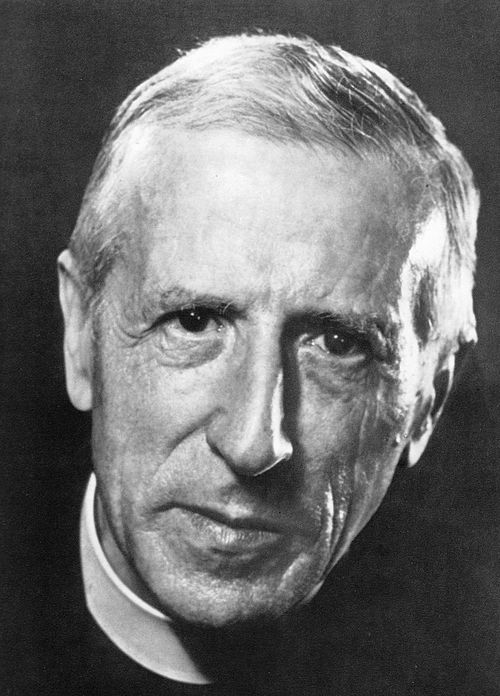
“God is not remote from us. He is at the point of my pen, my shovel, my paint brush, my sewing needle – and my heart and thoughts.”
~ Teilhard de Chardin
Pierre Teilhard de Chardin, S.J., (French: [pjɛʁ tɛjaʁ də ʃaʁdɛ̃]ⓘ; 1 May 1881 – 10 April 1955) was a French Jesuit, Catholic priest, scientist, paleontologist, philosopher, mystic, and teacher. Teilhard de Chardin investigated the theory of evolution from a perspective influenced by Henri Bergson and Christian mysticism, writing multiple scientific and religious works on the subject.
NEW YORK—Sharing new details about her highly anticipated 12th studio album, pop superstar Taylor Swift dropped major hints on her Instagram story Tuesday that The Life Of A Showgirl could be about her. “While creating this record, I took a lot of inspiration from a certain someone who I have a long history with,” said Swift, whose brief statement sent her army of dedicated fans into a tizzy over the possibility the album might include songs exploring experiences she herself had lived. “Of course, I’m not going to spill everything now—you’ll have to wait for the album to drop Oct. 3 to find out who the titular showgirl is. But let’s just say that the art on the cover might be a clue about the music inside.” At press time, eagle-eyed Swifties were freaking out after realizing the artist had referred to herself in the first person, and that the name “Taylor Swift” appeared 12 times in the album’s songwriting credits.
Last week, in a post on Truth Social, Donald Trump took the Smithsonian’s museums to task for emphasizing “how bad slavery was.” The White House staff followed up on August 21 with a statement titled “President Trump Is Right About the Smithsonian,” flagging several objectionable exhibits, including one, weirdly, on Anthony Fauci.
Trump is in eminent company. For nearly a century, between the 1860s and the 1950s, defenders of slavery succeeded in creating a dominant narrative in the nation’s textbooks, trying to show that slavery wasn’t so bad and that the real outrage was the abbreviated period of Reconstruction.
The whitewashing of slavery began as early as 1867, with publication of a book by Edward Pollard, titled The Lost Cause. In this account, slavery was mostly a benign system that uplifted Blacks; plantation owners were typically kindly. This echoed a century of antebellum Southern propaganda. Pollard contended that the Civil War was not really about slavery; it was a war over states’ rights.
As public education systems became more widespread in the South after the Civil War, states of the former Confederacy set standards to ensure that textbooks for public schools would portray a sympathetic view. These laws influenced Northern publishers. Meanwhile, some prominent Northern scholars embraced the Lost Cause view. The most notable of these was William Archibald Dunning of Columbia University.
Dunning became the leader of what became known as the Dunning School of studies on slavery and Reconstruction. He served as president of both the American Historical Association, in 1913, and the American Political Science Association, in 1922. More a theorist than an empirical research scholar, he nonetheless supervised dozens of dissertations, and the Dunning School became the dominant influence on the next generation of historians.
In Dunning’s view, slavery was mostly benevolent, and Reconstruction was a vicious scheme to deny the South’s leading citizens their rights, operated by a vengeful Union army and manipulated by opportunistic “carpetbaggers” from the North and local “scalawags” who collaborated with the South’s Northern oppressors and corrupt Blacks. The trampled rights of freedmen were largely ignored in these accounts. D.W. Griffith’s 1915 film The Birth of a Nation, replete with outrageously racist stereotypes, dramatized these fictions and was seen by tens of millions of Americans, both Northern and Southern.
This version of history, which was dominant from the 1860s through the first half of the 20th century, chimed perfectly with the use of Jim Crow laws and court decisions that wiped out the last vestiges of Black civil rights and Black representation in Congress and in local Southern governments. It chimed as well with state terrorism and lynchings as the necessary way to maintain a racist order that was slavery in everything but name.
John Kennedy’s famous book, Profiles in Courage, written in 1956 (and ghostwritten by his aide Ted Sorenson), which helped establish Kennedy as a contender for the presidency, adopted the Dunning view of the Lost Cause. The fact that the book won a Pulitzer shows the persistence of Dunning’s influence.
In one of his eight profiles, Kennedy lionizes Sen. Edmund Ross of Kansas for refusing to vote to convict President Andrew Johnson for defying Congress on Reconstruction after the House impeached him. Had Ross voted to convict, Johnson would have been removed from office. Ross’s vote was really a profile in cowardice. Kennedy awarded another profile in courage to Sen. Daniel Webster, a Northerner, for bravely supporting the Fugitive Slave Act, part of the Compromise of 1850, allowing escaped slaves to be hunted down in free states.
As late as the 1960s, when I went to high school, a popular exam question was whether the Civil War was about abolishing slavery or about states’ rights and preservation of the Union. The “correct” answer was the latter.
It was only with a new wave of historians, beginning with W.E.B. Du Bois as early as the 1930s, that the standard narrative of the Lost Cause began to be overthrown by scholarly evidence. The work of John Hope Franklin, Eugene Genovese, Kenneth Stampp, Stanley Elkins, and C. Vann Woodward (and later, Eric Foner), among others, went deeper into how slavery actually functioned, the arduous journey from slavery to freedom, and the forgotten contributions of Black intellectuals and elected officials after the Civil War. Contemporary works such as the autobiography of Frederick Douglass were rediscovered, and the true picture of the dehumanizing brutality of slavery emerged.
The Trump who took offense at the Smithsonian’s emphasis on “how bad slavery was” is the same Trump who said of the pro-Nazi riot at Charlottesville, in 2017, that there were “good people on both sides.” Trump’s blurting out what he really thinks, and his whitewashed view of slavery, provide a window into his crusade against DEI. Evidently, for Trump, Black people have had things too easy, going all the way back to slavery times, while whites have been oppressed.
Let’s see. It was in Trump’s own lifetime that President Truman integrated the armed forces; that Jackie Robinson became the first Black player allowed in the major leagues; that strict segregation of Southern schools was overturned by the Supreme Court (though massive de facto segregation persists); that Emmett Till, among many others, was lynched, often with the complicity of local law enforcement; that Congress finally, belatedly, passed three great civil rights acts, after the heroism and civil disobedience of the civil rights movement; and that Southern Blacks could finally vote.
And then the progress went into reverse, as progress so often does, abetted by Republican appointees to the Supreme Court and now supercharged by Trump’s war on DEI.
We now await the tribute to William Archibald Dunning, and the exhibit at the National Museum of African American History and Culture, curated by Trump, on all the great things about slavery.
I’ve quoted this observation of Orwell before, but under Trump you can’t quote him too often. Who controls the past controls the future. Who controls the present controls the past.



 I had suffered a tragedy and made a drastic geographical and cultural move fairly baggageless… It had occurred to me that comfort was only a disguise for discomfort; reference points, a disguise for what will always change.