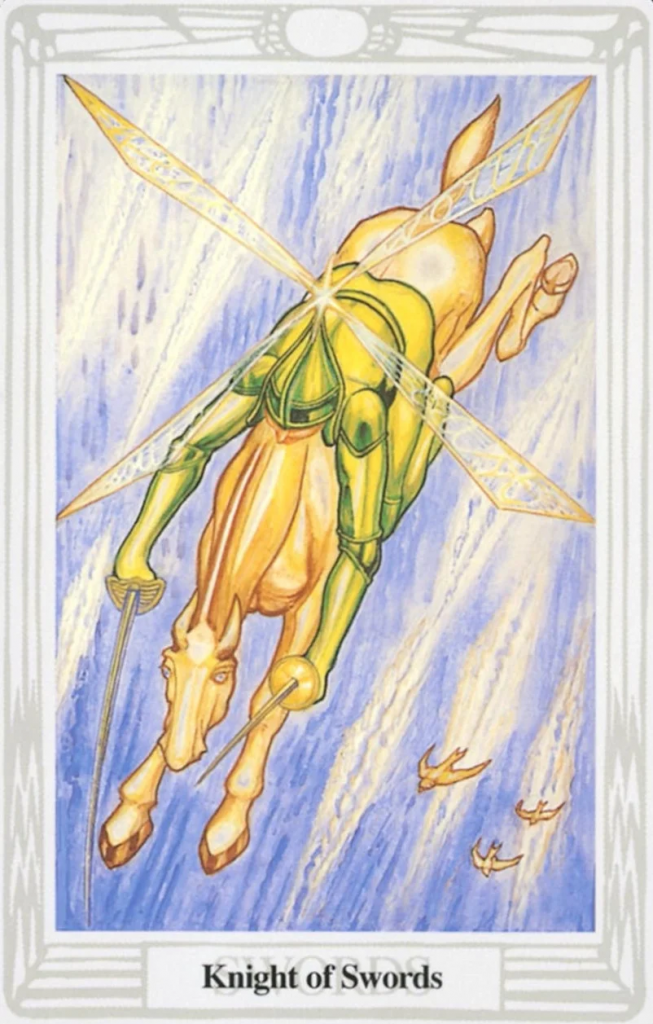
This card brings in a swift, bright energy which clears our heads, allowing us to see right the way to the heart of things, undistracted by clutter or red herrings. Here we can ‘cut to the chase’ so to speak, avoiding any of the tempting, but wasteful, side issues that may come up around important issues.If you flow well with this energy, you’ll finding yourself thinking quickly and clearly, finding unexpected solutions to apparently intractable problems. Matters which had, until now, refused to yield their solutions, will suddenly start willingly spitting them out, so you can clear several obstacles from your path on a day ruled by the Knight of Swords.Intuition plays quite a strong role here, too, as you move into closer touch with your psychic ability, thereby accessing answers to awkward questions which you had before felt frustrated by.Accordingly, on a day ruled by the Knight of Swords, pick out the things which have been giving you headaches in the last little while. Spend a little time (not too much) considering the apparent obstacles and difficulties of the problem. Then forget it! At some point during the day, a solution should quite simply pop into your head. Also keep a close watch on your dreams overnight – these may contain the answers you seek. You can probably get away with dealing with two medium serious problems – but if you have one BIG one, only concentrate on that.Also be alert to messages and hints coming through the normal patterns of life. Sometimes you’ll get explanations from the most unexpected sources.
Affirmation: “Every problem contains the seed of its own resolution.”
“Spiritual opening is not a withdrawal to some imagined realm or safe cave. It is not a pulling away, but a touching of all the experiences of life with wisdom and a heart of kindness, without any separation.”
John Bradshaw (1933-2016) American Educator
AN OPPORTUNITY FOR DAILY REFLECTION BROUGHT TO YOU BY THE SCHOOL OF PRACTICAL PHILOSOPHY
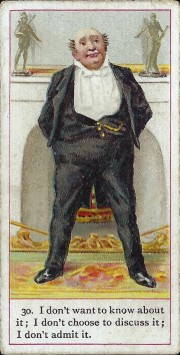
Podsnap in Dickens’ Gallery, included with Cope’s Cιgarettes Image: eBay
A.Word.A.Daywith Anu Garg
Imagine the world about 200 years ago. No Friends on television, no Squid Game on Netflix, not even instant downloads of the latest novels on your Kindle.
This was the world in which Charles Dickens published his stories, often one chapter at a time. Cliffhangers weren’t just a plot device, they were a publishing strategy. Dickens had a knack for creating unforgettable characters. Readers didn’t just love the characters, they started using their names in everyday speech. Thus were born Dickensian eponyms — words born from names.
Now it’s your turn: Do you have a favorite character from fiction? If this character became a word, what would it mean? Would Gatsby be a noun for someone who throws parties they don’t enjoy? Would Sherlocking mean excessive Googling before a first date?
Share on our website or email us at words@wordsmith.org. Include your location (city, state).
Podsnap
PRONUNCIATION:
(POD-snap)
MEANING:
noun: A smug, self-satisfied person.
ETYMOLOGY:
After John Podsnap, a character in Charles Dickens’ novel Our Mutual Friend (1865). Earliest documented use: 1865.
One afternoon a fox was walking through the forest and spotted a bunch of grapes hanging from a lofty branch.“
Just the thing to quench my thirst,” he thought.
Taking a few steps back, the fox jumped and just missed the hanging grapes. Again, the fox took a few paces back and tried to reach them but still failed.
Finally, giving up, the fox turned up his nose and said, “They’re probably sour anyway,” and proceeded to walk away.
From Aesop’s Fables
AN OPPORTUNITY FOR DAILY REFLECTION BROUGHT TO YOU BY THE SCHOOL OF PRACTICAL PHILOSOPHY
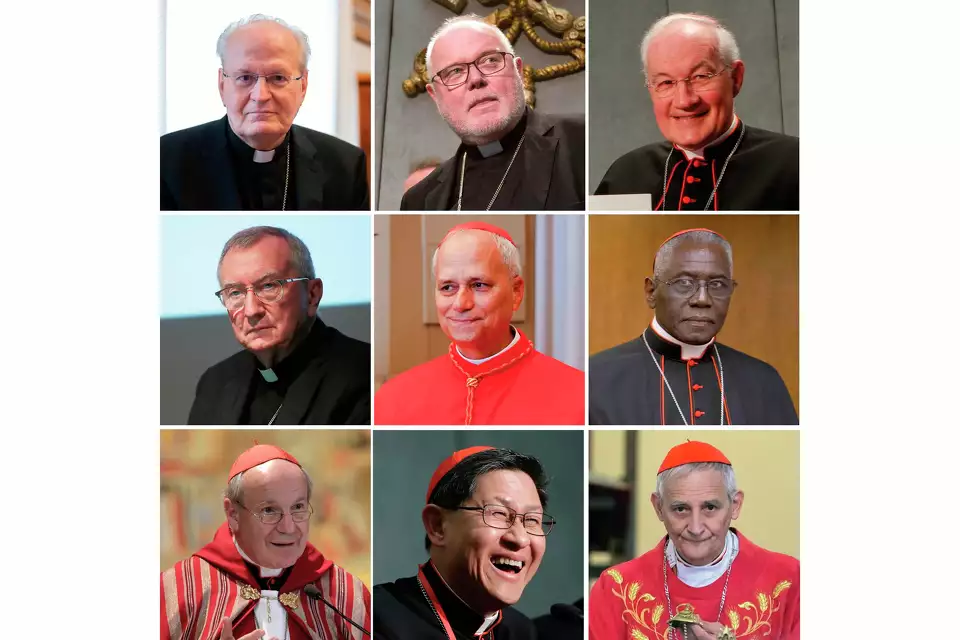
This combination of photos shows, top row from left, Cardinal Peter Erdo, Cardinal Reinhard Marx, Cardinal Marc Ouellet, middle row from left, Cardinal Pietro Parolin, Cardinal Robert Prevost, Cardinal Robert Sarah, and bottom row from left, Cardinal Christoph Schoenborn, Cardinal Luis Tagle and Cardinal Matteo Zuppi.AP
VATICAN CITY (AP) — A popular saying in Vatican circles is that if you “enter a conclave as pope, you leave as a cardinal.”
It implies the sacred and secretive process is no popularity contest or campaign, but rather the divinely inspired election of Christ’s Vicar on Earth by the princes of the church.
Still, there are always front-runnrs, known as “papabile,” who have at least some of the qualities considered necessary to be pope — much like those depicted in last year’s Oscar-nominated film “Conclave.”
Any baptized Catholic male is eligible, though only cardinals have been selected since 1378. The winner must receive at least two-thirds of the vote from those cardinals under age 80 and thus eligible to participate. Pope Francis, who died Monday, appointed the vast majority of electors, often tapping men who share his pastoral priorities, which suggests continuity rather than rupture.
Anyone trying to handicap the outcome should remember that Jorge Mario Bergoglio was considered too old to be elected pope in 2013 at age 76, and that Karol Wojtyla wasn’t on any front-runner lists going into the 1978 conclave that elected him Pope John Paul II.
Some possible candidates:
Cardinal Peter Erdo
Erdo, 72, the archbishop of Budapest and primate of Hungary, was twice elected head of the Council of European Episcopal Conferences, in 2005 and 2011, suggesting he enjoys the esteem of European cardinals who make up the biggest voting bloc of electors. In that capacity, Erdo got to know many African cardinals because the council hosts regular sessions with African bishops’ conferences. Erdo had even more exposure when he helped organize Francis’ 2014 and 2015 Vatican meetings on the family and delivered key speeches, as well as during papal visits to Budapest in 2021 and 2023.
Cardinal Reinhard Marx
Marx, 71, the archbishop of Munich and Freising, was chosen by Francis as a key adviser in 2013. Marx later was named to head the council overseeing Vatican finances during reforms and belt-tightening. The former president of the German bishops’ conference was a strong proponent of the controversial “synodal path” process of dialogue in the German church that began in 2020 as a response to the clergy sexual abuse scandal there. As a result, he is viewed with skepticism by conservatives who considered the process a threat to church unity, given it involved debating issues such as celibacy, homosexuality and women’s ordination. Marx made headlines in 2021 when he dramatically offered to resign as archbishop to atone for the German church’s dreadful abuse record, but Francis quickly rejected the resignation and told him to stay.
Cardinal Marc Ouellet
Ouellet, 80, of Canada, led the Vatican’s influential bishops office for over a decade, overseeing the key clearinghouse for potential candidates to head dioceses around the world. Francis kept Ouellet in the job until 2023, even though he was appointed by Pope Benedict XVI, and thus helped select the more doctrinaire bishops preferred by the German pontiff. Considered more of a conservative than Francis, Ouellet still selected pastorally minded bishops to reflect Francis’ belief that bishops should “smell like the sheep” of their flock. Ouellet defended priestly celibacy for the Latin Rite church and upheld the ban on women’s ordination but called for women to have a greater role in church governance. He has good contacts with the Latin American church, having headed the Vatican’s Pontifical Commission for Latin America for over a decade. Since 2019, his office has taken charge of investigating bishops accused of covering up for predator priests, a job that would have made him no friends among those sanctioned but also could have given him lots of otherwise confidential and possibly compromising information about fellow cardinals.
Cardinal Pietro Parolin
Parolin, 70, of Italy, has been Francis’ secretary of state since 2014 and is considered one of the main contenders to be pope, given his prominence in the Catholic hierarchy. The veteran diplomat oversaw the Holy See’s controversial deal with China over bishop nominations and was involved — but not charged — in the Vatican’s botched investment in a London real estate venture that led to a 2021 trial of another cardinal and nine others. A former ambassador to Venezuela, Parolin knows the Latin American church well. He would be seen as someone who would continue in Francis’ tradition but as a more sober and timid diplomatic insider, returning an Italian to the papacy after three successive outsiders: St. John Paul II (Poland); Benedict (Germany) and Francis (Argentina). But while Parolin has managed the Vatican bureaucracy, he has no real pastoral experience. His ties to the London scandal, in which his office lost tens of millions of dollars to bad deals and shady businessmen, could count against him.
Cardinal Robert Prevost
The idea of an American pope has long been taboo, given the geopolitical power already wielded by the United States. But the Chicago-born Prevost, 69, could be a first. He has extensive experience in Peru, first as a missionary and then an archbishop, and he is currently prefect of the Vatican’s powerful dicastery for bishops, in charge of vetting nominations for bishops around the world. Francis clearly had an eye on him for years and sent him to run the diocese of Chiclayo, Peru, in 2014. He held that position until 2023, when Francis brought him to Rome for his current role. Prevost is also president of the Pontifical Commission for Latin America, a job that keeps him in regular contact with the Catholic hierarchy in the part of the world that still counts the most Catholics. In addition to his nationality, Prevost’s comparative youth could count against him if his brother cardinals don’t want to commit to a pope who might reign for another two decades.
Cardinal Robert Sarah
Sarah, 79, of Guinea, the retired head of the Vatican’s liturgy office, was long considered the best hope for an African pope. Beloved by conservatives, Sarah would signal a return to the doctrinaire and liturgically minded papacies of John Paul II and Benedict. Sarah, who had previously headed the Vatican’s charity office Cor Unum, clashed on several occasions with Francis, none more seriously than when he and Benedict co-authored a book advocating the “necessity” of continued celibacy for Latin Rite priests. The book came out as Francis was weighing whether to allow married priests in the Amazon to address a priest shortage there. The implication was that Sarah had manipulated Benedict into lending his name and moral authority to a book that had all the appearances of being a counterweight to Francis’ own teaching. Francis dismissed Benedict’s secretary and several months later retired Sarah after he turned 75. Even Sarah’s supporters lamented the episode hurt his papal chances.
Cardinal Christoph Schoenborn
Schoenborn, 80, the archbishop of Vienna, Austria, was a student of Benedict’s, and thus on paper seems to have the doctrinaire academic chops to appeal to conservatives. However, he became associated with one of Francis’ most controversial moves by defending his outreach to divorced and civilly remarried Catholics as an “organic development of doctrine,” not the rupture that some conservatives contended. Schoenborn’s parents divorced when he was a teen, so the issue is personal. He also took heat from the Vatican when he criticized its past refusal to sanction high-ranking sexual abusers, including his predecessor as archbishop of Vienna. Schoenborn has expressed support for civil unions and women as deacons, and was instrumental in editing the 1992 update of the Catechism of the Catholic Church, the handbook of the church’s teaching that Benedict had spearheaded when he headed the Vatican’s doctrine office.
Cardinal Luis Tagle
Tagle, 67, of the Philippines, would appear to be Francis’ pick for the first Asian pope. Francis brought the popular archbishop of Manila to Rome to head the Vatican’s missionary evangelization office, which serves the needs of the Catholic Church in much of Asia and Africa. His role took on greater weight when Francis reformed the Vatican bureaucracy and raised the importance of his evangelization office. Tagle often cites his Chinese lineage – his maternal grandmother was part of a Chinese family that moved to the Philippines — and he is known for becoming emotional when discussing his childhood. Though he has pastoral, Vatican and management experience — he headed the Vatican’s Caritas Internationalis federation of charity groups before coming to Rome permanently — Tagle would be on the young side to be elected pope for life, with cardinals perhaps preferring an older candidate whose papacy would be more limited.
Cardinal Matteo Zuppi
Zuppi, 69, the archbishop of Bologna and president of the Italian bishops conference, elected in 2022, is closely affiliated with the Sant’Egidio Community, a Rome-based Catholic charity that was influential under Francis, particularly in interfaith dialogue. Zuppi was part of Sant’Egidio’s team that helped negotiate the end of Mozambique’s civil war in the 1990s and was named Francis’ peace envoy for Russia’s war in Ukraine. Francis made him a cardinal in 2019 and later made clear he wanted him in charge of Italy’s bishops, a sign of his admiration for the prelate who, like Francis, is known as a “street priest.” In another sign of his progressive leanings and closeness to Francis, Zuppi wrote the introduction to the Italian edition of “Building a Bridge,” by the Rev. James Martin, an American Jesuit, about the church’s need to improve its outreach to the LGBTQ+ community. Zuppi would be a candidate in Francis’ tradition of ministering to those on the margins, although his relative youth would count against him for cardinals seeking a short papacy. His family had strong institutional ties: Zuppi’s father worked for the Vatican newspaper L’Osservatore Romano, and his mother was the niece of Cardinal Carlo Confalonieri, dean of the College of Cardinals in the 1960s and 1970s.
WASHINGTON—Staunchly defending his decision to share sensitive military data in messages to his wife, Defense Secretary Pete Hegseth told reporters Monday, “There are no state secrets in a healthy relationship.” “Communication is key in every strong marriage, and that includes communication about airstrikes on foreign adversaries,” said the Pentagon chief, who called the mere idea of withholding classified information from one’s spouse “toxic” and “unhealthy.” “In fact, when I told my therapist we were attacking the Houthis, the first thing he asked me was ‘Did you tell your wife?’ The real scandal would have been not telling her. I mean, if she’d had war plans, I would’ve wanted her to text me.” Hegseth added that the best marital advice he had ever received was to never go to bed without saying you’re going to bomb Yemen.
VATICAN CITY—Saying he couldn’t help but think “I told you so” in the wake of the bishop of Rome’s death, Cardinal Giuseppe Betori of Florence confirmed Monday that he was feeling pretty vindicated after having spent all of Easter dinner telling Pope Francis to ease off the butter. “Yesterday I kept telling him, ‘Your Holiness, I can hardly see your mashed potatoes underneath all that butter you’re putting on them,’ but he refused to listen and look where it got him,” said Betori, explaining that he’d repeatedly warned the supreme pontiff that he needed to watch his saturated fat intake because he wasn’t 65 anymore. “I don’t like being right, but I did explicitly tell him that peas stop being healthy when you insist on eating a pat of butter with every spoonful. He probably went through half a stick on the dinner rolls alone. The salted kind, too. It made me gag. He kept saying he needed all that butter to give his body energy to recover from his pneumonia, but we can all see who was right in the end. The way he was wolfing down the stuff, it almost seemed like he wanted to go.” Betori added that Francis really should have known better, having watched Pope Emeritus Benedict XVI die in 2022 after housing four buckets of heavily buttered popcorn.
WASHINGTON—Lifting up the hem of existence as she gestured for the kids to go within and explore, Melania Trump reportedly informed children visiting the White House on Sunday that she had hidden many Easter eggs behind the curtain of reality. “Hurry inside, boys and girls, for there are many trinkets and treats to be found beyond the edge of human reckoning,” said the first lady, pulling away a section of the fabric of reality in the Oval Office to reveal an endless cosmic void without hope or logic where pastel-colored eggs floated alongside a costumed Easter Bunny. “Make sure you check in the darkest folds of these otherlands. Go quick before the best toys are lost forever! There’s infinite space to play in and infinite time to search. But if you find your other self in there, do not make eye contact. For there lies madness. Great, endless madness. That’s what happened to Barron.” At press time, sources confirmed Trump had eternally sealed the fabric of reality behind the last child before returning to watching television in her residence.
Earth Day is an annual event on April 22 to demonstrate support for environmental protection. First held on April 22, 1970, it now includes a wide range of events coordinated globally through earthday.org (formerly Earth Day Network)[1] including 1 billion people in more than 193 countries.[1][2][3]
In 1969 at a UNESCO conference in San Francisco, peace activistJohn McConnell proposed a day to honor the Earth and the concept of peace, to first be observed on March 21, 1970, the first day of spring in the northern hemisphere. This day of nature’s equipoise was later sanctioned in a proclamation written by McConnell and signed by Secretary General U Thant at the United Nations. A month later, United States Senator Gaylord Nelson proposed the idea to hold a nationwide environmental teach-in on April 22, 1970, and hired a young activist, Denis Hayes, to be the national coordinator. The name “Earth Day” was coined by advertising writer Julian Koenig.[4] Denis and his staff grew the event beyond the original idea for a teach-in to include the entire United States. Key non-environmentally focused partners played major roles. Under the leadership of labor leader Walter Reuther, for example, the United Auto Workers (UAW) was the most instrumental outside financial and operational supporter of the first Earth Day.[5][6][7] According to Hayes: “Without the UAW, the first Earth Day would have likely flopped!”[8] Nelson was later awarded the Presidential Medal of Freedom award in recognition of his work.[9][10] The first Earth Day was focused on the United States. In 1990, Denis Hayes, the original national coordinator in 1970, took it international and organized events in 141 nations.[11][12][13] On Earth Day 2016, the landmark Paris Agreement was signed by the United States, the United Kingdom, China, and 120 other countries. This signing satisfied a key requirement for the entry into force of the historic draft climate protection treaty adopted by consensus of the 195 nations present at the 2015 United Nations Climate Change Conference in Paris. Numerous communities engaged in “Earth Day Week actions,” an entire week of activities focused on the environmental issues that the world faces.[14] On Earth Day 2020, over 100 million people around the world observed the 50th anniversary in what is being referred to as the largest online mass mobilization in history.[3]
On January 28, 1969, a well called Platform A, drilled by Union Oil 6 miles (10 km) off the coast of Santa Barbara, California, blew out. More than 3 million U.S. gallons (2.5 million imperial gallons; 11 million liters) of oil spilled, killing more than 10,000 seabirds, dolphins, seals, and sea lions. As a reaction to this disaster, activists were mobilized to create environmental regulation, environmental education, and Earth Day. Among the proponents of Earth Day were the people in the front lines of fighting this disaster, Selma Rubin, Marc McGinnes, and Bud Bottoms, founder of Get Oil Out.[15]Denis Hayes, organizer of the first Earth Day, said that Senator Gaylord Nelson from Wisconsin was inspired to create Earth Day upon seeing an 800-square-mile (2,100 km2) oil slick from an airplane in the Santa Barbara Channel.[15][16]
Santa Barbara’s Environmental Rights Day 1970
On the first anniversary of the oil blowout, January 28, 1970, Environmental Rights Day was created, and the Declaration of Environmental Rights was read. It had been written by Rod Nash during a boat trip across the Santa Barbara Channel while carrying a copy of Thomas Jefferson’s Declaration of Independence.[15] The organizers of Environmental Rights Day, led by Marc McGinnes, had been working closely over a period of several months with Congressman Pete McCloskey (R-CA) to consult on the creation of the National Environmental Policy Act, the first of many new environmental protection laws sparked by the national outcry about the blowout/oil spill and on the Declaration of Environmental Rights. Both McCloskey (Earth Day co-chair with Senator Gaylord Nelson) and Earth Day organizer Denis Hayes, along with Senator Alan Cranston, Paul Ehrlich, David Brower and other prominent leaders, endorsed the Declaration and spoke about it at the Environmental Rights Day conference. According to Francis Sarguis, “the conference was sort of like the baptism for the movement.” According to Hayes, this was the first giant crowd he spoke to that “felt passionately, I mean really passionately, about environmental issues.” Hayes also thought the conference might be the beginning of a real movement.[15] Nash, Garrett Hardin, McGinnes and others went on to develop the first undergraduate Environmental Studies program of its kind at the University of California at Santa Barbara.[17]
The seeds that grew into the first Earth Day were planted by Wisconsin Senator Gaylord Nelson. An ardent conservationist and former two-term governor of Wisconsin, Nelson had long sought ways to increase the potency of the environment as a political issue. The extraordinary attention garnered by Rachel Carson‘s 1962 book, Silent Spring, the famous 1968 Earthrise NASA photograph of the Earth from the Moon, the saturation news coverage given to the Santa Barbara oil spill[18] and the Cuyahoga River catching fire in early 1969[19] led Nelson to think the time was ripe for an environmental initiative. As a result of interactions with his staff and with Fred Dutton,[20] a prominent Democratic operative who had been Robert Kennedy’s presidential campaign manager, Nelson became convinced that environmental teach-ins on college campuses could serve as such a vehicle.[21]
Teach-ins had been held on hundreds of college campuses to debate the war in Vietnam. They generally reflected the divide between those who thought of Vietnam as a bulwark to stop additional countries falling to communism like dominos, versus those who believed that the war was the latest stage of a nationalist, anti-colonialist campaign[22] by Vietnamese who had fought against China, then France, Japan, France again, and now the United States. These debates elevated arguments over the war in the public consciousness and enlisted a generation of student activists.[citation needed]
Nelson asked public interest lawyer Anthony Roisman[23] to establish a non-profit, Environmental Teach-In, Inc., to manage the campaign, and recruited a small board of directors. He asked Republican Congressman Pete McCloskey[14] to co-chair the board to ensure it was bipartisan and bicameral.[15]
On September 20, 1969, Senator Nelson first announced his plans for an “environmental teach-In” in a little-publicized talk at the University of Washington. “I am convinced that the same concern the youth of this nation took in changing this nation’s priorities on the war in Vietnam and on civil rights can be shown for the problem of the environment. That is why I plan to see to it that a national teach-in is held.”[16]
Senator Nelson went on to encourage teach-ins at many more speeches. A November talk at Airlie House had a New York Times reporter in the audience. The resulting front-page article[17] was a turning point. Letters of inquiry from across the country began to pour into Nelson’s Senate office. The article piqued the interest of Denis Hayes, then a graduate student at Harvard. Hayes traveled to Washington, D.C., and arranged a 10-minute visit with Senator Nelson (which stretched into two hours).[24] Hayes returned to Harvard with the charter to organize Boston. After a few days of reference checks,[25] he was asked to drop out of Harvard to become executive director of the national campaign.[26]
Because of the non-hierarchical tenor of the times, Hayes suggested that people be designated coordinators rather than directors. He became the national coordinator,[27] and he quickly hired various regional coordinators, a press coordinator, a K–12 coordinator, a volunteer coordinator, etc. At its peak, the national office had a few dozen paid staff, each earning a flat $375/month (equivalent to $3,215 in 2024), plus more than 100 regular volunteers.[citation needed]
As the talented regional coordinators fanned out across the country, however, they immediately encountered two problems. First, by 1970, the concept of “teach-ins” had become passé. Moreover, teach-ins generally involved debates, and no one was pro-pollution. Second, and more troubling, leading activists on college campuses were deeply involved in the anti-war and civil rights movements. They tended to view the environment as a distraction.[26]
The “Earth Day” name
The solution to the first problem came from an unexpected direction. Shortly after the turn of the year, Julien Koenig stopped by the national offices and volunteered to help. Koenig was a Madison Avenue giant. His campaign for Volkswagen, “Think Small,” was later cited by Advertising Age as the “greatest advertising campaign of the 20th century.”[28]
Over coffee, Hayes confided that the “teach-in” moniker was not working and asked whether Koenig had any ideas. Koenig asked for a few days. A week later, he returned with an assortment of mock-ups for ads, laid out around the announcement of “Ecology Day,” “Environment Day,” “Earth Day,” and “E Day.” Koenig said that his personal favorite was Earth Day – in part because April 22 happened to be his birthday, and “birthday” rhymes with “Earth Day.”[29] Hayes immediately agreed. Koenig offered to prepare a fully refined ad. Hayes insisted that it include a small coupon soliciting funds for the threadbare operation. Koenig’s ad was visually arresting, and perfectly summed up the issues and values, the feisty-but-welcoming tone that the campaign had adopted. Hayes loved it and decided to bet the farm. He committed about half of all the money in the campaign’s bank account to buy a full page in the Sunday New York Times opinion section.[30]
The ad was a huge success. Overnight, “Earth Day” became the almost-universally-used name for the upcoming event. The ad generated more than enough revenue to repay its cost, and thousands of potential organizers sent in their names and addresses along with their checks. In future months, magazines and alternative newspapers ran the ad for free, generating still more names and more financial support. The national office started using Environmental Action, rather than Environmental Teach-in, on its letterhead and publications to promote Earth Day.[31]
At this point, Hayes made a far-reaching decision. In those early days, it would have been easy to obtain trademark protection for Earth Day and force compliance with a set of standards by anyone using it. Hayes decided, however, that he wanted the name to be broadly used by anyone who planned to focus on environmental issues that spring.[32]
Although “Earth Day” swiftly replaced Environmental Teach-in, the second problem proved more complicated. College activists, for the most part, viewed anything other than ending the war as a distraction. A majority of the Earth Day staff had cut their teeth as organizers against the war and saw no conflict. The war appeared to be winding down, and they felt it was prudent to start paying attention to the far more profound changes needed to produce a healthy, sustainable America. But time was short, and college activists were not responding.[citation needed]
Hayes spent a day reviewing the letters Senator Nelson had received, and discovered that very few were from college students. Most were from women who appeared to be college-educated homemakers who wanted to do something to improve the world for their children. Another large share was from K–12 teachers.[citation needed]
Hayes decided to shift the campaign’s focus from colleges and universities to community organizing. Building off the successful strategies of the anti-war movement and the civil rights movement, he decided to promote large urban rallies, focused on major environmental issues, while also encouraging environmental education at the K–12 level.[citation needed]
Bryce Hamilton, who had been Midwest coordinator, was shifted to K–12 coordinator, and it proved to be a great choice.[33] Hamilton reached out to the National Education Association, American Federation of Teachers, and the National Science Teachers Association to enlist their members; he provided materials to thousands of educators who wrote to the group directly; and he distributed the most creative ideas he received from anyone to everyone else. In April, more than 10,000 primary and secondary schools engaged in Earth Day activities, mostly education and service actions like beach clean-ups, tree planting, and recycling.[citation needed]
Walt Kelly created an anti-pollution poster featuring his comic strip character Pogo with the quotation “We have met the enemy and he is us” to promote the 1970 Earth Day. Environmental groups have sought to make Earth Day into a day of action to change human behavior and provoke policy changes.[34]
On the first Earth Day an estimated 20 million Americans took part in rallies, marches, and teach-ins calling for environmental reform.[35][36] Earth Day is now observed in 192 countries, and coordinated by the nonprofit Earthday.org (formerly Earth Day Network). According to Denis Hayes, the first Earth Day 1970 organizer and current Board Chair Emeritus of Earthday.org, Earth Day is now “the largest secular day of protest in the world, and more than a billion people participate in Earth Day actions every year.”[37]
By far the largest source of funding for the first Earth Day was organized labor. Walter Reuther had led the United Auto Workers (UAW) since 1946, and he was a progressive supporter of civil rights, opposed the war, and championed the environment. He was a founding member of the Coalition for Clean Air, which successfully lobbied for the Clean Air Act of 1970. Walter Reuther, president of the United Auto Workers, made the first donation to support the first Earth Day in the amount of $2,000 (equivalent to $16,194 in 2024).[38] Under his leadership, the UAW also funded telephone capabilities so that the organizers could communicate and coordinate with each other from all across the United States.[6] The UAW also financed, printed, and mailed all of the literature and other materials for the first Earth Day and mobilized its members to participate in the public demonstrations across the country. According to Denis Hayes, “The UAW was by far the largest contributor to the first Earth Day” and “Without the UAW, the first Earth Day would have likely flopped!” Hayes further said, “Walter’s presence at our first press conference utterly changed the dynamics of the coverage—we had instant credibility.”[39]
At a meeting of the Environmental Teach-In board of directors, the finance committee chair arrived with a check for $20,000 (equivalent to $161,937 in 2024) from Standard Oil of New Jersey (now ExxonMobil). That would have provided an effective measure of financial relief for the financially strapped group. But Hayes declined the check, convincing the board that it would destroy the credibility of the nascent organization. He said that he would be delighted to accept money from clean sources, but no other corporate money was ever raised for the national organization.[citation needed]
Individual donations were a significant source of funding, generally accompanied by a contribution slip from the Earth Day Ad providing the donor’s name and address. Larry Rockefeller persuaded Robert Rauschenberg to create and donate a batch of Earth Day lithographs, but the Earth Day staff lacked contacts in the art world who were able to sell them for their $2,000 market value, so they were provided to donors for much less.[citation needed]
The sale of standard posters and especially pins brought in additional revenue. The staff refused to sell bumper strips because they would be attached to cars.[citation needed]
The Dirty Dozen
The staff of Environmental Teach-In resigned immediately after Earth Day, and most moved directly to a new organization, Environmental Action, with a tax status that permitted lobbying and a more activist stance.[40] EA immediately confronted a problem that had been looming in the background throughout the campaign. Some of the staff had been drawn to the movement through science and culture and felt that politics was inherently dirty and government was irredeemably compromised. This group believed that by living lives of voluntary simplicity, employing tools like those that filled the resolutely-nonpolitical Whole Earth Catalog, they could force the world to adapt to them. Their theory of change was modeled loosely on the southern African Americans who sat at segregated lunch counters, drank from segregated lunch counters, and sat in the front of the bus, it ignored the role of strategic litigation[41]federal legislation, and electoral politics[42] in cementing lasting change.
Other staff members had worked in the Robert Kennedy, Gene McCarthy, and various congressional campaigns before Earth Day. They believed that lasting progress could only come through institutional change. The year 1970 was a congressional election year. They had just organized the largest demonstration in the nation’s history to support environmental values. Former Lindsay organizer, Steve Haft, summed up this faction’s attitude at an Environmental Action staff meeting, “We had 20 million people in the streets in an election year, and you plan to sit out the election? Are you nuts?”[citation needed]
To square the circle, Hayes proposed that the group not endorse any candidates but that it try to defeat 12 of the worst. If having a terrible environmental record became a political liability, it would inevitably lead to better environmental legislation. Haft was selected to coordinate the Dirty Dozen campaign. With just $50,000 to defeat 12 incumbent members of the House, the odds were long.[43]
To improve the odds, the group selected candidates who not only had lousy environmental records—which were plentiful—but who also had won their most recent race by a narrow margin; who were on the wrong side of an important environmental issue in their districts; and who lived in areas where talented Earth Day organizers resided. In the end, seven of the original Dirty Dozen were defeated—five Republicans and two Democrats. And the first to fall was George Fallon, chairman of the hugely powerful House Public Works Committee.[44]
Representative Pete McCloskey, Earth Day co-chair, credits the Dirty Dozen’s defeat of key congressional leaders with the unstoppable wave of environmental legislation that immediately followed: the Clean Air Act, Clean Water Act, Endangered Species Act, and others.[45]
The University of Michigan teach-in
As the tone of major planned Earth Day activities shifted to become less academic and more confrontational, and the Environmental Action newsletter emphasized the need for broad structural change, interest in the event began to mount among college student activists.[citation needed]
One place where the interest in a teach-in was robust from the beginning was the University of Michigan. The first teach-in on the Vietnam War had been held at the University of Michigan in March 1965, and a group of students, led by Doug Scott,[46] decided to mark the five-year anniversary with an environmental teach-in on March 11–14, 1970.[47] The Michigan teach-in presented a series of speeches dealing with various environmental problems, along with some debate over the best tactics and solutions. No one, including the president of Dow Chemical, argued for more environmental destruction.
After the University of Michigan teach-in, there was an explosion of interest on other college campuses. Upwards of 2,000 universities, colleges, and junior colleges ultimately put on events. By the end, the national staff had a hard time merely keeping up with the colleges that called to register events.[citation needed]
The focus on pollution
The delicate line straddled by organizers was to attract seasoned activists who would demand far-reaching change without alienating the middle class whose active participation and political support were seen as essential. The greatest environmental insults were visited on the poor. Factories and power plants were located in the poorest neighborhoods. Freeways were plowed through the poorest neighborhoods. Toxic waste dumps were situated in the poorest neighborhoods. But these problems tended not to affect the middle class.[citation needed]
The solution was to promote an overarching concern with air and water pollution, which affected everyone, while encouraging each community to pay attention to whatever other issues were of most concern to it. Earth Day included events that focused on fighting freeways, protecting the ozone layer, organic food, whales and endangered species, oil spills, the military use of Agent Orange in Vietnam, overpopulation, peeling lead paint in ghetto housing, opposition to the supersonic transport, and myriad other topics. At one event, college students would pound an automobile apart with sledgehammers,[48] or, wearing gas masks, would block traffic on a freeway. At other events, grade-school students would plant trees, pick up litter in city parks, or identify birds. Earth Day welcomed them all.[citation needed]
Regional coordinators focused heavily on finding and enlisting the best local leadership in major metropolitan areas. For instance, Hayes flew to Chicago to help organize a subtle coup, replacing a pro-business Earth Day organization with a Saul Alinsky affiliated group called Campaign Against Pollution.[49] CAP abruptly shifted the focus away from recycling to focus on two issues: opposition to a massive proposed freeway program, the Crosstown Expressway, and protesting the uncontrolled air pollution Commonwealth Edison was pouring into Chicago’s air—more sulfur pollution than all other companies combined.[50] Although mailings went out to thousands of communities of all sizes, the campaign focused especially hard on large cities.[citation needed]
New York City
In the winter of 1969–1970, a group of students met at Columbia University to hear Denis Hayes talk about his plans for Earth Day. Among the group were Fred Kent, Pete Grannis, and Kristin and William Hubbard. This group agreed to head up the New York City activities within the national movement. Fred Kent took the lead in renting an office and recruiting volunteers. The liberal Republican mayor of New York, John Lindsay, saw the environment as an issue that could help unite his then-troubled city. Moreover, he viewed the environment as a progressive wedge issue that would position him as clearly distinct from President Nixon’s ultra-conservative “Southern Strategy,”[51] in a struggle for the soul of the Republican Party. He became fully engaged in supporting the event, and he delegated many of the talented young staff who had been drawn to his administration to help as well.[citation needed]
U.S. Senator Edmund Muskie speaking at Fairmount Park, Philadelphia on Earth Day, 1970
“The big break came when Mayor Lindsay agreed to shut down Fifth Avenue for the event. A giant cheer went up in the office on that day,” according to Kristin Hubbard (now Kristin Alexandre). “From that time on we used Mayor Lindsay’s offices and even his staff. I was Speaker Coordinator but had tremendous help from Lindsay staffer Judith Crichton.” Mayor Lindsay completely closed down Fifth Avenue to traffic from E. 14th Street to West 59th Street (Central Park)—more than 2 miles—and 14th Street between 3rd and 7th Avenues.[52] An estimated one million participants took part—right in the nerve center of the nation’s communications complex.[citation needed]
In addition to shutting down Fifth Avenue, Mayor John Lindsay made Central Park available for Earth Day. In Union Square, the New York Times estimated crowds of up to 20,000 people at any given time and, perhaps, more than 100,000 over the course of the day.[53] Since Manhattan was also the home of NBC, CBS, ABC, The New York Times, Time, and Newsweek, it provided the best possible anchor for national coverage from their reporters throughout the country.[54]
Paul Tinari officially launched the first Canadian Earth Day on September 11, 1980 – included are Flora MacDonald MP, Ken Keyes and Dr. Ronald Watts
The first Canadian Earth Day (French: Jour de la Terre) was held on Thursday, September 11, 1980, and was organized by Paul D. Tinari, then a graduate student in Engineering Physics/Solar Engineering at Queen’s University. Flora MacDonald, then MP for Kingston and the Islands and former Canadian Secretary of State for External Affairs, officially opened Earth Day Week on September 6, 1980, with a ceremonial tree planting and encouraged MPs and MPPs across the country to declare a cross-Canada annual Earth Day. The principal activities taking place on the first Earth Day included educational lectures given by experts in various environmental fields, garbage and litter pick-up by students along city roads and highways, and tree plantings to replace the trees killed by Dutch elm disease.[145][146]
History of the Equinox Earth Day (March 20)
The equinoctial Earth Day is celebrated on the March equinox (around March 20) to mark the arrival of astronomical spring in the Northern Hemisphere, and of astronomical autumn in the Southern Hemisphere. An equinox in astronomy is that point in time (not a whole day) when the Sun is directly above the Earth’s equator, occurring around March 20 and September 23 each year. In most cultures, the equinoxes and solstices are considered to start or separate the seasons, although weather patterns evolve earlier.
John McConnell[147] first introduced the idea of a global holiday called “Earth Day” at the 1969 UNESCO Conference on the Environment. The first Earth Day proclamation was issued by San Francisco Mayor Joseph Alioto on March 21, 1970. Celebrations were held in various cities, such as San Francisco and in Davis, California with a multi-day street party. UN Secretary-General U Thant supported McConnell’s global initiative to celebrate this annual event; and on February 26, 1971, he signed a proclamation to that effect, saying:[148]
May there be only peaceful and cheerful Earth Days to come for our beautiful Spaceship Earth as it continues to spin and circle in frigid space with its warm and fragile cargo of animate life.
United Nations secretary-general Kurt Waldheim observed Earth Day with similar ceremonies on the March equinox in 1972, and the United Nations Earth Day ceremony has continued each year since on the day of the March equinox (the United Nations also works with organizers of the April 22 global event). Margaret Mead added her support for the equinox Earth Day, and in 1978 declared:[149]
Earth Day is the first holy day which transcends all national borders, yet preserves all geographical integrities, spans mountains and oceans and time belts, and yet brings people all over the world into one resonating accord, is devoted to the preservation of the harmony in nature and yet draws upon the triumphs of technology, the measurement of time, and instantaneous communication through space.
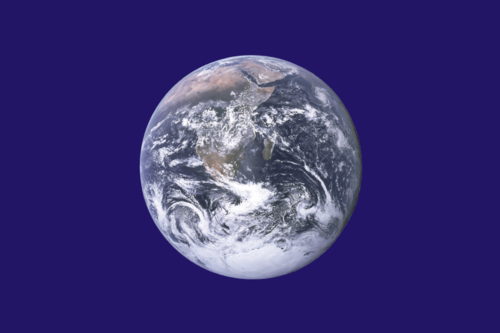
Earth Day draws on astronomical phenomena in a new way – which is also the most ancient way – by using the Vernal Equinox, the time when the Sun crosses the equator making the length of night and day equal in all parts of the Earth. To this point in the annual calendar, EARTH DAY attaches no local or divisive set of symbols, no statement of the truth or superiority of one way of life over another. But the selection of the March Equinox makes planetary observance of a shared event possible and a flag that shows the Earth, as seen from space, appropriate.
— Kurt Waldheim
At the moment of the equinox, it is traditional to observe Earth Day by ringing the Japanese Peace Bell, which Japan donated to the United Nations.[150] Over the years, celebrations have occurred in various places worldwide at the same time as the UN celebration. On March 20, 2008, in addition to the ceremony at the United Nations, ceremonies were held in New Zealand, and bells were sounded in California, Vienna, Paris, Lithuania, Tokyo, and many other locations. The equinox Earth Day at the UN is organized by the Earth Society Foundation.[151]
Earth Day ringing the peace bell is celebrated around the world in many towns, ringing the Peace Bell in Vienna,[152]Berlin, and elsewhere. A memorable event took place at the UN in Geneva, celebrating a Minute for Peace ringing the Japanese Shinagawa Peace Bell with the help of the Geneva Friendship Association and the Global Youth Foundation,[153] directly after in deep mourning about the Fukushima Daiichi Nuclear Power Plant catastrophe ten days before.
Besides the Spring Equinox for the Northern Hemisphere, the observance of the Spring Equinox for the Southern Hemisphere in September is of equal importance. The International Day of Peace[154] is celebrated on September 21, and can thus be considered to accord with the original intentions of John McConnell, U Thant and others.
April 22 observances
Growing eco-activism before Earth Day 1970
In 1968, Morton Hilbert and the U.S. Public Health Service organized the Human Ecology Symposium, an environmental conference for students to hear from scientists about the effects of environmental degradation on human health.[155] This was the beginning of Earth Day. For the next two years, Hilbert and students worked to plan the first Earth Day.[156] In April 1970 – along with a federal proclamation from U.S. Sen. Gaylord Nelson – the first Earth Day was held.[157]
Project Survival, an early environmentalism-awareness education event, was held at Northwestern University on January 23, 1970. This was the first of several events held at university campuses across the United States in the lead-up to the first Earth Day. Also, Ralph Nader began talking about the importance of ecology in 1970.
The 1960s had been a very dynamic period for ecology in the US. Pre-1960 grassroots activism against DDT in Nassau County, New York, and widespread opposition to open-air nuclear weapons tests with their global nuclear fallout, had inspired Rachel Carson to write her influential bestseller, Silent Spring (1962).
Nelson chose the date to maximize participation on college campuses for what he conceived as an “environmental teach-in”. He determined the week of April 19–25 was the best bet as it did not fall during exams or spring breaks.[158] Moreover, it did not conflict with religious holidays such as Easter or Passover, and was late enough in spring to have decent weather. More students were likely to be in class, and there would be less competition with other mid-week events – so he chose Wednesday, April 22. The day also fell after the anniversary of the birth of noted conservationist John Muir. The National Park Service, John Muir National Historic Site, has a celebration every year on or around Earth Day (April 21, 22 or 23), called Birthday–Earth Day, in recognition of Earth Day and John Muir’s contribution to the collective consciousness of environmentalism and conservation.[159][160]
Unbeknownst to Nelson,[161] April 22, 1970, was coincidentally the 100th anniversary of the birth of Vladimir Lenin, when translated to the Gregorian calendar (which the Soviets adopted in 1918). Time reported that some suspected the date was not a coincidence, but a clue that the event was “a Communist trick”, and quoted a member of the Daughters of the American Revolution as saying, “subversive elements plan to make American children live in an environment that is good for them.”[162]J. Edgar Hoover, director of the U.S. Federal Bureau of Investigation, may have found the Lenin connection intriguing; it was alleged the FBI conducted surveillance at the 1970 demonstrations.[163] The idea that the date was chosen to celebrate Lenin’s centenary still persists in some quarters,[164][165] an idea borne out by the similarity with the subbotnik instituted by Lenin in 1920 as days on which people would have to do community service, which typically consisted in removing rubbish from public property and collecting recyclable material. Subbotniks were also imposed on other countries within the compass of Soviet power, including Eastern Europe, and at the height of its power the Soviet Union established a nationwide subbotnik to be celebrated on Lenin’s birthday, April 22, which had been proclaimed a national holiday celebrating communism by Nikita Khrushchev in 1955.