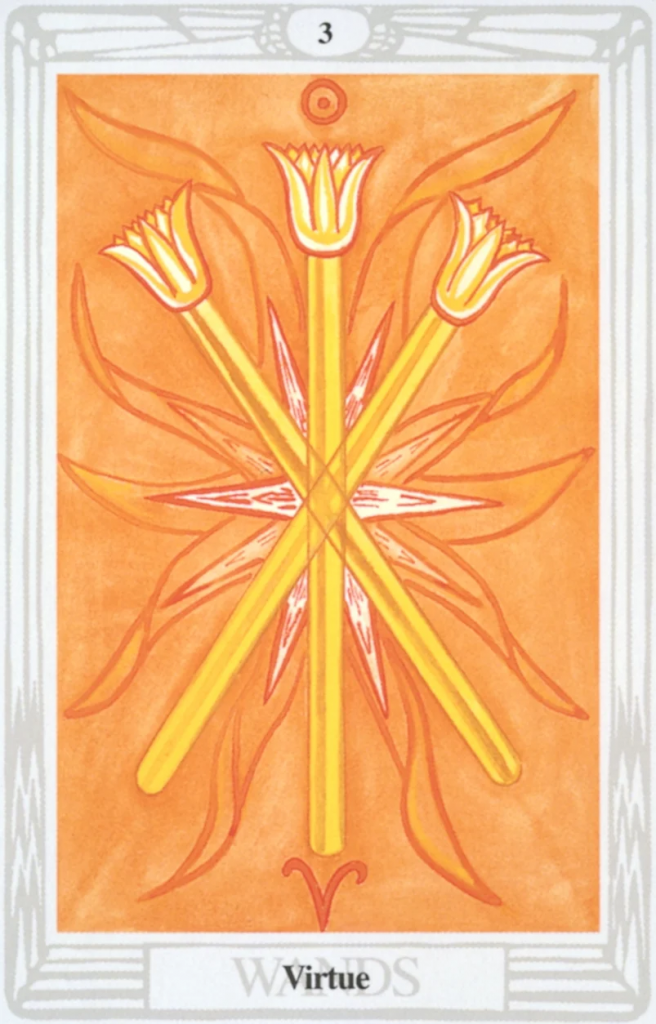
It’s quite easy to mistake the meaning of a card named the Lord of Virtue. We can easily be misled into thinking that this means being dutiful and ‘doing the right thing’. However there is a much deeper level to this card than is immediately apparent. Virtue is about excellence – ethically and personally.It is about developing and maintaining high standards of behaviour, and then learning to have the confidence, self belief and strength of character to live out those standards through our every act.When we fall short of our expectations of ourselves, we retreat, disappointed and ashamed of ourselves. We can then take a long time to climb back up to the higher ground from which we can regard our own acts as part of the grand pattern of life. And, in the meantime, we continue to disappoint ourselves.This is obviously not good for us, and neither is it good for life. So we need strategies to reduce the number of times we feel we let ourselves down, methods of forgiving ourselves when we do, and ways of recovering lost virtue as quickly as we can.This is where the Three of Wands comes in. So, on a day ruled by him, make yourself a promise… you will spend a little time moving back into the centre of yourself – do this by sitting quietly and gently drawing in breath, directing it to your heart centre and allowing it to fill you up with energy.When you have done that, spend a few more minutes thinking about your ethical standpoint. Ask yourself if you are out of alignment with yourself about anything. (Please avoid the trap of going “Absolutely EVERYTHING!!!!” This won’t help! Much better to work on one issue at a time, rather than allowing yourself to be overwhelmed.) If you find something you are unhappy about in your own behaviour, think the act, thought or feeling through without judging it.Work out why you have done/said/thought this thing. Go to the core of the problem, and do not blame anybody else. When you find the core reason, write it down on a piece of paper, tear the paper into several different pieces and throw them in the rubbish bin.Since you have now rid yourself of the core problem, you now have no further need to act out that problem. So forgive yourself and do it differently.
Affirmation: “I live out my beliefs in all my acts.”
Today is Holocaust Remembrance Day. Of all the memories, I have been gutted by one more than others.
At Yad Vashem, the Holocaust museum in Jerusalem, there is a Children’s Memorial dedicated to the approximately 1.5 million Jewish children Hitler murdered. The Nazis realized the most effective way to eliminate a people is to kill its children.
How did they do that?
They hanged them.
Parents sent to Nazi death camps had their children ripped from their arms upon arrival, then put into a special section marked for death.
Hysterical mothers, deranged with grief, would rush manically to do the what they could to be with their children, if not to save them, at least to be with them in their final moments.
Walking onto the gallows, the children knew that they were facing death. They looked over the crowd to glance the face of their mothers one last time. And many of them reportedly said, “Mama, don’t look.”
Mama, don’t look.
That is my most painful remembrance today.
May their memory be a blessing and a reminder to us all.
On April 27th, 2025, we have a New Moon at 7° Taurus.
Taurus New Moons reconnect us to the Taurus archetype – what’s stable, what endures, what’s real.
If you’ve observed nature, there’s a certain unapologetic quality about it. Nature simply is. Trees are majestic in their stability. Flowers bloom naturally, without self-doubt or hesitation.
There’s a sense of ‘things are exactly how they should be’. No second-guessing, no overthinking – just presence, rhythm, and quiet assurance.
Taurus is that part of us that’s natural, grounded, pragmatic, and rooted in common sense.
Taurus is the real thing.
However, just like Persephone was suddenly abducted by Pluto from her peaceful garden while picking a narcissus flower – our own sense of stability can be abruptly shaken by the intense Mars-Pluto opposition tightly squaring this New Moon.
At the New Moon in Taurus, the very foundations of our life will be tested.
The question this lunation is asking is:
“Are these foundations a real, authentic expression of who you truly are?”
Because if not, something needs to change.
Something you’ve been resisting – perhaps because it felt safe, or because it was too uncomfortable to question – now demands your full attention.
Chances are, given the buildup of Mars-Pluto tension in recent months, a part of you already knows what is no longer sustainable.
New Moon In Taurus – The Aspects
We cannot talk about the New Moon in Taurus without talking about the infamous Mars-Pluto opposition.
The fact that the ‘final blow’ of Mars opposite Pluto (we’ve been experiencing this tension building for months now) coincides with a New Moon – a new beginning – is very telling.
Whenever a transit lasts longer than its normal cycle – this happens when one or both of the planets involved are retrograde – we know it’s important. We also know that the work that needs to be done is not easy. It will create resistance.
Think about it. If it were easy, we would have had our regular Mars-Pluto transit for 2–3 days. Thank you Mars, goodbye Mars, thank you Pluto, goodbye Pluto.
But no. This time around, we are digging into something that is deeply embedded in our being, woven into the fabric of our identity. Something so entwined with our values that we don’t even think to question it. Something we resist by default, as if it were a natural law.
And when we face THAT kind of resistance – the transit lingers. We get a second blow. Then a third.
With this Mars-Pluto opposition, we’ve gone deep – and touched something intimately tied to our identity and place in the world.
Mars is our will – what we want, what matters to us, what feels like a direct expression of our individuality. Mars needs to emerge and be expressed. That’s why Mars is also associated with anger – because we get angry when we don’t get our way.
Pluto is the higher octave of Mars. If Mars is our personal will, Pluto is the collective will – the sum of all individual wills out there, woven into the larger unfolding of reality.
If Mars is what we want to happen, Pluto is what actually happens.
All good when the two align, right? You want your favorite sports team to win (Mars) – and they do (Pluto).
But what if they don’t? What if things don’t go as planned? What if the world is uncooperative – at least as seen from our individual Mars lens – and there’s nothing we can do about it?
THIS is the ultimate Pluto test. Do we accept reality, or do we resist it?
When Mars is opposite Pluto, these two forces are at odds. Chances are, we’re in resistance mode. There’s something we’re struggling to accept – and instead of facing it, we deny it, fight it, go in circles about it, or project blame onto others.
New Moon In Taurus – Pluto’s Plot Twist
When we have tense Pluto transits, we often feel that the whole world is against us.
We push, we fight – and the world pushes back harder. The external environment feels controlling, oppressive; power imbalances feel heightened and inescapable.
Pluto becomes the bad guy.
But is he, really?
Remember, Pluto is the result of all the inner workings of individuals – all the drives, desires, and fears that, together, create a collective force. Pluto is that mass effect.
When we don’t like the results of this “mass effect,” we project our anger and discomfort onto people and situations that appear to symbolize Plutonic power – systems, authorities, or individuals who seem to hold more control than we do.
These people or institutions – who don’t let us get what we want (Mars) – become the “power-hungry,” the “abusers,” the “manipulators.”
But the twist here is that Pluto doesn’t create them – it reveals them.
“The fault is not in our stars, but in ourselves.”
Pluto simply exposes the shadow content already alive inside us.
Just like a liar assumes everyone else is lying, the inauthentic sees manipulation everywhere. The power-hungry sees abusers around every corner. And the disempowered believes that everyone else is somehow more powerful.
Pluto, in its harshest transits, shows us where we’re still entangled – where we’ve given away our power, or denied our agency.
Whenever personal power is not embodied and acted upon in an honest, integrated way, it becomes subdued.
A little bit less authentic, with every action that is not aligned with our true essence. A little bit delayed, with every little secret we keep. A little bit distorted, whenever we choose to turn a blind eye, reframe, reinterpret, and try to control or manipulate the natural flow of life to suit a version of the truth we find more comfortable at the moment.
Pluto is that knowing that sooner or later, whatever mask, whatever white lie, whatever step we skip to avoid discomfort – is only taking us farther and farther away from our truth, from our true power – and will eventually boomerang back to us.
New Moon In Taurus – Get Real
Pluto reminds us that power doesn’t lie in withholding, diverting, or bending reality, but in expressing, confronting, and being real.
Mars is in Leo. Are we asserting ourselves for the sake of being right, or for the sake of being real? Do we do it for approval – or for authentic alignment? Do we want to be known, or do we want to be seen?
At its highest, Mars in Leo is not about acting from ego, but from the courage to express the truth of oneself.
And courage does not mean blazing into other people’s lives shouting, “THIS is what I want!” – as if our desire was the only one that mattered.
Courage is about the willingness to be real in every fiber of our being – whatever that means.
No more pretense. No more facade. No more baby voice – when you don’t get your way. No more smiling – if you don’t mean it.
Sometimes this means walking away. Sometimes it means silence. Most of the time, it means removing all the programming, layers and layers of conditioning, and acting from a deeper place – one rooted in clarity, and truth.
Mars in Leo might be tempted to wear flashy garments to ‘impress’ Pluto. It might arch its back like a cat – to signal it’s ready to fight.
But Pluto doesn’t care about any of this. Pluto doesn’t care if you come, or if you go.
Stop trying to impress, convince, or persuade Pluto.
Instead, get real.
Pluto is not here to fight you. It’s not here to win over you. It’s not here to crush you.
All these are illusions our own ego creates so it can stay in control.
The enemy you’re fighting does not exist.
Just like the windmills that became enemies in Don Quixote’s projection on his quest to prove his chivalry, Pluto becomes our projection – a backdrop for the unresolved power dynamics within ourselves.
As Kafka said, “The court wants nothing from you – it receives you when you come, and dismisses you when you go.”
The court doesn’t pursue us – we go to it. It doesn’t ask anything – yet we feel we must explain ourselves. It doesn’t judge – but we feel judged.
We’re basically seeking something from something that wants nothing from us.
And this one-sided pursuit alters our actions, our motivations – and step by (inauthentic) step, creates a narrative that is no longer rooted in our true self. A fake story that ends up living us, instead of the other way around.
As disorienting as this might feel (since we’re wired to function in a world of hierarchy, and validation) – what if you lived your life as if no one was watching?
What if you moved with the quiet simplicity of nature, where the flower grows, blooms, and fruits – not to impress, not to prove, but simply because it’s in its nature to do so?
The New Moon in Taurus asks: can we simply get on with our lives – not for approval, not for validation, not for verdicts?
Can we step out of the fake story we’ve been performing, and into something that actually feels like us?
The New Moon in Taurus is not here to teach us anything. It’s not here to give us guidance – to offer us a prayer, a ritual, or a promise of transformation. It simply demands us to get real.
The two great tasks of the creative life are keeping failure from breaking the spirit and keeping success from ossifying it. If you do attain success by the weft and warp of hard work and luck, it takes great courage to resist becoming a template of yourself that replicates whatever has garnered you acclaim in the past, continually lowering and lowering your willingness to take risks, narrowing and narrowing your locus of curiosity — that elemental building block of creativity.
In 2005, while working as a designer at a branding agency, Debbie Millman — my onetime partner, now closest friend — rented a microphone and a room in an office building and sat down, excited and nervous and overprepared, to conduct her first interview. She had never interviewed anyone before. The word “podcast” did not yet exist. She had to pay a commercial internet radio service to air her tiny labor of love, which she called Design Matters.
It began as an inquiry into how her design heroes came to be who they are. But in a living testament to Bertrand Russell’s abiding insight that the key to a fulfilling life as you grow older is to “make your interests gradually wider and more impersonal, until bit by bit the walls of the ego recede, and your life becomes increasingly merged in the universal life,” over the years the interviews rippled beyond design to draw out the inner lives of musicians and poets, philosophers and physicists, and a panoply of artists across every discipline. These conversations would widen and widen to become one great investigation of what it takes to design a creative life, a life of substance and significance that touches other lives in a meaningful way.
To celebrate the 20th anniversary of Design Matters — the best of which is collected in this excellent book — I decided to revisit my favorite interviews from the entire archive and apply to them my bird divination process, reading over the hundreds of pages of transcripts, taking down words and phrases that called out to my imagination as particularly original or beautiful or plainly true, and rearranging them into a kind of lyric, or perhaps divination, that captures the spirit of the show and the overarching philosophy for living emanating from it.
Here is the fruit of this strange, wildly time-consuming, and utterly joyful labor:
TWENTY WAYS TO MATTER
Excavate the truth beneath the truth beneath the truth — the deeper you go, the simpler it gets: the longing, love, insecurity, rage, loss — all of it part of the same fabric, all just a story emerging from the quantum foam.
Move through the world knowing that everyone around you is doing the best they can, that humanity is capable of the Moonlight Sonata and the concentration camp, that you are a piece of the same puzzle.
If you are longing for the world to be more perfect do something about it: become a kind of translator between reality and possibility, cast a light on a parallel world, that little speck in the distance — it is the hope, it is the struggle, it is the reward.
Let go of the future but hold on to the beautiful things that, like music, exist outside of time — the sense of wonder and love and light.
When the chord changes on you what if you harmonized it?
The black hole of your devastation is a wild strange expansive place. We are really good at coming up with reasons to not go there. Go there. You will find the seeds that become galaxies of growth. You will find what the soul and the spirit and the heart need to know.
Be on the inside of your heart, make a home inside yourself, for to keep other people happy is distraction from the real work of being in which there is no final test for how to be human — only the open question of how to be yourself which you must answer daily with all the strength and kindness that you’ve got.
And remember that life is an extraordinary creative collaboration, that if we keep shining a light on the things that mean and matter the most the light overcomes the darkness, that love is the oldest light in the universe and when you live and work and listen with open-hearted love everything everything everything is possible for your life.
Six weeks before my grandmother was born on the other side of the world, the Brooklyn Daily Eagle announced the publication of a book described only as “a children’s story of a bull,” sold for $1.
In The Story of Ferdinand (public library), a gentle-souled young misfit sits out the perpetual head-butting by which his peers hone their bull-skills, choosing instead to smell the flowers under his favorite cork tree in solitude. His mother, at first worried about his bullness, recognizes her son’s difference and trusts that he would find his way.
And so he does.
Ferdinand grows up to remain entirely himself.
The day he is taken to the bull ring, he models for the violence-hungry crowd — as he would for millions of readers in the century since — a saner way of being in an insane world.
Wilbur Monroe Leaf, better known as Munro Leaf (December 4, 1905–December 21, 1976), wrote the story in the first year of his thirties, on a yellow legal pad, in half an hour, as a creative prompt for his friend Robert Lawson (October 4, 1892–May 27, 1957) — he wanted to give the illustrator something to tickle his artistic imagination out of a lull.
Their collaborative creation went on to become one of the most beloved children’s books of all time — cherished by Eleanor Roosevelt and Gandhi, adapted by Disney into an Oscar-winning film, translated into sixty languages, continuously in print for nearly a century.
It is a “children’s book” in the same way that The Little Prince is — a miniature work of philosophy, delivered with simplicity and warmth, radiating immense and eternal ideas about the meaning of human life. Like a great poem, it can be read many different ways and taken to mean many different things — a story about otherness that can speak to modern-termed styles of otherness like queerness and neurodivergence; a story about the quiet power of nonconformity; a story about the world-shifting power of personal example.
This latter aspect is what rendered the book so threatening to the dictators and militants of the day, who were already compacting the ashes of one World War into the foundation of another. In a stark affirmation of Iris Murdoch’s timeless observation that “tyrants always fear art because tyrants want to mystify while art tends to clarify,” the book was deemed pacifist propaganda, banned in Franco’s Spain and burned in Hitler’s Germany.
Like The Little Prince — a book published eight years later and inspired by its author’s wartime experience in the desert — The Story of Ferdinand has its roots in the lived experience of its creators. Both Leaf and Lawson had seen the world come undone in its first global war. When drafted, Lawson had joined the U.S. Army’s first camouflage unit. As the young artist Franz Marc was painting his extraordinary hill-wide canvases across the French countryside in another army’s camouflage unit, Lawson was putting on plays and music shows for French children. We have always survived history’s dark patches by making our own light and meeting brutality with beauty.
Like Winnie-the-Pooh — a book published a decade earlier, inspired by a real-life rescue baby bear its author had visited with his son at the London Zoo — The Story of Ferdinand has its roots in the true story of a real bull in the Spanish countryside.
Don Juan Cobaleda had been a rancher all his life, but he had never seen what he saw one morning in the mid-1930s: Carmelita — his seven-year-old daughter — was petting his blackest bull, bred as a toro bravo for bullfighting; the beast was eating flowers out of the little girl’s hand.
Don Juan must have been both touched by the sight and dismayed by his prized animal’s corrida prospects, for he named the bull Civilón — “Large Civilian,” a colloquial slur Spanish soldiers used for ordinary citizens.
Soon, other children were flocking to the farm with bouquets of wildflowers and succulent grass for Civilón to eat from their hands as photographs of him populated the human interest sections of Spanish newspapers.
Then, when Franco’s fascist forces threatened to attack Barcelona in the late spring of 1936, the enterprising manager of city’s historic bull ring set out to do what Facebook algorithms do today — prey on the way violence and sensation scintillate the weakest parts of human nature.
Civilón was taken from his bucolic paradise, carted to Barcelona, and released into the arena packed with thousands of scintillated spectators who had come to see what would happen to the famous furred pacifist under the bloodthirsty threat they took for entertainment.
Like any reasonable animal faced with another animal’s aggression, Civilón pushed through the pain the picadors were stabbing between his shoulders and charged back, chasing them behind their barricade.
But when the rancher called out to the wounded animal from the side of the arena, Civilón trotted quietly over and leaned in for a caress — he hadn’t let the violence erase his memory of kindness, or his trust in it.
The spectators were so moved by this a supreme manifestation of the bull’s natural nobility, known as nobleza, that when the famous matador strutted into the arena with his sword to deliver the barbaric finale of the spectacle, a woman cried out for un indulto — that rare “indulgence,” or pardon, by which a bull is spared death in recognition of his bravery and nobility. Other voices immediately joined her. The crowd rose to its feet as one and began chanting its unified demand for indulto.
It was such a powerful moment — the people acting as a people, acting human — that the president waved his orange handkerchief, granting the pardon. Civilón, mobbed by photographers and fans, was sent to the city stables to recover before being sent home to his peaceful pasture.
After the corrida, he appeared on the cover of the July 4 issue of the popular women’s weekly Estampa alongside a beautiful woman embracing him snugly while holding his horn.
“The Adventure of Civilón in Barcelona’s Bull Plaza,” announced the headline. “The Women Saved Him,” declared the subtitle.
The declamation was premature.
In mid-July, with Civilón still in Barcelona, Franco’s militiamen burst through the city gates. In their looting and ransacking, they broke into the stables, killed Civilón, butchered him and ate him for breakfast before the resistance drove them away that evening. The July day Civilón was murdered is the day the Spanish Civil War began in full force, maiming the country for three years and stirring in Europe’s bosom the violent passions that soon erupted into the next World War.
The Story of Ferdinand was published three months after the Spanish Civil War began. The great Spanish cellist Pablo Casals would live through it to emerge with his impassioned insistence on our shared duty “to make this world worthy of its children.”
Twenty years later, at the peak of the Cold War, three months after Robert Lawson’s death and four days before the release of the Hollywood film based on Hemingway’s bullfighting novel, LIFE Magazine dusted off the story of Civilón — “a huge bull… so bravo y noble that his life was spared.” Above one of Lawson’s Ferdinand illustrations, the magazine noted that bulls of his disposition may be spared death in the ring but are “disgraced” for being “too timid to fight.”
That year, the pioneering X-ray crystallographer, Quaker, and peace activist Kathleen Lonsdale wrote in her quiet masterwork on moral courage and the key to a nonviolent world that “those people who see clearly the necessity of changed thinking… must persuade others to do so.” She believed that children must be nursed on this ethic, for they are the stewards of tomorrow. “What is essential,” she wrote, “is that every member of the family, even little children, should learn at whatever cost not to give way to wrong or to co-operate in it.”
The Story of Ferdinand was Leaf and Lawson’s quiet, courageous act of persuasion — a testament to Ursula K. Le Guin’s insistence that what imaginative art and storytelling give us is the ability to imagine alternative endings as attainable.
In the story’s alternate universe, the peaceful bull’s peacefulness does save his life — he makes it home unharmed, modeling a different way of being for a savage world, embodying the power of personal resistance that Eleanor Roosevelt knew furnishes the cumulative force of cultural change.
“And for all I know,” Munro Leaf writes in the final pages, “he is sitting there still, under his favorite cork tree, smelling the flowers just quietly.”
To me, The Story of Ferdinand is the picture-book counterpart of Auden’s poem “The More Loving One” — that eternal masterwork in the art of alternative endings, defying the unhappy ending not on the miniature scale of the bull ring but on the grand scale of the universe. To be human is to long for a great cosmic indulto that would make for us an exception in the fate of all matter. All the art we make — the picture-books and the poems, the paintings and the songs — is our act of resistance to the blade between the horns that menaces us with its unpardonable promise from the moment we are born.
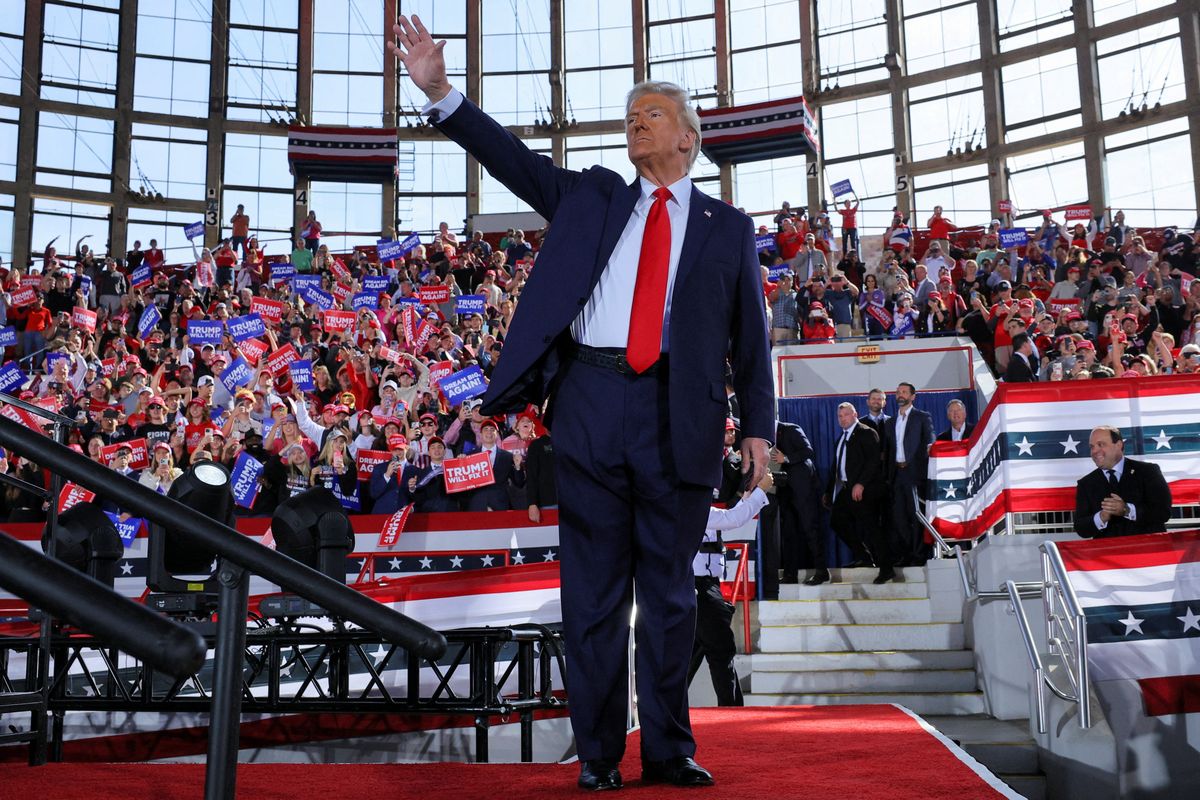
Republican presidential nominee and former U.S. President Donald Trump gestures to the crowd as sons Eric Trump and Donald Trump Jr. look on near the exit, during a campaign rally at J.S. Dorton Arena in Raleigh, North Carolina, U.S., November 4, 2024. REUTERS/Brian Snyder TPX IMAGES OF THE DAY
A historically Jewish newspaper compared President Donald Trump’s tactics to a scheme used by Germany’s Adolf Hitler before World War II.
In an op-ed for Forward this week, author Terrence Petty likened Trump’s demonization of his self-declared enemies to Hitler’s attempt to blame Jewish people for Germany’s loss in World War I. The tactic was known as the Dolchstosslegende, or stabbed-in-the-back legend.
” Trump has created an American version of Adolf Hitler’s ‘Dolchstosslegende,’ also known as the ‘stabbed-in-the-back’ lie,” the article in Forward said.
Dolchstosslegende alleged that Germany did not lose the First World War, but instead was betrayed by Jews.
“Donald Trump has created an American version of the Dolchstosslegende, propagating a myth that the nation is being led to ruination by Joe Biden and the Democrats, prosecutors who go after Trump, judges who rule against him, non-MAGA news media, practitioners of ‘wokeism,’ and elite universities, among others,” Petty wrote.
“All of this is utter nonsense, of course, but this American stabbed-in-the-back lie is at the core of Trump’s assaults on democracy.”
The author compared Hitler’s first speech as chancellor on Feb. 10, 1933, to Trump’s second inaugural address, which he insisted “reads like a stabbed-in-the-back manifesto.”
“For many years, a radical and corrupt establishment has extracted power and wealth from our citizens, while the pillars of our society lay broken and seemingly in complete disrepair,” Trump said during the speech in January.
Looking forward, Petty wondered if the U.S. was going through the early stages of authoritarianism.
“There are some signs of hope,” he noted. “Some law firms and universities are fighting back against Trump’s efforts to coerce them into bending to his will. Citizens are mobilizing, legions of them taking to the streets in protest of Trump’s power grabs. Courts have been ruling against his attempts to subvert the law. But none of this seems to faze him. And as appeals play out in rulings against him, he keeps using his authoritarian jackhammer against the foundations of American democracy.”






 TWENTY WAYS TO MATTER