Not that many people know that The Wizard of Oz, one of America’s most-loved films, is based on the arcane economic world of monetary policy. L Frank Baum’s novel is a disguised critique of the folly of the Gold Standard written in the wake of the 1896 election, at a time when America was deeply divided socially and geographically, when enormous power was wielded by a billionaire class, the so-called Robber Barons.
The election centred on whether America should swap the straitjacket of a gold-backed dollar for the looser cardigan of a silver-backed dollar. As gold is less plentiful and more expensive than silver, opting for a silver-backed currency would cause a devaluation that would inject more dollars into the economy, helping the poor.
The yellow bricks of the Yellow Brick Road, represent the gold bars which paved the way to the Emerald City, the city of green – or greenback, the colloquial term for the dollar. Dorothy represents the wholesome daughter of middle America, literally Kansas. The Scarecrow is the put-upon Midwestern farmer American and the Tin Man is the industrial worker.
Politically, the Democrats, in an alliance with a new party called the Popular Party, representing workers, farmers and the lower middle class, wanted a dollar backed by silver, meaning there would be more dollars around. In contrast, the Republicans represented industrialists, Wall Street and the wealthy, the kind of people who wanted to preserve their dollar wealth and maintain the Gold Standard.
With so much at stake and the country so explicitly divided along class lines, the rich opened their wallets and, for the first time, America’s election was truly swung by money. The Republicans won because they raised more cash.
William McKinley, the victorious Republican candidate, received contributions worth more than $16 million (about $600 million in today’s money). McKinley’s chief fundraiser, Mark Hanna, raised more than $6 million by courting corporations with the promise of a big-business-friendly agenda. Hanna is famously quoted as saying: “There are two things that are important in politics: the first is money and I can’t remember the second one”.
And who do you think the Wizard of Oz represented? Why, Mark Hanna the financier, hiding behind the slogans and conspiring against the ordinary American, embodied by the innocent Dorothy.
The American political scene was set over a century ago. Money matters in American politics, and that adage of the Republicans being for sale while the Democrats are only for rent is no longer strictly accurate.
Today’s Democrats aren’t above a mutually beneficial deal and are in the pockets of big business as much as their opponents. The problem with big money and unrestrained capitalism in politics is so obvious that it doesn’t need to be pointed out, but suffice to say that it is inimical with a properly functioning democracy.
At its core, the promise of democracy is “one man one vote”; but the attraction of capitalism is “one man many votes”, meaning the rich guys get the best things and lots of them, while the poor guy loses out.
Capitalism and democracy are in a constant state of friction. The excesses of capitalism need to be tempered by the equalising nature of democracy; however, too much democracy and redistribution limit the “animal spirits” of capitalism upon which prosperity rests.
Modern western societies are a tug of war between these two alternating ideas where a balance is sought between both; sometimes it’s called social democracy, Christian democracy or centrism but it amounts to the same, a truce.
Unfortunately, the conditions of the truce are influenced by money, which is why big money in elections is problematic. As is the case in any indecent proposal, whoever pays the money expects favours. Money buys policy. That is and always has been the deal. American politics has become the fiefdom of billionaires, the effect of which can only be imagined.
We’ve all seen Elon Musk jumping around Trump’s rally with the physical co-ordination of a homeschooled kid who’s never seen a PE class, but Musk isn’t the only billionaire with a stake in the game. The two US presidential candidates had raised more than $3.8 billion by mid-October. A Financial Times analysis of campaign finance filings found that billionaires have donated at least $695 million, or about 18 per cent of the total. Trump is particularly dependent on US elites, with about a third of his money coming from billionaires compared with about 6 per cent of the funds raised by Harris.
Trump’s finance base is rich but narrow while Harris’s is more broadly based. From January 2023 to mid-October 2024, Joe Biden and Harris outraised Trump ($2.2 billion to Trump’s $1.7 billion). But the rich guys have placed their bets; at least 144 people on the list of 800 US billionaires compiled by Forbes have donated to either candidate.
Billionaires leaning toward Harris may seem incongruous as she often criticises Trump for being too close to the plutocrats, but there are practical reasons why the ultra-wealthy may favour Harris.
As was the case in 1896, if you are rich you want stability – after all, you are doing well from the status quo. A letter signed by more than a dozen billionaires last month endorsing Harris explained their belief that she will “continue to advance fair and predictable policies that support the rule of law, stability, and a sound business environment”. In contrast, although he might cut their tax bills, Trump represents chaos and commotion, which is never good for business.
No matter whether the money comes from the liberal centre or the tear-it-all-down libertarian right, it comes with a price, a sort of pay-to-play cover charge. If you want influence in America you pay for it.
In Europe, strict limits on campaign contributions help curb plutocratic influence. For example, the $1.6 billion Joe Biden spent to win the 2020 presidential election is 70 times more than the sum Emmanuel Macron spent on his 2022 win – despite the fact that the US population is just five times larger than that of France. The total spend across all 12 candidates in the French presidential race was just over €83 million. Germany – a country with more billionaires per head than America – enforces strict donation limits and transparency rules, with caps of €50,000 per donor, reducing the risk of policies favouring an elite few.
Irish elections are subject to strict spending limits. Candidates running for the Dáil can only spend up to a maximum of €38,900 in a three-seat constituency, €48,600 in a four-seater and €58,350 in a five-seater. These numbers are paltry in the context of US elections, where there are no spending limits. In Ireland, donations from individuals or companies to a party are capped at €2,500 per year, while donations to individual candidates are limited to €1,000 per year.
After the alfresco political bribery of the Charlie Haughey and tribunal years, things are more above board and the days of rich guys buying elections in return for explicit special treatment are long gone. By way of contrast, the clear conflict between capitalism and democracy in America is there for all to see. As they say, the US is “the best democracy money can buy”, and the die was cast in 1896 with the election of William McKinley.
In those final days of the 19th century, with their man in the White House and tariffs erected to protect their businesses, America’s billionaire plutocrats must have felt unassailable. But following McKinley’s assassination by an anarchist in 1901, power moved to his vice-president, Teddy Roosevelt, who would turn on the very plutocrats who had financed his campaigns. Sensing that America yearned for equality after years of division and a decade of rich men lording it over the working man, Roosevelt brought the billionaires to heel, regulating them, taxing them and breaking up their monopolies.
A decade after buying the election, the billionaire class was on the skids, accused by Republican president Roosevelt of “predatory capitalism”. Fortunes turned dramatically. Political power slipped away from the plutocrats just when they thought victory was theirs.
Can history repeat itself? I wouldn’t bet against it.
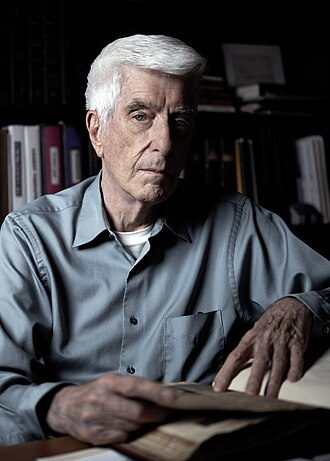
John Edward Mack (October 4, 1929 – September 27, 2004) was an American psychiatrist, writer, and professor of psychiatry. He served as the head of the department of psychiatry at Harvard Medical School from 1977 to 2004. In 1977, Mack won the Pulitzer Prize for his book A Prince of Our Disorder on T. E. Lawrence.[1]
Mack was born in New York City to an academic German Jewish family.[4] His father, the historian Edward Clarence Mack (1904–1973), was a professor at CUNY, while his mother Eleanor Liebmann Mack (1905–1930) died while John was an infant. After his mother died, his father married the economist Ruth P. Mack, through which he had a half-sister, Mary Lee Ingbar, a pioneer of computer analysis who became a professor at Dartmouth College and University of Massachusetts Medical School.[5] As John grew up, his father would read the Bible to him and his sister, but as a work of culture or literature. Mack graduated from the Horace Mann-Lincoln School in 1947 and Phi Beta Kappa from Oberlin in 1951 and received his medical doctorate degree cum laude from Harvard Medical School in 1955. Mack subsequently interned at the Massachusetts General Hospital and trained as a psychiatrist at the Massachusetts Mental Health Center.
In 1959, Mack joined the United States Air Force, serving as a medic in Japan,[6] where he rose to the rank of captain. In 1961, he returned from military service in Japan, continuing at the Massachusetts Mental Health Center and Boston Psychoanalytic Society and Institute, receiving certification in child and adult psychoanalysis and psychotherapy. From 1964, Mack returned to Harvard Medical School, becoming a full professor at Harvard in 1972.[7] In 1977, he became the chairman of the executive committee of Psychiatry at Harvard Medical School, which position he occupied until his death in 2004.[8][7]
Mack published over 150 scientific articles and eleven books in his career. As department head at Harvard Medical School, he worked primarily in the field of child and adolescent psychology. He worked on treating suicidal patients and published research on heroin addiction.[9] The dominant theme of his life’s work at Harvard had been the exploration of how one’s perceptions of the world affect one’s relationships. He addressed this issue of “world view” on the individual level in his early clinical explorations of dreams, nightmares and teen suicide, and in A Prince of Our Disorder, his biographical study of the life of British officer T. E. Lawrence, for which he received the Pulitzer Prize for Biography in 1977.[10]
Activism during the Cold War
In the 1980s, Mack interviewed many international political figures as part of his research into the root causes of the Cold War, including former United States President Jimmy Carter and the “father of the hydrogen bomb“, Edward Teller.
In the early 1990s, Mack commenced a decade-plus psychological study of 200 men and women who reported recurrent alien encounter experiences. Such encounters had seen some limited attention from academic figures, R. Leo Sprinkle perhaps being the earliest, in the 1960s. Mack, however, remains probably the most esteemed academic to have studied the subject.[citation needed]
He initially suspected that such persons were suffering from mental illness, but when no obvious pathologies were present in the persons he interviewed, his interest was piqued. Following encouragement from longtime friend Thomas Kuhn, who predicted that the subject might be controversial, but urged Mack to collect data and ignore prevailing materialist, dualist and “either/or” analysis, Mack began concerted study and interviews.[12] Many of those he interviewed reported that their encounters had affected the way they regarded the world, including producing a heightened sense of spirituality and environmental concern.[13][14]
Mack was somewhat more guarded in his investigations and interpretations of the abduction phenomenon than were earlier researchers. Literature professor Terry Matheson writes that “On balance, Mack does present as fair-minded an account as has been encountered to date, at least as these abduction narratives go.”[15] In a 1994 interview, Jeffrey Mishlove stated that Mack seemed “inclined to take these [abduction] reports at face value”. Mack replied by saying “Face value I wouldn’t say. I take them seriously. I don’t have a way to account for them.”[16] In a 1996 interview with PBS, he stated ” There are aspects of this which I believe we are justified in taking quite literally. That is, UFOs are in fact observed, filmed on camera at the same time that people are having their abduction experiences….It’s both literally, physically happening to a degree; and it’s also some kind of psychological, spiritual experience occurring and originating perhaps in another dimension.”[17] The BBC quoted Mack as saying, “I would never say, yes, there are aliens taking people. [But] I would say there is a compelling powerful phenomenon here, that I can’t account for in any other way, that’s mysterious. Yet I can’t know what it is, but it seems to me that it invites a deeper, further inquiry.”[18]
Mack noted that there was a worldwide history of visionary experiences, especially in pre-industrial societies. One example is the vision quest common to some Native American cultures. Only fairly recently in Western culture, notes Mack, have such visionary events been interpreted as aberrations or as mental illness. Mack suggested that abduction accounts might best be considered as part of this larger tradition of visionary encounters.[19]
His interest in the spiritual or transformational aspects of people’s alien encounters and his suggestion that the experience of alien contact itself may be more transcendent than physical in nature – yet nonetheless real – set him apart from many of his contemporaries, such as Budd Hopkins, who advocated the physical reality of aliens.[citation needed]
His later research broadened into the general consideration of the merits of an expanded notion of reality, one which allows for experiences that may not fit the Western materialist paradigm, yet deeply affect people’s lives. His second (and final) book on the alien encounter experience, Passport to the Cosmos: Human Transformation and Alien Encounters (1999), was as much a philosophical treatise connecting the themes of spirituality and modern world-views as it was the culmination of his work with the “experiencers” of alien encounters, to whom the book is dedicated.[20]
In November 1994, Mack travelled to Ruwa, Zimbabwe, to interview children at the Ariel School who claimed that they had seen a UFO land near their school and aliens exit the craft.[21]
Investigation by Harvard
In May 1994, the Dean of Harvard Medical School, Daniel C. Tosteson, appointed a committee of peers to confidentially review Mack’s clinical care and clinical investigation of the people who had shared their alien encounters with him (some of their cases were written of in Mack’s 1994 book Abduction). Angela Hind wrote, “It was the first time in Harvard’s history that a tenured professor was subjected to such an investigation.”[18]
The committee chairman was Arnold “Budd” Relman, M.D., a Professor of Medicine and of Social Medicine at Harvard Medical School who served as editor of The New England Journal of Medicine. According to Daniel P. Sheehan, one of Mack’s attorneys, the committee’s draft report suggested that “To communicate, in any way whatsoever, to a person who has reported a ‘close encounter’ with an extraterrestrial life form that this experience might well have been real … is professionally irresponsible.”[22]
Upon the public revelation of the existence of the committee (inadvertently revealed during the solicitation of witnesses for Mack’s defense, ten months into the process), questions arose from the academic community (including Harvard Professor of Law Alan Dershowitz) regarding the validity of an investigation of a tenured professor who was not suspected of ethics violations or professional misconduct. Concluding the fourteen-month investigation, Harvard then issued a statement stating that the Dean had “reaffirmed Dr. Mack’s academic freedom to study what he wishes and to state his opinions without impediment,” concluding “Dr. Mack remains a member in good standing of the Harvard Faculty of Medicine.” (Mack was censured in the committee’s report for what they believed were methodological errors, but Dean Tosteson took no action based on the committee’s assessment.) He had received legal help from Roderick MacLeish and Daniel Sheehan[23] (of the Pentagon Papers case),[24] and the support of Laurance Rockefeller, who also funded Mack’s non-profit organization for four consecutive years at $250,000 per year.[25]
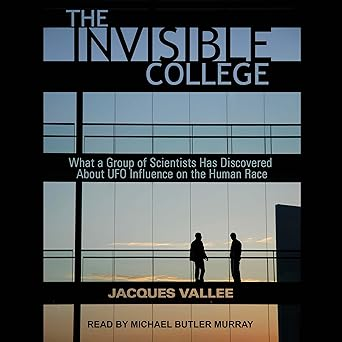
Here at last is a sensible book about Unidentified Flying Objects that neither sensationalizes the subject nor dismisses the whole idea as nonsense. This book makes a persuasive case that UFOs are real, all right, but they represent a different order of reality entirely- a “psychic reality” -for which the best historical precedent is the traditional religious revelation.
Excerpted from wikipedia: Jacques Fabrice Vallée (born September 24, 1939 in Pontoise, Val-d’Oise, France) is a venture capitalist, computer scientist, author, ufologist and former astronomer currently residing in San Francisco, California.
In mainstream science, Vallée is notable for co-developing the first computerized mapping of Mars for NASA and for his work at SRI International in creating ARPANET, a precursor to the modern Internet. Vallée is also an important figure in the study of unidentified flying objects (UFOs), first noted for a defense of the scientific legitimacy of the extraterrestrial hypothesis and later for promoting the interdimensional hypothesis.
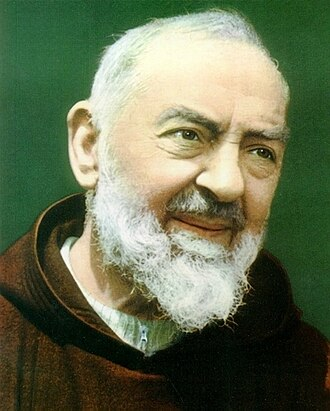
Pio of Pietrelcina (born Francesco Forgione; 25 May 1887 – 23 September 1968), widely known as Padre Pio (Italian for ‘Father Pius’), was an Italian Capuchin friar, priest, Stigmata, and mystic. He is venerated as a saint in the Catholic Church, celebrated on 23 September.[3]
Pio joined the Capuchins when he was fifteen and spent most of his religious life in the convent of San Giovanni Rotondo. He was marked by stigmata in 1918, leading to several investigations by the Holy See. Despite temporary sanctions imposed by the Vatican, his reputation kept increasing during his life, attracting many followers to San Giovanni Rotondo. He was the founder of the Casa Sollievo della Sofferenza, a hospital built near the convent of San Giovanni Rotondo.[4]
After his death, his devotion continued to spread among believers all over the world. He was beatified on 2 May 1999 and canonized on 16 June 2002 by Pope John Paul II. His relics are exposed in the sanctuary of Saint Pio of Pietrelcina, next to the convent of San Giovanni Rotondo, now a major pilgrimage site.[5]
Life
Early life
Francesco Forgione was born on 25 May 1887 to Grazio Mario Forgione (1860–1946) and Maria Giuseppa Di Nunzio (1859–1929), in Pietrelcina, a town in the province of Benevento, in the Southern Italian region of Campania.[6] His parents were peasant farmers.[7] He was baptized in the nearby Santa Anna Chapel, which stands upon the walls of a castle.[8] He later served as an altar boy in this same chapel. He had an older brother, Michele, and three younger sisters, Felicita, Pellegrina, and Grazia (who was later to become a Bridgettine nun).[7] His parents had two other children who died in infancy.[6] When he was baptized, he was given the name Francesco. He stated that by the time he was five years old, he had already made the decision to dedicate his entire life to God.[6][8] He worked on the land up to the age of 10, looking after the small flock of sheep the family owned.[9]
Pietrelcina was a town where feast days of saints were celebrated throughout the year, and the Forgione family was deeply religious. They attended Mass daily, prayed the Rosary nightly, and abstained from meat three days a week in honour of Our Lady of Mount Carmel.[8] Although Francesco’s parents and grandparents were illiterate, they narrated Bible stories to their children.
According to the diary of Father Agostino da San Marco (who was later his spiritual director in San Marco in Lamis), the young Francesco was afflicted with a number of illnesses. At six he suffered from severe gastroenteritis. At ten he caught typhoid fever.[10]
As a youth, Francesco reported that he had experienced heavenly visions and ecstasies.[6] In 1897, after he had completed three years at the public school, Francesco was said to have been drawn to the life of a friar after listening to a young Capuchin who was in the countryside seeking donations. When Francesco expressed his desire to his parents, they made a trip to Morcone, a community 13 miles (21 km) north of Pietrelcina, to find out if their son was eligible to enter the Order. The friars there informed them that they were interested in accepting Francesco into their community, but he needed to be better educated.[8]
Francesco’s father went to the United States in search of work to pay for private tutoring for his son, to meet the academic requirements to enter the Capuchin Order.[6] It was in this period that Francesco received the sacrament of Confirmation on 27 September 1899. He underwent private tutoring and passed the stipulated academic requirements. On 6 January 1903, at the age of 15, he entered the novitiate of the Capuchin friars at Morcone. On 22 January, he took the Franciscanhabit and the name of Fra (Friar) Pio, in honour of Pope Pius I, whose relic is preserved in the Santa Anna Chapel in Pietrelcina.[8][11] He took the simple vows of poverty, chastity and obedience.[6]
Priesthood
Commencing his seven-year study for the priesthood, Pio travelled to the friary of Saint Francis of Assisi in Umbria.[8] At 17, he fell ill, complaining of loss of appetite, insomnia, exhaustion, fainting spells, and migraines. He vomited frequently and could digest only milk and cheese. Religious devotees point to this time as being that at which inexplicable phenomena began to occur. During prayers, for example, Pio appeared to others to be in a stupor, as if he were absent. One of Pio’s fellow friars later claimed to have seen him in ecstasy, and levitating above the ground.[12]
In June 1905, Pio’s health worsened to such an extent that his superiors decided to send him to a mountain convent, in the hope that the change of air would do him good. This had little impact, however, and doctors advised that he return home. Even there his health failed to improve. Despite this, he still made his solemn religious profession on 27 January 1907.
In August 1910, Pio was ordained a priest by Archbishop Paolo Schinosi at the Cathedral of Benevento. Four days later, he offered his first Mass at the parish church of Our Lady of the Angels.
His health being precarious, he was permitted to remain with his family in his hometown of Pietrelcina while still retaining the Capuchin habit.[13] He stayed in Pietrelcina until 1916, due to his health and the need to take care of his family when his father and brother briefly emigrated to the United States.[14] During these years, Padre Pio frequently wrote mystic letters to his spiritual directors, Father Benedetto and Father Agostino, two friars from the Capuchin monastery of San Marco in Lamis.[14][15]
The conventual cell of Padre Pio in the monastery of Our Lady of Grace in San Giovanni Rotondo
On 4 September 1916, Pio was ordered to return to his community life. He moved to an agricultural community, Our Lady of Grace Capuchin Friary, located in the Gargano Mountains in San Giovanni Rotondo in the Province of Foggia. At that time the community numbered seven friars. He remained at San Giovanni Rotondo until his death in 1968, except for a period of military service. In the priesthood, Padre Pio was known to perform a number of successful conversions to Catholicism.[16]
Pio was devoted to rosary meditations. He compared weekly confession to dusting a room weekly, and recommended the performance of meditation and self-examination twice daily: once in the morning, as preparation to face the day, and once again in the evening, as retrospection. His advice on the practical application of theology he often summed up in his now famous quote: “pray, hope, and don’t worry”.[17] He directed Christians to recognize God in all things and to desire above all things to do the will of God.[18]
Many people who heard of him travelled to San Giovanni Rotondo to meet him and confess to him, ask for help, or have their curiosity satisfied. Pio’s mother died in the village around the convent in 1928. Later, in 1938, Pio had his elderly father Grazio live with him. His brother Michele also moved in. Pio’s father lived in a little house outside the convent, until his death in 1946.[19]
World War I and aftermath
When World War I started, four friars from his community were selected for military service in the Italian army. At that time, Pio was a teacher and spiritual director at the seminary. When one more friar was called into service, Pio was put in charge of the community. On 15 November 1915, he was drafted and on December 6, assigned to the 10th Medical Corps in Naples. Due to poor health, he was continually discharged and recalled until on 16 March 1918, he was declared unfit for service and discharged completely.[20]
Padre Pio c. 1918. His hands are covered due to stigmata
In September 1918, Pio began to display permanent wounds on his hands and feet, known as stigmata in reference to Christ’s wounds.[21] In the next months, his reputation of sainthood grew rapidly in the region of San Giovanni Rotondo, attracting hundreds of believers at the monastery coming each day to see him.[21]
People who had started rebuilding their lives after the war began to see in Pio a symbol of hope.[18] Those close to him attest that he began to manifest several spiritual gifts, including the gifts of healing, bilocation, levitation, prophecy, miracles, extraordinary abstinence from both sleep and nourishment (one account states that Padre Agostino recorded one instance in which Pio was able to subsist for at least 20 days at Verafeno on only the Holy Eucharist without any other nourishment), the ability to read hearts, the gift of tongues, the gift of conversions, and pleasant-smelling wounds.[22][better source needed]
Pio increasingly became well known among the wider populace. He became a spiritual director, and developed five rules for spiritual growth: weekly confession, daily Communion, spiritual reading, meditation, and examination of conscience.[18]
La Casa Sollievo della Sofferenza hospital
The hospital that was built on Padre Pio’s initiative in San Giovanni Rotondo, Italy. (Casa Sollievo della Sofferenza)
By 1925, Pio had converted an old convent building into a medical clinic with a few beds intended primarily for people in extreme need.[23] In 1940, a committee was set-up to establish a bigger clinic[24] and donations started to be made. Construction began in 1947.[23]
Lodovico Montini, head of Democrazia Cristiana, and his brother Giovanni Battista Montini (later Pope Paul VI) facilitated engagement by UNRRA.[28] The hospital was initially to be named “Fiorello LaGuardia”, but eventually presented as the work of Pio himself.[29] The Casa Sollievo della Sofferenza (‘Home for the Relief of Suffering’) opened in 1956.[24] Pio handed direct control to the Holy See. However, in order that Pio might directly supervise the project, Pope Pius XII granted him a dispensation from his vow of poverty in 1957.[30][31] Some of Pio’s detractors have subsequently suggested there had been misappropriation of funds.[30]
Death
Some photos of the funeral ceremony (attended by near 100,000) and procession to Our Lady of Grace
Pio’s health deteriorated in the 1960s, but he continued his spiritual works.[32] On 22 September 1968, Padre Pio celebrated the Mass to celebrate the 50th anniversary of his receiving the stigmata, with a huge crowd of pilgrims present to celebrate the event as well as television crews.[33] Due to a large number of pilgrims present for the Mass, the superior of the monastery decided that a Solemn Mass be celebrated.[34] Pio carried out his duties, but appeared extremely weak and frail.[35] His voice was weak, and, after the Mass had concluded, he nearly collapsed while walking down the altar steps. He needed help from his Capuchin brothers.[36] This was his last celebration of the Mass.[37]
Early in the morning of 23 September 1968, Pio made his last confession and renewed his Franciscan vows.[18][38] As was customary, he had his rosary in his hands, though he did not have the strength to pray the Hail Marys aloud, instead repeating the words Gesù, Maria (‘Jesus, Mary’).[39] He died in his cell in San Giovanni Rotondo around 2:30 a.m. at the age of 81.[40]
A few days before dying the stigmata had disappeared. Examining Padre Pio’s body, the doctor who was present at his deathbed observed that the wounds of the stigmata were completely healed, without any trace or scar.[40] His body was placed in a coffin in the church of the monastery to allow pilgrims to pay their respects. The funeral ceremony was held on 26 September, with an estimated 100,000 people attending.[41][42] After a funeral procession in San Giovanni Rotondo and the funeral Mass, the body was buried in the crypt in the Church of Our Lady of Grace.[41]
Supernatural phenomena
Pio was said to have had mystical gifts such as reading souls, the ability to bilocate and the ability to work favours and healings before they were requested of him.[43] His reported supernatural experiences also include celestial visions, communication with angels and physical fights with Satan and demons. The reports of supernatural phenomena surrounding Pio attracted fame and amazement, even if the Vatican seemed sceptical. Some of these phenomena were reported by Pio himself in letters written to his spiritual directors, while others have been reported by his followers.
Stigmata
Padre Pio showing the stigmata (photo from 19 August 1919)
Pio wrote in his letters that, early in his priesthood, he experienced bodily marks, pain, and bleeding in locations indicative of the (not yet visible) stigmata.[44] In a letter to his spiritual companion and confessor Father Agostino, dated 21 March 1912, Pio wrote of his devotion to the mystical body of Christ and the intuition that he would bear the stigmata. Luzzatto claims that in this letter Pio uses unrecognized passages from a book by the stigmatized mystic Gemma Galgani.[14]
In a 1915 letter, Agostino asked Pio specific questions, including: when did he first experience visions, whether he was stigmatic, and whether he felt the pains of the Passion of Christ, namely the crowning of thorns and the scourging. Pio replied that he had had visions since his novitiate period (1903 to 1904) and that he was stigmatic, adding that he had been so terrified by the phenomenon that he begged God to withdraw his stigmata. He also wrote that he did not wish the pain to be removed, only the visible wounds, since he considered them to be an indescribable and almost unbearable humiliation.[44]
On 20 September 1918, while hearing confessions, Pio is said to have had a reappearance of the physical occurrence of the stigmata. His stigmatism reportedly continued for fifty years, until the end of his life. The blood flowing from the stigmata purportedly smelled of perfume or flowers.[45] Pio conveyed to Agostino that the pain remained and was more acute on specific days and under certain circumstances. Though he said he would have preferred to suffer in secret, by early 1919, news that he was a stigmatic had begun to spread. Pio often wore red mittens or black coverings on his hands and feet, saying that he was embarrassed by the marks.[30]
Agostino Gemelli claimed that the wounds were consistent with those that soldiers had inflicted on themselves “by the use of a caustic substance”,[46] while Amico Bignami considered that Pio’s wounds might be a skin necrosis that was hindered from healing through the use of iodine tincture or similar chemicals.[47]
Once made public, the wounds were studied by a number of physicians, some hired by the Vatican as part of an independent investigation. Some claimed that the wounds were unexplainable and never seemed to have become infected.[30][48] Despite seeming to heal they would then reappear periodically.[49] Alberto Caserta took X-rays of Pio’s hands in 1954 and found no abnormality in the bone structure.[50] Some critics accused Pio of faking the stigmata, for example by using carbolic acid to make the wounds. Maria De Vito (the cousin of the local pharmacist Valentini Vista at Foggia) testified that the young Pio bought carbolic acid and the great quantity of four grams of veratrine “without presenting any medical prescription whatsoever” and “in great secret”.[51] Veratrine is a “mixture of alkaloids”, a “highly caustic product”: “Veratrine is so poisonous, that only a doctor can decide whether to prescribe it”, as the pharmacist Vista stated in front of witnesses.[52] Veratrine was once used as a paralyzing muscle insecticide, primarily against lice, but was also described by pharmacists as an “external stimulant” that renders one insensitive to pain.[53] Pio maintained that the carbolic acid was used to sterilize syringes used for medical treatments and that after being subjected to a practical joke where veratrine was mixed with snuff tobacco, causing uncontrollable sneezing after ingestion, he decided to acquire his own quantity of the substance in order to play the same joke on his confreres;[54][55] the bishop of Volterra, Raffaele Rossi came to share this view, believing that “Instead of malice, what is revealed here is Padre Pio’s simplicity, and his playful spirit”,[55] and that “the stigmata at issue are not a work of the devil, nor a gross deceit, a fraud, the trick of a devious and malicious person […] his ‘stigmata’ do not seem to me a morbid product of external suggestion.”[56] Rossi saw these stigmata as a “real fact”.[57]
Transverberation
In August 1918, a few weeks before reportedly receiving the stigmata, Pio described a mystical experience during which he felt being pierced and burnt spiritually and physically. According to Pio, this mystical experience began on 5 August and ended on 7 August. Padre Benedetto, his spiritual director, interpreted this phenomenon as a transverberation. Pio later claimed that this experience left a physical wound on his left side.[58] Most witnesses who examined Pio’s wounds reported that he had a wound on his left side, around three inches long and the shape of a cross.[59][60]
Bilocation
Pio was believed by his followers to have the gift of bilocation, the ability to be in two places at the same time. When bishop Raffaele Rossi asked him about bilocation as part of a Vatican inquiry, Pio replied: “I don’t know how it is or the nature of this phenomenon—and I certainly don’t give it much thought—but it did happen to me to be in the presence of this or that person, to be in this or that place; I do not know whether my mind was transported there, or what I saw was some sort of representation of the place or the person; I do not know whether I was there with my body or without it.”[61][62]
Healing
In the 1999 book Padre Pio: The Wonder Worker, a segment by Irish priest Malachy Gerard Carroll describes the story of Gemma de Giorgi, a Sicilian girl whose blindness was believed to have been cured during a visit to Pio.[63] Gemma, who was brought to San Giovanni Rotondo in 1947 by her grandmother, was born without pupils. During her trip to see Pio, the little girl began to see objects, including a steamboat and the sea.[63][64] Gemma’s grandmother did not believe the child had been healed. After Gemma forgot to ask Pio for grace during her confession, her grandmother implored the priest to ask God to restore her sight.[63] Pio told her, “The child must not weep and neither must you for the child sees and you know she sees.”[63]
According to the bishop of Volterra, Raffaele Rossi, in charge of investigating Pio: “Of the alleged healings, many are unconfirmed or non-existent. In Padre Pio’s correspondence, however, there are some credible declarations that attribute miracles to his intercession. But without medical confirmation it is difficult to reach a conclusion, and the issue remains open.”[65]
Prophecy
In 1947, 27-year-old Father Karol Józef Wojtyła (later Pope John Paul II) visited Pio, who heard his confession. Austrian Cardinal Alfons Stickler reported that Wojtyła confided to him that during this meeting, Pio told him he would one day ascend to “the highest post in the church, though further confirmation is needed.”[66] Stickler said that Wojtyła believed that the prophecy was fulfilled when he became a cardinal.[67] John Paul’s secretary, Stanisław Dziwisz, denies the prediction,[68] while George Weigel‘s biography Witness to Hope, which contains an account of the same visit, does not mention it.
Rossi describes in Pio a “very intense and pleasant fragrance, similar to the scent of the violet”, and concludes that he was unable to determine the origin of the scent.[69] Pio replied that he had intellectual visions seen through the eyes of the intellect,[70] accounts of diabolical assaults and harassment against him,[71] malicious visions under human shape and beastly shape,[72] and Pio confirmed to Rossi: “A very few times I happened to feel inside me with clarity someone’s fault, or sin, or virtue, of people of whom I had some knowledge, at least generally”.[73]
On March 14th, 2025, we have a Full Moon and Total Lunar Eclipse at 23° Virgo. And what an incredible eclipse this is!
Firstly, it’s a Total Eclipse, which means it’s much more intense than a partial eclipse. We are going to feel this one deeply. It’s a South Node Eclipse, meaning it’s outcome-oriented, bringing resolutions that have been long in the making.
Many people focus more on Solar Eclipses because they seem more dramatic or eventful; however, it’s Lunar Eclipses – Full Moons on steroids – when things actually happen in tangible, concrete terms.
And while North Node eclipses might sound more appealing (given the North Node’s connection to life purpose and future growth), it’s the South Node eclipses that bring true resolutions.
South Node Eclipses like this one are when karma ripens, and events finally unfold.
This doesn’t mean that major events will unfold for every single one of us at the Lunar Eclipse in Virgo. It all depends on our natal chart and whether we have sensitive points (luminaries, chart ruler, angles) very close to the degree of the eclipse (23° Virgo or other mutable signs: Gemini, Sagittarius, Pisces).
However, what this Lunar Eclipse will bring to most of us is a sense of “This has run its course. Now let’s move on.”
Have you ever felt stuck in a never-ending spiral, looping on and on over the same thing? These phases – when we’re processing, reflecting, even obsessing over something – are necessary because this is when growth happens.
However, we can’t stay in that space forever. At some point, something has to shift.
And that’s the role of eclipses. Eclipses – especially South Node eclipses – are times when ‘enough is enough.’ Eclipses bring much-needed resolution. This is when we press the reset button and move on to the next thing.
Lunar Eclipse In Virgo – The Common Sense Thing
With Virgo, practicality will prevail over idealism.
Of course, it’s not that the 2 are mutually exclusive – quite the opposite. Every Piscean ideal needs Virgoan systems and frameworks to bring it into reality.
And every Virgoan task, effort, or act of service isn’t just for the sake of keeping busy – it’s animated by some sort of ideal, aspiration, or greater legacy (Pisces).
However, since it’s the Virgo side of the axisthat is eclipsed, we will likely interpret things through a Virgoan lens – practical, concrete, and rooted in common sense. A Virgo lunation is when we look at what has been bothering us or holding us back and assess it with Virgo’s humble, clear-eyed perspective.
Have you ever felt trapped in some sort of ‘impossible situation’, only to find that the solution – usually a very simple, logical one – wasright in front of you?
This happens especially when we get stuck in the previous stage of our development (Leo) and are driven by pride. We resist taking certain steps – perhaps because we see them as a loss of authenticity or even a personal failure.
However, in many cases, what we resist is actually the most logical – and best – thing to do.
That’s not to say that the Lunar Eclipse’s resolution has to be a humbling, I’m-gonna-lose-something kind of experience. Not at all. For many, this is a time of achievement – a moment when hard work finally pays off. Something we’ve been working on for a long time is now bearing fruit.
At this turning point, the key question to ask is: does it (whatever is unfolding in your life) make sense – beyond right, wrong, or ego? Does it add value to your life?
More than anything, Virgo wants to be useful. Virgo seeks to add value to everything it touches. That’s what makes Virgo feel fulfilled – bringing value, finding solutions, and improving the physical world we live in.
At the Full Moon Lunar Eclipse in Virgo, it’s a time to let go of pride, unrealistic expectations, or attachments to an outdated vision – and simply do the common-sense thing.
Lunar Eclipse In Virgo – The Aspects
The Full Moon Lunar Eclipse in Virgo forms a tight square with Saturn (now at 22° Pisces) and also a very tight, almost exact trine to Uranus (at 24° Taurus).
This speaks to a systemic change or a disruptive outcome that was long overdue and pretty much inevitable. If something has been built on unstable foundations, the house of cards will collapse.
But if we’ve put in the work and built something solid, the eclipse delivers the final piece – handing us the keys to what we’ve constructed.
The eclipse is also loosely sextiling Mars, which is a positive signal of change. While there may be no turning back from the path we’ve been on, a whole new horizon lies ahead.
That being said, things may not be entirely as they seem. Just one day after the eclipse, the eclipse ruler, Mercury, goes retrograde – almost like a cosmic “wait a second” moment, asking us to go back and review something important.
Perhaps the realization or breakthrough that comes requires some follow-up action – closing loose ends, revisiting details, or finishing what has been left unfinished.
More details will unfold as we move through the eclipse season, and even beyond it, when Mercury goes direct on April 7th, 2025.
Lunar Eclipse In Virgo – What Goes Around Comes Around
The key to understanding **this eclipse – eclipses in general, and, in broader terms, transits and life itself – **is accepting that, fundamentally, things are exactly as they should be.
When we embrace this mindset, it becomes easier to settle into the present situation and take the best course of action.
Whatever the outcome of this eclipse, it’s the logical resolution of previous actions and choices.
Some of us might be pleased with the outcomes – some of us might not. Whatever happens, remember this: it’s not the universe that’s ‘wrong.’
The universe is never wrong. It couldn’t be wrong, because it wouldn’t function if its laws were flawed. Yes – in the short term, things may seem unfair or misaligned. But the universe is vast, intelligent, and always in motion – constantly adjusting itself to bring about the most natural and balanced outcomes over time.
And so, if the outcome of the Lunar Eclipse in Virgo surprises us, perhaps it’s not the universe that was off course – but our perception. Maybe we didn’t have all the pieces of information. Or maybe we were attached to a narrative or expectation that wasn’t truly aligned with reality.
Most likely, there will be no big surprises. Deep down, we already sensed this was coming – it was inevitable.
Eclipses – especially lunar eclipses, and even more so, South Node eclipses – are a recalibration of the karmic scales.
A reminder that what goes around eventually comes around. Maybe in a slightly different form. Maybe in a way where causality isn’t immediately obvious.
However, in the grand scheme of things, the outcome – the resolution – is always the best way forward. Why? Because it allows us to close a chapter that belongs to the past – so we can move on to the next one.
At the Full Moon Lunar Eclipse in Virgo, ask yourself: What is the most natural course of action? What’s the common-sense thing to do?
And if the choice isn’t yours to make – then trust that the universe is already making it for you.
New Thinking Allowed with Jeffrey Mishlove • Mar 12, 2025 Robert Davis, PhD, is a retired professor of neuroscience at the State University of New York. He is author of The UFO Phenomenon: Should I Believe? and Life After Death: An Analysis of the Evidence. You can view Bob Davis’ film The Consciousness Connection for free on Gaia.com during their 7-day free trial. https://www.gaia.com/lp/gaia-experien…. In this video, rebooted from 2019, he describes the results of a survey of individuals who believe themselves to have experienced contact with non-human intelligence associated with unidentified aerial phenomena. Over 3,000 people responded to an in-depth survey. About 70% reported that their experiences had a positive impact in their life. About 25% reported that they had strong, waking memories of having been taken aboard a craft of some sort. New Thinking Allowed host, Jeffrey Mishlove, PhD, is author of The Roots of Consciousness, Psi Development Systems, and The PK Man. Between 1986 and 2002 he hosted and co-produced the original Thinking Allowed public television series. He is the recipient of the only doctoral diploma in “parapsychology” ever awarded by an accredited university (University of California, Berkeley, 1980). He is also the Grand Prize winner of the 2021 Bigelow Institute essay competition regarding the best evidence for survival of human consciousness after permanent bodily death. He is Co-Director of Parapsychology Education at the California Institute for Human Science. (Recorded on February 1, 2019)
ARIES (March 21-April 19): What can you do to show how much you care about everyone and everything that deserves your love? Now is a fantastic time to unleash a flood of gratitude and appreciation that takes very practical forms. Don’t just beam warm and fuzzy feelings toward your favorite people and animals, in other words. Offer tangible blessings that will actually enhance their lives. Find your own personally meaningful ways to nourish all that nourishes you.
TAURUS (April 20-May 20): Ancient Egyptians loved the color blue. The mineral azurite and the semiprecious stones turquoise and lapis lazuli satisfied their fascination to some degree, but were rare and difficult to work with. So the Egyptians decided to fabricate their own pigment. After extensive experimentation, using copper, silica and lime, they succeeded. The hue they made is known as Egyptian blue. I heartily endorse a comparable process for you in the coming weeks, Taurus. Identify the experience, substance or feeling you really, really want more of, and then resolve to get as much of it as you really, really want.
GEMINI (May 21-June 20): Dandelions germinate quickly and grow fast. Because of their deep taproots, they are hardy. Once they establish their presence in a place, they persist. Dandelions are adaptable, too, able to grow anywhere their seeds land, even from cracks in concrete. Their efficient dispersal is legendary. They produce large quantities of lightweight seeds that are easily carried by the wind. Bees love dandelions in the spring when there are few other flowers yet to provide them with nectar. I propose we make the dandelion your symbol of power in the coming weeks, Gemini. Be like them! (PS: They are also beautiful in an unostentatious way.)
CANCER (June 21-July 22): About 36,000 years ago, humans created remarkable drawings and paintings in the Cave of Altamira, located in what we now call Spain. When an early discoverer of the art published his findings in 1880, he was met with derision. Experts accused him of forgery, saying such beautiful and technically proficient works could not have been made by ancient people, who just weren’t that smart. Eventually, though, the art was proved to be genuine. I propose we meditate on this as a metaphor for your life. It’s possible that your abilities may be underestimated, even by you. Hidden potentials and unexpressed capacities may be close to ripening, but they will need your full confidence and boldness. Don’t let skepticism, either from your inner critic or others, hold you back.
LEO (July 23-Aug. 22): In 1977, NASA launched two Voyager probes to study our solar system’s outer planets. Their original mission was designed to last a few years. But in 2025, they still continue to send back useful information from the great beyond, far past Uranus and Neptune, and into interstellar space. I suspect that now is also a good time for you Leos to seek valuable information from adventures you began years ago. Even if those past experiences have not yielded relevant revelations recently, they may soon do so. Be alert for ways to harvest new riches from old memories.
VIRGO (Aug. 23-Sept. 22): About 3,775 years ago, a Babylonian man named Nanni wrote a crabby letter to Ea-nasir, a merchant who had sold him substandard copper ingots. Nanni was also upset that his servant was treated rudely. It is the oldest customer complaint in history. With this as our touchstone, I remind you that maintaining high standards is always crucial for your long-term success. Others may be tempted to cut corners, but your natural integrity is one of your superpowers. Please redouble your commitment to providing highest value, Virgo. And ask for it from others, too.
LIBRA (Sept. 23-Oct. 22): Blogger Yukiko Kisaki writes about the Japanese concept of ma. She says it’s “the emptiness full of possibilities, like a promise yet to be fulfilled. It’s the purposeful pauses in a speech that make words stand out; the quiet time we all need to make our busy lives meaningful; the silence between the notes that make the music.” According to my analysis, Libra, you will be wise to make ma a central theme in the coming weeks. I invite you to research the power of pauses. Rather than filling up every gap, allow space for pregnant blankness. Trust that in being open to vacancy, you will make room for unexpected riches.
SCORPIO (Oct. 23-Nov. 21): The literal meaning of the Japanese word yohen is “kiln mutation.” It refers to a type of glaze that undergoes unpredictable variations in color when baked in a kiln. The finished pottery that emerges displays patterns and hues that are blends of the artist’s intention and accidental effects created by the heat. I would love to see you carry out metaphorical versions of yohen in the coming weeks, Scorpio. Suggested meditations: 1. Collaborate to create beauty with energies that aren’t entirely manageable. 2. Undertake projects that require both careful preparation and a willingness to adapt to shifting conditions. 3. Engage with opportunities that will have the best outcomes if you relinquish some control.
SAGITTARIUS (Nov. 22-Dec. 21): A big party is underway in your astrological House of Self-Understanding and Self-Definition. The near future will be a favorable time to discover yourself in greater depth and bring your identity into clearer focus. I see this mostly as a task for you to carry out in intimate conversation with yourself. It’s also fine to solicit the feedback of allies who have insight into your nature, but I urge you to rely heavily on your private investigations. How can you deepen your knowledge of the reasons you are here on earth? Can you learn more about your dormant potentials? Who are you, exactly?
CAPRICORN (Dec. 22-Jan.19): Ethiopian marathon runner Abebe Bikila was selected by his country to compete in the 1960 Rome Olympics. But the honor was offered shortly before the games began, and he had to scramble to get there in time. When he arrived for the main event, he couldn’t find any running shoes in local stores that fit comfortably. So he decided to go barefoot for the 26.2-mile race. Success! He won, setting a new world-record time. I propose we make him your role model, Capricorn. May he inspire you to respond to an apparent scarcity or deficiency by calling on earthy alternatives. May you adjust to a problem by deepening your reliance on your natural self.
AQUARIUS (Jan. 20-Feb. 18): After being part of two journeys to Antarctica, Aquarian explorer Ernest Shackleton (1874–1922) assembled a team to try what no one had ever done: crossing the entire continent on foot with pack dogs and motorized sledges. But the proposed 1,800-mile expedition failed soon after it began. That’s when Shackleton did what he is most famous for. His leadership during the harrowing struggle to survive became legendary. I don’t think you will face anything remotely resembling his challenges in the coming weeks. But I suspect that your response to tests and trials will define your success. As you encounter obstacles, you will treat them as opportunities to showcase your resourcefulness and adaptability. You will inspire others to summon resiliency, and you will bring out their best as together you engage in creative problem-solving. Trials will become triumphs.
PISCES (Feb. 19-March 20): I’m not exactly sure where you are going, Pisces, but I’m certain you are headed in the right direction. Your instincts for self-love are at a peak. Your ability to see your best possible future is lucid and strong. Your commitment to gracefully serving all that gracefully serves you is passionate and rigorous. I will congratulate you in advance for locating the exact, robust resources you need, not mediocre resources that are only half-interesting.
Singer/songwriter Janis Ian will always have a special place in my heart. Janis was the first artist I ever interviewed at the beginning of my journalism career. It was 1994, after the release of what some considered to be her comeback album, “Breaking Silence.” She couldn’t have been more delightful or forthcoming.
Never miss a story!
Sign up today to receive trusted LGBTQ news in your inbox.Submit
Although many know Ian from her hit single, “At Seventeen,” it was actually from her seventh album and the singer songwriter had been performing since the early 1960s. Added to her burst of fame was her performance in the premiere episode of “Saturday Night Live.”
Janis Ian performing (photo: Peter Cunningham)
Over the years, Ian has won multiple awards, and has been outspoken about financial and management abuses in the record industry. She came out officially in 1993 and lives with her wife Patricia Snyder on Anna Maria Island, Florida.
Now retired from touring and recording, Ian, 73, is the subject of Varda Bar-Kar’s informative documentary “Janis Ian: Breaking Silence.” Janis was, once again, kind enough to make time for an interview shortly before the release of the documentary, “Janis Ian: Breaking Silence,” will be in theaters March 28.
Gregg Shapiro: Janis, I’d like to begin by asking you to say a few words about how the documentary “Janis Ian: Breaking Silence” came to be? Janis Ian: I’ve been offered the chance to tell my story in documentaries since I was 16. It was not something that I was looking for. I figured that between touring starting to wind up, and my life starting to kind of wind down, it was a good time to release the last album and then go quiet. That was my plan.
Then, I got approached by a fairly big company to do an autobiography. The point they made was that this is an autobiography, it ties in with your archives, it’s good for people to understand, and so on. I signed (it), and then the company completely changed. I waited out the contract and walked away. I thought, “Well, this is not meant to be, clearly.”
But then Varda approached me. She sent me an email and I spoke with her out of courtesy. She was so enthusiastic and so understanding that I said, “Okay, let me see your previous work.”
Janic Ian with her first Grammy Award in 1976
She sent me links to the previous work and then my lawyer said, “Okay, you need to show me a 20-minute idea of what you’re going to do.” She did that, and it was interesting. So, I kept talking to her. We were at the start of COVID and nobody knew what was causing it. She said she would put on a hazmat suit and fly out, and I said, “No. You’re not getting within 20 feet of me.”
We kept talking and the more she talked about her ideas for it and the more she understood what I wanted out of it, which was a slice of the times, the more comfortable I got until I finally said, “Okay.” It’s a very straightforward deal. I don’t get any money for it. She agreed to give me — not approval of the rough cut — but the right to request factual corrections in the rough cut.
There are a few of those. Otherwise, the first time I saw it was pretty much along with everybody else in its finished formed during my Berea (College) archives opening.
Do you see the documentary as a visual extension of your 2008 memoir, “Society’s Child”? I think so, to a point. It’s not based on the book. We can’t really say that. Although I just got the rights back to the book so that’s gonna be interesting.
Wow! Yeah, what an unusual thing, right? You as a writer know publishers never give you anything. But it happens. I see it as just an examination of my work and my life within that work.
Early in “Janis Ian: Breaking Silence,” there is a clip of you in the 1967 TV documentary “Inside Pop: The Rock Revolution,” hosted by Leonard Bernstein. What did it mean to you to be featured in that program? [Laughs] I don’t remember. I thought it was pretty cool, but it sort of ended there. My parents, I think, were more excited than I was. To me, I didn’t really understand the impact that it could have. I was pretty clueless about that.
So, once it did come out and everybody went, “Oh my God! Oh my God! Oh my God!” then I went, “Oh, Okay.” I didn’t grow up watching a huge amount of TV, so I didn’t really understand the power of an “Ed Sullivan Show” or a primetime special.
Did you remain in contact with Bernstein after that? Lightly here and there. A couple of books were exchanged. I sent him a couple of notes; he sent back notes. My uncle went up to him at Tanglewood and told him who he was, and Bernstein said that he had been following my career very closely. Then, I ended up studying with Stella Adler, whose daughter Ellen married David Oppenheim, who had been the great love of Bernstein’s. It was just one amazingly big circle.
The documentary includes a great deal of vintage footage. How much of it was drawn from your archives at Berea College in Kentucky? Very little, because the archives weren’t open or finished collating then. I don’t really know how much Varda took. I know I sent her everything I had. I had digitized all of my photos way early. But in terms of the archival footage, she and her daughter, who was her main researcher, did an astonishing job of finding things. There was stuff there that I’d never seen.
I loved the variety of interviews featured in the documentary, especially hearing Laurie Metcalf and Jean Smart talking about the impact that “At Seventeen” had on them. Wasn’t that great?
Yes! How does it feel to hear Arlo Guthrie, Joan Baez, and many others singing your praises? It’s pretty splendid, I will say. My wife once told me that I had to be careful when I talked about my friends. I asked and she said, “You throw around names like Joan and Arlo, and it doesn’t mean anything to you because those people are your friends. But for other people, these are very famous names, and it can sound like you’re bragging.”
I thought, “I have to watch myself now when I talk about my friends.” But she was right. I think somebody in my position, doing it as long as I have, winds up knowing a lot of people that other people don’t get the chance to know.
I think it’s great that you’ve earned the right to drop those names. It’s pretty cool. But I think it’s cooler because of what they’ve meant to me. Joan has been so good to me all my life. I’ve known Arlo since I was 16. There’s not a lot of people who’ve been through what I’ve been through or been in my position. It’s becoming more and more of an exclusive club every year.
So, when I could reach out to somebody like Arlo and say, “Hey man, do you remember…?” Or, like, I called him the morning Pete (Seeger) died, and I said, “I’m just making sure you’ve already heard.” Stuff like that. It’s things that people not in this position wouldn’t think about.
Janis Ian with Joan Baez in Amsterdam, 1993 (photo: Janis Ian)
In the film, gay journalist James Reed described you as an LGBTQ icon. What does such an accolade mean to you? Nothing [laughs]. What’s an icon? An icon is something you put on the dresser and pray to. I understand what he was trying to say. I think anytime you make somebody an icon, it’s a great danger to that person. I don’t think of myself in that way. I think we’ve talked about this before.
People keep telling me when they see the film how brave I was. To me, it’s mostly accidents. I was there, and I did the right thing. If you stop and think, “Am I going to be brave about this or not?” therein lies perdition. If you think about it too long, you get scared.
I also enjoyed listening to the late music producer Brooks Arthur talk about your collaboration. I think I was remarkably fortunate in (working with producer) Shadow (Morton), and Brooks was the engineer under Shadow. I was incredibly fortunate in that both thought I could do anything.
If you listen to (the album) “Stars” or most of “Between the Lines,” after I fired the lead guitarist, we suddenly realized we didn’t have a lead guitarist. So, all of those lead guitar parts are me. It never occurred to Brooks that I couldn’t do that. He just figured, okay, put a guitar in her hands and see what she comes up with. I think that’s an amazing gift. Especially when their careers are riding on it. Especially for a female artist in those days, and even now.
Brooks said something great to me once. He said, “No matter who you work with, no matter what you do, even if they don’t use your guitar track, make sure you’re playing when they’re putting the track down, because there’s a different energy.” I thought that was a really great observation. I really wish he’d lived to see this film. He would have been very proud.
You also have the distinction of being the second musical guest, following Billy Preston, on the October 1975 premiere episode of “Saturday Night Live,” at which you performed “At Seventeen” and “In the Winter.” As “SNL” celebrates its 50th anniversary, do you have a memory you’d like to share about that? Actually, I really don’t. It just kind of flew by. CBS Records flew me in and flew me out. Boom, boom, boom. I didn’t make any of the rehearsals. I was on tour at the time behind “(At)17” and couldn’t cancel any shows. I think we postponed a show for that night so I could do it, and then they took me right back out to the West Coast.
At the October 2024 Janis Ian tribute concert, some of the next generation of queer artists, including Amythyst Kiah, S.G. Goodman, and Melissa Carper, were among the performers. Would you agree that you helped pave the way for queer artists to be able to be open and out about their identities? No. I think if it hadn’t been me, it would have been somebody else. There were three of us at The Triangle Ball the year that Clinton was elected. There was Melissa (Etheridge), k.d. (lang) and me. We all came out at the same time, very loudly, for all the reasons I say in the film. Honestly, Gregg, I think anybody who lives an open life has paved the way.
Finally, Janis, we both live in Florida at a time when being queer in the Sunshine State is constantly under threat. Well, everything in the Sunshine State is constantly under threat.
That is sad but true. Is there anything else you’d like to say about that? Yes, go back to one man, one vote, and go back to paper ballots. That’s my theory of the world right now. I don’t think Trump and the Republicans would have taken Pennsylvania with that. I hate to sound like a conspiracy theorist.
Janis Ian with Ronnie Gilbert, Holly Near and Odetta, May 15, 2005. (photo: Linda Panetta)
I think people here are like people anywhere. They’re essentially good-hearted and easily swayed, just like me. Whoever’s got their ear is going to get their attention. It’s unfortunate that it’s so hard to cut through the noise. Because if you cut through the noise, you see that we don’t have enough water, we don’t have enough electricity.
I lived in Nashville when all this happened. I lived in West LA when all this happened. I lived in Santa Monica when all this happened. I mean, you want to get rich on property? Just follow me. (I lived on the) Upper West Side when nobody wanted to live there. I’m a hallmark for that. I’ve watched it happen over and over again.
You can’t blame somebody for taking $1,000,000 when they paid $50,000 for their house 40 years ago on the GI bill. But you can blame people who don’t pay attention. Here on (Anna Maria) Island, we’ve got one guy who apparently is still making up for not being part of the gang in school. He wants to own the entire island, and he’s doing a really good job.
Then, in Bradenton, you’ve got 3500 new domiciles, 2500 in a place that doesn’t have enough water for the people who are already there. We’re going to have another 5000 cars, 8000 people or so. It goes back to what my friend, poet Jane Hirshfield, said. Somebody asked her to define Buddhism, because she’s a Buddhist monk. She said, “Pay attention.” That’s it; pay attention. People don’t pay attention. They let the noise drown out the voices.
“Janis Ian: Breaking Silence” opens nationally March 28, and screens at several Bay Area theaters starting April 9.
BATON ROUGE, LA—As a direct result of receiving pediatric emergency care services, local toddler Tim Ilsington, who was hospitalized Monday, will reportedly spend the rest of his life associating Mickey Mouse with physical pain. Sources confirmed that the 2-year-old, who was admitted to Ochsner Medical Center after fracturing his ulna, will from this point forward let out an involuntary wince every time he even imagines the big ears and smiling face of the popular cartoon rodent. According to sources, the hours Ilsington spent in the brightly colored rooms of the hospital’s children’s wing will form an inexorable link in his mind between the Walt Disney Company’s mascot and agonizing bodily distress, leading him to experience convulsions and vomiting during viewings of Mickey Mouse Funhouse as a preschooler, or while visiting the Magic Kingdom as a preteen. Sources added that this hospitalization will lead to the adult Ilsington only being able to achieve sexual release by getting whipped by a partner dressed like Steamboat Willy.
Nothing, not one thing, hurts us more — or causes us to hurt others more — than our certainties. The stories we tell ourselves about the world and the foregone conclusions with which we cork the fount of possibility are the supreme downfall of our consciousness. They are also the inevitable cost of survival, of navigating a vast and complex reality most of which remains forever beyond our control and comprehension. And yet in our effort to parse the world, we sever ourselves from the full range of its beauty, tensing against the tenderness of life.
In consonance with neurologist Oliver Sacks’s insight into narrative as the pillar of personal identity, Saunders examines the elemental impulse for storytelling as the basic organizing principle by which we govern our lives:
The instant we wake the story begins: “Here I am. In my bed. Hard worker, good dad, decent husband, a guy who always tries his best. Jeez, my back hurts. Probably from the stupid gym.”
And just like that, with our thoughts, the world gets made.
Or, anyway, a world gets made.
This world-making via thinking is natural, sane, Darwinian: we do it to survive. Is there harm in it? Well, yes, because we think in the same way that we hear or see: within a narrow, survival-enhancing range. We don’t see or hear all that might be seen or heard but only that which is helpful for us to see and hear. Our thoughts are similarly restricted and have a similarly narrow purpose: to help the thinker thrive.
All of this limited thinking has an unfortunate by-product: ego. Who is trying to survive? “I” am. The mind takes a vast unitary wholeness (the universe), selects one tiny segment of it (me), and starts narrating from that point of view. Just like that, that entity (George!) becomes real, and he is (surprise, surprise) located at the exact center of the universe, and everything is happening in his movie, so to speak; it is all, somehow, both for and about him. In this way, moral judgment arises: what is good for George is… good. What is bad for him is bad. (The bear is neither good nor bad until, looking hungry, it starts walking toward George.)
So, in every instant, a delusional gulf gets created between things as we think they are and things as they actually are. Off we go, mistaking the world we’ve made with our thoughts for the real world. Evil and dysfunction (or at least obnoxiousness) occur in proportion to how solidly a person believes that his projections are correct and energetically acts upon them.
Over time, our stories harden into certainties that collide with each other every time we engage with another person, who is another story — another embodiment of the unreliable first-person narration known as skaz that permeates classic Russian literature. With an eye to the inescapable fact that “there is no world save the one we make with our minds, and the mind’s predisposition determines the type of world we see,” Saunders contours the commonplace tragicomedy of colliding in the mind-made world of skaz:
I think, therefore I am wrong, after which I speak, and my wrongness falls on someone also thinking wrongly, and then there are two of us thinking wrongly, and, being human, we can’t bear to think without taking action, which, having been taken, makes things worse.
[…]
The entire drama of life on earth is: Skaz-Headed Person #1 steps outside, where he encounters Skaz-Headed Person #2. Both, seeing themselves as the center of the universe, thinking highly of themselves, immediately slightly misunderstand everything.
Trying to communicate across this fissure of understanding yields results sometimes comical and sometimes tragic, always affirming that reality is not singular but plural, not a point of view but a plane of possible vantages. With an eye to Chekhov — who was a physician by training and an excellent one, but an even better writer because a diagnosis is a forced conclusion of curiosity but art is the eternal sandbox of doubt — Saunders writes:
In a world full of people who seem to know everything, passionately, based on little (often slanted) information, where certainty is often mistaken for power, what a relief it is to be in the company of someone confident enough to stay unsure (that is, perpetually curious).
After a close reading of Chekhov’s short story “Gooseberries,” he reflects:
It’s hard to be alive. The anxiety of living makes us want to judge, be sure, have a stance, definitively decide. Having a fixed, rigid system of belief can be a great relief.
[…]
As long as we don’t decide, we allow further information to keep coming in. Reading a story like “Gooseberries” might be seen as a way of practicing this. It reminds us that any question in the form “Is X right or wrong?” could benefit from another round of clarifying questions. Question: “Is X good or bad?” Story: “For whom? On what day, under what conditions? Might there be some unintended consequences associated with X? Some good hidden in the bad that is X? Some bad hidden in the good that is X? Tell me more.”
This openness to more — to truth beyond story, to beauty beyond certainty — is precisely what teaches us how to love the world more. With a deep bow to Chekhov as the master of this existential art, Saunders writes:
This feeling of fondness for the world takes the form, in his stories, of a constant state of reexamination. (“Am I sure? Is it really so? Is my preexisting opinion causing me to omit anything?”) He has a gift for reconsideration. Reconsideration is hard; it takes courage. We have to deny ourselves the comfort of always being the same person, one who arrived at an answer some time ago and has never had any reason to doubt it. In other words, we have to stay open (easy to say, in that confident, New Age way, but so hard to actually do, in the face of actual, grinding, terrifying life). As we watch Chekhov continually, ritually doubt all conclusions, we’re comforted. It’s all right to reconsider. It’s noble — holy, even. It can be done. We can do it. We know this because of the example he leaves in his stories, which are, we might say, splendid, brief reconsideration machines.







 The instant we wake the story begins: “Here I am. In my bed. Hard worker, good dad, decent husband, a guy who always tries his best. Jeez, my back hurts. Probably from the stupid gym.”


