
New Thinking Allowed with Jeffrey Mishlove • Jan 15, 2025 Gary Lachman is the author of more than twenty books on topics ranging from the evolution of consciousness to literary suicides, popular culture and the history of the occult. He has written a rock and roll memoir of the 1970s, biographies of Aleister Crowley, Rudolf Steiner, C. G. Jung, Helena Petrovna Blavatsky, Emanuel Swedenborg, P. D. Ouspensky, and Colin Wilson, histories of Hermeticism and the Western Inner Tradition, studies in existentialism and the philosophy of consciousness, and about the influence of esotericism on politics and society. His website is https://www.gary-lachman.com/ In this video, rebooted from 2018, he describes the amazing life of Helena Petrovna Blavatsky, whom he characterizes as one of the most remarkable women of any age in human history. She was a world traveler and she read widely in the esoteric, philosophical, and scientific literature available in her day. People around her believed her to possess astounding powers of telepathy and telekinesis. As a founder of the Theosophical Society, she became internationally renowned. She was also an extremely controversial figure. Many concepts associated with modern spirituality can be traced to her. New Thinking Allowed host, Jeffrey Mishlove, PhD, is author of The Roots of Consciousness, Psi Development Systems, and The PK Man. Between 1986 and 2002 he hosted and co-produced the original Thinking Allowed public television series. He is the recipient of the only doctoral diploma in “parapsychology” ever awarded by an accredited university (University of California, Berkeley, 1980). He is also the Grand Prize winner of the 2021 Bigelow Institute essay competition regarding the best evidence for survival of human consciousness after permanent bodily death. He is Co-Director of Parapsychology Education at the California Institute for Human Science. (Recorded on November 30, 2018)
Monthly Archives: January 2025
The Unification of Mind and Matter with Nobel Laureate Brian Josephson
New Thinking Allowed with Jeffrey Mishlove • Jan 13, 2025 Brian Josephson, PhD, is a Nobel Laureate physicist who is director of the Mind Matter Unification Project at Cambridge University. His recent research has revolved around intelligent processes in nature as they relate to foundational physics. He is coeditor of the anthology, Consciousness and the Physical World. His website is https://www.tcm.phy.cam.ac.uk/~bdj10/ In this interview, rebooted from 2018, he describes various lines of investigation that point toward the role of mind-like activity in the physical world. These include nonlocality, or entanglement, in physics; the collapse of the wave packet in physics; memory in water; the field of cymatics, or the response of water to acoustical excitation; language processing in computers; and the field of biosemiotics, or the biological processing of signs and symbols. He also describes his interest in parapsychology as well as the social stigma attached to such interest. New Thinking Allowed host, Jeffrey Mishlove, PhD, is author of The Roots of Consciousness, Psi Development Systems, and The PK Man. Between 1986 and 2002 he hosted and co-produced the original Thinking Allowed public television series. He is the recipient of the only doctoral diploma in “parapsychology” ever awarded by an accredited university (University of California, Berkeley, 1980). He is also the Grand Prize winner of the 2021 Bigelow Institute essay competition regarding the best evidence for survival of human consciousness after permanent bodily death. He is Co-Director of Parapsychology Education at the California Institute for Human Science. (Recorded on December 12, 2018)
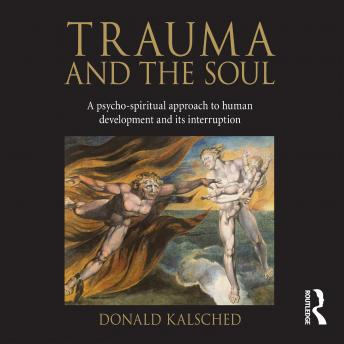
Notes from “Trauma and the Soul: A psycho-spiritual approach to human development and its interruption” by Donald Kalsched
Complled by Mike Zonta, H.W., M., BB editor
“Samuel Coleridge once lamented that many people contemplate ‘nothing but parts’–the universe for them amounts to nothing but a ‘mass of little things,’ whereas Coleridge himself ‘ached to behold and know something great–something one and indivisible … something Great and Whole.’”
“Jung says that the instinct for wholeness and unity is ‘the most important of the fundamental instincts.’ Nonetheless, it plays the least conspicuous part in contemporary consciousness because it is contaminated by two much more obvious instincts: sexuality and power. Therefore the instinct for wholeness ‘requires for its evidence a more highly differentiated consciousness, thoughtfulness, reflection, responsibility, and sundry other virtues.’ Otherwise, the instinct for wholeness will remain hidden in our secular, materialistic world.”
“Fairbairn’s idea that traumatic relationships in the child’s life are recreated within picks up Ferenczi’s and Anna Freud’s early emphasis upon the child’s ‘identification with the aggressor.’ Aggression that rightfully belonged ‘in the world’ as a healthy impulse toward an outer abuser, was inverted back into the psyche, attacking the child inside … and leading to the psychic equivalent of autoimmune disease.”
“As William James made clear many years ago, people who are ‘broken’ by trauma are also broken open to another dimension of reality. And sometimes their experiences in this dimension can have life-saving significance….”
“Self-actualizing people are, without one single exception, involved in a cause outside their own skin, in something outside of themselves. They are devoted, working at something, something which is very precious to them–some calling or vocation in the old sense, the priestly sense. They are working at something which fate has called to them somehow and which they work at and which they love.” (quoting Abraham Maslow, 1972)
“‘The true god is reached through a deep and sustained reflection on the nature of reality.” [e.g., Translation]
“the ‘dead child” is universally ensconced in abused and traumatized patients and is transformed into the “undead child,” the one who relentlessly haunts them for their having made a Faustian bargain with an internal dark force in order to survive. They have ‘died a little’ in order to be safe.”
“Thus human innocence is an imprisoned hostage within … the devil himself. The devil paradoxically symbolized [holds] the most holy aspect of ourselves, the innocent self that we sold into bondage and left to the embrace of the dark demon. (Grostein, 2000)
The bud
stands for all things,
even for those things that don’t flower,
for everything flowers, from within, of self-blessing;
though sometimes it is necessary
to reteach a thing its loveliness,
to put a hand on its brow
of the flower
and retell it in words and in touch
it is lovely
until it flowers again from within, of self-blessing;
–Galway Kinnell, St. Francis and the Sow (1993)
“At some time before the ego is formed, the infant psyche encounters the daimonic aspect of the sacred, the dark side of the numen; this encounter imprints the infant’s archaic psyche with a sense not of ‘shame’ but of its own defilement and consequent feeling of dread which, unless mitigated by a holding environment created by an empathetic mother, becomes pervasive and chronic. … because the trauma is caused by the parent-qua-god, the unspoken message is that the child is inherently unworthy before god or she [sic] would not be subjected to (chosen for) this experience.” (Edelman, 1998)
“St. Augustine is reported to have said (Romanyshyn, 2002) that to be an orphan is to be related to God. Or to put in psychological language, when an essential God-given core of the self is split-off (orphaned) and banished to the unconscious as happens in trauma, it is ‘care-taken’ there by archetypal powers (angels and demons) that feed it on the ‘ambrosia’ of the Gods (necessary illusion) until such time as it can come back into the world and start to eat real food.”
“A traumatic complex brings about dissociation of the psyche. The complex is not under the control of the will … it forces itself tyrannically upon the conscious mind. The explosion of affect is a complete invasion of the individual, it pounces upon him like an enemy or a wild animal.” (Jung, 1928)
By enspiriting the body, the Spirit turns the body into a living body–an ensouled body. At the same time, by embodying the Spirit the body helps ground the spirit in time and space, making it real. Spirit and matter appear to seek each other through the psyche, and the place where they meet is the human soul.
As the Surrealist poet Paul Eluard is reported to have said, “Il y a un autre monde mais il est dans celui-ci” which translates as “There’s another world, but it’s in this one.”
(Photo from Goodreads.com)
Winston Churchill on having enemies
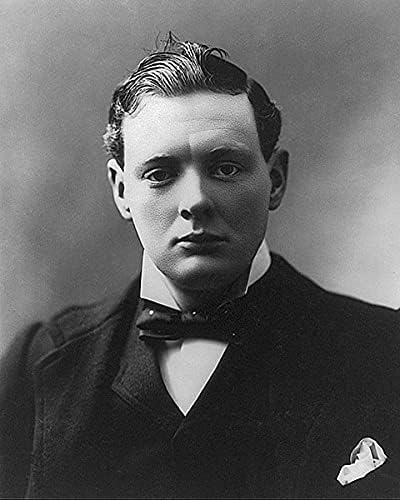
“You have enemies? Good. That means you’ve stood up for something, sometime in your life.”
― Winston Churchill
Sir Winston Leonard Spencer Churchill (November 30, 1874 – January 25, 1965) was a British statesman, military officer, and writer who was Prime Minister of the United Kingdom from 1940 to 1945 and again from 1951 to 1955. Apart from 1922 to 1924, he was a member of Parliament from 1900 to 1964 and represented a total of five constituencies. Wikipedia
Impeachment trial of South Korean President Yoon begins
ASIA / PACIFIC
The impeachment trial of South Korean President Yoon Suk Yeol began Tuesday, as the Constitutional Court reviews his failed attempt to enforce martial law. The session was adjourned minutes later after the suspended leader did not attend court. Under South Korean law, at least six of eight justices must approve an impeachment for it to be upheld.
Issued on: 14/01/2025 – France24.com
By: NEWS WIRES

The impeachment trial of South Korea‘s President Yoon Suk Yeol started Tuesday, with the country’s Constitutional Court deciding whether to strip him of his presidential duties over a failed martial law bid.
Yoon’s December 3 power grab plunged South Korea into its worst political crisis in decades, after he directed soldiers to storm parliament in an unsuccessful attempt to stop lawmakers voting down his suspension of civilian rule.
He was impeached soon after and suspended from duty, but has gone to ground in his residence since, refusing summonses from investigators probing him on insurrection charges and using his presidential security team to resist arrest.
The trial’s first of five hearings began at 2:00 pm (0500 GMT) but lasted just minutes with Yoon not in attendance, the court’s spokesperson told AFP.
The following sessions will take place on January 16, 21, 23 and February 4.

Lawmakers also impeached Yoon’s stand-in last month, putting the country in further political instability, and the current acting president has appeared unwilling to wade into the standoff, instead urging all parties to negotiate for a solution.
The court’s eight judges will decide mainly two issues, whether Yoon’s martial law declaration was unconstitutional and if it was illegal.
“This impeachment case focuses solely on the martial law situation, so the facts are not particularly complex,” lawyer Kim Nam-ju told AFP.
“Since most of the individuals involved have already been indicted and the facts have been somewhat established, it doesn’t seem like it will take a long time.”
READ MOREThousands of South Koreans protest in rival rallies as impeached Yoon faces new arrest attempt
The court has up to 180 days from December 14, when it received the case, to make its ruling on whether Yoon indeed violated the constitution and the martial law act.
Yoon’s legal team said he would not appear at the first hearing over purported safety concerns, saying he would be willing to appear at a later date if security issues were ironed out.
The trial can continue from the second hearing in his absence if he does not appear.
Former presidents Roh Moo-hyun and Park Geun-hye did not appear for their impeachment trials in 2004 and 2016-2017, respectively.
Yoon’s lawyers have argued the court must utilise the full 180 days — specifically to examine what “led to the declaration of martial law”.
The attempt to place South Korea under military rule for the first time in more than four decades lasted just six hours.
READ MOREWas Yoon’s declaration of martial law an ‘act of treason’?
Arrest attempt
In a parallel criminal inquiry, a joint team of investigators from the Corruption Investigation Office (CIO) — which is probing Yoon over insurrection — and police are preparing a fresh attempt to arrest the president.
An earlier attempt failed after Yoon’s presidential guards blocked access to investigators, while rival camps of protesters rallied outside his home.
Yoon’s chief of staff Chung Jin-suk said his office was “ready to consider all options for investigation or visits” to the sitting leader “at a third location”.
If the new warrant is executed successfully, Yoon would become the first sitting South Korean president to be arrested.
If eventually convicted in that case, Yoon faces prison or even the death penalty.
As media speculation rose that the second attempt would take place this week, the police, CIO and Yoon’s presidential security service met Tuesday to discuss the arrest warrant, the Yonhap news agency reported.
A CIO official told reporters they were “continuing preparations” for the second effort to arrest Yoon.
Police are also reportedly preparing 1,000 investigators for the fresh attempt.
Yoon’s guards have reinforced his Seoul compound with barbed wire installations and bus barricades, while a military unit patrols outside.
But the defence ministry said Tuesday that the soldier unit would “focus solely on its primary mission of perimeter security in the vicinity of the official (presidential) residence and will not be mobilised during the execution of the warrant”.
Yoon’s legal team has also sought to put pressure on police to avoid being involved in the arrest attempt, claiming officers would be in “in violation of multiple laws” if they cooperated with investigators.
Late Sunday, the CIO sent a letter to the defence ministry and presidential security service saying anyone blocking Yoon‘s potential arrest “may face criminal charges” for obstruction and abuse of authority.
(AFP)
The psychological toll of California’s catastrophic fires

- April Rubin
- January 12, 2025 (Axios.com)

Entire neighborhoods in Southern California have been destroyed by deadly wildfires, displacing communities that don’t know what — if anything — they’ll have to return to.
The big picture: Researchers have linked wildfires to long-lasting anxiety, depression and post-traumatic stress disorder in survivors, in addition to the well-documented physical toll.
- Both the loss and uncertainty surrounding wildfires are traumatic, Jeff Katzman, a Connecticut-based psychiatrist who grew up in Pacific Palisades, California, told Axios.
- “There is the lingering, not knowing status of what happened,” he said. “There’s the experience of loss of an entire community that has generations of meaning.”
Between the lines: Like other modern tragedies, destruction in California is being shared immediately on social media.
- “There’s something potentially positive about it that people who have suffered together or are in this together can connect and can share resources and can share experiences,” said Katzman, director of education at Silver Hill Hospital.
- On another level, he added, it can be “difficult to integrate” seeing so much relatable, devastating information, leading to a sense of helplessness.
Context: Research published last year found a link between wildfires and worsened mental health by analyzing psychotropic prescription data on 7 million people over an eight-year period following 25 large fires on the West Coast.
- People exposed to California’s deadliest wildfire, the 2018 Camp Fire, showed greater chronic symptoms of PTSD, anxiety and depression, according to research published in 2023.
- “These findings dovetail with significant psychological impacts noted after extreme climate events,” researchers wrote. “Warming temperatures have been further linked to greater suicide rates.”
- Another study from last year found that wildfires are associated with increased emergency room visits for anxiety disorders in the western U.S.
State of play: Sometimes pragmatism comes before grief during a disaster like the urban wildfires, Katzman said. People might first prioritize figuring out what a return to work or school will could like, before processing the loss.
- “Like when we lose our loved ones, there’s stuff to do that often shields or distracts us from the underlying experience of loss,” he said. “That can be a really tender experience.”
- Surviving can help people rationalize their situation, too, he said. Material objects might become secondary, but memories and all existing notions of the future are still tainted.
Zoom out: Survivors in California could even grapple with feelings that they have to move out of their home state to stay protected from future extreme weather events — which could bring upon loneliness and further instability.
- “Solastalgia” has been used to describe the chronic distress of seeing negative environmental change in one’s home environment.
- “With this increase in the pace of these events, which one would imagine will keep growing, anxiety and all mental health issues will increase,” Katzman said. “Mental health issues following a single event are nothing compared to an exposure to multiple events.”
Case in point: Los Angeles families calling into Parents Anonymous’ California Parent & Youth Helpline have been expressing extreme overwhelm this week, said Lisa Pion-Berlin, CEO of Parents Anonymous.
- For those whose houses were destroyed, “it’s not just the things in the building you lost, you lost a home,” she said. “And that’s a safe place where you’re raising a family, where you go to relax, where you go to cry, where you go to celebrate, where you have birthday parties.”
- “A home is much more than a building, a home is part of your heart, and that’s been totally cut out.”
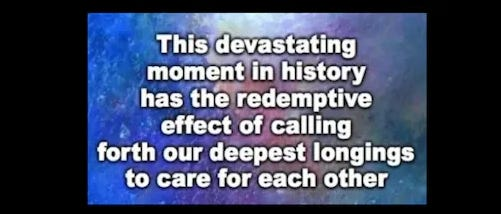
This moment in history
Sun Unsure What It Has To Do To Get Humans To Worship It Again

Published: January 14, 2025 (TheOnion.com)
HOUSTON—Coming to terms with its diminished status after thousands of years as a venerated deity commanding pure devotion, the sun admitted this week that it was unsure what it had to do to get humans to worship it again. “Last year I tried this huge total eclipse, and that didn’t do shit,” the sun said via a series of violent solar flares translated by NASA astronomer Wayne Stern, who noted the yellow dwarf star’s displeasure that it no longer received sacrificial offerings of human virgins or even herd animals. “How can I make it any more glaringly obvious that I am an omnipotent force deserving of unwavering loyalty? I’m the largest object in the sky. I am life and I am death. I am creator and destroyer. I am the motherfucking sun. How can there be any doubt that I am God?” On Monday evening, the sun announced it had officially given up after thousands of humans stepped out into the backyard to admire a particularly neat full moon.
The L.A. fires skipped over this historic avenue. Neighbors credit ‘trees of God’
By Julie Johnson, ReporterJan 14, 2025 (SFChronicle.com)
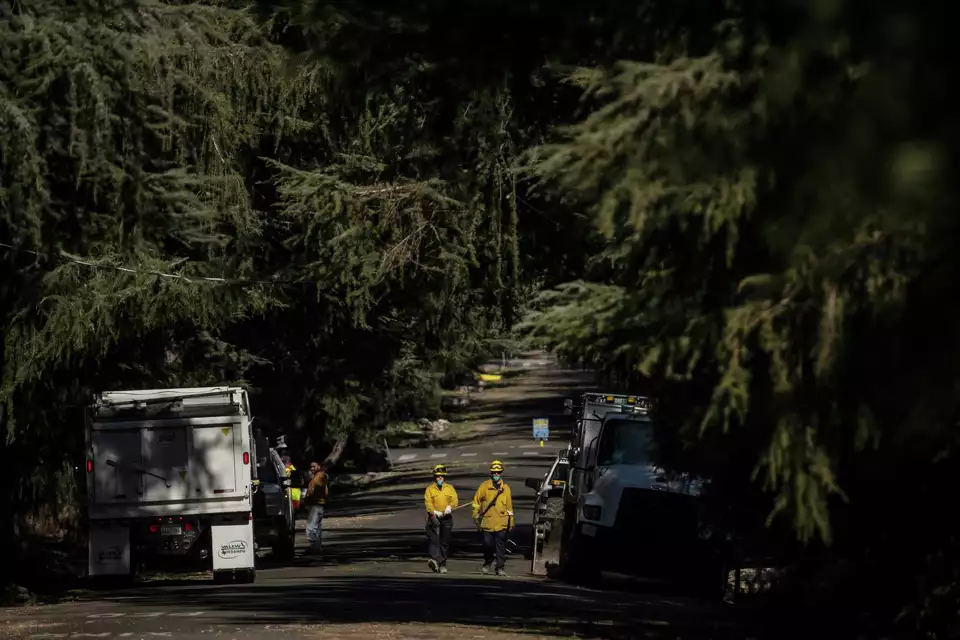
Firefighters walk along Santa Rosa Avenue in Altadena (Los Angeles County) on Monday, Jan. 13. Locals credit the cedar trees — which are less flammable than vegetation such as pine needles — that line the street with sparing homes in the neighborhood from being destroyed by the Eaton Fire. Stephen Lam/The Chronicle
ALTADENA, Los Angeles County — A towering river of green flows through Altadena and marks where the Eaton firestorm inexplicably blew by and left rows of homes untouched.
Over 100 cedars native to the Himalayan mountains line Santa Rosa Avenue, which is known by locals and on historical markers as Christmas Tree Lane. The mile-long avenue is lit up in December with thousands of colorful holiday lights strung up in the trees.
“These trees protected our little pocket,” said Kevin Van Vreede, 58, whose home still stands on nearby Sacramento Street.
The Eaton Fire turned block after block of Altadena into ashen ruins. But these shaggy Dr. Seuss cedars still stand where they have grown since their 19th century planting. Embers didn’t take hold in their needles — even with about 20,000 lights, wires and electrical boxes hung high in their boughs.
The species — deodar cedar — is roughly translated as “trees of God” in Hindi, and some neighbors said that detail rings with a little more weight after the smoke cleared and they emerged, standing.
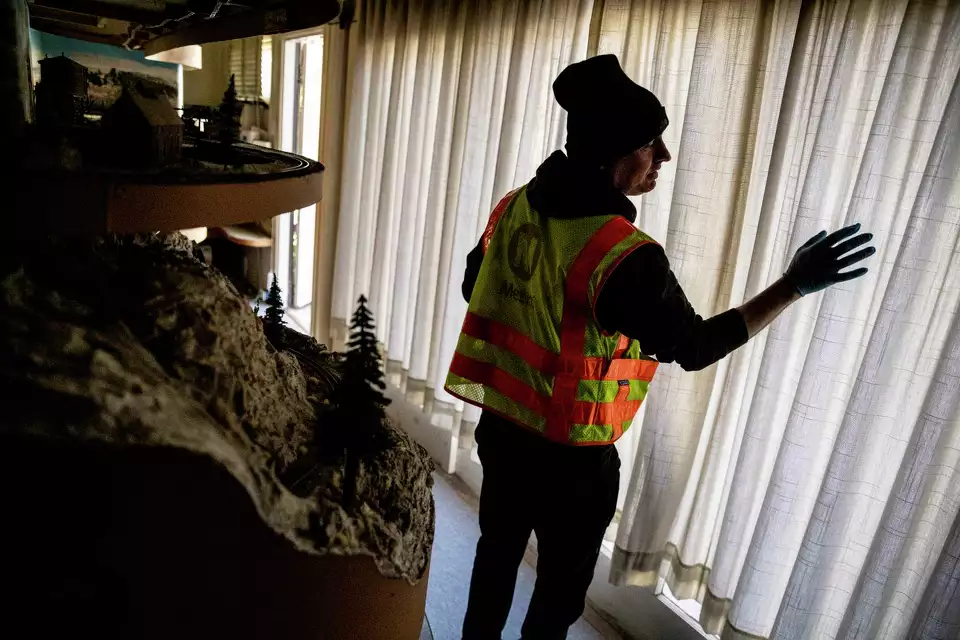
Rob Caves opens a curtain near a miniature train display at his intact home in Altadena after the Eaton Fire on Monday.Stephen Lam/The Chronicle
Christmas Tree Lane resident Rob Caves, 37, theorized the tree bark contained special “fire-resistant sap.”
Across the street, Michael Russell, 60, was hosing down his ash-covered roof, and he mused that the mile-long stand of cedars could have created a wind break.
They and others defied evacuation orders to protect their homes and this symbol of Altadena with garden hoses.
Mike Miguel, 70, whose metal-roofed home stands at the end of the lane, said he was evacuating as flames and smoke bore down on the neighborhood, “but then a voice in my head told me to go back.”
“These trees are a symbol of the city — they survived so we can survive,” said Scott Wardlaw, president of the all-volunteer Christmas Tree Lane Association.
The Eaton Fire destroyed at least 2,700 structures and killed 15 people, and the fire as of Tuesday morning was 35% contained. Damage estimates aren’t complete, and authorities are still searching for human remains.
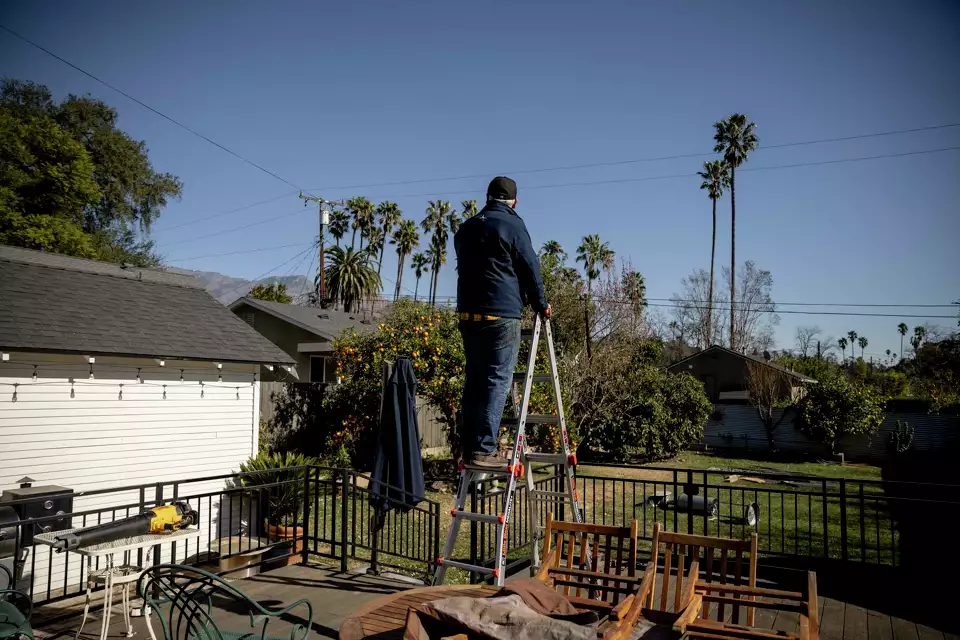
Lifelong Altadena resident Mike Russell climbs a ladder he used when he witnessed the initial glow from the fast-moving Eaton Fire in Altadena. Russell’s home survived the fire despite the widespread destruction in the close-knit community.Stephen Lam/The Chronicle
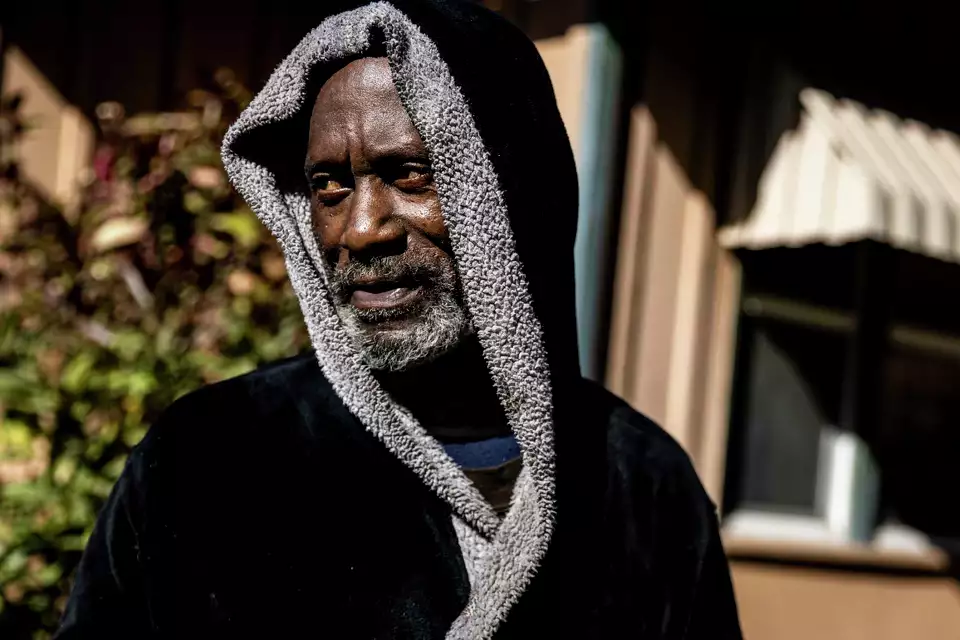
John Robinson, 66, who lives on Mendocino Avenue at the corner of Christmas Tree Lane, remained at the Altadena home his mother bought decades ago as the Eaton Fire ravaged though the community. “We’re just fortunate,” he said standing in the front yard of his intact house. “There’s devastation everywhere.”Stephen Lam/The Chronicle
Christmas Tree Lane is within the uneven path of the fire’s southern edge. Flames leapfrogged some homes and decimated others, including properties along the northern end of Santa Rosa Avenue.
Wardlaw took a more practical view of why Altadena’s jewel, which draws thousands of onlookers in December, still stands: Wildfire is fickle.
“My own speculation is that’s luck of the draw,” he said.
Bill Stewart, retired director of Berkeley Forests, part of University of California Cooperative Extension, said all plants burn, but cedar trees are generally less flammable than other types of vegetation such as pine needles, which have especially incendiary resin in their needles. And he said mature, well-maintained trees are far more resistant to fire than younger ones.
“They are lucky they planted those trees and not others,” Stewart said.
Still, the trees are not a panacea: Some California communities do not want them planted in fire-prone areas.
That decision was made in the 1880s by Altadena’s founder John Woodbury, who wanted to create an enclave at the base of the San Gabriel Mountains apart from bustling Pasadena.
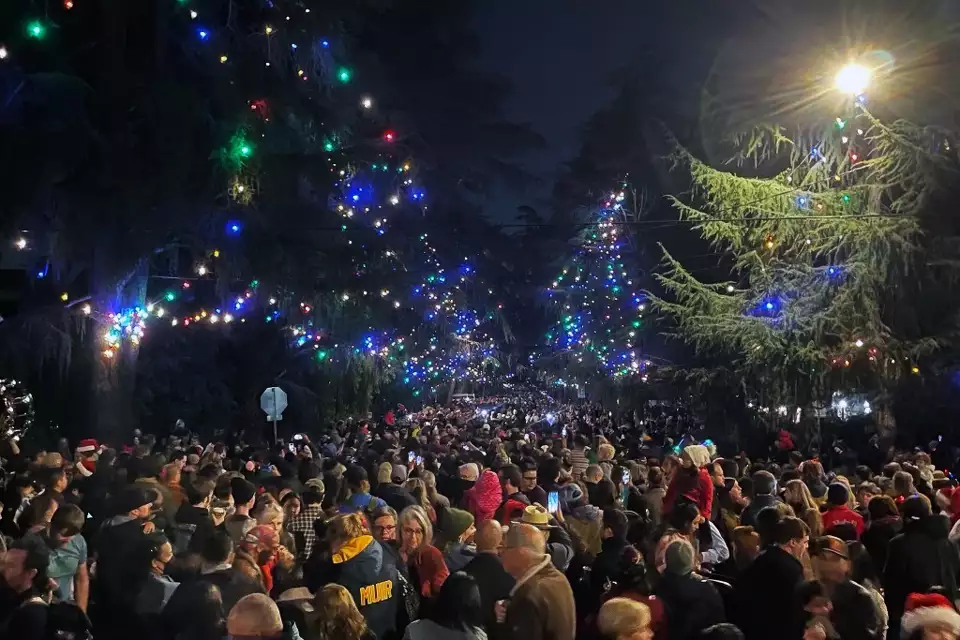
A crowd fills the street to see the light decorations on Christmas Tree Lane in Altadena prior to the Eaton Fire in that begun in early January.Courtesy of Deb Halberstadt
They were first lit up for Christmas time around 1920, and the tradition continued. It was designated a historic landmark by the state of California in 1989.
Strings of lights are hauled up each December with ropes and pulleys and connected to electrical boxes affixed to each tree trunk about 20-25 feet from the ground. Southern California Edison maintains the electrical boxes, and the nonprofit association run by volunteers maintains the lights and pays the electricity bill, Wardlaw said.
Just last month, slow caravans of onlookers clogged these festive blocks. Wardlaw said the lights were only turned off for the season the night before the Eaton Fire ignited.
And they can be lit again next December and give something familiar when so much else is gone.
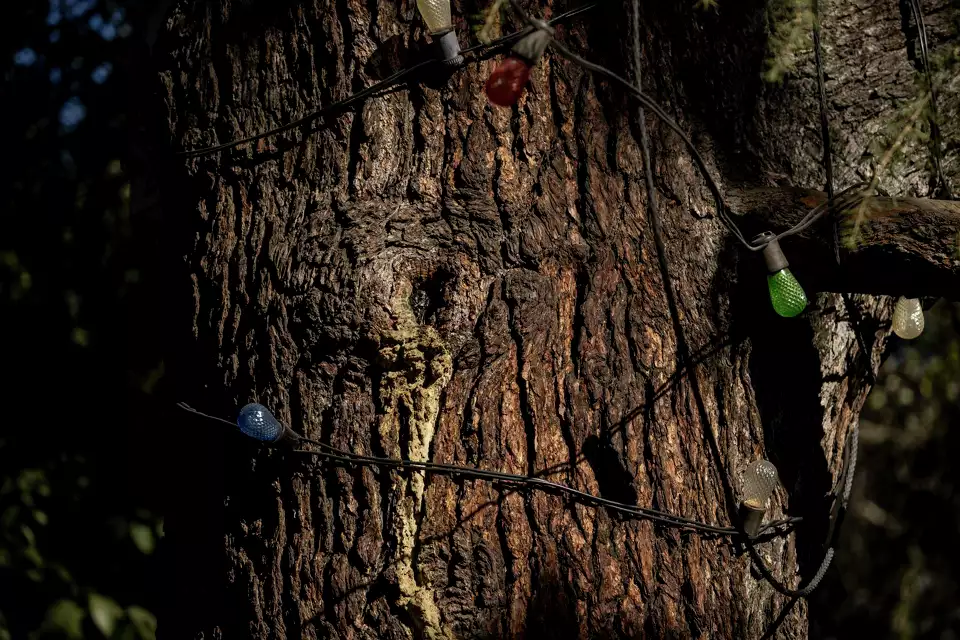
String lights are still wrapped around a deodar cedar tree along Santa Rosa Avenue, known locally as Christmas Tree Lane, on Monday, Jan. 13, after the Eaton Fire swept through the neighborhood in Altadena.Stephen Lam/The Chronicle
Reach Julie Johnson julie.johnson@sfchronicle.com
Jan 14, 2025
REPORTER
Julie Johnson is a reporter with The Chronicle’s climate and environment team. Previously she worked as a staff writer at the Santa Rosa Press Democrat, where she had a leading role on the team awarded the 2018 Pulitzer in breaking news for coverage of 2017 wildfires.
Tarot Card for January 15: The Lovers
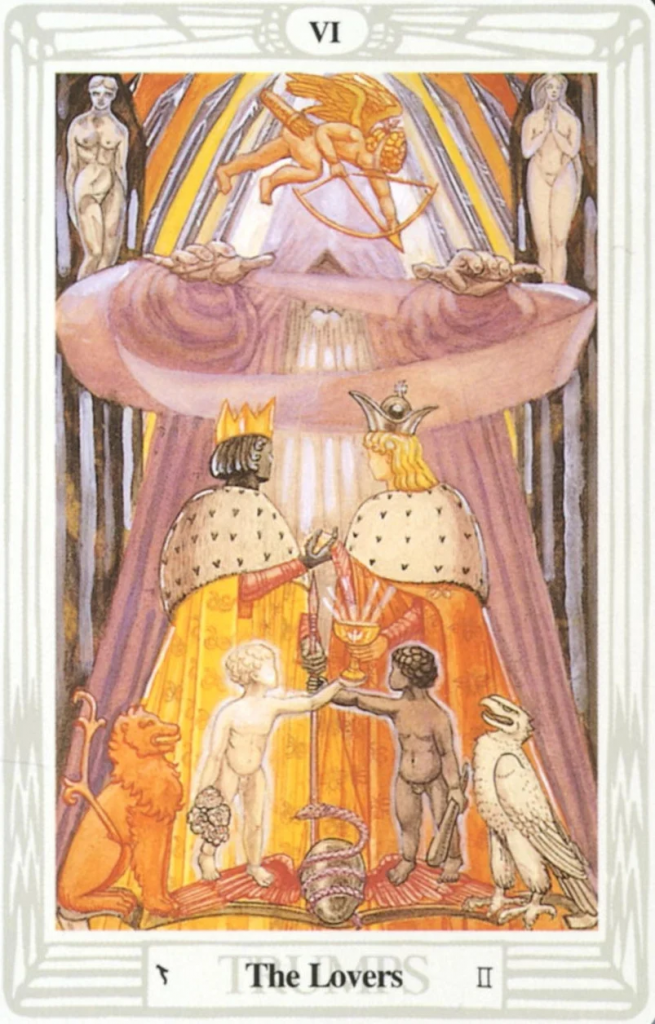
| The Lovers This is a lovely card, concerned with the harmonisation of opposites at all levels of being. At the highest level, the Lovers represents the marriage of the Emperor and the Empress – the archetypal union of male and female.Of course, one of the areas that this card therefore covers is that of emotional relationships. We’ve discussed often how, for love to grow and create change, it must be allowed to flow unhindered and free. If this is stopped, then love, like the water used symbolically to represent it so often, becomes stagnant and fetid.So, on a day ruled by the Lovers, consider your partner, if you have one. Have you expressed to them everything you need to say? Have you offered them emotional honesty and genuine access to the feelings you have for them? If not, then today – try it!!If you are in a period where you do not have a partner, see yourself as your own partner. This is more true than you might at first think! Our relationships with others are often reflections of our own inner struggles to realise and fulfil our needs.Ask yourself the same questions – have you been emotionally honest with yourself? Have you achieved genuine access to positive feelings about yourself? If not, then open up those doors and let yourself really see who you are. You might just get a pleasant surprise. And after all – if you don’t like it at all, you can always move on tomorrow!! |