The women and the Disciples watch on as Jesus feeds the 5000 in Season’s 3 final episode. The last two episodes comprising the Season 3 finale will be in cinemas for two days only, on 3 and 4 February. Photo: The Chosen
Alex was introduced to the Prosperos in 1969, “I was looking for some answer to life meaning and my purpose in the scheme of the Universe. Then I met a wonderful and spirited lady by the name of Ruth Backlund and her husband who own a health food store across the street from where I was working at the time and which I used to visited every day and started talking about the meaning of life and she mention if you need a an answer there is a group of people that might help you point you in the right direction to find your own purpose in life; and they/re having an open meeting at the Knickerbocker Hotel in Hollywood on that Sunday. The speaker was Norma Keller. From there on my life has changed to an immense degree, I must say I’m not the same person that I used to be and having fun and wandering along the way of changes that have taken place in my life, is a very magical and mystical trip.”
(from The Prosperos website, www.theprosperos.org)
“Finding the Unpredictable Good” is a collection of short stories and essays by four authors sharing their real-life experiences. The challenges they’ve faced reflect their pursuit of the unpredictable good each of us discovers as we move through life. The realization of this good shows up in the most amazing moments, in the most unpredictable ways. Life always provides a gift. (Amazon.com)
Alex’s stories:
Dazed and Confused Get Off My Lawn The Fly Ive’ Got ‘Tude, Dude Quite a Pair Unpredictable Good at Work Take Me to Your Leader For A Good Night’s Sleep Call Alex Through the Syes of a Child I Love a Good Story The Lady at the Health Food Store
When I’m bored or watching the news on TV and want something to engage my ADHD/hyperactive mind that doesn’t involve words (which distract me from listening to the news), I play backgammon against my iPhone. I’ve been doing it for years (Louise and I have been playing each other for over 50 years, mostly over dinner in restaurants and on planes.)
One of the weirdest things I’ve noticed is that when I take a chance and think to myself, “Okay, I’ll do this because there’s little chance the machine will roll a two,” it not only rolls the two, but rolls double twos!
Seriously; this happens at least once every dozen or so games. And it’s always when I think to myself, “No way it’ll do this.” It then hits me with doubles like it’s sneering at me way more frequently than anything that mere chance could account for.
Or it’s reading my mind. Or my mind is influencing the iPhone’s random number generator to produce the output most closely associated with the spike in emotion I experience when I think, “No way…”
Micro-psi effects, often described as the subtle influence of consciousness on physical systems, remain a compelling yet controversial area of inquiry in parapsychology and consciousness studies.
Researchers in this field explore whether human intention or observation can alter outcomes in random or chaotic systems.
One of the foundational studies in micro-psi research is Helmut Schmidt’s work in the 1970s. Schmidt utilized random number generators (RNGs) to investigate whether participants could influence the output through intention alone.
RNGs, which produce sequences of numbers based on quantum processes, are theoretically immune to external bias. But, amazingly, Schmidt’s experiments found that participants could achieve statistically significant deviations from randomness, implying a clear interaction between human consciousness and the physical system like the one I think I’m seeing with my backgammon game.
Critics questioned Schmidt’s methodologies, including potential biases in experimental design and data analysis. However, his work inspired decades of subsequent research, establishing Random Number Generator studies as a cornerstone of micro-psi investigations.
In 2006, scientists Bosch, Steinkamp, and Boller conducted a comprehensive meta-analysis of RNG studies to assess the robustness of micro-psi effects. Their analysis encompassed nearly 400 experiments conducted over several decades. The results indicated a small but statistically significant effect size, suggesting that consciousness is actually capable of influencing what should be purely random outcomes.
Bosch et al noted that while the overall effect size was modest, the consistency across numerous studies added weight to the findings. Importantly, they addressed potential publication bias and methodological weaknesses, concluding that the observed effects were unlikely to result solely from chance or experimental artifacts. This meta-analysis remains a key reference point for proponents and skeptics alike.
Dean Radin’s work on the double-slit experiment elevated a quantum perspective into micro-psi research. In this classic physics setup, particles such as electrons or photons create an interference pattern when unobserved by a human but behave like particles when measured. Radin hypothesized that human intention might influence the collapse of the wave function, altering the interference pattern.
To understand the significance of Radin’s findings, it helps to first grasp the basics of the double-slit experiment. When photons (“particles” of light) pass through two closely spaced slits, they behave like waves, creating an interference pattern of alternating light and dark bands on a screen. This pattern suggests that each photon takes multiple paths simultaneously, interfering with itself. However, if a detector is placed at the slits so a person can observe which slit each photon goes through, the interference pattern disappears, and the photons behave like particles instead.
This phenomenon demonstrates the principle of wave-particle duality in quantum mechanics, where particles like photons exhibit both wave-like and particle-like properties depending on whether they are observed. The “collapse” of the wave function—the transition from a probabilistic wave state to a definite particle state—only occurs upon measurement.
Radin’s experiments sought to determine whether human intention could influence this collapse — another way of measuring the micro-Psi effect — effectively altering the interference pattern without direct physical interaction.
In his studies, participants were instructed to focus their attention on the double-slit apparatus with the intention of either strengthening or weakening the interference pattern. The apparatus itself was shielded from any physical or environmental interference, ensuring that any observed changes could not be attributed to external factors.
Radin succeeded in measuring subtle shifts in the interference pattern, analyzing the results to show statistically significant deviations that could correlate with participants’ intentions.
Radin’s results found small but consistent deviations in the interference pattern when participants focused their attention on the apparatus. These deviations were measured using highly sensitive photodetectors and statistical methods to rule out chance as an explanation. The findings suggested that consciousness might interact with quantum systems in ways not accounted for by traditional physics.
The implications of these results are profound.
If consciousness can influence the behavior of photons in a double-slit experiment, it challenges the conventional understanding of quantum mechanics and suggests a deeper connection between mind and matter.
It also raises questions about the nature of observation itself—a cornerstone of quantum theory—and whether consciousness plays a more active role in shaping physical reality than previously thought.
In 2023, Milojević and Elliott published a groundbreaking study that combined advances in machine learning with micro-psi research. They analyzed large datasets from RNG experiments using sophisticated algorithms to detect subtle patterns potentially influenced by human intention. Their findings reinforced earlier observations of small but significant deviations from randomness, providing a new level of analytical rigor.
Milojević and Elliott also explored the implications of micro-psi effects for understanding consciousness as a nonlocal phenomenon. They proposed that the observed effects might arise from entanglement-like interactions between human consciousness and physical systems, challenging conventional materialist paradigms.
In other words, consciousness may underlie physical matter!
Further evidence supporting micro-psi effects comes from the Global Consciousness Project (GCP), a long-term study initiated by Roger D. Nelson. The GCP employs a network of RNGs worldwide to investigate correlations between global events and deviations in randomness.
In other words, can millions of people experiencing the same strong emotion or thought at the same time actually influence what appear to be, based on the research mentioned above, subtle sensors of conscious like random number generators?
Significant deviations from randomness have been observed during major world events, such as natural disasters and large-scale celebrations, suggesting that collective human consciousness might influence actual physical systems.
Another line of inquiry stems from William Braud’s research on bio-PK (psychokinesis on biological systems). Braud demonstrated that human intention could subtly influence biological processes, such as the movement of microorganisms or the rate of seed germination. While these effects are also small, they provide further evidence that consciousness can impact physical systems under controlled conditions.
In addition, studies conducted by Jahn and Dunne at Princeton Engineering Anomalies Research (PEAR) Laboratory revealed consistent, albeit modest, effects of human intention on mechanical and electronic systems. Their experiments, conducted over nearly three decades, involved thousands of participants and consistently yielded results that defied chance expectations.
The cumulative evidence from decades of research suggests that micro-psi effects like my backgammon game seems to be expressing, while subtle and often elusive, cannot be easily dismissed.
These findings raise profound questions about the nature of consciousness and its relationship to physical reality. If human intention can influence random or quantum systems, this could have far-reaching implications for fields ranging from physics to medicine.
They could also explain how and why prayer — simply another form of focused intention — can work the way Christian Scientists and others have claimed for millennia.
The study of micro-psi effects remains a frontier in understanding the interplay between consciousness and the physical world. From Schmidt’s pioneering RNG experiments to Milojević and Elliott’s modern analyses, researchers have consistently uncovered subtle anomalies that challenge our conventional understanding of reality.
Additional studies, such as those by the Global Consciousness Project, Braud’s bio-PK experiments, and the PEAR Laboratory, provide further evidence supporting the validity of these effects.
While much work remains to establish the mechanisms underlying micro-psi phenomena, their potential implications are profound. As methodologies improve and interdisciplinary collaborations expand, micro-psi research may one day illuminate fundamental truths about the nature of consciousness and its role in shaping the universe.
We feel our way through life, then rationalize our actions, as if emotion were a shameful scar on the countenance of reason. And yet the more we learn about how the mind constructs the world, the more we see that our experience of reality is a function of our emotionally directed attention and “has something of the structure of love.” Philosopher Martha Nussbaum recognized this in her superb inquiry into the intelligence of emotion, observing that “emotions are not just the fuel that powers the psychological mechanism of a reasoning creature, they are parts, highly complex and messy parts, of this creature’s reasoning itself.”
A century before Nussbaum, the far-seeing Scottish philosopher John Macmurray (February 16, 1891–June 21, 1976) took up these questions in a series of BBC broadcasts and other lectures, gathered in his 1935 collection Reason and Emotion (public library).
John Macmurray by Howard Coster, 1933. (National Portrait Gallery, London.)
Macmurray writes:
We ourselves are events in history. Things do not merely happen to us, they happen through us.
They happen primarily through our emotional lives — the root of our motives beneath the topsoil of reason and rationalization. We suffer primarily because we are so insentient to our own emotions, so illiterate in reading ourselves.
All of us, if we are really alive, are disturbed now in our emotions. We are faced by emotional problems that we do not know how to solve. They distract our minds, fill us with misgiving, and sometimes threaten to wreck our lives. That is the kind of experience to which we are committed. If anyone thinks they are peculiar to the difficulties of his own situation, let him… talk a little about them to other people. He will discover that he is not a solitary unfortunate. We shall make no headway with these questions unless we begin to see them, and keep on seeing them, not as our private difficulties but as the growing pains of a new world of human experience. Our individual tensions are simply the new thing growing through us into the life of mankind. When we see them steadily in this universal setting, then and then only will our private difficulties become really significant. We shall recognize them as the travail of a new birth for humanity, as the beginning of a new knowledge of ourselves and of God.
At the heart of this recognition, this reorientation to our own inner lives, lies what Macmurray calls “emotional reason” — a capacity through which we “develop an emotional life that is reasonable in itself, so that it moves us to forms of behaviour which are appropriate to reality.” The absence of this capacity contributes both to our alienation from life and to our susceptibility to dangerous delusion. Its development requires both a willingness to feel life deeply and what Bertrand Russell called “the will to doubt.” Macmurray writes:
The main difficulty that faces us in the development of a scientific knowledge of the world lies not in the outside world but in our own emotional life. It is the desire to retain beliefs to which we are emotionally attached for some reason or other. It is the tendency to make the wish father to the thought. .. If we are to be scientific in our thoughts… we must be ready to subordinate our wishes and desires to the nature of the world… Reason demands that our beliefs should conform to the nature of the world, not the nature of our hopes and ideals.
The strength of our opposition to the development of reason is measured by the strength of our dislike of being disillusioned. We should all admit, if it were put to us directly, that it is good to get rid of illusions, but in practice the process of disillusionment is painful and disheartening. We all confess to the desire to get at the truth, but in practice the desire for truth is the desire to be disillusioned. The real struggle centres in the emotional field, because reason is the impulse to overcome bias and prejudice in our own favour, and to allow our feelings and desires to be fashioned by things outside us, often by things over which we have no control. The effort to achieve this can rarely be pleasant or flattering to our self-esteem. Our natural tendency is to feel and to believe in the way that satisfies our impulses. We all like to feel that we are the central figure in the picture, and that our own fate ought to be different from that of everybody else. We feel that life should make an exception in our favour. The development of reason in us means overcoming all this. Our real nature as persons is to be reasonable and to extend and develop our capacity for reason. It is to acquire greater and greater capacity to act objectively and not in terms of our subjective constitution. That is reason, and it is what distinguishes us from the organic world, and makes us super-organic.
And yet reason, Macmurray argues, is “primarily an affair of emotion” — a paradoxical notion he unpacks with exquisite logical elegance:
All life is activity. Mere thinking is not living. Yet thinking, too, is an activity, even if it is an activity which is only real in its reference to activities which are practical. Now, every activity must have an adequate motive, and all motives are emotional. They belong to our feelings, not our thoughts.
[…]
It is extremely difficult to become aware of this great hinterland of our minds, and to bring our emotional life, and with it the motives which govern our behaviour, fully into consciousness.
This difficulty is precisely what makes us so maddeningly opaque to ourselves, and what makes emotional reason so urgent a necessity in understanding ourselves — something only possible, in a further paradox, when we step outside ourselves:
The real problem of the development of emotional reason is to shift the centre of feeling from the self to the world outside. We can only begin to grow up into rationality when we begin to see our own emotional life not as the centre of things but as part of the development of humanity.
There can be no hope of educating our emotions unless we are prepared to stop relying on other people’s for our judgements of value. We must learn to feel for ourselves even if we make mistakes.
Our sense-life is central and fundamental to our human experience. The richness and fullness of our lives depends especially upon the richness and fullness, upon the delicacy and quality of our sense-life.
[…]
Living through the senses is living in love. When you love anything, you want to fill your consciousness with it. You want to affirm its existence. You feel that it is good and that it should be in the world and be what it is. You want other people to look at it and enjoy it too. You want to look at it again and again. You want to know it, to know it better and better, and you want other people to do the same. In fact, you are appreciating and enjoying it for itself, and that is all that you want. This kind of knowledge is primarily of the senses. It is not of the intellect. You don’t want merely to know about the object; often you don’t want to know about it at all. What you do want is to know it. Intellectual knowledge tells us about the world. it gives us knowledge about things, not knowledge of them. It does not reveal the world as it is. Only emotional knowledge can do that.
Emotional reason thus becomes the pathway to wholeness, to integration of the total personality — a radical achievement in a culture that continually fragments and fractures us:
The fundamental element in the development of the emotional life is the training of this capacity to live in the senses, to become more and more delicately and completely aware of the world around us, because it is a good half of the meaning of life to be so. It is training in sensitiveness… If we limit awareness so that it merely feeds the intellect with the material for thought, our actions will be intellectually determined. They will be mechanical, planned, thought-out. Our sensitiveness is being limited to a part of ourselves — the brain in particular — and, therefore, we will act only with part of ourselves, at least so far as our actions are consciously and rationally determined. If, on the other hand, we live in awareness, seeking the full development of our sensibility to the world, we shall soak ourselves in the life of the world around us; with the result that we shall act with the whole of ourselves.
We have to learn to live with the whole of our bodies, not only with our heads… The intellect itself cannot be a source of action… Such action can never be creative, because creativeness is a characteristic which belongs to personality in its wholeness, acting as a whole, and not to any of its parts acting separately.
This wakefulness to the sensorium of life, he argues, is not only the root of emotional reason but the root of creativity:
If we allow ourselves to be completely sensitive and completely absorbed in our awareness of the world around, we have a direct emotional experience of the real value in the world, and we respond to this by behaving in ways which carry the stamp of reason upon them in their appropriateness and grace and freedom. The creative energy of the world absorbs us into itself and acts through us. This, I suppose, is what people mean by “inspiration.”
And yet we can’t be selectively receptive to beauty and wonder — those rudiments of inspiration — without being receptive to the full spectrum of reality, with all its terrors and tribulations. Our existential predicament is that, governed by the reflex to spare ourselves pain, we blunt our sensitivity to life, thus impoverishing our creative vitality and our store of aliveness. Macmurray writes:
The reason why our emotional life is so undeveloped is that we habitually suppress a great deal of our sensitiveness and train our children from the earliest years to suppress much of their own. It might seem strange that we should cripple ourselves so heavily in this way… We are afraid of what would be revealed to us if we did not. In imagination we feel sure that it would be lovely to live with a full and rich awareness of the world. But in practice sensitiveness hurts. It is not possible to develop the capacity to see beauty without developing also the capacity to see ugliness, for they are the same capacity. The capacity for joy is also the capacity for pain. We soon find that any increase in our sensitiveness to what is lovely in the world increases also our capacity for being hurt. That is the dilemma in which life has placed us. We must choose between a life that is thin and narrow, uncreative and mechanical, with the assurance that even if it is not very exciting it will not be intolerably painful; and a life in which the increase in its fullness and creativeness brings a vast increase in delight, but also in pain and hurt.
The development of emotional reason, Macmurray argues, is the development of our highest human nature and requires “keeping as fully alive to things as they are, whether they are pleasant or unpleasant, as we possibly can.” It requires, above all, being unafraid to feel, for that is the fundament of aliveness. He writes:
The emotional life is not simply a part or an aspect of human life. It is not, as we so often think, subordinate, or subsidiary to the mind. It is the core and essence of human life. The intellect arises out of it, is rooted in it, draws its nourishment and sustenance from it, and is the subordinate partner in the human economy. This is because the intellect is essentially instrumental. Thinking is not living. At its worst it is a substitute for living; at its best a means of living better… The emotional life is our life, both as awareness of the world and as action in the world, so far as it is lived for its own sake. Its value lies in itself, not in anything beyond it which it is a means of achieving.
[…]
The education of the intellect to the exclusion of the education of the emotional life… will inevitably create an instrumental conception of life, in which all human activity will be valued as a means to an end, never for itself. When it is the persistent and universal tendency in any society to concentrate upon the intellect and its training, the result will be a society which amasses power, and with power the means to the good life, but which has no correspondingly developed capacity for living the good life for which it has amassed the means… We have immense power, and immense resources; we worship efficiency and success; and we do not know how to live finely. I should trace the condition of affairs almost wholly to our failure to educate our emotional life.
In our first discussion of the Lord of Disappointment, we said that none of us look forward to this card turning up… but since turn up it will, I thought perhaps it would help to have a discussion about how to reduce levels of disappointment in life, how to improve our chances of contentment and how to deal with disappointment when, inevitably, we have to face it.First and foremost, it’s important to realise that, whilst our disappointments often come from outside sources, the reason that we experience them is because of internal beliefs and expectations. We are disappointed when the company refuses to offer us that job we wanted and hoped for so much. We are disappointed when friends, lovers, family let us down and fail to treat us in a fashion we had believed they should. We are disappointed when something does not work out the way we had hoped.Yet we cannot go through life without expectations. And we cannot protect ourselves by holding negative expectations. Hope is a fighter.no matter how much we try to squash it down, it pops back up again.often in the sneakiest fashion.So… perhaps we simply have to be brave enough to hope, honest enough to assess our expectations realistically, and courageous enough to accept that sometimes, no matter how hard we try, we are going to be hurt by disappointment. Maybe we have to make the choice to risk ourselves, and accept that, sometimes, we will get let down…So on a day that is ruled by the 5 of cups, don’t go looking for disappointment… rather, spend some time assessing your expectations. Look for imbalance, or lack of realism, in your expectations of people and situations. If you find any, then be true to yourself, and adjust those expectations till they serve you better.Look for negative expectations (nothing good ever happens to me; I am always going to be lonely/miserable/unhappy; I am too weak/inadequate/uninformed to achieve what I need) and tackle these with gusto… they create darkness in your life, and serve no earthly purpose. Drive them out of your head with determined use of the affirmation, and agree to go after them every single time they surface.And finally… expect a nice surprise in every single day you live. Expect to find something that fills your heart with joy and gratitude every single day. Go looking for these things… make it part of your daily routine to discover something which makes joy arise within you…
Affirmation: “I expect happiness to flow through my life, driving out negative thoughts and emotions.”
LOS ANGELES – Fierce wildfires continue to rage out of control across the greater Los Angeles area, resulting in at least five confirmed deaths and forcing nearly 180,000 people to evacuate their homes. Authorities have not yet determined the total number of casualties. Currently, at least five separate fires are burning over more than 45 square miles, fueled by dry conditions and powerful winds, creating an unprecedented crisis in areas typically less prone to wildfires. The most destructive of these is the Palisades Fire, which has scorched over 17,234 acres—nearly 27 square miles—and destroyed 1,000 structures. With zero containment, it has become the most devastating wildfire in L.A. history.
Meanwhile, the newly ignited Sunset Fire, which started around 6 p.m. in the Hollywood Hills, has already consumed 60 acres and is threatening iconic landmarks. The fires have disrupted daily life, leaving over 350,000 energy customers without power, including 200,000 in L.A. County alone. Though the intense Santa Ana winds have somewhat subsided compared to previous days, forecasts still predict wind gusts of 40-50 mph today and 50-70 mph overnight, further complicating firefighting efforts.
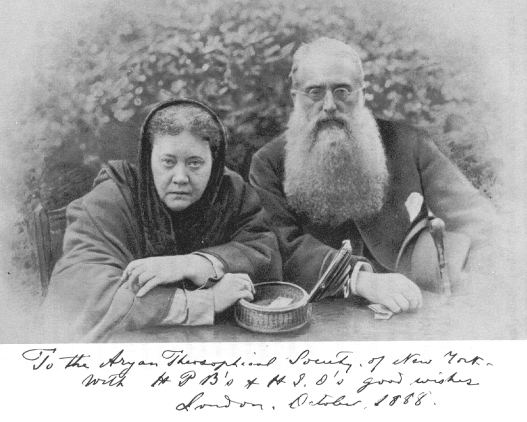
Helena Blavatsky and Henry Olcott, two of the founding members of the Theosophical Society [Public Domain]
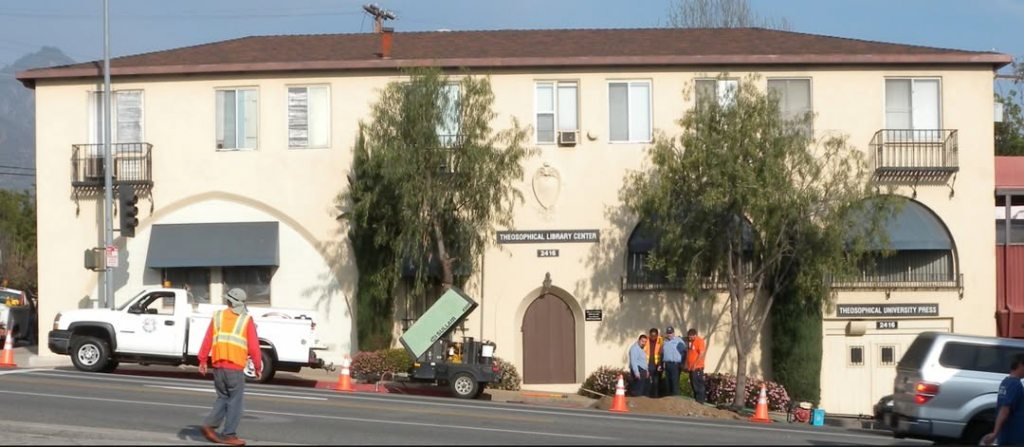
The Wild Hunt is saddened to report that the entire property of the Theosophical Society in Altadena near Pasadena has been completely destroyed. The library building is located at 2416 N. Lake Avenue. We are still gathering information.
The Pasadena location was “the world’s largest archive of Theosophical materials, including a library with 40.000 titles, the entire archive of the history of the TS, including ca. 10.000 unpublished letters, pertaining to HPB, the Mahatmas, W.Q. Judge, G.R.S. Mead, Katherine Tingley, and G. de Purucker, membership records since 1875, art objects, and countless other irreplaceable materials. The archives also contained works of Boehme, Gichtel, donations from the king of Siam including rare Buddhist scriptures, and so on.”
Horrible, deeply dramatic news for anybody who cares about the preservation of Theosophical heritage.
I was just told that the entire property of the Theosophical Society in Altadena near Pasadena has been completely destroyed by the fires in Los Angeles. This was the world’s largest archive of Theosophical materials, including a library with 40.000 titles, the entire archive of the history of the TS, including ca. 10.000 unpublished letters, pertaining to HPB, the Mahatmas, W.Q. Judge, G.R.S. Mead, Katherine Tingley, and G. de Purucker, membership records since 1875, art objects, and countless other irreplaceable materials. The archives also contained works of Boehme, Gichtel, donations from the king of Siam including rare Buddhist scriptures, and so on. [with thanks to Reinout Spaink for the information]
This is obviously just one part of an even much larger drama that is currently unfolding, but one that deals a devasting blow to the modern study of esotericism and of modern Theosophy more in particular. It is hard to fathom but it seems to be true.
Reports also say that paintings by Reginald Machell were destroyed.
Machell was a British artist, writer, and mystic closely associated with the Theosophical Society. His life and work reflected his deep interest in the occult, symbolism, and spirituality. Machell was born in England and initially trained as a painter and designer. He gained recognition for his talent in fine arts, working in both painting and interior design, including commissions for decorative works in wealthy homes. He exhibited his art at the prestigious Royal Academy in London.
Machell’s artwork is characterized by strong allegorical and symbolic themes, often depicting mystical subjects and spiritual ideals. His paintings and drawings frequently featured esoteric symbols, such as the Tree of Life, spheres of existence, and cosmic motifs.
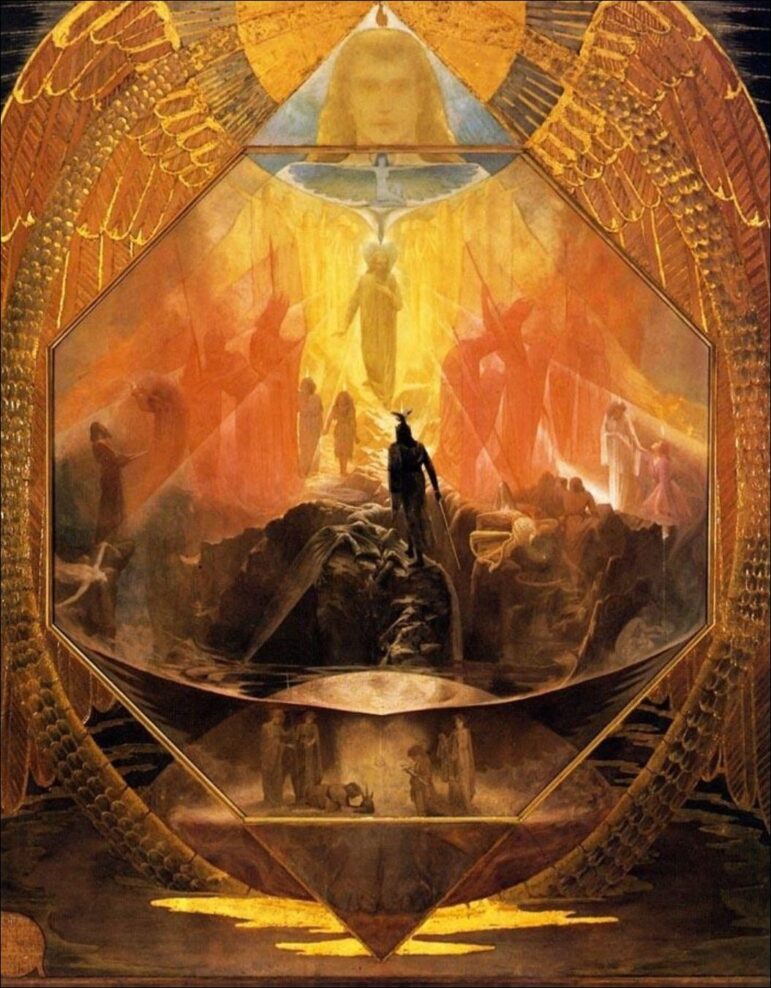
One of his most famous works is “The Path,” a highly symbolic painting representing the spiritual journey toward enlightenment. This piece is often cited as a visual encapsulation of Theosophical teachings, with its intricate use of symbolism to convey ideas about human evolution and the quest for spiritual knowledge.
The Path. by Reginald W. Machell c. 1895.
Social media reports suggest that The Path was moved to a nearby building to avoid the fire. However, these reports are unconfirmed.
Note: This is a developing story. We will provide updates as they are available.
The Wild Hunt is not responsible for links to external content.
To join a conversation on this post:
Visit our The Wild Hunt subreddit! Point your favorite browser to https://www.reddit.com/r/The_Wild_Hunt_News/, then click “JOIN”. Make sure to click the bell, too, to be notified of new articles posted to our subreddit.
Manny Moreno (pro: he/él/lui) was born in Cuba and raised in the American South. He lives in South Florida and Nemi, Italy. He has been in the Pagan community for almost four decades. He is a Witch and was raised as a child of Oyá. He is encouraged by the Balance within the natural world and enjoys storms and the night. Manny is married and splits his free time between the Florida Swamps, the Atlantic Ocean, and the Alban Hills. He is also a beekeeper, orchid-grower, and builder of bat houses.
ARIES (March 21-April 19): Abdulrazak Gurnah is a Tanzanian writer who won the Nobel Prize for Literature in 2021. He has also been shortlisted for four other prestigious awards. I find it odd that his acclaimed novels have received mediocre scores on the prominent book-rating website, Goodreads, which has 150 million members. Why is there such a marked difference between expert critics and average readers? I speculate that those in the latter category are less likely to appreciate bold, innovative work. They don’t have the breadth and depth to properly evaluate genius. All this is my way of encouraging you to be extra discerning about whose opinions you listen to in the coming weeks, Aries—especially in regard to your true value. Trust intelligent people who specialize in thoughtful integrity. You are in a phase when your ripening uniqueness needs to be nurtured and protected.
TAURUS (April 20-May 20): “Every joke is a tiny revolution,” said author George Orwell. I agree, which is why I hope you will unleash an unruly abundance of humor and playfulness in the coming days. I hope you will also engage in benevolent mischief that jostles the status quo and gently shakes people out of their trances. Why? Because your world and everyone in it need a sweet, raucous revolution. And the best way to accomplish that with minimum chaos and maximum healing is to: 1. do so with kindness and compassion; 2. be amusing and joyful and full of joie de vivre.
GEMINI (May 21-June 20): Research suggests that if you’re typical, you would have to howl with maximum fury for a month straight just to produce enough energy to toast a piece of bread. But you are not at all typical right now. Your wrath is high quality. It’s more likely than usual to generate constructive changes. And it’s more prone to energize you rather than deplete you. But don’t get overconfident in your ability to harness your rage for good causes. Be respectful of its holy potency, and don’t squander it on trivial matters. Use it only for crucial prods that would significantly change things for the better.
CANCER (June 21-July 22): I invite you to write a message to the person you will be in one year. Inform this Future You that you are taking a vow to achieve three specific goals by January 15, 2026. Name these goals. Say why they are so important to you. Describe what actions you will take to fulfill them. Compose collages or draw pictures that convey your excitement about them. When you’ve done all that, write the words, “I pledge to devote all my powers to accomplish these wonderful feats.” Sign your name. Place your document in an envelope, write “MY VOWS” on the front, and tape the envelope in a prominent place in your home or workplace.
LEO (July 23-Aug. 22): Congratulations on all the subtle and private work you’ve been doing to make yourself a better candidate for optimal togetherness. Admitting to your need for improvement was brave! Learning more about unselfish cooperation was hard work, and so was boosting your listening skills. (I speak from personal experience, having labored diligently to enhance my own relationship skills!) Very soon now, I expect that you will begin harvesting the results of your artful efforts.
VIRGO (Aug. 23-Sept. 22): Construction on the Great Wall of China began in the seventh century BCE and lasted until 1878. Let’s make this monumental accomplishment your symbol of power for the next ten months, Virgo! May it inspire you to work tirelessly to forge your own monumental accomplishment. Take pride in the gradual progress you’re making. Be ingeniously persistent in engaging the support of those who share your grand vision. Your steady determination, skill at collaborating, and ability to plan will be your superpowers as you create a labor of love that will have enduring power.
LIBRA (Sept. 23-Oct. 22): We are all accustomed to dealing with complications and complexities—so much so that we may be tempted to imagine there’s never a simple solution to any dilemma. Copious nuance and mystifying paradox surround us on all sides, tempting us to think that every important decision must inevitably be taxing and time-consuming. As someone who specializes in trying to see all sides to every story, I am especially susceptible to these perspectives. (I have three planets in Libra.) But now here’s the unexpected news: In the coming weeks, you will enjoy the luxury of quickly settling on definitive, straightforward solutions. You will get a sweet respite from relentless fuzziness and ambiguity.
SCORPIO (Oct. 23-Nov. 21): When my daughter Zoe was eleven years old, she published her first collection of poems. The chapbook’s title was “Secret Freedom.” That’s a good theme for you to meditate on in the coming weeks. You are currently communing with a fertile mystery that could ultimately liberate you from some of your suffering and limitations. However, it’s important to be private and covert about your playful work with this fertile mystery—at least for now. Eventually, when it ripens, there will come a time to fully unleash your beautiful thing and reveal it to the world. But until then, safeguard it with silence and discretion.
SAGITTARIUS (Nov. 22-Dec. 21): From a distance, Brazil’s Rio Negro looks black. The water of Rio Solimões, also in Brazil, is yellowish-brown. Near the city of Manaus, these two rivers converge, flowing eastward. But they don’t blend at first. For a few miles, they move side-by-side, as if still autonomous. Eventually, they fuse into a single flow and become the mighty Amazon River. I suspect the behavior of Rio Negro and Rio Solimões could serve as a useful metaphor for you in the coming weeks, Sagittarius. Consider the possibility of allowing, even encouraging, two separate streams to merge. Or would you prefer them to remain discrete for a while longer? Make a conscious decision about this matter.
CAPRICORN (Dec. 22-Jan. 19): During the next three weeks, doing the same old things and thinking the same old thoughts are strongly discouraged. For the sake of your spiritual and physical health, please do not automatically rely on methods and actions that have worked before. I beg you not to imitate your past self or indulge in worn-out traditions. Sorry to be so extreme, but I really must insist that being bored or boring will be forbidden. Stated more poetically: Shed all weak-heart conceptions and weak-soul intentions. Be of strong heart and robust soul.
AQUARIUS (Jan. 20-Feb. 18): Wilderness campers have developed humorous terms to gently mock their fears and anxieties. The theory is that this alleviates some of the stress. So a “bear burrito” refers to a hammock. It addresses the worry that one might get an unwanted visit from a bear while sleeping. A “bear fortune cookie” is another name for a tent. “Danger noodle” is an apparent stick that turns out to be a snake. “Mountain money” is also known as toilet paper. I approve of this joking approach to dealing with agitation and unease. (And scientific research confirms it’s effective.) Now is an excellent time to be creative in finding ways to diminish your mostly needless angst.
PISCES (Feb. 19-March 20): If you were producing the movie of your life, what actor or actress would you want to portray you? Who would play your friends and loved ones? How about the role of God or Goddess? Who would you choose to perform the role of the Supreme Being? These will be fun meditations for you in the coming weeks. Why? Because it’s an excellent time to think big about your life story—to visualize the vast, sweeping panorama of your beautiful destiny. I would also love it if during your exploration of your history, you would arrive at interesting new interpretations of the meanings of your epic themes.






 We ourselves are events in history. Things do not merely happen to us, they happen through us.


 By
By