
New Thinking • Feb 16, 2021 James Tunney, LLM, is an Irish barrister who has lectured on legal matters throughout the world. He is a poet, a scholar, and author of The Mystery of the Trapped Light: Mystical Thoughts in the Dark Age of Scientism plus The Mystical Accord: Sutras to Suit Our Times, Lines for Spiritual Evolution. His paintings have been shown in galleries in Scandinavia and London.His website is http://www.jamestunney.com. Here he describes the history of the transhumanist movement, with a particular focus on its development in the 1920s – and a view to understanding both proponents and critics. On the positive side, the movement seeks to enhance the human lifespan and human capacities. On the negative side it sometimes treats humans as machines, perhaps even inferior to machines, or perhaps as cogs in a greater machine – denying conscious sovereignty and spirituality. New Thinking Allowed host, Jeffrey Mishlove, PhD, is author of The Roots of Consciousness, Psi Development Systems, and The PK Man. Between 1986 and 2002 he hosted and co-produced the original Thinking Allowed public television series. He is the recipient of the only doctoral diploma in “parapsychology” ever awarded by an accredited university (University of California, Berkeley, 1980). (Recorded on January 30, 2021)
Monthly Archives: December 2024
Pope Francis Decries Legal Head Shops Overrunning Vatican City

Published: December 27, 2024 (TheOnion.com)
VATICAN CITY—Speaking to reporters in front of Saint Peter’s Holy Vape House in the heart of downtown, Pope Francis spoke out this week against the legal head shops he decried are overrunning Vatican City. “You can’t walk the colonnade without passing a cluttered window display with a bunch of bongs and a painting of a Grateful Dead bear praying the rosary,” said His Holiness, who called on Vatican City officials to outlaw the cannabis paraphernalia retailers from operating within 100 yards of any religious site such as the Sistine Chapel. “These rundown head shops make the piazzas look tacky, especially at night with their flashing neon crucifix-inside-a-marijuana-leaf signs. Sure, some of their stained glass bubblers are pretty dope, but do we really need so many of them? Besides, you can already get grinders and lighters and shit at the Vatican gift shop.” The Supreme Pontiff was later spotted stepping out of The Virgin Mary’s Smoke Shack with a fresh pack of rolling papers.
Timothy Snyder. On the Rise of Authoritarianism Today
CCCB • Sep 30, 2024 The rise of the extreme right around the world has made manifest a growing mistrust in democracy as a political system in a shift which involves serious curtailment of freedoms and demonisation of minority groups. Timothy Snyder, one of the leading authorities on the history of Europe, warns of alarming antidemocratic trends appearing in western societies and urges rebellion against any form of authoritarianism. This lecture took place at the CCCB on December 3, 2018.
The Astrology Of 2025 – Saturn And Neptune In Aries, Uranus In Gemini
(Astrobutterfly.com)
2025 is one of those big, milestone years that will make history, and we will talk about for decades.
What makes some years – like 2025 – more ‘special’ astrology-wise than others?
It basically comes down to outer planets forming significant alignments. Let’s take 1969, 1989, and 2020 as examples of other milestone years:
- In 1969, we had a Jupiter-Uranus conjunction in Libra, part of a stellium with Pluto and the South Node, marking a time of cultural and technological revolution
- In 1989, the Saturn-Uranus-Neptune alignment in Capricorn heralded the collapse of the Berlin Wall and the end of the Cold War
- In 2020, the Saturn-Pluto conjunction (part of a Capricorn stellium) followed by the Jupiter-Saturn conjunction at 0° Aquarius triggered a seismic shift in global structures
What these years have in common is rare outer planetary alignments. Since Uranus, Neptune, and Pluto move very slowly, their conjunctions, oppositions, and stelliums are pretty rare. When they DO occur, they coincide with profound societal shifts.
2025 is one of those years.

Saturn, the Lunar Nodes, Uranus, and Neptune all change signs, and the outer planets – Uranus, Neptune, and Pluto – connect through a Minor Triangle, a rare and powerful configuration.
The most striking feature of 2025 is Saturn and Neptune entering Aries together. 0° Aries is the beginning of the zodiac, a point of initiation and new cycles. This alignment signals a powerful new beginning – a true Genesis moment.
The first half of 2025 is marked by a series of significant planetary ingresses. Practically everything changes signs:
- The Lunar Nodes (January 2025)
- Neptune (March 2025)
- Saturn (May 2025)
- Jupiter (June 2025)
- Uranus (July 2025)
This creates an atmosphere of unprecedented novelty. The astrological landscape shifts dramatically. Our focus and priorities completely change. We are entering a brand-new chapter.
The 2nd half of the year is shaped by the Uranus-Neptune-Pluto Minor Triangle. This configuration weaves together the changes initiated earlier in the year. Out of the chaos of rapid change, something coherent and forward-looking will emerge.
The change will be fundamental as it will shift the structures of our society. Until 2025, the outer planets have been predominantly in Earth signs, with Neptune in Pisces (a Water sign). But starting in 2025, these planets move into Fire and Air signs.
2025 is not just another year – it’s the start of a completely new era.
2025 By Quarters
If we divide 2025 into quarters, we note distinct themes:
- Q1 – the 1st quarter – is the ‘retrograde’ quarter, with Mars and later Venus in retrograde motion
- Q2 is the ‘change’ quarter, characterized by multiple outer planets changing signs
- Q3 is the ‘Minor Triangle’ quarter, as the energy of Uranus trine Pluto and sextile Neptune reaches its peak
- Q4 is the ‘Water Trine’ quarter, highlighted by Jupiter in Cancer forming a trine with Saturn and Neptune.
Each quarter builds on the previous one, leading to an interconnected narrative. By the end of 2025, everything will make sense.
The most important transits of 2025:
January 2025 – North Node Enters Pisces, South Node Enter Virgo
On January 11th, 2025, the Lunar Nodes are moving from the Aries/Libra axis to the Pisces/Virgo axis.
This change moves the collective focus from themes of “me vs. we,” conflict, and individualism, to themes of service, compassion, and integration.
This shift might mark the end of military conflict, or at least a collective redirection of focus toward more unifying or humanitarian concerns.
Messianic leaders (North Node in Pisces), who promise to clean up the mess of the past (South Node in Virgo) might emerge – in politics, entertainment, media – people who inspire collective hope and offer visions of healing and practical solutions for fixing what is broken.
A detailed report about the Nodal shift will follow early January.
March 2025 – Venus Turns Retrograde
From March 1st to April 12th, 2025, Venus turns retrograde in Aries.
The retrograde starts at 10° Aries and ends at 24° Pisces, bringing focus to the 24° Pisces – 10° Aries area of the zodiac.
Venus retrograde periods are very important because they bring changes of heart and shifts in priorities. This is when we make up our mind (aka heart) on important matters.
This particular Venus retrograde is connected to the Venus retrograde cycles of March-April 2017 and March-April 2009, etc. – Venus retrograde revisits the same area of the zodiac every 8 years.
Some people, especially those with planets or angles in late Pisces and early Aries, may notice a repeating theme or pattern. If this is you, reflect on what was happening in your life during the previous Venus retrograde periods to note any similar themes.
A detailed report about Venus retrograde in Aries will follow closer to the date.
March 2025 – Neptune Enters Aries
This is finally happening: Neptune enters Aries! It feels like Neptune has been in Pisces forever… more precisely, since 2012. Neptune spends approximately 13 years in a sign, so when it changes signs, we are talking about BIG shifts that impact society as a whole.
On March 30th, 2025, Neptune moves into Aries, starting a new 165-year cycle around the zodiac.
Neptune will stay in Aries until 2038, marking 13 years of bold visioning and innovations in Neptunian fields like spirituality, medicine or the arts.
What is especially unique about this ingress is that Neptune joins Aries hand in hand with Saturn.
We couldn’t think of 2 planets more different. Neptune is foggy and imaginary, while Saturn is grounded and real. When the 2 join forces, Neptune will be brought down to earth, while Saturn will become a little bit more imaginative.
How would this work out? Think along the lines of the Taj Mahal or Burj Al Arab – grand, visionary dreams brought into tangible, awe-inspiring reality.
May 2025 – Saturn Enters Aries
On May 25th, 2025, Saturn joins Neptune in Aries.
In fact, the two will spend several months together in the early degrees of the zodiac, to prepare the field. Saturn and Neptune will dance together in Aries until September, when Saturn will retrograde back into Pisces to tie up loose ends.
While Saturn and Neptune technically conjunct in 2026, their co-presence in Aries will already begin to activate the themes of this very important astrological shift.
The Astro Butterfly School will create a special event dedicated to Saturn and Neptune in Aries called Genesis – more details closer to the date.
June 2025 – Jupiter Enters Cancer
Jupiter leaves Gemini to enter its sign of exaltation, Cancer, on June 9th, 2025. Jupiter feels very good in Cancer since both Cancer and Jupiter are associated with growth, tradition and a sense of comfort and prosperity.
What’s particularly noteworthy about this transit is that in the last 3 months of the year, Jupiter will trine both Saturn and Neptune (as the 2 retrograde back into Pisces), forming a harmonious Water Trine.
This transit will infuse the Cancer area of our chart with a sense of optimism and abundance. This is where we will feel more confident to go after our goals.
July 2025 – Uranus Enters Gemini
On July 7th, 2025 Uranus leaves Taurus and enters Gemini. Uranus ingresses usually come with a BANG.
While planets like Neptune may bring more subtle, gradual shifts, Uranus ingresses are anything but subtle. The energy shifts dramatically, bringing a sense of urgency and unpredictability. It’s now or never.
Historically, Uranus in Gemini transits have been highly eventful. There’s something about the quick-witted, dynamic energy of Gemini that stimulates Uranus’ revolutionary and disruptive tendencies, triggering innovation and rapid change.
The Gemini area of your chart has already been energized by Jupiter. While in Gemini (2024-2025), Jupiter has come up with some grand ideas, but it might have lacked the momentum to create lasting change.
Uranus, with its 7-year stay in the sign, will bring concrete developments that will revolutionize that area of your chart.
August-December 2025 – Uranus, Neptune, Pluto Minor Triangle
In the 2nd part of the year, the 3 outer planets – Uranus, Neptune and Pluto – form a beautiful configuration called Minor Triangle. Basically Neptune sextiles both Uranus and Pluto, while Uranus and Pluto are connected through a trine.
Minor Triangles are supportive configurations with dynamic potential. They are more active than grand trines, as the energy is channeled and focused through the apex planet, in this case, Neptune in Aries.
Pluto and Uranus in Air signs serve as the supporting pillars, facilitating breakthroughs through information, communication, technology, and AI.
These advancements will fuel the “birth” energy of Aries, represented by Neptune, potentially bringing about a new understanding of life, creation, or the very concept of existence itself.
October-December 2025 – Jupiter Trine Saturn And Neptune
2025 has the potential to be a magical year, with an exalted Jupiter forming trines with both Saturn and Neptune.
This is a “dreams come true” aspect where the abundance of Jupiter meets the magic of Neptune, anchored by the common sense and stability of Saturn. These are not castles in the sand – Saturn brings the necessary structure to turn dreams into reality.
Water Trines are favorable for emotional connection, deep bonds, and intuitive flow. This Jupiter-Saturn-Neptune Water Trine is a beautiful complement to the otherwise intellectual energy of the Air sign planets active throughout the year.
Mercury Retrograde in 2025
In 2025, Mercury goes retrograde in Fire and Water signs.
It’s one of the distinctive patterns of the Mercury cycle to retrograde in the same element for approximately a couple of years before transitioning to another element.
Last year, the retrogrades were predominantly in Fire, and in 2026, they will shift to Water. 2025 is a transition year, bridging the gap between the Fire focus and the emerging Water focus.
Fire is our vision and goals, while Water our sense of connection and emotional depth. The Mercury retrograde cycles in 2025 will guide us in moving from ambitious visions – which may feel inspiring yet somewhat detached – to a more heartfelt approach focused on meaningful connections.
Here are the 3 annual Mercury retrogrades in 2025:
- April 2nd – April 26th, 2025: Mercury retrograde from 9° Aries to 26° Pisces
- July 17th – August 11th, 2025: Mercury retrograde from 15° Leo to 4° Leo
- November 9th – November 29th, 2025: Mercury retrograde from 6° Sagittarius to 20° Scorpio
As with any other transit, you will be particularly influenced if you have a personal planet or an angle anywhere on Mercury’s retrograde path, and especially at the degrees of its station.
Eclipses in 2025 – Dates And Types
In 2025, we have 4 eclipses, 3 of which occur on the Virgo/Pisces axis and one on the Aries/Libra axis.
Eclipses are times when fated energy comes into play, bringing karmic recalibration. Eclipses act as catalysts for change, helping us close old chapters and begin new ones.
All the 2025 eclipses carry powerful energy, and the Solar Eclipse one in September is especially significant.
The Solar Eclipse on September 21st, 2025, happens at the very last degree of Virgo (29°), making it especially potent. The Eclipse (the Sun and the Moon) are the propellers of a kite configuration involving planets positioned across the final degrees and the first degrees of multiple signs.
This alignment symbolizes a massive push from the “old” (planets at 28-29 degrees) toward the “new” (planets at 0-1 degree), marking a significant turning point.
Here are the 2025 Eclipses:
- March 14th, 2025 – Total South Node Lunar Eclipse at 23° Virgo
- March 29th, 2025 – Partial North Node Solar Eclipse at 9° Aries
- September 7th, 2025 – Total North Node Lunar Eclipse at 15° Pisces
- September 21st, 2025 – Partial South Node Solar Eclipse at 29° Virgo
If you have personal planets or angles at the degree of the Eclipse (plus minus 2-3 degrees) that particular eclipse will be especially relevant.
https://content.leadquizzes.com/lp/G57HA7gFog?embed=1
The Astrology Of 2025 – A New World
If the Jupiter-Saturn conjunction in 2020 was the seed of a “new order,” 2025, with its outer planet ingresses, marks the beginning of a new world.
While astrology is not a crystal ball and cannot pinpoint exact events with certainty, it can definitely ‘signal’ when important shifts are on the horizon.
We astrologers knew long before 2020 that something ‘big’ would happen in 2020-2021 because of the rare and significant alignment of important transits.
2025 is just as important in terms of shifts and transformative events, if not more so.
Something profound is bound to happen – and it will be so impactful, it will forever redefine the course of our collective journey.
The good news is that in 2025 we are blessed with highly supportive aspects.
This is definitely a year when the universe is abundant with possibilities. IMPORTANT: While opportunities will be present, we must be ready to recognize and seize them.
So many people remain stuck in their past visions, unable to embrace new paths. When we cling to outdated dreams or frameworks, we often overlook the opportunities right in front of us.
Change – no matter how beneficial – can feel destabilizing, especially when it doesn’t match our expectations.
But just because we’ve invested in a goal for so long doesn’t mean we should continue to pursue it.
New opportunities, even better and more aligned with the current realities, are waiting to be discovered.
In 2025, remember that the universe is indeed working in our favor. Keep an open mind, be adaptable, and trust the process.
Word-Built World: forswunk
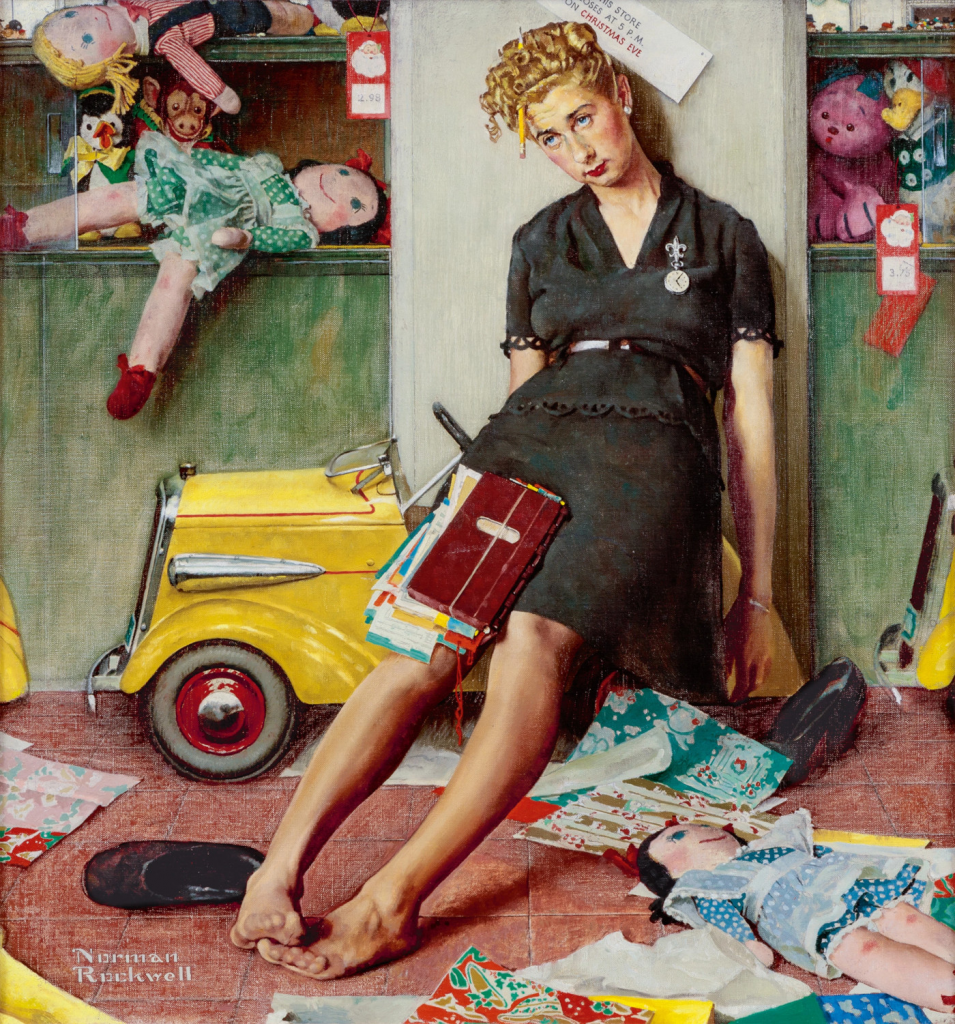
Tired Salesgirl on Christmas Eve Art: Norman Rockwell, 1947
A.Word.A.Daywith Anu Garg
forswunk
PRONUNCIATION:
MEANING:
adjective: Exhausted.
ETYMOLOGY:
From Middle English forswinken (to overwork), from forswink (to exhaust), from for- + swink (to labor). Earliest documented use: 1250.
Featured books from New Thinking Allowed
The Inward Arc offers practical wisdom for healthy human development and valuable guiding principles for integrating psychological and spiritual growth. It provides a wealth of information about transpersonal psychology and a variety of experiential exercises for inspiration and renewal.
The Betty Book chronicles the development of the author’s wife as one of the best mediums of the 20th century. It describes how she first discovered her talent, how she developed it, and what her research came to mean. It also introduces the reader to the “Invisibles” – a group of people living on the inner planes who guided Betty and helped her understand the nature of life without a physical body.
The Unobstructed Universe records the investigations of Stewart White after the death of his wife Betty, who had acted as medium in earlier explorations. Utilizing the mediumship of their friend Joan, Betty leads Stewart on a challenging adventure in “the unobstructed universe” in which we all live and move and have our being, although we generally do not know it. In the process, they break through many of the illusions of physical life and open up to us a rich and exciting portrayal of the inner life.

Rollo May: “We avoid anxiety by becoming rich.”
ThinkingAllowedTV
Existential psychology emphasizes philosophic rather than psychopathological aspects of the human condition. In this animated, two-part discussion, Dr. May proposes that genuine growth comes from confronting the pain of existence rather than escaping into banal pleasures or shallow, positive thinking. Genuine joy, he says, can emerge from an appreciation of life’s agonies. The late psychotherapist Rollo May was a recipient of the Distinguished Career Award of the American Psychological Association and a founding sponsor of the Association for Humanistic Psychology. He was author of numerous classic works including Love and Will, Psychology and the Human Dilemma, Freedom and Destiny, Dreams and Symbols, The Meaning of Anxiety and Man’s Search for Himself.

Love and Will
Rollo May
The heart of the human dilemma, according to Rollo May, is the failure to understand the real meaning of love and will, their source and interrelation. Bringing fresh insight to these concepts, May shows how we can attain a deeper consciousness.
About the author

Rollo May
Rollo May (April 21, 1909 – October 22, 1994) was an American existential psychologist. He authored the influential book Love and Will during 1969.
Although he is often associated with humanistic psychology, his philosophy was influenced strongly by existentialist philosophy. May was a close friend of the theologian Paul Tillich. His works include Love and Will and The Courage to Create, the latter title honoring Tillich’s The Courage to Be.
Biography
May was born in Ada, Ohio in 1909. He experienced a difficult childhood, with his parents divorcing and his sister becoming schizophrenic. His educational career took him to Michigan State College majoring in English and Oberlin College for a bachelor’s degree, teaching for a time in Greece, to Union Theological Seminary for a BD during 1938, and finally to Teachers College, Columbia University for a PhD in clinical psychology during 1949. May was a founder and faculty member of Saybrook Graduate School and Research Center in San Francisco.[1]
He spent the final years of his life in Tiburon on San Francisco Bay, where he died in October 1994.
Accomplishments
May was influenced by American humanism, and interested in reconciling existential psychology with other philosophies, especially Freud’s.
May considered Otto Rank (1884-1939) to be the most important precursor of existential therapy. Shortly before his death, May wrote the foreword to Robert Kramer’s edited collection of Rank’s American lectures. “I have long considered Otto Rank to be the great unacknowledged genius in Freud’s circle,” wrote May (Rank, 1996, p. xi).
May used some traditional existential terms in a slightly different fashion than others, and he invented new words for traditional existentialist concepts. Destiny, for example, could be “thrownness” combined with “fallenness” — the part of our lives that is determined for us, for the purpose of creating our lives. He also used the word “courage” to signify resisting anxiety.
He defined certain “stages” of development:
Innocence – the pre-egoic, pre-self-conscious stage of the infant.
An innocent is only doing what he or she must do. However, an innocent does have a degree of will in the sense of a drive to fulfill needs.
Rebellion – the rebellious person wants freedom, but does not yet have a good understanding of the responsibility that goes with it.
Decision – The person is in a transition stage in their life such that they need to be more independent from their parents and settle into the “ordinary stage”. In this stage they must decide what to do with their life, and fulfilling rebellious needs from the rebellious stage.
Ordinary – the normal adult ego learned responsibility, but finds it too demanding, and so seeks refuge in conformity and traditional values.
Creative – the authentic adult, the existential stage, self-actualizing and transcending simple egocentrism.
These are not “stages” in the traditional sense. A child may certainly be innocent, ordinary or creative at times; an adult may be rebellious. The only association with certain ages is in terms of importance: rebelliousness is more important for a two year old or a teenager.
May perceived the sexual mores of the 1960s and 1970s, as well as commercialization of sex and pornography, as having influenced society such that people believed that love and sex are no longer associated directly. According to May, emotion has become separated from reason, making it acceptable socially to seek sexual relationships and avoid the natural drive to relate to another person and create new life. May believed that sexual freedom can cause modern society to neglect more important psychological developments. May suggests that the only way to remedy the cynical ideas that characterize our times is to rediscover the importance of caring for another, which May describes as the opposite of apathy.
His first book, The Meaning of Anxiety, was based on his d…
(Goodreads.com)
Spirituality and Psychology with Frances Vaughan (1935 – 2017)
New Thinking • Dec 27, 2024 This video is a special release from the original Thinking Allowed series that ran on public television from 1986 until 2002. It was recorded in about 1986. It will remain public for only one week. True psychology is incomplete without an understanding of the spiritual yearnings of human beings. The late Frances Vaughan, PhD, was a transpersonal psychotherapist and was president of the Association for Humanistic Psychology. She is author of Awakening Intuition and The Inward Arc. Dr. Vaughan stresses that all spiritual traditions ultimately offer a means toward transcendence of the limited self. Now you can watch all of the programs from the original Thinking Allowed Video Collection, hosted by Jeffrey Mishlove. Subscribe to the new Streaming Channel (https://thinkingallowed.vhx.tv/) and watch more than 350 programs now, with more, previously unreleased titles added weekly. Free month of the classic Thinking Allowed streaming channel for New Thinking Allowed subscribers only. Use code THINKFREELY.
Colin Wilson on Gurdjieff, Van Gogh, peak experiences and mysticism
“It’s the big that’s true, not the small.”
\ThinkingAllowedTV • Dec 15, 2013 Great news!! Now watch every title and guest in the Thinking Allowed Collection, complete and commercial free. More than 350 programs now streaming.

The Stature of Man
Colin Wilson
Published in the UK as The Age of Defeat.
This is a complex compendium, by the author of The Outsider, which all too often resembles a brilliant term paper. Wilson has read very widely & calls on more authors than the average reader can hope to have read in order to support his thesis. This is that the inner-directed Hero is dying out of society & literature, being replaced by the other-directed man, who is haunted by a sense of insignificance, “hell is other people”, Billy Graham religions, the Organization Man–& occasional crimes of violence as a desperate compensation. This interesting problem has already been treated widely by sociologists, psychologists, philosophers & writers. Wilson’s attempt to include them all makes this book rather crowded. His proposed cure, that man must try turning inward “& then turning outward again” bears a strong unacknowledged resemblance to Toynbee & there are other echoes in this book. The question of redirection is certainly a pressing & absorbing one, & is pointed up in an odd way by this book, in which a man who speaks in favor of inner-direction does so largely in terms of other people’s ideas.–Kirkus (edited)
About the author

Colin Wilson
Librarian Note: There is more than one author by this name in the Goodreads database.
Colin Henry Wilson was born and raised in Leicester, England, U.K. He left school at 16, worked in factories and various occupations, and read in his spare time. When Wilson was 24, Gollancz published The Outsider (1956) which examines the role of the social ‘outsider’ in seminal works of various key literary and cultural figures. These include Albert Camus, Jean-Paul Sartre, Ernest Hemingway, Hermann Hesse, Fyodor Dostoyevsky, William James, T. E. Lawrence, Vaslav Nijinsky and Vincent Van Gogh and Wilson discusses his perception of Social alienation in their work. The book was a best seller and helped popularize existentialism in Britain. Critical praise though, was short-lived and Wilson was soon widely criticized.
Wilson’s works after The Outsider focused on positive aspects of human psychology, such as peak experiences and the narrowness of consciousness. He admired the humanistic psychologist Abraham Maslow and corresponded with him. Wilson wrote The War Against Sleep: The Philosophy of Gurdjieff on the life, work and philosophy of G. I. Gurdjieff and an accessible introduction to the Greek-Armenian mystic in 1980. He argues throughout his work that the existentialist focus on defeat or nausea is only a partial representation of reality and that there is no particular reason for accepting it. Wilson views normal, everyday consciousness buffeted by the moment, as “blinkered” and argues that it should not be accepted as showing us the truth about reality. This blinkering has some evolutionary advantages in that it stops us from being completely immersed in wonder, or in the huge stream of events, and hence unable to act. However, to live properly we need to access more than this everyday consciousness. Wilson believes that our peak experiences of joy and meaningfulness are as real as our experiences of angst and, since we are more fully alive at these moments, they are more real. These experiences can be cultivated through concentration, paying attention, relaxation and certain types of work.
(Godoreads.com)
How George Orwell was right — and Steve Jobs was wrong
Opinion by Thom Hartmann (msn.com)

Screenshot of Apple SuperBowl ad, 1984© provided by AlterNet
A fascinating article in The New York Timesthis week by Kurt Gray, professor of psychology and neuroscience at the University of North Carolina at Chapel Hill, gives us the beginnings of an understanding of how and why social media is so destructive to society.
Gray points out that most people assume humans have historically been predators, the metaphorical big cats of the jungle. In fact, Gray says, we’ve historically been prey, the victims of predators:
“This picture of fearfulness is consistent with our understanding of human psychology. We’re hard-wired to detect threats quickly and to stay fixated on places where threats once appeared, even after they have vanished. We fear that ‘child predators’ will abduct our kids even when they are safer than ever.
“Modern humans, ensconced in towns and cities, are now mostly safe from animal predators, but we are still easily frightened. Whether we’re scrolling social media or voting for a presidential candidate, we all still carry the legacy of our ancestors, who worried about big cats lurking in the darkness.”
Thus, if you could invent a drug that would cause people to be fearful — and thus stimulate the rage that comes from fear — you could have incredible control over a population if you could simply tell them where and against whom to direct that fear-induced rage.
We all have opiate receptors in our brains that modulate our response to pain. Compounds that bind to these receptors are produced naturally by our body in response to extreme pain and shock, and numerous plants—most famously, opium poppies—naturally produce chemicals that bind to and activate our opiate receptors.
When we lived in Germany back in the late 1980s, I loved to visit a nearby castle in Kulmbach and order mohnkuchen, a piecrust filled with poppy seeds ground into a paste with sugar and a few spices. I always felt so good after eating a slice or two of the pie; when we had a glass of a fresh German Riesling with it, my smile went from ear to ear for hours.
The mohnkuchen seemed to constipate me a bit, and when I noticed one afternoon that my pupils were pinned so small as to nearly vanish, the same as I’d noticed whenever I’d taken narcotic painkillers after injuries and surgery, the penny dropped. Turns out I was enjoying opium in that little German café in a way that people around the world have for millennia.
Similarly, I once shared a few days with a shaman from Peru; he had a bag of coca leaves, and we each chewed a few along with a tiny piece of alkalized ash to release its active ingredient as an afternoon pick-me-up. The buzz I experienced was considerably less strong than what a two or three cups of coffee provide.
Mountain-dwelling Andean tribes have been doing this for as long as there have been people in the region; they consume coca the way people in India and parts of China consume local tea leaves. We consumed coca leaf extract here in the US, too, from 1886 to 1929, in a drink called Coca Cola.
Somewhere on the spectrum from these drugs’ original state to their becoming increasingly concentrated and purified, a toxic/addictive threshold or tipping point is reached. I never experienced withdrawal symptoms from mohnkucken, but I did from the highly concentrated opiate painkiller (Oxycontin) I took for a few weeks for severe sciatica prior to spinal surgery and for a week after. It wasn’t terrible; a few nights of trouble sleeping and sensitivity to pain and touch, but there it was.
Heroin is concentrated opium poppy. Cocaine is concentrated coca leaf. Substances that are otherwise benign become both potent and deadly when they’re super-concentrated.
Which is exactly what the algorithms deployed in secret by social media do: they purify and concentrate hate and fear spread across the broader social media site, distilling the most potent memes and messages to the top and shoving them into people’s brains.
But that’s just the beginning of the damage these top-secret algorithms are doing to our societies and politics. By increasing our individual levels of fear and rage, they create a broader social sense of fear and rage, making these emotions far more easy to exploit.
Enter stage right “populist” politicians and media sites who push people’s now-sensitized fear and rage buttons for political gain. (Not to mention the billions earned by social media billionaires pushing this psychological heroin while absolutely refusing to publish their algorithms.)
Numerous studies show that when people believe crime is a serious problem in their own communities and lives, they measurably shift toward the political right of the spectrum. Law-and-order campaigns and promises of severe punishment acquire a sudden appeal, as Joe Biden and Bill Clinton discovered in the early 1990s and politicians everywhere since the pandemic have seen.
Fear of crime — and fear more generally (of your kids being victims of trans people or renegade surgeons in public schools, for example, or of immigrants raping your wife or taking your job) — push people toward an embrace of conservative and then authoritarian politics and governance.
When media promote narratives about crime being out of control — whether true or not — they measurably drive acceptance of more reactionary crime control legislation along with rejection of efforts at rehabilitation and reform.
There may be an even wider impact of social media’s promotion of fear and rage.
The Transcendental Meditation group reported in the Journal of Mind and Behavior on several 1970s and 1980s studies showing that when a certain relatively small threshold number of people in a particular community meditated daily, crime and violence went down.
Another report in Social Indicators Research found that when a group of meditators moved to Washington, DC between 1988 and 1993 that over those following years crime went down by an impressive 23.3%.
A comprehensive study was run during the 1883 Lebanon war, when a group of meditators took up residence in Jerusalem and meditated daily for two years. The result, almost certainly exceeding any possibility of coincidence, was:
— A 76% reduction in war deaths in Lebanon on days when there was high participation in the meditating group,
— A 71% decrease in war-related fatalities,
— A 68% reduction in war-related injuries,
— A 48% drop in the level of conflict, and
— A 66% increase in cooperation among antagonists.
If a certain threshold of people being intentionally peaceful for a year or two can lower crime rates, what happens when a certain threshold of people are daily enraged by the injection of fear and hate into their psychological bloodstreams?
Could it be that social media is directly (or indirectly) responsible for much of the swing we’re seeing around the world toward bigotry, hate, and violence? That rightwing movements are emerging as a result of the impact of social media, rather than social media merely and passively reflecting the trend as the social media companies argue?
The meditation studies are controversial, but it’s hard to dispute the assertion that as more and more individuals in a given society are racked with fear and rage, the result, as I lay out in The Hidden History of Big Brother, will be more hate and violence.
Republican Senator Josh Hawley has been thinking along the same lines. In his book The Tyranny of Big Tech, he wrote:
“Big tech has embraced a business model of addiction. Too much of the ‘innovation’ in this space is designed not to create better products, but to capture more attention by using psychological tricks that make it difficult to look away.”
The past two years have shown America and the world what happens when a social media company is captured by an unaccountable billionaire with a specific political goal. The site that was once Twitter is now a veritable sewer, filled with hate and Nazi-level extremists.
Is it possible this is making the world less stable, less peaceful, and more violent through a reverse “Maharishi Effect”? Are wars around the world and the recent assassination of a healthcare CEO demonstrations of the power social media has over society? School shootings? The rise of Nazi-adjacent militia groups here and in Europe?
The simple reality is that we won’t know until government steps in and requires these companies to both publish and moderate their algorithms and monitor/control the naked hate on their platforms. And that day can’t come too soon.
NOW READ: Greed is immoral — but health care greed is worse
(Contributed by Gwyllm Llwydd)