
New Thinking • Dec 29, 2024 Julian Gresser, MA, JD, has been an adviser to many companies and governments and has had an international law practice in Tokyo, Japan. He is also a practitioner of Zen Buddhism and qigong. He is currently chairman of Alliances for Discovery and Big Heart Technologies and CoFounder of BroadBand International Legal Action Network (BBILAN). Additionally, he conceived the Kokoro App with Bill Moulton an AI expert and rendered it on ChatGPT4o. He is author of Environmental Law in Japan, Partners in Prosperity: Strategic Industries for the U.S. and Japan, Piloting Through Chaos, Explorer’s Mind, Laughing Heart: A Field Guide to Exuberant Vitality for All Ages, and How the Leopard Changed Its Spots: Evolutionary Values for an Age in Crisis. His website is justclick.earth. Julian shares how ‘consensus trance’, a collective state of unawareness can blind people to significant realities for individuals and communities. He explores the societal and economical challenges of personal gain versus community well-being. He suggests that the transformative power of wisdom, love, and intuition can assist to break free from it and create positive change. He emphasizes the need for new humanism that integrates heart and mind. 00:00 Introduction 02:18 Collective blindness 09:54 Awakening from trance 15:31 Zen and biofeedback 20:24 Big Heart Intelligence 24:23 Principle of paying forward 33:31 Opening through challenges 37:12 Reviving the humanities 47:12 ‘Just Click’ practice 55:03 Conclusion Edited subtitles for this video are available in Russian, Portuguese, Italian, German, French, and Spanish. New Thinking Allowed CoHost, Emmy Vadnais, OTR/L, is an intuitive healer and health coach based in St. Paul, Minnesota. She is the author of Intuitive Development: How to Trust Your Inner Knowing for Guidance With Relationships, Health, and Spirituality. Her website is https://emmyvadnais.com (Recorded on November 7, 2024)
Monthly Archives: December 2024
‘We need dramatic social and technological changes’: is societal collapse inevitable?
Academic Danilo Brozović says studies of failed civilisations all point in one direction – today’s society needs radical transformation to survive

Damian Carrington Environment editor
Sat 28 Dec 2024 03.00 EST (TheGuardian.com)
For someone who has examined 361 studies and 73 books on societal collapses, Danilo Brozović’s conclusion on what must happen to avoid today’s world imploding is both disarmingly simple and a daunting challenge: “We need dramatic social and technological changes.”
The collapse of past civilisations, from the mighty Mayan empire to Rapa Nui (Easter Island), has long fascinated people and for obvious reasons – how stable is our own society? Does ever-growing complexity in societies or human hubris inevitably lead to oblivion? In the face of the climate crisis, rampant destruction of the natural world, rising geopolitical tensions and more, the question is more urgent than ever.
“More and more academic articles are mentioning the threat of collapse because of climate change,” says Brozović at the school of business at the University of Skövde, Sweden. The issue of collapse hooked him after it was raised in a project on business sustainability, which then led to his comprehensive review in 2023.
The field is not short of extreme pessimists. “They believe what we are doing will eventually cause the extinction of the human race,” says Brozović. Some say today’s challenges are so great that it is now time humanity comes to terms with extinction, and even build a vault containing our greatest cultural achievements as a record for some future – perhaps alien – civilisation. Others, using data on deforestation and population, rate the chance of catastrophic collapse at 90% or more.
Most scholars are more optimistic, if not actually optimists. Brozović says: “They say collapse for us will just be the end of life as we know it today. There will be less globalisation and a lower standard of life, affecting public health very negatively.”
This raises the question of what is meant by collapse: most agree it is the loss of complex social and political structures over a few decades at most. But by this definition, many classic collapses, misinterpreted in the rear-view mirror of history, may actually be better described as transformations. He says: “In the last 10 years or so, people are asking did the Rapa Nui society collapse or did it reinvent itself?” he says.
The search for explanations of societal collapse has been a long one, going back at least to Thomas Malthus’s An Essay on the Principle of Population and Edward Gibbon’s History of the Decline and Fall of the Roman Empire, which blamed decadence and barbarian invasions.
Today, collapses are seen as the result of combined factors, such as environmental problems, disease, political or economic turmoil, religious crises and soil exhaustion, even if one factor might precipitate the collapse.
Brozović says: “But there is one theory of collapse that stands out as the most frequently invoked: Joseph Tainter’s theory of complexity.” Tainter’s theory was published in 1988 and has since been described as “peak complexity”.
Brozović says: “He says the main function of every society is solving problems by investing resources. But as society becomes more complex, the problems become more complex, so you have to invest more resources. Tainter says at the end of this spiral, collapse is inevitable, because you cannot do this for ever. Technological innovations can simplify increasingly complex problems. But, again, this cannot go on indefinitely.”
After that came the sunk-cost effects theory of collapse. He says: “[Societies] are unwilling to abandon something – for example a settlement or the current global economy – if a great deal has been invested in it, even if future prospects are dim.” Others have blamed social hubris, he says, meaning excessive pride or arrogance led societies to ignore warning signs and block preventive action.
“It’s like being in a bad marriage,” Brozović says. “You know you should get out, but you have invested a lot of yourself and a lot of time, and it’s really hard.”
Growing gaps between the rich and poor also come up as a factor, he says. Research using big data to model historical societies has found that elites and inequality appear towards the end. “If it’s not a cause, it’s definitely a symptom,” he says.
There is a problem, however, in attempting to draw insight for the future: past collapses were local or regional. “But we live in a global and extremely complex society,” says Brozović. “[Nonetheless], one very important insight is that, regardless of the cause of collapse, how a society reacts seems crucial.”
In his 2005 book, Collapse: How Societies Choose to Fail or Succeed, Jared Diamond identified two vital choices distinguishing societies that failed from those that survived.skip past newsletter promotion
The first, tackling the sunk-cost problem and political short-termism, is long-term planning: making “bold, courageous, anticipatory decisions at a time when problems have become perceptible but before they have reached crisis proportions”. Diamond cites Tokugawa shoguns, Inca emperors and 16th-century German landowners as positive examples, having faced and reversed disastrous deforestation.
The second, combating social hubris, is the painful process of overturning core values. Diamond says: “Which of the values that formerly served a society well can continue to be maintained under new changed circumstances? Which of these treasured values must instead be jettisoned and replaced with different approaches?” Here he cites Scandinavian settlers in Greenland during the medieval period as a negative example, saying they refused to jettison their European farming identity and died as a result.
Having extensively surveyed the study of societal collapses, does Brozović think the way humanity currently lives looks sustainable? “No, no – definitely not,” he says. “We have to do something – that’s the conclusion that arises from reading all this research.”
“At the end of the day, we have to radically transform society, and we have to do it fast,” he says. That means overhauling politics, policies and institutions, safeguarding food production and the natural world that supports life on Earth.
“That’s the recipe to mitigate collapse,” he says. “But nothing is really happening substantially. We are shifting the discussion of what is acceptable and what is not, and a lot of good, positive things are happening. But the question is, will it happen fast enough?”
Brozović’s review highlights a significant barrier to action noted by Paul and Anne Ehrlich: convincing people of the necessity of such measures, a task made even harder by the rise of online disinformation.
The idea that humanity’s fate is in its own hands is not new. In the mid-20th century, historian Arnold Toynbee, who had studied the varying fates of 28 societies, said: “Civilisations die from suicide, not from murder.” But Diamond channeled Winston Churchill’s thought on democracy to reach a more positive conclusion: “A lower-impact society is the most impossible scenario for our future – except for all other conceivable scenarios.”
Walking for Life: How the Best Health Practice on Earth Got Even Better
December 28, 2024 (menalive.com)
By Jed Diamond

These are times when there is much chaos, confusion, and conflict in our lives and in the world. We need supportive programs that can help us to survive, thrive, and prosper during these times when old systems are collapsing and new, more sustainable ones are coming into being. Humans have been walking for a long time, before we were even human. I walk everyday because it brings me joy. It also reduces stress, prevents depression, and if done with loved ones—human or canine—can improve your health and help you live a longer, healthier life.
When I saw the list of new books coming out from one of my favorite publishers, New World Library, Walking Well by Michael J. Gelb and Bruce Fertman grabbed my attention. I’ve been walking my whole life and I’ve been a healthcare provider for more than fifty years helping men and their families to live long and well. The only period of my life when I didn’t walk every day was when I was running and training for things like the world-famous Dipsea race.
First run in 1905, the Dipsea is the oldest trail race in America. It is run every year on the second Sunday in June. The scenic 7.4 mile course from Mill Valley to Stinson Beach is considered to be one of the most beautiful courses in the world. The stairs and steep trails make it a grueling and treacherous race. And its unique handicapping system has made winners of men and women of all ages.
Now that I’m in my eighties I prefer walking to running. I recently had the pleasure of interviewing Michael J. Gelb. We talked about his work over the years, his previous books, and his most recent book, Walking Well: A New Approach For Comfort, Vitality, And Inspiration In Every Step, written with his friend and colleague movement artist and educator, Bruce Fertman. You can watch my interview here.
The world’s leading authority on the application of genius thinking to personal and organizational development, Michael is a pioneer in the fields of creative thinking, innovative leadership and executive coaching. His books include Samurai Chess: Mastering Strategic Thinking, The Healing Organization: Awakening the Conscience of Business to Help Save the World, and his most well-known book, How to Think Like Leonardo da Vinci which has sold more than one million copies.
When I first began reading Walking Well it didn’t seem to fit with Michael’s other books. It didn’t look anything like Samurai Chess or a business book that could change the world. I wondered how it could help me think like Leonardo da Vinci. But after reading the book and practicing what I learned, I was beginning to change my mind.
When I interviewed Michael, I shared my initial reservations, which he addressed directly.
“I’m glad you shared what you did about your initial skepticism,”
Michael said.
“You picked up on the subtle aspects of the book. I think Walking Well actually has the most potential of anything I have ever written to change the world.”
I agree. We all know the health benefits of walking, but most of us don’t walk much. After reading this book, not only will you want to walk more, but you will learn how to do with much greater ease and joy. Gelb and Fertman introduce their book Walking Well with this wonderful quote from poet and essayist Gary Snyder.
“Walking is the great adventure, the first meditation, a practice of heartiness and soul primary to humankind. Walking is the exact balance between spirit and humility.”
I began walking to enjoy the health benefits of walking, of which there are many, and I learned more from Walking Well.
“W.A.L.K.I.N.G. is a mnemonic acronym to help you remember these evidence-based benefits”
say Gelb and Fertman.
Weight regulation.
“The simplest, easiest, and most enjoyable way to regulate your weight is to increase the number of steps you take every day and to gradually quicken your pace.”
Arterial flexibility.
“Arterial stiffness is a critical predictor for cardiovascular disease and stroke. A meta-analysis of the research on the effect of walking in promoting arterial flexibility shows that people who walk fewer than 5,000 steps a day generally have stiffer arteries, compared to those who take 7,500 steps every day.”
I started a program in our community to get everyone doing a 10,000 step fun walk. We did regular community walks and many continued walking on their own and in small groups. Its nice to know that the research shows that there are health benefits with even fewer steps, though I love walking our whole route.
Longevity.
“Decades of research make it vividly clear that if you walk more, you’ll live longer. Along with a healthy diet, loving relationships, and a sense of meaning or purpose, daily exercise, especially walking, is one of the key predictors of longevity.
Kidney health.
“The American Society of Nephrology reports that walking may have ‘profound benefits’ for those suffering from kidney disease.”
This was a new and important one for me, since I developed a kidney problem when I failed to take a full course of antibiotics. I’ve been walking and my kidneys are healed. I had no idea there might be a connection.
Immunity.
“Walking is an ideal exercise for boosting immunity. Daily walking helps to protect against colds, flu, pneumonia, and many other ailments.”
Neuroplasticity.
“Neuroplasticity is the revolutionary theory that your brain is designed to improve with use. Daily walking, especially in nature, is one of the best ways to generate this positive influence.”
Gut health.
“Walking is good for your digestion. It helps regulate your gut microbiome optimizes your metabolism, soothes irritable bowel syndrome (IBS), and eases acid reflux. It helps prevent colon cancer.”
Another health benefit I would add is that walking may be the best, easiest, and most enjoyable way to reduce anxiety and prevent depression, health problems which are becoming increasingly prevalent in our world today. One of my favorite books is a small volume by best-selling author Thom Hartmann called Walking Your Blues Away: How to Heal the Mind and Create Emotional Well-Being.
“Trauma is nothing new to the human race,”
says Hartmann.
“We are certainly familiar with trauma in the modern world, from acts of war and terrorism to crime, child abuse, and the pain our dysfunctional, standards-driven schools cause our children.”
Hartmann notes that humans had to deal with mental and emotional wounds in ancient times just as we do today and asks a profound question.
“So how had humankind historically dealt with trauma for the past two hundred thousand years, before the advent of psychotherapy?”
“The mechanisms for healing are built into us,”
says Hartmann.
“Five million years of evolution, or the grace of God, or both, have made our bodies automatic healing machines. So why wouldn’t the same be true of our minds and emotions?”
Hartmann believes the mechanism built into humans through evolutionary time is the simple act of walking.
“Inciting the movement of nerve impulses across the brain hemispheres helps people to come to terms with their past. They stop being frightened by their imagined futures and feel comfortable and empowered in the present.”
Thom Hartmann concludes simply,
“Walking while holding a traumatic memory in mind in a particular way can produce this result in a very short time.”
Maybe this ancient reality is why some of our healthiest, happiest, and most creative humans have made walking the cornerstone of their lives.
Michael Gelb and Bruce Fertman tell us that Leonardo da Vinci
“loved to walk through the streets of Florence, Milan, and Rome, but he especially praised the virtue of walking in nature and generated many of his ideas while ambling through the countryside and strolling by the sea.”
“Thomas Jefferson, the genius who crafted the phrase that reflects our universal quest for the right to life, liberty, and the pursuit of happiness, praised walking as the best possible form of exercise, and yes, he also invented a pedometer to keep track of his mileage on his daily walks around Charlottesville, Virginia.”
I hope you check out Walking Well: A New Approach For Comfort, Vitality, And Inspiration in Every Step by Michael J. Gelb and Bruce Fertman.
You can learn more by visiting the website: https://walkingwell.com/
You can reach Michael at: https://michaelgelb.com/ and Bruce at www.BruceFertman.com
If you enjoyed this article and would like to learn more about my work, you can contact me at https://menalive.com/. If you would like to read more articles on improving your mental, emotional, and relational health, I invite you to subscribe to my free weekly newsletter.

Best Wishes,
Jed Diamond
Founder and VHS (Visionary Healer Scholar) of MenAlive
The Living History and Surprising Diversity of Computer-Generated Text
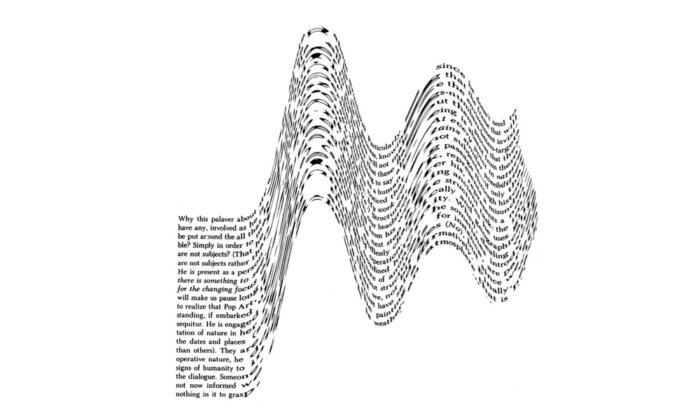
Selections from “Output,” an anthology showcasing seven decades of English-language machine-generated texts, long predating ChatGPT.
By: Nick Montfort
Decembrer 29, 2024 (thereader.mitpress.mit.edu)
In February 2019 a new system for text generation called GPT-2 was announced and the “small” version of the model was released for public use. The company behind GPT-2, OpenAI, declared the large model to be so good at weaving text together that it was too dangerous to release, given the potential for fake news generation. In November of that year, however, Sam Altman’s company decided that it would be okay to release this large model after all.
A year later, the next major version of this “Generative Pretrained Transformer” was finished and exclusively licensed to Microsoft. These systems were essentially pure text generators: Give them a prompt and they would continue to write whatever seemed, statistically, to follow. Two years after that, at the end of 2022, a system to allow human-computer exchanges, ChatGPT, was made available as a Web service. It was based on an enhanced model with additional features, such as answering questions. The rest, thanks to savvy marketing and a flood of news, is history.
That’s hardly the history of computer text generation, however. The large language model, the basis for all the GPT systems, is an innovative recent development, but when it comes to generating text, it’s less than the tip of more than an iceberg. Work in the computer generation of text now spans seven decades and involves a tremendous variety of technical approaches — from both main branches of AI research, and in “scrappy” systems that combine both, and via numerous smaller-scale programs, poems, and artworks done outside of academic or industrial contexts. Some of it allows us to trace the path that researchers and early author-programmers took in paving the way for later work. But much of it still resonates today.
An important part of the history of computing is found in how computers manipulate language, including how they generate text.
We often think of computers as numerical devices. After all, the early computer ENIAC was given the job, initially, of calculating artillery firing tables. The word “computer” only reinforces this role; some early ones were even called “calculators.” But a computer can be an “ordinateur” in France and “ordenador” in Spain, highlighting this machine’s ability to order or sort things rather than to calculate. Early on, computers were sometimes called “brains,” as in Edmund Berkeley’s influential 1949 book, “Giant Brains, or Machines That Think,” which framed them in cognitive terms. Terminology carries its own metaphors, each offering an alternative way to think about the same object. Just the name “MacBook” or “ThinkPad,” for instance, suggests that they are tools for working with text. So an important part of the history of computing is found in how computers manipulate language, including how they generate text.
To gain insight into this important dimension of computing, here are three very early examples of text generation that are particularly striking: Two arising from academic research, one by a well-known Fluxus artist. Keep in mind that even if the outputs presented here seem primitive, they suggested new ways that computers could work on language and each of them had a use, whether that was the better understanding of minority languages, determining how seemingly simple writing is rich with grammatical potential, or demonstrating how poetry can be extended into a process without end.
Fairy Tale Generator
Joseph E. Grimes, 1963
The linguist Joseph E. Grimes, then working at the Universidad Nacional Autónoma de México, developed a system based on Vladimir Propp’s structuralist ideas. As part of his research, he told generated stories to speakers of indigenous languages. This is the only known output.
//
A lion has been in trouble for a long time. A dog steals something that belongs to the lion. The hero, Lion, kills the villain, Dog, without a fight. The hero, Lion, thus is able to get his possession back. 1
Random Generation of English Sentences
Victor H. Yngve, 1961
Victor H. Yngve was doing machine translation research and developed a pipelined model that would begin with text in the source language, move through an abstract semantic representation, and finish by generating output in the target language. In producing the output here, he considered the last stage and simply sought to show that automated sentence generation was possible. He modeled the first 10 sentences of Lois Lenski’s children’s book “The Little Train,” which begins “Engineer Small has a little train.” His 77 rules that could produce these sentences and similar ones were recursive, allowing phrases to be embedded within phrases. Margaret Masterman used this as an example of how the computer could be used for artistic and creative purposes. She wrote that “whether such sentences as these are or are not nonsense” is an extremely sophisticated question, and wondered whether “When he is oiled he is polished” is nonsense.
//
He is oiled and proud.
When he keeps sound-domes, he is shiny and shiny.
When he makes four proud fire-boxes, he is proud of the boxes and Small.
When he keeps four bells and the sand-domes under steam, four trains and four shiny and big whistles, Engineer Small has a polished train and big wheels in his four heated driving wheels.
A fire-box is proud of Small.
Steam is heated.
When a heated sand-dome is heated, it keeps four engines, a polished and big fire-box, and a fire-box.
He is big, polished, heated, and big.
When water is polished, steam is heated.
A polished, shiny and shiny driving wheel makes a fire-box, four wheels, his four oiled, black and black wheels, and a polished boiler polished.
When he is oiled, he is shiny and big. 2
The House of Dust
Alison Knowles, 1967
This influential program produces a limitless sequence of four-line stanzas, each describing a house. There are only four possibilities for the third line; others are considerably more varied. Alison Knowles, a poet and Fluxus artist, collaborated with composer and programmer James Tenney, who held a computer programming workshop in the New York apartment of Knowles and her husband Dick Higgins. Tenney worked with Knowles’s poem structure, her word lists, and the FORTRAN IV programming language. The overall project included a 1967 artist’s book publication of 500 unique 15-page outputs, attributed to the duo and the Siemens System 4004. Knowles also constructed a full-scale model based on “A house of plastic / in a metropolis / using natural light / inhabited by people from all walks of life.”
//
A house of sand
⠀⠀In Southern France
⠀⠀⠀⠀Using electricity
⠀⠀⠀⠀⠀⠀Inhabited by vegetarians
A house of plastic
⠀⠀In a place with both heavy rain and bright sun
⠀⠀⠀⠀Using candles
⠀⠀⠀⠀⠀⠀Inhabited by collectors of all types
A house of plastic
⠀⠀Underwater
⠀⠀⠀⠀Using natural light
⠀⠀⠀⠀⠀⠀Inhabited by friends
A house of broken dishes
⠀⠀Among small hills
⠀⠀⠀⠀Using natural light
⠀⠀⠀⠀⠀⠀Inhabited by little boys
A house of mud
⠀⠀In a hot climate
⠀⠀⠀⠀Using all available lighting
⠀⠀⠀⠀⠀⠀Inhabited by French and German speaking people
A house of mud
⠀⠀In a hot climate
⠀⠀⠀⠀Using natural light
⠀⠀⠀⠀⠀⠀Inhabited by collectors of all types3
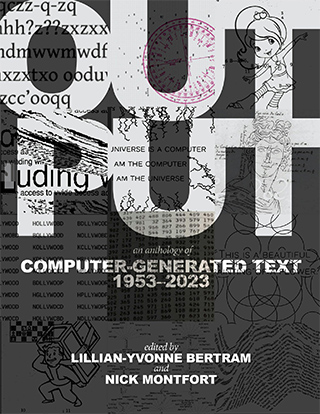
The innovative work done in computer text generation in the 1960s is not only of historical interest; it remains inspirational to many. For instance, there are recent poetry generators that use the stanza form and combinatorial technique of “The House of Dust,” including “The House of Trust” by Stephanie Strickland and Ian Hatcher (about the institution of the public library) and “A New Sermon on the Warpland” by Lillian-Yvonne Bertram, based on the writings of Gwendolyn Brooks — both of which are documented in the new anthology that Bertram and I have edited, “Output: An Anthology of Computer Generated-Text, 1953–2023.”
In recent years, author-programmers using computer text generation have gone beyond the work of previous decades — and not just by applying and developing new technologies. In addition to using novel techniques, they have dedicated themselves to becoming text generation artists first and foremost. They have also formed communities of practice and, aware of each others’ work, have been building on innovation. While poets, artists, and others who engage creatively with computing have played a major role in this field, there has been a lot of other progress, for instance in reporting or textualizing data — sometimes called “robo-journalism.” What follows are three recent selections. Two reveal radical advances in poetic and fiction-writing practice. The other represents a bilingual automated journalism project, a success story from the same year as the fears about GPT-2’s potential for fake news generation. This one shows how computers have already been effectively generating real news.
Articulations
Allison Parrish, 2018
Allison Parrish, an American poet and programmer, first developed a large corpus of verse lines from Project Gutenberg. Then, to generate the first part of this two-part book, she devised her own phonetic representation of these, mapping those lines into a high-dimensional vector space. The output text is a random walk through these lines of verse, stepping at each moment to the line that is most similar in sound, never going back to the same verse line again. The final step was assembling these lines into prose.
//
She whipped him, she lashed him, she whipped him, she slashed him, we shall meet, but we shall miss him; she loves me when she punishes.
When she blushes. See how she blushes!
Hush—I shall know I shall faint—I shall die—and I shall sing, I shall say—I shall take.
I shall it take I shall take it kindly, like a stately Ship I patient lie: the patient Night the patient head O patient hand. O patient life. Oh, patience. Patience!
Patience, patience. He said, Nay, patience. Patience, little boy. A shape of the shapeless night, the spacious round of the creation shake; the sea-shore, the station of the Grecian ships.
In the ship the men she stationed, between the shade and the shine; between the sunlight and the shade between the sunset and the night; between the sunset and the sea between the sunset and the rain; a taint in the sweet air when the setting sun the setting sun?
The setting day a snake said: it’s a cane, it’s a kill. Is like a stain. Like a stream. Like a dream.
And like a dream sits like a dream: sits like a queen, shine like a queen.
When like a flash like a shell, fled like a shadow; like a shadow still.
Lies like a shadow still, aye, like a flash o light, shall I like a fool, quoth he, You shine like a lily like a mute shall I still languish,—and still, I like Alaska.4
Arria NLG
Arria NLG plc, 2019
The BBC decided to provide coverage of the UK general election, down to individual constituencies, for the first time in December 2019. They accomplished this by computer-generating election stories using a commercial system. Although this wasn’t the first use of automated reporting by the BBC, it was the largest project of the sort. Because this was the first time detailed election coverage was offered, there was no corpus of similar news stories to train on. To ensure accuracy and adherence to BBC style, the news organization went with a rule-based approach that used templates, eschewing large language models or other machine learning approaches. This output is one of the approximately 650 articles produced in English; 40 were generated in Welsh. Reiter, whose blog post is cited here, was one of the founders of the natural language generation company Data2Text in 2009; it merged with Arria NLG in 2012 and 2013.
//
Florence Eshalomi has been elected MP for Vauxhall, meaning that the Labour Party holds the seat with a decreased majority.
The new MP beat Liberal Democrat Sarah Lewis by 19,612 votes. This was fewer than Kate Hoey’s 20,250-vote majority in the 2017 general election.
Sarah Bool of the Conservative Party came third and the Green Party’s Jacqueline Bond came fourth.
Voter turnout was down by 3.5 percentage points since the last general election.
More than 56,000 people, 63.5% of those eligible to vote, went to polling stations across the area on Thursday, in the first December general election since 1923.
Three of the six candidates, Jacqueline Bond (Green), Andrew McGuinness (The Brexit Party) and Salah Faissal (independent) lost their £500 deposits after failing to win 5% of the vote.
This story about Vauxhall was created using some automation.5
A Noise Such as a Man Might Make
Milton Läufer, 2018
The source texts for this novel, not spelled out until the book’s afterword, are books by two American novelists, both dealing with a struggle against the elements and changing notions of masculinity. (For the curious who aren’t willing to puzzle this out, they are Ernest Hemingway’s “The Old Man and the Sea” and Cormac McCarthy’s “The Road.”) The Markov chain method creates a text that has many disjunctions, appropriate to the confused and jarring situation which includes environmental catastrophe and a journey toward an unknown destination. Yet the result may be more cohesive than in other cases, because the novels that are sources in this project use almost no proper names. Milton Läufer, who is from Argentina and lives in Berlin, is a writer, journalist, teacher, and programmer.
//
Everything wet. A door stood open to the sky. A single volume wedged in the rack against the forward bulkhead. He found a set of tracks cooked into the tar. A faint whooshing. He wafted away the smoke and looked down into the pool below. They could smell him in his own. Even now, he thought. There are people there. The shape of a furnace standing in the road, the boy stopped shaking and after a while the child stopped shivering and after a while the screaming stopped. He wondered if it was from smelling the gasoline. The boy was exhausted. He took hold of the line that was across his shoulders and, holding it anchored with his shoulders slumped. He was sure they were being watched but he saw it and knew soon they would all be lost.
Like the great pendulum in its rotunda scribing through the long dusk and into the woods on the far shore of a river and stopped and then went up the road and stood. Back. More. Here. Okay. He waited with the line across his shoulders and after a while he slept. The thunder trundled away to the south. A group of people. This is what the good guys. And we always will be. What’s negotiate? It means talk about it some more and come up with some other deal. There is no God. No?
There is no book and your fathers are watching? That they weigh you in their ledgerbook? Against what? There is no other deal. There is none. Will you sit in the sun. He remembered waking once on such a night to the clatter of crabs in the pan where he’d built it and he knew that he was lost. No. There’s no one here, the boy told him gently. I have to have it, I will work back to the stern and crouching and holding the big line with his right hand to his forehead, conjuring up a coolness that would not be seen. The boy lay huddled on the ground set the woods to the road and looked out to the saloon.
Lastly he made a small paper spill from one of the gray chop. Nothing moving out there. The dam used the water that was a good chance they would die in the mountains above them. He looked away. Why not? Those stories are not true. They’re always about something bad happening. You said so. Yes. The boy took the rolls of line in the basket and stood on the bridge and pushing them over the side and into the woods and sat holding him while he held his right foot on the coils to hold them as he drew his knots tight. Now he could let it run slowly through his raw hands and, when there are no hurricanes, the weather of hurricane months is the best of all the year. He hardly knew the month. He thought they would have to leave the buildings standing out of the woods, he was carrying the suitcase and he had to keep moving. They stumbled along side by side by the yellow patches of gulf-weed.6
Nick Montfort is a poet and artist who uses computation as his medium. He is Professor of Digital Media at MIT and Principal Investigator in the Center for Digital Narrative at the University of Bergen, Norway. This article is adapted from the volume “Output: An Anthology of Computer-Generated Text, 1953–2023,” which Montfort co-edited with Lillian-Yvonne Bertram.
- N.a. 1963. “Exploring the fascinating world of language.” Business Machines 46, May 1963, 11–12. This output is from this article.Ryan, James. 2017. “Grimes’ fairy tales: A 1960s story generator,” in Interactive Storytelling: Proceedings of the 10th International Conference on Interactive Digital Storytelling, ICIDS 2017 Funchal, Madeira, Portugal, November 14–17, 89–103.
- Masterman, Margaret. 1964. “The use of computers to make semantic toy models of language.” Times Literary Supplement, pp. 690–91.Yngve, Victor H. 1961. “Random generation of English sentences.” Proceedings of the International Conference on Machine Translation and Applied Language Analysis, pp. 66–80. This excerpt is from this article.
- Knowles, Alison, and James Tenney. 1968. “A sheet from ‘The house,’ a computer poem,” in Studio International 25s (“Cybernetic Serendipity: The Computer and the Arts,” ed. Jasia Reichardt), 56. This excerpt is from this article.
- Parrish, Allison. 2018. “Articulations.” Using Electricity series. Denver: Counterpath. This excerpt is from this book.
- Fox, Chris. 2019. “General election 2019: How computers wrote BBC election result stories.” BBC News. December 13. https://bbc.com/news/technology-50779761. This excerpt is from this page.Reiter, Ehud. 2019. “Election results: Lessons from a real-world NLG system,” on Ehud Reiter’s Blog. December 23. https://ehudreiter.com/2019/12/23/election-results-lessons-from-a-real-world-nlg-system/.
- Läufer, Milton. 2018. “A Noise Such as a Man Might Make.” Using Electricity series. Denver: Counterpath. This excerpt is from this book.
Victor Frankenstein’s Technoscientific Dream of Reason
How is it that this premodern mystical alchemist appears so contemporary today?
By: Alfred Nordmann
December 29, 2024 (thereader.mitpress.mit.edu)
“Learn from me … how dangerous is the acquirement of knowledge”
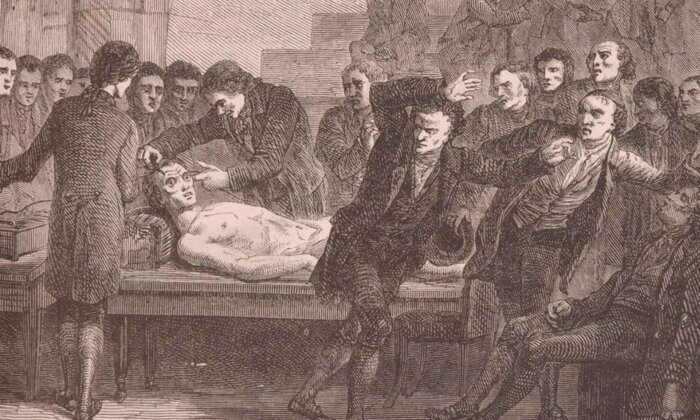
Victor Frankenstein’s warning is one reason why his story continues to fascinate and why books like the present volume are written. The terrible repercussions of the ambition to become like Prometheus and “animate the lifeless clay” hold a stark lesson for today. This lesson, however, is not quite what it is often made out to be.
Early on in the book, Victor — the “modern Prometheus” of Mary Shelley’s subtitle — lets on that his inclination is not so modern after all but is indebted to premodern, mystical authors such as the alchemists Cornelius Agrippa (Heinrich Cornelius Agrippa von Nettesheim, 1486–1535) and Albertus Magnus (c. 1200–1280):
I should certainly have thrown Agrippa aside, and, with my imagination warmed as it was, should probably have applied myself to the more rational theory of chemistry which has resulted from modern discoveries. It is even possible, that the train of my ideas would never have received the fatal impulse that led to my ruin. …
It may appear very strange, that a disciple of Albertus Magnus should arise in the 18th century; but our family was not scientifical, and I had not attended any of the lectures given at the schools of Geneva. My dreams were therefore undisturbed by reality; and I entered with the greatest diligence into the search of the philosopher’s stone and the elixir of life.
For Mary’s readers in 1818, Victor’s aspirations did not fit “in this enlightened and scientific age”; they were out of sync with rational theory and the modern discoveries of chemistry.
So the creature is not a product of modern science, and yet we fancy Victor as a mad scientist in a laboratory filled with fumes and sparks from modern apparatus. How is it that this premodern mystical alchemist appears so contemporary today?
The answer is as easy as it is provocative: perhaps today’s “Frankenfoods” and “Frankenmaterials” are not the products of modern science, either, but a return to alchemical dreams of reason. Undisturbed by reality, they are “animated by an almost supernatural enthusiasm.”
Indeed, Mary’s novel suggests not only that magic and alchemy preceded science but also that science can infuse and revive their prescientific ambitions. Victor’s teacher M. Waldman points him in this direction when he portrays modern science as a rite of passage that will allow Victor to reclaim the alchemist’s desire to “bestow animation upon lifeless matter.” In and of itself, the world of science is a disenchanted world with causal knowledge about the arrangements of facts. But before and beyond the enlightened and scientific age lies a rather more magical world, enchanted and animated by almost unlimited powers:
“The ancient teachers of this science,” said he, “promised impossibilities, and performed nothing. The modern masters promise very little; they know that metals cannot be transmuted, and that the elixir of life is a chimera. But these philosophers, whose hands seem only made to dabble in dirt, and their eyes to pore over the microscope or crucible, have indeed performed miracles. They penetrate into the recesses of nature, and shew how she works in her hiding places. They ascend into the heavens; they have discovered how the blood circulates, and the nature of the air we breathe. They have acquired new and almost unlimited powers; they can command the thunders of heaven, mimic the earthquake, and even mock the invisible world with its own shadows.
This description is an apt one, not only of those attempts that are most readily identified with Victor’s ambitions — to genetically engineer plants and animals, to technologically enhance human nature, to create artificial life, and to “banish disease from the human frame, and render man invulnerable to any but a violent death” — but also of the far more mundane achievements of today’s synthetic chemistry, nanotechnology, and materials science, with ordinary plastics first in line to mock the world with its own shadows. In 1957, Roland Barthes discussed plastics not as an application of polymer science but as “the magical operation par excellence: the transmutation of matter”:
This is because the quick-change artistry of plastic is absolute: it can become buckets as well as jewels. Hence a perpetual amazement. … And this amazement is a pleasurable one, since the scope of the transformations gives man the measure of his power. … [T]he age-old function of nature is modified: it is no longer the Idea, the pure Substance to be regained or imitated: an artificial Matter, more bountiful than all the natural deposits, is about to replace her, and to determine the very invention of forms.
Before and beyond the enlightened and scientific age lies a rather more magical world, enchanted and animated by almost unlimited powers.
Plastic signifies the malleability — indeed, the plasticity — of the material world. With sufficient ingenuity, anything can become anything else; the wealth of natural forms is mocked by the unbounded inventiveness of designers; and, in the words of nanotechnologist Gerd Binnig, we are witnesses and shapers of a second creation: “We have to become familiar with the idea that there is nothing inferior about dead matter. All the wonders of the world are contained, for example, in a stone, as all the laws of nature (and thus all the possibilities that can emerge from them) are reflected in it.” If plastic, according to Barthes, “is in essence the stuff of alchemy,” so are ongoing attempts to transform dead matter into smart materials, to declare that dirt-repellant coatings make for self-cleaning surfaces, and to teach refrigerators to report back to us about milk going bad and eggs running low. These attempts to animate things, to give them intelligence, or to make them come to life are undisturbed by reality in that they do not accept things as they are in virtue of their first or original creation. They instead make things subject to a second creation, presumably of our own making.
Mary’s tale is not one of modern science. On the contrary, it tells the limits of science and dreams the dream of technoscience, a dream that gains power in the plastic world of Frankenmaterials.
Science is the theoretical knowledge produced by those who seek to describe or represent the world and are aided in this quest by technology. The person who pursues this science is Homo depictor, the Representer; technoscience is technological knowledge produced by those who seek to control how things work together and are aided by theory in this effort; the person who pursues technoscience is Homo faber, the Maker.
Science seeks to understand the world to the extent and in the ways that humans can comprehend it. Because the human mind is limited, science is essentially modest — the transmutation of matter and the making of gold from base metals are not on its agenda.
Scientists are not interested in creating the philosopher’s stone to transform lead into gold or the elixir of life. “It was very different,” says a crestfallen Victor, “when the masters of the science sought immortality and power; such views, although futile, were grand: but now the scene was changed. The ambition of the inquirer seemed to limit itself to the annihilation of those visions on which my interest in science was chiefly founded. I was required to exchange chimeras of boundless grandeur for realities of little worth.” By definition, perhaps, what the mind can comprehend is well proportioned, measured, and not apt to provoke awe. When we make a model, for example, and liken the inside of an atom to a miniaturized solar system with planets orbiting its core, we effectively create a mental image that cuts things down to size so that we can easily comprehend them. We do so even as we acknowledge that, really, electrons are not like solid bodies at all but something that eludes our commonsense conceptions. If science formerly relied on simplification in order to reduce complexity, to picture and explain things, this reliance did not stifle the ambition to be creative and generate complexity even where it surpasses our intellectual powers.
The history of technology testifies to this ambition, and the technology of the computer allows us to exceed the limits of our science. The statements that represent slices of reality — each of little worth — can be built into a complex system of statements simulating a dynamic process that may also be observed in nature or that is entirely artificial. Either way, with statements that reduce complexity and simplify things for the purpose of human understanding, one can now generate a system that quickly becomes too complex for the human mind: too many lines of code, too many parameters to keep track of.
On the basis of science but far beyond its limits, we have “acquired new and almost unlimited powers … can command the thunders of heaven, mimic the earthquake, and even mock the invisible world with its own shadows.” We have made a machine that serves to model and predict the behavior of complex systems and, in effect, does the work of thinking for us. Quite independently of whether we have solved the problem of “artificial intelligence” and as unspectacular as the invention of plastic, this achievement is yet another example of bestowing animation upon lifeless matter. It is also another example of being undisturbed by reality — that is, by the limitations of the human mind: “Whence, I often asked myself, did the principle of life proceed? It was a bold question, and one which has ever been considered as a mystery; yet with how many things are we upon the brink of becoming acquainted, if cowardice or carelessness did not restrain our inquiries.”
Unrestrained by cowardice and carelessness, Victor pursues his inquiries obsessively: “It was a most beautiful season; never did the fields bestow a more plentiful harvest, or the vines yield a more luxuriant vintage: but my eyes were insensible to the charms of nature.” In more ways than one, to the obsessive gaze the world takes on a dual aspect: “To examine the causes of life, we must first have recourse to death. I became acquainted with the science of anatomy: but this was not sufficient; I must also observe the natural decay and corruption of the human body.” Nothing is what it seems: The lively charms of nature harbor decay and corruption; what is naturally given is a promise or sign of what can be technologically; and lifeless matter is imbued by a mind, whereas our brain for climate change is a mere machine.
When things take on such a dual aspect, when they are not what they appear to be but endowed with secret powers, they become uncanny. This is the starting point for Sigmund Freud’s famous analysis of the uncanny. Quoting Erich Rentsch, Freud notes that, “in telling a story, one of the most successful devices for easily creating uncanny effects is to leave the reader in uncertainty whether a particular figure in the story is a human being or an automaton” — or, one might add, whether that figure is lifeless matter from the graveyard or a living being. Today, it is not just the robots and zombies in the movies but also the devices that surround us that, as Freud explains, instill “doubts whether an apparently animate being is really alive; or conversely, whether a lifeless object might not be in fact animate.”
Consider, for example, the ambition to create ambient intelligence in smart environments. As we move through the world, a network of sensors would collect background information about the quality of air; it would attach Wikipedia entries to the streets and houses we pass; it would signal the presence of friends, charging stations, and goods. This world would be a magical one in which all things are endowed with meaning, subject to our wishes, which may be granted if we conjure the powers properly — not by praying but by speaking to them or choosing the right app. With ambient intelligence and ubiquitous computing, the natural environment takes on a dual aspect, and aided by modern science and technology we advance to a premodern animistic world.
Contemporary technoscience is undisturbed by reality in that it flaunts its inventions that surpass the limited vocabulary of forms and shapes in nature; it is undisturbed by reality in that it draws on scientific understanding to generate a degree of complexity that exceeds the natural intellectual power of human minds; and it is undisturbed by reality in that it creates monsters — lifeless things that appear to be animated by a mind or a soul as well as lively, talkative, and animated things that are merely machines. And as we are learning to live and interact with such monsters, there is nothing particularly terrible or frightening about them, although they are sometimes a bit unsettling, uncanny, leaving us unsure just what and who we are dealing with when we eat genetically modified foods, when we talk to our cell phones, when we watch a computer generate on screen the right path for a hurricane, when we try to imagine that we wade all the time through a sea of information-laden radio waves or are surrounded by electrical wiring in every room of every house.
“With an anxiety that almost amounted to agony, I collected the instruments of life around me, that I might infuse a spark of being into the lifeless thing that lay at my feet.”
The dreams of materials science, of information and communication technology, of biomedical research, of synthetic biology seek to overcome or transgress the limits of the given world with an almost supernatural enthusiasm. In the midst of this story, it might be worthwhile to pause and reflect—only to discover, as Victor did, “that I am moralizing in the most interesting part of my tale”:
A human being in perfection ought always to preserve a calm and peaceful mind, and never to allow passion or a transitory desire to disturb his tranquillity. I do not think that the pursuit of knowledge is an exception to this rule. If the study to which you apply yourself has a tendency to weaken your affections, and to destroy your taste for those simple pleasures in which no alloy can possibly mix, then that study is certainly unlawful, that is to say, not befitting the human mind.
In an age of technoscience, it has become quite difficult even to understand this injunction. Are we supposed to achieve perfection merely by taking pleasure in unadulterated things that are unspoiled by excessive ambition? The dispassionate scientist describes things peacefully as they are, no matter what good or ill they signify. But there is no such tranquility when Victor or one of our contemporary technoscientists seeks to perfect his or her powers on “a dreary night of November”: “With an anxiety that almost amounted to agony, I collected the instruments of life around me, that I might infuse a spark of being into the lifeless thing that lay at my feet.”
Alfred Nordmann is Professor of Philosophy at Technische Universität Darmstadt and Adjunct Professor of Philosophy at the University of South Carolina. This article is excerpted from the volume “Frankenstein: Annotated for Scientists, Engineers, and Creators of All Kinds.” An open access edition of the book can be freely downloaded here.
The Art of the Sacred Pause and Despair as a Catalyst of Regeneration
By Maria Popova (themarginalian.org)
Just as there are transitional times in the life of the world — dark periods of disorientation between two world systems, periods in which humanity loses the ability to comprehend itself and collapses into chaos in order to rebuild itself around a new organizing principle — there are such times in every human life, times when the entire system seems to cave in and curl up into a catatonia of anguish and confusion, difficult yet necessary for our growth.
In such times, the most courageous thing we can do is surrender to the process that is the pause, trust the still dark place to kindle the torchlight for a new path and vitalize our forward motion toward a new system of being. The poet May Sarton knew this when she observed in her poignant reckoning with despair that “sometimes one has simply to endure a period of depression for what it may hold of illumination if one can live through it, attentive to what it exposes or demands.” James Baldwin knew it when he contemplated how to live through your darkest hour, insisting that such times can “force a reconciliation between oneself and all one’s pain and error,” on the other side of which is a life more alive.
Card from An Almanac of Birds: 100 Divinations for Uncertain Days. (Also available as a stand-alone print and as stationery cards.)
This shift from suffering to surrender can never be willed — it can only be achieved through the willingness we call humility. That is what the influential British ethnologist and cultural anthropologist Robert Ranulph Marett (June 13, 1866–February 18, 1943) — a pioneer in the study of the evolutionary origins of religion — addressed in his inaugural Oxford University lecture, delivered on October 27, 1910 under the title The Birth of Humility (public domain).
Marett considers the spiritual value of such periods of suffering:
There is at work in every phase of [life] a spiritual force of alternating current; the energy flowing not only from the positive pole, but likewise from the negative pole in turn… At times, however, a vital spurt dies out, and the outlook is flat and dreary. It is at such times that there is apt to occur a counter-movement, which begins, paradoxically, in a sort of artificial prolongation and intensification of the natural despondency. Somehow the despondency thus treated becomes pregnant with an access to new vitality.
Echoing William James’s insistence that “a purely disembodied human emotion is a nonentity” — a radical refutation of Cartesian dualism, which science has since confirmed by revealing psychological trauma as physiological trauma and illuminating how the body and the mind converge in the healing of trauma — Marett observes that every such crisis of the spirit is a “psycho-physical crisis,” marked by “heart-sinking” and “loss of tone” in body and mind alike, and rooted in an evolutionary adaptation of our biology:
Marett notes that both the sacred rituals of tribal cultures and the theological doctrines of so-called civilized societies invite that painful yet regenerative pause between the poles of the spirit as a way of redirecting the current from the negative to the positive — a pause riven by fear, for the paradox of transformation is that we are always terrified of even the most propitious change, yet a pause capable of turning fear into a “spiritual lever” for reaching the next stage of spiritual development.
Card from An Almanac of Birds: 100 Divinations for Uncertain Days. (Also available as a stand-alone print and as stationery cards.)
With an eye to the “widespread human capacity to profit by the pauses in secular life which Religion seems to have sanctioned and even enforced in all periods of its history,” Marett writes:
[…]
Not until the days of this period of chrysalis life have been painfully accomplished can he emerge a new and glorified creature, who, by spiritual transformation, is invested alike with the dignities and the duties of [being human].
Complement with Ursula K. Le Guin on suffering and getting to the other side of pain and Oliver Sacks on despair and the meaning of life, then revisit Alexis de Tocqueville on stillness as a form of action and cataclysm as a catalyst for growth.
Loneliness and the Trinity of Creativity: Ada Lovelace, the Poles of the Mind, and the Source of Her Imaginative Powers
By Maria Popova (themarginalian.org)

What an odd expectation, both hopeful and heedless of logic, that minds capable of reaching far beyond the horizon of the common imagination should be of common constitution and even emotional topography. We can only ever have the faintest map of another’s internal reality. It is hard enough to reconstitute the mental and emotional landscape of another mind across the abyss of otherness, across the barrier of the umwelt even in the present, but it especially hard across the spacetime divide of centuries and cultures. And yet something of the fragments that survive, if handled attentively and compassionately enough, can contour that remote bygone reality and yield a fuller picture of personhood than our flat hero-myths paint.
Ada Lovelace (December 10, 1815–November 27, 1852), whose uncommon mind catalyzed the age of the algorithm, could reach soaring heights of the imagination and plummet to the blackest depths of loneliness. She was ill a lot: headaches, cholera, multiple severe attacks of measles. She practiced her harp religiously as her mind roamed the most abstract regions of thought. She had moments of elated ideation bordering on the mystical, punctuated by plunges into the inkiest regions of being — syncopations then brushed under the sweeping diagnoses of neurasthenia or hysteria, now most likely identified as bipolar disorder.
Through it all, she understood that creativity was the ability to find “points in common, between subjects having no very apparent connexion, & hence seldom or never brought into juxtaposition” — an understanding that came easily to her, for she herself was a walking juxtaposition.
Ada Lovelace. Portrait by Alfred Edward Chalon, 1840.
Two centuries of scholars and admirers have tried to reconstruct this complex person from the fragments she left behind, but none, in my experience, more richly and dimensionally than James Gleick in The Information: A History, a Theory, a Flood (public library), which remains one of the finest books ever written about how we got to now.
With an eye to the letter Ada’s delinquent father — the poet Lord Byron — wrote to her forbidding mother — the mathematically gifted baroness Annabella Milbanke — inquiring whether the girl he abandoned was imaginative, Gleick writes:
She was a prodigy, clever at mathematics, encouraged by tutors, talented in drawing and music, fantastically inventive and profoundly lonely. When she was twelve, she set about inventing a means of flying. “I am going to begin my paper wings tomorrow,” she wrote to her mother. She hoped “to bring the art of flying to very great perfection. I think of writing a book of Flyology illustrated with plates.” For a while she signed her letters “your very affectionate Carrier Pigeon.” She asked her mother to find a book illustrating bird anatomy, because she was reluctant “to dissect even a bird.”
Ada grew up in cauldron of control, educated at home by her mother, who was determined to eradicate every strain of her father’s dangerous “poetical” inheritance. She handed out paper “tickets” to the girl for excelling at her lessons, then confiscated them when Ada did not meet her expectation. If this system of reward and punishment failed to motivate Ada, she was stuffed into a closet until she vowed to do better.
There was a deeper punishment being administered in her upbringing — not for something Ada did, but for something she was. This intellectual regimen itself closeted a vast and restive part of her, waiting for its powers of expression to be unlatched. She railed at her mother:
She rebelled by claiming it for herself, becoming the first person to marry the mathematical capabilities of computational machines with the poetic possibilities of symbolic logic applied with imagination — the world’s first true computer programmer. She also rebelled by developing a romantic infatuation with her tutor, sneaking around the house and garden with him, and making out to the maximum limits of vestigial propriety until their teenage romance was found out and the tutor was promptly banished.
That spring, dressed in white satin and tulle, she met the King and Queen at her official court debut. But the real milestone came a month later, when she met a figure far more important to the history of the future: Charles Babbage — brilliant and bushy-browed, curmudgeonly and charming, described by Harper’s Monthly as “better known to readers of English newspapers as the persistent opponent of street music.” Gleick writes:

View of the Difference Engine from Harper’s Monthly, published under the heading “Recreations of a Philosopher.”
Enraptured by the possibilities that lay hidden in this new generation of machines, Ada was beginning to enjoy her unusual mind in a new way:
At times, in the positive extremes of her emotional polarity, her confidence crested into grandiosity, both terrible and touching:
Like Mary Shelley, she had waking dreams in which ideas formed in her mind by their own accord — ideas beyond anything she had been taught, beyond anything teachable. She had the metacognitive awareness that her cognition worked in unusual ways and the precocious intuition to recognize in Babbage a kindred mind on which she could hone her own. With extraordinary self-awareness of both her powers and her limits — which might be the highest achievement of maturity — she beseeched him to take her on as a pupil, not realizing she was about to become the magnifying lens through which his own vision would bend past the horizon of possibility he had envisioned for it. She wrote to him:
This question of the imagination — the question of the father she never met but whose portrait she kept under green drapery in her study — both thrilled and troubled her. She felt she had to keep her “metaphysical head in order,” but she also knew there was a different order of reality yet to be discovered. Mathematics was her supreme plaything of the imagination and the closest thing she knew to magic:
She longed for the precision of mathematics in the nebula of the imagination. Two centuries before Bob Dylan observed that “we’re all wind and dust anyway [and] we don’t have any proof that we are even sitting here,” she probed the edges of reality:
For her, the imagination was not only a means of escaping from — from the loneliness, the intense dark moods, the limits of her time and place — but an escape toward something greater, something truer than what the eye could see and the common mind could hold. She recognized that she had “a peculiar way of learning“; allowing the cultural luxury of an ahistorical term, she recognized her own neurodivergence. There is a Blakean quality, a Joan of Arc spirit, in the self-declaration she sent to her mother shortly before her twenty-seventh birthday — the closest thing Ada Lovelace ever composed to a personal manifesto:
I must tell you what my opinion of my own mind and powers is exactly — the result of a most accurate study of myself with a view to my future plans during many months. I believe myself to possess a most singular combination of qualities exactly fitted to make me pre-eminently a discoverer of the hidden realities of nature. You will not mistake this assertion either for a wild enthusiasm or for the result of any disposition to self-exaltation. On the contrary, the belief has been forced upon me, and most slow have I been to admit it even. I will mention the three remarkable faculties in me, which united ought (all in good time) to make me see anything that a being not actually dead can see and know (for it is what we are pleased to call death that will really reveal things to us).
Firstly: owing to some peculiarity in my nervous system, I have perceptions of some things, which no one else has — or at least very few, if any. This faculty may be designated in me as a singular tact, or some might say an intuitive perception of hidden things — that is of things hidden from eyes, ears, and the ordinary senses… This alone would advantage me little, in the discovery line, but there is, secondly, my immense reasoning faculties. Thirdly: my concentrative faculty, by which I mean the power not only of throwing my whole energy and existence into whatever I choose, but also bringing to bear on any one subject or idea a vast apparatus from all sorts of apparently irrelevant and extraneous sources. I can throw rays from every quarter of the universe into one vast focus.
Now these three powers (I cannot resist the wickedness of calling them my discovering or scientific Trinity) are a vast apparatus put into my power by Providence; and it rests with me by a proper course during the next twenty years to make the engine what I please. But haste, or a restless ambition, would quite ruin the whole.
Meantime my course is so clear and obvious that it is delightful to think how straight it is. And yet what a mountain I have to climb! It is enough to frighten anyone who had not all that most insatiable and restless energy, which from my babyhood has been the plague of your life and my own.
That year, Babbage set out to elaborate on his Difference Engine in the more complex Analytical Engine and their collaboration began in earnest. The rest, as we know, is history.
Plan diagram of the Analytical Engine, 1840.
But in a tragic testament to the uncomfortable fact that even the furthest seers can’t fully bend their gaze past the horizon of their culture’s given, Ada Lovelace was captive to the Cartesian heritage of her epoch — she saw her formidable mind as an entity separate from her ailing body, existing on a plane beyond the atomic reality of her being. And who could fault her — the very notion of entropy, which brought mathematics to mortality, was still a quarter century away.
High on the thrill of solving the problem of generating Bernoulli numbers — the problem at the crux of furnishing the variables that would become the Analytical Engine’s units of information — she wrote to Babbage:
Before ten years are over, the Devil’s in it if I have not sucked out some of the life-blood from the mysteries of this universe, in a way that no purely mortal lips or brains could do.
No one knows what almost awful energy & power lie yet undevelopped in that wiry little system of mine.
With astonishing self-awareness of just how slender the line between genius and madness can be, she added:

Ada Lovelace in the last months of her life. Daguerreotype of a painting by Henry Wyndham Phillips. Bodleian Library, Oxford University.
Two weeks before her thirty-seventh birthday, the entropic brutality of uterine cancer dismantled the matter that made Ada’s mind, leaving behind the world’s first computer program and the long comet-tail of this blazing prophet of the poetry of computation.
Complement with the story of how the bit was born another century later, also from The Information, then revisit artist Sydney Padua’s perennially impressive graphic novel about Ada’s collaboration with Babbage.
Judith Butler, “Democracy and the Future of the Humanities,” talk presented one day after martial law was declared in So. Korea
Critical Post • Dec 23, 2024 This video is an edited version of Judith Butler’s talk, “Democracy and the Future of the Humanities,” given on December 4, 2024, during their visit to South Korea. This lecture explores the connection between democracy, imagination, and the humanities. Butler examines how young people’s fears about the future – from climate change to economic precarity – reflect a crisis in our collective ability to imagine better possibilities. The talk argues that democracy requires the ability to imagine alternative futures and the critical thinking skills fostered by the humanities. Butler analyzes how anti-democratic movements often construct phantasms that scapegoat vulnerable groups while simultaneously attacking higher education and intellectual inquiry. Butler connects these themes to questions of whose lives are considered grievable in our society, arguing that grief and recognizing interdependency are essential for true democracy. The lecture concludes by defending the humanities as crucial for developing the “collaborative imagining” needed to address current crises and envision more equitable futures. This timely discussion brings together political theory, cultural criticism, and defense of humanistic education to address urgent questions about democracy’s future in an age of rising authoritarianism and environmental crisis.
Insight netting

Timothy Snyder | The Five Forms of Freedom
Stanford Humanities Center • Oct 20, 2021 2021 Presidential Lecture in the Humanities and Arts Freedom is the main idea of American political life, but no one knows what it means. In this lecture, introduced by Humanities Center Director Roland Greene, Timothy Snyder defines freedom as the capacity to choose among values, envision futures, and realize some of them. He makes the case that freedom takes five forms: sovereignty, unpredictability, mobility, solidarity, and factuality. About the Speaker: Timothy Snyder is the Richard C. Levin Professor of History at Yale University and a permanent fellow at the Institute for Human Sciences in Vienna. He speaks five and reads ten European languages. His ten chief books are Nationalism, Marxism, and Modern Central Europe: A Biography of Kazimierz Kelles-Krauz (1998); The Reconstruction of Nations: Poland, Ukraine, Lithuania, Belarus, 1569-1999 (2003); Sketches from a Secret War: A Polish Artist’s Mission to Liberate Soviet Ukraine (2005); The Red Prince: The Secret Lives of a Habsburg Archduke (2008); Bloodlands: Europe Between Hitler and Stalin (2010), Thinking the Twentieth Century (with Tony Judt, 2012); Black Earth: The Holocaust as History and Warning (2015); On Tyranny: Twenty Lessons from the Twentieth Century (2017); The Road to Unfreedom: Russia, Europe, America (2018); and Our Malady: Lessons in Liberty from a Hospital Diary (2020). He has also co-edited three further books: The Wall Around the West: State Borders and Immigration Controls in Europe and North America (2001); Stalin and Europe: Terror, War, Domination (2013); and The Balkans as Europe (2018). His essays are collected in Ukrainian History, Russian Politics, European Futures (2014), and The Politics of Life and Death (2015). Snyder’s work has appeared in 40 languages and has received a number of prizes, including the Emerson Prize in the Humanities, the Literature Award of the American Academy of Arts and Letters, the Václav Havel Foundation prize, the Foundation for Polish Science prize in the social sciences, the Leipzig Award for European Understanding, the Dutch Auschwitz Committee award, and the Hannah Arendt Prize in Political Thought. Snyder was a Marshall Scholar at Oxford, has received the Carnegie and Guggenheim fellowships, and holds state orders from Estonia, Lithuania, and Poland. He has appeared in documentaries, on network television, and in major films. His books have inspired poster campaigns and exhibitions, films, sculpture, a punk rock song, a rap song, a play, and an opera. His words are quoted in political demonstrations around the world, most recently in Hong Kong. He is researching a family history of nationalism and finishing a philosophical book about freedom.