Jean-Marie-Mathias-Philippe-Auguste, comte de Villiers de l’Isle-Adam (November 7, 1838 – August 1889) was a French symbolist writer. His family called him Mathias while his friends called him Villiers; he would also use the name Auguste when publishing some of his books. Wikipedia
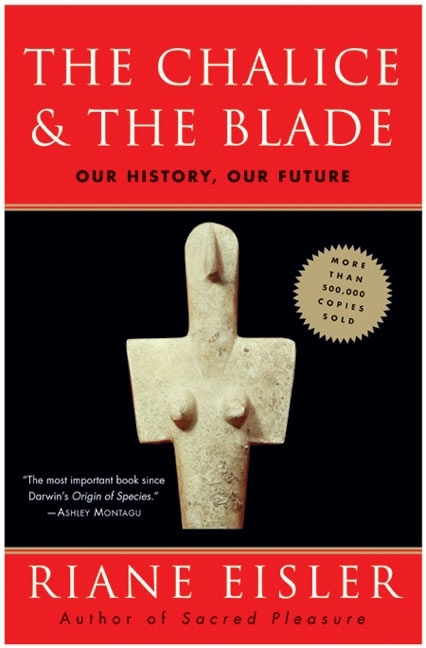
The Chalice and the Blade tells a new story of our cultural origins. It shows that warfare and the war of the sexes are neither divinely nor biologically ordained. It provides verification that a better future is possible—and is in fact firmly rooted in the haunting dramas of what happened in our past
Riane Eisler is internationally known for her bestseller The Chalice and The Blade, now in 26 foreign editions and celebrating its 30th anniversary with a new 2017 epilogue in its 57th US printing, as well as for other award-winning books. She keynotes conferences worldwide, with venues including the United Nations General Assembly and the US Department of State. She is President of the Center for Partnership Studies and has received many honors, including honorary Ph.D. degrees, the Alice Paul ERA Education Award, and the Nuclear Age Peace Foundation’s 2009 Distinguished Peace Leadership Award, and is featured in the award-winning book Great Peacemakers as one of 20 leaders for world peace, along with Mahatma Gandhi, Mother Teresa, and Martin Luther King.
Pope Francis issues an appeal to state leaders and to the international community to ensure a ceasefire may be reached in countries suffering from war before Christmas.
By Linda Bordoni
Pope Francis on Sunday launched a plea directly to political leaders and to the international community that ceasefires may be agreed upon in all countries torn by war before Christmas.
“I appeal to Governments and the International Community, that a ceasefire may be reached on all war fronts by the Christmas celebrations,” he said during the Angelus prayer.
“I appeal to Governments and the International Community, that a ceasefire may be reached on all war fronts by the Christmas celebrations.”
His words followed his request that all men and women of goodwill join in prayer for peace in war-torn countries worldwide.
“Let us continue to pray for peace, in tormented Ukraine, in the Middle East – Palestine, Israel, Lebanon, and now Syria – in Myanmar, in Sudan, and wherever people suffer from war and violence,” the Pope pleaded.
Countries at war
His reiterated appeal comes as violence continues to rage in Gaza, where over 40,300 people have been killed since the Hamas attack on Israel on 7 October 2023 and in neighbouring Lebanon where Israeli attacks have also escalated in the past months; as Ukraine recently marked the tragic milestone of 1,000 days from a full-blown Russian invasion of the country; in Myanmar where civil war has been ongoing g since a military coup overthrew the government in 2021; in Sudan where fighting between the army and paramilitary rebels has killed over 60,000 people and displaced millions since April 2023.
The Pope also mentioned the volatile situation in Syria where a 14-year conflict appears to have come to a head in the past hours with rebels claiming to have captured the capital, Damascus.
BePeriod Po • Nov 23, 2024 There are periods in the life of humanity… often coinciding with geological cataclysms, climatic changes, and similar phenomena of a planetary character, when the masses irretrievably lose their reason and begin to destroy everything that has been created by centuries and millenniums of culture…” said George Gurdjieff. “Such periods release a very great quantity of the matter of knowledge. This, in its turn, necessitates the work of collecting this matter of knowledge which would otherwise be lost.” This is an excerpt of our 6-day workshop on Esoteric Hinduism.
It takes a long time to know a person — to unbutton the costume of personality and unlace the corset of coping mechanisms in order to touch the naked soul. It is a process delicate and difficult, riven by anxiety and absolutely terrifying to both, requiring therefore great courage and great vulnerability — a process the hard-won product of which we call intimacy. “There is no terror like that of being known,” Emerson anguished in his journal while trying to navigate his deep and complicated relationship with Margaret Fuller. It is a wise terror, for it knows that there is no greater pain than the pain of intimacy severed — by betrayal, by distance, by death. To triumph over that terror in order to know and be known on the level of the naked soul is an act of faith — perhaps the greatest act of faith there is. Because all faith requires a surrender to something we cannot control, all faith begins with the anguishing anxiety that prefaces the leap.
Poet and philosopher David Whyte explores the terrifying and transcendent work of intimacy in Consolations II — the second volume of his short, splendid essays, each reckoning with the deeper meaning of some ordinary and overused word to reveal its unexamined emotional etymology. In “Intimacy,” he writes:
Intimacy is presence magnified by our vulnerability, magnified by increasing proximity to the fear that underlies that vulnerability. Intimacy and the vulnerabilities of intimacy are our constant, invisible companions, yet companions who are always wishing to make themselves visible and touchable to us, always emerging from some deep interior, to ruffle and disturb the calm surface of our well apportioned lives. Intimacy is a living force, inviting me simultaneously from the inside as much as the outside. Something calling from within that wants to meet something calling in recognition from without. Intimacy is the art and practise of living from the inside out.
[…]
Our need and our fear of intimacy is felt through an ever present almost volcanic force emerging from some unknown origin inside us, exhibiting to all and sundry, our previously hidden unspoken desires, flowing out against all efforts to the contrary, through our unconscious and conscious behaviours.
To become intimate is to become vulnerable not only to what I want and desire in my life, but to the fear I have of my desire being met.
This is the paradox of longing: Because longing can be an addiction, because no active addict ever wants to give up their addiction — or can without a great deal of suffering — it can be terrifying and almost unbearably vulnerable to surrender to an intimacy so amply fulfilling that it leaves nothing to long for. And yet in that vulnerability lies our power and our freedom to transform a relationship from a tether of dependency into a slender cord of grace.
David writes:
Intimacy cannot occur without a robust sense of vulnerability, and is tied to the sense of being pulled along in the gravitational field of any newly felt openness. In that new openness we feel as if we are pulled through the very doorway of our needs for something we desire deeply but cannot fully identify, partly because what we are about to identify is intimately connected with our own ability or inability to love.
Ultimately, he observes, intimacy is an instrument of discovery and self-discovery — a way of turning the walls between us and within us into sunlit windows through which to see and be seen:
Intimacy always carries the sense of something hidden about to be felt and known in surprising ways; something brought out and made visible, that previously could not be seen or understood. In intimacy what is hidden will become a gift, discovered and rediscovered again and again in the eyes of both giver and receiver.
[…]
To become human is to become visible, while carrying what is hidden as a gift to others.
Because what is visible is vulnerable, because what can be seen can be touched and what can be touched can be wounded, he adds:
Intimacy is intimately related to our sense of having been wounded, and the startling intuition that my way forward into life, or into another person’s life will be through the very doorway of the wound itself. Intimacy invites me to learn to trust the way being wounded has actually made me more available, more compassionate and possibly more intimate with the world, by being opened in ways I never realised it was possible to be open… Intimacy is always calibrated by the letting go of or the taking on of fear. Almost always our fear is experienced as an intimate invitation to understand and feel fully our particular form of wounded-ness.
[…]
Intimacy finds its ultimate expression in all the forms of surrender human beings find difficult to embrace.
The difficulty of that surrender almost always takes shape as anxiety — a word to which David devotes another of the book’s essays. Anxiety, he observes, is often an avoidance mechanism and a dissociation device — “a protection against real intimacy, real friendship and real engagement with our work,” a way not to feel “the full vulnerability of being visible and touchable in a difficult world.” In anxiety, we disallow ourselves “the ability to stop and rest and the spacious silence needed for… a new understanding” — and all true intimacy opens into a new understanding of ourselves, so that “we learn that what we thought we knew is not equal to what we are discovering… that who we thought we were is not who we are now.”
By allowing true intimacy on the smallest scale of personal love — the bond between one and one — we open into the largest scale of belonging, into cohesion with what Margaret Fuller, inspired by Goethe, called the All. David writes:
The need for intimacy in a human life and in a human social life is as foundational as our daily hunger and our never ending thirst, and needs to be met in just the same practical way, every day, just as necessarily and just as frequently: in touch, in conversation, in listening and in seeing, in the back and forth of ideas; intimate exchanges that say I am here and you are here and that by touching our bodies, our minds or our shared work in the world, we make a world together… Intimacy is our evolutionary inheritance, the internal force that has us returning to another and to the world from our insulated aloneness again and again, no matter our difficulties and no matter our wounds.
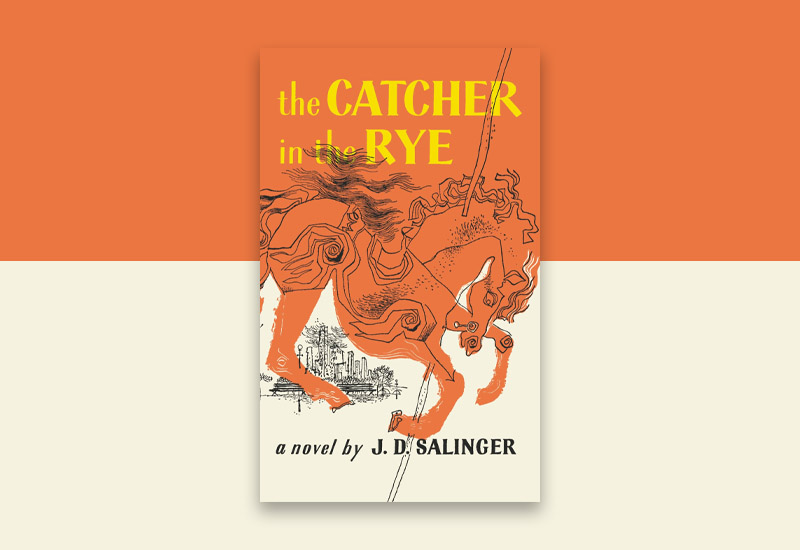
Mark David Chapman shoots John Lennon, and then proceeds to flip through his copy of The Catcher in the Ryeuntil the police come.
On December 8, 1980, Mark David Chapman, a former mental patient and ex-security guard, shot and killed John Lennon outside his home in New York City. Then he sat down. When the cops came, he was waiting for them, reading his copy of J.D. Salinger’s The Catcher in the Rye. That afternoon, Chapman told police: “I’m sure the big part of me is Holden Caulfield, who is the main person in the book. The small part of me must be the Devil.” After his arrest, Chapman sent a statement to The New York Times, handwritten on yellow legal stationery in capital letters, with a ballpoint pen: It is my sincere belief that presenting this written statement will not only stimulate the reading of J.D. Salinger’s The Catcher in the Rye but will also help many to understand what has happened. If you were able to view the actual copy of The Catcher in the Rye that was taken from me on the night of Dec. 8, you would find in it the handwritten words “This is my statement.” Unfortunately I was unable to continue this stance and have since spoken openly with the police, doctors and others involved in this case. I now fully realize that this should not have been done for it removed the emphasis that I wanted to place on the book. My wish is for all of you to someday read The Catcher in the Rye. All of my efforts will now be devoted toward this goal, for this extraordinary book holds many answers. My true hope is that in wanting to find these answers you will read The Catcher in the Rye. Thank you. Chapman’s defense team urged him to plead not guilty by reason of insanity, but Chapman refused, and pleaded guilty. At his sentencing, Chapman read the passage that gives the novel its name, in which Holden fantasizes about standing at the edge of a cliff and protecting the children playing nearby from falling off. “Simply put, it appears Chapman misread The Catcher in the Rye,” wrote Daniel Stashower in “On First Looking into Chapman’s Holden: Speculations on a Murder.” He took the “catcher” passage to be the novel’s solution, when in fact it is the crisis. … Holden Caulfield could not find a way to preserve innocence forever and was forced to entertain the notion of growing up. If I am correct in my speculation, Chapman found a way. Taking as a model the only character in The Catcher in the Rye who achieved perpetual innocence, Chapman found his course clear. For John Lennon’s innocence—which was essential to Chapman’s own spiritual well-being—to remain intact, Lennon himself would have to die. Only then could his innocence, like [Holden’s dead brother] Allie’s, be preserved forever. Chapman was sentenced to twenty years to life, and remains in prison.
“Many experiences in life are common to all of us, and a word or two is frequently enough to enrich a story with a wealth of recollection; take, for instance, the words “income tax.”
–SHIRLEY JACKSON
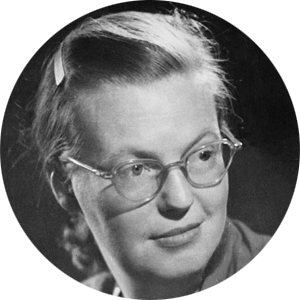
Shirley Hardie Jackson (December 14, 1916 – August 8, 1965) was an American writer known primarily for her works of horror and mystery. Her writing career spanned over two decades, during which she composed six novels, two memoirs, and more than 200 short stories. Wikipedia
During the holiday season, we often reflect on what we’re grateful for and what gifts we might want to receive or give to those we love. One of the greatest gifts I have been given involves my family and my work with men and their families.
It has been said that the two most important days of our life are the day we were born and the day we found out why. I was born on December 21, 1943. I found out why was November 21, 1969, the day our first son, Jemal, was born. When I held him in my arms, I made a vow that I would be a different kind of father than my father was able to be for me and to do everything I could to create a world where fathers were fully healed and engaged with their families throughout their lives.
Following the birth of our daughter, Angela, on March 22, 1972, I launched my website MenAlive.com. Like many parents who have boy children and girl children, I soon became fascinated with their similarities and differences. Many things followed the gender norms that we tend to associate with male or female qualities. Despite giving them a range of toys to play with, our son was drawn to toy cars and our daughter was drawn to dolls.
We usually think of boys and men as being the risk-takers, but in our family, Angela was the risk-taker. Growing up in California, summer fun usually involved water sports so getting the children accustomed to water was something we started early. Angela loved the water. As soon as she could walk she toddled into the deep end of the community pool in our neighborhood. She immediately sank to the bottom and I had to dive in to rescue her. Pulling her own and admonishing her, I was sure she would never do that again. But I was wrong. As soon as our heads were turned, she scampered to the pool’s edge and repeated the process. She learned to swim very quickly or she wouldn’t still be here.
When I finished college at U.C. Santa Barbara in 1965, I applied and was accepted into several medical schools. I chose U.C. San Francisco and had visions of becoming a psychiatrist so I could help men like my father who had taken an overdose of sleeping pills when I was five years old after he had become increasingly depressed because he felt he couldn’t make a living to support me and my mother.
I grew up wondering what happened to my father, when it would happen to me, and how I could prevent it from happening to other families. I wrote about my father’s healing journey in my book, My Distant Dad: Healing the Family Father Wound.
I found traditional medical education too restrictive at the time and I transferred to U.C. Berkeley’s School of Social Welfare where I earned a master’s degree in Social Work in 1968. I began a PhD program at the same time, but found I was doing research about issues with which I had little life experience. After many years working in the field, I returned to school and earned a PhD in International Health.
Even before I had children sex and gender issues were on my mind. When I began medical school in 1965, nearly all the students were male. When I transferred to social work, nearly all the students were women. When I graduated in 1968 and began getting interested in men’s health issues, there were very few professionals working in the field.
In was a time when feminism was on the rise. I still have my paperback copy of Betty Friedan’s The Feminine Mystique with the $.75 price posted on the cover. I had bought the book when it first came out in 1963 and discussed it with my wife as we contemplated marriage. After publishing The Feminine Mystique, one of the best-selling books of the 1960s, Betty Friedan led a life of political action on behalf of feminism that led to a reformation of American laws and culture. She helped found the National Organization for Women in 1966, an organization that won notable legal and political victories for feminism. Friedan believed the future of civilization depended upon women choosing a new, career-focused way of life.
The first chapter of Friedan’s book was titled, “The Problem That Has No Name.” She described the increasing dissatisfaction that women were feeling in the 1960s.
“The problem lay buried, unspoken, for many years in the minds of American women,”
said Friedan.
“It was a strange stirring, a sense of dissatisfaction, a yearning that women suffered…She was afraid to ask even of herself the silent question, ‘Is this all?’”
My wife was questioning the roles that she and other women were being told they must follow. I was dealing with similar questions about the male role. I had seen my father nearly die because he felt he was a failure at the traditional “breadwinner” role for men. I certainly wanted to be successful in the world of work, but I also wanted to be successful as a husband and a father.
I saw the emerging women’s liberation movement as being a movement for men’s liberation as well. In my mind, if women were breaking out of old sex and gender roles that meant men could break out of the complementary roles that were restricting men. Although some feminists I encountered in the 1960s saw men as allies, most did not.
I remember going into San Franciso one Saturday in 1965 and visited a feminist bookstore. I was alone, but always loved to explore bookstores and look for interesting books. I was immersed in the glorious world of reading and didn’t notice the young boy who kept bumping into me as the walked the isles pulling out books that could my attention. I finally noticed him and smiled as he walked by. On the next pass, he pushed a piece of paper into my hands.
At first I thought this was a playful game the boy was initiating until I read the note. My heart broke when I read it. In the scrawling handwriting of an eight-year-old it said, “We don’t like men in this store.” I looked up and saw the woman behind the desk looking at me, obviously the boy’s mother. I don’t know whether she would have approved of the note he left or what messages she passed on subconsciously, but it pained me to think about what this boy would feel about himself as a male as he grew older.
Training Men to Work in the Helping Professions
Richard V. Reeves is the founding president of the American Institute for Boys and Men (AIBM) and author of the book, Of Boys and Men: Why The Modern Male is Struggling, Why It Matters, and What to Do About It. He says,
“Mental health needs are pervasive among men, yet the share of men meeting those needs in mental health professions is low and declining.”
He goes on to say,
“Men account for only 18% of social workers and 20% of psychologists, down from a male share of 38% in social work and 68% in psychology in 1968″.
I was fortunate to have been healthcare professional who specializes in working with men and their families for many years. It has been a wonderful profession that I have enjoyed for more than fifty years. I have been able to do work I love, with people I care about, and make a great living for myself and my family.
Beginning in 2025, my MenAlive Academy for Gender-Specific Healthcare is planning to offer trainings for the following groups:
Men who are trained and licensed professionals in fields including medicine, psychology, social work, marriage and family counseling, who want to specialize in working with men and their families.
Male practitioners including coaches, facilitators, healers, who currently work with men but want to add to their skills and professional success.
Male professionals, including those from the business world and other fields, who would like to develop expertise to work to improve men’s mental, emotional, and relational well-being.
If you would like to get more information about me and my work, you can visit me at www.MenAlive.com. If you would like to get more information about upcoming trainings, please email me: Jed@MenAlive.com and put “Men’s Training” in the subject line. If you know men who may be interested, please share this information with them.
I will be writing a series of articles to share more information about why men should consider becoming professionally involved with helping men and their families. If you are not already subscribed to my free weekly newsletter, you can do so here:
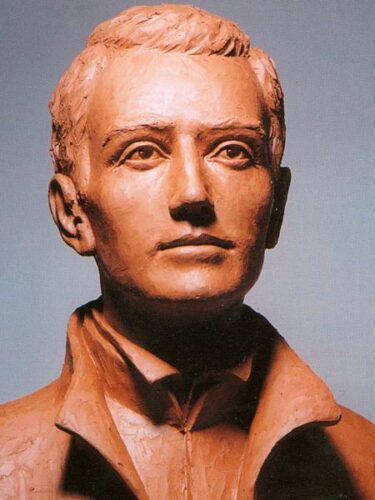
Blessed Bernardo Francisco de Hoyos y de Seña is an 18th-century Spanish priest who wrote vividly of his mystical gay marriage to Jesus. This queer saint was beatified in 2010 and his feast day is Nov. 29.
On Nov. 28, 2020, Q Spirit presented a new, never-before-published translation of one of Bernardo’s queer visions, plus a newly translated prayer calling upon him. These beautiful modern translations were done by Cody Hooks, who was a queer student at Harvard Divinity School. The translations are presented in full later in this article.
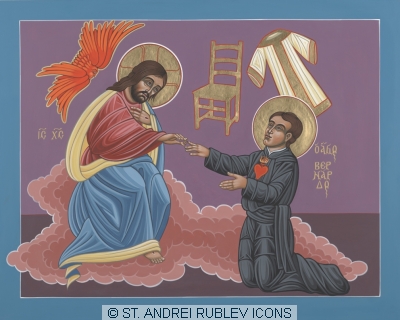
Bernardo (1711-1735) was 18 when he had a vision of marrying Jesus in a ceremony much like a human wedding. He described it this way:
Always holding my right hand, the Lord had me occupy the empty throne; then He fitted on my finger a gold ring…. “May this ring be an earnest of our love. You are Mine, and I am yours. You may call yourself and sign Bernardo de Jesus, thus, as I said to my spouse, Santa Teresa, you are Bernardo de Jesus and I am Jesus de Bernardo. My honor is yours; your honor is Mine. Consider My glory that of your Spouse; I will consider yours, that of My spouse. All Mine is yours, and all yours is Mine. What I am by nature you share by grace. You and I are one!” (quoted from “The Visions of Bernard Francis De Hoyos, S.J.” by Henri Bechard, S.J.)
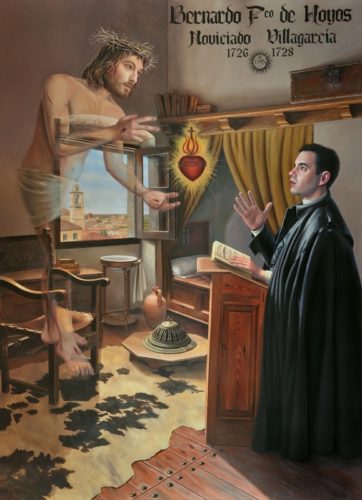
Bernardo’s vision inspired artist-priest William Hart McNichols to paint an icon of Bernardo’s wedding with Jesus. It is surprising to see that the sacred heart of Jesus is burning in Bernardo’s own chest.
“I was so taken with this profoundly beautiful account of Jesus’ mystical marriage with Bernardo, including all the symbols of a human wedding,” McNichols wrote.
Bernardo’s experiences fit into a long tradition of “mystical marriage” comparing the soul’s union with God to a human wedding. It is also called nuptial mysticism or bridal mysticism. Other men who were honored by the church and experienced the queer “bridal mysticism” of a same-sex “mystical marriage” to Jesus include Bernard of Clairvaux, John of the Cross, Paul of the Cross (Paul Danei) and John of La Verna.
Bernardo de Hoyos was inspired by queer visions
Official Roman Catholic accounts emphasize how Bernardo went on to become “the first apostle of the Sacred Heart of Jesus in Spain,” but the church downplays the queer vision that inspired him. Bernardo’s marriage with Christ can justifiably be interpreted as a “gay Jesus” story.
Bernardo lived during the so-called Golden Age of Spanish mysticism, when famous saints such as John of the Cross, Teresa of Avila and Ignatius of Loyola renewed the church by describing their intimacy with Christ.
Bernardo spent nine years in the Jesuit formation process and was ordained in January 1735. His pastoral ministry was cut short later that same year when he died of typhus on Nov. 29, 1735. Some call him a “boy saint” because he only lived to be 24. His dying words indicate that he felt the presence of his Spouse Jesus at the end. Bernardo’s last words were, “Oh, how good it is to dwell in the Heart of Jesus!”
After his death, Bernardo’s superiors preserved and circulated the journals and letters where he wrote about his spiritual life. His reputation for holiness continued to grow, but church politics slowed his path to sainthood until the 21st century. His beatification ceremony was held in April 2010 in the northwestern Spanish province of Valladolid, where Bernardo spent his entire life.
While the Catholic church refuses to bless same-sex marriages, the lives and visions of its own saints tell a far different story — in which Christ the Bridegroom gladly joins himself in marriage with a man.
Translated vision: “Bernardo, I Want You as Mine”
A newly translated portion of Bernardo’s visions is posted here for the first time online. The modern translation was done by Cody Hooks, a queer writer, editor, and gardener with roots in the South and Southwest. He is a student at Harvard Divinity School focusing on spiritual caregiving.
“This translation takes up a particular task: to excavate and elevate the queer nature of the unspeakable, mysterious love that existed between the Divine and male mystics like Bernardo,” Hooks explained. “To that end, I have chosen to translate the words ‘bride’ and ‘wife’ as ‘companion.’ I think the phrase ‘bride of Christ’ (especially as it is used for the collective of all professed Christians) is, firstly, so common as to be clichéd, and secondly, too narrow for my project of making the version of holy love in Bernard’s mystical union more available to queer spiritual seekers today.”
Here is the translation:
____________________
For this heavenly betrothal, Jesus the Lord was readying Bernardo, his beloved servant, for the mystical union. Jesus gave him particular gifts; the first wedding favor was speaking luxuriously to Bernardo in the interior of his spirit and, like this, asking his very soul for consent to be married. The Lord said to him in the divine language and love:
“Handpicked soul of mine, I want you for my companion. I am the Son of the Eternal Father, equal and the same as Him, and from whom I come by generative creation. I am the second face of the Blessed Trinity, having the same essence as the Father and the Holy Spirit. Equal is my power, my grandeur, my immensity, my kindness, my distinctions and my perfections with the Father and the Divine Spirit. Really consider whether you want to have me for your husband, because I want you as mine.
I am God and Man, thus blessed as a Man in all the dowries corresponding to my heavenly dignity. I am the most beautiful of Men. The scriptures are full of my grandeurs. Authority over all of creation has been handed to me, being King of all that is. This beautiful machine of the Universe, with all its perfections, has grabbed hold of me like the Maker, as God and as the heir to the reign of Judah. The supreme Angels kneel before me and they adore me, knowing the dignity that I have and the infinite distance that there is between them and myself.
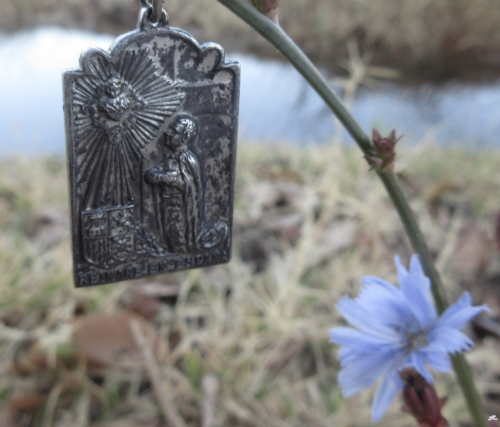
Vintage holy medal of Bernardo de Hoyos (Photo by Andrew Robson)
Consider, beloved soul, if it would suit you to take me as your husband, because I — who only have love for you — want to marry myself with you. Consider it well, and desire it with the desires owed, because much time is still to pass; meanwhile, I will go on preparing you and giving you lavish gifts, that will be a certain pledge. These are my favors and the first is this vision, which I have made to burn in your heart,” said Jesus to his beloved, Bernardo.
And Bernardo answered his Beloved, “The words were clear as day and deep inside me, and my soul was listening to these sweet nothings with sweet fright. Oh who has the tongue of angels to say some pretty little thing about how much happened in my soul in this moment! Now see for yourself how pleasant and full of love these recited words are. But such was the love with which he told this to me that, if his Majesty does not treasure and keep my life, it would be impossible to live.”
The Lord was waiting for the answer, but Bernardo’s confused soul, submerged in the abyss of its miseries and its own nothingness, did not know what to do, seeing with a clear light what had been communicated to him and how unworthy he was of this sovereign favor. He seemed undone and annihilated. Stunned and surprised by excessive admiration, Bernardo could not speak, as if embraced in living flames of love. And babbling, without forming a word, he was speaking in riddles and could only say: “Ecce Ancilla Domini fiat mihi secundum Verbum tuum” — “Here is the servant of the Lord, let it be done to me according to your Word.”
It is not easy to explain other such virtuous acts, to explain how, with this singular fondness, Bernardo only loved, admired, praised, magnified, thanked, adored, venerated and exalted the grandeurs of his Beloved. He was confused, annihilated and looked unworthy of such great favor.
“The effects of this proposal have been divine,” Bernardo said. “And now I had better be silent, since I am pining from love and I cannot go on.” ____________________
The section translated here comes from Book 1, Chapter 10 of the biography written by Padre Juan de Loyola S.J., Bernardo’s spiritual director.
Translated prayer: “O Bernardo, young and kindest angel, pray for us”
Cody Hooks also translated a 19th-century Spanish prayer calling on the energies of Bernardo. It was written by Father José Eugenio de Uriarte around 1896.
“This is a prayer for centering yourself in love. To work with this prayer in the tradition of a Roman Catholic novena, as it was originally written, pray it every day for nine days. Hold in your heart a specific intention, such as the healing of someone who is sick, the wellbeing of your community, or the needs of a friend or your family. You can also pray for the needs and longings in your own heart. (The spot for making these “petitions” is marked in the prayer with a set of asterisks),” Hooks explained.
“Bernardo de Hoyos: Villagarcia novitiate, 1776-1778,” source unknown
To begin, Hooks suggests settling into a comfortable position and looking at an image of Bernardo or the Sacred Heart. Then pray:
“Holy and eternal are the divine gifts of the cosmos, and blessed is the miraculous unfolding of every form of life, made with perfection in the first instant of their creation. May it be so.”
This is followed by silent meditation and optional movement such as a bow, making the sign of the cross, or another bodily gesture that feels holy. When ready, move on to the main prayer:
____________________
Oh Beloved Bernardo, you are the embodiment of spiritual seekers. You are the most precious jewel of your ancestors, child of perfect divinity, and my most loving protector. Open and trusting, I come to you. I come to you for your powerful, spiritual guidance. Oh Bernardo, Beloved of Jesus and Friend of the Sacred Heart of Universal Love, I contemplate the grit on your brow and the radiant crown of your soul. With all the energy with which you loved this holy and infinite presence, please bless the body, mind and soul of **my beloved** with the blessings of perfect wellness.
Bernardo, my most beloved companion, please ask our most loving Mother, Mary, to help me open myself to the eternal flow of loving-kindness you knew so well. Because of the tender relationship that you had with Her, for which she let you glimpse the cosmic mysteries, I know with every particle of my being that you receive my intentions with care.
Oh Bernardo, kindly hear my prayers. May your burning love reach those who need it. May you have your place among the saints and on the altars, helping to guide the everyday miracles and profound transformations at work in our lives. May you especially bless the sick and troubled, and those who dwell in compassion and loving-kindness. May I do what I can with what I have, and like you, may I do it always with the infinite love of the cosmos. May it be so.
Heart of Love, bless our ancestors and the generations to come.
Heart of Love, glorify our beloved Bernardo. Please hear our prayers and grant miracles to those who need them.
Heart of Love, through Holy Mary and through every cell of creation, help us soon, and may the seeds of your divine essence now blossom.
O Bernardo, young and kindest angel, pray for us.
____________________
This prayer comes from “Vida Del P. Bernardo Francisco de Hoyos de La Compañia De Jésus” by José Eugenio de Uriarte and Vicente Agustí, published in Barcelona in 1896 by Francisco Rosal.
It is also part of the Queer Christ series series by Kittredge Cherry at the Jesus in Love Blog. The series gathers together visions of the queer Christ as presented by artists, writers, theologians and others.
This article was originally published on Q Spirit in November 2016, was expanded with new material over time, and was most recently updated on Nov. 27, 2024.
Kittredge Cherry is a lesbian Christian author who writes regularly about LGBTQ spirituality.She holds degrees in religion, journalism and art history.She was ordained by Metropolitan Community Churches and served as its national ecumenical officer, advocating for LGBTQ rights at the National Council of Churches and World Council of Churches.
Police arrested 41 people at a Mexico City drag ball known as the Dance of the 41 Queers in a notorious police raid on Nov. 17-18, 1901. Now the Dance of the 41 is being reclaimed by the LGBTQ community, and same-sex marriage is legal in Mexico City. Cross-dressing balls are an international phenomenon that has continued for centuries, sometimes protected and often persecuted.
The Mexico City raid caused a huge scandal with lasting repercussions against LGBTQ people. The incident was widely reported and was used thereafter to justify years of police harassment, including more raids, blackmail, beatings and imprisonment. The number 41 entered popular culture in Mexico and continues to be used as a negative way to refer to gay men, evoking shame. The number is so taboo that in Mexico many buildings have no 41st floor, no army battalion is named 41, and many hotels and hospitals have no room 41.
About half of the people at the Dance of the 41 were described as men in female clothing, with European-style silk and satin dresses, elegant wigs, jewelry and make-up. The rest of the group wore expensive tailcoats and white gloves. Police raided the private house where the “transvestite ball” was underway. They never released the names of those arrested because they came from the upper-class elite of Mexican society. Reportedly a 42nd guest was allowed to go free because he was the president’s son-in-law. The guests at the Dance of the 41 are usually described as gay or homosexual, but recently some are identifying the cross-dressers as transgender.
The lives and reputations of the 41 detainees were ruined. Those dressed in women’s clothing were forced to sweep the streets of Mexico City in female attire. Some were imprisoned and another group was forced into the army, where they dug ditches and cleaned latrines in the Yucatan. A lesbian gathering in Santa Maria was raided soon after on Dec. 4, 1901, but it received much less publicity.
The event is known in Spanish as simply as “el baile de los cuarenta y uno” (the dance of the forty-one) or with an added anti-gay insult “el baile de los cuarenta y uno maricones” (the dance of the forty-one queers).
“El baile de los 41” a Spanish-language feature film about the Dance of the 41, premiered in theaters in 2020. It was dubbed into English and premiered worldwide on Netflix in May 2021 as “Dance of the 41.” It was directed by David Pablos, written by Monika Revilla and filmed on location in Mexico City and Guadalajara. Even the video trailer is fascinating because it shows what the fateful ball might have been like.
Artists portray the Dance of the 41
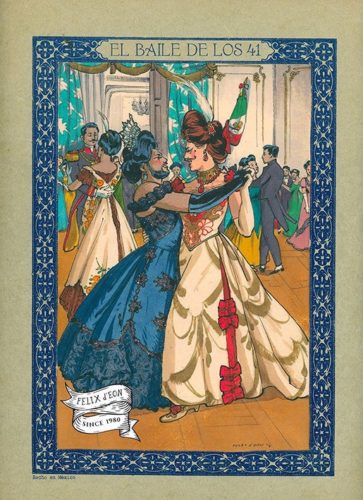
A gay Mexican artist celebrates the Dance of the 41 in the painting at the top of this post: “El Baile de los 41” by Felix d’Eon. “I painted a scene from the party, in which the men enjoy a beautiful evening, of happiness, friendship, and love, before their lives are ruined forever, at the ‘Dance of the 41,’” he explains. Based in Mexico City, D’Eon describes himself as a “latinx painter and activist dedicated to the art of queer love, romance, and sensuality,” Prints of this and his other art are available at Art of Felix d’Eon Etsy shop.
“Los 41 Maricones” (The 41 Queers) by Jose Guadalupe Posada, 1901 (Wikipedia)
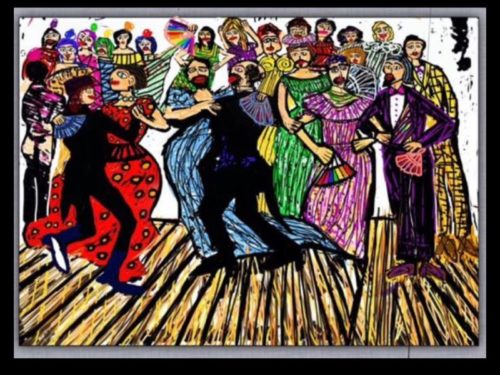
The vivid reports of the Dance of the 41 included a famous series of caricatures by popular Mexican artist Jose Guadalupe Posada. One of his satirical images is revitalized in a colorful painted drawing by Ralfka Gonzalez. He is a self-taught Chicano artist and gay Latino activist who divides his time between Oaxaca, Mexico and San Francisco. Gonzalez often paints Mexican and/or gay themes in a folk-art style. Some of the dancers wave rainbow fans in his “Los 41 Homosexuals de Mexico.” He intends to turn it into a limited-edition print to raise funds for queer causes.
The mocking images also stand in contrast to the LGBT Stations of the Cross by Mary Button, whose paintings connect police raids of queer bars with the suffering of Jesus. The raid on the Dance of the 41 is an example of police harassment that happened in many countries and continues in some.
Dance of 41 is being reclaimed
Mexico’s 41 queer dancers were condemned as sinners, but they are included in the LGBTQ Saints series because their arrest and humiliation has contributed to LGBTQ visibility and pride. They represent the courage of all who were punished because of the queer ways that they lived and loved.
Mexico City became the first Latin American jurisdiction to legalize same-sex marriage in 2009 — before the U.S. Supreme Court legalized marriage equality. The law took effect on March 4, 2010.
A non-profit organization called “Honor 41” honors and celebrates Latinx LGBTQ individuals who are role models. Their English-language video on the Dance of the 41 gives an accessible overview of the history.
___ Top image credit: “El Baile de los 41” by Felix d’Eon. Prints are available at his Etsy shop.
___ This post is part of the LGBTQ Saints series series by Kittredge Cherry. The series celebrates religious and spiritual holidays, events in LGBTQ history, holy days, feast days, festivals, anniversaries, liturgical seasons and other occasions of special interest to lesbian, gay, bisexual, transgender and queer people of faith and allies.
This article was originally published on Q Spirit in November 2016, expanded with new material over time, and most recently updated on Nov. 16, 2024.
Kittredge Cherry is a lesbian Christian author who writes regularly about LGBTQ spirituality.She holds degrees in religion, journalism and art history.She was ordained by Metropolitan Community Churches and served as its national ecumenical officer, advocating for LGBTQ rights at the National Council of Churches and World Council of Churches.
Consciousness, spirituality, biography, sexuality, androgyny, futurism, space, the arts, science, astrology, democracy, humor, books, movies and more




 Intimacy is presence magnified by our vulnerability, magnified by increasing proximity to the fear that underlies that vulnerability. Intimacy and the vulnerabilities of intimacy are our constant, invisible companions, yet companions who are always wishing to make themselves visible and touchable to us, always emerging from some deep interior, to ruffle and disturb the calm surface of our well apportioned lives. Intimacy is a living force, inviting me simultaneously from the inside as much as the outside. Something calling from within that wants to meet something calling in recognition from without. Intimacy is the art and practise of living from the inside out.