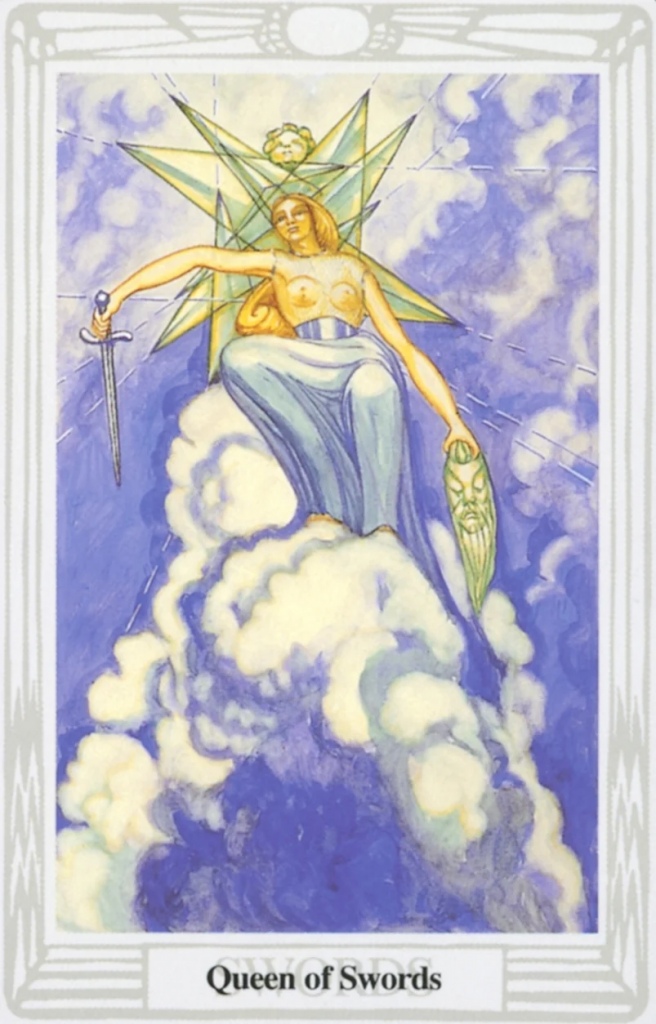
Here we see the Queen of perception and insight. It’s a hard thing to pull the wool over the eyes of somebody like this – they will look beyond the face we present and see to the very core of the being. That’s one reason why this Queen often represents a woman who stirs deep and complex reactions in the people who come into contact with her. They can feel uneasy, discomforted and awkward when being observed by her. But they may also feel open, relieved and glad to have found somebody with such long sight.On a day ruled by her, we need to practise our own powers of perception. Rather than dealing with the imaginal psychic quality which is rightly the realm of the Queen of Cups, we must now turn our attention to the everyday world. For, though the Queen of Swords is often highly spiritually developed, she is also absorbed by the intricacies of the process of life. Therefore she looks closely at what happens in life around her.On this day, try to remind yourself to study the interactions you have with others. Don’t just deal with the face value. Struggle to seek behind that mask for the whole being beyond.Everybody takes up roles, plays out games, displays masks. We have ‘professional’ faces, which fit each of our roles. And we can become forgetful of the fact that every person we meet does the same thing. Only when we come to know a person well do we recognise the complexity that lies behind the mask.Recognise yourself when you take up a mask. Know that at this moment you are acting like (for instance) a working person doing their job, or a family member loving the family, or a person alone and taking a bath. Look hard at yourself. You take up roles. Use this day to begin to identify them clearly. Examine the way that you feel differently in each situation. And recognise that though each of those roles is an expression of you, not one single one of them IS you.Then take that realisation beyond you into the world…Affirmation: “My life is a constant and glorious exploration.”
If there’s one principle on which the vast majority of Chinese people agree, it’s meritocracy. People believe that social resources and social status should be allocated according to personal merit and that everyone — regardless of their background — should enjoy equal opportunities, with their ultimate success defined by their abilities, education, and hard work.
Chinese people’s faith in meritocracy is rooted in both our culture and our institutions. The imperial examination allowed talented individuals to rise through the bureaucracy on the basis of their education and abilities. After the market reforms of the 1970s and ’80s brought an end to Maoist egalitarianism, personal ability, educational qualifications, and expertise were all closely intertwined with one’s new economic status.
The embodiment of this trend was the revival of the gaokao college entrance exam. Although fiercely competitive, the degree it promised resulted in a significant increase in salary in the 1980s and ’90s. People who grew up in poverty and made it into university transformed their lives.
But as higher education has become more commonplace, degrees hold less and less value on the job market. Prior to the expansion of higher education in 1998, the percentage of high school students who were accepted into undergraduate programs was only 25.9%; 20 years later, that figure had soared to 54.2%. The ever-growing pool of university graduates has led to cut-throat competition extending beyond the gaokao and into the graduate school entrance exam, civil service exam, and job market.
The depreciation of diplomas has reinforced the influence of factors outside students’ control — such as their place of birth, family background, and social connections — on their educational prospects, and by extension their opportunities later in life. Disillusionment seems to have become so widespread there’s even a set phrase for the phenomenon: “poor familes struggle to produce successful sons.” Meanwhile, mounting pressure on young people has produced a series of cynical online buzzwords over the course of the last 15 years, ranging from pindie (“to rely on family connections”) and “985 losers” (a reference to unsuccessful graduates of China’s elite “Project 985” schools) to tangping (“lying flat”).
Together, these terms reflect a rising frustration in the face of tremendous societal pressure and dwindling social mobility. There’s just one problem: Very few young Chinese actually appear to be lying flat. Given this seeming paradox, I was curious: Do young Chinese university students still believe their country is a meritocracy — that education and hard work can change their fates?
To find the answer, my research team and I analyzed data from the 2018 Panel Study of Chinese University Students, a longitudinal study organized by the Chinese Academy of Social Sciences. The results came as something of a surprise. Our study found that around 70% of current university students still believe that individuals can succeed through hard work, no matter their family background.
This continued faith in meritocratic advancement is a product of their upbringing. Educational advancement in China is dictated by a rigorously standardized exam system. Although flawed, these exams are generally perceived as fair and objective measures of academic performance.
An interesting corollary to this finding, however, is the role exposure to digital media plays in determining students’ faith in the current system. Following the rapid development of information technology and the internet, online media has become a key means through which the public — and, in particular, young people — acquire information. Our research shows that students who view online content related to social injustices more often tend to have less faith in meritocracy, with such reports heightening their cynicism.
Investigating the public’s faith in meritocracy is important because of what it can tell us about society’s faith in itself. Our study indicates that, however widespread, memes about “lying flat” do not necessarily affect the mindsets of most Chinese university students. As a group, they still strongly agree that success is defined by merit.
But it’s just as important to interrogate the assumptions that underlie this faith. Meritocratic principles give people motivation to pursue their goals and faith in their ability to climb the social ladder. A side effect of this is that differences in meritocratic belief can actually reproduce and exacerbate social inequality. For instance, if upper-middle-class children share their parents’ high degree of faith in meritocracy, while those belong to lower social strata believe they no longer have the power to change their fates, then the disparity between the two groups will only become more deeply entrenched.
Differences in meritocratic belief can actually reproduce and exacerbate social inequality.
— Li Zhonglu, sociologist
This isn’t an idle concern. Among university students, the more prestigious a student’s university and the better their grades, the greater their faith in meritocratic advancement.
Among the general population, faith in meritocracy drops to 59%, with people’s degree of faith in the system closely correlated to their class.
Meanwhile, fierce competition within the education system means that kids who don’t make it into prestigious universities, or those whose grades aren’t up to par, face greater challenges establishing themselves after graduation. Their experience of failure can lead them to become more pessimistic or doubtful of the existence of meritocracy. Indeed, we’ve noticed that many students who attended mid-range schools or had mediocre grades choose to “lie flat” after graduation or live off their parents. If our education and employment systems are teaching the majority of the population to lose confidence in their future simply because of one academic setback, that’s nothing short of tragic.
There’s a reason why meritocracy is sometimes criticized as mere window dressing covering up social inequalities. In a healthy society, the criteria for success are diverse, and any system which rewards the strong and eliminates the weak does not really address the broader social factors that lead to inequality.
Translator: Lewis Wright, editors: Cai Yiwen and Kilian O’Donnell.
Mandatory Credit: Photo by Buckner/Variety/REX/Shutterstock (5827653am) Mark Burnett and Gary Barber Roma Downey honored with a star on the Hollywood Walk of Fame, Los Angeles, USA – 11 Aug 2016Shutterstock
In a statement released Wednesday, the TV producer says, “Given all the false media reports, I feel compelled to clarify a few points. I am not now and have never been a supporter of Donald Trump’s candidacy. I am NOT ‘Pro-Trump.’ Further, my wife and I reject the hatred, division and misogyny that has been a very unfortunate part of his campaign.”
These strong words come after many in the media pressed Burnett to release unaired footage from Trump’s time on The Apprentice, hoping that something as explosive as Friday’s video with Trump making sexist comments to Billy Bush might lie in Burnett’s archives. Burnett said in a statement on Monday that he wasn’t legally able to release any footage, which had some speculating he was trying to protect Trump. (Celebrity attorney Gloria Allred held a news conference on Tuesday calling on Burnett to release the footage.)
Trump hosted NBC’s The Apprentice, which Burnett created, from its 2004 debut until last year, when NBC dropped him following his remarks about Mexicans being “murderers” and “rapists.” Former Apprentice producer Bill Pruitt hinted on Twitter that he recalls “far worse” footage of Trump from his time on the show.
Ganesha (Sanskrit: गणेश, IAST: Gaṇeśa), also spelled Ganesh, and also known as Ganapati, Vinayaka, Lambodara and Pillaiyar, is one of the best-known and most worshipped deities in the Hindu pantheon[4] and is the Supreme God in the Ganapatya sect. His depictions are found throughout India.[5]Hindu denominations worship him regardless of affiliations.[6] Devotion to Ganesha is widely diffused and extends to Jains and Buddhists and beyond India.[7]
Although Ganesha has many attributes, he is readily identified by his elephant head and four arms.[8] He is widely revered, more specifically, as the remover of obstacles and bringer of good luck;[9][10] the patron of arts and sciences; and the deva of intellect and wisdom.[11] As the god of beginnings, he is honoured at the start of rites and ceremonies. Ganesha is also invoked during writing sessions as a patron of letters and learning.[2][12] Several texts relate anecdotes associated with his birth and exploits.
Ganesha is mentioned in Hindu texts between the 1st century BCE and 2nd century CE, and a few Ganesh images from the 4th and 5th centuries CE have been documented by scholars.[13] Hindu texts identify him as the son of Parvati and Shiva of the Shaivism tradition, but he is a pan-Hindu god found in its various traditions.[14][15] In the Ganapatya tradition of Hinduism, Ganesha is the Supreme Being.[16] The principal texts on Ganesha include the Ganesha Purana, the Mudgala Purana and the Ganapati Atharvasirsha.
Etymology and other names
Ganesha has been ascribed many other titles and epithets, including Ganapati (Ganpati), Vighneshvara, and Pillaiyar. The Hindu title of respect Shri (Sanskrit: श्री; IAST: śrī; also spelled Sri or Shree) is often added before his name.[17]
The name Ganesha is a Sanskrit compound, joining the words gana (gaṇa), meaning a ‘group, multitude, or categorical system’ and isha (īśa), meaning ‘lord or master’.[18] The word gaṇa when associated with Ganesha is often taken to refer to the gaṇas, a troop of semi-divine beings that form part of the retinue of Shiva, Ganesha’s father.[19] The term more generally means a category, class, community, association, or corporation.[20] Some commentators interpret the name “Lord of the Gaṇas” to mean “Lord of Hosts” or “Lord of created categories”, such as the elements.[21]Ganapati (गणपति; gaṇapati), a synonym for Ganesha, is a compound composed of gaṇa, meaning “group”, and pati, meaning “ruler” or “lord”.[20] Though the earliest mention of the word Ganapati is found in hymn 2.23.1 of the 2nd-millennium BCE Rigveda, it is uncertain that the Vedic term referred specifically to Ganesha.[22][23] The Amarakosha,[24] an early Sanskrit lexicon, lists eight synonyms of Ganesha: Vinayaka, Vighnarāja (equivalent to Vighnesha), Dvaimātura (one who has two mothers),[25]Gaṇādhipa (equivalent to Ganapati and Ganesha), Ekadanta (one who has one tusk), Heramba, Lambodara (one who has a pot belly, or, literally, one who has a hanging belly), and Gajanana (gajānana), having the face of an elephant.[26]
Vinayaka (विनायक; vināyaka) or Binayaka is a common name for Ganesha that appears in the Purāṇas and in Buddhist Tantras.[27] This name is reflected in the naming of the eight famous Ganesha temples in Maharashtra known as the Ashtavinayak (Marathi: अष्टविनायक, aṣṭavināyaka).[28] The names Vighnesha (विघ्नेश; vighneśa) and Vighneshvara (विघ्नेश्वर; vighneśvara) (Lord of Obstacles)[29] refers to his primary function in Hinduism as the master and remover of obstacles (vighna).[30]
A prominent name for Ganesha in the Tamil language is Pillai (Tamil: பிள்ளை) or Pillaiyar (பிள்ளையார்).[31] A. K. Narain differentiates these terms by saying that pillai means a “child” while pillaiyar means a “noble child”. He adds that the words pallu, pella, and pell in the Dravidian family of languages signify “tooth or tusk”, also “elephant tooth or tusk”.[32] Anita Raina Thapan notes that the root wordpille in the name Pillaiyar might have originally meant “the young of the elephant”, because the Pali word pillaka means “a young elephant”.[33]
In the Burmese language, Ganesha is known as Maha Peinne (မဟာပိန္နဲ, pronounced [məhà pèiɰ̃né]), derived from PaliMahā Wināyaka (မဟာဝိနာယက).[34] The widespread name of Ganesha in Thailand is Khanet (can be transliterated as Ganet), or the more official title of Phra Phi Khanet.[35] The earliest images and mention lists Ganesha as a major deity in present-day Indonesia,[36] Thailand, Cambodia and Vietnam dating to the 7th and 8th centuries,[37] and these mirror Indian examples of the 5th century or earlier.[38] In Sri Lankan, among Sinhalese Buddhists, he is known as Gana deviyo, and revered along with Buddha, Vishnu, Skanda and other deities.[39]
Ganesha is a popular figure in Indian art.[40] Unlike those of some deities, representations of Ganesha show wide variations and distinct patterns changing over time.[41] He may be portrayed standing, dancing, heroically taking action against demons, playing with his family as a boy, sitting down on an elevated seat, or engaging in a range of contemporary situations.
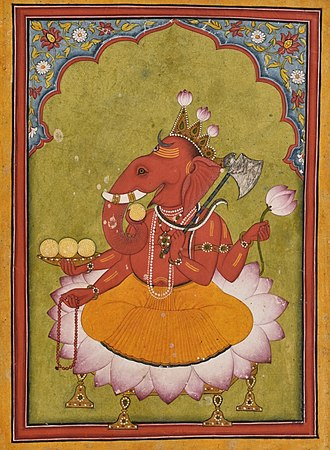
Ganesha images were prevalent in many parts of India by the 6th century.[42] The 13th century statue pictured is typical of Ganesha statuary from 900 to 1200, after Ganesha had been well-established as an independent deity with his own sect. This example features some of Ganesha’s common iconographic elements. A virtually identical statue has been dated between 973 and 1200 by Paul Martin-Dubost,[43] and another similar statue is dated 12th century by Pratapaditya Pal.[44] Ganesha has the head of an elephant and a big belly. This statue has four arms, which is common in depictions of Ganesha. He holds his own broken tusk in his lower-right hand and holds a delicacy, which he samples with his trunk, in his lower-left hand. The motif of Ganesha turning his trunk sharply to his left to taste a sweet in his lower-left hand is a particularly archaic feature.[45] A more primitive statue in one of the Ellora Caves with this general form has been dated to the 7th century.[46] Details of the other hands are difficult to make out on the statue shown. In the standard configuration, Ganesha typically holds an axe or a goad in one upper arm and a pasha (noose) in the other upper arm. In rare instances, he may be depicted with a human head.[note 1]
The influence of this old constellation of iconographic elements can still be seen in contemporary representations of Ganesha. In one modern form, the only variation from these old elements is that the lower-right hand does not hold the broken tusk but is turned towards the viewer in a gesture of protection or fearlessness (Abhaya mudra).[50] The same combination of four arms and attributes occurs in statues of Ganesha dancing, which is a very popular theme.[51]
A typical four-armed form. Miniature of Nurpur school (circa 1810)[52]
Ganesha has been represented with the head of an elephant since the early stages of his appearance in Indian art.[53] Puranic myths provide many explanations for how he got his elephant head.[54] One of his popular forms, Heramba-Ganapati, has five elephant heads, and other less-common variations in the number of heads are known.[55] While some texts say that Ganesha was born with an elephant head, he acquires the head later in most stories.[56] The most recurrent motif in these stories is that Ganesha was created by Parvati using clay to protect her and Shiva beheaded him when Ganesha came between Shiva and Parvati. Shiva then replaced Ganesha’s original head with that of an elephant.[57] Details of the battle and where the replacement head came from vary from source to source.[58] Another story says that Ganesha was created directly by Shiva’s laughter. Because Shiva considered Ganesha too alluring, he gave him the head of an elephant and a protruding belly.[59]
Ganesha’s earliest name was Ekadanta (One Tusked), referring to his single whole tusk, the other being broken.[60] Some of the earliest images of Ganesha show him holding his broken tusk.[61] The importance of this distinctive feature is reflected in the Mudgala Purana, which states that the name of Ganesha’s second incarnation is Ekadanta.[62] Ganesha’s protruding belly appears as a distinctive attribute in his earliest statuary, which dates to the Gupta period (4th to 6th centuries).[63] This feature is so important that according to the Mudgala Purana, two different incarnations of Ganesha use names based on it: Lambodara (Pot Belly, or, literally, Hanging Belly) and Mahodara (Great Belly).[64] Both names are Sanskrit compounds describing his belly (IAST: udara).[65] The Brahmanda Purana says that Ganesha has the name Lambodara because all the universes (i.e., cosmic eggs; IAST: brahmāṇḍas) of the past, present, and future are present in him.[66]
6th-century Ganesha Statue in Badami caves temples, depicting Ganesha with two arms
Ganesha in Bronze from 13th century Vijayanagara Empire, depicting Ganesha with four arms
The number of Ganesha’s arms varies; his best-known forms have between two and sixteen arms.[67] Many depictions of Ganesha feature four arms, which is mentioned in Puranic sources and codified as a standard form in some iconographic texts.[68] His earliest images had two arms.[69] Forms with 14 and 20 arms appeared in Central India during the 9th and the 10th centuries.[70] The serpent is a common feature in Ganesha iconography and appears in many forms.[71] According to the Ganesha Purana, Ganesha wrapped the serpent Vasuki around his neck.[72] Other depictions of snakes include use as a sacred thread (IAST: yajñyopavīta)[73] wrapped around the stomach as a belt, held in a hand, coiled at the ankles, or as a throne. Upon Ganesha’s forehead may be a third eye or the sectarian mark (IAST: tilaka), which consists of three horizontal lines.[74] The Ganesha Purana prescribes a tilaka mark as well as a crescent moon on the forehead.[75] A distinct form of Ganesha called Bhalachandra (IAST: bhālacandra; “Moon on the Forehead”) includes that iconographic element.[76]
Ganesha is often described as red in colour.[77] Specific colours are associated with certain forms.[78] Many examples of color associations with specific meditation forms are prescribed in the Sritattvanidhi, a treatise on Hindu iconography. For example, white is associated with his representations as Heramba-Ganapati and Rina-Mochana-Ganapati (Ganapati Who Releases from Bondage).[79]Ekadanta-Ganapati is visualised as blue during meditation in that form.[80]
Ganesha is often shown riding on or attended by a mouse.[84] Martin-Dubost says that the rat began to appear as the principal vehicle in sculptures of Ganesha in central and western India during the 7th century; the rat was always placed close to his feet.[85] The mouse as a mount first appears in written sources in the Matsya Purana and later in the Brahmananda Purana and Ganesha Purana, where Ganesha uses it as his vehicle in his last incarnation.[86] The Ganapati Atharvashirsa includes a meditation verse on Ganesha that describes the mouse appearing on his flag.[87] The names Mūṣakavāhana (mouse-mount) and Ākhuketana (rat-banner) appear in the Ganesha Sahasranama.[88]
The mouse is interpreted in several ways. According to Grimes, “Many, if not most of those who interpret Gaṇapati‘s mouse, do so negatively; it symbolizes tamoguṇa as well as desire”.[89] Along these lines, Michael Wilcockson says it symbolises those who wish to overcome desires and be less selfish.[90] Krishan notes that the rat is destructive and a menace to crops. The Sanskrit word mūṣaka (mouse) is derived from the root mūṣ (stealing, robbing). It was essential to subdue the rat as a destructive pest, a type of vighna (impediment) that needed to be overcome. According to this theory, showing Ganesha as master of the rat demonstrates his function as Vigneshvara (Lord of Obstacles) and gives evidence of his possible role as a folk grāma-devatā (village deity) who later rose to greater prominence.[91] Martin-Dubost notes a view that the rat is a symbol suggesting that Ganesha, like the rat, penetrates even the most secret places.[92]
Mohandas Karamchand Gandhi (October 2, 1869 – January 30, 1948) was an Indian lawyer, anti-colonial nationalist, and political ethicist who employed nonviolent resistance to lead the successful campaign for India’s independence from British rule. He inspired movements for civil rights and freedom across the world. Wikipedia
“In traditional magic — for example, Tibetan — there is a belief that ‘thought forms’ can be brought into existence by a long effort of concentration. (In Tibet, they are called tulpas.) Such thought-forms may be benevolent or otherwise.”
–Colin Wilson in From Atlantis to the Sphinx(1997)
“For the Quiché, living a life is somewhat analogous to composing music, painting, or writing a poem. Each day properly approached can be either a work of art or a disaster … The Quické really do have to think deeply and seriously about the process of how each day is to be lived.”
s/t: Principles of the psychological method in its application to problems of science, religion and art Preface Prefatory Note Introduction Esotericism and modern thought The fourth dimension Superman Christianity and the New Testament The symbolism of the Tarot What is yoga? On the study of dreams and on hypnotism Experimental mysticism In search of the miraculous A new model of the universe Eternal recurrence and the laws of Manu Sex and evolution Index
Pyotr Demianovich Ouspenskii (known in English as Peter D. Ouspensky, Пётр Демья́нович Успе́нский; was a Russian mathematician and esotericist known for his expositions of the early work of the Greek-Armenian teacher of esoteric doctrine George Gurdjieff, whom he met in Moscow in 1915. He was associated with the ideas and practices originating with Gurdjieff from then on. He shared the (Gurdjieff) “system” for 25 years in England and the United States, having separated from Gurdjieff in 1924 personally, for reasons he explains in the last chapter of his book In Search of the Miraculous.
All in all, Ouspensky studied the Gurdjieff system directly under Gurdjieff’s own supervision for a period of ten years, from 1915 to 1924. His book In Search of the Miraculous is a recounting of what he learned from Gurdjieff during those years. While lecturing in London in 1924, he announced that he would continue independently the way he had begun in 1921. Some, including his close pupil Rodney Collin, say that he finally gave up the system in 1947, just before his death, but his own recorded words on the subject (“A Record of Meetings”, published posthumously) do not clearly endorse this judgement, nor does Ouspensky’s emphasis on “you must make a new beginning” after confessing “I’ve left the system”.
Ryan Walters, Oklahoma’s superintendent of public instruction, has ordered schools to incorporate the Bible into lesson plans for students in grades five through 12, putting the separation of church and state to the test. The Onion shares some of the ways schools are changing their curriculum.
Updating the periodic table of chemical elements to include “Jesusonium.”
Banning murder and adultery in schools.
Requiring students to yell the “under God” part of the Pledge of Allegiance.
Covering way more incest in sex ed class.
Adjusting dress codes to include year-round open-toe sandal wearing.
Streamlining woodshop options to “table,” “ark,” or “cross.”
Including Bible-inspired exercises in gym class, like flee-the-Jew and stone-the-idolater.
Renaming all 272 high school football teams “the Crusaders.”
Emphasizing the importance of shunning lepers in health class.
“The intuitive mind is a sacred gift and the rational mind is a faithful servant. We have created a society that honors the servant and has forgotten the gift.”
― Albert Einstein
Albert Einstein (March 14, 1879 – April l18, 1955) was a German-born theoretical physicist who is widely held as one of the most influential scientists. Best known for developing the theory of relativity, Einstein also made important contributions to quantum mechanics. Wikipedia
Consciousness, spirituality, biography, sexuality, androgyny, futurism, space, the arts, science, astrology, democracy, humor, books, movies and more