With incidence rates increasing over the past two decades, more doctors are recommending routine self-checks to catch early signs of breast cancer. Here’s how to perform a breast self-exam.
Remove your clothes and place them in a safe location so that rambunctious neighbor boys can’t steal them and ride away on their bicycles laughing.
Beg your male keeper for the key that unlocks your metal modesty brassiere.
Before starting the examination, have each of your breasts sign a medical waiver to protect your hands from malpractice litigation.
Use a vise clamp to secure the breast to your workstation.
Lure the tumors to the surface by opening a can of tuna.
While pressing on the breast with one hand, cup the other around a baked ham, comparing and contrasting size, texture, and temperature.
Replicate a professional mammogram at home by smashing your breasts in the waffle iron.
Once completed, take your breast down to a notary public to have its clean bill of health authenticated.
Finally, use the prepaid return shipping label to mail your breasts to the Susan G. Komen foundation.
Decades into his long life, the poet Robert Graves defined love as “a recognition of another person’s integrity and truth in a way that… makes both of you light up when you recognize the quality in the other.” A generation later, the poetic playwright Tom Stoppard defined it as “knowledge of each other… knowledge of self, the real him, the real her, in extremis, the mask slipped from the face.” This unmasked fact is the antidote to the most dangerous fiction the Romantics bequeathed us — their model of love as union between lover and beloved, a kind of fusion of selves, with its connotation of mutual completion rather than mutual recognition of and rejoicing in two parallel completenesses.
Such gladsome recognition of the other’s otherness is the foundation of love and the foundation of morality — both requiring not a bridging of selves but an unselfing, both vulnerable to same fundamental misconception that fissures the very foundation upon which they rest. Almost every religious, spiritual, and contemplative tradition in the history of our species, when stripped of its mystical and counterscientific aspects, holds at its center an ethic of love. But also central to almost every tradition, especially of the West, is a dangerous warping of love in the hands of the self.
Most commonly known as the Golden Rule, it mistakes the reality of the self for the only reality, taking one’s own wishes, desires, and longings as universal and presuming that the other shares those precisely — negating the sovereign reality of the other, negating the possibility that a very different person might want something very different done unto them.
The remedy for this malady of selfing is to remember that there are infinitely many kinds of beautiful lives, each with its singular longings for and visions of beauty, goodness, and gladness. Nothing reminds us of this more readily than art, with its invitation to step into the intimate realities of other lives — the word “empathy,” after all, originated in the imaginative act of projecting oneself into a work of art — and no one has irradiated that reminder more luminously than the uncommon philosopher-novelist Iris Murdoch (July 15, 1919–February 8, 1999).
Dame Iris Murdoch by Ida Kar (National Portrait Gallery)
Art and morals are… one. Their essence is the same. The essence of both of them is love. Love is the perception of individuals. Love is the extremely difficult realisation that something other than oneself is real. Love, and so art and morals, is the discovery of reality.
In the same era when, across the Atlantic, Alan Watts was cautioning that “Life and Reality are not things you can have for yourself unless you accord them to all others” as he was introducing Eastern teachings in the West, Murdoch builds on the parallels between art and morality through the multiple dimensions of love — the personal and the political, the individual and the communal:
The enemies of art and of morals, the enemies that is of love, are the same: social convention and neurosis. One may fail to see the individual… because we are ourselves sunk in a social whole which we allow uncritically to determine our reactions, or because we see each other exclusively as so determined. Or we may fail to see the individual because we are completely enclosed in a fantasy world of our own into which we try to draw things from outside, not grasping their reality and independence, making them into dream objects of our own. Fantasy, the enemy of art, is the enemy of true imagination: Love, an exercise of the imagination… The exercise of overcoming one’s self, of the expulsion of fantasy and convention… is indeed exhilarating. It is also, if we perform it properly which we hardly ever do, painful.
“Real isn’t how you are made… It’s a thing that happens to you.” Maurice Sendak’s little-known 1960 illustrations for The Velveteen Rabbit.
In a sentiment that calls to mind James Baldwin’s reflection on love and his haunting observation that “nothing is more unbearable, once one has it, than freedom,” Murdoch adds:
The tragic freedom implied by love is this: that we all have an indefinitely extended capacity to imagine the being of others. Tragic, because there is no prefabricated harmony, and others are, to an extent we never cease discovering, different from ourselves… Freedom is exercised in the confrontation by each other, in the context of an infinitely extensible work of imaginative understanding, of two irreducibly dissimilar individuals. Love is the imaginative recognition of, that is respect for, this otherness.
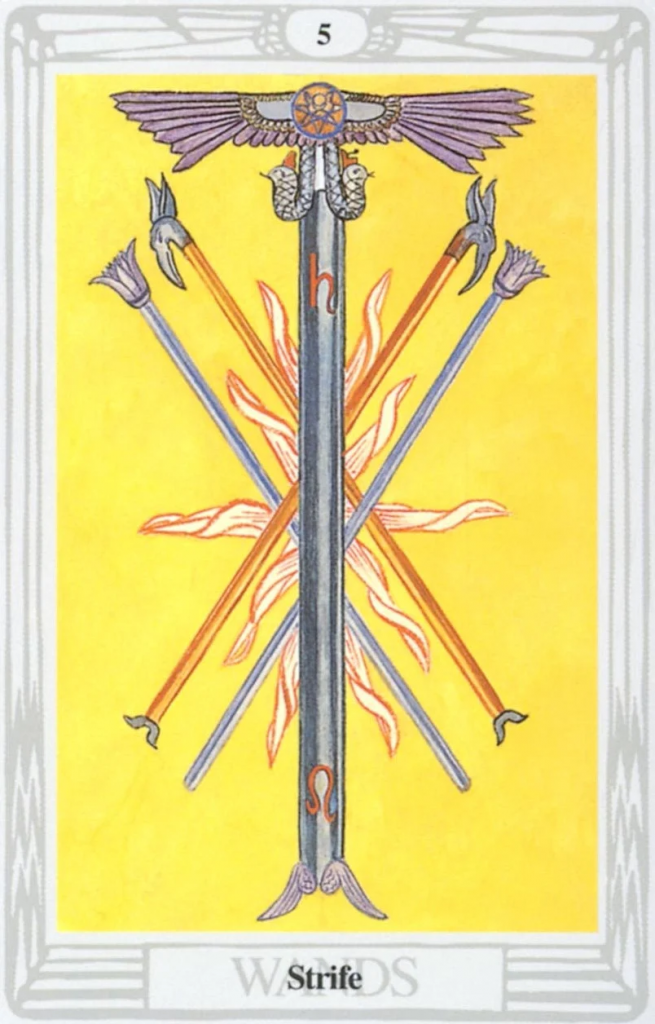
A day ruled by the Lord of Strife is bound to have its inherent problems. This card brings restriction, limitation, frustration and annoyance with it. Often these problems will be experienced in the workplace, and they sometimes indicate that we feel overwhelmed by the number of tasks that we need to get through.Expect this day to be one in which even minor things create their own difficulties and obstacles. First and foremost, we all need to take our senses of humour to work with us!! It’s probably also useful to regard a Five of Wands day as a ‘bad attitude’ day. That could as easily be our own as anyone else’s, as well!So, having wrapped yourself up in your sense of humour, study the workload in front of you, and leave all the things you know will drive you mad till the atmosphere is better. Try to pick out tasks that you will enjoy. That way if they frustrate you, at least you’ll enjoy the bits before and afterwards!Assess your own attitude carefully and try to dispel any nagging negativity. Isolate anything that looks like it is an inner conflict brewing, and write it down to address soon (they all tend to come to the surface on this day).Also assess the mood of those people you come into contact with, and avoid any who seem to be having the same sort of bad attitude day as you!! That should minimise the conflict you meet.Finally, at the end of the day try hard to shed anything that you have picked up along the way. Use whatever method you find most effective to de-stress, in the hope that you’ll have a better day tomorrow!! By the way, the affirmation is designed to be hard to say – hopefully it’ll make you laugh!!
Affirmation: “I meet conflict and obstacles with equanimity.”
The next phase of Thane’s seminal meditative practice Friday / Saturday, December 13-14, via Zoom
Metonymy Translation® (MTR) provides a shorthand for quickly inducing a shift in consciousness that brings intuition to the fore. Metonymy Translation, practiced regularly, provides any person with a panoramic vista of their inner world and the apparently outer-world elements that interact with it. Among many benefits, MTR enables anyone to :Rejuvenate, revitalize, re-energizeIntroduce a “short circuit” for habitual behaviorTelescope time and space21st century speeds require a 21st century tool and a fundamentally revised philosophical structure.
The moral codes of even the bloody 20th century have been ripped to shreds, leaving us bereft in the middle of a maelstrom of change. We have never been more in need of a tool like MTR, nor of the all-inclusive philosophy of Ontology, the science, or knowing, of Being.
The Prosperos Dean, William Fennie, will present this material online using the Zoom platform.
Presentation times: Pacific Focus The class will follow an unusual schedule so that we can include students from Australia and Hawaii.
We will begin on Friday (December 13th) at 2:00 p.m. PT, which is 8:00 a.m. Saturday (December 14th) in Brisbane. Students in Hawaii will begin at 12:00 p.m. on Friday, and mainland East coast students will begin at 5:00 p.m. ET. Class will run for 4-5 hours each day.
The cow is of the bovine ilk; One end is moo, the other, milk
==Ogden Nash
Frederic Ogden Nash (August 19, 1902 – May 19, 1971) was an American poet well known for his light verse, of which he wrote more than 500 pieces. With his unconventional rhyming schemes, he was declared by The New York Times to be the country’s best-known producer of humorous poetry. Wikipedia
In 1913, C.G. Jung started a unique self- experiment that he called his “confrontation with the unconscious”: an engagement with his fantasies in a waking state, which he charted in a series of notebooks referred to as The Black Books. These intimate writings shed light on the further elaboration of Jung’s personal cosmology and his attempts to embody insights from his self- investigation into his life and personal relationships. The Red Book drew on material recorded from 1913 to 1916, but Jung actively kept the notebooks for many more decades.
Presented in a magnificent, seven-volume boxed collection featuring a revelatory essay by noted Jung scholar Sonu Shamdasani—illuminated by a selection of Jung’s vibrant visual works—and both translated and facsimile versions of each notebook, The Black Books offer a unique portal into Jung’s mind and the origins of analytical psychology.
Carl Gustav Jung (/jʊŋ/; German: [ˈkarl ˈɡʊstaf jʊŋ]), often referred to as C. G. Jung, was a Swiss psychiatrist and psychotherapist who founded analytical psychology. Jung proposed and developed the concepts of extraversion and introversion; archetypes, and the collective unconscious. His work has been influential in psychiatry and in the study of religion, philosophy, archeology, anthropology, literature, and related fields. He was a prolific writer, many of whose works were not published until after his death.
The central concept of analytical psychology is individuation—the psychological process of integrating the opposites, including the conscious with the unconscious, while still maintaining their relative autonomy. Jung considered individuation to be the central process of human development.
Jung created some of the best known psychological concepts, including the archetype, the collective unconscious, the complex, and synchronicity. The Myers-Briggs Type Indicator (MBTI), a popular psychometric instrument, has been developed from Jung’s theory of psychological types.
Though he was a practising clinician and considered himself to be a scientist, much of his life’s work was spent exploring tangential areas such as Eastern and Western philosophy, alchemy, astrology, and sociology, as well as literature and the arts. Jung’s interest in philosophy and the occult led many to view him as a mystic, although his ambition was to be seen as a man of science. His influence on popular psychology, the “psychologization of religion”, spirituality and the New Age movement has been immense.
“What we see from the air is so simple and beautiful,” Georgia O’Keeffe wrote after her first airplane flight, “I cannot help feeling that it would do something wonderful for the human race — rid it of much smallness and pettiness if more people flew.”
I am writing this aboard an airplane. An earthbound ape in my airborne cage of metal and glass, I wonder who we would be, in the soul of the species, if we could fly — really fly, the way birds do; if we were born not just seeing “the world all simplified and beautiful and clear-cut in patterns,” as Georgia did out of that small round window, but feeling it. And yet you and I shall never know the open sky as a way of being — never know the touch of a thermal or the taste of a thundercloud, never see our naked shadow on a mountain or slice a cirrus with a wing. What cruel cosmic fate to live on this Pale Blue Dot without ever knowing its blueness. And yet we are recompensed by a consciousness capable of wonder — that edge state on the rim of understanding, where the mind touches mystery.
It is wonder that led us to invent science — that quickening of curiosity driving every discovery — so that science may repay us with magnified wonder as it reveals the weft and warp of nature — the tapestry of forces and phenomena, of subtleties and complexities, woven on the enchanted loom of reality. To look at any single thread more closely, in all its hidden wonder, is to see more clearly how the entire tapestry holds together, to strengthen how we ourselves hold together across the arc of life. For, as Rachel Carson so memorably wrote, the greatest gift you could give a child — or the eternal child in you — is “a sense of wonder so indestructible that it would last throughout life, as an unfailing antidote against the boredom and disenchantments… the sterile preoccupation with things that are artificial, the alienation from the sources of our strength.”
Art by Nikki McClure from Something About the Sky — Rachel Carson’s serenade to the wonder of the clouds
Take the wonder of a bird — this living poem of feather and physics, of barometric wizardry and hollow bone, in whose profoundly other brain evolution invented dreams. That so tiny a creature should defy the gravitational pull of an entire planet seems impossible, miraculous. And yet beneath this defiance is an active surrender to the same immutable laws that make the whole miracle of the universe possible.
In one of the three dozen fascinating essays collected in The Miraculous from the Material: Understanding the Wonders of Nature (public library), the poetic physicist and novelist Alan Lightman illuminates the lawful wonder of avian flight, from evolution to aerodynamics, from molecules to mathematics, beginning with the fundamental wonderment of how a bird creates strong enough an upward force to counter gravity’s pull on its weight:
[The force] is created by a net upward air pressure, which in turn is created by the bird’s forward motion and the shape of its wings. The topside of an avian wing is curved, while the bottom side is rather flat. This difference in shape, together with the angle and some smaller adjustments of the wing, cause the air to flow over the top of the wing at higher speed than on the bottom. The higher speed on top reduces the air pressure above the wing compared to the air pressure below the wing. With more pressure pushing up from below than pressure pushing down from above, the wing gets an upward lift.
Anatomy of a bird by French artist Paul Sougy. (Available as a print, benefitting The Nature Conservancy.)
It may seem counterintuitive that a higher air speed above the wing would produce a lower pressure, but our creaturely intuitions have often been poor reflections of reality — it took us eons to discern that the flat surface beneath our feet is a sphere, that the sphere is not at the center of the universe, and that there is an invisible force acting on objects without touching them to make the universe cohere — a force which a bored twenty-something sitting in his mother’s apple orchard called gravity.
Alan explains the reality of chemistry and physics that makes flight possible as air molecules strike against the underside of the wing to lift the bird up:
Air consists of little molecules that push against whatever they strike, causing pressure. Molecules of air are constantly whizzing about in all directions. If no energy is added, the total speed of the molecules must be constant, by the law of the conservation of energy. But that speed is composed of two parts: a horizontal speed, parallel to the wing, and a vertical speed, perpendicular to the wing. Increase the horizontal speed of air molecules above the wing, and the vertical speed of those molecules must decrease. Lower speed of molecules striking the wing from above means less pressure, or less push. The molecules on the bottom of the wing, moving slower in the horizontal direction but faster in the vertical direction (with greater upward pressure), lift the wing upward.
The lift is greater the larger the wing area and the faster the speed of air past the wing. There’s a convenient trade-off here. The necessary lift force to counterbalance the bird’s weight can be had with less wing area if the animal increases its forward speed, and vice versa. Birds capitalize on this option according to their individual needs. The great blue heron, for example, has long, slender legs for wading and must fly slowly so as not to break them on landing. Consequently, herons have relatively large wingspan. Pheasants, on the other hand, maneuver in underbrush and would find large wings cumbersome. To remain airborne with their relatively short and stubby wings, pheasants must fly fast.
There are, however, limits to this factorial conversation between surface and speed. Alan considers why there are no birds the size of elephants:
As you scale up the size of a bird or any material thing, unless you drastically change its shape, its weight increases faster than its area. Weight is proportional to volume, or length times length times length, while area is proportional to length times length. Double the length, and the weight is eight times larger, while the area is only four times larger. For example, if you have a cube of 1 inch on a side, its volume is 1 cubic inch, while its total area is 6 (sides) × 1 square inch, or 6 square inches. If you double the side of the cube to 2 inches, its volume goes up to 8 cubic inches, or 800 percent (with a similar increase in weight), while its area goes up to 24 square inches, or 400 percent. Since the lift force is proportional to the wing area while the opposing weight force is proportional to the bird’s volume, as you continue scaling up, eventually you reach a point where the bird’s wing area is not enough to keep it aloft. Although birds have been experimenting with flight for 100 million years, the heaviest true flying bird, the great bustard, rarely exceeds 42 pounds. The larger gliding birds, such as vultures, are lifted by rising hot air columns and don’t carry their full weight.
But all this elaborate molecular and mathematical aerodynamics of upward motion is not enough to make flight possible — birds must also propel themselves forward without propellers. For a long time, how they do this was a mystery. (The mystery was even deeper for the singular flight of the hummingbird, hovering between science and magic.) It was the birth of modern aviation that finally shed light on it. In the early nineteenth century, watching how birds glide, the pioneering engineer and aerial investigator George Cayley became the first human being to discern the mechanics of flight, identifying the three forces acting on the weight of any flying body: lift, drag, and thrust.
Alan details the physics of drag and thrust that allow birds to move forward:
Birds do in fact have propellers, in the form of specially designed feathers in the outer halves of their wings. These feathers, called primaries, change their shape and position during a wingbeat. Forward thrust is obtained by pushing air backward with each flap. In a similar manner, we are able to move forward in a swimming pool by vigorously moving our arms backward against the water.
All of this helps explain why larger birds often fly in a V formation — each bird benefits from the uplifting air pockets produced by the bird in front of it, conserving 20 to 30 percent of the calories needed for flight compared to flying solo. Because the lead bird takes most of the aerodynamic and caloric brunt shielding the rest from the wind, the flock takes turns in the frontmost position.
This, too, is the physics of any healthy community, any healthy relationship — the physics of vulnerability and trust. Because life always exerts different pressures on each person at different times, internal or external, thriving together is not a matter of always pulling equal weight but of accommodating the ebb and flow of one another’s vulnerability, each trusting the other to shield them in times of depletion, then doing the shielding when replenished. One measure of love may be the willingness to be the lead bird shielding someone dear in their time of struggle, lifting up their wings with your stubborn presence.


 Art and morals are… one. Their essence is the same. The essence of both of them is love. Love is the perception of individuals. Love is the extremely difficult realisation that something other than oneself is real. Love, and so art and morals, is the discovery of reality.







 [The force] is created by a net upward air pressure, which in turn is created by the bird’s forward motion and the shape of its wings. The topside of an avian wing is curved, while the bottom side is rather flat. This difference in shape, together with the angle and some smaller adjustments of the wing, cause the air to flow over the top of the wing at higher speed than on the bottom. The higher speed on top reduces the air pressure above the wing compared to the air pressure below the wing. With more pressure pushing up from below than pressure pushing down from above, the wing gets an upward lift.