
Essentia Foundation • Apr 27, 2024 Essentia Foundation’s Hans Busstra interviews Prof. Jeffrey Kripal, PhD, who holds the J. Newton Rayzor Chair in Philosophy and Religious Thought at Rice University in Houston, on his new book: ‘The Superhumanities, Historical Precedents, Moral Objections, New Realities.’ What if the humanities would open their horizon to more metaphysical possibilities? Prof. Kripal has written a book about a future in which the humanities study the full human. In these superhumanities, the weird, the psi—in short, the impossible—is taken seriously metaphysically: anomalous phenomena are not only regarded as subjective truths, but also as objective claims about reality. In his book, Prof. Kripal clearly shows how the nineteenth century ontology of materialism reigns in almost all of the humanities, which limits our scientific understanding of who we are as humans: there is no transcendence, the individual is nothing but a social body in spacetime, shaped by society. As Prof. Kripal likes to quip: “if there is one dogma in the humanities, it is that the truth has to be depressing.” The humanities need to expand beyond this depressing view, not because it’s depressing, but because it’s simply a half truth. We are conditioned social animals and transcendent beings. We are human and superhuman, as he argues. Interestingly, the superhumanities can build on the same foundational thinkers as the humanities. When we read the full Friedrich Nietzsche, William James, or Jacques Derrida, for instance, we see that these thinkers very much acknowledged the super. It is only the postmodern reading of their texts in academia that filters out the ecstatic. When it comes to Nietzsche, Prof. Kripal convincingly argues that the ‘crazy’ Nietzsche was perhaps the real Nietzsche, at the pinnacle of his thought. But here’s the thing: did he think his way to the vision of the Übermensch—which later unjustly got contaminated by fascism—or did he somehow receive it as a vision? According to Prof. Kripal, Nietzsche’s vision should be taken much more literally than we now take it: he was talking about an actual superspecies, with superhuman capabilities. What if the humanities could scientifically investigate what happened when, for instance, Nikola Tesla had the visions that led to groundbreaking inventions? What happened when Einstein saw the principles of general relativity in a dream? Perhaps the key takeaway from Prof. Kripal’s book is that, if the humanities would only dare to turn into the superhumanities, they would again become relevant for the other disciplines in academia. 00:00 Intro 06:49 The humanities only focus on Clark Kent… 08:45 The humanities reduce everything to society 10:53 The humanities are not aware of ontology 12:11 The humanities have to catch up with physics 13:25 What exactly is the ‘super’ in the super humanities? 15:31 The precognitive dreams of Schopenhauer 18:01 How is Nietzsche read in the humanities and how should we read it? 21:51 How ‘super’ was Nietzsche’s Übermensch vision? 23:51 If you actually read Nietzsche not just about him… 26:58 God has to die so super humans can live 28:23 How the Superhuman has been kept alive in many traditions 30:27 How can the humanities deny empirical evidence in favor of the Super? 32:05 X-Men is true! 35:01 Are you opening the door to literal readings of religious stories? 39:39 On the miracles Ram Dass described 41:46 The ontology of William James 44:48 The pragmatist vs metaphysical William James 50:06 Jeffrey’s critique on metaphysical ‘agnosticism’ 54:26 The immunological response of the humanities 1:00:53 The human as 2 1:05:09 Jung on UAP’s 1:09:21 We need a story that unites us 1:12:43 Kripal’s take on Foucault 1:15:17 What was Foucault’s ontology? 1:17:27 The study of religion nowadays is only about the horizontal 1:19:28 On decolonizing reality 1:22:15 On the Afro pessimism movement 1:24:18 A day in college in the Superhumanities 1:26:33 The super humanities are very much alive outside of academia 1:29:03 Science should stay science 1:30:42 On Donald Hoffman 1:32:09 On the tyranny of clarity 1:35:36 On becoming AND studying the Superhuman 1:37:27 Integration of these experiences are NOT possible 🙂 1:46:56 Closing remarks on the lava and the rock… Essentia makes use of film fragments and YouTube content under YouTube’s fair use policy. All music is under paid license from Soundstripe. AI transparency: for our thumbnails we use Midjourney to create visuals and cinematic angles on still images of our interviewees. All is in accordance with our interviewees. Copyright © 2024 by Essentia Foundation. All rights reserved.
Monthly Archives: May 2024
Marcel Proust attends the infamous premiere of Stravinsky’s ballet The Rite of Spring in Paris.
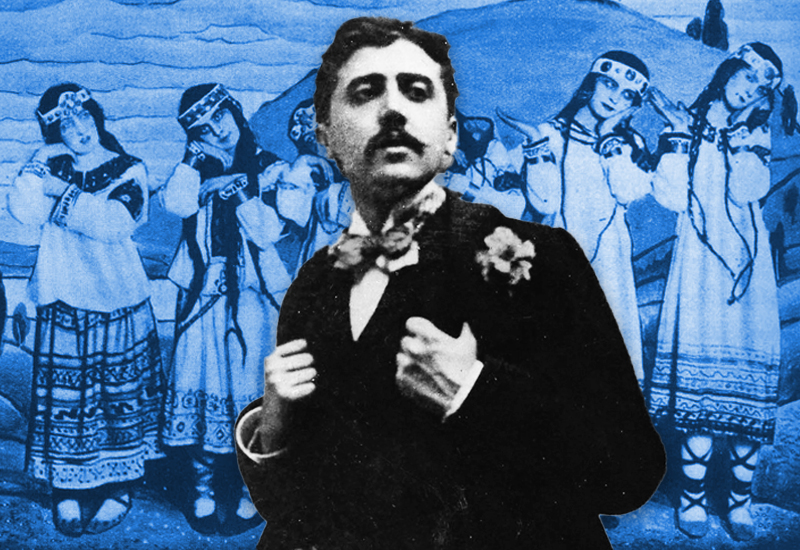
“Every reader, as he reads, is actually the reader of himself. The writer’s work is only a kind of optical instrument he provides the reader so he can discern what he might never have seen in himself without this book. The reader’s recognition in himself of what the book says is the proof of the book’s truth.”
–Marcel Proust
| Literary History MAY 26 — JUNE 1, 2024 (Lithub.com) |
On May 29, 1913, Igor Stravinsky’s Le Sacre du printemps (The Rite of Spring), performed by the Ballets Russes, premiered at the newly constructed Theatre de Champs-Elysees in Paris.
Even before the curtain was raised, the audience had begun to protest. What was this “deformed,” “demented” and atonal music? But once the dancing started—a jarring, contorted, and “almost bestial” kind of movement that no one had ever seen before—all hell really broke loose. “There were fistfights, stampedes, chairs knocked over,” writes Madison Mainwaring.
A lady took out her hatpin in order to stab the man next to her (who may or may not have been Jean Cocteau). The police had to be called in during intermission in order to take away forty of the audience’s more boisterous members. One of the double bass players in the orchestra reported that “many a gentleman’s shiny top hat or soft fedora was pulled down by an opponent over his eyes and ears, and canes were brandished like menacing implements of combat.” Brawls carried on into the streets and at least one duel was fought the next day.
“It’s not clear which elements of the performance caused the disturbance in the audience: Igor Stravinsky’s music or Vaslav Nijinsky’s choreography, Nicholas Roerich’s costumes, the set, the plot,” writes Catherine Nichols. (The ballet’s titular rite is that of a virgin being sacrificed to a pagan god in hopes of a bountiful harvest.) “It could have been the emergent effect of accumulation: Sergei Diaghilev [founder and impresario of the Ballets Russes] had gathered these artists to work on it together because he was interested in Richard Wagner’s Gesamtkunstwerk—a plan for the theater to unite the arts to create a single, totalizing impression in the viewer.”
In the roiling, raucous opening night audience was Marcel Proust (also Gertrude Stein, Pablo Picasso, Claude Debussy, and Maurice Ravel), though it is difficult to imagine him being horrified by such ecstatic artistic experimentation. Swann’s Way, the first volume of Proust’s own masterpiece In Search of Lost Time, was due to be published in November. More likely, he understood exactly what Stravinksy and Nijinsky were up to.
“As literary modernism seemed to be about stripping away the pleasures of the Victorian novel, making text simpler and more minimalist, Proust was going in the other direction, writing the most descriptive possible novel,” writes Nichols.
He doesn’t seem interested in the mechanization of industry, the alienation of workers, or the new uses of language associated with slick, machine-made objects. He seems out of step with the other trends of literary modernism, but in the context of Gesamtkunstwerk, his project makes sense in its time. While Proust was publishing In Search of Lost Time, the 20th century was only at the beginning of its taste for totalizing aesthetics—a separate cultural strand from the taste for simplicity, but equally modern.
Both The Rite of Spring and In Search of Lost Time would become revolutionary works of modernism, their influence directing the course of art for decades; perhaps one did not influence the other, but nor was it, exactly, a coincidence. According to legend, after the disastrous premiere, Stravinsky, Diaghilev, and Nijinsky had dinner at Larue, where they were joined by Proust and his frenemy Jean Cocteau. “At two o’clock in the morning, Stravinsky, Nijinsky, Diaghilev and myself piled into a cab and were driven to the Bois de Boulogne,” Cocteau wrote.
We kept silent; the night was cool and clear. The odor of the acacias told us we had reached the first trees. Coming to the lakes, Diaghilev, bundled up in opossum, began mumbling in Russian. I could feel Stravinsky and Nijinsky listening attentively and as the coachman lighted his lantern I saw tears on the impresario’s face. … You can’t imagine the gentleness and the nostalgia of these men, and no matter what Diaghilev may have done later, I shall never forget, in that cab, his great tear-stained face as he recited Pushkin in the Bois de Boulogne.
Source: https://link.lithub.com/view/602ea880180f243d6535c479l50ut.202g/89d71269
John Gardner on the Key to Self-Renewal Across Life and the Art of Making Rather Than Finding Meaning
By Maria Popova (themarginalian.org)

A person is not a potted plant of predetermined personality but a garden abloom with the consequences of chance and choice that have made them who they are, resting upon an immense seed vault of dormant potentialities. At any given moment, any seed can sprout — whether by conscious cultivation or the tectonic tilling of some great upheaval or the composting of old habits and patterns of behavior that fertilize a new way of being. Nothing saves us from the tragedy of ossifying more surely than a devotion to regularly turning over the soil of personhood so that new expressions of the soul can come abloom.
In the final years of his long life, former U.S. Secretary of Heath, Education, and Welfare John Gardner (October 8, 1912–February 16, 2002) expanded upon his masterwork on self-renewal in the posthumously published Living, Leading, and the American Dream (public library), examining the deepest questions and commitments of how we become — and go on becoming — ourselves as our lives unfold, transient and tender with longing for meaning.
Butterfly metamorphosis by Philip Henry Gosse from Entomologia terrae novae, 1833. (Available as a print and as stationery cards.)
With an eye to the mystery of why some people and not others manage to live with vitality until the end, and to the fact that life metes out its cruelties and its mercies with an uneven hand, Gardner writes:
One must be compassionate in assessing the reasons. Perhaps life just presented them with tougher problems than they could solve. It happens. Perhaps they were pulled down by the hidden resentments and grievances that grow in adult life, sometimes so luxuriantly that, like tangled vines, they immobilize the victim. Perhaps something inflicted a major wound on their confidence or their self-esteem. You’ve known such people — feeling secretly defeated, maybe somewhat sour and cynical, or perhaps just vaguely dispirited. Or perhaps they grew so comfortable that adventures no longer beckoned.
Recognizing that the challenges we face are both personal and structural, that we are products of our conditions and conditioning but also entirely responsible for ourselves, he adds:

Art by Giuliano Cucco from Before I Grew Up by John Miller
Of the lessons we learn along the vector of living — things difficult to grasp early in life — he considers the hardest yet most liberating:
But no learning is harder, or more countercultural amid this cult of achievement and actualization we live in, than the realization that there is no final and permanent triumph to life. A generation after the poet Robert Penn Warren admonished against the notion of finding yourself and a generation before the psychologist Daniel Gilbert observed that “human beings are works in progress that mistakenly think they’re finished,” Gardner writes:
In a sentiment that mirrors the driving principle of nature itself, responsible for the evolution and survival of every living thing on Earth, he considers the key to that growth:
The supreme reward of putting yourself in novel situations that draw out dormant potentialities is the exhilaration of feeling new to yourself, which transforms life from something tending toward an end into something cascading forward in a succession of beginnings — for, as the poet and philosopher John O’Donohue observed in his magnificent spell against stagnation, “our very life here depends directly on continuous acts of beginning.” This in turn transforms the notion of meaning — life’s ultimate aim — from a product to be acquired into a process to be honored.
One of Antoine de Saint-Exupéry’s original watercolors for The Little Prince
Gardner recounts hearing from a man whose twenty-year-old daughter was killed in a car crash. In her wallet, the grief-stricken father had discovered a printed passage from a commencement address Gardner had delivered shortly before her death — a fragment evocative of Nietzsche’s insistence that “no one can build you the bridge on which you, and only you, must cross the river of life.” It read:
Complement with the pioneering education reformer and publisher Elizabeth Peabody on middle age and the art of self-renewal, the great nonagenarian cellist Pablo Casals on the secret to creative vitality throughout life, and this Jungian field guide to transformation in midlife, then revisit Nick Cave on blooming into the fulness of your potentialities and Simone de Beauvoir on the art of growing older.
No One You Love Is Ever Dead: Hemingway on the Most Devastating of Losses and the Meaning of Life
By Maria Popova (themarginalian.org)

Along the spectrum of losses, from the door keys to the love of one’s life, none is more unimaginable, more incomprehensible in its unnatural violation of being and time, than a parent’s loss of a child.
Ernest Hemingway (July 21, 1899–July 2, 1961) was in his twenties and living in France when he befriend Gerald and Sara Murphy. The couple eventually returned to America when one of their sons fell ill, but it was their other son, Baoth, who died after a savage struggle with meningitis.
Upon receiving the news, the thirty-five-year-old writer sent his friends an extraordinary letter, part consolation for and part consecration of a loss for which there is no salve, found in Shaun Usher’s moving compilation Letters of Note: Grief (public library).
Ernest Hemingway
On March 19, 1935, Hemingway writes:
You know there is nothing we can ever say or write… Yesterday I tried to write you and I couldn’t.
It is not as bad for Baoth because he had a fine time, always, and he has only done something now that we all must do. He has just gotten it over with…
About him having to die so young — Remember that he had a very fine time and having it a thousand times makes it no better. And he is spared from learning what sort of a place the world is.
It is your loss: more than it is his, so it is something that you can, legitimately, be brave about. But I can’t be brave about it and in all my heart I am sick for you both.
Absolutely truly and coldly in the head, though, I know that anyone who dies young after a happy childhood, and no one ever made a happier childhood than you made for your children, has won a great victory. We all have to look forward to death by defeat, our bodies gone, our world destroyed; but it is the same dying we must do, while he has gotten it all over with, his world all intact and the death only by accident.

Art by Charlotte Pardi from Cry, Heart, But Never Break by Glenn Ringtved — a soulful Danish illustrated meditation on love and loss
In a breathtaking sentiment evocative of Anaïs Nin’s admonition against the stupor of near-living, and of poet Meghan O’Rourke’s grief-honed conviction that “the people we most love do become a physical part of us, ingrained in our synapses, in the pathways where memories are created,” Hemingway adds:
With this, echoing Auden’s insistence that “we must love one another or die,” he comes the closest he ever came to formulating the meaning of life. Like David Foster Wallace, who addressed the meaning of life with such exquisite lucidity shortly before he was slain by depression, Hemingway too would lose hold of that meaning in the throes of the agony that would take his life a quarter century later. Now, from the fortunate platform of the prime of life, he writes:
Complement with the young Dostoyevsky’s exultation about the meaning of life shortly after his death sentence was repealed, Emily Dickinson on love and loss, Thoreau on living through loss, and Nick Cave — who lived, twice, the unimaginable tragedy of the Murphys — on grief as a portal to aliveness, then revisit the fascinating neuroscience of your brain on grief and your heart on healing.
Shunryu Suzuki on sitting

Biden Bounces Back In Polls As Americans Notice Netflix Added A Few Good Shows Recently
Published Friday 2:54PM (TheOnion.com)

WASHINGTON—With his approval rating recovering among people likely to vote in the 2024 election, President Joe Biden enjoyed a surge in the polls this week after Americans noticed Netflix had added a few good shows recently. “It appears that the tide is finally turning in Biden’s favor now that voters have stumbled onto pretty decent shows like Baby Reindeer and Dead Boy Detectives,” said political analyst Aaron Higgins, adding that the shift signaled a renewed optimism with regard to what might lie ahead for American television. “While there was some lingering nostalgia for the Stranger Things episodes of the Trump era, many poll respondents answered in the affirmative when asked if their watchlists looked better now than they did four years ago. Data from recent surveys also indicated that Biden could effectively clinch a second term if he brought back Glow.” At press time, Biden had begun plummeting in the polls after Americans discovered the Hunger Games movies would be leaving Netflix at the end of the month.
World War II veterans leave their children a legacy of trauma
From our special correspondent – The trauma experienced by World War II veterans of D-Day left a lasting impact on their children at a time before post-traumatic stress disorder (PTSD) was recognised, leaving families struggling to understand and cope with the psychological scars. Recent gatherings of experts in Normandy highlight both the enduring challenges and the resilience that was passed down through generations.
Issued on: 27/05/2024 – France24.com

For the largest seaborne invasion of World War II – along Normandy’s coastline on June 6, 1944 – to be a success, three important conditions had to be met. There had to be a full moon, so Allied paratroopers could have more visibility when landing. The tide had to be low enough that thousands of amphibious landing craft could reach the shores of Utah, Omaha, Juno, Gold and Sword beaches. And a morning fog on the horizon was needed to hide the arrival of Operation Overlord from German forces.
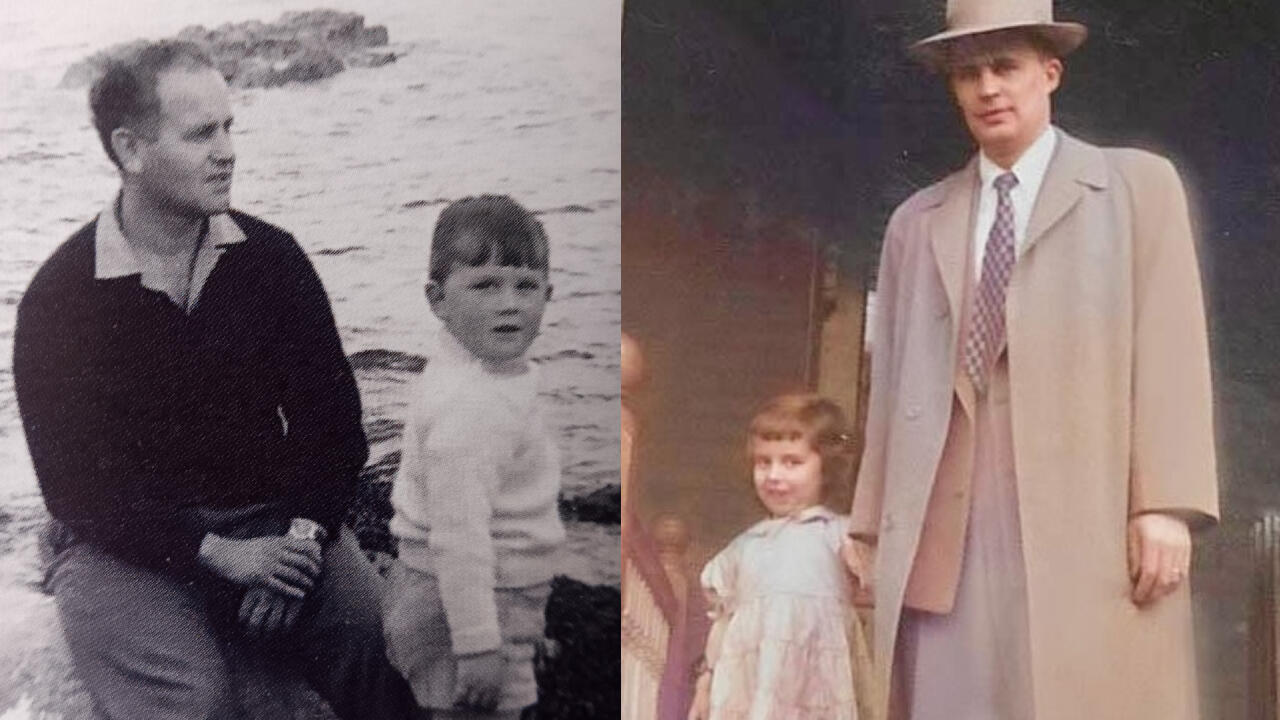
They did not know it at the time, but what US paratrooper Arthur ‘Dutch’ Schultz and British Royal Marine Thomas Nicholls experienced on D-Day would outlast their lifetimes. Both men returned to their homes with varying degrees of post-traumatic stress disorder. They struggled with symptoms like intrusive thoughts, irritability, anxiety, depression and nightmares. While the two veterans dealt with their pain differently, their condition had a lasting impact on their families and especially on their children.

On May 21, 30 experts from around the world gathered on the historic sites of the Normandy landings to discuss the lasting mental health consequences of traumatic events like D-Day. Though PTSD is now a widely known condition, war trauma took decades to become recognised by the medical profession. And researchers have found that, even if veterans like Schultz and Nicholls have now passed, their children still bear the signs of having grown up with a traumatised parent.
As a thick fog begins to set on the horizon, the low tide swells in and out, tickling the shores of the coastline. Eighty years after the landings took place here in Normandy, the weather conditions are uncannily similar to that fateful day back in June 1944.
‘We were all sort of clueless’
Post-traumatic stress disorder was only officially recognised decades after WWII veterans ended their service, in the wake of the Vietnam War. It first appeared in the Diagnostic and Statistical Manual of Mental Disorders (DSM), published by the American Psychiatric Association to define and classify mental disorders, in 1980. For the nearly 160,000 Allied troops who landed in Normandy in 1944, the lack of a diagnosis or framework made it difficult to seek proper treatment.
Before PTSD was recognised, it went by many other names. After World War I, PTSD symptoms such as panic, tremors or sleep issues were known as “shell shock” and seen as a direct reaction to artillery shells exploding. “War neuroses” was another name given to the condition at the time, as well as “combat fatigue”. Both terms reflected the prevailing belief that once a soldier was no longer on the front line and had time to relax, his war-related trauma would disappear. As a result, soldiers often received only a few days of rest before returning to battle.
Read more‘Taboo’: French women speak out on rapes by US soldiers during WWII
Dominant theories to explain war trauma before 1980 were based on Freudian psychoanalysis. According to this approach, the main reason veterans had psychological issues was repressed childhood feelings of anxiety and hostility, awakened by their experience of war. The horror of combat was not considered an independent cause of psychological trauma. Instead, it was assumed that soldiers already had emotional issues before their service.
“[Now we know] that in order for someone to develop PTSD, they have to experience a life-threatening traumatic event,” explains Dr. Sonya Norman, professor of clinical psychology at the University of California San Diego, who travelled across the Atlantic to share her experience working with PTSD patients. “Someone could have a genetic predisposition to PTSD but if they don’t experience this kind of event, they will never develop it.”
Dangerous societal myths in the post-war era also contributed to stifling the legitimacy of PTSD as a serious disorder. “People would say veterans were just ‘nervous from the service’ or even tell them that: ‘The war is over, buddy, get on with it’,” sighs US paratrooper Schultz’s daughter, Carol Schultz Vento. The dominant discourse at the time was that of the “Greatest Generation”, who fought heroically in what was known as the “Good War” and returned from battle healthy and well-adjusted.
Portrayals of World War II on the silver screen were also far from what servicemen had experienced on the ground. Vento’s father, a US paratrooper, was portrayed by the actor Richard Beymer in the 1962 film, “The Longest Day”. But the narrative did not reflect the real horrors her father witnessed on D-Day. His young and hapless character gets lost after being dropped at the wrong location and never seems to reach the active combat around him. “I only found out 30 years later that yes, he was lost, but he was actually at battle,” a stunned Vento admits. After making contact with other lost soldiers on June 6, Schultz came under violent fire and even witnessed the chilling mercy killing of a wounded US compatriot.
For many WWII veterans and their children, it wasn’t until Steven Spielberg’s 1998 war epic “Saving Private Ryan” that the trauma of their experience was unveiled. “My father said it was the most realistic movie he had ever seen in terms of actually demonstrating what happened in the war,” says Vento.
Secondary trauma
“[PTSD] is a significant mental health issue and it impacts the way you parent. And then your children suffer because of that,” says Diane Elmore Borbon, executive director of the International Society for Traumatic Stress Studies (ISTSS), while walking the dunes of Utah Beach. “People didn’t realise that there were consequences they could pass down to their children and even grandchildren.”
Vento is now 72 years old and lives in New Jersey. Her early memories of her father are of a man who “drank, but was highly functioning”, a “good and involved father”. As a child, her dad would play marching games with her and her sister, so she knew that he had been a soldier. But “he didn’t talk about it very much”, she says.
It was only at around age 13, when Vento’s mother and father divorced, that she began to see her father’s symptoms worsen. “He slid down into a much more severe alcoholism and depression … he basically fell apart,” she describes. Going in and out of rehab, her father became distant. He attempted suicide. He had recurrent nightmares. He missed important moments of Vento’s life, like her high school graduation. But she understood that to a certain extent, it was not his fault. Following their divorce, her mother had explained that her father had, in fact, been struggling with trauma symptoms since the first day of their marriage.
“I was hurt and I felt somewhat abandoned. But at the same time, I felt sorry for him,” she says.

The field of intergenerational trauma is still relatively young. After PTSD was officially recognised in 1980, researchers started looking at its impact on the families of war survivors and veterans. Studies on the children of Holocaust survivors suggested that they were deeply affected by the trauma of their parents. But research on the families of World War II veterans with PTSD has been much sparser. A 1986 study by Robert Rosenheck, professor of psychiatry at the Yale School of Medicine, found that some children seemed “embroiled in a shared emotional cauldron” with their fathers. Of the dozen children he studied, some over-identified and experienced “secondary traumatisation” while others were aloof and chose to distance themselves.
“I became the rescuer,” Vento explains, “which is a big burden. When you are going through something [tough in life], you think it is normal. But I didn’t realise until after a lot of therapy that it is really parentification,” a phenomenon where children take on caregiving responsibilities at the expense of their own developmental needs.
It was only when Vento was in her 40s, during her first foray into psychotherapy, that she began to understand how her father’s trauma had shaped her. “My therapist asked me how I felt and I said: ‘What do you mean by ‘feel’?’ I was very repressed. I could not even express how I was feeling.”
Up until that point, Vento had coped with her emotions by burying herself in her studies. “I told my therapist that I thought I was addicted to education. He said yes, but that I was essentially trying not to deal with my suppressed emotions,” she explains.
It was only a year and a half ago, at age 71, that Vento began trauma therapy after her daughter suggested she find a specialised counsellor.
“I have been told I definitely have secondary PTSD,” she says.
The transmission of resilience
In the late 1960s, Vento’s father Schultz eventually turned his life around. He got sober and spent the rest of his career as the director of drug and alcohol rehabilitation programmes in Philadelphia.
“There is incredible resilience in these families,” ISTSS director Borbon explains. “For a lot of people, war experiences help them find meaning in their lives. At a young age, they knew what it was like to lose people.”
British soldier Thomas Nicholls was only 19 years old on D-Day. Though he did not take part in front-line active combat on the June 6, 1944, he witnessed gruesome scenes. He came under fire when he landed on Juno beach with Canadian soldiers as part of a follow-up reinforcement wave and was involved in fighting. “I believe these were memories he never shared with me in order to protect me,” says his son Philip. After Operation Overlord was well under way, the young soldier was ordered to retrieve bodies from the sea, which Philip says was the worst memory his father had of the war.
Read moreFamily of celebrated French WWII veteran Léon Gautier refuses the commercialisation of his legacy
But the now 62-year-old did not know any of this until he was well into his 20s and began to take an interest in his father’s past. Once a week, Nicholls would bring his father to the pub and buy him a few drinks. Over time, he began to open up and share experiences of his past as a young serviceman in World War II.
“I wanted to know more,” says Nicholls. “I wanted to know why he repressed it for 40 years.”
Nicholls describes his childhood relationship with his father as “very much one of distance”. The pub conversations fostered proximity, a sense of connectedness, and eventually transformed their relationship. Down the line, however, his curiosity became “an obsession”. And though he has not felt particularly anxious, depressed or stressed throughout his life, Nicholls admits that this obsession stood in the way of his family life. “It ruined my first marriage,” he says.

Daily newsletterReceive essential international news every morningSubscribe
Though researchers have not identified a PTSD gene per se they have found some genetic predisposition to trauma, depression and anxiety in general. “We have seen multi-generational effects of trauma, whether that is nature or nurture, we can’t say,” Dr. Norman explains. “We know that there are higher rates of depression, anxiety and stress among children who are raised with PTSD. The experiences of that child could predispose them to be more likely to have those conditions later on in life.”
Looking back, Nicholls regards his father’s stoicism with pride. “I am amazed he was able to hold that in for four decades,” he says. Though he says he did not inherit any trauma, he says he gets his strength from his dad. “I learned how to cope,” he beams.
Despite the resilience his father passed down to him, Nicholls says he would have liked to have had more “good years” with his father. “I had 25. I would have liked 45,” he says gently, tears forming in his eyes.
As the experts are ushered back into the coach to visit the next D-Day site, Borbon looks back at the shores of Utah Beach fondly. With a sparkle in her eye, she underscores the positive effects of the transmission of resilience that can come with growing up with a war-traumatised parent.
“At the end of the day, society needs bravery. And thank goodness there are people in the world who step forward,” she says.
Are we celebrating the wrong leaders?
Martin Gutmann | TEDxBerlin
• February 2024
We tend to celebrate leaders for their dramatic words and actions in times of crisis — but we often overlook truly great leaders who avoid the crisis to begin with. Historian Martin Gutmann challenges us to rethink what effective leadership actually looks like, drawing on lessons from the famed (but disaster-prone) explorer Ernest Shackleton.
TED is supported by ads and partners
About the speaker
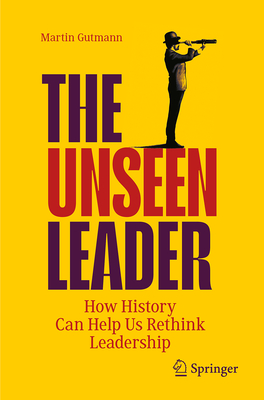
The Unseen Leader: How History Can Help Us Rethink Leadership
Martin Gutmann
The Unseen Leader delivers one simple but immensely powerful we need to radically rethink how we discuss leadership. In this book, American historian Martin Gutmann passionately challenges the received wisdom that history’s great leaders were individuals with a proclivity for action and brash words. Drawing on extensive historical scholarship and contemporary leadership theory, Gutmann delves into the journeys of four unknown or misunderstood leaders who achieved remarkable successes in vastly different environments―the Polar North, the deserts of Arabia, the sugar plantations of the Caribbean, and Second World War London. What emerges is an entirely new narrative on leadership. Contrary to the perception of heroic protagonists forging ahead boldly, history’s truly great leaders were often precisely those who didn’t need to generate excessive noise or activity. Instead, they skillfully minimized dramatic circumstances. Their stories challenge our present-day conception of leadership and can inspire the leaders of tomorrow.
(Goodreads.com)
How Did The Universe Begin?
Pope Francis: The 60 Minutes Interview
60 Minutes • May 19, 2024 In a rare interview, Pope Francis answers questions on global conflicts in Ukraine and Gaza, migrants in the U.S., sexual abuse in the church, and more during a conversation with Norah O’Donnell.