
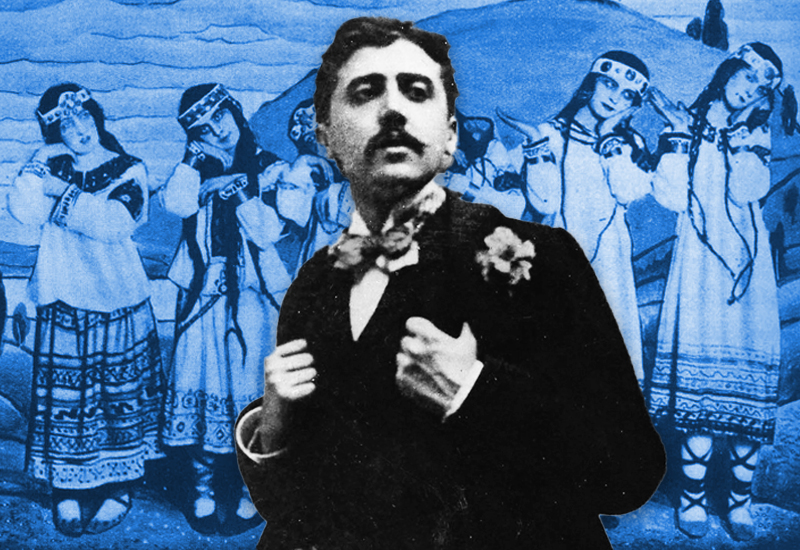
“Every reader, as he reads, is actually the reader of himself. The writer’s work is only a kind of optical instrument he provides the reader so he can discern what he might never have seen in himself without this book. The reader’s recognition in himself of what the book says is the proof of the book’s truth.”
–Marcel Proust
| Literary History MAY 26 — JUNE 1, 2024 (Lithub.com) |
On May 29, 1913, Igor Stravinsky’s Le Sacre du printemps (The Rite of Spring), performed by the Ballets Russes, premiered at the newly constructed Theatre de Champs-Elysees in Paris.
Even before the curtain was raised, the audience had begun to protest. What was this “deformed,” “demented” and atonal music? But once the dancing started—a jarring, contorted, and “almost bestial” kind of movement that no one had ever seen before—all hell really broke loose. “There were fistfights, stampedes, chairs knocked over,” writes Madison Mainwaring.
A lady took out her hatpin in order to stab the man next to her (who may or may not have been Jean Cocteau). The police had to be called in during intermission in order to take away forty of the audience’s more boisterous members. One of the double bass players in the orchestra reported that “many a gentleman’s shiny top hat or soft fedora was pulled down by an opponent over his eyes and ears, and canes were brandished like menacing implements of combat.” Brawls carried on into the streets and at least one duel was fought the next day.
“It’s not clear which elements of the performance caused the disturbance in the audience: Igor Stravinsky’s music or Vaslav Nijinsky’s choreography, Nicholas Roerich’s costumes, the set, the plot,” writes Catherine Nichols. (The ballet’s titular rite is that of a virgin being sacrificed to a pagan god in hopes of a bountiful harvest.) “It could have been the emergent effect of accumulation: Sergei Diaghilev [founder and impresario of the Ballets Russes] had gathered these artists to work on it together because he was interested in Richard Wagner’s Gesamtkunstwerk—a plan for the theater to unite the arts to create a single, totalizing impression in the viewer.”
In the roiling, raucous opening night audience was Marcel Proust (also Gertrude Stein, Pablo Picasso, Claude Debussy, and Maurice Ravel), though it is difficult to imagine him being horrified by such ecstatic artistic experimentation. Swann’s Way, the first volume of Proust’s own masterpiece In Search of Lost Time, was due to be published in November. More likely, he understood exactly what Stravinksy and Nijinsky were up to.
“As literary modernism seemed to be about stripping away the pleasures of the Victorian novel, making text simpler and more minimalist, Proust was going in the other direction, writing the most descriptive possible novel,” writes Nichols.
He doesn’t seem interested in the mechanization of industry, the alienation of workers, or the new uses of language associated with slick, machine-made objects. He seems out of step with the other trends of literary modernism, but in the context of Gesamtkunstwerk, his project makes sense in its time. While Proust was publishing In Search of Lost Time, the 20th century was only at the beginning of its taste for totalizing aesthetics—a separate cultural strand from the taste for simplicity, but equally modern.
Both The Rite of Spring and In Search of Lost Time would become revolutionary works of modernism, their influence directing the course of art for decades; perhaps one did not influence the other, but nor was it, exactly, a coincidence. According to legend, after the disastrous premiere, Stravinsky, Diaghilev, and Nijinsky had dinner at Larue, where they were joined by Proust and his frenemy Jean Cocteau. “At two o’clock in the morning, Stravinsky, Nijinsky, Diaghilev and myself piled into a cab and were driven to the Bois de Boulogne,” Cocteau wrote.
We kept silent; the night was cool and clear. The odor of the acacias told us we had reached the first trees. Coming to the lakes, Diaghilev, bundled up in opossum, began mumbling in Russian. I could feel Stravinsky and Nijinsky listening attentively and as the coachman lighted his lantern I saw tears on the impresario’s face. … You can’t imagine the gentleness and the nostalgia of these men, and no matter what Diaghilev may have done later, I shall never forget, in that cab, his great tear-stained face as he recited Pushkin in the Bois de Boulogne.
Source: https://link.lithub.com/view/602ea880180f243d6535c479l50ut.202g/89d71269