The Brain Doesn’t Create Consciousness — It Constrains It.

Why we should reposition how we think of the mind.

Matthew

Matthew

Published in TRIBE

Apr 12, 2024 (Medium.com)

Vladimir Srajber

The theory that consciousness is epiphenomenal is pretty much assumed by much establishment science today. In spite of the fact that no one has ever proposed the faintest inkling of a solution to David Chalmers Hard Problem that points out that even if we mapped every atom in the brain we would not actually arrive at consciousness, the view that we will inevitably stumble upon a feature of the brain that offers us an explanation for consciousness remains strangely persistent.

In spite of apparently banishing metaphysical speculation there are ironically metaphysical reasons for this, which is to say that science has siloed much of its work in a materialist position from which other kinds of solutions to the problem of consciousness sound far too much like spirituality to be taken remotely seriously.

The question though is still one that science has to have some role in considering. And there are some fascinating insights into which we can shed light into an alternative way of viewing consciousness.

The epiphenomenal view of consciousness essentially assumes that the brain “emits” consciousness. That is to say the material of the brain contains a set of processes that somehow conspire to produce consciousness ‘upwards’ causally, like air coming out from an air conditioner vent. This seems like the default position, especially to those who are materialist or scientifically minded, but it has some significant problems.

The first is what consciousness itself is actually doing if the brain itself exists on a level of unconscious processes, but more importantly it has the basic problem of failing to explain where out of reality consciousness comes from. Since consciousness seems to be virtually by definition a reality different in kind, almost ontologically different, from what we class as material or natural reality, how does a biological process simply come to produce it unless it is already a property of the material it has to work with?

So this takes us to a second way of viewing consciousness, not as something the brain “emits” but as something the brain “permits”.

In this way of viewing consciousness, consciousness itself is a fundamental substance of reality, perhaps the fundamental substance of reality, and the brain rather than emitting consciousness like a lightbulb being turned on and generating it permits consciousness in your particular experience in the same way a voice constrains air in order to create your particular voice.

Is there any evidence for this? One of the most reliable ways to elicit at the very least a feeling of this intuition is psychedelic drugs, in fact many of those early pioneers of psychedelics in the twentieth century who experimented with psychedelics were convinced of consciousness as primary and universal after the experience of egoless consciousness that drugs such as LSD or psilocybin can elicit. One of these was Aldous Huxley whose book The Doors of Perception was named after a quote by William Blake:

“If the doors of perception were cleansed every thing would appear to man as it is, Infinite. For man has closed himself up, till he sees all things thro’ narrow chinks of his cavern.”
Interestingly studies of the brain on psychedelics seem to show something in common with the brains of experienced meditators. Although it remains mysterious to some extent, most significant seems to be a reduction in blood flow to an area of the brain called the default mode network, something that is interestingly the inverse of those experiencing rumination and depressive disorder which are associated with increased connectivity in the DMN.

It seems that this is a part of the brain that operates as scientist Robin L. Carhart-Harris has put it as something like the orchestra conductor, constraining, inhibiting and limiting other parts of the brain. By shutting this down psychedelics seem to unconstrain cognition allowing an increase in connections across the brain that explain the synesthetic and hallucinogenic qualities of the psychedelic experience.

The DMN seems to be associated with something like the ego. It is not present in early childhood and seems to be a later evolutionary development, and its deactivation is associated with the loss of self experienced by meditation practitioners and psychedelic trips.

Yet the loss of self does not reduce consciousness, rather it seems to expand it. In a paper The entropic brain Robin L. Carhart-Harris and others suggest that the brain is essentially balanced between ordered and disordered states, from high-entropy, which they associate with infancy (essentially Harris seems to see the expansive love of the psychedelic trip as a return to the state of consciousness on your mother’s breast) to low entropy such as depression. (1)

Part of what, say, a psilocybin trips seems to be able to do is shake the snow globe of the mind by turning off the DMN enough to allow some resetting of those low entropy states the mind can become encased in, in other words it at least temporarily lets down the prison walls of the ego.

Naturally though this theory, while fascinating, still has a kind of problem with consciousness. It begs the obvious question, why is there this infant conscious that seems to essentially not be created by the self but constrained by it? In other words what the DMN seems to be doing, or what the self or the ego or whatever is doing is actually limiting consciousness in order for us to function properly in the world.

So do the experience of meditators, mystics, poets, visionaries or psychedelic trips allow us to witness a more universal consciousness unconstrained by the mind? It seems to me the alternative is eminently less likely, which is that consciousness is emitted by the brain from childhood and the rest of life is spent constructing a functionality that constrains it increasingly restrictively as we get older. Why does the consciousness need to be there? What on earth is it doing?

Interestingly poets and artists have had this insight long before science wrestled with these ideas. Wordsworth in his poem Intimations of Immortality wrote of the loss of an apparent sense of joy or transcendence as he moved away from childhood:

There was a time when meadow, grove, and stream, / The earth, and every common sight, / To me did seem / Apparelled in celestial light…It is not now as it hath been of yore; — / Turn wheresoe’er I may, / By night or day. / The things which I have seen I now can see no more.

Wordsworth sees this as a reflection of hints of a pre-existence that has a strange resonance to the theory that the mind increasingly constrains a more universal infant consciousness:

Our birth is but a sleep and a forgetting: / The Soul that rises with us, our life’s Star, / Hath had elsewhere its setting, / And cometh from afar: / Not in entire forgetfulness, / And not in utter nakedness, / But trailing clouds of glory do we come / From God, who is our home.

This idea is found elsewhere in literature, in Ben Okri’s 1990 Booker Prize winning novel The Famished Road the narrator is Azaro, a ‘spirit child’, who in the African tradition is a child who comes from the blissful world of spirits and is reborn countless times in the world, always wishing to die young in order to return to this happy realm of love where there is no suffering. A quote from the first chapter echoes Wordsworth’s poem “There are many reasons why babies cry when they are born, and one of them is the sudden separation from the world of pure dreams, where all things are made of enchantment, and where there is no suffering…to be born is to come into the world weighed down with strange gifts of the soul, with enigmas and with an extinguishable sense of exile.”

More recently in his 2018 book The Poem, poet Don Paterson suggests that part of what poetry itself can do is enable us to relate to the form of our consciousness that emerges in early childhood, before language. Poetry for Patterson allows us for a moment to take language to its very limits, find momentary glimpses of higher unity, of the universe as it is. Paterson, drawing on the word of Chilean psychoanalyst Ignacio Matte Blanco, describes this “atemporal and infinite connection” as something that still exists, “like an operating system upon which the more recently acquired software of perceptual category and language sits.”

All this seems to cry the suggestion that viewing consciousness as “permitted” by the mind seems to offer far more space for actually accommodating both a material conception of the brain as well as allowing for an explanation of how consciousness could have any role in something that can be objectified, and the nearest answer to the hard problem it seems like we can produce. Unless the materialist position can offer some serious explanation for how the brain produces a non-objective substrate objectively, it seems the most obvious, elegant, and familiar to experience.

For the scientist, this poetic speculation is naturally unhelpful. But it is worth the observation that at this stage the idea that consciousness is a pure epiphenomenal product of the brain is one that falls far short of possessing any explanatory scope. The poets are and have been observing their experience far longer than our clumsy instruments have been, and to my mind nothing we have found contradicts them. Our birth is but a sleep and a forgetting. Or as Blake put it, again:

“If the doors of perception were cleansed every thing would appear to man as it is, Infinite. For man has closed himself up, till he sees all things thro’ narrow chinks of his cavern.”

Matthew

Written by Matthew

·Editor for TRIBE

Let’s meet the mountains and see what they heard. https://linktr.ee/mattw1596Follow

A biblical text with ‘new’ facts about Jesus was found—and Christians ignore it

The strange story of “Jason and Papiscus”

Jonathan Poletti

Jonathan Poletti

Published in I blog God.

Feb 15, 2024 (Medium.com)

It isn’t every day that a biblical text is found, but it does happen. In 2004, two passages were found from a lost text of early Christianity, a dialogue attributed to the ‘Luke’ of the New Testament.

I was reading about it in a 2021 paper in the Harvard Theological Review. After two millennia, there’s new information about Jesus? If you didn’t notice that in the news, you didn’t miss it.

Christianity hasn’t wanted to talk about what it says.

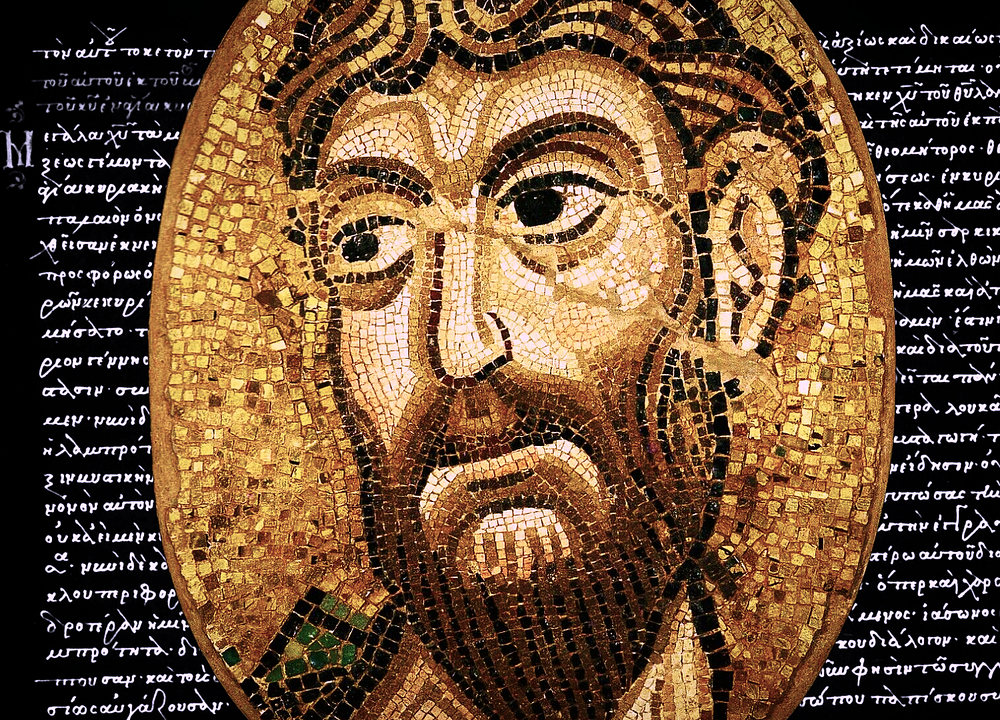
collage: 1950 Libary of Congress microfilm of MS 1807An Apostle Mosaic (Sotheby’s)

A “lost” work is mentioned in early Christian writings—unknown for over a millennia.

Sometimes it was called The Dialogue of Jason and Papiscus and sometimes The Dispute of Jason and Papiscus About Christ. Several descriptions survive. Two men were said to be talking, a Jew and a Christian, discussing, at times testily, the meaning of the Old Testament.

The Christian, Jason, was probably the Jason of Thessalonica who is seen in Acts 17. He had a different way of reading the Old Testament (or Hebrew Bible). He didn’t see it as non-fiction.

He said it was a “messianic prophesy.” He saw the stories as being ‘allegorical’ of Christ. He saw even the Creation story this way.

But Jason seemed to have a different Bible.

Ancient Christian sources quote him quoting Bible verses in unexpected versions. He seems to have quoted Genesis 1:1 this way:

“In the beginning God created a son…”

It seemed mystifying. Surely Genesis 1:1 said:

“In the beginning God created the heavens and the earth.”

But there was a problem. The “weird” version of Genesis 1:1 was cited by many early Christians. Was it possible early Christianity was working off a quite different version of the scriptures?

A ‘church father’ seemed to know who wrote “Jason and Papiscus.”

Sometime around 170 A.D., Clement of Alexandria said it was written by Luke. If anyone would know, it’d be him. Clement knew people who’d known the apostles.

Near the end of the fifth century, however, a monk named John of Scythopolis noted the belief it was by Luke—then he added that he supposed Jason and Papiscus was written by Ariston of Pella. This was a second century Christian writer usually thought to have no importance.

How had John of Scythopolis known this fact, centuries later? He doesn’t say. One might have to recall that, by then, the “allegorical” reading of the Bible was toxic. In the logic of the time, to assign such views to Luke would’ve made a biblical writer the author of ‘heresy’.

Into the 19th century, “lost” Christian texts were being found.

And many strange “variants” of the Bible were found with them—especially around Genesis. Just as Jason and Papiscus had suggested, there seemed to have been a different version of the Creation.

In 1844, a single copy of a once-well-known text called the Epistle of Barnabas was found, and it had more quotations from a “different” Genesis. The Creation became an interaction between Father and ‘Son’.

When God says, in Genesis 1:26: “Let us make humans according to our image and likeness” — the words are said to the Son.

When God says “Be fruitful and multiply,” the words are again said to the Son.

That’s not how it goes in the usual version in Genesis 1:28. There, God seems to be speaking to the newly-created humans.

Another line was quoted, as said by God:

“Behold, I make the first things as the last”

This line was also found in another early Christian text that was recovered a few years later, called Didascalia Apostolorum. Except the line was quoted in a longer version. As it went:

“Behold, I make the first things as the last, and the last as the first.”

This line was said after God created the humans. The story then would be that the Son was the first creation. Humans were the last. The Father is saying: they are alike.

But many “church fathers” said that the Creation story was not non-fiction, but allegory.

In Genesis 1:27, we read that “male and female” are created. Clement of Rome, the 1st century Christian, writes that didn’t mean a man and woman were created.

He explained:

“The male is Christ and the female is the Church.”

St. Catherine’s Monastery in Egypt (2011)

In 2004, a fragment of “Jason and Papiscus” was found in Egypt.

In the archives of St. Catherine’s monastery, a homily of Sophronius of Jerusalem had been unnoticed for over a millennia. This bishop lived from c.560 to 638 A.D. On Sunday, January 1, 635 he’d risen to speak about an unusual subject: why Christians meet on Sunday.

It’s a difficult issue. Jews worship on the Sabbath, which is Saturday, the seventh day of the week. This is commanded in the Ten Commandments. So why did Christians prefer Sunday, the first day of the week?

The New Testament does not address the issue, and Christians likely have no idea why they disregard the Sabbath and meet on Sunday. So Sophronius reaches for another text he regards as authoritative. He quoted from Jason and Papiscus, as Jason speaks from across the ages.

The reason Christians meet on Sunday, Jason explains, goes back to Creation.

It’s there, he says, when God says: “Behold! I am making the last things just as the first!”

The same line found in the Epistle of Barnabas and Didascalia Apostolorum is heard again. Jason says it is from the ‘scriptures’.

He goes on to say that the first ‘word’ of God at Creation, “Let there be light,” was not the appearance of ‘light’ in physical terms.

He says that was Christ. He was the light, and, Jason adds, “the son of God through whom all things came to be.”

Is that saying that Jesus was created?

Apparently in this text he was ‘born’ as a spirit, then as a man on earth. And each event, Jason explains, happened on Sunday. Then Jesus was crucified, then resurrected—also on Sunday, the day of births and rebirths.

That’s the cosmic meaning of Sunday. The idea seems to be that, in the Bible, history is chronicled in vast stretches of time that are called ‘days’. Each ‘day’ is marked by a different divine action.

On Sunday, everything is beginning again.

Jason offers a glimpse of Jesus’ return to the earth to “raise up the righteous” in the Resurrection. After that comes the Kingdom, which he calls “the eternal light in the eternal.”

The discovery was reported in scholarly literature as a minor find of a work by Ariston of Pella.

The Lukan attribution was dismissed without really any analysis. But a Bible scholar named Harry Tolley was thinking about it all.

He had the unusual status of being the only expert on Ariston of Pella who has ever lived, having written his 2009 Ph.D. thesis on the subject.

He didn’t think that Jason and Papiscus was by Ariston. In 2021, he published the paper in the Harvard Theological Review that laid out the surviving evidence of the work, leaving open the question of its author. But I had the feeling Tolley thought it might really be by Luke.

That turned out to be true.

In support of the idea, he makes a range of points. Clement of Alexandria and Sophronius of Jerusalem both said the work is by Luke. That’s persuasive, he suggests. “Sophronius is regarded as a much more reliable source than even Clement of Alexandria.”

I asked: Does he think the newly-discovered text suggests the style of Luke?

He replies: “I do, but it would be difficult to prove Luke had a style.”

The Luke of the New Testament doesn’t speak in a personal voice.

He researched the life of Jesus for his gospel. He followed the apostles and wrote the Acts of the Apostles. There’s been a regular idea that he edited the book of Hebrews, perhaps from a speech by the apostle Paul. Many voices flow through him, but he never speaks in his own.

Was Jason and Papiscus his next ‘Act’? It doesn’t seem too odd to think he was listening to early Christians and Jews talking, and wrote it up as a dialogue. Tolley was prepared to analyze the vocabulary of the fragment found at St. Catherine’s monastery as ‘Lukan’. The fragment has words found, in the New Testament, only in Luke’s writing

There wasn’t much interest in that subject. Scholars avoid the evidence of Luke’s authorship, he suggests, “just to avoid controversy.”

I queried scholars who mentioned “Jason and Papiscus” in recent publications.

Uta Heil is the author of the recent book The Apocryphal Sunday: History and Texts from Late AntiquityShe replies to me:

“The dialog is certainly later, more likely to be from the time of Justin’s dialog or later, so it cannot be by the author of Luke’s Gospel. Perhaps there was another Luke who is not otherwise known? But that all remains speculative.”

I asked if she could say how she knows that Jason and Papiscus is “certainly” a second-century work.

“Well, all researchers agree about this,” she replied, citing a 2019 discussion of the text that is unaware of the 2004 discovery. To the scholarly mind, it seems, the fragment was never found at all.

How about a second opinion?

Matthew J. Thomas discusses Jason and Papiscus in a 2018 bookPaul’s “Works of the Law” in the Perspective of Second-Century Reception.

He offers his assessment of the situation:

“With Jason and Papiscus, the trouble is the lack of solid evidence (not to mention the lack of the text itself!). From an a priori standpoint, I don’t think it’s impossible that Luke could have written it. However, if this were the case one would expect to find significantly wider attestation to Luke’s authorship within early reception (think figures like Irenaeus, Origen, Eusebius, Jerome, etc).”

So I guess I’m left adding up the numbers. Is Clement of Alexandria and Sophronius—two venerated saints—enough mention of the Lukan attribution? Or is John of Scythopolis the deciding voice?

What I know for sure is that this isn’t why Christianity would accept or reject the text. It was rejected without such debate.

Christianity likes the Bible that tells a true story of God’s favorite people…leading up to them.

I grew up with that idea pounded into my head. We’re God’s favorites. Everyone else is going to Hell.

The religion, or the men in the religion, likes a Creation story that sets men above women, and somehow manages to read Genesis this way.

Early Christianity tells a different story.

Around 700 C.E., a monk named Anastasius of Sinai had studied the subject of early Christian views of the Creation story. He cites texts no longer in existence and concludes that most early Christian teachers—Papias, Clement, Pantaenus, Ammonius, a lineage tracing back to the apostle John—taught the ‘allegorical’ view of the Old Testament.

They had, he writes, “understood the whole six-day creation as referring to Christ and the Church.”

But if the ‘Church’ is created in Genesis, then isn’t “the church” just another word for humanity?

That wouldn’t be a reading the religion would want to explore.

So Jason and Papiscus was ‘lost’. And when a fragment was found, there was another effort to lose it. ?

Jonathan Poletti

Written by Jonathan Poletti

·Editor for I blog God.

God blogger

Whirlpool Galaxy

Jeffrey Mishlove took this photograph of the Whirlpool Galaxy (Messier 52) with his 4″ refractor telescope. This galaxy is located 31 million light years away near the handle of the Big Dipper. It is approximately 80,000 light years in diameter. It was the first galaxy to be classified as a spiral galaxy. It is interacting gravitationally with the smaller companion galaxy (NGC 5195) that is situated somewhat behind it and to the right on this image. (jmishlove@newthinkingallowed.com)

Global Mind Changes with Willis Harman (1918 – 1997)

New Thinking • May 3, 2024 This video is a special release from the original Thinking Allowed series that ran on public television from 1986 until 2002. It was recorded in about 1988. It will remain public for only one week. There is a new global emphasis on the inner life of the mind. Willis Harman, PhD, suggests that a new set of values, emerging spontaneously in many social strata and in different parts of the world, is having an impact in the world of business and corporate training. Willis Harman was President of the Institute of Noetic Sciences. He is author of Global Mind Change, An Incomplete Guide to the Future and Higher Creativity.

Advisors Assure Biden This Will Blow Over Once All Gazans Dead

Published Yesterday (TheOnion.com)

Image for article titled Advisors Assure Biden This Will Blow Over Once All Gazans Dead

WASHINGTON—As mounting campus protests and arrests over the Israel-Hamas war threatened his fragile electoral coalition, advisors to President Joe Biden assured him Friday that this would blow over once all Gazans were dead. “Just lie low, let a few thousand more bombs drop on densely populated areas, and you’re golden, Mr. President,” said senior communications advisor Anita Dunn, promising the depleted Biden that in a matter of months, there would hopefully be no one left to protest for in the besieged Palestinian territory. “I know things might seem bleak now, sir, but all you need to do is hold the course giving Israel billions in military aid, and this will most likely all be a distant memory by November. After that, it’s smooth sailing ahead. What are the activists going to be angry about then? A bunch of rubble and mass graves?” Dunn went on to stress that with any luck, there soon wouldn’t be any student protesters left alive, either.

Two Incredible Events. One Powerful Message.


Two Incredible Events
One Powerful Message


YOU are a change maker!!

Don’t believe it?

Feel overwhelmed by unprecedented developments and incomprehensible occurrences in our world?  

Challenge these assumptions in these two upcoming Prosperos events:

May 05th: Sunday Meeting “Reidentifying for Creative Empowerment” with William Fennie, H.W., M at 11 a.m. pacific / noon mountain / 1:00 pm central / 2:00 pm eastern; This event is free and open to the public!

Find out more: https://www.theprosperos.org/prosperos-events/sunday-meeting-05-05-2024

May 18th: Advance Seminar monitor class with Anne Bollman, H.W., M, beginning at 9 a.m. pacific / 10:00 a.m. mountain / 11:00 a.m. central / noon eastern.

Find out more: https://www.theprosperos.org/prosperos-events/advance-seminar-7t6ka-ez5bs
.
Copyright © 2024 The Prosperos, All rights reserved.
You are receiving this email because you opted in via our website.

Our mailing address is:
The Prosperos
P.O. Box 4969
Culver City, CA  90231

Book: “Waking the Witch: Reflections on Women, Magic, and Power”

Waking the Witch: Reflections on Women, Magic, and Power

Pam Grossman

A whip-smart and illuminating exploration of the world’s fascination with witches from podcast host and practicing witch Pam Grossman ( The Witch Wave ), who delves deeply into why witches have intrigued us for centuries and why they’re more relevant now than ever.

When you think of a witch, what do you picture? Pointy black hat, maybe a broomstick. But witches in various guises have been with us for millennia. In Waking the Witch , Pam Grossman explores the cultural and historical impact of the world’s most magical icon. From the idea of the femme fatale in league with the devil in early modern Europe and Salem, to the bewitching pop culture archetypes in Buffy the Vampire Slayer, Sabrina the Teenage Witch , and Harry Potter ; from the spooky ladies in fairy tales and horror films to the rise of feminist covens and contemporary witchcraft, witches reflect the power and potential of women.

In this fascinating read that is part cultural analysis, part memoir, Pam opens up about her own journey on the path to witchcraft, and how her personal embrace of the witch helped her find strength, self-empowerment, and a deeper purpose.

A comprehensive meditation on one of the most mysterious and captivating figures of all time, Waking the Witch celebrates witches past, present, and future, and reveals the critical role they have played—and will continue to play—in shaping the world as we know it.

About the author

Profile Image for Pam Grossman.

Pam Grossman

Pam Grossman is the creator and host of The Witch Wave podcast and the author of Waking the Witch: Reflections on Women, Magic, and Power (Gallery Books, June 2019) and What Is A Witch (Tin Can Forest Press). She is co-founder of the Occult Humanities Conference at NYU, and her art exhibitions and magical projects have been featured in The New York Times, Artforum, and The New Yorker. Her writing has appeared in such outlets as Sabat Magazine, HuffPost, and her occulture blog, Phantasmaphile. You can find her at PamGrossman.com and @Phantasmaphile.

(Goodreads.com)

Arab Peace Initiative

From Wikipedia, the free encyclopedia

Not to be confused with Arab League Monitors in Syria.

See also: 2002 Arab League summit and 2007 Arab League summit

The Arab Peace Initiative (Arabic: مبادرة السلام العربية; Hebrew: יוזמת השלום הערבית), also known as the Saudi Initiative (Arabic: مبادرة السعودية; Hebrew: היוזמה הסעודית), is a 10 sentence proposal for an end to the Arab–Israeli conflict that was endorsed by the Arab League in 2002 at the Beirut Summit and re-endorsed at the 2007 and at the 2017 Arab League summits.[1] The initiative offers normalisation of relations by the Arab world with Israel, in return for a full withdrawal by Israel from the occupied territories (including the West BankGaza, the Golan Heights, and Lebanon), with the possibility of comparable and mutual agreed minor swaps of the land between Israel and Palestine, a “just settlement” of the Palestinian refugee problem based on UN Resolution 194, and the establishment of a Palestinian state with East Jerusalem as its capital.[2] A Palestinian attack called the Passover massacre took place on 27 March 2002, the day before the Initiative was published, which initially overshadowed it.[3]

The Palestinian Authority led by Yasser Arafat immediately embraced the initiative.[4] His successor Mahmoud Abbas also supported the plan and officially asked U.S. President Barack Obama to adopt it as part of his Middle East policy.[5] Initial reports indicate that Islamist political party Hamasthe elected government of the Gaza Strip, was deeply divided,[6] while later reports indicate that Hamas accepted the peace initiative.[7][8] The Israeli government under Ariel Sharon rejected the initiative as a “non-starter”[9] because it required Israel to withdraw to pre-June 1967 borders.[10] In 2015, Israeli Prime Minister Benjamin Netanyahu expressed tentative support for the Initiative,[11] but in 2018, he rejected it as a basis for future negotiations with the Palestinians.[12]

The plan

Further information: Arab League

Prelude to the 2002 Beirut summit

Main article: Middle east peace process

The Arab League summit held after the Six-Day War, during which Israel occupied large swathes of Arab territory, established the Khartoum Resolution on September 1, 1967. It contained the “three noes” that was to be the center of all Israeli-Arab relations after that point: No peace deals, no diplomatic recognitions, and no negotiations. UN Security Council Resolution 242, which called for normalization of Israel with the Arab states and for Israel to withdraw from territories taken during the war, was enacted on November 22, 1967, and faced initial rejection by most of the Arab world. The peace initiative marked a major shift from the 1967 position.[2]

Like most peace plans since 1967, it was based on UN Security Council Resolution 242. It followed the July 2000 Middle East Peace Summit at Camp David which ended in failure and the al-Aqsa Intifada beginning in September 2000. In fall 2002, the Bush administration strenuously tried to push a temporary cease-fire in the intifada to give breathing room for the Beirut summit but failed to achieve an agreement.[13] However, the presence of American negotiator Anthony Zinni in Israel led to a lull in the conflict for the two weeks before the summit.[14] During this period, the Bush administration hoped to draw attention away from the Iraq disarmament crisis that would later escalate into the 2003 invasion of Iraq.[13][15]

Some reporters were skeptical about the summit’s prospects. Robert Fisk explained the absence of Egypt’s Hosni Mubarak and Jordan’s King Abdullah: “they can smell a dead rat from quite a long way away.”[15] On March 14, analyst Shai Feldman stated on The News Hour with Jim Lehrer that “[t]here’s little hope that negotiations will pick up or that negotiations will eventually succeed in bringing about a negotiated outcome between the two sides.”[16] However, Pulitzer Prize-winning columnist Thomas Friedman met Saudi Crown Prince Abdullah in February 2002 and encouraged him to make the peace proposal.[17]

2002 summit

Main article: Beirut Summit

The declaration

Wikisource has original text related to this article:

Arab Peace Initiative

Only ten of the twenty-two leaders invited to the March 27 Arab League summit in Beirut, Lebanon attended.[13] The missing included Palestinian Authority Chairman Yasser ArafatPresident Hosni Mubarak of Egypt, and King Abdullah of Jordan.[13] Ariel Sharon’s government, despite American and European pressure, had told Arafat that he would not be allowed to return if he left for the summit.[13] The lack of participation led Australian Broadcasting Corporation reporter Tim Palmer to label the summit “emasculated”.[13]

Abdullah, along with other members of the Saudi royal family, was outspoken in his support for the plan.

The Arab League members unanimously endorsed the peace initiative on March 27.[14] It consists of a comprehensive proposal to end the entire Arab–Israeli conflict.[18] It provides in a relevant part:

(a) Complete withdrawal from the occupied Arab territories, including the Syrian Golan Heights, to the 4 June 1967 line and the territories still occupied in southern Lebanon; (b) Attain a just solution to the problem of Palestinian refugees to be agreed upon in accordance with the UN General Assembly Resolution No 194. (c) Accept the establishment of an independent and sovereign Palestinian state on the Palestinian territories occupied since 4 June 1967 in the West Bank and Gaza Strip with East Jerusalem as its capital. In return the Arab states will do the following: (a) Consider the Arab–Israeli conflict over, sign a peace agreement with Israel, and achieve peace for all states in the region; (b) Establish normal relations with Israel within the framework of this comprehensive peace.[18]

Crown Prince Abdullah of Saudi Arabia made a speech to the Arab League on the day of its adoption saying that:

In spite of all that has happened and what still may happen, the primary issue in the heart and mind of every person in our Arab Islamic nation is the restoration of legitimate rights in Palestine, Syria and Lebanon…. We believe in taking up arms in self-defence and to deter aggression. But we also believe in peace when it is based on justice and equity, and when it brings an end to conflict. Only within the context of true peace can normal relations flourish between the people of the region and allow the region to pursue development rather than war. In light of the above, and with your backing and that of the Almighty, I propose that the Arab summit put forward a clear and unanimous initiative addressed to the United Nations security council based on two basic issues: normal relations and security for Israel in exchange for full withdrawal from all occupied Arab territories, recognition of an independent Palestinian state with al-Quds al-Sharif as its capital, and the return of refugees.[19]

The initiative refers to United Nations General Assembly Resolution 194, which emphasizes the return of Palestinian refugees to Israel.[17][20] In a compromise wording, it states that the League supports any negotiated settlement between Israel and Palestinians and does not mention the term “right of return”.[17][20]

More at: https://en.wikipedia.org/wiki/Arab_Peace_Initiative

Egon Schiele on the body’s own light

Self-Portrait with Physalis, 1912

Bodies have their own light which they consume to live: they burn, they are not lit from the outside.
— Egon Schiele

Egon Leo Adolf Ludwig Schiele (June 12, 1890 – October 31, 1918) was an Austrian Expressionist painter. His work is noted for its intensity and its raw sexuality, and for the many self-portraits the artist produced, including nude self-portraits. Wikipedia

(Courtesy of Gwyllm Llwydd)