The edges we face today — the threshold — are ones that may well affect the future viability of our civilization, and perhaps even our species.

MAY 05, 2024 (wisdomschool.com)
“Come to the edge,” he said.
They said, “We are afraid.”
“Come to the edge,” he said.
They came.
He pushed them . . . And they flew.
—Guillaume Apollinaire (French Poet 1880-1918)
Edges are where all the action is. Biological edges — from seashores to the edges of rainforests — are always the areas of greatest biodiversity. Human edges — from conflict zones to places of learning — are where we find the most visible truths about where we’ve been, where we are, and where we’re going.
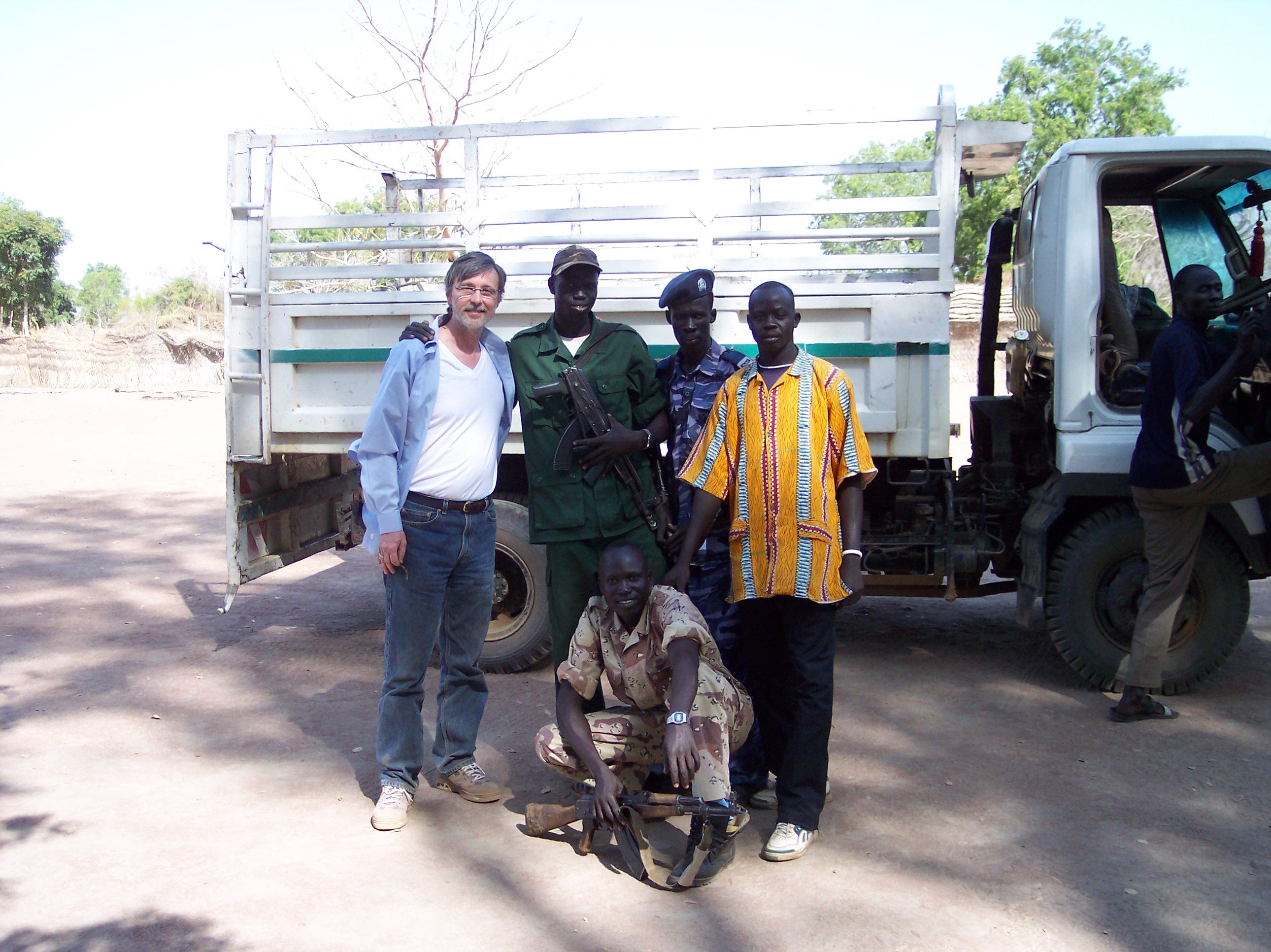
The edges we face today — the threshold — are ones that may well affect the future viability of our civilization, and perhaps even our species. For a glimpse into the worldwide thresholds we’re approaching, I visited the cultural, ecological, and political edge of Southern Sudan on the Darfur border.
On the border with Darfur, Sudan — 16 March 2008
It’s late morning, and I’m sitting on the dirt ground typing into an old, AA-battery-operated pocket word processor (a Zaurus ZR5000), in part because the nearest electricity is over 500 miles away. So is the nearest paved road, and the nearest building made from anything other than mud or grass. This is Gok Machar, South Sudan, just a few miles from the border with Darfur, a village that’s swelled from 8000 people to over 45,000 people as refugees flee the bombings and murders that are taking place as I type these words just fifteen miles to my northwest. About three hundred people have arrived just this morning, most with nothing more than the clothes they are wearing, many with stories of relatives who died along the way as they fled here or before the UN could pick others up to bring here.
When we first arrived on the African continent we looked out onto the nighttime savannah beyond our Nairobi hotel and it was truly a startling site. The landscape was huge, horizon to horizon, like the movies you see of these parts of Africa. The land here in South Sudan is just as vast and flat. The 45,000 people around me share one single hand-pumped well (drilled a decade ago by the United Nations), and no other infrastructure beyond that. No buildings, no roads, no septic or sewage, no schools, no clinics or hospitals, no stores or even storehouses, nothing. Most live on a patch of reddish dirt about ten feet square with a few of their possessions marking the perimeters of their “home,” sleeping on the dirt, or on a ragged piece of cloth or, the lucky few, a piece of salvaged tarp from some previous relief mission. Stick-thin women and children with bellies swollen by malnutrition outnumber the men, whose peers were murdered by the Janjaweed or taken as slaves to the north,.
The air is so hot and dry that even smells of body odor vanish. My nose is encrusted with dust.
The land is barren of any vegetation at all other than the occasional large tree with roots deep enough to reach into the water table thirty or so feet below us. Dust devils blow up and around, tiny cyclones that seem to erupt from nowhere amidst air that is so hot and dry it feels as if we’ve been wrapped in glass wool insulation and tossed into a furnace’s heating duct.
One relief worker we met on the way here, who was leaving the Darfur area via Juba in South Sudan, said, “If there is a hell, it is much like Darfur.”
This being a refugee community, it is thick with disease, as refugees not only bring diseases with them but are among the most vulnerable of all populations to disease. There’s Buruli ulcer, a flesh-eating and incurable (other than by surgery) disease caused by a bacteria related to leprosy — I saw a case of it yesterday in a girl who had just arrived from Darfur. She had a hole in the side of her shin that was about four inches long, two inches wide, and three-quarters of an inch deep, nearly down to the bone.
Ebola was first discovered here and in nearby Zaire. Eighty percent of the world’s cases of Guinea Worm disease are here in Southern Sudan — the microscopic eggs are in the guts of tiny, almost invisible sand fleas that infest food and water, and about three months after eating one, the worms hatch. Over the course of the next year they grow throughout the body, often boring out through the skin causing an ulcer that can take months before the worm fully emerges, causing dreadful and incapacitating pain. There is no cure.
In parts of South Sudan sleeping sickness — caused by a parasite named trypanosoma that’s transmitted by the bite of local flies — kills more people than AIDS. This is also the world epicenter of onchocerciasis — another worm that grows more than 1 1/2 feet long inside the body and spreads thousands of eggs to all the organs — soon to become more worms — over the decade or so it takes to kill a person. Sometimes the smaller worms work their way into the cornea, causing blindness which gives this parasite its common name: “River Blindness.”
There’s also visceral leishmaniasis, tuberculosis, leprosy, yellow fever, dengue fever, various bacteria and mycoplasma that cause severe and deadly forms of pneumonia, and many, many of the people in this village are infected with malaria (a particularly nasty, drug-resistant, and usually fatal form, P. falciparum, is the most common here in Southern Sudan).
All of the refugees have horror stories to tell. Most were burned out of their villages, some shot, beaten, stabbed, and/or raped (including the young boys). Many had been taken as slaves and were only allowed to escape when they became too sick, lame, or old to be of value. The women and girls have particularly horrific stories to tell about gang rape by the northern Arab Muslims, with the specific goal of impregnation so they would have “Arab” children, thus destroying the racial/cultural/religious/tribal lineage of their families and thus their culture. (We saw many “Arab-looking” young children among these very dark-skinned Sudanese women.)
The sun is relentless, the air still and thick. At night it gets down into the 90s, and the sky is so big and wide and we are so far from any electric lights that it looks like you can reach out and touch the thick horizon-to-horizon strip of the Milky Way.
And yet the human spirit is not crushed by this.
In the community around me children are playing, women are cooking and talking, the men are regaling each other with tall tales.
Every night in different parts of the community they bring out the drums. The music and the singing begin, people dance and talk and chant. Young people flirt and old people gossip, and the children play with sticks — always sticks, because there is no metal, no plastic, no stones, no toys — and because you can do a lot with a stick. (They’re actually a fairly rare commodity: firewood is hard to find.)
The trip we were on was organized and sponsored by Michael Harrison’s Talkers Magazine and Ellen Ratner’s Talk Radio News Service, in collaboration with Christian Solidarity International, a Swiss-based charity that has been working in Darfur for several years. South Sudan is the most undeveloped and barren place in the world. When the British pulled out in 1956, as Churchill did with Uganda, they simply and abruptly left, creating huge vacuums in power, social and political infrastructure, and, perhaps most importantly, because the entire colonial economy had been geared to transport resources and raw materials from Sudan to the UK with little by way of compensation going back the other way: a huge business vacuum.
To the north were the lighter skinned Arabs who generally took the attitude of early European-ancestry Americans — these very dark-skinned Africans in the south, with their animist and tribal ways — must be inferior peoples.
From the notion of simple superiority/inferiority came the rationale for all-out genocide, as the Arab government in North Sudan — Khartoum is the capitol and biggest city — undertook a covert but not particularly well-concealed program of extermination of the Black Africans in the south. This got going soon after the British pullout, but really stepped up in 1972 when the various tribes of central and southern Sudan began to fight back. They were called rebels and terrorists, but by and large most were simply fighting to maintain their own homelands and protect their own people.
In the 1980s, oil was discovered throughout Sudan, but particularly in the South. This put the conflict on steroids, as the north was no longer simply trying to consolidate land and drive out the Africans to create an Arab state, but also wanted the oil. Several groups emerged to fight against the north but the SPLA ended up the primary of the armies, and when the Comprehensive Peace Agreement (CPA) was finally signed in 2005, the SPLA had effective control of the south.
They also got half of the oil revenue from the south (the rest going to the north, which kept 100% of its own oil revenue), although there has been no accounting for the oil revenues: just ‘trust me’ payments to the South from the North.
The result of the increased revenue — at least for the moment — has been that portions of the South have been able to approach or even cross the threshold of safety and security that exists in any society between those who can grasp for the higher needs of a culture (education, innovation, social change) and thus evolve, and those who must spend all of their mental and physical energies simply surviving from day to day.
Back in the 1970s, psychologist Abraham Maslow, the founder of the school of Humanistic Psychology, posited that there is a “hierarchy of human needs,” with safety and security at the very bottom, followed above by social and family needs, then relationship needs, then intellectual needs, then self-actualization and spiritual needs.
Wherever a person is on this hierarchy, everything above that point is invisible to them. When you’re worried about survival because your car is spinning out of control on the highway, you’re not thinking about enlightenment, or even what car you want to buy, for example.
For the purposes of this book, I’m positing a critical threshold in Maslow’s hierarchy, which I call “Maslow’s Threshold,” that being the line at the top of safety and security and below all the other needs. Because the people in South Sudan are so close to this threshold, war is an omnipresent risk. The legalized mass killing that is war is the ultimate failure of people to cross this threshold.
The crisis that the people of Darfur and Southern Sudan are facing — the threshold that will determine their future survival — is a microcosm of the “macro” issues we are all facing as the world slides into peak oil, resources (particularly water) run low, human population explodes, and our atmosphere has developed a fever that increasingly is confronting people around the world with many of the same conditions Darfurians and Sudanese face daily.
One of my personal goals for this trip was to find ten stones to build a small altar, anoint it with oil, and say the 91st Psalm over it. It’s an eccentricity I learned from my mentor, Gottfried Mueller[ii]. The problem I encountered is that there are no stones.
None.
This land is so incredibly ancient that all the stone has been weathered to dust. I can’t even find grains of dirt big enough to compare with a typical grain of beach sand.
This (and the adjoining countries of Kenya and Tanzania) is the land where humanity began. And in many ways it’s just as it was 160,000 years ago when modern humans first emerged here.
The little hut I’m sitting in as I type these words is held up with a square of sticks — the main supports being about 3 inches thick, those around the edge of the roof around a half-inch thick — tied together with a rope made of braided reed. The walls are woven reed, and the roof is a carefully woven grass of some sort.
There is not a nail in sight. Not a brick or a stone. While it’s a very utilitarian technology, it’s also one that has probably existed as long as has mankind.
One of the relief workers from CSI, Gunar, yesterday remarked to me, ‘‘You will not find here a wheel, unless it’s imported. They are living without the wheel! And there are no stones. This precedes even the stone age. These are ‘clay age’ people.’’
“Why?” I asked him. Why, when this part of the world has had contact with metal and technology for centuries, do the people still choose to live in the Clay Age?
This is one of the really big questions that Sudan must confront as oil revenues make the nation richer, and increasingly the developed, Arab north comes into collision with the tribal Black African ‘clay age’ south.
This is not an issue of race, of IQ, or (as some racists are fond of evoking) ‘motivation.’ There are people from this part of the world who are among the world’s most elite scientists, engineers, and writers. One of them is currently running for President of the United States and his grandparents lived in a hut much like this one, only a few hundred miles from here in rural Kenya.
Instead, perhaps, it’s an issue of what works. Marshall Sahlin coined the term ‘the original leisure society’ to describe people who live tribally. Given enough resources, there’s really not a whole lot of work to do. And before oil was discovered and the current war and evangelical Islam and Christianity came to this region, the winter rains produced enough food and wood and reeds to make it through the dry summers. There was no reason to “work.” But oil, “civilization,” and the religions that came with both changed society in such a way that it became necessary for many people to do productive work (particularly of food) so that others could participate in non-productive (at least of food) social functions.
“Cultural overhead” is the term anthropologists use. It’s a fancy way of defining how many non-productive people there are in a society. For every priest, king, prince, warrior, middle manager, or CEO — none of whom directly produce food or shelter — the average person must work that much harder to provide food and shelter for all. In some of our “developed” cultures, as few as two to five percent of us provide all the food for everybody. And they work damn hard and use enormous numbers of calories (mostly from oil – tractors, fertilizer, transport) to produce that food for the rest of us.
But in a society without such cultural overhead, without a nonproductive class of people, every family provides for their own, and in this part of the world that could historically be done in just a few hours a day (more during the rainy season, less in the dry season). The rest of the time is free to talk, play, and be.
The indigenous people of Sudan, for over 100,000 years, have by and large simply had a life of leisure and great simplicity in this unforgiving land. The dry season — what I’m experiencing right now — is a time of brutal, unrelenting heat and drought. Without preparation, you die in as little as a few days. The rainy season brings floods and the diseases often associated with them, from malaria to dengue, typhoid, and yellow fever. And yet, over tens of thousands of years, people have found ways to live in balance with this difficult continent. It’s a minimalist balance, to be sure, but how can we say that’s better or worse than ‘civilized’ societies with massive crime, conspicuous accumulations of wealth cheek-by-jowl with grinding poverty so intense that parents can’t even get to know their children as they must work so many hours just for food? And when considering life in South Sudan now, it’s vital to remember that while these people are living, to a large extent, with the technology of millennia ago, their culture from that time that allowed them to survive has been largely decimated by several centuries of colonization.
I took a break from my writing to stand up and stretch my legs, and one of the young men came over to say hello. He introduced himself as James, a Dinka, with a last name hard for me to pronounce: Saliahtja perhaps phonetically. His father’s name, he said.
I asked him the names of some of the trees, and he knew the Dinka names for all of them, but the only English one he knew was the giant Mahogany under which we’ve been camped.
He said that CSI is good in that they’re bringing supplies to returning refugees, but that the locals like him have to rely mostly on the UN’s World Food Program.
He was born and raised in this region and told me about being here when the ‘Arab raiders from the north’ came in 2003, just at the end of the war. They took everything, he said. Our sorghum, our food for the year, they took it by force. With guns. Anything they wanted. They took everything.
Did they take people? I asked.
He looked down at his feet and softly said, ‘Yes. Yes.’ Then he immediately changed the subject, telling me the name of another tree off in the distance. He told me he is a member of the Episcopal Church, in whose compound we’re camped.
Later in our conversation I asked how life was here in the village. He said they are constantly afraid that the Arabs will return. Every day we are afraid, he said.
Before the arrival of Christianity, Islam, English, Arabic, the alphabet and “technology,” James’ ancestors knew not just the Dinka names of each of the trees and plants in the area, but their “spirits” as well. They knew which ones could cure which diseases. (Remember that more than half of all the drugs we use in our hospitals todaycome from plants and were first “discovered” by indigenous peoples. Most of the other half are merely variations on these, like aspirin is a synthetically produced form of the active ingredient in White Willow Bark, and Valium and that whole family of benzodiasophene anti-anxiety and sleeping drugs) is a synthetically produced form of the active ingredient in Valerian Root.)
They knew the world in which they lived. It was the only way they could have survived.
They would have known, for example, that the bark of the Cinchona tree (or the local variation on it) contained a power that would kill parasites including the plasmodium that causes malaria. Although today we can cite the drugs contained in Cinchona bark (aricine, caffeic acid, cinchofulvic acid, cincholic acid, cinchonain, cinchonidine, cinchonine, cinchophyllamine, cinchotannic acid, cinchotine, conquinamine, cuscamidine, cuscamine, cusconidine, cusconine, epicatechin, javanine, paricine, proanthocyanidins, quinacimine, quinamine, quinic acid, quinicine, quinine, quininidine, quinovic acid, quinovin, and sucirubine),[iii] it took Europeans hundreds of years to learn from aboriginal people about the properties of the tree.
A tree known as Wontangue in the Bakweri language of Cameroon is known to modern science as Prunus Africana, and is more effective at preventing benign prostatic hypertrophy (prostatic enlargement, something that hits over 80% of men who live over 70 years) than any drugs so far developed. Kigelia Africana or Woloulay in Bakweri is effective for malaria and snakebites. Sterculia tragacantha or Ndototo in Bakweri kills worms in the body, as does Wokaka, botanically known as Khaya Spp.[iv]
Other African plants that are today used to manufacture medicines you’ll encounter at your local pharmacy include: Hyoscyamus muticus, Urginea maritima, Colchicum autumnale, Senna alexandrina, Plantago afra, Juniperus communis, Anacyclus pyrethrum, and Citrullus colocynthis.[v]
But James knew of none of them. As our culture moved across Africa over the past five centuries or so, it took away the ancient knowledge, just as we extracted minerals and plants for our own use and even took people from the continent to use as slaves. But we returned virtually nothing, and today the people of Southern Sudan live in a simulacrum of Clay Age life, the forms and external appearances intact, but the deep knowledge and culture necessary for both survival and happiness gone.
As anybody from New Orleans can tell you, refugee camps are the worst places in the world. While they often provide heartbreaking glimpses into how deep compassion and generosity can run (particularly among the refugees themselves), they also, by their nature, lack the ‘commons’ so necessary to civil society and so much at the core of every culture and civilization.
Yesterday at a refugee center a half-day’s drive from here, I was sitting with Ellen Ratner as a group of children lined up near our seats to watch their parents get the ‘Sacks of Hope’ from CSI. John had warned us several times in the past to be careful not to eat food that had had flies on it, and never to leave food out because of the flies here, and the sight in front of me brought all this to mind.
The way flies eat is they drop down their tongue — really a thick, hollow tube with a sort of sucker on the end — and vomit the contents of their stomach onto the surface they’re ‘tasting.’ As their stomach contents includes their digestive juices, when they quickly suck that slurry back up, it loosens and dissolves some of contents of the food they taste. This is why in places like Africa, with so many deadly diseases all transmissible by flies, when you see flies you should worry.
A little boy, probably seven years old, stood in front of Ellen and me, his face and body in profile as he watched his mother get a bag of grain. On his right shin were three or four open wounds — just scratches, really, probably from a brush with a thorn bush. But each was jammed full of flies. There must have been 20 of them, with others competing for the space. This is the beginning of the kinds of ulcers and sores we’d seen among the refugees when we first arrived — the girl and boy with giant holes in their legs — and without quick treatment this little boy will probably be dead in a few months. Unfortunately, that camp has no doctor or clinic.
People living in the Darfur region and South Sudan are well below the threshold of safety and security. Small changes — a meal, a bottle of safe water, toilet paper — make huge differences not just in their quality of life but in their ability to survive. These Sudanese also demonstrate — in their endurance of the evil behavior of humans bombing and murdering and enslaving people, in part for land, in part for oil for China — that no matter how terrible things are, people will still pull together, form communities, care for each other, and default to democracy.
At a certain level, our modern consumer society is built on a truth and a lie. The truth is that if you’re living below the threshold of safety and security, a little bit of “stuff” can create a huge change in your mental and emotional states, and the quality of your life. If you’re outside alone at night, naked and cold, you’re miserable. If somebody brings you inside, gives you clothes to wear, a warm blanket, a fire to sit by and warm food to eat, a comfortable bed to sleep in, then you move from “unhappy” to “happy” pretty fast.
The lie is the siren song of our culture. “If that much stuff will generate that much instant happiness,” the lie goes, “then ten times as much stuff will make you ten times happier. A hundred times as much stuff will make you a hundred times happier. A thousand times as much stuff, a thousand times happier. And Bill Gates lives in a state of perpetual bliss!”
In this region, we’re seeing the failure of modern thinking. The failure of a consumerist society that values its stuff more than it does other people, cultures and the environment, so it’s willing to colonize, pillage, and then desert another nation. The failure of a communist/capitalist society that will support a nation that engages in genocide, because there’s oil to be had. The failure of modern Islam to learn from the mistakes of twelfth-century Christianity and see non-Islamic peoples as inferior or as potential proselytes, rather than respecting cultures, peoples, and property.
As the large parts of our world are sliding below that threshold — today over three billion of the world’s nearly seven billion people don’t have reliable access to safe water, sanitation, or food supplies, and desertification marches on across the planet — we can see in Darfur the potential future for much of the world as well as validation of the idea that there’s something to be done here, something possible, something that’s part of our DNA.
We can lift others above the threshold, and confront the coming environmental and economic storm of the next century, but it’s going to require a comprehensive approach covering the environment, commerce, population control, energy, politics, the empowerment of women, and a dramatic reevaluation of how we power our society.
These are our thresholds: it’s up to us if we decide to step across into a new way of understanding and knowing the world, or fall and fail as so many cultures have.
[i] http://www.cbsnews.com/stories/2004/02/03/health/main597751.shtml (a February 3, 2004 report from Sudan by the Associated Press’s Emma Ross, “Sudan A Hotbed of Exotic Diseases: Country has unique combination of worst diseases in the world,” and http://www.cdc.gov.
[ii] I wrote a book about Herr Mueller and my time with him titled “The Prophet’s Way,” named after a trail in the forest near his home in Stadtsteinach, Germany.
[iii] http://www.rain-tree.com/quinine.htm
[iv] http://peopleandplants.org/web-content/web-content%201/wp2/geo.htm#International%20medicinal%20uses%20of%20Prunus%20africana%20bark
[v] Batanouny, K.H. 1999. THE WILD MEDICINAL PLANTS IN NORTH AFRICA: HISTORY AND PRESENT STATUS. Acta Hort. (ISHS) 500:183-188


 Former President Donald Trump. (photo: Erin O’Flynn/The Daily Beast)