
Zeteo • May 2, 2024 In a conversation with Mehdi for her new contributor segment at Zeteo, called “Unshocked,” Jewish activist, academic, and author Naomi Klein calls for an “exodus from the ideological shackles of Zionism.” Naomi also reacts to Israeli PM Benjamin Netanyahu comparing student protesters at Columbia University to Nazis, telling Mehdi that when it comes to Netanyahu, “there is nobody more adept at exploiting Jewish trauma, historical trauma, and turning it into a political weapon for his own advantage.” Mehdi also opens up to Naomi about why he decided to boycott the White House Correspondents Dinner. “I can’t call out what Israel is doing to Palestinian journalists with American-made bombs and then go to a fun, comedy-type dinner with the President of the United States — who’s not just responsible for that, but is also not even acknowledging it,” Mehdi told Naomi. In 2007, Naomi wrote “The Shock Doctrine,” a book that explains what happens when a national crisis throws citizens into a state of shock and how the powerful exploit those moments. Although it may be one her most popular books, Naomi tells Mehdi that she dreams of a day where the Shock Doctrine will no longer be relevant, where people can stay grounded even in times of chaos. Look out for “Unshocked” with Naomi Klein every month, where Naomi and Mehdi will provide deeper analysis on current events, religion, politics, ideology, and more. — Founded by Mehdi Hasan, Zeteo has a strong bias for the truth and an unwavering belief in the media’s responsibility to the public. Unfiltered news, bold opinions. For more content from Zeteo, subscribe now www.zeteo.com.”
Monthly Archives: May 2024
What We Learn About Kafka From His Uncensored Diaries
Stuart Jeffries/Guardian UK
 Photo of Franz Kafka on his grave at the New Jewish Cemetery, Prague. (photo: Radim Beznoska/Alamy)
02 may 24 (RSN.org)
On the centenary of his death, a new English translation of the great writer’s journals reveals some surprising details
After his death on 3 June 1924, a letter was found in Franz Kafka’s office in Prague addressed to Max Brod. “Dear Max, My last request: Everything I leave behind me … in the way of diaries, manuscripts, letters (my own and others’), sketches and so on, to be burned unread.”
His friend did not honour Kafka’s wishes. “Brod was unshakably convinced of their immeasurable value to contemporary and future humanity, and he was right,” says Ross Benjamin, whose new translation of the Czech writer’s diaries is published in this centenary year of Kafka’s death.
Two months after Kafka died, Brod signed an agreement to publish his friend’s novels. The Trial came out in in April 1925, The Castle in 1926 and Amerika in 1927. The title of the last of these was Brod’s not Kafka’s: in a 1915 diary entry, Kafka had called the novel Der Verschollene (The Missing Person).
Brod later edited a bowdlerised edition of Kafka’s diaries that, for the best part of a century, has been the basis of German editions and the English translation which, overseen by Hannah Arendt, appeared in 1949. Brod removed passages with homoerotic undertones, put a blue pencil through passages about brothel visits, excised unkind descriptions of Kafka’s fiancee, and elided slurs on those still living, not least Brod himself.
“Kafka’s worldwide reception was shaped by a misrepresentation of what he had actually written,” writes Benjamin in his translator’s preface.
Instead, he reveals Kafka warts and all – as a sexual, troubled, sometimes self-loathing, literary experimenter – and a man more knowingly compromised than Brod thought it proper for his readers to meet.
Here are some of the fresh details that can add to our understanding of the author of Metamorphosis.
Dabbling in nudism
During a stay at a nudist sanatorium, Kafka notes that he stands out among the naked men by keeping his swimming trunks on. “I’m known as the man with the swimming trunks”. Finally, he ditched even those in order to be sketched, writing an entry that Brod trimmed: “Served as a model for Dr Schiller. Without swimming trunks. Exhibitionist experience.” Such modesty, Benjamin surmises, might have been because of shyness, or to do with being circumcised, but not because of the thesis advanced in Alan Bennett’s play Kafka’s Dick, that he had a small penis. Benjamin says: “He writes a lot about his body and his discomfort with his body (unusually tall for the time period, not an ounce of fat, etc) but not about his penis.”
Homoerotic observations
At the same nudist sanatorium, Kafka described “2 beautiful Swedish boys with long legs, which are so formed and taut that one could really only run one’s tongue along them”. Brod rendered the passage thus: “Two handsome Swedish boys with long legs.” And then there is this, Kafka’s description of a fellow train passenger, that Brod saw fit to delete: “His apparently sizeable member makes a large bulge in his pants [ie trousers].” For all that, it’s not yet the moment to dust off those “Uncensored diaries reveal gay Kafka” headlines, counsels Benjamin: “Perhaps the most that such passages tell us is that Kafka was capable of admiring and – at least imaginatively – desiring male bodies.”
Brothel talk
During one visit, Kafka noted a girl by the door, “whose scowling face is Spanish, whose putting her hands on her hips is Spanish and who stretches in a bodice-like dress of prophylactic silk. Hair runs thickly from her navel to her private parts.” Brod omitted the last sentence, which perhaps says more about his than Kafka’s erotic compunctions.
In a later entry, Kafka is among congregants at Prague’s Altneu synagogue on the evening of Yom Kippur when he notices the family of the owner of the brothel he visited a few days earlier. Brod’s editing of this entry – losing the name of the brothel – distorts Kafka’s meaning. “Where Kafka unflinchingly implicated himself in the impurity and false piety he found in the synagogue, “ says Benjamin, “the retouched text portrays Kafka was judging the other congregants from a loftier, less compromised position.”
Internalised antisemitism
Between 1911 and 1912, Kafka attended more than 20 performances by a travelling Yiddish theatre troupe, befriending one of the actors, Jizchak Löwy. In this, Kafka stood out against the prejudice of assimilated German-speaking Jewish bourgeoisie like his father towards impoverished, Yiddish-speaking Jews from the east. One diary entry Brod excised reads: “Löwy – My father about him: He who lies down in bed with dogs gets up with bugs.” Benjamin points out that such antisemitic tropes to do with hygiene, insect infection not to mention comparisons with animals, resurface in Kafka’s fiction. Hence Gregor Samsa waking up as a giant insect in Metamorphosis.
Brod cut another entry in which Kafka implicates himself in his father’s prejudices “L. confessed his gonorrhoea to me; then my hair touched his when I leaned toward his head, I grew frightened due to at least the possibility of lice.”
Contempt for his fiancee
“If F. has the same repugnance for me as I do, then a marriage is impossible,” wrote Kafka in an entry Benjamin has reinstated. The woman in question, Felice Bauer was twice engaged to Kafka before he, suffering symptoms from the tuberculosis that would kill him, broke it off with her in 1917. Brod kept many disobliging diary entries about Bauer, such as this one: “Bony, empty face that wore its emptiness openly. Bare throat. A blouse thrown on. Looked very domestic in her dress although, as it turned out, she by no means was. (I alienate myself from her a little by inspecting her so closely …) Almost broken nose. Blonde, somewhat straight, unattractive hair, strong chin.” However, he cut one passage in which Kafka said she looked like a maid.
Workplace ennui
One day while working at the Accident Insurance Institute, Kafka found himself struggling to find a word for a bureaucratic report. In the diary he wrote: “At last I have the word ‘stigmatise’ and the sentence that goes with it, but still hold everything in my mouth with a feeling of disgust and shame as if it were raw meat, cut out of my own flesh (so much effort has it cost me). At last I say it, but retain the great horror that everything in me is ready for a literary work and such a work would be a heavenly dissolution and a real coming alive for me, while here in the office for the sake of so wretched a document I must rob a body capable of such happiness of a piece of its flesh as being like robbing his body of a piece of its flesh.”
What is Kafka up to in this suppressed passage? “He’s self-dramatising, perhaps with some degree of comic hyperbole,” says Benjamin, “and at the same time elaborating on an image that becomes part of his literary repertoire, the poetics of (often tortured and butchered) corporeality we find throughout his work.”
The literary process
Brod removed Kafka’s first great short story, The Judgment, from the diaries. This tale reverses the natural order by having a toothless, decrepit father throwing off his bedclothes and sentencing his son to death. Benjamin reinstates the story, which now sits alongside an entry expressing Kafka’s elation at writing it in a single sitting on 22 September 1912. It represented for him “the total opening of body and soul,” in which “the story evolved as a true birth, covered with filth and slime.”
Where Brod was convinced the function of a diary was therapeutic, involving the expulsion of the intolerable on to paper (“When you keep a diary you usually put down only what is oppressive or irritating,” he wrote in his postscript). Benjamin reckons Kafka was doing something more literary. It was “one of the places where he transformed what he called “the tremendous world I have in my head” into literature.
Brod’s vanity
“Although I have used the blue pencil in the case of attacks on people still alive, I have not considered this sort of censorship necessary in the little that Kafka has to say against myself,” wrote Brod in his postscript to his edition of the diaries. But a passage reinstated by Benjamin reveals otherwise. Kafka noted that a Berlin reviewer called the novelist Franz Werfel “far more significant” than Brod, and that Brod “had to strike out this sentence before he brought the review to the Prager Tagblatt [a Prague daily newspaper] to have it reprinted.” None of this appears in Brod’s edition.
Finally, I asked Ross Benjamin what he would have done if he had been Max Brod. He says he wouldn’t have burned anything either, and adds that Kafka had put his great friend in “a terrible bind”. “He knew the friend he was instructing to do this was the person least likely to be able to bring himself to do it,” says Benjamin. “From the time they met as university students, Brod had recognised his genius, championed his work, prodded him to publish against his own resistance, and been instrumental in the publication and promotion of his work while he was alive. And so giving Brod this task could be seen as a crowning act of ambivalence by the genius of ambivalence we know Kafka to have been.” Just possibly, Kafka made his request knowing it would go unhonoured.
Tarot Card for May 3: The Hanged Man
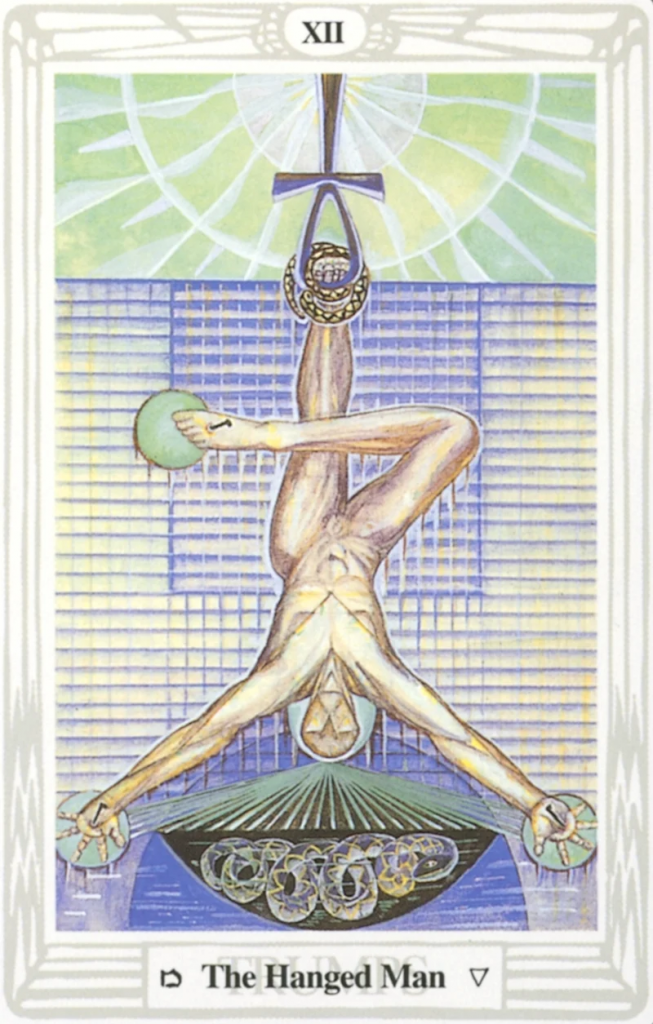
| The Hanged Man The Hanged Man is numbered twelve and is depicted as a figure, usually male, hanging upside down from a tree or branch. He often has his hands behind his back, as though tied (though as you can see the Thoth interpretation moves away from this aspect of apparent helpnessness). Usually one leg is tucked behind the other to form a triangle shape. Strangely though, he tends to look quite happy and content with his situation.Not a very popular card, the Hanged Man deals with sacrifice, delays and waiting – and also being bogged down and helplessness. We sacrifice every time we make a choice – reading this web page means you have sacrificed reading the alternatives. Since sacrifice can mean giving up one thing of value for another thing of equal or greater value, this card can easily be seen as representing the natural and normal function of disposing of something that no longer suits its purpose as well as its replacement will.The Hanged Man is totally vulnerable, his attitude is “whatever will be, will be”. He accepts everything that happens with equanimity and courage – he is, after all, simply giving in to his destiny. He can sometimes represent the person who has waited too long, who is perhaps scared to change. We should endure with strength and inner peace, but also be courageous enough to take action when destiny calls. |
William F. Buckley defines conservative

“A conservative is someone who stands athwart history, yelling Stop, at a time when no one is inclined to do so, or to have much patience with those who so urge it.”
― William F. Buckley
William F. Buckley Jr. (November 24, 1925 – February 27, 2008) was an author and political commentator. In 1955, he founded the influential conservative magazine National Review. Buckley also hosted the popular television show Firing Line and wrote a twice-weekly syndicated newspaper column. … Google Books
Weekly Invitational Translation
Translation is a 5-step process of “straight thinking in the abstract” comparing and contrasting what you think is the truth with what you can syllogistically and axiomatically prove is the truth.
The claims in a Translation may seem outrageous, but they are always (or should always) be based on self-evident syllogistic reasoning. Here is one Translation from this week.
1) Truth is that which si so. That which is not truth is not so. Therefore Truth is all that is. Truth being all is therefore total, therefore whole, therefore complete, therefore otherless, therefore one, therefore united, therefore harmonious, therefore orderly. Truth being true is therefore right, therefore correct, therefore flawless, therefore perfect. I think therefore I am. Since I am and since Truth is all that is, therefore I, being, am Truth. Since I, being, am Truth, therefore I, being, have all the attributes of Truth. Therefore I, being, am total, whole, complete, otherless, one, united, harmonious, orderly, true, right, correct, flawless, perfect. Since I am Truth and since I am mind/awareness, therefore Truth is Mind/Awareness.
2) I resent that my mother is a better person than I am.
Word-tracking:
resent: to feel badly about a perceived wrong or injustice, aggrieved, gravity, heavy, burdened, responsible
mother: female parent, nurturer, source
person: persona, mask
better: superior to
mature: ripe
3) Truth being all that is, there can be no source but Truth, therefore Truth is my mother. Truth being one, cannot at the same time be divided up into countless unique individuals. Therefore Truth is one, unique Individual. Persons (personas) being the masks we all wear to distinguish ourselves (and hide ourselves) from others and Truth being the only Self, therefore Truth is one naked Self. Truth being one cannot be divided up into gradations of Truth/Good, therefore there is no better or worse in truth OR Truth is equal good. Truth being right and Truth being Perception/Consciousness, there can be no perception of wrong/injustice, since there is no wrong or injustice in Truth. Therefore Truth only perceives the right, the just, the real. Since Truth is whole, full, complete, perfect, Truth doesn’t have to be raised or brought up or reared, therefore Truth comes fully-equipped at every moment or stage of life. Truth being fully-equipped at every moment or stage of life, is therefore always ripe for the moment.
4) Truth is my mother.
Truth is one, unique Individual
Truth is one naked Self
. Truth is equal good.
Truth only perceives the right, the just, the real.
Truth comes fully-equipped at every moment or stage of life.
Truth is always ripe for the moment.
5) Truth, or Source, always rises to the moment with equal good for all.
For information about Translation or other Prosperos classes go to: https://www.theprosperos.org/teaching
THE 5TH STEP
Translation is a 5-step process of “straight thinking in the abstract” to compare what we think is truth to what we can syllogistically and axiomatically prove is the truth.
The fifth step is the conclusion. Here’s the premiere installment of “The 5th Step”:
5. Truth is movement.
–from Mike Zonta, H.W., M.
To submit your 5th step, just email the BB at zonta1111@aol.com with your 5th step and we will post it with your name or without, your choice.
For information about Translation or other Prosperos classes go to: https://www.theprosperos.org/teaching
Free Will Astrology: Week of May 2, 2024
BY ROB BREZSNY | APRIL 30, 2024 (NewCity.com)

Blooming Flowers and Almond Trees/Photo: Ferran Buireu
ARIES (March 21-April 19): The world’s record for jumping rope in six inches of mud is held by an Aries. Are you surprised? I’m not. So is the world’s record for consecutive wallops administered to a plastic inflatable punching doll. Other top accomplishments performed by Aries people: longest distance walking on one’s hands; number of curse words uttered in two minutes; and most push-ups with three bulldogs sitting on one’s back. As impressive as these feats are, I hope you will channel your drive for excellence in more constructive directions during the coming weeks. Astrologically speaking, you are primed to be a star wherever you focus your ambition on high-minded goals. Be as intense as you want to be while having maximum fun giving your best gifts.
TAURUS (April 20-May 20): I don’t casually invoke the terms “marvels,” “splendors” and “miracles.” Though I am a mystic, I also place a high value on rational thinking and skeptical proof. If someone tells me a marvel, splendor or miracle has occurred, I will thoroughly analyze the evidence. Having said that, though, I want you to know that during the coming weeks, marvels, splendors and miracles are far more likely than usual to occur in your vicinity—even more so if you have faith that they will. I will make a similar prediction about magnificence, sublimity and resplendence. They are headed your way. Are you ready for blessed excess? For best results, welcome them all generously and share them lavishly.
GEMINI (May 21-June 20): In accordance with astrological omens, I recommend you enjoy a celebratory purge sometime soon. You could call it a Cleansing Jubilee, or a Gleeful Festival of Purification, or a Jamboree of Cathartic Healing. This would be a fun holiday that lasted for at least a day and maybe as long as two weeks. During this liberating revel, you would discard anything associated with histories you want to stop repeating. You’d get rid of garbage and excess. You may even thrive by jettisoning perfectly good stuff that you no longer have any use for.
CANCER (June 21-July 22): Graduation day will soon arrive. Congrats, Cancerian! You have mostly excelled in navigating through a labyrinthine system that once upon a time discombobulated you. With panache and skill, you have wrangled chaos into submission and gathered a useful set of resources. So are you ready to welcome your big rewards? Prepared to collect your graduation presents? I hope so. Don’t allow lingering fears of success to cheat you out of your well-deserved harvest. Don’t let shyness prevent you from beaming like a champion in the winner’s circle. PS: I encourage you to meditate on the likelihood that your new bounty will transform your life almost as much as did your struggle to earn it.
LEO (July 23-Aug. 22): Ritualist and author Sobonfu Somé was born in Burkina Faso but spent many years teaching around the world. According to her philosophy, we should periodically ask ourselves two questions: 1. “What masks have been imposed on us by our culture and loved ones?” 2. “What masks have we chosen for ourselves to wear?” According to my astrological projections, the coming months will be an excellent time for you to ruminate on these inquiries—and take action in response. Are you willing to remove your disguises to reveal the hidden or unappreciated beauty that lies beneath? Can you visualize how your life may change if you will intensify your devotion to expressing your deepest, most authentic self?
VIRGO (Aug. 23-Sept. 22): If human culture were organized according to my principles, there would be over eight billion religions—one for every person alive. Eight billion altars. Eight billion saviors. If anyone wanted to enlist priestesses, gurus and other spiritual intermediaries to help them out in their worship, they would be encouraged. And we would all borrow beliefs and rituals from each other. There would be an extensive trade of clues and tricks about the art of achieving ecstatic union with the Great Mystery. I bring this up, Virgo, because the coming weeks will be an ideal time for you to craft your own personalized and idiosyncratic religious path.
LIBRA (Sept. 23-Oct. 22): Hidden agendas and simmering secrets will soon leak into view. Intimate mysteries will become even more intimate and more mysterious. Questions that have been half-suppressed will become pressing and productive. Can you handle this much intrigue, Libra? Are you willing to wander through the amazing maze of emotional teases to gather clues about the provocative riddles? I think you will have the poise and grace to do these things. If I’m right, you can expect deep revelations to appear and long-lost connections to re-emerge. Intriguing new connections are also possible. Be on high alert for subtle revelations and nuanced intuitions.
SCORPIO (Oct. 23-Nov. 21): It’s fun and easy to love people for their magnificent qualities and the pleasure you feel when they’re nice to you. What’s more challenging is to love the way they disappoint you. Now pause a moment and make sure you register what I just said. I didn’t assert that you should love them even if they disappoint you. Rather, I invited you to love them BECAUSE they disappoint you. In other words, use your disappointment to expand your understanding of who they really are, and thereby develop a more inclusive and realistic love for them. Regard your disappointment as an opportunity to deepen your compassion—and as a motivation to become wiser and more patient. (PS: In general, now is a time when so-called “negative” feelings can lead to creative breakthroughs and a deepening of love.)
SAGITTARIUS (Nov. 22-Dec. 21): I assure you that you don’t need “allies” who encourage you to indulge in delusions or excesses. Nor do I recommend that you seek counsel from people who think you’re perfect. But you could benefit from colleagues who offer you judicious feedback. Do you know any respectful and perceptive observers who can provide advice about possible course corrections you could make? If not, I will fill the role as best as I can. Here’s one suggestion: Consider phasing out a mild pleasure and a small goal so you can better pursue an extra fine pleasure and a major goal.
CAPRICORN (Dec. 22-Jan. 19): I invite you to take an inventory of what gives you pleasure, bliss and rapture. It’s an excellent time to identify the thrills that you love most. When you have made a master list of the fun and games that enhance your intelligence and drive you half-wild with joy, devise a master plan to ensure you will experience them as much as you need to—not just in the coming weeks, but forever. As you do, experiment with this theory: By stimulating delight and glee, you boost your physical, emotional and spiritual health.
AQUARIUS (Jan. 20-Feb. 18): Aquarian author Lewis Carroll said, “You know what the issue is with this world? Everyone wants some magical solution to their problem, and everyone refuses to believe in magic.” In my astrological opinion, this won’t be an operative theme for you in the coming weeks, Aquarius. I suspect you will be inclined to believe fervently in magic, which will ensure that you attract and create a magical solution to at least one of your problems—and probably more.
PISCES (Feb. 19-March 20): Which would you prefer in the coming weeks: lots of itches, prickles, twitches and stings? Or, instead, lots of tingles, quivers, shimmers and soothings? To ensure the latter types of experiences predominate, all you need to do is cultivate moods of surrender, relaxation, welcome and forgiveness. You will be plagued with the aggravating sensations only if you resist, hinder, impede and engage in combat. Your assignment is to explore new frontiers of elegant and graceful receptivity.
Homework: Tell yourself the truth about something you have not been fully honest about. Newsletter.FreeWillAstrology.com
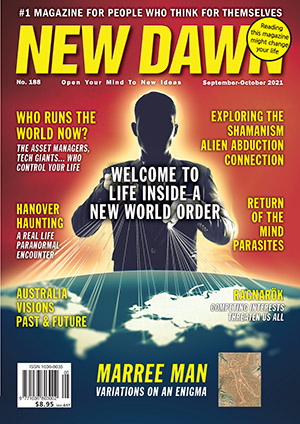
Return of The Mind Parasites: Lovecraft, Wilson, & Phenomenological Science Fiction
BY GARY LACHMAN (newdawnmagazine.com)
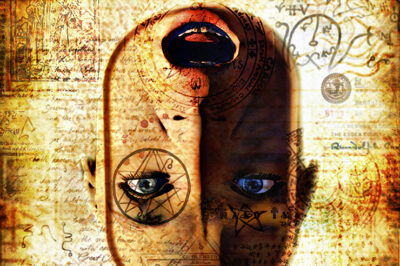
From New Dawn 188 (Sept-Oct 2021)
In 1959, while staying at the farmhouse of an old friend, the British existentialist Colin Wilson came across a book seemingly designed to attract his attention; the fact that it was the only one in the house practically ensured that it would. Its title was The Outsider and Others and its author was H. P. Lovecraft, the American pulp horror fiction writer from the pages of Weird Tales, who in recent time has been promoted to the rank of a Penguin Modern Classic. Wilson had never heard of Lovecraft but his own first book, the one that had made his name as an “angry young man” a few years back, was called The Outsider, so naturally he was interested.
Wilson’s book was an account of modern alienation and the extreme mental states of creative individuals trying to overcome it. Lovecraft’s brand of “eldritch,” “grotesque,” “nameless” horror – these are only a few of his hyperbolic adjectives – seems far away from the angst and la nausée of existentialism, and yet appearances can be deceiving. Wilson took the mouldy volume off the shelf – it was published in 1939, two years after Lovecraft’s death – its yellowing pages almost crumbling at his touch, and settled down to read. Before turning in that night Wilson knew that he had come across an “outsider” indeed. If anyone fit the bill of the isolated, alienated man of genius, loathing the mediocrity of the modern age, Lovecraft did.
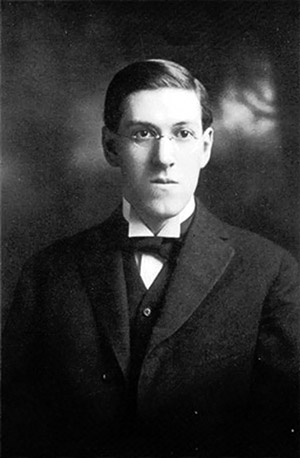
Wilson was so taken with Lovecraft that reading him inspired one of the books in his “Outsider Cycle,” in which he attempts to provide the foundation of what he called a “new existentialism,” to replace the dreary rive gauche version of Sartre and Camus, and the gloomy Schwarzwald meditations of Professor Heidegger.1 Wilson believed that all three had taken a wrong turn at Edmund Husserl, the founding father of phenomenology, out of which existentialism emerged. The books in Wilson’s “Outsider Cycle” methodically spell out his objections to what had become a philosophy of meaninglessness and despair, in an attempt to regain existentialism’s original object: the vision of freedom. In outsider figures like Blake, Nietzsche, Gurdjieff, and others, Wilson had discovered experiences of a “Yea-saying,” affirmative consciousness that Sartre and the others had left out of their analyses. Central to his analysis of these moments of “affirmation” was Husserl’s dictum that consciousness is intentional. It is not the passive recipient of sense impressions impinging from without, but an active reaching out to reality, in order to grab it with the talons of the mind. It was this, Wilson believed, that the old existentialists had lost sight of.
Wilson’s book, The Strength to Dream (1962), a study in what he called “existential criticism,” focused on how different writers used the imagination to present their values, their vision of the world. He started with Lovecraft and were he alive to have read it – which is entirely possible; he would only have been in his early seventies – Lovecraft would no doubt had been gratified that he was taken seriously, and perhaps not a little bemused at the literary company he was keeping. Wilson put him in the context of W. B. Yeats, August Strindberg, and, perhaps surprisingly Oscar Wilde, as agents of what he called “The Assault on Rationality,” writers who reject the everyday world and create an alternative more to their liking. Yet Lovecraft might not have been amused at Wilson’s assessment of him as “that man of dubious genius” who “carried on a lifelong guerrilla warfare against civilisation and materialism,” and who was a “somewhat hysterical and neurotic combatant.”2
Aside from his atrocious style, filled with phrases like “black clutching panic” and “stark utter horror” – Lovecraft always had a bad habit of overwriting – what repelled Wilson about Lovecraft was his “soured romanticism.” He was a man so revulsed by the triviality of modern life, it seemed, that he reminded Wilson more of the Düsseldorf mass murderer Peter Kürten, who dreamed of blowing up whole cities, in fantasies of revenge against the inequities of life, than of his tragic predecessor, Edgar Allan Poe.3 Lovecraft never engaged in any of the violent acts that filled Kürten’s horrific career, but his tales of ancient evil and exiled gods – Cthulhu and Co. – returning to their lost domain – planet Earth – were, Wilson believed, the literary and psychological equivalents of Kürten’s brutal assaults on “society.” Both, Wilson argued, were engaged in acts of ressentiment against a world that negated them.
Wilson’s estimation of Lovecraft, however, increased over time, helped by a visit to Providence, Rhode Island, where Lovecraft spent most of his short life. Wilson was a visiting lecturer at Brown University and took the opportunity to read Lovecraft’s letters and other works held in the library. His interest eventually led to a correspondence with August Derleth, the man more than anyone else responsible for Lovecraft being known at all today. After Lovecraft’s death Derleth became his literary executor and through his Arkham House Press kept Lovecraft in print. Derleth had read Wilson’s criticisms of Lovecraft and thought he had been unfair. Wilson was open enough to Derleth’s comments to revise some of his remarks about Lovecraft for the American edition of the book. Yet Derleth still felt Wilson had short changed Lovecraft. In a letter to Wilson he wrote, “If you’re so critical of Lovecraft, why don’t you write a fantasy novel, and see whether it’s any good…”4
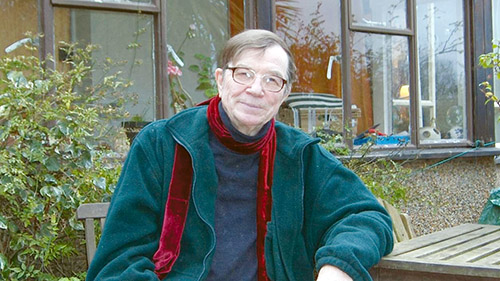
Wilson Takes Up the Challenge
Not one to ignore a challenge, Wilson brooded on the idea. His interest was not in terrifying people as Lovecraft’s had been. It was, in fact, more along the lines of the sort of quasi-science fiction Lovecraft was writing towards the end of his life, in stories like The Shadow Out of Time. With its vision of ancient alien races sending their consciousness out into the depths of time and space, this produces more a sense of awe than a shudder – something we find in H.G. Wells and Olaf Stapledon, two other writers with a “cosmic” point of view. Wilson’s own vision was that of a consciousness free from time, able to rise above the “triviality of everydayness” that revulsed Lovecraft (the phrase is Heidegger’s) and become aware of the “reality of other times and places,” and not only of the one in front of your nose.
It was while working on his Introduction to the New Existentialism (1966)that Wilson came upon an idea that would give the old Lovecraftian theme a new twist. Lovecraft’s fellow Weird Tales writers all added to Lovecraft’s Cthulhu Mythos, inventing gods, ancient races, lost cities, and, most effectively, fictional texts such as Lovecraft’s Necronomicon, that give the tales a flavour of authenticity. But Wilson’s contribution wouldn’t be another god, like Clark Ashton Smith’s Tsathoggua, although he will draw on this, nor a forbidden text like Robert E. Howard’s Unaussprechlichen Kulten, nor will his protagonists meet their doom in a ruined temple on some unknown South Pacific island. Wilson’s monsters would come from somewhere else. They would come from the mind.5
Wilson’s first foray into what we can call “phenomenological science fiction,” The Mind Parasites (1967), came on the back of a series of novels in which Wilson used the constraints of genre fiction for philosophical purposes.6 His first novel, Ritual in the Dark (1960), is an existential thriller about a sexual killer, and could best be described as Jack the Ripper meets the Brothers Karamazov in duffle-coated early 1950s London. It works out in fictional form some of the themes of The Outsider. This was a practice Wilson continued with detective novels (Necessary Doubt (1964)), psychological crime thrillers (The Glass Cage (1966)), erotica (The Sex Diary of Gerard Sorme (1961)), and later with espionage, police procedural, soft porn, and, as we will see, science fiction.
Wilson’s engagement with Lovecraft led to several works, some serious attempts at using Lovecraft’s themes for philosophical purposes, some, like his contributions to the Lovecraft sendups The Necronomicon (1978) and The R’lyeh Text (1995) more tongue in cheek pastiche than anything else.7 The two novels I look at here, The Mind Parasites and its follow-up The Philosopher’s Stone (1969), are Wilson’s masterpieces in the genre. In them Wilson managed to put into gripping fictional form the essence of his “new existentialism,” and the insight that would inform his decades long investigation into the occult and paranormal, his search for “Faculty X,” the ability of the human mind to free itself of the constraints of time and space and occupy “other times and places.”
Wilson wrote another science fiction novel, The Space Vampires (1976), that uses some Lovecraftian ideas – sadly it was made into the dreadful film Lifeforce (1984) – and his later epic Spider World series(1987-2002)is his attempt at a Tolkienesque fantasy. Yet it is in The Mind Parasites and The Philosopher’s Stone that Wilson managed to find, to my mind at least, the perfect balance between the ideas and a narrative to convey them. The books are, borrowing a title from Alfred North Whitehead, “adventures of ideas.” Like the late novels of H.G. Wells, that Wilson, against critical opinion, rated highly, they are compelling because of Wilson’s ability to make the ideas come alive. The reviewer who said of his work that he had a “narrative style that can make the pursuit of any idea seem exciting detective work” knew what he was talking about.
The Mind Parasites
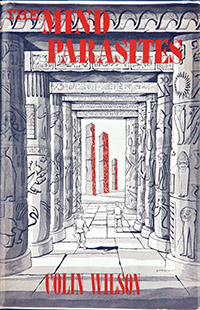
The Mind Parasites begins in 1994 – the future for its first readers, the past for us – when the archaeologist Gilbert Austin learns that his friend, the psychologist Karel Weissman, has committed suicide. The death, of course, was enough to shock him. But suicide? “It was impossible.” Weissman “had not an atom of self-destruction in his composition.” What could have driven him to take his own life? It was true that the suicide rate had increased considerably over the years. But Weissman was a follower of the humanistic psychology of Abraham Maslow (who shares billing with Husserl in the new existentialism). It was unthinkable. What made him do it?
The answer to that, Austin suspects, could be found in the collection of papers Weissman left behind. Yet before Austin can attend to them, his own work takes him to Turkey where he and his colleagues make an incredible discovery. Strange figurines of an unknown origin lead them to tunnel below the surface only to discover a huge block seventy feet long two miles underground. It is the remains of a cyclopean city, a metropolis built by giants eons ago…
Yet these allusions to the Great Old Ones and Elder Gods of Lovecraft’s mythos are really a red herring, for the truly evil creatures – who, borrowing from Clark Ashton Smith, Wilson calls the Tsathogguans – are not, like Cthulhu, resting in sunken R’lyeh, waiting to be awakened, but inhabit a much more intimate space: that of the mind. Austin discovers why his friend had killed himself: he had become aware of psychic vampires that have been bleeding human consciousness dry for the past two centuries, and they had got rid of him… Just as they had got rid of the generation of creative geniuses, the Romantics, who Wilson sees as the first sign of a new stage in the evolution of human consciousness.
Wilson’s The Outsider sought to answer the question why so many creative individuals of the 19th and early 20th centuries either died young, went mad, committed suicide, or in some way came to a bad end. Nietzsche, Baudelaire, Ibsen, Keats, Shelley, Kleist, Novalis, Poe; this list, chosen at random, could go on. These men and others, lesser known, experienced eruptions of the imagination unlike anything that had been seen before. The poets of the previous age said that the “proper study of man is man.” The Romantics disagreed and sought to embrace the entire universe. The ecstasies they experienced convinced them that men were really sleeping gods. Yet when they returned to earth from their ecstatic excursions, they were struck by the banality of the world they were forced to inhabit, and their inability to revive the vision of inner freedom and space, the “bird’s eye view” over space and time. Self-pity, depression, weariness set in. Baudelaire compared the poet to the albatross: when aloft, the bird’s great wings enable him to soar gracefully, yet on land they are encumbrance, tripping him up. This brutal world was not meant for such noble creatures, and so many of them succumbed.
Wilson’s mind parasites are an allegory of how the mind can collapse on itself, of how easy it is for it to slip into existential despair and a self-produced insanity. In The Outsider Wilson relates several experiences of what Swedenborg called “vastation,” a total emptying out of any sense of meaning, of any reality propping up your existence. One night on the desert, meditating on the reality of history, and on the knowledge of that reality housed within his mind, Gilbert Austin becomes aware that within his own consciousness, there is a universe as strange and unknown as the one he gazes out on at the stars… the essence of the Romantic vision. It was then that something odd happens. Austin catches a glimpse of “some alien creature” in his own mind. He then discovers that his friend Weissman had had the same experience. Weissman’s research into the growing suicide rate uncovered a disturbing fact: the human race was losing its power of self-renewal. “For more than two centuries now,” Weissman reports, “the human mind has been constantly a prey to energy vampires.”
Around the turn of the eighteenth century, a kind of change came over the western mind: the powerful optimism of the early Romantics – Beethoven, Goethe, Blake – is followed by a gloomy pessimism, a despair the mind parasites feed on. “The artists who refused to preach a gospel of pessimism and life-devaluation were destroyed.” Some individuals, like the Marquis de Sade, were completely in the vampires’ control. Pessimists, like Schopenhauer, lived to a ripe old age. Nietzsche, the life-affirmer, goes mad. Men may really be gods, but it is in the parasites’ interest that they never find this out. Those who suggest as much are quickly done away with…
Having become aware of the parasites, Weissman is a threat to them, so they attack him with waves of depression and despair until he can stand it no longer and kills himself. When the parasites discover that Austin is aware of them, they try the same tactic. But in the meantime he has learned of Husserl’s work in phenomenology and of the central insight that consciousness is intentional. In one of the most remarkable battle scenes in all literature, a campaign that takes place entirely within the mind, Austin fends off the waves of suicidal emptiness and cosmic despair until his increased powers of intentionality rout the parasites.8 Now that their cover is blown, it is all out war.
The rest of the novel relates Austin’s gathering together a team of other intellectuals – psychologists, historians, scientists – who become the human race’s vanguard against the parasites. Through mastering Husserl’s phenomenological techniques, they learn how to direct their intentionality as if it were a laser beam of consciousness. One by-product of this is that they all become psychokinetic, their consciousness able to reach out and “grab” the world in a very literal way. Their psychokinetic powers are enormous. In an attempt to unite the world against the parasites, they use their combined mental energies to disintegrate the “Kadath block” on live television, claiming it was destroyed by the parasites. When they discover that the parasites have a base on the moon, they decide the only way to rid humanity of these deadly pests is to move the moon out of its orbit. Wilson’s use of the moon as the source of mankind’s afflictions is a nod to Gurdjieff, who saw “sleeping humanity” as “food for the moon.” He also makes use of the theories of Hanns Hörbiger, enamoured by Hitler, about the different moons the earth has had in the past.
By the end of the novel, not only have Austin and his colleagues got rid of the moon, they have fended off a race war, prompted by the parasites, who glut themselves on the negative energies given off. The discovery of the ancient cyclopean city that started the book is of relatively minor importance compared to the revelatory insights into consciousness the team has achieved. At one point in the story, Austin becomes aware of other intelligences, benevolent ones, out in space, beyond the orbit of Pluto. He and his colleagues ride off, not into the sunset, but in the direction of that distant planet, their spaceship propelled by the powers of their minds… They are eager to join the other “policemen of the universe,” and to learn exactly how powerful a consciousness free of the parasites really is. Their mysterious voyage becomes a myth for future exploration into the vastness of existence, inner and outer.
The Philosopher’s Stone & Relationality
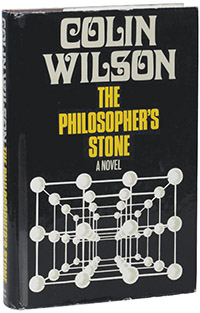
In The Mind Parasites Wilson explores the possibilities inherent in Husserl’s intentionality. In The Philosopher’s Stone it is another power of consciousness, relationality, Wilson’s own coinage, that takes centre stage. Readers of Wilson’s little book Poetry and Mysticism (1968), written at the behest of the poet Lawrence Ferlinghetti for his City Lights imprint, will recall that in it Wilson’s speaks of “duo-consciousness” and of what he calls the “web-like” character of consciousness, when thoughts and recollections spread out and link together, forming a kind of “net” of awareness. In The Philosopher’s Stone the relationality of consciousness leads to what Wilson calls “time-vision,” the ability to look into the past as if through a telescope. If in The Mind Parasites the heroes discover their psychokinetic powers, in The Philosopher’s Stone it is psychometry, the ability to know the past of an object simply through touch, that Wilson’s heroes discover they possess. It is through this that the protagonists become aware of the Great Old Ones, brooding in some dimension outside our own, waiting for their chance to return…
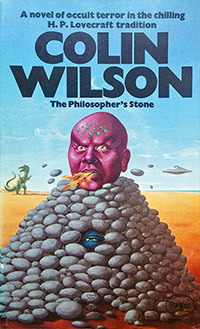
But again, they are a red herring. The real subject of the novel is once again consciousness; this time, its potential to slow down and even to stop the aging process. In Back to Methuselah, Bernard Shaw argued that human life is too short to make any good use of it; humans needed to live to at least three hundred in order to mature. Wilson took up Shaw’s challenge as to how this could be done. His answer: the fountain of youth – or at least of immortality – lay in the prefrontal lobes of the brain.9
In search of a phenomenological elixir vitae, Wilson’s hero, Howard Lester, discovers that the “value experiences” of the psychologist Aaron Marks (Maslow’s “peak experiences”) seem able to slow down our biological clocks. He arrives at this insight after his research leads him to conclude that, statistically, philosophers, composers, scientists, mathematicians – anyone who makes a practice of trying to view life objectively, and not through the gauze of their emotions – live longer than other people. He discovers that the source of the “VE” are the brain’s prefrontal lobes, its most evolutionarily advanced part. Through a series of experiments introducing a minute quantity of “Neumann alloy” into their own prefrontal lobes, Lester and his colleague, like Gilbert Austin and his team, discover unknown powers of consciousness. Their “relationality,” the intuitive glue that spreads across reality like the ripples on the surface of a deep, still pond, increases enormously, until they are able to use their imagination to peer into time.
Wilson has a long section in which Lester, sinking into a state of “contemplative objectivity,” finds himself in sixteenth century London, rather as Charlotte Ann Moberly and Eleanor Jourdain, authors of An Adventure (1911), found themselves transported to the Versailles of Marie Antoinette. This is a time travel novel with a twist. Actual, physical time travel, the kind his hero H. G. Wells wrote about in The Time Machine, Wilson argues, is an absurdity. There is no “time” to travel through; “time” is a word we use to refer to process, and to think of “process travel” is nonsense. But the mind is not limited by the logic that constrains physical reality, as J.W. Dunne, author of An Experiment With Time (1927), discovered with his “precognitive dreams.” Just as Dunne was able to see into the future, Wilson’s phenomenological alchemists, in search of their own philosopher’s stone, can turn their vision to the past. The imagination, Wilson said, is “the ability to grasp realities not immediately present.” The past isn’t present, but it is a reality, and through their increased powers of relationality – awareness of the connectedness of everything – Wilson’s heroes can imaginatively grasp it.
One result of this new faculty is proof that Francis Bacon was really the author of Shakespeare’s plays. Another is that K’ tholo – Lovecraft’s Cthulhu – was one of the founders of human civilisation. Another is that the Great Old Ones are not dead, only sleeping, but their influence can be felt. They have erected barriers to the heroes’ time-vision which prevents them from reaching far enough back into the past to solve the mystery of… but that would be telling. En route the reader learns the truth about Stonehenge, the Maya, the Voynich Manuscript – a Wilsonian standby, that surfaces in more than a few places – poltergeists and much more.
Wilson said that the aim of his writing was to get people to think. His novels are more fables or parables, than the kind of character analysis we associate with most modern fiction, which sticks obsessively to “everyday” consciousness and its trivial concerns. They share this character with the late novels of Wells, which use the barest structure of a novel for didactic purposes. Readers who find ideas exciting will find Wilson’s – and Wells’ – didactic fictions breath-taking. (“I apologise for sounding didactic,” Wilson’s hero says at one point. “It is impossible to say anything that is not commonplace without sounding didactic.”) I have read them a number of times yet each time I discover new things and come away exhilarated. If, as Wilson says, “close-upness deprives us of meaning,” his phenomenological fictions are cable cars to the heights, to the “bird’s eye view,” that enables us to enter that inner universe from which we can view the outer one with “contemplative objectivity.” “The will feeds on enormous vistas,” Wilson tells us. “Deprived of them, it collapses.” In The Mind Parasites and The Philosopher’s Stone the reader will find vistas enormous enough to feed his will no end.
Footnotes
1. The Outsider (1956), Religion and the Rebel (1957), The Age of Defeat (The Stature of Man in the US) (1959), The Strength to Dream (1962), Origins of the Sexual Impulse (1963), Beyond the Outsider (1965), and Introduction to the New Existentialism (1966).
2. Colin Wilson, The Strength To Dream (London: Abacus, 1979) p. 1.
3. Colin Wilson and Pat Pitman, Encyclopedia of Murder (London: Arthur Baker, 1961) pp. 326-335.
4. Colin Wilson, The Mind Parasites (Rhinebeck, NY: Monkfish Press, 2005) p. xvii.
5. Wilson admits to being inspired by the science fiction film Forbidden Planet (1956), in which Walter Pidgeon portrays Morbius, a scientist who has increased his mental powers through contact with the technology of an ancient, more highly evolved race. He was unaware that he was at the same time increasing the power of his unconscious mind. Because of this he releases “monsters from the Id.”
6. Recently the book has been the object of some renewed interest, seeing Wilson’s allegorical creatures as the possible agents of our contemporary malaise. See www.awakeninthedream.com/articles/mind-parasites-of-colin-wilson
7. Wilson also contributed two shorter works, “The Return of the Lloigor,” in Tales of the Cthulhu Mythos, ed August Derleth (Sauk City, WI: Arkham House, 1969) and “The Tomb of the Old Ones” in The Antarktos Cycle, ed Robert M. Price (Oakland, CA: Chaosium Publications, 1999).
8. I can only mention here that in another novel, The Black Room (1971), an espionage tale set around the effort to defeat a sensory deprivation chamber, Wilson works out the same ideas.
9. This was before Wilson became aware of the significance of “split brain” psychology surrounding the left and right cerebral hemispheres, which he will write about in Frankenstein’s Castle (1981) and Access to Inner Worlds (1983).
© New Dawn Magazine and the respective author.
For our reproduction notice, click here.
Support New Dawn
Minimal Ads, No Paywall, No Clickbait – help us
keep this website free with new articles regularly posted.
Show your appreciation & gratitude.
About the Author
Gary Lachman was born in Bayonne, New Jersey, but has lived in London, England since 1996. A founding member of the rock group Blondie, he is now a full time writer with more than a dozen books to his name, on topics ranging from the evolution of consciousness and the western esoteric tradition, to literature and suicide, and the history of popular culture. Lachman writes frequently for many journals in the US and UK, and lectures on his work in the US, UK, and Europe. His work has been translated into several languages. His website is www.garylachman.co.uk.
New book details Steve Bannon’s ‘Maga movement’ plan to rule for 100 years
Isaac Arnsdorf’s Finish What We Started shows how the strategist wanted to create a dominant coalition to take US political power
Martin Pengelly in Washington Thu 4 Apr 2024 (TheGuardian.com)

Steve Bannon leaves federal court in Washington DC on 15 November 2021. Credit: Andrew Caballero-Reynolds / AFP / Getty
Steve Bannon, Donald Trump’s 2016 campaign chair and White House strategist, believed before the 2020 election and the January 6 attack on Congress that a “Maga movement” of Trump supporters “could rule for a hundred years”.
“Outside the uniparty,” the Washington Post reporter Isaac Arnsdorf writes in a new book, referring to Bannon’s term for the political establishment, “as Bannon saw it, there was the progressive wing of the Democratic party, which he considered a relatively small slice of the electorate. And the rest, the vast majority of the country, was Maga.
“Bannon believed the Maga movement, if it could break out of being suppressed and marginalised by the establishment, represented a dominant coalition that could rule for a hundred years.”
Arnsdorf’s book, Finish What We Started: The Maga Movement’s Ground War to End Democracy, will be published next week. The Post published an excerpt on Thursday.
A businessman who became a driver of far-right thought through his stewardship of Breitbart News, Bannon was Trump’s campaign chair in 2016 and his chief White House strategist in 2017, a post he lost after neo-Nazis marched in Charlottesville that summer.
He remained close to Trump, however, particularly as Trump attempted to overturn his 2020 defeat by Joe Biden.
That attempt culminated in the attack on Congress of 6 January 2021, when supporters Trump told to “fight like hell” to block certification of Biden’s win attacked the US Capitol.
Nine deaths have been linked to the attack, including law enforcement suicides. More than 1,200 arrests have been made and hundreds of convictions secured. Trump was impeached for inciting the insurrection but acquitted by Senate Republicans.
Notwithstanding 88 criminal charges for election subversion, retention of classified information and hush-money payments, and multimillion-dollar penalties in civil cases over fraud and defamation, the latter arising from a rape claim a judge called “substantially true”, Trump won the Republican nomination with ease this year.
As a Trump-Biden rematch grinds into gear, Bannon remains an influential voice on the far right, particularly through his War Room podcast and despite his own legal problems over contempt of Congress and alleged fraud, both of which he denies.
The “uniparty”, in Bannon’s view, as described by Arnsdorf, is “the establishment [Bannon] hungered to destroy. The neocons, neoliberals, big donors, globalists, Wall Street, corporatists, elites.”
“Maga” stands for “Make America great again”, Trump’s political slogan.skip past newsletter promotion
Arnsdorf writes: “In his confidence that there were secretly millions of Democrats who were yearning to be Maga followers and just didn’t know it yet, Bannon was again taking inspiration from Hoffer, who observed that true believers were prone to conversion from one cause to another since they were driven more by their need to identify with a mass movement than by any particular ideology.”
Eric Hoffer, Arnsdorf writes, was “the ‘longshoreman philosopher’, so called because he had worked as a stevedore on the San Francisco docks while writing his first book, The True Believer [which] caused a sensation when it was published in 1951, becoming a manual for comprehending the age of Hitler, Stalin and Mao”.
Bannon, Arnsdorf writes, “was not, like a typical political strategist, trying to tinker around the edges of the existing party coalitions in the hope of eking out 50% plus one. Bannon already told you: he wanted to bring everything crashing down.
“He wanted to completely dismantle and redefine the parties. He wanted a showdown between a globalist, elite party, called the Democrats, and a populist, Maga party, called the Republicans. In that match-up, he was sure, the Republicans would win every time.”
Now, seven months out from election day and with Trump and Biden neck-and-neck in the polls, Bannon’s proposition stands to be tested again.

