
sandorpeter • Premiered Jan 2, 2023 • BUDAPESTI OPERETTSZÍNHÁZÓévbúcsúztató Gála 2023 – Nevem Berger
Monthly Archives: May 2024
Alvin Levin on spitting at death

Sharon Stone returns to San Francisco, the city where she nearly died, with new art show
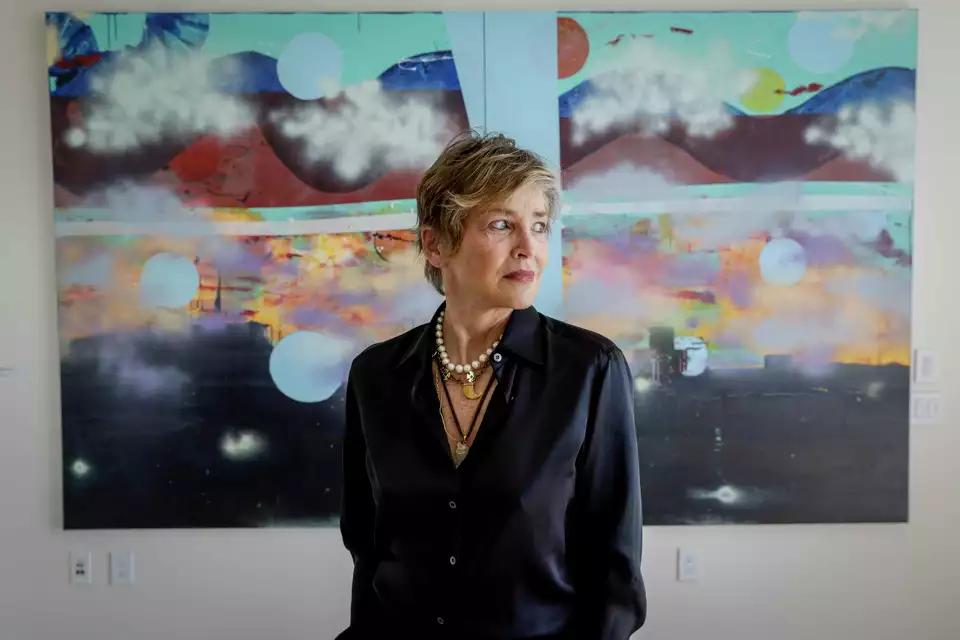
Sharon Stone stands for a portrait with the title painting in her “My Eternal Failure” exhibition, at 181 Fremont in San Francisco on Wednesday, April 10. It is the first time her artworks have been exhibited in San Francisco.Brontë Wittpenn/The Chronicle
By Tony Bravo
April 30, 2024 (SFChronicle.com)
More than 20 years later, Sharon Stone still remembers the moment she died.
In the 181 Fremont gallery atop San Francisco’s South of Market luxury residential building, the Academy Award-nominated actor sits near her painting “The Bridge,” a new work in her show “Sharon Stone: My Eternal Failure.” A dark blue stripe at the top of the canvas is interrupted by brushstrokes that reveal white space underneath, the marks resembling vital signs on a patient monitor or tombstones. At the bottom, stripes of deep red, gray and periwinkle blue are stacked atop one another; at the white center of the painting, a figure emerges, surrounded by licks of yellow.
Digital Discovery Sale: 25¢. Find something new every day with unlimited digital access.Act Now
“I was in the MRI machine and all these things happened,” recalled Stone, 66, describing her experience when hospitalized for a subarachnoid hemorrhage in September 2001 while living in San Francisco. “Then I came out and I flatlined.”
“The Bridge,” she said, “is the experience of what that was like when I went and blew up through the white light. I saw all these people that had passed away, and they turned to me and told me how much they loved me, and they were waiting for me.”
In the painting, Stone is the figure in blue; the yellow brushstrokes her spirit guides. “And then suddenly, I guess, they defibrillated me.”
More Information
“Sharon Stone: My Eternal Failure”: By appointment only; contact Carmen Legarda at carmen@181fremont.com. Through Aug. 31. Free. 181 Fremont St., S.F. www.181fremont.com/art-program
Following experimental brain surgery, Stone recovered at the Sea Cliff house she shared with her then-husband, Phil Bronstein, senior vice president and executive editor of the Chronicle at the time, and their baby son, Roan. During that time she said she hallucinated colors, lost hearing in one ear (since regained) and had to learn how to speak again without stuttering.
Stone said she was also visited by five glowing orbs during her recovery, which she believes were spiritual beings. In “The Bridge,” the five orbs appear toward the top of the painting, showing through the dark blue.
Eventually, Stone said, she addressed the orbs: “If I’m going to live, you can’t all stay with me. A couple of you have to go and stay with my son.”
All the work exhibited in “My Eternal Failure” is autobiographical and related to Stone’s time in San Francisco. As the title suggests, her years in the city — from her marriage to Bronstein in 1998 to their separation in 2003 (they divorced in 2004) — were not easy. That relationship and the loss of primary custody of Roan are among the failures referenced in the show’s title.
“I was frightened to come (back) here,” Stone told the Chronicle in her low, resonant voice, the blue eyes that have appeared in close-ups in dozens of films looking down for a moment. In person, the charisma that makes her so watchable onscreen is tempered by an artist’s vulnerability.
San Francisco is complicated for Stone. While it’s the city where her personal life hit its lowest point, it’s also the setting of “Basic Instinct,” the 1992 erotic thriller by Dutch filmmaker Paul Verhoeven that shot her to stardom. While femme fatale Catherine Tramell remains among her best-known roles, her 2021 memoir, “The Beauty of Living Twice,” reveals that making the movie wasn’t easy. (Stone alleges that the infamous up-skirt shot in the interrogation scene was filmed without her consent, but that she ultimately allowed it to be kept in the film.)
She’s returned to the Bay Area, though, at the beginning of a triumphant new act. “My Eternal Failure” is Stone’s fourth art show in the past 12 months, and her three prior showings in America and Europe have been met with positive reviews.
Although prices are not available for Stone’s show at 181 Fremont, in October of last year, two of her paintings sold for $250,000 each at the Barrow Neurological Foundation gala auction.
Stone’s paintings are clearly more than a movie star side project. There’s a confidence in the long gestures of her brushwork, strength in the organic quality of her more minimalist works, and a fascinating use of color in her blending of hues and use of contrasting tones as punctuation.
The title work of the show, which took Stone three years to complete, combines a darkened cityscape with fiery skies, bisected by a blue line and abstract forms crawling across the top of the work. “The Party,” from 2022, features the same chaotic, entwining figures against a black backdrop. But in works like “Bonne Nuit” from 2022 and “Hoisted on My Own Petard” from 2024, there’s an elegance in her forms’ simplicity.
While it feels like Stone is still experimenting in some of the smaller works that mix in elements of impressionism and abstract expressionism, viewers get the sense that she knows where she’s going as she refines her aesthetic.
In a New York magazine story about his December 2023 conversation with Stone at the 92nd Street Y cultural center, Pulitzer Prize-winning art critic Jerry Saltz wrote that she “took all of these life events, everything that was taken away, everything that was given, and she learned to breathe and to forgive. In a sort of mystic unraveling, I see an artist, someone living a life in art. Being a freedom machine.”
Art has long been a passion for Stone. Growing up in Meadville, Pa., she painted with her aunt, artist Vonne Stone, and studied art and creative writing at the Edinboro University of Pennsylvania before leaving to pursue modeling and acting in New York.
Stone’s movie breakthrough came at age 34 with “Basic Instinct,” and for a decade, she was among the biggest female stars in Hollywood. She was nominated for an Academy Award for best supporting actress in Martin Scorsese’s “Casino.”
“I read a quote from Sharon saying back in the 1990s, the two most famous female celebrities were her and Princess Diana,” said Matthew Lituchy, chief investment officer at Jay Paul Co., the developer of 181 Fremont presenting the show. “She’s quite right.”
Following her divorce, Stone moved back to Los Angeles, adopted sons Laird and Quinn, and continued acting, as well as working as a prolific fundraiser for HIV-AIDS organizations. She began painting again when she returned to college in 2016, completing her bachelor’s degree in art at Edinboro.
But it was during the pandemic when her painting practice kicked into high gear. Stone now works with a studio assistant, Zach Megalis, and devotes much of her time to visual art.
“My Eternal Failure” follows Stone’s show “Shedding,” which was presented at Los Angeles’ Allouche Gallery in the spring of 2023 and built upon for “Welcome to My Garden” at C. Parker Gallery in Greenwich, Conn. Her first European show, “Totem,” opened at Galerie Deschler in Berlin in February.
Lituchy, who met Stone through a mutual friend, said he pursued a 181 Fremont show with her for a year.
“I think it was meaningful for her to come back to San Francisco in such a glorious way,” said Lituchy. “That time was filled with so many mixed emotions. This is sort of her coming-out party, if you will.”
Following the opening reception for the show on April 10, guest Robert Huw Morgan of San Francisco said he was impressed with the range of Stone’s visual vocabulary.
“Within the realm of acrylic, she manages to achieve so many results, which are all so beautifully painterly,” said Huw Morgan, the university organist at Stanford’s Memorial Church. “No gesture is without thought. Even in those paintings with a repeated gesture, everything is in the right place.”
It may have taken two decades since her “Eternal Failure” in San Francisco, but Stone too is finally in the right place. Through her new life as an artist, she has exorcised the ghosts of the city and found a new joy.
“Happiness is really my discipline,” said Stone. “You have to decide to be happy and then you have to make sure you stay happy.”
Reach Tony Bravo: tbravo@sfchronicle.com
April 30, 2024
ARTS AND CULTURE REPORTER
Tony Bravo is the San Francisco Chronicle’s Arts & Culture writer. He primarily covers visual arts, the LGBTQ community and pop culture. His column appears in print every Monday in Datebook. Bravo joined the Chronicle staff in 2015 as a reporter for the Style section and also wrote the relationship column “Connectivity.” He is the host of the live interview series “Show & Tell” every month at Four One Nine and created the VoiceMap Chronicle LGBTQ audio tour “Over the Rainbow in the Castro” available for download on the app. Bravo is also an adjunct instructor at the City College of San Francisco Fashion Department, where he teaches journalism.
Book: “Our Polyvagal World: How Safety and Trauma Change Us”

Our Polyvagal World: How Safety and Trauma Change Us
Stephen W. Porges, Seth Porges
The creator of the Polyvagal Theory explains the principles in simple terms that are accessible to all. Since Stephen Porges first proposed the Polyvagal Theory in 1994, its basic idea―that the level of safety we feel impacts our health and happiness―has radically shifted how researchers and clinicians approach trauma interventions and therapeutic interactions. Yet despite its wide acceptance, most of the writing on the topic has been obscured behind clinical texts and scientific jargon. Our Polyvagal World definitively presents how Polyvagal Theory can be understandable to all and demonstrates how its practical principles are applicable to anyone looking to live their safest, best, healthiest, and happiest life. What emerges is a worldview filled with optimism and hope, and an understanding as to why our bodies sometimes act in ways our brains wish they didn’t. Filled with actionable advice and real-world examples, this book will change the way you think about your brain, body, and ability to stay calm in a world that feels increasingly overwhelming and stressful. 3 black-and-white figures; 1 color figure (tip-in page)
(Goodreads.com)
(Recommended by John Atwater, H.W.)
Book: “Body-Centered Psychotherapy: The Hakomi Method: The Integrated Use of Mindfulness, Nonviolence and the Body”

Body-Centered Psychotherapy: The Hakomi Method: The Integrated Use of Mindfulness, Nonviolence and the Body
Ron Kurtz
One of the seminal books in the body-centered movement in psychotherapy, the Hakomi Method integrates the use of mindfulness, nonviolence, meditation and holism into a highly original amalgam of therapeutic techniques. Hakomi work incorporates the idea of respect for the wisdom of each individual as a living organic system, organizing matter and energy to maintain its goals, and identity. It is written with clarity, humor and simplicity; sure to inspire and give insight to both therapists and laypersons.
(Goodreads.com)
(Recommended by John Atwater, H.W.)
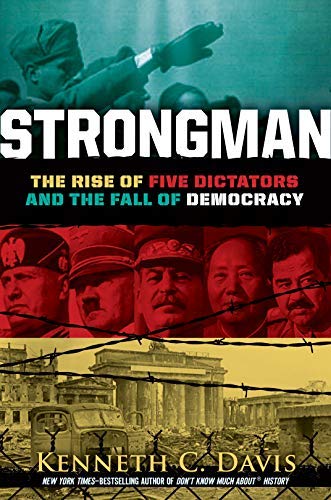
Book: “Strongman: The Rise of Five Dictators and the Fall of Democracy”
Strongman: The Rise of Five Dictators and the Fall of Democracy
Kenneth C. Davis
From the bestselling author of the Don’t Know Much About® books comes a dramatic account of the origins of democracy, the history of authoritarianism, and the reigns of five of history’s deadliest dictators. A Washington Post Best Book of the Year! A Bank Street College of Education Best Book of the Year! A YALSA 2021 Nonfiction Award Nominee!What makes a country fall to a dictator? How do authoritarian leaders—strongmen—capable of killing millions acquire their power? How are they able to defeat the ideal of democracy? And what can we do to make sure it doesn’t happen again?By profiling five of the most notoriously ruthless dictators in history—Adolf Hitler, Benito Mussolini, Joseph Stalin, Mao Zedong, and Saddam Hussein—Kenneth C. Davis seeks to answer these questions, examining the forces in these strongmen’s personal lives and historical periods that shaped the leaders they’d become. Meticulously researched and complete with photographs, Strongman provides insight into the lives of five leaders who callously transformed the world and serves as an invaluable resource in an era when democracy itself seems in peril.* “A fascinating, highly readable portrayal of infamous men that provides urgent lessons for democracy now.” —Publishers Weekly, starred review “Strongman is a book that is both deeply researched and deeply felt, both an alarming warning and a galvanizing call to action, both daunting and necessary to read and discuss.” —Cynthia Levinson, author of Fault Lines in the Constitution
About the author

Kenneth C. Davis
Kenneth C. Davis is the New York Times bestselling author of the Don’t Know Much About® series of books and audios for adults and children. Don’t Know Much About® History, the first title in the series, became a New York Times bestseller in 1991 and remained on the paperback list for 35 consecutive weeks. It has since been revised several times and now has more than 1.6 million copies in print. The 30th anniversary edition of the book was published with a new preface, “From an Era of Broken Trust to an Era of Broken Democracy.”
Davis is, according to Publishers Weekly, “a go-to guy for historical insight and analysis.”
(Goodreads.com)
Scoop: U.S. put a hold on an ammunition shipment to Israel
Updated May 5, 2024 –World (Axios.com)


The Biden administration last week put a hold on a shipment of U.S.-made ammunition to Israel, two Israeli officials told Axios.
Why it matters: It is the first time since the Oct. 7 attack that the U.S. has stopped a weapons shipment intended for the Israeli military.
- The incident raised serious concerns inside the Israeli government and sent officials scrambling to understand why the shipment was held, Israeli officials said.
- President Biden is facing sharp criticism among Americans who oppose his support of Israel. The administration in February asked Israel to provide assurances that U.S.-made weapons were being used by Israel Defense Forces in Gaza in accordance with international law. Israel provided a signed letter of assurances in March.
State of play: The Israeli officials said the ammunition shipment to Israel was stopped last week.
- The White House declined to comment.
- The Pentagon, the State Department and the Israeli Prime Minister’s Office didn’t immediately respond to questions.
Driving the news: The Biden administration is highly concerned Israel will invade the southern Gaza city of Rafah where more than one million displaced Palestinians have been taking shelter.
- Israeli Prime Minister Benjamin Netanyahu released several statements in recents days saying he intended to order an invasion of Rafah regardless of whether Israel and Hamas reach a deal for the release of hostages being held in Gaza and a ceasefire.
Netanyahu hinted at tensions with the Biden administration in a statement on Holocaust Remembrance Day issued Sunday.
- “In the terrible Holocaust, there were great world leaders who stood by idly; therefore, the first lesson of the Holocaust is: If we do not defend ourselves, nobody will defend us. And if we need to stand alone, we will stand alone,” he said.
Behind the scenes: Last Wednesday U.S. Secretary of State Antony Blinken visited Israel and had a “tough” conversation with Netanyahu regarding a possible Israeli operation in Rafah, two sources briefed on the meeting said.
- Blinken told Netanyahu during their meeting that “a major military operation” in Rafah would lead to the U.S. publicly opposing it and would negatively impact U.S.-Israel relations.
- A day later White House spokesman John Kirby told reporters that Israeli leaders understand that President Biden “is sincere” when he talks about the possibility of changes to U.S. policy regarding the Gaza war “should they move ahead with some sort of ground operation in Rafah that doesn’t take into account the refugees.”
- White House National Security Adviser Jake Sullivan said at a Financial Times conference in Washington on Saturday that the Biden administration made clear to Israel that the way it will conduct an operation in Rafah will influence U.S. policy towards the Gaza war.
The big picture: Egyptian and Qatari mediators are still trying to reach a hostage deal between Israel and Hamas that would lead to a pause in the fighting in Gaza.
- The Biden administration is deeply involved in the efforts and CIA director Bill Burns joined talks in Cairo over the weekend.
- Hamas in a statement on Friday said it was reviewing the current proposal with “positive spirit” and was “going to Cairo in the same spirit to reach an agreement.”
While Israel waits for Hamas’ response to the proposal, Netanyahu has issued several statements over the weekend saying he won’t agree to end the war as part of a hostage deal.
- Israeli Minister of Defense Yoav Gallant visited Israeli military forces in Gaza on Saturday and said Israel sees “worrying signals” that Hamas isn’t going to move toward an agreement on releasing hostages.
- “This means that an operation in Rafah and in other parts of Gaza will take place in the very near future,” Gallant said.
New Moon In Taurus – Your Unique Value Proposition
(Astrobutterfly.com)
On May 8th, 2024 we have a New Moon at 18° Taurus.
The New Moon forms a powerful conjunction-stellium with Venus, Jupiter, and Uranus, amplifying the energy of this lunation.
Jupiter and Uranus, as outer planets, represent collective energies. When aligned with personal planets like the Sun, Moon, and Venus, these influences become more intimate and relevant on a personal level.
The upcoming New Moon in Taurus will activate the promise of the Jupiter-Uranus conjunction, bringing forth important insights or revelations that resonate with your personal journey and aspirations.
At the New Moon in Taurus, something important that may have been elusive or unclear before will become more personal and relatable.

New Moon In Taurus – As Within, So Without
The Jupiter-Uranus conjunction last month came with the promise of an important OPPORTUNITY.
The challenge with the ‘opportunity’, given the context of Jupiter and Uranus as outer planets, lies in its collective nature.
There might be opportunities ‘out there’ but this doesn’t mean that we, individuals, know how to tap into them.
In fact, when our self-awareness (Aries) and self-worth (Taururs) are lacking, we might not even recognize these opportunities – even when they are right in front of our eyes – let alone tap into them.
Why?
“As within, so without, as above, so below, as the universe, so the soul.” This basically means that the world around us is a reflection of who we are on the inside. Those ‘opportunities’ only exist when the person that we are is able to recognize and seize them.
The magic is finding that sweet spot where our personal talent (Sun, Moon, and Venus) meets opportunity (Jupiter and Uranus).
We need to be able to tune into the frequencies of the outer world, we need an energetic alignment between the inner and the outer. And to ‘tune in’, we need a unique set of skills.
A salesperson will notice subtle cues given off by a prospect that indicate they are ready to buy. A photographer will intuitively spot the best shots because their brain is tuned to that frequency.
Abundance and opportunity are not luck; they are about tuning your inner frequency to match the frequency of the universe. As Seneca put it, “Luck is where opportunity meets preparation”.

We can only recognize opportunities when we know who we are, what our skills are, and what we have to offer to the world.
When we don’t know who we are or lack clarity about our abilities, we may overlook potential opportunities that are perfectly aligned with our talents.
However, when we have a clear understanding of ourselves and our unique offerings, we effortlessly attract the right opportunities that resonate with our true selves.
New Moon In Taurus – Your Unique Value Proposition (UVP)
The Unique Value Proposition (UVP) is a term used to describe the specific benefits or advantages that a product, service, or offering provides to its customers or audience, setting it apart from competitors.
People also have UVPs. A personal UVP is what sets an individual apart, what unique skills, experiences, or qualities they bring to the table, and why they are valuable or indispensable in a particular context.
A UVP is our unique combination of skills, expertise, personality traits, and experiences that make us stand out from others in our field of work or any other setting.
Knowing what your UVP is can help you attract opportunities that align with your strengths and capabilities.
Our unique value proposition is centered around value creation. It’s something that actually creates value for the world.
You might be the most amazing accountant, but if the labor market is saturated or if technology replaces our skills, then finding opportunities might be challenging.
You could be the best emerging artist, but if no one is interested in that particular style or genre of art, gaining traction could be difficult. Of course, you can continue making art for the joy of it, but you would still need a viable income to make ends meet.
Our unique value proposition is not only rooted in our talents and skills, but also helps us create or produce something that fulfills a genuine need in the world.

Taurus And Value Creation
Out of all the signs of the zodiac, Taurus is instrumental in understanding what our unique value proposition is. Taurus, the 2nd sign of the zodiac, provides the solid foundations for Aries’ seed of life to take shape and manifest in the material world.
Taurus shapes and creates the tangible realities of our world thanks to its earthy, practical, matter-of-fact attributes.
Taurus is the sign of resources – not only material resources – but also our mental, emotional, and spiritual resources. Basically, everything that is ours – everything that we can use to support and sustain ourselves and others.
We know that our resources create value when we can recognize the connection between what we input (effort, time, energy) and what output results from it.
This output is something that the world needs and it’s willing to pay for.
I’ll never forget my first ‘Taurus’ job as a fruit picker, where I learned the values of hard work and consistency. More importantly, the straightforward nature of this job taught me there’s a ‘basic formula’ to value creation: 1 bushel of picked fruit = x amount of earnings; 1 hour of work = x customers served.
Of course, it becomes more complex when what we offer is intellectual or emotional support – it’s hard to measure what impact a counselor has on their clients’ lives, for example.
Nevertheless, there’s always some sort of basic equation or relationship between what we do, the value we create, and the benefits derived from it.
To achieve success in life, it’s crucial to recognize what exactly it is that we excel at, and then focus and capitalize on that.
Maybe the counselor in our example above has very good results with helping people recover from addictions – because they have experienced addiction themselves – but not so good with relationship counseling.
If what we do (job, personal project) doesn’t actually create value, we will never be able to tap into Jupiter’s proverbial abundance and opportunities.
Taking in any type of client can dilute the counselor’s expertise and effectiveness. The counselor (for their sake, and for the sake of their future clients) would be much better off focusing on addiction-recovery. That’s their core competency. That’s what they’re good at. That’s what sets them apart from other counselors.
New Moon In Taurus – Your Unique Skill That The World Needs
Focusing on what you’re really good at (and removing non-value-adding activities) will give you a unique advantage and maximize your impact.
The New Moon in Taurus conjunct Venus, Jupiter, and Uranus is an invitation to discover your unique value proposition – that thing you’re really good at and that the world needs.
The New Moon in Taurus is an invitation to reflect on the following questions:
- “What am I really good at?”
- “What unique skills or qualities do I have that the world needs?”
- “What is my unique value proposition”?
Gaza truce talks resume in Egypt without Israeli representation
Talks resumed in Egypt Saturday aimed at halting months of war in Gaza between Hamas militants and Israel that have triggered protests around the world.
Issued on: 04/05/2024 – Modified: 04/05/2024 – France24.com

By:NEWS WIRES
Mediators from Qatar, Egypt and the United States sat down with a Hamas delegation to hear the militant group’s response to a proposal that would halt fighting for 40 days and exchange hostages for Palestinian prisoners, according to details released by Britain.
Read moreIsrael downplays reports of progress in truce talks as Hamas delegation arrives in Cairo
After the talks began, a top Israeli official accused Hamas of “thwarting the possibility of reaching an agreement” by refusing to give up its demand for an end to the war.
Shortly before 9 pm (1800 GMT), a senior Hamas source close to the negotiations told AFP the talks had ended for the day and would resume on Sunday.
Previous negotiations stalled in part on Hamas’s demand for a lasting ceasefire and Israeli Prime Minister Benjamin Netanyahu’s repeated vows to crush the group’s remaining fighters in the southern city of Rafah, which is flooded with displaced civilians.
The prospect of an assault on Rafah has sparked deepening international concern.

Israel has yet to send a delegation to Cairo. The Israeli official told AFP that it would do so only if there was “positive movement” on the proposed framework.
“Tough and long negotiations are expected for an actual deal,” the official added.
More deaths
The war broke out after Hamas’s unprecedented October 7 attack on Israel resulted in the deaths of more than 1,170 people, mostly civilians, according to an AFP tally of Israeli official figures.
Israel’s retaliatory offensive against Hamas has killed at least 34,654 people in Gaza, mostly women and children, according to the Hamas-run territory’s health ministry.
Gaza’s civil defence agency and hospitals reported more deaths from Israeli strikes in Rafah as well as areas farther north.

The United Nations says more than 70 percent of Gaza’s residential buildings have been completely or partly destroyed, and rebuilding will require an effort unseen since the aftermath of World War II.
Accepting a ceasefire deal with Israel should be a “no-brainer” for Hamas, US Secretary of State Antony Blinken said late Friday.
“The reality in this moment is the only thing standing between the people of Gaza and a ceasefire is Hamas,” Blinken said.
The World Health Organization says 1.2 million people, half of the Gaza Strip‘s population, are sheltering in the city.
WHO chief Tedros Adhanom Ghebreyesus warned “a full-scale military operation in Rafah… could lead to a bloodbath.”
UN humanitarian office spokesman Jens Laerke said an assault on Rafah could “strike a disastrous blow” to agencies struggling to provide aid.
The war in Gaza has also triggered a surge in violence in the already restive occupied West Bank, where Israel said on Saturday its troops killed five Palestinian “terrorists” during a 12-hour siege near Tulkarem.
At least 496 Palestinians have been killed in the territory by Israeli troops or settlers since October 7, according to an AFP tally.
‘Open mind’
Egypt‘s Al-Qahera News, which is linked to the intelligence services, quoted an unidentified high-ranking source as saying “there is significant progress in the negotiations” and that the mediators have “reached an agreed-upon formula on most points of contention”.
A senior Hamas official told AFP before the talks resumed that the movement “looks with an open mind to changes in the occupation’s (Israel’s) position and the American position, but there are issues that must be addressed”.

Senior Hamas official Hossam Badran accused Netanyahu Friday of trying to undermine the latest truce proposal with his threats to keep fighting with or without a deal.
Badran said Netanyahu’s insistence on attacking Rafah was calculated to “thwart any possibility of concluding an agreement”.
The top Israeli official, who spoke anonymously, said: “What we are looking at is an agreement over a framework for a possible hostage deal.”
He said that the sign of progress “would be if we send a delegation led by Mossad (intelligence service) chief (David Barnea) to Cairo”.
Demonstrators have regularly taken to Israeli streets demanding the government reach a deal to bring the hostages home, with thousands again protesting in Tel Aviv on Saturday.
“War is not holy, life is,” the protesters chanted.
The Israeli government says 128 hostages remain in Gaza, including 35 the military says are presumed dead.
Wartime wedding
US President Joe Biden has come under mounting domestic pressure to leverage more concessions from Netanyahu’s government over its conduct of the war.

A letter signed by 88 congressmen from Biden’s Democratic Party expressed serious concern over Israel’s “deliberate withholding” of aid for Palestinian civilians and urged Biden to consider halting arms sales unless Israel’s conduct changes.
Daily newsletterReceive essential international news every morningSubscribe
At US urging, Israel has facilitated more aid deliveries into Gaza in recent days but UN agencies say it has not averted advancing famine.
World Food Programme chief Cindy McCain said in an interview published Friday that there was already “full-blown famine in the north (of Gaza) and it’s moving its way south”.
In a rare break from the daily struggle to survive, dozens of Palestinians gathered under decorative lights in Khan Yunis for a mass wedding on Friday. The grooms, one of them on crutches, wore matching dark suits over white shirts.

The war remained close, though. The Israeli military said it struck a munitions site in the Khan Yunis area on Friday after a projectile was fired towards Israel.
(AFP)
How to Tell Love from Desire: José Ortega y Gasset on the Chronic Confusions of Our Longing
By Maria Popova (themarginalian.org)

It is a strange thing, desire — so fiery yet so forlorn, aimed at having and animated by lack. In its restlessness and its pointedness, so single of focus, it shares psychic territory with addiction. Its Latin root — dē + sidus, “away from one’s star” — bespeaks its disorientation, its rush of longing, which we so easily mistake for love. And yet, when unplugged from the engine of compulsion and possession, desire can be a powerful clarifying force for the hardest thing in life: knowing what we want and wanting it unambivalently, with wholehearted devotion and fully conscious commitment. In this aspect, desire is not a simulacrum of but scaffolding for love. It shares a strand of that same Latin root with consider, for it is only through consideration — of our own soul’s yearnings and the sovereign soul of the other — that we can truly love.
How to tell love from desire and how to make of desire a stronghold of love is what the Spanish philosopher José Ortega y Gasset (May 9, 1883–October 18, 1955) explores in On Love: Aspects of a Single Theme (public library) — the posthumous collection of his superb newspaper essays challenging our standard narratives and touching self-delusions about who we are and what we want, anchored in the recognition that “people are the most complicated and elusive objects in the universe.”
Lee Miller and Friend by Man Ray. Paris, 1930.
In a passage that calls to mind Auden’s haunting meditation on true and false enchantment, Ortega considers how our slippery grasp of reality shapes our experience of love:
It would be outlandish to conclude that, after being consistently wrong in our dealings with reality, we should hit the mark in love alone. The projection of imaginary qualities upon a real object is a constant phenomenon… To see things — moreover, to appreciate them! — always means to complete them… Strictly speaking, no one sees things in their naked reality. The day this happens will be the last day of the world, the day of the great revelation. In the meantime, let us consider our perception of reality which, in the midst of a fantastic fog, allows us at least to capture the skeleton of the world, its great tectonic lines, as adequate. Many, in fact the majority, do not even achieve this… They lead a somnambulant existence, scurrying along their delirium. What we call genius is only the magnificent power… of piercing a portion of that imaginative fog and discovering behind it a new authentic bit of reality, quivering in sheer nakedness.
Love, Ortega argues, can uniquely pierce the veil of delirium and reveal a greater truth, unlike “inactive sentiments” like joy and sadness, to which desire is akin:

Illustration by Japanese artist Komako Sakai for a special edition of The Velveteen Rabbit
In consonance with Iris Murdoch’s magnificent definition of love as “the extremely difficult realisation that something other than oneself is real,” Ortega observes that the essence of love is an “intense affirmation of another being, irrespective of his attitude toward us.” With an eye to all the things we mistake for it — “desire, curiosity, persistence, madness, sincere sentimental fiction” — he admonishes against the culturally conditioned error of measuring the magnitude of love by the intensity of violent emotion it stirs in us, drawing a crucial distinction between falling in love, as a transient altered state of consciousness drunk on dopamine, and loving, as a continuous mode of being:
[…]
The more violent a psychic act is, the lower it is in the hierarchy of the soul, the closer it is to blind physical mechanism, and the more removed from the mind. And, vice versa, as our sentiments become more tinged with spirituality, they lose violence and mechanical force. The sensation of hunger in the hungry man will always be more violent than the desire for justice in the just man.
We are always, of course, trapped by the limitations of language in communicating the limitless. Observing the difficulty of using a single term to encompass “the most varied fauna of emotions” — the love of science or art, the love of a lover or a child, the love of a country or a cause — and the fact that any term becomes unwieldy when tasked with conveying too many disparate things, Ortega considers what the defining feature of love might be:

Art by Olivier Tallec from Big Wolf & Little Wolf
Desire is often so difficult to distinguish from love because it is rooted in longing, but longing exists only in absence and evaporates at the moment of attainment, while love grows more saturated the more presence and energy it is given. A generation before the poet J.D. McClatchy contemplated the contrast and complementarity of desire and love, Ortega writes:
[…]
In loving we abandon the tranquility and permanence within ourselves, and virtually migrate toward the object. And this constant state of migration is what it is to be in love.
And yet, he concedes, desire can bloom into love:

Art by Arthur Rackham for a rare 1917 edition of the Brothers Grimm fairy tales. (Available as a print.)
The distinction between desire and love, Ortega observes, goes beyond that between the static and the active. Even more crucially, there is the distinction between possession and affirmation, between greed and generosity:
[…]
Loving is perennial vivification, creation and intentional preservation of what is loved… a centrifugal act of the soul in constant flux that goes toward the object and envelops it in warm corroboration, uniting us with it and positively affirming its being.
Couple with Ortega on how the people we love reveal us, then revisit French philosopher Alain Badiou on why we fall and how we stay in love, Thich Nhat Hanh on how to love, and Hannah Arendt on love and how to live with the fundamental fear of loss.