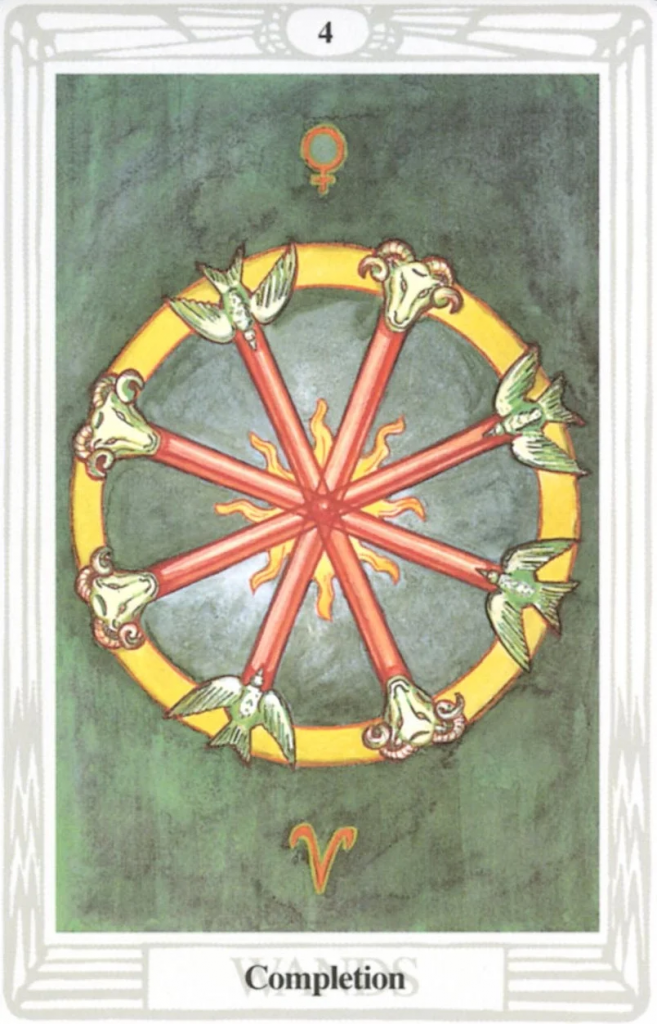
The Lord of Completion marks a point where a circle has been completed. It can apply to work projects, personal situations – even phases of life. In some respects it’s like a lesser reflection of the Universe, the final Major Arcana card.Another aspect of the Four of Wands associate it with the Major Arcanum of Adjustment, or Justice. This is because this Wand indicates the manifestation of balanced forces, resulting in the fulfilment of earlier hopes, ideas and dreams. The balance aspect, combined with the overall morality of Wands, brings us to think about injustice being resolved, inequity acknowledged and set right.This is a good card, promising not only the sense of natural satisfaction which arises when we follow our ideas through to their logical conclusion, but also the opportunity to start new things off.If we stop when we have achieved a goal along the way, we begin to stagnate. We need to take the sense of contentment and channel it into the stage on our journey – that way we continually grow.
“If the Jew did not exist, the anti-Semite would have to invent him.”
–Jean-Paul Sartre in Anti-Semite and Jew (1948)
Jean-Paul Charles Aymard Sartre was a French philosopher, playwright, novelist, screenwriter, political activist, biographer, and literary critic, considered a leading figure in 20th-century French philosophy and Marxism. Sartre was one of the key figures in the philosophy of existentialism. Wikipedia
Iwas one of those children who had to count to ten in different languages while I brushed my teeth. No surprises, then, that when I went to university, I chose to read French and Spanish. I cannot say I worked particularly hard; though I did get to live in Paris and then Barcelona, where I had ample opportunity to indulge at least some of my many vices.
In a way it is a shame that I am no longer asked what I plan to ‘do’ with my languages degree, since finally, after about a decade of mulling it over, I now have a satisfying response. I always bridled at the notion that language was just a ‘tool’—a means to ask for directions, order wine, or defend yourself when your French girlfriend found out you also had a French boyfriend. Reducing language to mere use depressed me, just as it depresses me to hear people say that AI will make language-learning pointless. For language is not just something to be used. It shapes the way we perceive and experience the world.
Reducing language to mere use depressed me, just as it depresses me to hear people say that AI will make language-learning pointless.
This, of course, is not a novel insight. Edward Sapir and Benjamin Whorf, made famous by the film Arrival, proposed that the structure of language informs the thinking style and worldview of its speakers, and that, therefore, language determines how we see the world. But the Ancient Greeks beat them to it, as the Ancient Greeks tend to do. Plato suggested in his dialogue with Cratylus that certain conceptions of reality are embedded in language. The 18th century German Romantic Johann Georg Hamann, too, (curiously nicknamed ‘The Wizard of the North’), prefigured Sapir and Whorf, writing that ‘the lineaments of [a people’s] language will […] correspond to the direction of their mentality’.
Consider how we think about time. English speakers tend to talk about it as if it were a horizontal line, with the past behind us and the future before us. But speakers of Aymara, a language native to the Andes, view time the other way around. For them, the future, being unknown, is behind them, since they cannot see behind them. The past is ahead of them, since they can see what is ahead of them. For the speakers of Aymara, time is something that moves past us. We do not move through it.
Speakers of Aymara, a language native to the Andes, view time the other way around.
A commonly cited example in conversations about linguistic relativity is the Russian understanding of ‘blue’. Russian distinguishes between lighter blues (‘голубой’) and darker blues (‘синий’), and research suggests that because of this linguistic difference, Russians perceive these two shades as more distinct than we do. Language thus influences not just thought, but vision.
It is a matter of debate as to whether speakers of Guugu Yimithirr, an Aboriginal language in Australia, have a better sense of navigation because of their language. My hunch is that it does. Where we (English-speakers) use left and right, forward and back, speakers of this language use north, south, east and west. In order to do this, they must know where north is at all times. Hence it would seem to follow that they orient themselves more deftly than we do.
Where we (English-speakers) use left and right, forward and back, speakers of this language use north, south, east and west.
The existence of words and phrases in some languages but not others would seem to suggest at least that some cultures feel certain emotions with a greater depth or strength than others. The Portuguese have the rather beautiful word ‘saudade’ (immortalised by the great Cesaria Evora, who was known to like a cigarette and a drink during intermissions), which describes a deep longing for someone or something that is made more painful by the knowledge that we may never encounter him, her or it again. The Japanese phrase ‘mono no aware’ describes an exquisite sensitivity to the transient, seen most vividly in the living and dying of things in the natural world.
To learn another language is not just to get by a bit more easily when you go on holiday. It is to learn to perceive the world differently: to think differently, to feel differently, even to be someone different—or at least, someone with a broader perspective on the world. And that, in turn, throws light on your native language, your culture and you.
The King called all of his wise men and counselors together for a meeting. He addressed them and said, “I want you to go research and consult the wisest and most learned men in the land. Spare no expense. I want you to find the one principle that will get me through all situations in life. Whether I am on top of the world or in the pits, find that principle. I don’t want to learn long and complicated philosophies, I want one simple principle. Find it and write it; just bring me the principle.”
The men left and consulted for months. They finally returned and handed the King a scroll. The King unrolled the scroll and on it was written four words, “This Too Shall Pass”. That was it.
The wise men explained, “When you are on top of the world, that is but a fleeting moment. Things change; always remember, ‘This Too Shall Pass.’ When you are in the pits, all nights are followed by day. At your lowest moments, remember also, ‘This Too Shall Pass.’ All external circumstances and material things change. No matter what your circumstances, remember, ‘This Too Shall Pass.” “
Author Unknown
AN OPPORTUNITY FOR DAILY REFLECTION BROUGHT TO YOU BY THE SCHOOL OF PRACTICAL PHILOSOPHY
Julian of Norwich is a medieval English mystic who celebrated “Mother Jesus” and had important relationships with women. Her feast day, May 8, always falls near Mother’s Day.
She had some queer ideas about God, shared her hermit’s cell with a woman, and spent many days communing with another powerful woman mystic, Margery Kempe. Julian is often listed with LGBTQ saints because of her genderbending visions of Jesus and God. She wrote, “As truly as God is our Father, so truly is God our Mother.”
Her discussions of Jesus as a mother sound radical even now, more than 600 years later. Her omnigendered vision of the Trinity fits with contemporary feminist and queer theology.
Mother’s Day is also a great time to honor mothers whose love for their LGBTQ children helped launch organizations such as Parents, Families, and Friends of Lesbians and Gays (PFLAG), founded by Jeanne Manford and Adele Starr.
Julian of Norwich (c.1342-1416) is the first woman to write a book in English. The book, “Revelations of Divine Love,” recounts a series of 16 visions or “showings” that she experienced from May 8-13, 1373 during a severe illness when she was 30 years old. The book includes Julian’s most famous saying, “All shall be well and all shall be well and all manner of things shall be well” — words spoken to her by God in one of Julian’s visions.
After her recovery Julian went on to become an anchoress, a type of recluse who lives in a cell attached to a church and does contemplative prayer. Becoming an anchoress involved an impressive ceremony with a requiem mass before the doorway was literally sealed with bricks. Her hermit’s cell was at the Church of St. Julian in Norwich. The cell had three windows, a church window for viewing worship and taking communion, a window for daily life, and a window to the street for communicating with the world. She became known throughout England for the spiritual counseling that she gave there.
A popular legend tells of Julian’s friendship with her cat companion, depicted in the painting by Tobias Haller at the top of this post. Julian was famously allowed to share her room was a cat — officially for the practical purpose of keeping it free from rats and mice.
Julian had important relationships with women
Julian lived as a recluse in a hermit’s cell, but she was not as isolated as is often supposed. A cat was not her only companion. A room for a servant was often attached to the cell, and in this space the anchoress and her servant form formed a lifelong bond. Julian shared her cell at different times with women named Alice and Sarah, who probably lived in . These companions are described as her “servant” or “maid.” But history suggests that sometimes a same-sex partner was called a servant to hide from social disapproval of homosexuality. Others whose same-sex “servants” were dearly beloved include the centurion and his boyfriend, Boris and George, and Good King Wenceslas and Podiven. Julian’s live-in companions Alice and Sarah are known because devout patrons gave bequests to them and Julian in their wills, documenting the significance of their relationships.
Julian also had an important relationship with another trailblazing woman writer and mystic. The queer side of Julian is explored in the chapter “Queer Touch Between Holy Women: Julian of Norwich, Margery Kempe, Birgitta of Sweden, and the Visitation” by scholar Laura Saetveit Miles of the University of Bergen, Norway, in the 2019 scholarly book “Touching, Devotional Practices, and Visionary Experience in the Late Middle Ages.” It “takes a new approach to the well-known meeting between two late-medieval English visionary women, Margery Kempe and the anchoress Julian of Norwich,” thereby revealing “the full transgressive effect of queer touch between women—or even its unspoken possibility,” according to the chapter summary.
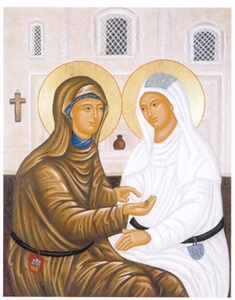
Icon of Julian of Norwich, left, meeting with Margery Kempe by Brother Leon of Walsingham, St Michael and All Angels Church, Brighton.
When Margery Kempe wrote the first autobiography in English, she described her long and intimate visit in 1413 with Julian, the first woman to write a book in English. Their literary landmarks sound impressive now, but at the time English was the low-ranking local dialect of the common people. Scholars used Latin, and English was in the early stages of replacing French as prestige language of England’s government.
Kempe was in her 40s when she visited the elderly Julian. Kempe was seeking approval for the visions that she received from God. During their many days together, Julian assured Kempe that her visions were genuine and counseled her about spiritual life. They shared their visions and became chosen family, calling each other “sister.”
Here’s how Kempe described their connection in “The Book of Margery Kempe”: “Much was the dalliance that the anchoress [Julian] and this creature [Kempe] had by communing in the love of our Lord Jesus Christ the many days that they were together.” This text is updated from Middle English to modern English, but Miles points out that both “dalliance” and “communing” had a wide spectrum of meanings, from conversation to sexual union. Anchoresses were allowed to have overnight female guests, so it’s possible that Kempe stayed overnight in the cell with Julian.
Some say that Julian entrusted her handwritten book manuscript to Kempe, who preserved it and lent it to close friends to copy and circulate. The printing press was not yet invented. The unpublished manuscripts were carefully preserved by a long and mysterious chain of guardians that included an English convent of Benedictine nuns in France. Women were preserving women’s writing over the centuries, despite harrowing clashes with authorities during the Protestant Reformation and French Revolution. A Benedictine monk published a translation in 1670, but it got little attention. Finally in 1901 Grace Warrack, a Scots Presbyterian, discovered a copy made by French nuns at the British Library, painstakingly copied it by hand, translated it into modern English, and introduced it to an enthusiastic 20th-century audience. Based on gender stereotypes, many readers assumed that the author of such profound spiritual visions must be a man, especially since the name Julian is more common for men. Many of the most popular and best-remembered historical women in the Q Spirit’s LGBTQ Saints series were writers, including Julian, Perpetua, and Hildegard of Bingen.
Julian lived a long life. The date of her death is unknown, but records show that she was still alive at age 73 to receive an inheritance. She was never formally canonized, but Julian is considered a saint by popular devotion. The Episcopal and Lutheran Churches keep her feast day on May 8.
Julian wrote of God as mother
Julian is considered the first Catholic to write at length about God as mother. Her profound ideas speak powerfully today to women and queer people of faith.
Here are a few short quotes from Julian’s extensive writings about “Mother Jesus”:
“So Jesus Christ who sets good against evil is our real Mother. We owe our being to him–and this is the essence of motherhood! –and all the delightful, loving protection which ever follows. God is as really our Mother as he is our Father.“ (Chapter 59)
“So Jesus is our true Mother by nature at our first creation, and he is our true Mother in grace by taking on our created nature.” (Chapter 59)
“A mother can give her child milk to suck, but our dear mother Jesus can feed us with himself, and he does so most courteously and most tenderly with the holy sacrament, which is the precious food of life itself… The mother can lay the child tenderly to her breast, but our tender mother Jesus, he can familiarly lead us to his blessed breast through his sweet open side….” (Chapter 60)
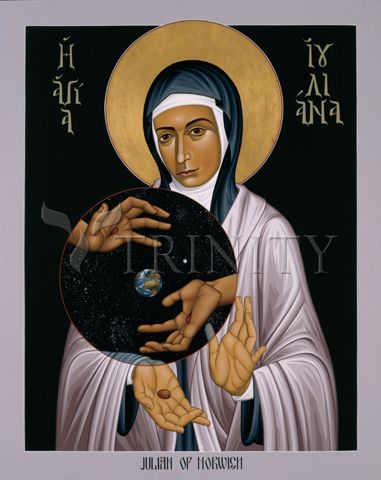
“Dame Julian’s Hazelnut” by Brother Robert Lentz, OFM, Prints available at Amazon or TrinityStores.com
Julian saw God’s love in ordinary life
The sacred feminine is just one of the many revelations that have endeared Julian to the public. She also uses objects from ordinary life to illustrate God’s loving, forgiving nature. For example, in one vision God shows Julian a small object like a hazel-nut in the palm of her hand. Julian writes:
“I looked at it and thought, ‘What can this be?’ And the answer came to me, ‘It is all that is made.’ I wondered how it could last, for it was so small I thought it might suddenly disappear. And the answer in my mind was, ‘It lasts and will last forever because God loves it; and in the same way everything exists through the love of God’.” (Chapter 5)
Julian of Norwich in art and art
Julian is a favorite subject for Tobias Haller, an iconographer, author, composer, and vicar of Saint James Episcopal Church in the Bronx. In addition to the icon at the top of this post, Haller sketched an elderly “Julian of Norwich” was sketched against a lavender background.
Haller enjoys expanding the diversity of icons available by creating icons of LGBTQ people and other progressive holy figures as well as traditional saints. He and his spouse were united in a church wedding more than 30 years ago and a civil ceremony after same-sex marriage became legal in New York. He is the author of “Reasonable and Holy: Engaging Same-Sexuality.”
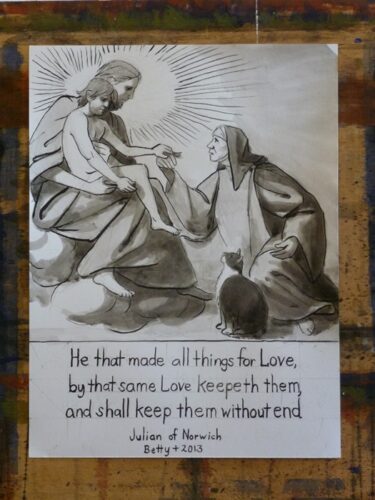
“Julian of Norwich,” a memorial drawing for his cat Betty, by Douglas Blanchard
New York painter Douglas Blanchard shows the saint with the artist’s own cat Betty in a drawing done as a memorial tribute to a beloved feline companion who died in 2013. He includes a favorite quote from Julian:
“He that made all things for love, by that same love keepeth them, and shall keep them without end.”
Blanchard is best known for his epic series “The Passion of Christ: A Gay Vision,” which is now available as a book. He teaches art and art history at the Bronx Community College of the City University of New York.
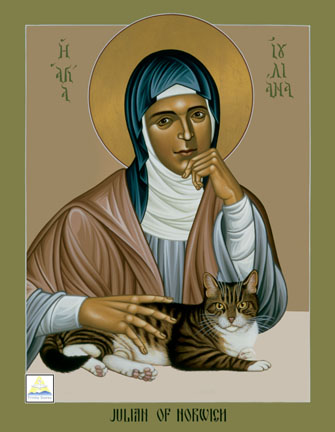
“Julian of Norwich” by Brother Robert Lentz, OFM, Prints available at Amazon or TrinityStores.com
Another icon of Julian and her cat was created by Robert Lentz, a Franciscan friar based in New York. Known for his innovative icons, he was rebuked by the church for painting LGBTQ saints and God as female.
Many important writers have been influenced by Julian, including 20th-century British poet T.S. Eliot. He quotes her in his masterpiece “Four Quartets,” which led to him receiving the Nobel Prize for literature in 1948.
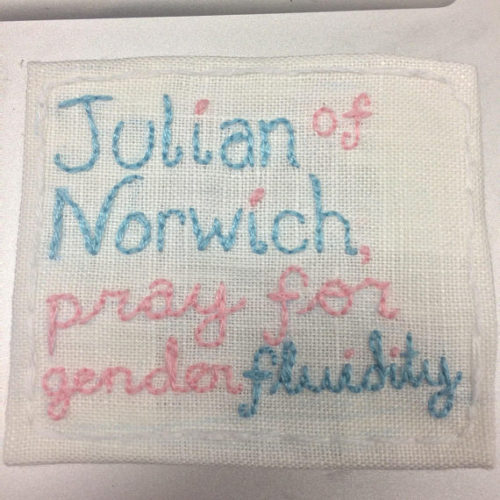
Various prayers related to Julian of Norwich are in circulation, including “Julian of Norwich, pray for gender fluidity.” The prayer was hand-sewn onto embroidered patch by artist Avery Smith of Louisville, Kentucky. Smith runs an Etsy shop called Sapphic Stitches that offers a variety of patches on LGBTA+ Christian and other themes.
“LGBTA+ Christians who choose to pray for the intercession of Saints deserve to have patrons whom they trust understand and support them,’ Smith affirms. “Whatever Saint or paired-Saint couple resonates with you as an LGBTA+ Christian can be made into a customizable patch.”
Julian’s famous words are set to music in the song “All Will Be Well” by Meg Barnhouse, a Texas-based Unitarian minister and singer/songwriter. The moving song comes from her album “Mango Thoughts in a Meatloaf Town” and is available on YouTube.
A longer quotation from Julian, again including “All will be well,” was set to music by 20th-century Welsh composer William Matthias in his piece “As Truly as God is Our Father.” it is sung on video by Plymouth Choir of First Plymouth Church, Lincoln Nebraska.
A mug shows Julian with her cat and her best-loved quote: “All shall be well and all shall be well and all manner of things shall be well.” Available from the Drinklings Coffee Mugs Etsy shop.
___ Top image credit: Julian of Norwich painting by Tobias Haller.
___ This post is part of the LGBTQ Saints series by Kittredge Cherry. Traditional and alternative saints, people in the Bible, LGBTQ martyrs, authors, theologians, religious leaders, artists, deities and other figures of special interest to lesbian, gay, bisexual and transgender and queer (LGBTQ) people and our allies are covered.
This article has evolved and expanded greatly since the first version was posted in May 2011. It was published on Q Spirit in May 2017, was enhanced with new material over time, and was most recently updated on May 6, 2024.
Kittredge Cherry is a lesbian Christian author who writes regularly about LGBTQ spirituality.She holds degrees in religion, journalism and art history.She was ordained by Metropolitan Community Churches and served as its national ecumenical officer, advocating for LGBTQ rights at the National Council of Churches and World Council of Churches.
For some time, it was possible to believe that many voters could not see the threat Donald Trump poses to America’s liberal democracy, and many still profess not to see it. But now, a little more than six months from Election Day, it’s hard to believe they don’t. The warning signs are clear enough. Trump himself offers a new reason for concern almost every day. People may choose to ignore the warnings or persuade themselves not to worry, but they can see what we all see, and that should be enough.
How to explain their willingness to support Trump despite the risk he poses to our system of government? The answer is not rapidly changing technology, widening inequality, unsuccessful foreign policies or unrest on university campuses but something much deeper and more fundamental. It is what the Founders worried about and Abraham Lincoln warned about: a decline in what they called public virtue. They feared it would be hard to sustain popular support for the revolutionary liberal principles of the Declaration of Independence, and they worried that the virtuous love of liberty and equality would in time give way to narrow, selfish interest. Although James Madison and his colleagues hoped to establish a government on the solid foundation of self-interest, even Madison acknowledged that no government by the people could be sustained if the people themselves did not have sufficient dedication to the liberal ideals of the Declaration. The people had to love liberty, not just for themselves but as an abstract ideal for all humans.
Americans are going down this route today because too many no longer care enough whether the system the Founders created survives and are ceding the ground to those, led by Trump, who actively seek to overthrow what so many of them call “the regime.” This “regime” they are referring to is the unique political system established by the Founders based on the principles of universal equality and natural rights. That, plain and simple, is what this election is about. “A republic if you can keep it,” Benjamin Franklin allegedly said of the government created by the Constitutional Convention in 1787. This is the year we may choose not to keep it.
A healthy republic would not be debating whether Trump and his followers seek the overthrow of the Founders’ system of liberal democracy. What more do people need to see than his well-documented attempt to prevent the peaceful transfer of power with the storming of the U.S. Capitol, the elaborate scheme to create false electoral slates in key states, the clear evidence that he bullied officials in some states to “find” more votes, and to persuade Vice President Mike Pence not to certify the legitimate results? What more do they need to know than that Trump continues to insist he won that election and celebrates as heroes and “patriots” the people who invaded the U.S. Capitol and smashed policemen’s faces with the stated aim of forcing Congress to negate the election results? As one 56-year-old Michigan woman present at the Capitol on Jan. 6, 2021, explained: “We weren’t there to steal things. We weren’t there to do damage. We were just there to overthrow the government.”
Trump not only acknowledges his goals, past and present; he promises to do it again if he loses this year. For the third straight election, he is claiming that if he loses, then the vote will have been fraudulent. He has warned of uprisings, of “bedlam” and a “bloodbath,” and he has made clear that he will again be the promoter of this violence, just as he was on Jan. 6. Trump explicitly warned in 2020 that he would not accept the election results if he lost, and he didn’t. This year he is saying it again. Were there no other charges against him, no other reason to be concerned about his return to the presidency, this alone would be sufficient to oppose him. He does not respect and has never pledged to abide by the democratic processes established by the Constitution. On the contrary, he has explicitly promised to violate the Constitution when he deems it necessary. That by itself makes him a unique candidate in American history and should be disqualifying.
This kind of open challenge to our democracy was never meant to be addressed by the courts. As the Founders well understood, you don’t serve a subpoena to a would-be tyrant and tell him to lawyer up. Nor was it meant to be addressed by the normal processes of democratic elections. They knew, and feared, that a demagogue could capture the allegiance of enough voters to overthrow the system. That was why they gave Congress, and particularly the Senate, supposedly more immune from popular pressures, the power to impeach and remove presidents and to deny them the opportunity to run again — and not simply because they violated some law but because they posed a clear and present danger to the republic. After Trump’s attempt to overthrow the government in 2020, Congress had a chance to use the method prescribed by the Founders in precisely the circumstances they envisioned. But Senate Republicans, out of a combination of ambition and cowardice, refused to play the vital role the Founders envisioned for them. The result is that the nightmare feared by the Founders is one election away from becoming reality.
The problem with Trump is not that he has some carefully thought-out plan for seizing power, much less an elaborate ideological justification for doing so. (Others do have such plans and such justifications, including many of those who will populate his administration — more on that in a moment.) With Trump, everything is about him and his immediate needs. He will run roughshod over the laws and Constitution simply to get what he wants for himself, his family and his business interests. Americans know that if he is elected, he would abuse the justice system to go after his opponents. They know this because he says so. “I am your retribution!” he declares, and by “your” he means “my.” Americans know he would use his power as president to try to solve his financial problems. He did it as president and is doing it now as a presidential candidate. They know he would not respect the results of fair elections if he loses, which is the very definition of a tyrant.
So, why will so many vote for him anyway? For a significant segment of the Republican electorate, the white-hot core of the Trump movement, it is because they want to see the system overthrown. This should not come as a shock, for it is not a new phenomenon. On the contrary, it is as old as the republic. Historians have written about the “liberal tradition” in America, but there has from the beginning also been an anti-liberal tradition: large numbers of Americans determined to preserve preliberal traditions, hierarchies and beliefs against the secular liberal principles of the Declaration of Independence and Bill of Rights. The Founders based the republic on a radical set of principles and assertions about government: that all human beings were created equal in their possession of certain “natural rights” that government was bound to respect and to safeguard. These rights did not derive from religious belief but were “self-evident.” They were not granted by the Christian God, by the crown or even by the Constitution. They were inherent in what it meant to be human.
This is the central tenet of liberalism. Before the American Revolution no government had ever been founded on liberal principles, and the vast majority of human beings had never believed in these natural rights — certainly not the Christian church in either its Protestant or Roman Catholic versions nor Islam nor Judaism nor Hinduism nor Buddhism. People might be equal in the eyes of their god, but no government or religious institution had ever been based on the principle of equal rights. Not even the English system was based on this principle but rather on monarchy, a ruling aristocracy, and a contract between crown and subjects that was modified over the centuries but was not based on the principle of universal “natural” rights.
The Founders knew these ideas were radical, that they were inaugurating, in their own words, a novus ordo seclorum — a new order of the ages — that required a new way of thinking and acting. They knew, as well, that their own practices and those of 18th-century American society did not conform to their new revolutionary doctrines. They knew that slavery was contrary to the Declaration’s principles, though they permitted slavery to continue, hoping it would die a natural death. They knew that established churches were contrary to those principles because they impinged on that most important of rights, “freedom of conscience,” which was vital to the preservation of liberty, yet a number of states in the 18th and 19th centuries retained all kinds of religious tests for office. In short, they knew that a great many Americans did not in fact believe in the liberal principles of the Revolution. As Benjamin Rush, a signer of the Declaration of Independence, put it, “We have changed our forms of government, but it remains yet to effect a revolution in our principles, opinions and manners so as to accommodate them to the forms of government we have adopted.” They did not insist that citizens believe in those principles. One could be an American citizen whether one believed in the Declaration or not.
And a great many did not. Leaders of the slaveholding South called the Declaration “a most pernicious falsehood.” South Carolina’s John C. Calhoun called the very idea of equal rights a “false doctrine.” They believed in democracy, but only if it was an exclusively White democracy. When democracy turned against them in 1860, they rebelled and sought an exit from the system. That rebellion never ended. It has been weakened, suppressed — sometimes by force — and driven underground, but it has never gone away. Although the South was militarily defeated and deprived of its special advantages in the Constitution, its hostility to the Founders’ liberalism did not abate. As Southern writer W.J. Cash observed in 1941, if the war had “smashed the southern world,” it had nevertheless “left the essential southern mind and will … entirely unshaken” and Southerners themselves determined “to hold fast to their own, to maintain their divergences, to remain what they had been and were.” In 1956, almost a century after the Civil War, a fifth of Congress, almost all Democrats — signed the “Southern Manifesto” calling on states to refuse to obey the Supreme Court’s 1954 decision to end segregation in public schools. Nothing had changed. Are we so surprised that for many Americans, nothing has changed even today?
Nor has anti-liberalism only been about race. For more than a century after the Revolution, many if not most White Anglo-Saxon Protestants insisted that America was a Protestant nation. They did not believe Catholics possessed equal rights or should be treated as equals. The influential “second” Ku Klux Klan of the 1920s was anti-Catholic and anti-Jewish as well as anti-Black, which was why, unlike the original Klan, it flourished outside the South. Many regard today’s Christian nationalism as a fringe movement, but it has been a powerful and often dominant force throughout America’s history.
For two centuries, many White Americans have felt under siege by the Founders’ liberalism. They have been defeated in war and suppressed by threats of force, but more than that, they have been continually oppressed by a system designed by the Founders to preserve and strengthen liberalism against competing beliefs and hierarchies. Since World War II, the courts and the political system have pursued the Founders’ liberal goals with greater and greater fidelity, ending official segregation, driving religion from public schools, recognizing and defending the rights of women and minorities hitherto deprived of their “natural rights” because of religious, racial and ethnic discrimination. The hegemony of liberalism has expanded, just as Lincoln hoped it would, “constantly spreading and deepening its influence, and augmenting the happiness and value of life to all people of colors everywhere.” Anti-liberal political scientist Patrick Deneen calls it “liberal totalitarianism,” and, apart from the hyperbole, he is right that liberalism has been steadily deepening and expanding under presidents of both parties since the 1940s.
The fury on the anti-liberal right against what is today called “wokeness” is nothing new. Anti-liberal movements in America, whether in defense of the White race or Christianity, and more often both together, have always claimed to be suffering under the expanding hegemony of liberalism. They have always claimed that a liberal government and society were depriving them of their “freedom” to live a life according to Christian teachings and were favoring various minority groups, especially Black people, at their expense. In the 1970s, influential theologian R.J. Rushdoony complained that the Christian in America had “no right to his identity” but was forced to recognize “all others and their ‘rights.’” And he was correct if a Christian’s “rights” included the right not only to lead a Christian life oneself but to impose that life on the entire society, or if a White person’s “freedom” included the freedom to preserve white primacy in society. In the 19th century, enslavers insisted they were deprived of their “freedom” to hold human beings as property; Southerners in the post-Reconstruction era insisted on their “freedom” to oppress Black citizens in their states.
Today, anti-liberals in American society are indeed deprived of their “freedom” to impose their religious and racial views on society, on public schools, on the public square and on the laws of the nation. What Christian nationalists call “liberal totalitarianism,” the Founders called “freedom of conscience.”
Six decades ago, people like Rushdoony were responding not to “woke” corporations or Black Lives Matter but to civil rights legislation. Today, anti-liberal conservatives complain about school curriculums that acknowledge the racism that has shaped America’s history, but even five decades ago, before the invention of “critical race theory,” anti-liberal White people such as Rushdoony insisted that the “white man” was being “systematically indoctrinated into believing he is guilty of enslaving and abusing the Negro.” Nor is it new that many White people feel that the demands of minority groups for both rights and respect have “gone too far” and it is they, the White people of America, who are suffering the worst discrimination. In the 1960s, surveys taken by the New York Times showed that majorities of White people believed even then that the civil rights movement had “gone too far,” that Blacks were receiving “everything on a silver platter” and the government was practicing “reverse discrimination” against White people. Liberalism is always going too far for many Americans — and certainly for anti-liberals. Anti-liberals these days complain about wokeness, therefore, but it is the liberal system of government bequeathed by the Founders, and the accompanying egalitarian spirit, that they are really objecting to, just as anti-liberals have since the founding of the nation. Many of Trump’s core supporters insist they are patriots, but whether they realize it or not, their allegiance is not to the Founders’ America but to an ethnoreligious definition of the nation that the Founders explicitly rejected.
Some do realize it. The smartest and most honest of them know that if people truly want a “Christian America,” it can only come through “regime change,” by which they mean the “regime” created by the Founders. The Founders’ legacy is a “dead end,” writes Glenn Ellmers, a scholar at the Claremont Institute. The Constitution is a “Potemkin village.” According to Deneen and Harvard Law School’s Adrian Vermeule, the system established by the Founders to protect individual rights needs to be replaced with an alternative form of government. What they have in mind is a Christian commonwealth: a “culture that preserves and encourages order and continuity, and support for religious belief and institutions,” with legislation to “promote public morality, and forbid its intentional corruption,” a “forthright acknowledgment and renewal of the Christian roots of our civilization,” “public opportunities for prayers,” and a “revitalization of our public spaces to reflect a deeper belief that we are called to erect imitations of the beauty that awaits us in another Kingdom.”
These anti-liberal conservatives know that bringing such a commonwealth into being means jettisoning the Founders’ obsession with individual rights. The influential advocate of “conservative nationalism,” Yoram Hazony, wants Americans to abandon the Declaration in favor of a nationhood built on Protestantism and the Bible. America is a “revolutionary nation,” Sen. Josh Hawley (R-Mo.) insists, not because of the principles of the Declaration and not even because of the American Revolution itself, but “because we are the heirs of the revolution of the Bible” that began with “the founding of the nation of Israel.” There could hardly be a statement more at odds with the American Founders’ liberal, ecumenical vision.
Expressing a belief in God is no threat to the Founders’ system, but reshaping society in accord with Christian teachings is. To build the nation Hawley and Hazony imagine would require jettisoning not only the Declaration but also the Constitution, which was designed to protect the Declaration’s principles. The Christian commonwealth would not and could not be a democracy because the majority of people can’t be trusted to choose correctly. According to the Claremont Institute’s Ellmers, “most people living in the United States today — certainly more than half — are not Americans in any meaningful sense of the term.” They are a “zombie” or “human rodent” who lives “a shadow-life of timid conformity.” Only “the 75 million people who voted in the last election” for Trump are true Americans. Instead of trying to compete with Democrats in elections that don’t reflect the will of the people, Ellmers writes, “Why not just cut to the chase and skip the empty, meaningless process?” The “only road forward” is “overturning the existing post-American order.”
For these intellectuals, Trump is an imperfect if essential vehicle for the counterrevolution. A “deeply flawed narcissist” suffering from a “bombastic vanity,” as Deneen and Ellmers note, he has “lacked the discipline to target his creative/destructive tendencies effectively.” But this can be remedied. If Trump failed to accomplish the desired overthrow in his first term, Deneen argues, it was because he lacked “a capable leadership class.” Things will be different in his next term. What is needed, according to Deneen, is a “self-conscious aristoi,” a class of thinkers who understand “both the disease afflicting the nation, and the revolutionary medicine required for the cure,” who know how to turn populist “resentments into sustained policy.” Members of Deneen’s would-be new elite will, like Vladimir Lenin, place themselves at the vanguard of a populist revolution, acting “on behalf of the broad working class” while raising the consciousness of the “untutored” masses. Indeed, according to Harvard’s Vermeule, it will be necessary to impose the common good even against the people’s “own perceptions of what is best for them” — a most Leninist concept indeed.
The Christian commonwealth, then, would require a powerful executive freed from the Constitution’s liberal and democratic constraints. The new state, Vermeule wrote, with its “robust executive,” would “sear the liberal faith with hot irons,” wielding the “authority to curb the social and economic pretensions of the urban-gentry liberals.” The whiff of violence and oppression in such statements is intentional. The anti-liberal intellectuals understand that changing the liberal system will require far more than an election and a few legislative reforms.
Deneen and Vermeule are often dismissed as mere intellectual provocateurs, but their writings stand out because they have the courage to acknowledge that what they seek is incompatible with the Founders’ liberal system. While others conceal their views under a phony fidelity to American liberal principles or claim that what they want accords with the Founders’ true intent, Deneen, Vermeule and other anti-liberals acknowledge that the country they want, a country subservient to the Christian God, a country whose laws are based on the Bible, cannot be created absent the overthrow of the Founders’ liberal and defiantly secular system. Even a justice of the U.S. Supreme Court, Neil M. Gorsuch, speaks of the “so-called separation of church and state.” Anti-liberalism at the Supreme Court is nothing new, either.
And the anti-liberals know as well that this year may be their last chance to effect their counterrevolution. The percentage of the population made up of White people (let alone White Protestants) is steadily shrinking. Just as the anti-liberal conservatives of the pre-World War II years closed the immigration gates too late and were overwhelmed by a tide of non-Nordic peoples from Southern and Eastern Europe, so the immigration wave of largely non-White people since 1965 has brought the nation to the cusp of a non-White majority. The anti-liberals thus face the task of engineering the revolution with only a minority of the electorate committed to “regime change.”
Trump’s takeover of the Republican Party makes this possible. Trump is not a unique figure in American history. In each generation, anti-liberal forces have turned to the same breed of demagogue, the flouter of norms, the boorish trampler of liberal nostrums. William Buckley noted that the very “uncouthness” of George Wallace seemed to “account for his general popularity.” James Burnham marveled at how Joseph McCarthy’s “inept acts and ignorant words” had a “charismatic” quality that well expressed the fears and angers of his devoted followers.
What their critics saw as boorishness and malevolence, however, their followers saw as strength and defiance against a liberal system stacked against them. They were rebellious opponents of the system, “wreckers,” unabashedly anti-liberal in both thought and manner, and that is precisely what made them popular among a broad swath of White Americans who felt themselves losing ground in the culture and society — to Black people, Catholics, Jews and immigrants from non-Nordic countries. Today, exactly a century after the most overtly racist immigration restriction in American history, Trump once again calls for more immigrants from “nice” European countries, such as Denmark, Switzerland and Norway.
Trump did not just stumble into leadership of this movement of White rebellion. He summoned it. He made his debut as presidential aspirant on an unabashed white supremacist platform, championing the birther conspiracy that America’s first Black president was not in fact an American. Riding that issue alone, he catapulted to the front of the Republican pack, according to polls in 2011, before bowing out to continue his hit show, “The Apprentice.” Whether his debut as a white supremacist was opportunism or sprang from conviction hardly matters — it certainly has not mattered to his followers. The fact is, white supremacy has been his calling card, and millions have responded to it to the point where white nationalists have become the core of his movement. Many Christian nationalists already see him as a suffering Christ, and in this bizarre sense it is true that the prosecutions have “helped” him: The more adversity he faces, the more court battles he must wage, the more allegations that are slung at him, the more devoted they are to him.
No other group can be counted on for such absolute loyalty. While some Republicans wobble when asked if they would support Trump if convicted of a crime, White Christian Evangelicals overwhelmingly say they will support him no matter what. Trump needs that unshakable loyalty because he is fighting for his life. The thought that he might end up in jail has given him every reason to hew as closely as possible to the people who will stick with him even if he is convicted. These are also the people he will need to back him unconditionally in challenging the results of the election should he lose. If he wins, he will need them in what are sure to be titanic fights with Democrats and the legal system and to keep the Republican Party in line.
This is one reason Trump has so far shown no inclination to reach out beyond his base, to Nikki Haley voters, to more moderate suburban Republicans, to those who are made uncomfortable by his statements and actions. He may show flexibility on the important issue of abortion to secure his own election, but since clinching the nomination, he has only hardened his Christian nationalist message. His “poisoning the blood” campaign, his “dictator-for-a-day” comments, his release of the Trump Bible, his claim that, upon taking office, he will create “a new federal task force” to fight “anti-Christian bias to be led by a fully reformed Department of Justice,” are all aimed directly at his white Christian nationalist base without much concern for how millions of other Republican voters feel about it. Christians are “under siege,” he claims in hawking his Bible. “We must make America pray again.”
Besides, his hard tack toward white supremacy and Christian nationalism has cost him little among the broader Republican electorate.
Why not? Why is there so little resistance to Trump even as he commits ever more deeply to a Christian nationalist program for undoing the Founders’ liberal project?
For many, the answer is simply narrow self-interest, either a positive interest in supporting him or a negative interest in not opposing him or being seen to oppose him. This seems to be the answer for corporate America. Having first followed marketing data to appeal to the broadest cross-section of Americans by embracing communities only recently enjoying more of the full panoply of rights, businesses learned the hard way that Trump and his movement will not tolerate this and have mostly retreated to silence and neutrality. But they have also gone further, making clear as much as possible that they will not be a problem for him — either before he is elected or after.
This was the message JPMorgan Chase CEO Jamie Dimon sent, from Davos, Switzerland, of all places, early this year when he declared that Trump was “kind of right about NATO, kind of right about immigration,” that he “grew the economy quite well.” There is no reason to doubt that he spoke for many of the richest Americans and for other corporate leaders. There was no outcry among them that anyone could hear. The truth is, they have no financial reason to oppose Trump. They know that Trump’s White working-class followers don’t have to be paid off economically because most care chiefly about the culture wars. Trump can still cut taxes and reduce federal regulations and other obstacles to corporate profit. The rich and powerful will always have some purchase in a Trump administration if only because he needs and respects money and will want to make deals for himself and his family, as he did in a first term. Whatever moral or political qualms business leaders may have about Trump, the bottom line dictates that they get along with him, and if that means turning a blind eye to his unconstitutional actions — Dimon’s favorable recounting of Trump’s first term notably ignored his attempt to overthrow the government — then so be it.
We already know that little or no opposition will come from the Republican Party ecosystem. Among elected officials, the few willing to stand up to Trump have either been driven out of the party or are retiring so fast that they cannot even bear to finish out their terms. Those who remain have accepted Trump’s iron rule and therefore now have an interest in his success.
But what about the average Republican voter, the “normal” Republicans who happily voted for George W. Bush, John McCain and Mitt Romney? Do they not see the difference between those Republicans and Trump — or do they not care? They, too, may feel their narrow interests are served by a Trump victory, and although they may not be Christian nationalists themselves, their views as White Americans make them sympathetic to the complaints of the anti-liberals. They, too, may feel they — or their children — are at a disadvantage in a system dedicated to diversity and wokeness. Their annoyance with a liberalism that has “gone too far” makes them susceptible to Trump’s appeal, and, more importantly, unconcerned about the threat he poses. Left to their own devices, they would not be interested in overthrowing the regime. But neither are they inclined to stand in the way of those who are.
Are these voters and GOP power players right to believe that they, like Dimon, will be just fine in a system no longer faithful to the Founders’ liberal ideals? Perhaps so. They will not be the first to suffer from a shift back toward a 1920s America. White Americans tolerated the systematic oppression of Black people for a century after the Civil War. They tolerated violence in the South, injustice in the courtrooms, a Supreme Court that refused to recognize the equal rights of Black people, women and various minorities. Will they rise up against a second Trump term infused by Christian and white nationalism, or will they acquiesce in the gradual dismantling of the liberal gains of the past eight decades?
The shame is that many White people today seem to have conveniently forgotten how much they and their forebears have depended on the Founders’ liberalism to gain their present status as fully equal members of American society and to enjoy the freedoms that they take for granted.
Most White Republicans, after all, do not have the “legacy European” lineage that Tucker Carlson praises. They do not have ancestors who stepped off the Mayflower or fought in the Revolution. The ancestors of the great majority of “White” Americans today were not considered “White” when they first set foot on American shores. Irish Americans may no longer remember that the Thomas Nast cartoons of the late 19th century depicted the Irish as apelike creatures. Many Italian Americans may not recall that a riot made up of “New Orleans’ finest” lynched and murdered 11 Sicilian immigrants and were never charged.
Many Catholics seem to have forgotten that they were once the most despised group in America, such that one of the Founders, John Jay, wanted them excluded from citizenship altogether. Most White Americans were at one time members of despised immigrant groups. They were the victims of the very anti-liberalism they are now voting back into power. They climbed to equality using liberalism as their ladder, and now that they have reached their destination they would pull away the ladder and abandon liberalism. Having obtained their equality using the laws and institutions of liberalism, their passion for liberalism has faded.
The Founders understood, and feared, that the fervor for rights and liberalism that animated the Revolution might not last. Writing in 1781, two years before the end of the war, Thomas Jefferson predicted that once the war ended, “we shall be going down hill.” The people would return to their quotidian lives, forgetting their passionate concern for rights, intent only on “making money.” They might never again come together “to effect a due respect for their rights,” and so their government would stop being solicitous of their rights. Over a half-century later, Lincoln, in his famous Lyceum address, lamented that the original spirit of the Revolution had dissipated with time, leaving Americans with only the normal selfishness of human beings. The original “pillars of the temple of liberty” had “crumbled away.” A little over two decades later, the nation fell into civil war.
If the American system of government fails this year, it will not be because the institutions established by the Founders failed. It will not be because of new technologies or flaws in the Constitution. No system of government can protect against a determined tyrant. Only the people can. This year we will learn if they will.
Opinion by Robert KaganRobert Kagan is a senior fellow at the Brookings Institution and an editor at large for The Washington Post. His latest book is “The Ghost at the Feast: America and the Collapse of World Order, 1900-1941.” He is the author of the forthcoming “Rebellion: How Antiliberalism is Tearing America Apart — Again,” which will be published by Knopf in May.
Border Song • Jul 25, 2018 Provided to YouTube by Universal Music Group Border Song · Elton John Elton John ℗ 1970 This Record Company Ltd. Released on: 1995-01-01 Producer: Gus Dudgeon Associated Performer, Recording Arranger: Paul Buckmaster Composer Lyricist: Elton John Composer Lyricist: Bernie Taupin Auto-generated by YouTube.
Holy Moses I have been removed I have seen the spectre he has been here too Distant cousin from down the line Brand of people who ain’t my kind Holy Moses I have been removed
Holy Moses I have been deceived Now the wind has changed direction and I’ll have to leave Won’t you please excuse my frankness but it’s not my cup of tea Holy Moses I have been deceived
I’m going back to the border Where my affairs, my affairs ain’t abused I can’t take any more bad water Been poisoned from my head down to my shoes
Holy Moses I have been deceived Holy Moses let us live in peace Let us strive to find a way to make all hatred cease There’s a man over there What’s his colour I don’t care He’s my brother let us live in peace He’s my brother let us live in peace He’s my brother let us live in peace
Writer/s: Bernie Taupin, Elton John Publisher: Universal Music Publishing Group Lyrics licensed and provided by LyricFind
Consciousness, spirituality, biography, sexuality, androgyny, futurism, space, the arts, science, astrology, democracy, humor, books, movies and more